Learning Bayesian Statistics cover
Podcast

Learning Bayesian Statistics

by Alexandre Andorra

Learning Bayesian Statistics has had 22 confirmed guests across 38 episodes in the last 12 months. Latest: Santiago Barreda, Nov 17, 2026.

Show websiteApple PodcastsHow guests are confirmed

Are you a researcher or data scientist / analyst / ninja? Do you want to learn Bayesian inference, stay up to date or simply want to understand what Bayesian inference is? Then this podcast is for you! You'll hear from researchers and practitioners of all fields about how they use Bayesian statistics, and how in turn…

Guests on the show

Tue17Nov
Learning Bayesian Statistics

Santiago BarredaGuest

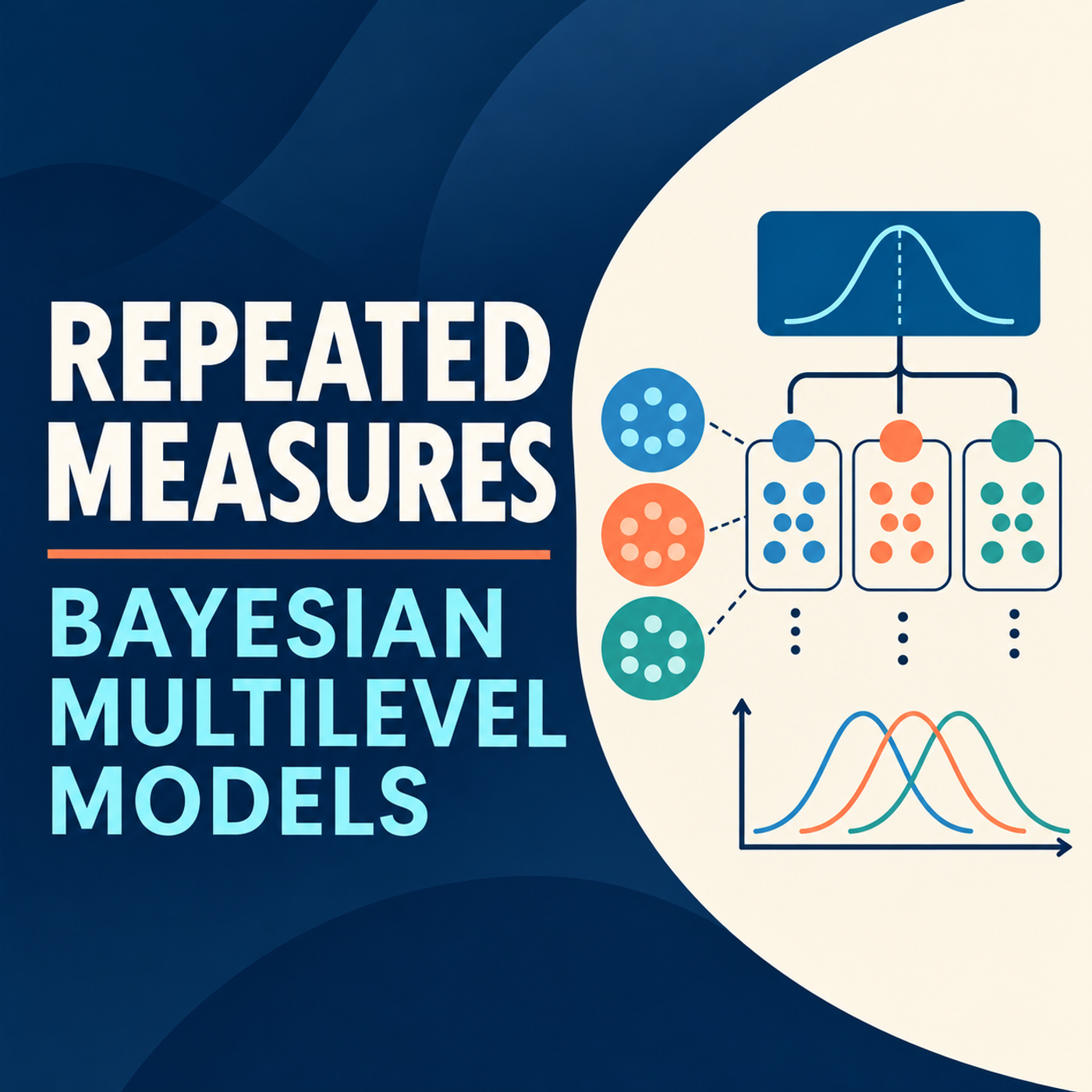
Why Start with Bayesian Multilevel Models for Repeated Measures?

Today's clip is from Episode 168 of Learning Bayesian Statistics, featuring Santiago Barreda, who joins host Alex Andorra to discuss Bayesian multilevel models and why they are particularly useful for researchers working with repeated measures data. Santiago explains why he believes students in linguistics and related fields should spend less time learning traditional statistical models like t-tests and ANOVAs, and start directly with the multilevel models they will actually use in their research. In fields like linguistics, researchers often collect hundreds of observations from each listener, making repeated measures data the norm rather than the exception. He also discusses the motivation behind his book, *Bayesian Multilevel Models for Repeated Measures Data*, which aims to make these methods more accessible through fully worked examples. The book walks readers through research questions, model structure, interpretation, visualisation and reporting results, with comparisons to equivalent frequentist analyses. Full discussion here Support & Resources → Support the show on Patreon → Bayesian Modeling Course (first 2 lessons free): Our theme music is « Good Bayesian », by Baba Brinkman (feat MC Lars and Mega Ran). Check out his awesome work!

5 min

Thu12Nov
Learning Bayesian Statistics

Santiago BarredaGuest

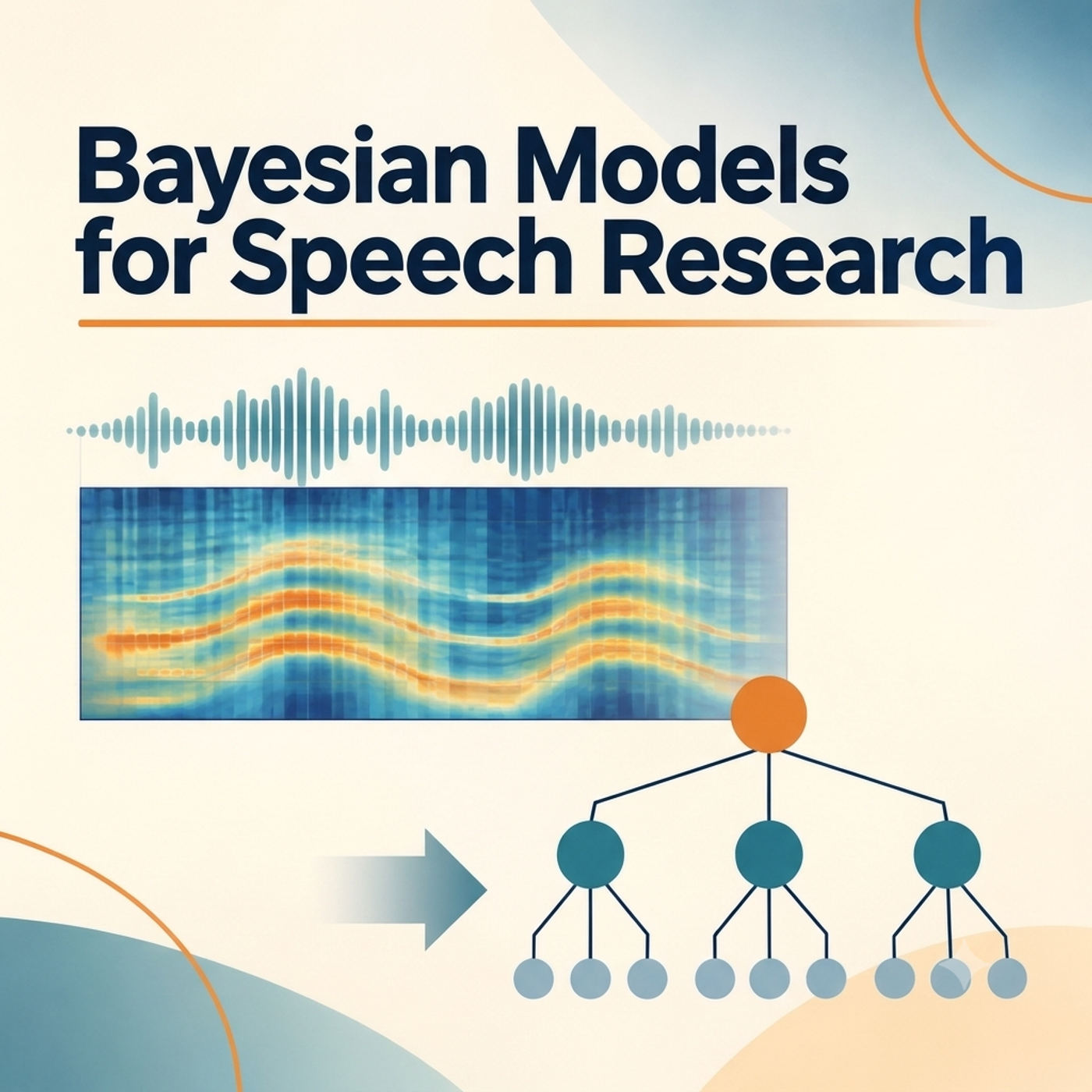
Why Speech Researchers Should Give Bayesian Statistics a Shot

Today's clip is from Episode 168 of Learning Bayesian Statistics, featuring Santiago Barreda, who joins host Alex Andorra to discuss Bayesian multilevel models and their applications in speech perception and linguistics. Santiago explains how tools like BRMS have made Bayesian modelling much more accessible, lowering the barrier to entry for researchers working in linguistics and speech perception. He also addresses some common concerns around Bayesian methods, particularly the choice of priors, arguing that these concerns are often overstated and that their influence can be examined directly. He highlights the value of multilevel models in understanding listener variation within speech communities, as well as their flexibility in handling outliers, heteroscedasticity, ordinal data and multinomial data. Alex adds to the discussion by sharing a practical example of fitting mixed-effects models using PyMC, including how different prior choices can affect the results. Full discussion here Support & Resources → Support the show on Patreon → Bayesian Modeling Course (first 2 lessons free): Our theme music is « Good Bayesian », by Baba Brinkman (feat MC Lars and Mega Ran). Check out his awesome work!

4 min

Wed4Nov
Learning Bayesian Statistics

Santiago BarredaGuest

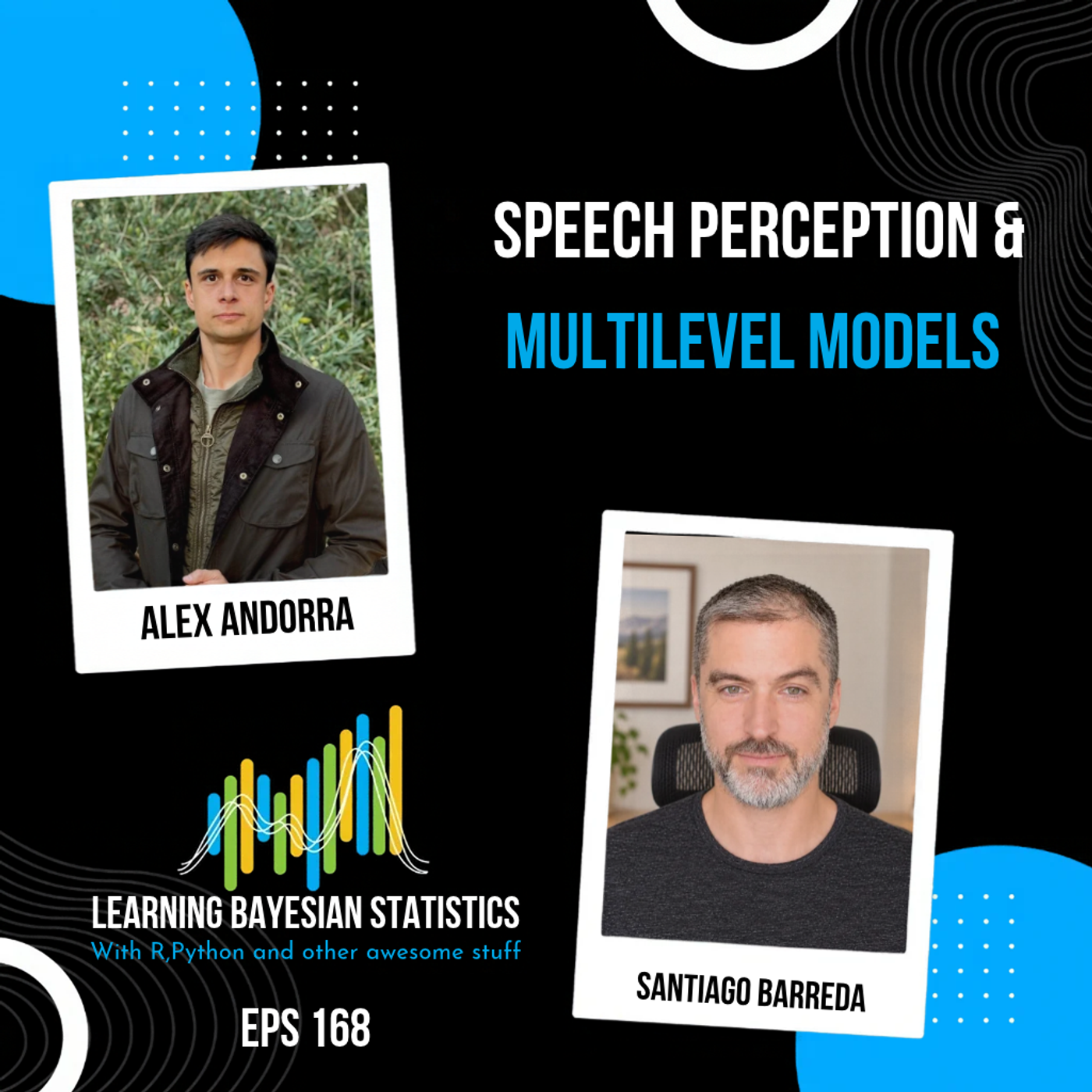
#168 Speech Perception & Multilevel Models, with Santiago Barreda

Support & Resources → Support the show on Patreon → Bayesian Modeling Course (first 2 lessons free) Our theme music is « Good Bayesian », by Baba Brinkman (feat MC Lars and Mega Ran). Check out his awesome work! Takeaways: Q: Why would a linguist switch from lme4 to Bayesian multilevel models? A: For Santiago, it was purely practical. Mixed-effects models fit with lme4 kept failing to converge, and they couldn't handle the complex repeated-measures structures his experiments needed. His friend Noah Silbert got him into Bayesian modeling around 2015, and only afterwards did he realize he agreed with the philosophy too. His analogy: the frequentist toolbox is a furniture store, and if it doesn't sell the bed you need, you settle for the nearest one; Bayesian modeling teaches you carpentry, so the model can match what you believe is going on in your data instead of squeezing the data into a standard structure. Q: Why teach Bayesian multilevel models before t-tests and ANOVA? A: Because in linguistics essentially all data are repeated measures: listeners judge hundreds of trials, and speakers produce many tokens. Yet students traditionally spend a year or more on one-sample t-tests, paired t-tests and ANOVAs they will never use in their own research. Santiago's book jumps straight to the multilevel version of the simplest case, a one-group model with many observations per listener, which he finds no harder to grasp than a t-test since there are no reference distributions or degrees of freedom to explain. Q: Do Bayesian and frequentist analyses give different results on typical phonetics data? A: With analogous models, largely no, at least with the amount of data phonetics experiments usually have. That's why the early chapters of Santiago's book end with a comparison to the equivalent frequentist analysis, to reassure readers. His rule of thumb: if you get dramatically different results, something has probably gone wrong. The gain from going Bayesian is not different point estimates, but models that actually converge, flexible error distributions and model structures, and much richer information about the so-called random effects, which in speech research describe how listeners vary within a speech community. Full takeaways here! Chapters: 09:09 Why did Santiago switch from lme4 to Bayesian multilevel models? 11:50 Why is Bayesian modeling like learning carpentry instead of shopping at IKEA? 18:10 How does Santiago's book differ from classic Bayesian textbooks? 21:11 Why do so many students wrongly decide they're bad at math? 24:01 Why is learning statistics more like learning the piano than memorizing facts? 29:53 What do listeners infer about a speaker from their voice, and why are they wrong in predictable ways? 43:59 How is vowel normalization like judging an object's size at a distance? 49:19 How do animals use their calls to signal body size? 56:15 Can we predict how accents and languages will change? 01:00:15 Why did Latin die, and what counts as a separate language? 01:07:28 What is Santiago working on next? Thank you to my Patrons for making this episode possible! Full links from the show here.

1 h 26 min

Mon26Oct
Learning Bayesian Statistics

Paul-Christian BürknerSteve BronderGuest

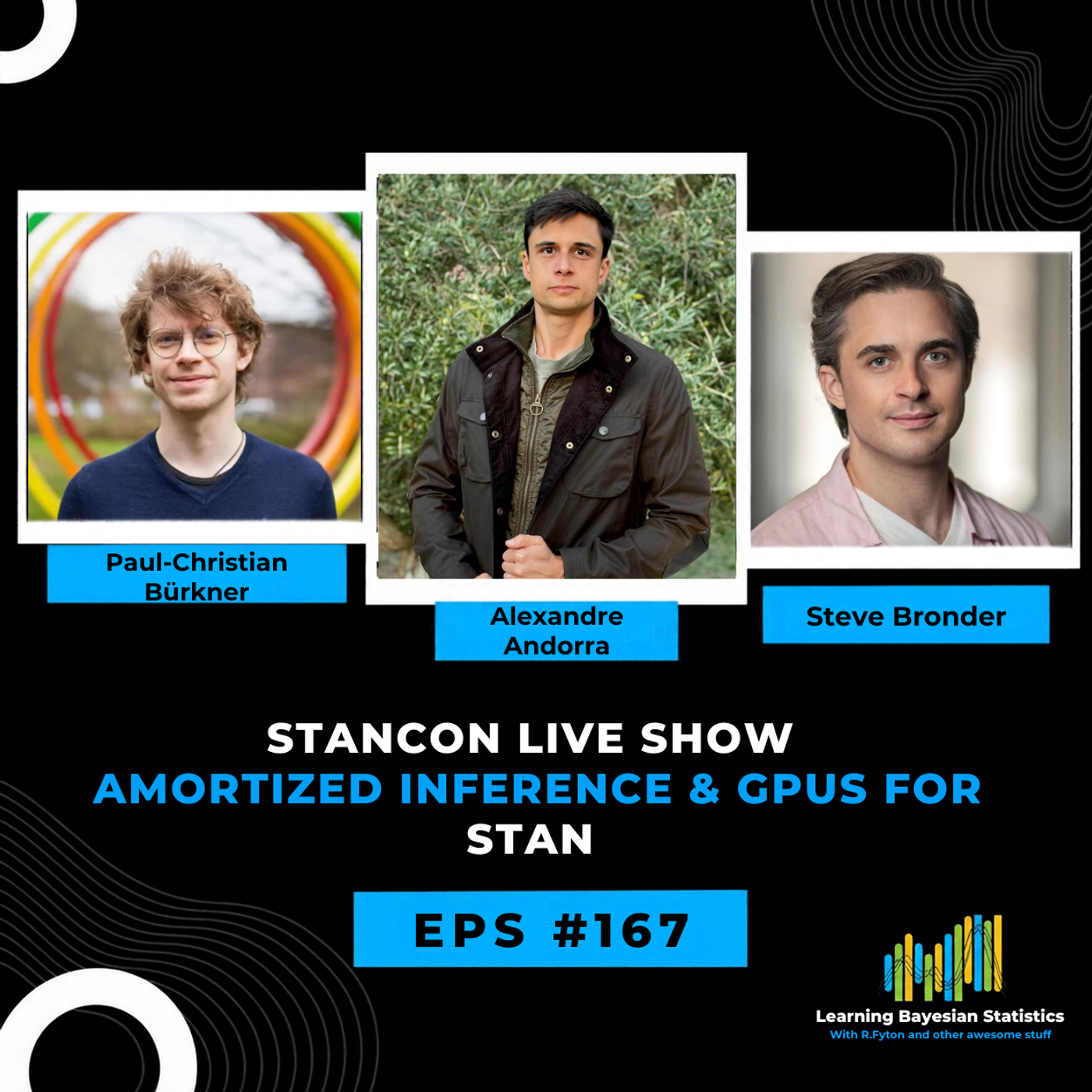
Can Neural Networks Replace MCMC?

Today’s clip is from Episode 167 of Learning Bayesian Statistics, featuring Paul-Christian Bürkner and Steve Bronder, recorded live at StanCon 2026 in Uppsala, Sweden. Paul Bürkner, creator of brms and a leading researcher behind BayesFlow, explains how neural networks can replace MCMC for Bayesian inference. Instead of evaluating likelihood and prior densities, the networks are trained on simulated data, so you can do simulation-based inference (SBI) even when the likelihood is intractable. Once trained, they give you amortized, real-time posteriors for new datasets, and they have made SBI scalable well beyond what approximate Bayesian computation could handle. Paul is also candid about the limits. Neural methods come with unstable training and no guarantees, and they can be unreliable on out-of-distribution or misspecified data, which is why MCMC is still the more trustworthy option wherever you can apply it. He ends with how his group is building diagnostics to flag when a neural posterior can’t be trusted. Full discussion here Support & Resources → Support the show on Patreon → Bayesian Modeling Course (first 2 lessons free): Our theme music is « Good Bayesian », by Baba Brinkman (feat MC Lars and Mega Ran). Check out his awesome work!

4 min

Tue20Oct
Learning Bayesian Statistics

Paul-Christian BürknerSteve BronderGuest

#167 Amortized Inference & GPUs for Stan, with Paul-Christian Bürkner & Steve Bronder

Support & Resources → Support the show on Patreon → Bayesian Modeling Course (first 2 lessons free) Our theme music is « Good Bayesian », by Baba Brinkman (feat MC Lars and Mega Ran). Check out his awesome work! Takeaways: Q: What is amortized Bayesian inference and how does it differ from MCMC? Instead of running MCMC on each dataset, you train neural networks on data simulated from the model, so you don't need likelihood or prior densities. Once training is done, inference on a new dataset is essentially instant: new data in, posterior out. The price is everything neural networks bring with them, from unstable training to a lack of guarantees. Paul's stated goal is to make these methods as reliable and robust as MCMC while staying orders of magnitude faster, and he's candid that he doesn't know whether the field will ever get there. Q: Why would a Bayesian model not have a usable likelihood? A: Usually not because the likelihood can't be written down in principle, but because computing it is so expensive or numerically unstable that it's intractable in practice. Paul gives two cases. First, mechanistic models built on complicated differential equations, as in physical chemistry or biology, where you can't solve through the equations to get densities and gradients in a stable, fast way. Second, big latent variable models with thousands of latent variables between the parameters and the data, where marginalizing them out is hopeless. In both cases, simulating from the model is easy: simulate the parameters, the latents and the data, throw the latents away, and learn the relation between parameters and data from the simulations. Full takeaways here! Chapters: 15:33 What is amortized Bayesian inference and when should you use it instead of MCMC? 23:18 Why would a Bayesian model not have a usable likelihood? 26:03 What's holding back GPU computing in Stan? 31:14 What are sum-to-zero constraints and why do they make models sample faster? 35:55 What is a Jacobian adjustment in Bayesian statistics? 39:17 How do you diagnose failures in amortized Bayesian inference? 42:01 What is leave-one-group-out cross-validation for hierarchical models? 45:57 Do undertrained neural posteriors overestimate or underestimate uncertainty? 49:06 How do Stan developers use AI tools in their work? 55:47 Should Stan and brms hide the inference algorithm from users? Thank you to my Patrons for making this episode possible! Full links from the show here!

1 h 03 min

Wed7Oct
Learning Bayesian Statistics

Bill EngelsJesse GrabowskiGuest

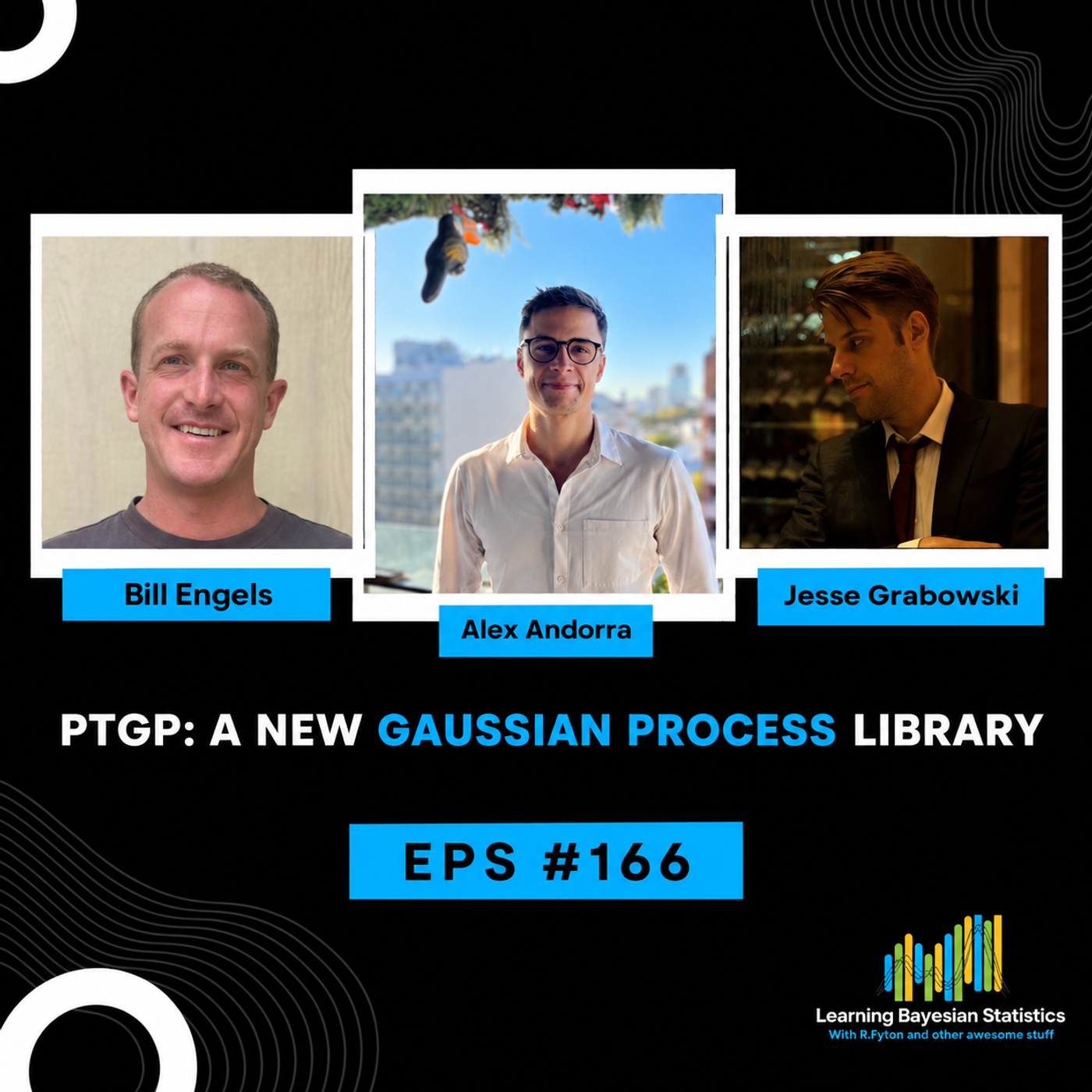
What Do Kernels, Length Scale & Amplitude Mean in Gaussian Processes?

Today's clip is from Episode 166, featuring Bill Engels & Jesse Grabowski. In this conversation, Bill explains what a kernel means in a Gaussian process and how it defines the idea of similarity between data points. He then breaks down the role of the length scale, showing how it controls how quickly the relationship between two points changes, and how amplitude controls the overall scale of the functions a GP can represent. The discussion also connects these ideas to the practical use of Gaussian processes for modeling unknown nonlinear relationships, and why kernels provide an interpretable way to describe how inputs are related. Full discussion here Support & Resources → Support the show on Patreon → Bayesian Modeling Course (first 2 lessons free): Our theme music is « Good Bayesian », by Baba Brinkman (feat MC Lars and Mega Ran). Check out his awesome work!

4 min

Thu1Oct
Learning Bayesian Statistics

Bill EngelsJesse GrabowskiGuest

#166 PTGP: A New Gaussian Process Library, with Bill Engels & Jesse Grabowski

Support & Resources → Support the show on Patreon → Bayesian Modeling Course (first 2 lessons free) Our theme music is « Good Bayesian », by Baba Brinkman (feat MC Lars and Mega Ran). Check out his awesome work! Takeaways: Q: What is PTGP and why did Bill and Jesse build it? A: PTGP is a new Gaussian process library built on PyTensor and PyMC, aimed squarely at practitioners rather than researchers assembling their own GP methods from papers. Bill Engels, who wrote PyMC's original GP submodule during a Google Summer of Code, built it because most GP libraries implement one method well but give little guidance on when to use it or how to fix it when it breaks. PTGP is opinionated by design: it picks battle-tested algorithms, tells you which one fits your data size, and ships the debugging knowledge alongside the code. Q: Why are Gaussian processes described as sitting at the intersection of statistics and machine learning? A: A Gaussian process starts from a simple idea: things that are close in the input space should be close in the output space, and the kernel function defines exactly what "close" means for your problem. That makes GPs look like machine learning (let the data speak through a flexible function) while staying fully interpretable once you've chosen a kernel, since observing data collapses the process into an ordinary multivariate normal. Full takeaways here! Chapters: 05:51 Where do Gaussian processes actually get used in practice? 09:07 What do a kernel's length scale and amplitude actually control? 11:58 What is HSGP and how does it combine with hierarchical models?14:51 Where does PTGP fit in a modern data science workflow? 21:01 Are Gaussian processes interpretable, or are they a black box?27:49 Why aren't Gaussian processes used everywhere already? 32:44 What does a kernel function actually tell you about your data?46:33 What is PyTensor and what does it give you over other backends?50:54 How do you build a Gaussian process model in PyTensor? 52:09 Why is fitting a Gaussian process so computationally expensive?56:00 How does PyTensor's rewrite system speed up GP math for you?59:54 How did an eight-line rewrite replace a matrix inverse in PTGP?01:01:10 Which backends can PyTensor compile your Gaussian process to? 01:11:27 What are inducing points and when should you use them?01:22:09 What goes wrong when you fit a VFE approximation, and how do you fix it? 01:23:18 How do you use an AI agent inside a Jupyter notebook?01:36:06 What are PTGP's skill files and which failures do they catch?01:42:20 How do you balance learning something against shipping it with an LLM? 01:44:28 How do you tell a useful LLM answer from a convincing wrong one? 01:48:37 Why does a good-looking AI output create an illusion of learning? Thank you to my Patrons for making this episode possible! Full links from the show here!

1 h 58 min

Mon28Sep
Learning Bayesian Statistics

Alex FenglerGuest

How AI Can Evaluate Bayesian Workflows with Bayesify

Today's clip is from Episode 165, featuring Alex Fengler. In this conversation, Alex introduces Bayesify , a tool that uses AI to analyze research papers and assess how well they follow a Bayesian workflow. He explains how the tool breaks an analysis down step by step, identifies strengths and weaknesses, and provides suggestions for improving the paper. They also discuss how BasiFi can be used as an educational resource, a review engine for researchers, and potentially as a way to study how the quality of Bayesian analyses has changed over time. Alex also explains why the team is building a human-rated "gold set" of papers to evaluate how well the tool's scoring aligns with expert judgment. It's an interesting example of how AI can be used not just to generate research, but to help verify and evaluate statistical workflows. Full discussion here Support & Resources → Support the show on Patreon → Bayesian Modeling Course (first 2 lessons free): Our theme music is « Good Bayesian », by Baba Brinkman (feat MC Lars and Mega Ran). Check out his awesome work!

5 min

Fri18Sep
Learning Bayesian Statistics

Alex FenglerGuest

#165 Hierarchical Sequential Sampling Modeling, with Alex Fengler

Support & Resources → Support the show on Patreon → Bayesian Modeling Course (first 2 lessons free) Our theme music is « Good Bayesian », by Baba Brinkman (feat MC Lars and Mega Ran). Check out his awesome work! Takeaways: Q: What is HSSM and how does it relate to HDDM? A: HSSM stands for hierarchical sequential sampling models, a generalization of HDDM (hierarchical drift diffusion models), the older toolbox for the same class of decision-making models, but HSSM is built from the ground up on simulation-based inference. That's what lets it handle any variation of the underlying process model, not just the ones with a tractable closed-form likelihood. Q: What is the drift diffusion model and why has cognitive science relied on it so heavily? A: The drift diffusion model treats a decision as a random walk that accumulates evidence until it crosses one of two boundaries, with parameters controlling boundary separation, starting bias, and drift rate. It's been used in thousands of published papers largely because it has a closed-form likelihood, which makes standard Bayesian and maximum-likelihood inference fast. Small variations on the model are often just as scientifically motivated, but if their likelihoods aren't analytically convenient, the literature using them stays sparse. Q: What is a likelihood approximation network (LAN) and what does it actually learn? A: A LAN is a neural network trained to take in a process's parameters and a trial's outcome and output how likely that outcome was, learned purely from repeated simulation rather than derived analytically. Once trained, it functions as a fast, reusable likelihood you plug directly into Bayes' rule, in place of a closed-form solution that may not exist for the model you actually want to fit. Q: What's the difference between amortizing the likelihood and amortizing the posterior? A: Amortizing the likelihood, HSSM's approach, means training a network once to approximate the likelihood, then reusing that same network across arbitrarily many downstream models: different priors, hierarchical structures, or regression backends, with no retraining. Amortizing the posterior directly, the approach tools like BayesFlow take, gives near-instant inference once trained, but locks the network into the specific scenario it was trained for. Chapters: 00:00:00 What is HSSM and how does it fit into the Bayesian inference landscape? 00:12:09 How did HSSM evolve from HDDM, and what does it apply to? 00:30:25 How do neural networks learn likelihoods for Bayesian inference? 00:37:01 What makes amortized Bayesian inference so flexible? 00:41:04 What are the real computational costs of amortized inference? 00:55:16 How does HSSM integrate with libraries like BayesFlow? 00:58:57 What does a live demo of HSSM and BayesFlow look like? 01:18:33 What is Bayesify and how does it score a paper's Bayesian workflow? 01:23:12 What new model classes are coming to the HSSM ecosystem? 01:30:12 How is AI reshaping development in the HSSM ecosystem? 01:38:42 How should society incentivize keeping hard cognitive skills alive? Thank you to my Patrons for making this episode possible! Links from the show.

1 h 48 min

Fri11Sep
Learning Bayesian Statistics

Andrew GelmanAki VehtariRichard McElreathGuest

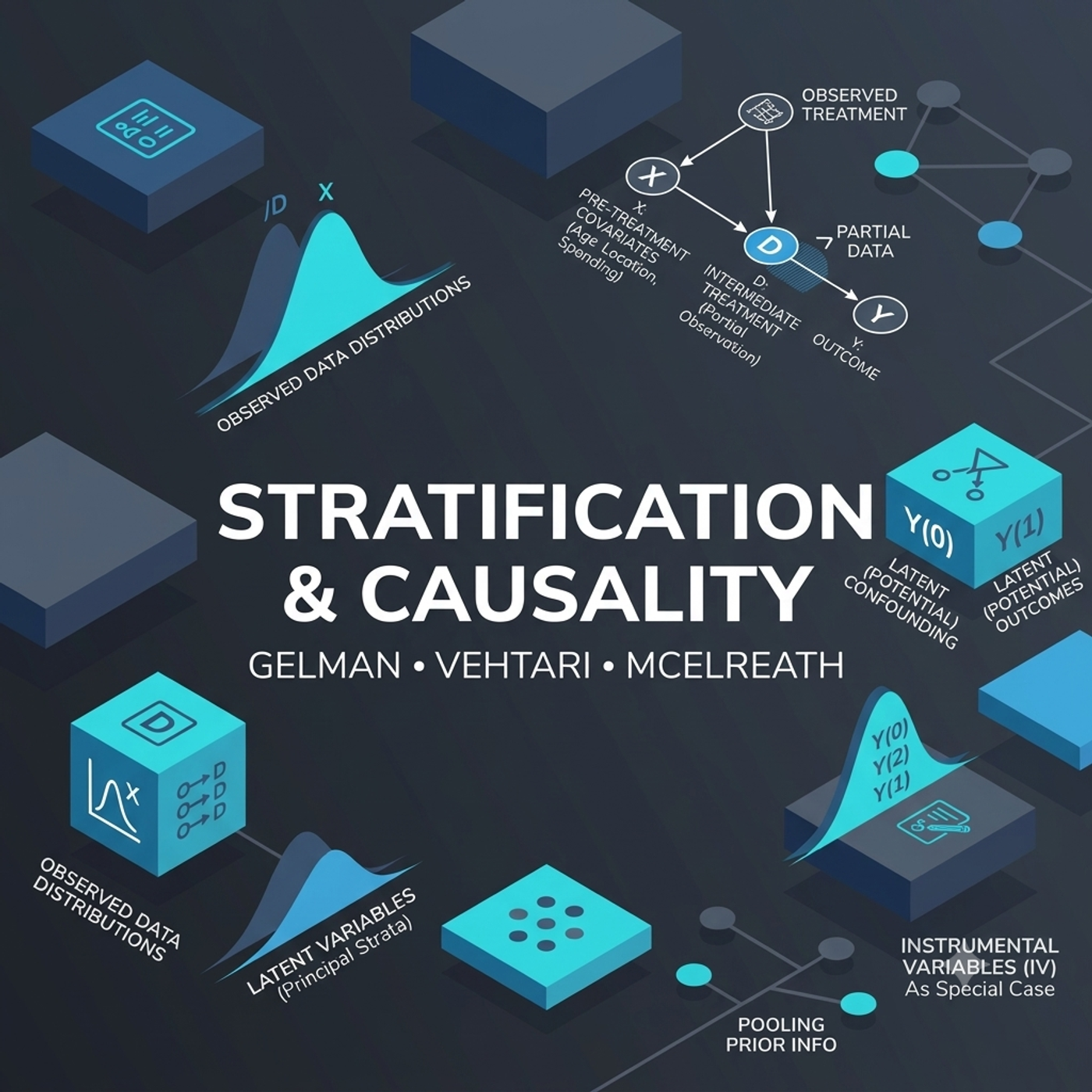
Bayesian Principal Stratification: Modeling Treatment Effects

Today's clip is from Episode 164, featuring Andrew Gelman, Aki Vehtari & Richard McElreath. In this conversation, Andrew explains how Bayesian principal stratification can be used to reason about treatment effects when there is an intermediate treatment or outcome that is only partially observed. He discusses how latent variables can represent whether someone would take a stage-two treatment, and how pre-treatment characteristics such as age, location, and past spending can help build a model for this process. Richard connects the problem to the broader distinction between per-protocol and intent-to-treat analyses, and they discuss how standard approaches such as instrumental variables can be understood as special cases of more general Bayesian models. It's a useful example of how Bayesian modeling can represent the full process behind a causal question rather than relying on simplifying assumptions. Full discussion here Support & Resources → Support the show on Patreon → Bayesian Modeling Course (first 2 lessons free): Our theme music is « Good Bayesian », by Baba Brinkman (feat MC Lars and Mega Ran). Check out his awesome work!

5 min

Wed2Sep
Learning Bayesian Statistics

Andrew GelmanAki VehtariRichard McElreathGuest

Why a Bayesian Workflow Goes Beyond Fitting Models

Today's clip is from Episode 164, featuring Andrew Gelman, Aki Vehtari & Richard McElreath. In this conversation, Andrew explains why a Bayesian workflow goes far beyond simply fitting a model. He discusses the importance of building, fitting, and checking models, and why moving between simpler and more complicated models can reveal insights that a single model might miss. He also explores how simulation and generative modeling can help researchers evaluate new models and gain confidence in their results, even when there isn't an established method or published study to rely on. It's a look at why good statistical practice isn't just about getting an answer, but knowing how much you can trust it. Full discussion here Support & Resources → Support the show on Patreon → Bayesian Modeling Course (first 2 lessons free): Our theme music is « Good Bayesian », by Baba Brinkman (feat MC Lars and Mega Ran). Check out his awesome work!

4 min

Mon31Aug
Learning Bayesian Statistics

Aki VehtariAndrew GelmanRichard McElreathGuest

#164 Bayesian Workflow, with Andrew Gelman, Aki Vehtari & Richard McElreath

Support & Resources → Support the show on Patreon → Bayesian Modeling Course (first 2 lessons free) Our theme music is « Good Bayesian », by Baba Brinkman (feat MC Lars and Mega Ran). Check out his awesome work Takeaways: Q: What is the "Bayesian Workflow" book about, and who is it for? A: It covers what the three authors know that isn't already in Bayesian Data Analysis (BDA3) or Statistical Rethinking, organized around case studies that walk through full analyses end to end rather than just giving a recommendation. It's not an introduction to Bayesian inference -- it assumes you already know the basics -- but a guide to making theoretically informed, professional decisions at the many branching points a real analysis involves that source books rarely acknowledge. Q: What's a concrete way to report Bayesian results without just handing over a posterior distribution? A: Report a few named scenarios from the distribution, such as pessimistic, median, and optimistic. This is easier to discuss than a full posterior and helps shift the conversation toward what would move outcomes from the median toward the optimistic case. Full takeaways Chapters: 00:18:22 What is the elevator pitch for the Bayesian Workflow book? 00:20:12 Where does workflow sit between statistical theory and case studies? 00:27:21 Why express your scientific background in a generative model? 00:36:43 How is a Bayesian workflow different from a pipeline? 00:39:03 What is reverse Bayes, and how does it help with prior sensitivity? 00:43:53 How do Bayesians reinterpret non-Bayesian methods? 00:45:02 How is the Bayesian Workflow book structured? 00:48:49 How do you model bat mortality at wind farms from zero-inflated carcass counts? 00:52:24 When does a hierarchical model stop being an innocuous assumption? 00:58:17 Can multilevel regression and poststratification pool detection across sites? 00:59:32 Why start with a big generative simulation before the statistical model? 01:02:05 What is the "secret weapon" of comparing shrinkage to fixed-effects estimates? 01:11:02 How do you detect which assumptions are actually driving your inference? 01:15:24 How do you get regulated industries to accept a posterior instead of a score? 01:22:04 Should statisticians soften uncertainty for decision makers? 01:23:11 Why report three scenarios instead of a single number? 01:27:51 How do you handle a leaky instrument in causal inference? 01:29:16 What is a principal stratification model? 01:34:47 What are the three authors working on next? Thank you to my Patrons for making this episode possible! Full show notes

1 h 44 min

Tue25Aug
Learning Bayesian Statistics

Thomas PinderGuest

Making Gaussian Processes Easier to Use

Today's clip is from Episode 154, featuring Thomas Pinder. In this conversation, Thomas shares what he sees as the next steps for GPJax and how the project could become easier to use beyond its original research-focused audience. He discusses creating a higher-level interface that could make fitting Gaussian processes possible in just a few lines of code, while still keeping the flexibility and infrastructure that GPJax provides. He also talks about making the documentation more engaging by moving beyond synthetic examples and showcasing real-world applications, such as modeling ocean currents with Gaussian processes. It's a look at how GPJax could evolve from a powerful research tool into something that's even more accessible and practical for a wider range of users. Full discussion here Support & Resources → Support the show on Patreon → Bayesian Modeling Course (first 2 lessons free): Our theme music is « Good Bayesian », by Baba Brinkman (feat MC Lars and Mega Ran). Check out his awesome work!

5 min

Fri21Aug
Learning Bayesian Statistics

Adrian SeyboldtEliot CarlsonGuest

The Future of Faster MCMC

Today's clip is from Episode 163, featuring Eliot Carlson and Adrian Seyboldt. In this conversation, Eliot and Adrian look beyond current approaches to HMC adaptation and preconditioning and share the ideas they're most excited to explore next. Eliot discusses new ways of parallelizing MCMC by solving for an entire trajectory at once rather than computing every step sequentially, a potentially powerful direction for expensive, high-dimensional problems. Adrian, meanwhile, talks about exploring non-adjusting methods and going beyond first-order information by investigating how higher-order autodiff and second-order derivatives could open up new possibilities for sampling. It's a glimpse into some of the ideas that could help make MCMC faster and more scalable as computational hardware continues to become increasingly parallel. Full discussion here Support & Resources → Support the show on Patreon → Bayesian Modeling Course (first 2 lessons free): Our theme music is « Good Bayesian », by Baba Brinkman (feat MC Lars and Mega Ran). Check out his awesome work!

4 min

Thu13Aug
Learning Bayesian Statistics

Adrian SeyboldtEliot CarlsonGuest

#163 How to make your models sample faster, with Adrian Seyboldt & Eliot Carlson

Support & Resources → Support the show on Patreon → Bayesian Modeling Course (first 2 lessons free) Our theme music is « Good Bayesian », by Baba Brinkman (feat MC Lars and Mega Ran). Check out his awesome work Takeaways: Q: What is mass matrix adaptation, in plain terms? A: Mass matrix adaptation is best understood as an automatic, fairly dumb, but very effective reparameterization of your model. The simplest version, the diagonal mass matrix, just rescales each parameter so its posterior standard deviation becomes one, which is exactly what you'd do by hand if you had the patience. Every time you sample a PyMC or Stan model, this kind of reparameterization is happening under the hood. Q: How does Nutpie's approach to mass matrix adaptation differ from Stan and PyMC's default? A: Stan and PyMC's default sampler only use one source of information for diagonal mass matrix adaptation: the posterior standard deviation estimated from warm-up draws. Nutpie also uses the gradients of the log density, which HMC is already computing at every step to build its trajectory. For a standard normal distribution, the covariance of the gradients is exactly the inverse covariance of the draws, so Nutpie takes the geometric mean of the two resulting standard deviations. There's no guarantee it's always better, but in practice it usually is. Q: What problem does "Preconditioning Hamiltonian Monte Carlo by Minimizing Fisher Divergence" actually solve? A: Preconditioning HMC means transforming your target distribution into one that's friendly to sample, but doing that well requires knowing things about the distribution, like its covariance, that sampling itself is supposed to discover. This chicken-and-egg problem is usually handled by sketching a rough estimate from a handful of early warm-up draws, which can burn a large share of total sampling time. Adrian and Eliot's paper formalizes how to make better use of a second signal, the score function, that HMC already computes for free but that Stan-style preconditioning ignores. Chapters: 00:00:00 What is HMC preconditioning? 00:09:03 A more robust low-rank mass matrix 00:11:58 What is mass matrix adaptation? 00:18:06 What does preconditioning HMC mean? 00:20:57 What is normalizing flow adaptation, and when does a linear mass matrix fall short? 00:23:50 When does normalizing flow adaptation actually help, and when is classic mass matrix adaptation enough? 00:27:13 What is Fisher divergence? 00:30:10 Why is HMC's trajectory, not its density, the right target for preconditioning? 00:33:04 What are the diagonal, dense, and low-rank-plus-diagonal versions of mass matrix adaptation? 00:46:25 How much faster is low-rank-plus-diagonal adaptation? 00:51:07 What's the practical recommendation for using Nutpie and its mass matrix adaptation? 00:54:31 Why does low-rank adaptation sometimes fail spectacularly? 01:01:35 Where does this research fit in the bigger picture of HMC? 01:12:12 How could centered vs. non-centered parameterization be chosen automatically? Thank you to my Patrons for making this episode possible! Links from the show here

1 h 24 min

Thu13Aug
Learning Bayesian Statistics

Vaden MasraniGuest

Bayesian Statistics vs. Epistemology

Today's clip is from episode 160, featuring Vaden Masrani. In this conversation, Vaden explores the tension between Bayesian statistics and Bayesian epistemology, and why he sees them as fundamentally different. He explains why Bayesian epistemology can run into problems when trying to explain where hypotheses themselves come from, and argues that an emphasis on finding supporting evidence can encourage confirmation bias rather than genuine scientific inquiry. He also discusses Hempel's paradox, Popper's idea of falsification, and why these philosophical problems don't necessarily undermine Bayesian statistics itself. Full discussion here Support & Resources → Support the show on Patreon → Bayesian Modeling Course (first 2 lessons free): Our theme music is « Good Bayesian », by Baba Brinkman (feat MC Lars and Mega Ran). Check out his awesome work!

5 min

Fri7Aug
Learning Bayesian Statistics

Vaden MasraniGuest

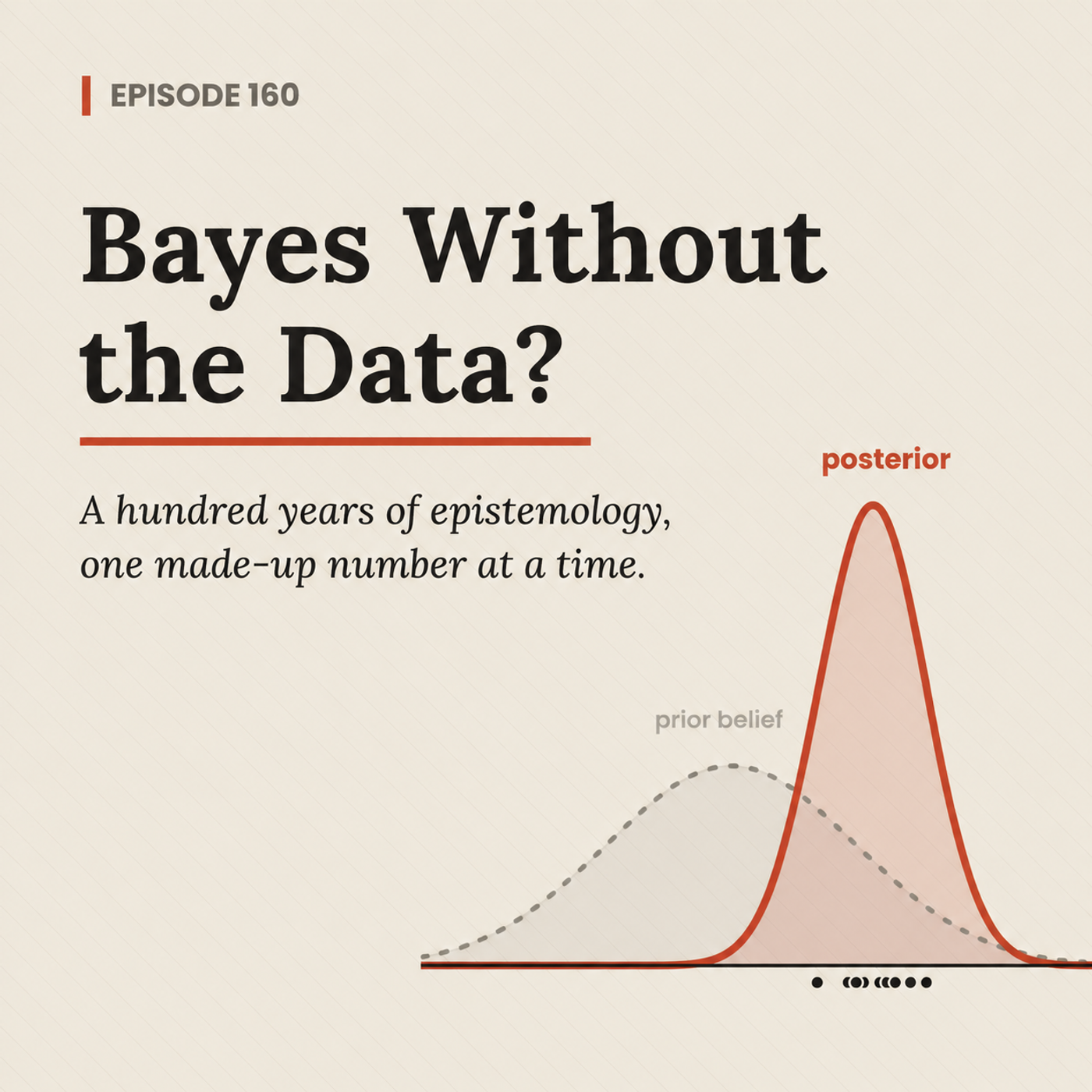
Bayesian Epistemology Is "Bayes' Theorem Without the Data"

Today's clip is from episode 160, featuring Vaden Masrani. In this conversation, Vaden lays out a sharp critique of Bayesian epistemology - the roughly hundred-year-old philosophical tradition, popular in some Oxford-adjacent circles, that treats subjective probability estimates as legitimate even when there's no data behind them. Vaden's core objection: doing Bayes' theorem on numbers you made up in your head is like fitting a regression line to an empty scatter plot - the math looks rigorous, but there's nothing underneath it. He argues this "math-washing" can trick people into thinking a decision is well-informed simply because it's dressed up in probability language, when frequentists and data-driven Bayesians alike would say the same thing: no data, no model. Get the full discussion here Support & Resources → Support the show on Patreon → Bayesian Modeling Course (first 2 lessons free): Our theme music is « Good Bayesian », by Baba Brinkman (feat MC Lars and Mega Ran). Check out his awesome work!

4 min
Mon3Aug
Learning Bayesian Statistics

Chris KrapuGuest

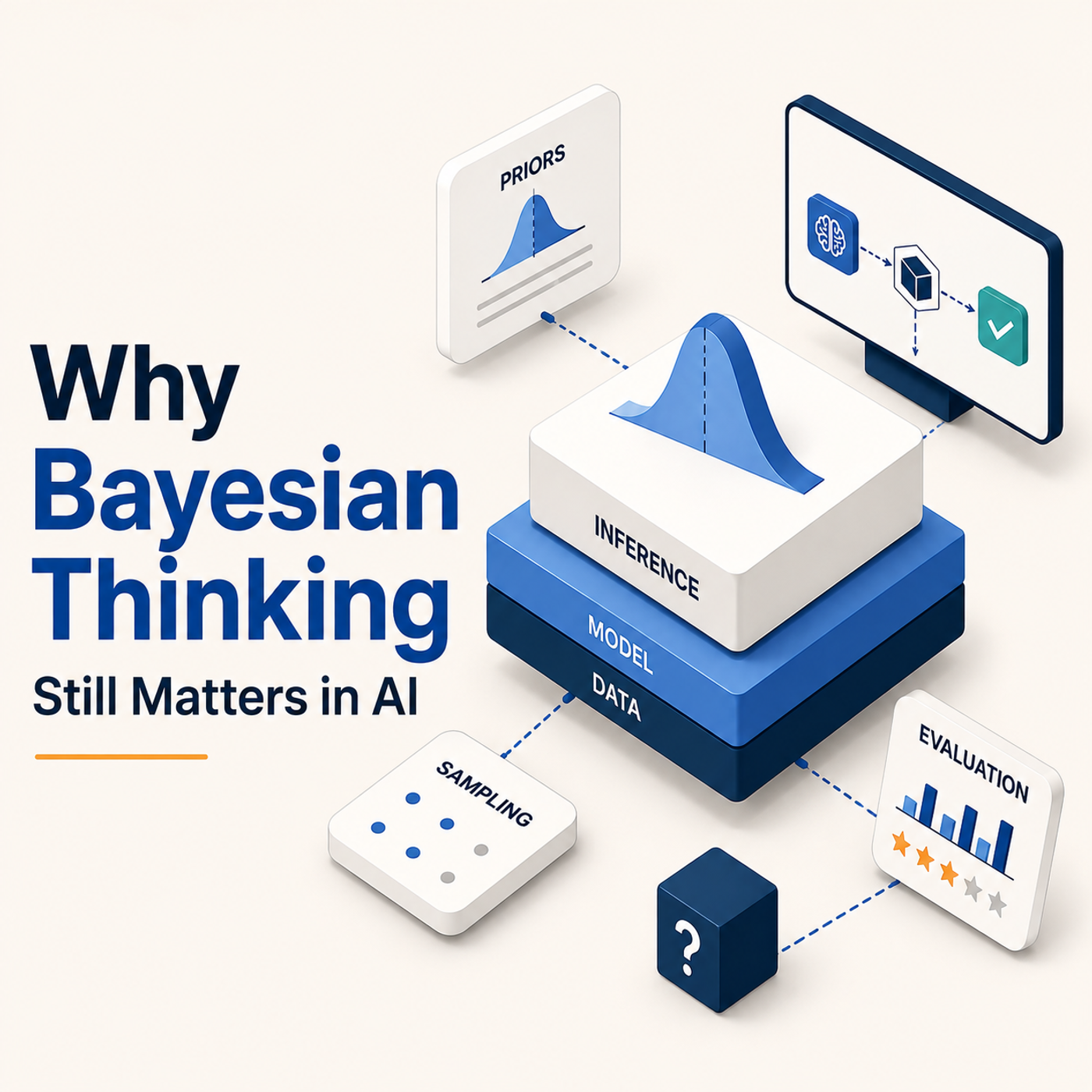
Why Bayesians Have an Edge in AI

Today's clip is from episode 162, featuring Chris Krapu. In this conversation, Chris explains why Bayesian thinking remains surprisingly valuable in today's AI landscape - even when the models themselves aren't explicitly Bayesian. Rather than uncertainty estimation, Chris highlights a different advantage: Bayesian training provides a deep intuition for concepts like priors, sampling, rejection sampling, and high-dimensional geometry, making it much easier to understand and apply modern AI research. He also discusses why Bayesian methods are becoming increasingly relevant for evaluating agentic AI systems, where complex workflows and limited evaluation data make hierarchical models and sensible priors especially powerful. Get the full discussion here Support & Resources → Support the show on Patreon → Bayesian Modeling Course (first 2 lessons free): Our theme music is « Good Bayesian », by Baba Brinkman (feat MC Lars and Mega Ran). Check out his awesome work!

4 min
Tue28Jul
Learning Bayesian Statistics

Christopher KrapuGuest

#162 Bayesian Hydrology & GPU AI, with Christopher Krapu

Support & Resources → Support the show on Patreon → Bayesian Modeling Course (first 2 lessons free) Our theme music is « Good Bayesian », by Baba Brinkman (feat MC Lars and Mega Ran). Check out his awesome work Takeaways: Q: How does putting a Gaussian process on unknown coordinates fix noisy location data in mineral prospecting? A: In mining and geostatistics, the classic Gaussian process model, known there as kriging, assumes you know exactly where each sample was taken. Chris’ project broke that assumption on purpose: the recorded coordinates for each core sample were only accurate to within a rough radius. By treating the true locations as latent variables and putting a Gaussian process over them jointly with the measurements, the model could still reconstruct the underlying gold-concentration field, even though the exact sampling locations were never known precisely. It's a demonstration that Gaussian processes can absorb structural uncertainty that looks, at first glance, like it should make the problem impossible. Q: What is "Poverty Bayes," and what did it cost to train a two-million-parameter Bayesian model? A: Poverty Bayes was Chris’ experiment in seeing how cheaply a large Bayesian model could be trained using modern cloud infrastructure. He fit a hierarchical logistic regression with close to two million parameters, using PyMC's Hamiltonian Monte Carlo on a single A100 GPU rented through Modal, a serverless platform that deploys a Python script straight to GPU hardware with almost no setup. He'd originally guessed it would cost around five dollars, the price of a Big Mac, but the real bill came in an order of magnitude lower. A model that would take a Gibbs sampler weeks to run, and that once required a research lab's dedicated GPU, now costs pocket change and a few minutes of setup. Q: What's the current bottleneck in Bayesian-at-scale tooling? A: Chris argues the software has largely caught up: PyMC's JAX backend and NumPyro make GPU-accelerated Bayesian modeling work out of the box for most problems. What's missing is common knowledge. Companies are clearly running large Bayesian models in production, but the results stay behind corporate firewalls. Chris’ proposal is a community benchmark effort: which frameworks handle a million-parameter Markov random field on a given GPU out of the box, since this kind of expensive, slow-running benchmark is a poor fit for standard CI pipelines but valuable for the field to know. Chapters: 22:57 When does GPU acceleration actually pay off for a Bayesian model? 26:33 What did it cost to train a two-million-parameter model on Modal? 30:36 What happened when Chris asked 200 different LLMs to flip a coin? 34:50 Where do Bayesian ideas show up in the agentic AI systems Chris builds at Nvidia? 40:16 Are statisticians being made obsolete by large language models? 41:19 How does putting a Gaussian process on unknown coordinates fix noisy data in mineral prospecting? 58:05 What is Chris looking forward to working on next? Thank you to my Patrons for making this episode possible! Links from the show here

1 h 05 min
Wed22Jul
Learning Bayesian Statistics

Luigi AcerbiGuest

The Next Step Beyond LLMs: Foundation Models for Inference

Today's clip is from episode 161, featuring Luigi Acerbi. In this conversation, Luigi explains one of the biggest engineering bottlenecks facing transformer-based probabilistic models—and how his group found a way around it. The core challenge is that many inference models treat data as an unordered set, making them naturally permutation invariant. That's statistically elegant, but computationally painful: every time a new data point arrives, the model has to recompute attention over the entire dataset from scratch, preventing the kind of KV caching that makes modern language models so efficient. Luigi walks through his team's solution: a hybrid architecture that keeps the original context fully set-based while introducing a causal-attention buffer for newly arriving data. The result is dramatically faster inference- up to 100× faster in some settings - opening the door to applications like reinforcement learning, active data acquisition, and, ultimately, Luigi's long-term vision of a foundation model for Bayesian inference. Get the full discussion here Support & Resources → Support the show on Patreon → Bayesian Modeling Course (first 2 lessons free) Our theme music is « Good Bayesian », by Baba Brinkman (feat MC Lars and Mega Ran). Check out his awesome work
6 min

Thu16Jul
Learning Bayesian Statistics

Luigi AcerbiGuest

#161 Amortized Inference & Neural Processes, with Luigi Acerbi

Support & Resources → Support the show on Patreon → Bayesian Modeling Course (first 2 lessons free) Our theme music is « Good Bayesian », by Baba Brinkman (feat MC Lars and Mega Ran). Check out his awesome work Takeaways: Q: What is Variational Bayesian Monte Carlo (VBMC) and how is it different from Bayesian optimization? A: VBMC borrows the machinery of Bayesian optimization but aims at a different target. Bayesian optimization fits a Gaussian process surrogate to an expensive function and uses it to hunt for the optimum. VBMC instead treats the log-posterior as the function to model, evaluates it at a few carefully chosen points, and keeps the whole reconstructed shape rather than just its peak. That gives you the full posterior, not a single best-fit value. Where MCMC might need tens of thousands to millions of evaluations, VBMC often reconstructs a good posterior approximation from a few hundred, which matters when each evaluation is slow. Q: When should you reach for PyVBMC, and when is it the wrong tool? A: Two symptoms tell you PyVBMC might help. First, speed: if a single evaluation of your log density takes on the order of a second, running MCMC over tens of thousands of evaluations becomes painful, and PyVBMC's few-hundred-evaluation budget pays off. Second, dimensionality: because it leans on a Gaussian process surrogate, it works well up to roughly 10 to 15 parameters and degrades beyond that. If your model already runs fine in Stan or PyMC, you do not need it. It shines for expensive, low-dimensional models common in science and engineering, where you are modeling a process rather than composing nice distributions. Full takeaways here Chapters: 00:18:13 What is Variational Bayesian Monte Carlo (VBMC) and how does it differ from Bayesian optimization? 00:30:21 When should you use VBMC versus BADS in practice? 00:31:20 What is Bayesian Adaptive Direct Search (BADS) and how does its hybrid optimization strategy work? 00:39:18 What are neural processes, and why are transformers a natural neural process architecture? 00:45:54 What is the Amortized Conditioning Engine (ACE) and what problem does it unify? 00:55:42 What do PriorGuide and the new autoregressive buffer paper solve for amortized inference? 01:02:03 How does the new autoregressive buffer speed up predictions in transformer probabilistic models? 01:06:11 What is Luigi Acerbi's vision for a foundation model for inference? 01:09:26 What is ALINE and how does it add active data acquisition to amortized inference? 01:12:43 How does Luigi Acerbi connect LLM agents, Bayesian decision theory, and the nature of intelligence? 01:18:44 For a PyMC, Stan, or NumPyro user, where should you start with VBMC, BADS, or BayesFlow? Thank you to my Patrons for making this episode possible! Links from the show here

1 h 32 min

Mon29Jun
Learning Bayesian Statistics

Vaden MasraniGuest

Bayesian Statistics vs Epistemology, with Vaden Masrani

Support & Resources → Support the show on Patreon → Bayesian Modeling Course (first 2 lessons free) Our theme music is « Good Bayesian », by Baba Brinkman (feat MC Lars and Mega Ran). Check out his awesome work Takeaways: Q: What's the difference between Bayesian statistics and Bayesian epistemology? A: Bayesian statistics uses Bayes' theorem on actual data: you put a prior over parameters, combine it with a likelihood, and the data is allowed to tell you your model is wrong. Vaden loves it. Bayesian epistemology, in his tongue-in-cheek phrase, is "Bayesian statistics minus the statistics" - taking Bayes' theorem as a general account of how anyone should reason under uncertainty, including about events where there is nothing to count. The first is falsifiable and grounded; the second, he argues, lets people attach authoritative-sounding numbers to pure belief. Q: Why is it a problem to put a probability on a one-off future event like human extinction? A: Because there are no statistics behind it. Vaden's trigger example is Toby Ord's The Precipice, where a data-derived probability (supervolcanoes per millennium) is placed side by side with a probability of extinction-by-superintelligence that came from no data at all. His reaction is the statistician's first instinct: where are the numbers coming from, and what could ever make them come out differently? A subjective degree of belief is fine as a hunch. The trouble starts when it is communicated as though it were an objective, data-grounded frequency. Q: What does Vaden Masrani actually like about Bayesian statistics? A: The freedom to encode domain knowledge as a prior and have the result respect common sense - estimating an average human height, you can rule out zero and a hundred feet before seeing a single measurement. But the part he keeps stressing is falsifiability: you fit the model, compare it to data, and the data can tell you the model was bad. That contact with reality is exactly what makes the statistics legitimate and what the epistemology lacks. On Bayesian-versus-frequentist for engineering problems, he says he has no dog in the fight -- both are useful, and any working statistician uses both. Full takeaways here Chapters: 00:24:01 What's the difference between Bayesian statistics and Bayesian epistemology? 00:33:12 How can Bayesian epistemology lead to bad real-world decisions? 00:36:36 Is Bayesian or frequentist statistics better for real-world problems? 00:39:31 What is the problem of induction, and how does Bayesian epistemology try to solve it? 00:43:50 What are the main logical problems with Bayesian epistemology? 00:48:40 What is Popper's critical rationalism, and how does falsifiability fit in? 00:52:31 How does critical rationalism work when you can't run a clean experiment? 01:15:03 Why should you treat criticism as a gift, even when it hurts? 01:19:54 How do Stoicism and equanimity help you handle criticism? 01:23:19 Why does critical rationalism apply to everyday life, not just science? Thank you to my Patrons for making this episode possible! Links from the show here

1 h 41 min

Fri19Jun
Learning Bayesian Statistics

Stefan RadevGuest

Why Bayesian Statistics Is More Computational Than Ever

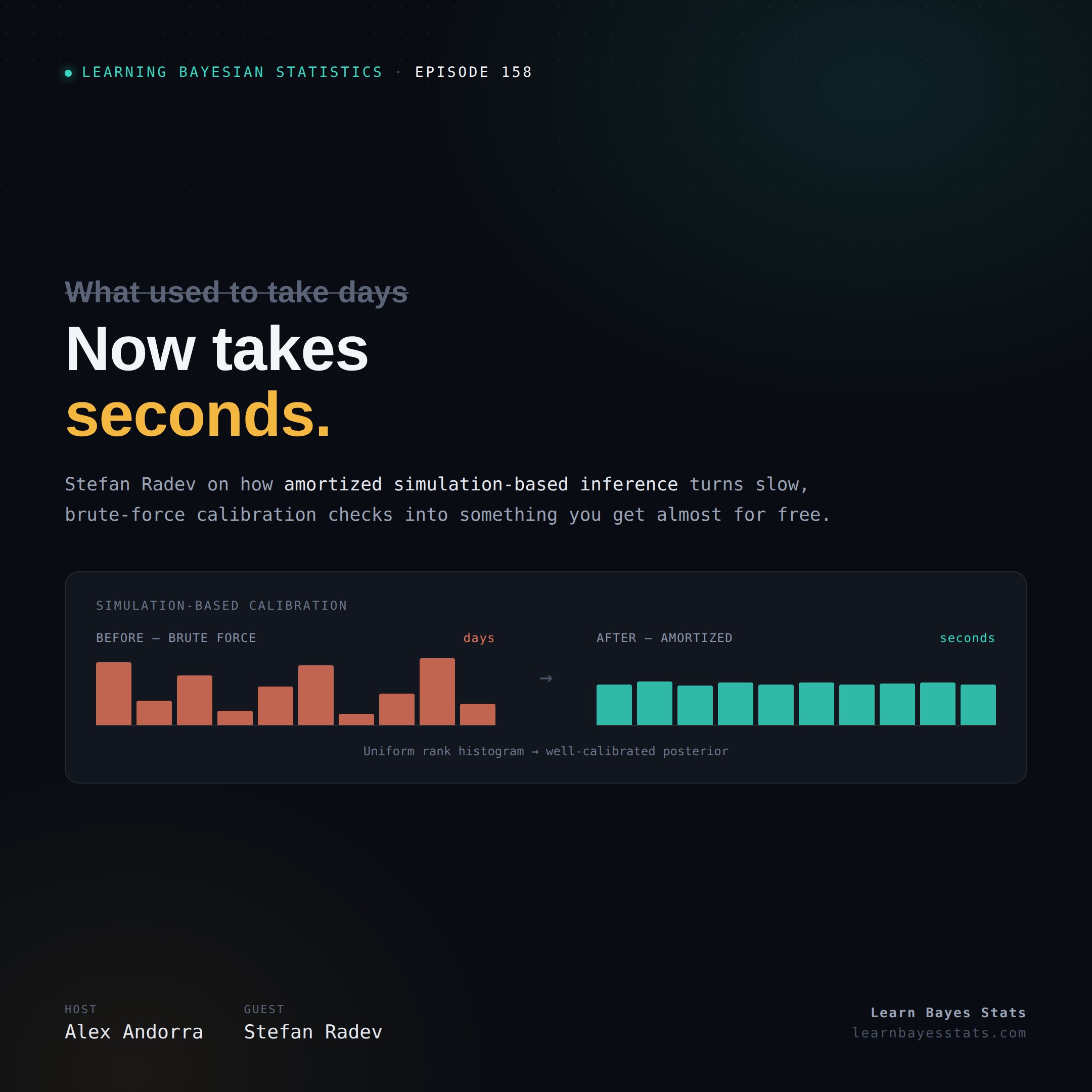
Today's clip is from Episode 158 featuring Stefan Radev. In this conversation, Alex Andorra and Stefan break down a core argument from their paper: Bayesian statistics has never been more computational than it is now, and simulation is the thread that ties the whole workflow together. Stefan parcellates the Bayesian workflow into four stages, and this clip covers the first two. Stage one is model specification, where the workflow community has long recommended prior predictive checks. You can do this informally, just running simulations from your model and eyeballing whether the output meets your expectations, or formally, à la Michael Betancourt, by pushing your model's high-dimensional output through a transformation into a low-dimensional, interpretable space and checking it against reality. The punchline: a surprising number of models can be discarded before you've even seen real data, yet Stefan notes these checks remain underused in practice. Stage two is model verification, where the question shifts to whether your inferences are well calibrated. This is the territory of simulation-based calibration and parameter recovery studies, classic tools that have always carried a steep computational price. You simulate thousands of synthetic datasets and run inference on every single one, which is exactly why these checks are so often skipped in papers, even though doing one well can be a contribution in its own right. Here's where amortized simulation-based inference changes the math entirely. Checks that used to take days now take seconds, and instead of laboriously running inference dataset by dataset, you get millions of posterior samples essentially for free. The calibration checks that the field has always known it should be doing finally become cheap enough to actually do. Get the full discussion here Support & Resources → Support the show on Patreon → Bayesian Modeling Course (first 2 lessons free) Our theme music is « Good Bayesian », by Baba Brinkman (feat MC Lars and Mega Ran). Check out his awesome work

5 min

Wed10Jun
Learning Bayesian Statistics

Matthijs HollandersGuest

Exact GPs vs Approximations: When to Use Each (and Why It Matters)

Today's clip is from episode 159 featuring Matthijs Hollanders. In this conversation, Alex and Matthijs dig into a deceptively practical question: when you're modeling wildlife across space and time with Gaussian Processes, how do you keep the math from becoming computationally unbearable - and what does good engineering actually look like in the field? Matthijs explains that for most real camera trapping datasets, exact GPs still hold up fine. The reason is less about clever math and more about ecological reality: researchers are usually resource-constrained, so datasets tend to be a few hundred sites, not thousands. And when datasets do get large, they're rarely one giant connected grid - they're clusters of independent regions. That structure is exploitable. Run a separate, smaller GP per region, share the hyperparameters, and you avoid building the massive covariance matrix that makes exact GPs expensive in the first place. But the more interesting thread is where this is heading. Alex introduces Hilbert Space Gaussian Processes (HSGPs) - an approximation that makes compute time nearly linear in dataset size, rather than cubic. The catch, as Matthijs points out, is that approximations aren't always better: if your dataset isn't large enough to be in the regime where the approximation accuracy kicks in, you're better off with the exact GP and its mathematical guarantees. The rule of thumb is simple - if you can use the vanilla GP, just do it. Get the full discussion here Support & Resources → Support the show on Patreon → Bayesian Modeling Course (first 2 lessons free) Our theme music is « Good Bayesian », by Baba Brinkman (feat MC Lars and Mega Ran). Check out his awesome work

4 min

Mon8Jun
Learning Bayesian Statistics

Matthijs HollandersGuest

#159 Bayesian Occupancy Models, with Matthijs Hollanders

Support & Resources → Support the show on Patreon → Bayesian Modeling Course (first 2 lessons free) Our theme music is « Good Bayesian », by Baba Brinkman (feat MC Lars and Mega Ran). Check out his awesome work Takeaways: Q: What is a Bayesian occupancy model and what problem does it solve? A: An occupancy model accounts for the fact that you don't always detect a species when surveying for it, especially when the species is rare. A naive count of where you found it underestimates true occupancy. The model adds a repeated-measures component: you visit each site multiple times, and from the pattern of detections vs. non-detections it estimates a detection probability. Matthijs framed it as a zero-inflation structure where the zero-inflation happens at the site level rather than the observation level -- which keeps the model conceptually simple, just a standard GLM with a Bernoulli “is the species here at all?” stacked on top of a detection-rate process. Q: What are Automated Recording Units and why don't traditional occupancy models handle them well? A: ARUs are camera traps and acoustic monitors that record continuously over deployment periods of days, weeks, or months. The data they produce isn't a sequence of discrete human-led surveys; it's a continuous-time observation stream. Traditional occupancy models were designed for the discrete case -- a human visits a site, records yes or no, goes home. With ARUs, the question becomes how to bin or threshold the continuous data without losing the richer signal it actually contains. Q: When should you not reach for occARU? A: When your dataset is large and your survey interval is fine-grained. The bottleneck is Stan's fitting speed -- years of daily count data across many sites will fit slowly. The workaround is to bin coarser (weekly or monthly), which doesn't hurt occupancy estimation at all and only loses some detection-rate resolution. If you're only interested in occupancy, big grouping windows are fine. Full takeaways here Chapters: 00:12:14 What is an occupancy model and what problem does it solve? 00:16:16 What are Automated Recording Units and why do they need different models? 00:18:45 What is the occARU R package and why does it exist? 00:23:55 Why does occARU model counts directly rather than binary detection? 00:26:38 What does multi-species hierarchical modeling with Gaussian processes look like? 00:32:22 How does occARU implement Gaussian processes efficiently? 00:41:01 Why are Gaussian processes such a powerful but tricky modeling tool? 00:44:11 What is variance decomposition with global-local shrinkage priors? 00:49:02 How does occARU leverage recent Stan features for zero-sum constraints? 00:57:37 When does within-chain parallelization actually help? 01:01:30 How does Monte Carlo integration reduce high Pareto-k values? 01:15:27 When does occARU underperform and what's on the roadmap? Thank you to my Patrons for making this episode possible! Links from the show here.

1 h 26 min

Tue2Jun
Learning Bayesian Statistics

Stefan RadevGuest

Can AI Learn What Experts Know? Automating Prior Elicitation with Generative Models

Today's clip is from episode 158 featuring Stefan Radev. In this conversation, Alex and Stefan explore a genuinely fascinating problem: how do you turn an expert's intuition into a mathematically valid prior distribution - and can AI help automate that process? Alex explains that prior elicitation is essentially a translation problem. Experts don't walk around thinking in probability distributions - their knowledge lives in intuitions, rules of thumb, and rough ranges. The challenge is converting that into something a Bayesian model can actually use. The traditional approach? Ask an expert for quantiles or a mean, then parameterize your prior with hyperparameters and simulate until the model-implied quantities match what the expert described. If your pipeline is differentiable end-to-end, you use gradient descent. If not, you fall back to something like Bayesian optimization. Either way, you're iterating toward a prior that genuinely reflects expert knowledge - not just a convenient assumption. But the really exciting part is what came next. In a follow-up paper, they pushed this further: instead of optimizing within a fixed parametric family (say, a Gaussian), they replaced the prior entirely with a normalizing flow - a flexible generative network - and ran the same procedure. No assumed distribution family. Just let the data and the expert's knowledge shape the prior from scratch. The catch? More flexibility means more non-identifiability and stability headaches. But the direction is clear: a fully automated, end-to-end pipeline for building priors from non-probabilistic expert knowledge. And in 2026, that pipeline could theoretically be driven by an agent. Get the full discussion here Support & Resources → Support the show on Patreon → Bayesian Modeling Course (first 2 lessons free) Our theme music is « Good Bayesian », by Baba Brinkman (feat MC Lars and Mega Ran). Check out his awesome work

5 min

Thu21May
Learning Bayesian Statistics

Stefan RadevGuest

#158 Bayesian Workflows & Foundation Models, with Stefan Radev

Support & Resources → Support the show on Patreon → Bayesian Modeling Course (first 2 lessons free) Our theme music is « Good Bayesian », by Baba Brinkman (feat MC Lars and Mega Ran). Check out his awesome work Takeaways: Q: Why are prior predictive checks so underused in practice, and how do simulations help? A: They're underused because researchers don't always think to run them before seeing data -- but also because doing them rigorously (in the style Michael Betancourt advocates, with prior push-forward checks on interpretable summaries) takes effort. Simulations make it cheap to generate thousands of “what-if world” datasets from your model and check whether they look plausible, catching bad priors before you ever touch real data. Q: How can generative AI help with prior elicitation? A: Rather than forcing a domain expert to choose a distributional family and parameterize it, you can use a generative model to translate their qualitative knowledge directly into a prior. The expert describes what realistic data should look like; the generative model produces synthetic datasets matching that description; those datasets are used to fit a prior distribution. It removes the assumption that experts can think in terms of parameters and replaces it with the more natural question: does this look like your data? Q: What would a foundation model for Bayesian inference actually look like? A: Stefan's bet is that it won't be a fine-tuned general LLM. The right analogy is chess: you don't fine-tune GPT to play chess, you teach it when to call Stockfish. For Bayesian inference, you'd want a semantic layer – an LLM that understands the analysis goal – calling specialized numerical engines (MCMC samplers, amortized inference networks) that do the actual computation. Agent skills are already a step in this direction; the longer-term vision is engines that have been trained from scratch to generalize across large families of models and priors. Full takeaways here. Chapters: 00:00 How does amortized inference fit into modern Bayesian workflows? 06:01 What role do simulations play across the full Bayesian workflow? 12:12 How do you elicit priors from a domain expert who doesn't think in distributions? 19:01 What would a foundation model for Bayesian inference actually look like? 35:32 What is self-consistency in amortized inference and why does it matter? 39:22 How does semi-supervised learning improve simulation-based inference? 43:16 Why is sensitivity analysis so important yet so underused in Bayesian practice? 47:40 What is multiverse analysis and how does it change how we report Bayesian results? 51:32 How does amortized inference make sensitivity and multiverse analysis affordable? 01:02:47 How do amortized inference and classical MCMC complement each other? 01:10:08 What are the next major directions for BayesFlow and amortized inference research? Thank you to my Patrons for making this episode possible! Links from the show here.

1 h 19 min

Wed13May
Learning Bayesian Statistics

Stefan RadevGuest

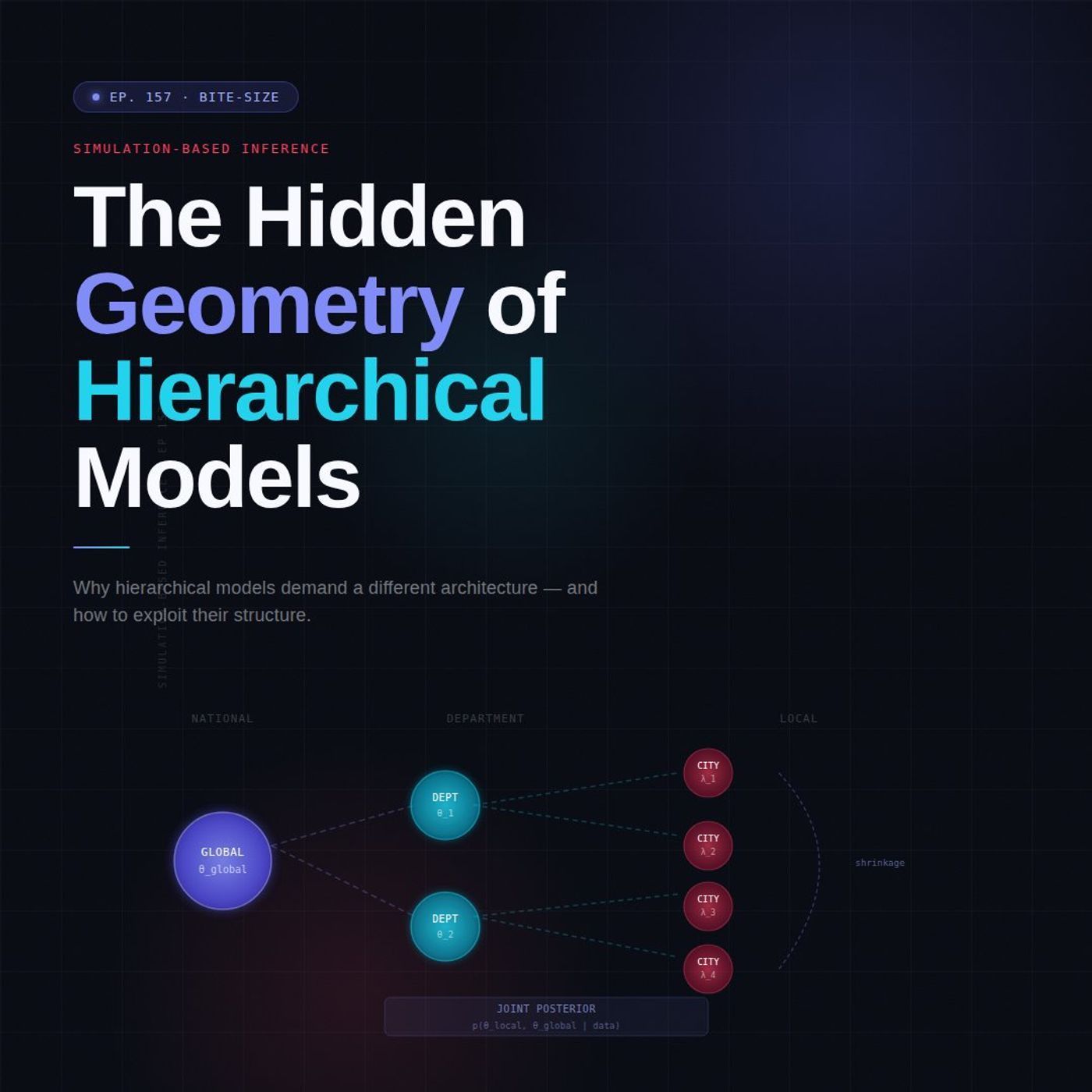
The Hidden Geometry of Hierarchical Models

Today's clip is from Episode 157 featuring Stefan Radev. In this conversation, Alex and Stefan dig into one of the hardest open problems in simulation-based inference — hierarchical models. The core idea: when you move from flat to hierarchical models, you're no longer estimating one set of parameters. You have local parameters that vary by location (or subject, or city) and global parameters that capture what's shared across all of them. And you don't just want each separately — you want the full joint posterior, because that's where the Bayesian magic of shrinkage actually lives. Stefan builds the problem from the ground up. Start with the simplest hierarchical case: a two-level model. He uses electoral forecasting in France as the example — cities nested inside departments nested inside the whole country. Now your simulator has to cover all three levels. If that simulator is slow (think: brain emulators, minutes per sample), scaling to hundreds of groups becomes completely intractable. Memory issues, specialized network requirements, the works. The key insight: this problem has structure you can exploit. The joint posterior factorizes in a particularly nice way — each local parameter depends on its own local data and on the global parameters. That means instead of cramming everything into one giant high-dimensional vector and hoping a neural network figures it out, you can decompose the problem. Estimate local parameters conditioned on local data and the globals. Use composition. The takeaway: hierarchical models aren't just "harder flat models" - they have a geometry that demands a different architecture. Respecting that structure is what makes amortized inference scale. Get the full discussion here Support & Resources → Support the show on Patreon → Bayesian Modeling Course (first 2 lessons free) Our theme music is « Good Bayesian », by Baba Brinkman (feat MC Lars and Mega Ran). Check out his awesome work

4 min

Wed6May
Learning Bayesian Statistics

Stefan RadevGuest

#157 Amortized Inference & BayesFlow in Practice, with Stefan Radev

Support & Resources → Support the show on Patreon → Bayesian Modeling Course (first 2 lessons free) Our theme music is « Good Bayesian », by Baba Brinkman (feat MC Lars and Mega Ran). Check out his awesome work Takeaways: Q: What is simulation-based inference and what does "sim-to-real" mean? A: Simulation-based inference (SBI) uses a mechanistic simulator as an epistemic tool: you train a neural network on a large number of labeled simulations and then deploy it on real, unlabeled data. The "sim-to-real" framing captures the key asymmetry -- your network never sees real data during training, only simulations, but it generalizes to real observations at inference time. This is the opposite of the more common "synthetic-for-ML" approach, where fake data is used purely to augment real training data. Q: What is the amortized inference agent skill and what does it do? A: It's an open-source AI agent skill, co-developed by Stefan and Alexandre, that teaches an AI coding agent to run a complete, state-of-the-art amortized inference workflow. Because amortized inference is recent enough that it's underrepresented in LLM training data, vanilla agents tend to get it wrong. The skill injects the right methodology: it guides the agent to set up the simulator, choose the right network architecture, run a pilot, train with appropriate diagnostics, and produce an actionable report -- without the user needing to know the details. Q: What is calibration coverage and why should you never skip it? A: Calibration coverage tells you whether your posterior uncertainty is honest -- whether your credible intervals actually contain the true parameter at the right frequency. A model can show poor parameter recovery yet still be well-calibrated (because it's falling back on the prior), or it can appear to recover parameters while being poorly calibrated. Running calibration diagnostics both in-sample and out-of-sample is especially revealing for hierarchical models, which often appear to underfit in-sample but generalize much better out-of-sample thanks to shrinkage. Full takeaways here Chapters: 00:00:00 How does amortized inference fit into the Bayesian workflow? 00:12:03 What does "sim-to-real" mean in simulation-based inference? 00:15:57 Why is amortized inference particularly suited to psychology and neuroscience? 00:21:51 What is the amortized inference agent skill? 00:39:00 What is calibration coverage and how do you interpret it? 00:41:50 How do you decide what to do next after your first training run? 00:44:53 How do actionable insights make Bayesian workflows more usable? 00:49:08 What are the unique challenges of hierarchical models in amortized inference? 01:00:51 What is the current state of BayesFlow's support for hierarchical models? 01:05:00 What are the main failure modes of amortized inference and how do you handle model misspecification? Thank you to my Patrons for making this episode possible! Links from the show

1 h 19 min

Fri1May
Learning Bayesian Statistics

Adam FosterGuest

How to Design Better Experiments with Expected Information Gain

Today's clip is from Episode 156 featuring Adam Foster. In this conversation, Adam explains Expected Information Gain (EIG) -the scoring function at the heart of optimal Bayesian experimental design. The core idea: when designing an experiment, you need a way to compare possible designs and pick the best one. EIG is that score - it tells you how much information you expect to gain about your model parameters from a given design. The higher the EIG, the better the design. Adam builds intuition for EIG from two directions that sound completely different but lead to the same place. First, the Bayesian angle: simulate datasets from your prior predictive distribution, run inference on each, measure how much uncertainty dropped, and average across datasets. Second, a classic puzzle - the 12 prisoners balance scale problem - where the best weighing strategy turns out to be the one that makes all three outcomes (tip left, tip right, balance) equally likely. This maximizes outcome entropy, which is exactly what EIG does: it steers you toward designs where every possible result narrows down your hypotheses as fast as possible. The takeaway: good experimental design isn't about intuition or convention - it's about making your data work as hard as possible, and EIG gives you a rigorous way to do that. Get the full discussion here Support & Resources → Support the show on Patreon → Bayesian Modeling Course (first 2 lessons free) Our theme music is « Good Bayesian », by Baba Brinkman (feat MC Lars and Mega Ran). Check out his awesome work

6 min

Sat25Apr
Learning Bayesian Statistics

Adam FosterGuest

#156 Bayesian Experimental Design & Active Learning, with Adam Foster

Support & Resources → Support the show on Patreon → Bayesian Modeling Course (first 2 lessons free) Our theme music is « Good Bayesian », by Baba Brinkman (feat MC Lars and Mega Ran). Check out his awesome work Takeaways Q: What is Bayesian experimental design and what problem does it solve? A: It's the practice of using a Bayesian model to decide how to collect data before you collect it. Most statistical thinking starts with a fixed dataset. Bayesian experimental design sits upstream -- you have control over experimental parameters (which questions to ask, which reagents to mix, which conditions to test) and you want to choose them optimally. The Bayesian angle is to ask: what new data would most reduce my current uncertainty? Q: When should you actually use Bayesian experimental design? A: When two conditions hold: you have active control over how data is collected (not just passive observation), and you have a Bayesian model whose prior predictive distribution gives a reasonable picture of what typical data might look like. It's especially valuable when data collection is expensive or irreversible -- when the "committal step" of running an experiment has real cost, it's worth doing the analysis first. Q: What is expected information gain (EIG) and why is it central to Bayesian experimental design? A: EIG is the score you assign to a candidate experimental design -- the amount of information you expect to gain about your model parameters by running an experiment with that design. You compute it by simulating datasets from your prior predictive, doing Bayesian inference on each, and averaging how much the uncertainty decreased. What's remarkable is that you can derive the same quantity from two completely different starting points -- reducing parameter uncertainty, or maximizing outcome uncertainty while correcting for noise - and arrive at the same formula. That convergence is why EIG keeps being re-discovered independently across fields. Full takeaways here Chapters: 00:00 What is Bayesian experimental design and why does it matter? 00:06:02 What problem does Bayesian experimental design actually solve? 00:08:54 When should practitioners use Bayesian experimental design? 00:12:00 Is Bayesian experimental design changing how scientists work in practice? 00:15:04 What are the limitations of Bayesian experimental design? 00:17:55 What is expected information gain (EIG) and how does it work? 00:21:05 How do you compute expected information gain in practice? 00:23:48 What is active learning and how does it connect to Bayesian experimental design? 00:41:02 What is active learning by disagreement? 00:48:57 What is deep adaptive design and when should you00: use it? 00:56:02 How is Bayesian experimental design applied in protein dynamics and quantum chemistry? 01:01:58 What does a practical Bayesian experimental design workflow look like? Thank you to my Patrons for making this episode possible! Links from the show

1 h 17 min

Thu16Apr
Learning Bayesian Statistics

Daniel SaundersGuest

Pricing Under Uncertainty: A Bayesian Workflow

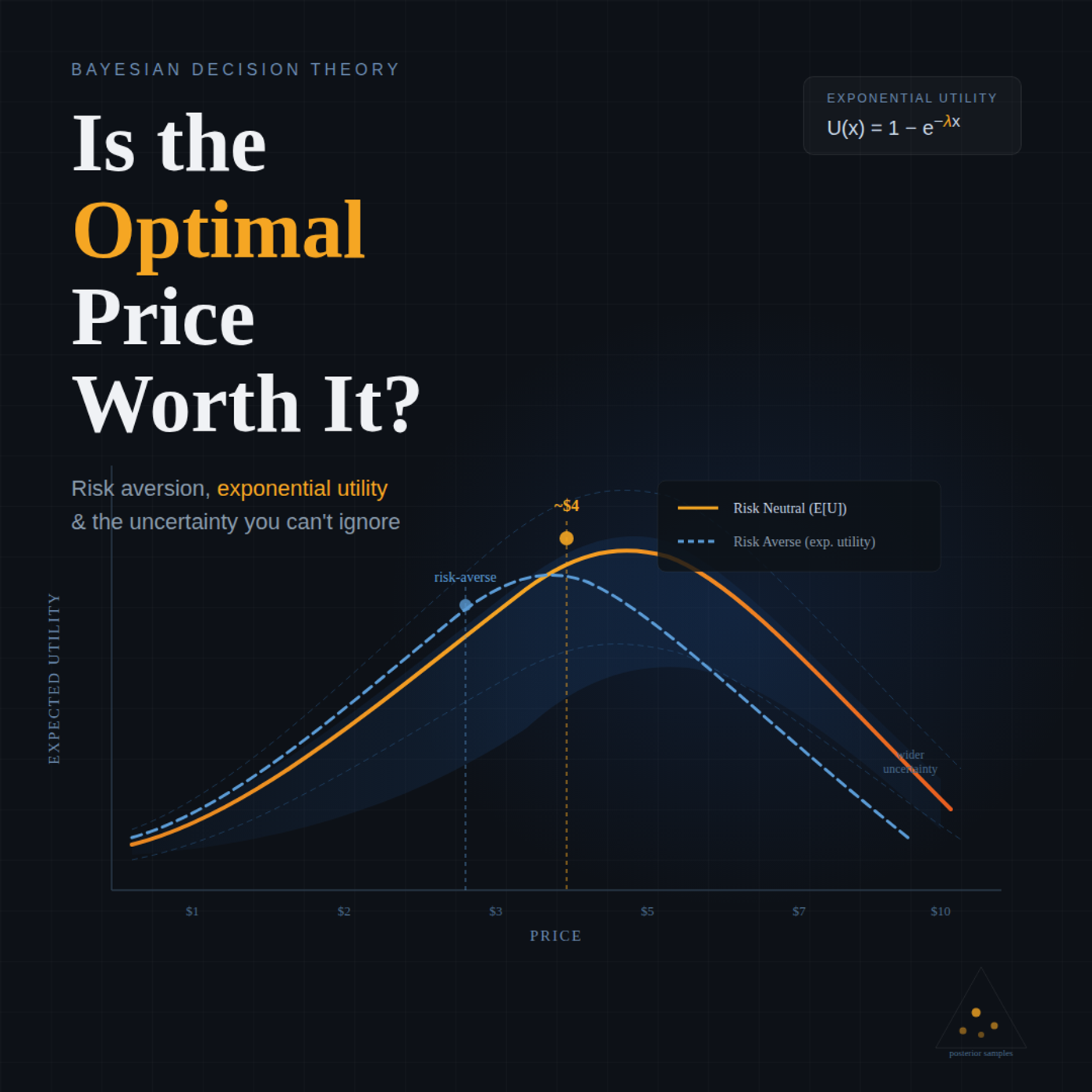
Today's clip is from Episode 152 of the podcast, featuring Daniel Saunders. In this conversation, Daniel explores how Bayesian decision theory handles real-world risk aversion beyond the textbook maximum expected utility framework. The key insight: classical Bayesian decision theory assumes risk neutrality, but in practice, people and businesses are risk-averse. Using a pricing optimization example, Daniel shows how uncertainty varies dramatically across price points—lower prices have predictable demand, while higher prices create wide uncertainty in profits. This asymmetry matters when you want safer decisions. Daniel introduces exponential utility functions—a technique from economics that models diminishing returns on money. By adjusting a risk-aversion parameter, you can see how increasing risk aversion shifts optimal decisions away from high-uncertainty, high-profit scenarios toward more predictable outcomes. The broader lesson: optimal decision-making requires separating the modeling process from the decision process, allowing you to build in constraints and risk adjustments that pure expected utility maximization would miss. Get the full discussion here Support & Resources → Support the show on Patreon: https://www.patreon.com/c/learnbayesstats → Bayesian Modeling Course (first 2 lessons free): https://topmate.io/alex_andorra/1011122 Our theme music is « Good Bayesian », by Baba Brinkman (feat MC Lars and Mega Ran). Check out his awesome work at https://bababrinkman.com/ !

5 min

Wed8Apr
Learning Bayesian Statistics

Andreas MunkGuest

#155 Probabilistic Programming for the Real World, with Andreas Munk

Support & Resources → Support the show on Patreon → Bayesian Modeling Course (first 2 lessons free): Our theme music is « Good Bayesian », by Baba Brinkman (feat MC Lars and Mega Ran). Check out his awesome work Takeaways: Q: Why is bridging deep learning and probabilistic programming so important? A: Deep learning is extraordinarily good at fitting complex functions, but it throws away uncertainty. Probabilistic programming keeps uncertainty explicit throughout. Combining the two – as in inference compilation – lets you get the expressiveness of neural networks while still doing proper Bayesian inference. Q: What is inference compilation and how does it relate to amortized inference? A: Amortized inference is the general idea of training a model upfront so you don't have to run expensive inference from scratch every single time. Inference compilation is a specific form of amortized inference where a neural network is trained to propose good posterior samples for a given probabilistic program – essentially learning to do inference rather than computing it fresh each query. Q: What is PyProb and what problems does it solve? A: PyProb is a probabilistic programming library designed specifically to support amortized inference workflows. It lets you write probabilistic models in Python and then train inference networks on top of them, making methods like inference compilation practical for real-world simulators and scientific models. Full takeaways here. Chapters: 00:00:00 Introduction to Bayesian Inference and Its Barriers 00:03:51 Andreas Munch's Journey into Statistics 00:10:09 Bridging the Gap: Bayesian Inference in Real-World Applications 00:15:56 Deep Learning Meets Probabilistic Programming 00:22:05 Understanding Inference Compilation and Amortized Inference 00:28:14 Exploring PyProb: A Tool for Amortized Inference 00:33:55 Probabilistic Surrogate Networks and Their Applications 00:38:10 Building Surrogate Models for Probabilistic Programming 00:45:44 The Challenge of Bayesian Inference in Enterprises 00:52:57 Communicating Uncertainty to Stakeholders 01:01:09 Democratizing Bayesian Inference with Evara 01:06:27 Insurance Pricing and Latent Variables 01:16:41 Modeling Uncertainty in Predictions 01:20:29 Dynamic Inference and Decision-Making 01:23:17 Updating Models with Actual Data 01:26:11 The Future of Bayesian Sampling in Excel 01:31:54 Navigating Business Challenges and Growth 01:36:40 Exploring Language Models and Their Applications 01:38:35 The Quest for Better Inference Algorithms 01:41:01 Dinner with Great Minds: A Thought Experiment Thank you to my Patrons for making this episode possible! Links from the show here.

1 h 54 min

Thu2Apr
Learning Bayesian Statistics

Thomas PinderGuest

Bitesize | "What Would Have Happened?" - Bayesian Synthetic Control Explained

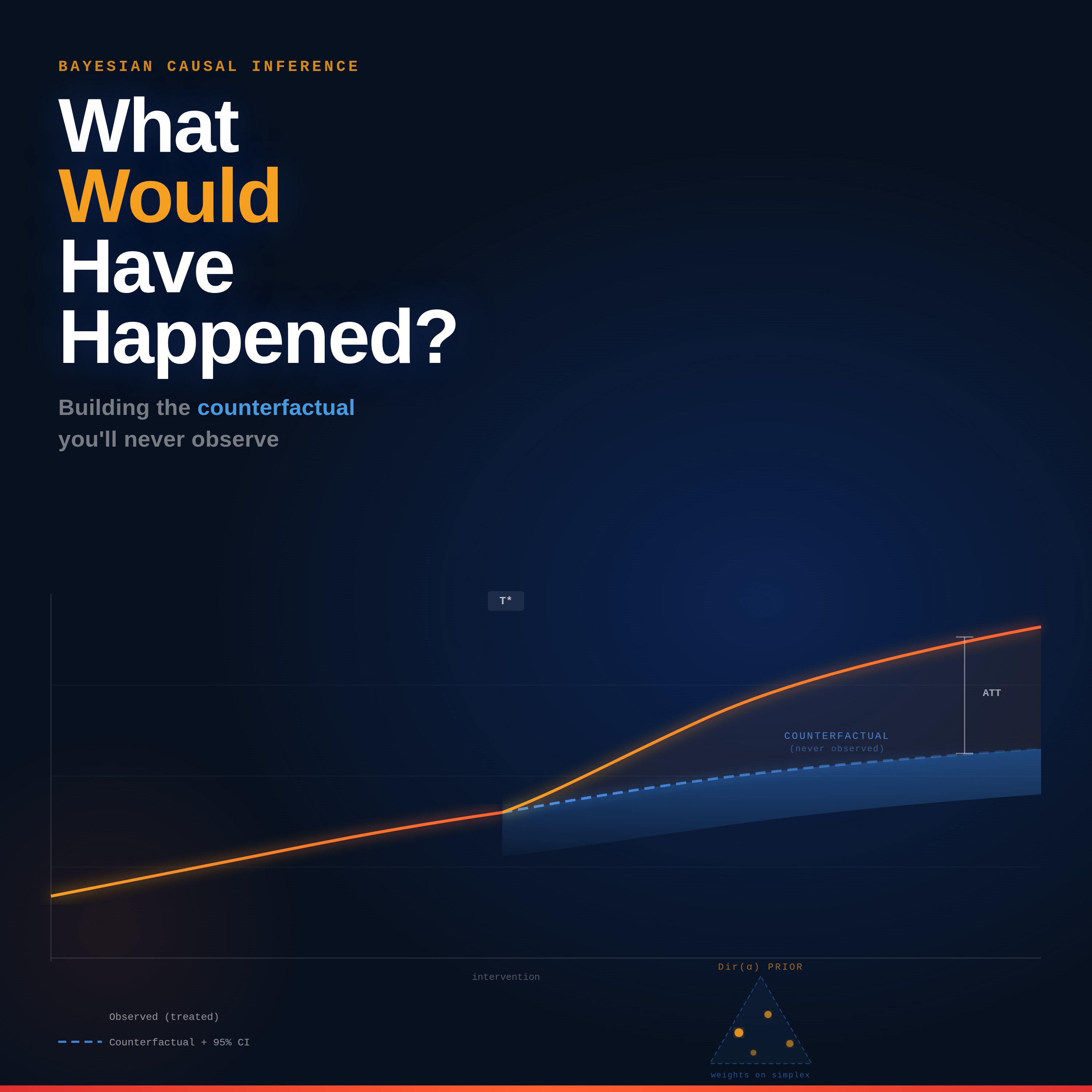
Today's clip is from Episode 154 of the podcast, with Thomas Pinder. In this conversation, Thomas Pinder explains how Bayesian methods naturally lend themselves to causal modeling, and why that matters for real-world business decisions. The key insight is that causal questions in industry are rarely black and white: instead of a single treatment effect, you get a full posterior distribution, credible intervals, and the ability to communicate the probability that an effect is positive, which is far more useful to stakeholders than a p-value. Thomas then dives into Bayesian Synthetic Control, a reframing of the classic synthetic control method from a constrained optimization problem into a Bayesian regression problem. Rather than optimizing weights on a simplex, you place a Dirichlet prior on the regression coefficients, which turns out to be not just mathematically elegant but practically richer: you can express prior beliefs about how many control units are informative, set the concentration parameter accordingly, or let a gamma hyperprior on that parameter let the data decide. The result is a more flexible, less fragile counterfactual, implemented cleanly in PyMC or NumPyro. Get the full discussion here Support & Resources → Support the show on Patreon: https://www.patreon.com/c/learnbayesstats → Bayesian Modeling Course (first 2 lessons free): https://topmate.io/alex_andorra/1011122 Our theme music is « Good Bayesian », by Baba Brinkman (feat MC Lars and Mega Ran). Check out his awesome work at https://bababrinkman.com/ !

5 min

Wed25Mar
Learning Bayesian Statistics

Thomas PinderGuest

#154 Bayesian Causal Inference at Scale, with Thomas Pinder

• Support & get perks! • Bayesian Modeling course (first 2 lessons free) Our theme music is « Good Bayesian », by Baba Brinkman (feat MC Lars and Mega Ran). Check out his awesome work! Takeaways: Q: Why was GPJax created and how does it benefit researchers? A: GPJax was developed to provide a high-performance, flexible framework for Gaussian processes (GPs) within the JAX ecosystem. It allows researchers to move beyond black-box implementations and easily experiment with custom kernels and model structures while leveraging JAX’s automatic differentiation and GPU acceleration. Q: What are the primary advantages of using Gaussian processes for data modeling? A: Gaussian processes are highly effective at modeling complex, nonlinear relationships in data. Unlike many machine learning methods that only provide a point estimate, GPs offer built-in uncertainty quantification, which is essential for understanding the reliability of predictions in research and industry. Q: How does the GPJax and NumPyro integration enhance probabilistic modeling? A: The integration allows users to treat GPJax models as components within a larger NumPyro probabilistic program. This combination enables the use of advanced sampling techniques like NUTS (No-U-Turn Sampler), making it easier to build and fit complex hierarchical models that include Gaussian processes. Q: What are the main challenges when applying Gaussian processes to high-dimensional data? A: High-dimensional data significantly complicates GP modeling due to the curse of dimensionality and the cubic scaling of computational costs. In high dimensions, defining meaningful distance metrics for kernels becomes harder, often requiring specialized techniques like sparse GPs or dimensionality reduction to remain tractable. Full takeaways here! Chapters: 11:40 What is GPJax and how does it simplify Gaussian Process modeling? 15:48 How are Bayesian methods used for experimentation and causal inference in industry? 18:40 How do you implement Bayesian Synthetic Control? 32:17 What is Bayesian Synthetic Difference-in-Differences? 39:44 What are the research applications and supported methods for the GPJax library? 45:47 What are the primary software and computational bottlenecks when scaling Gaussian Processes? 49:02 What are the real-world industrial applications of Gaussian Process models? 54:36 How is Bayesian modeling applied to soccer and sports analytics? 58:43 What is the future development roadmap for the GPJax ecosystem? 01:05:37 What is Impulso and how does it integrate into a Bayesian modeling workflow? 01:13:42 How do you balance Bayesian computational overhead with industrial latency requirements? 01:20:26 Why is there optimism that scalable Bayesian methods for causal inference are now within reach? Thank you to my Patrons for making this episode possible! Links from the show here!

1 h 26 min

Wed11Mar
Learning Bayesian Statistics

Cherian KoshyGuest

#153 The Neuroscience of Philanthropy, with Cherian Koshy

• Support & get perks! • Bayesian Modeling course (first 2 lessons free) Our theme music is « Good Bayesian », by Baba Brinkman (feat MC Lars and Mega Ran). Check out his awesome work ! Takeaways: Q: Is generosity a natural human trait? A: Yes, generosity is hardwired in our brains and is essential for social interaction. Q: Why do people say they care about causes but not act on it? A: There is often a disconnect between stated care for causes and actual action. Understanding the conditions under which generosity aligns with a person's identity is crucial for bridging this gap. Q: How should fundraising efforts be approached? A: Fundraising should primarily focus on belief updating rather than mere persuasion. Q: What are the benefits of being generous? A: Generosity has significant mental and physical health benefits, as the brain's reward systems activate when we give, making us feel good. Q: How do our beliefs relate to our actions? A: Our beliefs about ourselves strongly influence our actions and decisions, including our decision to be generous. Q: Can generosity impact a community? A: Yes, generosity can be a powerful tool for improving community dynamics. Q: How can technology like AI assist institutions with donors? A: AI could help institutions remember donors better, improving the donor-institution relationship. Chapters: 00:00 What's the role of Behavioral Science inPhilanthropy 19:57 What is The Neuroscience of Generosity? 24:40 How can we best understand Donor Decision-Making? 32:14 How can we achieve reframe Beliefs and Actions? 35:39 What is the role of Identity in Habit Formation? 38:06 What is the Generosity Gap in Philanthropy? 45:06 How can we reduce Friction in Donation Processes? 48:27 What is the role of AI and Trust in Nonprofits? 52:11 How can we build Predictive Models for Donor Behavior? 55:41 What is the role of Empathy in Sales and Stakeholder Engagement? 01:00:46 How can we best align ideas with Stakeholder Beliefs? 01:02:06 How can we explore Generosity and Memory? Thank you to my Patrons for making this episode possible! Links from the show: Come meet Alex at the Field of Play Conference in Manchester, UK, March 27, 2026! https://www.fieldofplay.co.uk/ Bayesian workflow agent skill Neurogiving, The Science of Donor Decision-Making Cherian's website Cherian's press kit LBS #89 Unlocking the Science of Exercise, Nutrition & Weight Management, with Eric Trexler

1 h 09 min

Wed4Mar
Learning Bayesian Statistics

Daniel SaundersGuest

Bitesize | How To Model Risk Aversion In Pricing?

Today's clip is from Episode 152 of the podcast, with Daniel Saunders. In this conversation, Daniel Saunders explains how to incorporate risk aversion into Bayesian price optimization. The key insight is that uncertainty around expected profit is asymmetric across price points, low prices yield more predictable (if modest) returns, while high prices introduce much wider uncertainty. Rather than simply maximizing expected profit, you can pass profit through an exponential utility function that models diminishing returns, a well-established idea from economics. This adds an adjustable risk aversion parameter to the optimization: as risk aversion increases, the model shifts toward more conservative price recommendations, trading off potentially large but uncertain gains for outcomes with tighter, more reliable distributions. Get the full discussion here • Join this channel to get access to perks: https://www.patreon.com/c/learnbayesstats • Intro to Bayes Course (first 2 lessons free): https://topmate.io/alex_andorra/503302 • Advanced Regression Course (first 2 lessons free): https://topmate.io/alex_andorra/1011122 Our theme music is « Good Bayesian », by Baba Brinkman (feat MC Lars and Mega Ran). Check out his awesome work at https://bababrinkman.com/ !

4 min

Thu26Feb
Learning Bayesian Statistics

Daniel SaundersGuest

#152 A Bayesian decision theory workflow, with Daniel Saunders

• Support & get perks! • Proudly sponsored by PyMC Labs! • Intro to Bayes and Advanced Regression courses (first 2 lessons free) Our theme music is « Good Bayesian », by Baba Brinkman (feat MC Lars and Mega Ran). Check out his awesome work ! Chapters: 00:00 The Importance of Decision-Making in Data Science 06:41 From Philosophy to Bayesian Statistics 14:57 The Role of Soft Skills in Data Science 18:19 Understanding Decision Theory Workflows 22:43 Shifting Focus from Accuracy to Business Value 26:23 Leveraging PyTensor for Optimization 34:27 Applying Optimal Decision-Making in Industry 40:06 Understanding Utility Functions in Regulation 41:35 Introduction to Obeisance Decision Theory Workflow 42:33 Exploring Price Elasticity and Demand 45:54 Optimizing Profit through Bayesian Models 51:12 Risk Aversion and Utility Functions 57:18 Advanced Risk Management Techniques 01:01:08 Practical Applications of Bayesian Decision-Making 01:06:54 Future Directions in Bayesian Inference 01:10:16 The Quest for Better Inference Algorithms 01:15:01 Dinner with a Polymath: Herbert Simon Thank you to my Patrons for making this episode possible! Links from the show: Come meet Alex at the Field of Play Conference in Manchester, UK, March 27, 2026! https://www.fieldofplay.co.uk/ A Bayesian decision theory workflow Daniel's website, LinkedIn and GitHub LBS #124 State Space Models & Structural Time Series, with Jesse Grabowski LBS #123 BART & The Future of Bayesian Tools, with Osvaldo Martin LBS #74 Optimizing NUTS and Developing the ZeroSumNormal Distribution, with Adrian Seyboldt LBS #76 The Past, Present & Future of Stan, with Bob Carpenter

1 h 19 min

Guests from more than 12 months ago are part of Pro. See plans