SB

Steve Bronder

Steve Bronder has been a guest on 2 podcast episodes in the last 12 months. Latest: Learning Bayesian Statistics, Oct 26, 2026.

Two years on the air

GuestHostMentioned

Guest appearances

Mon26Oct
Learning Bayesian Statistics

Learning Bayesian Statistics

Can Neural Networks Replace MCMC?

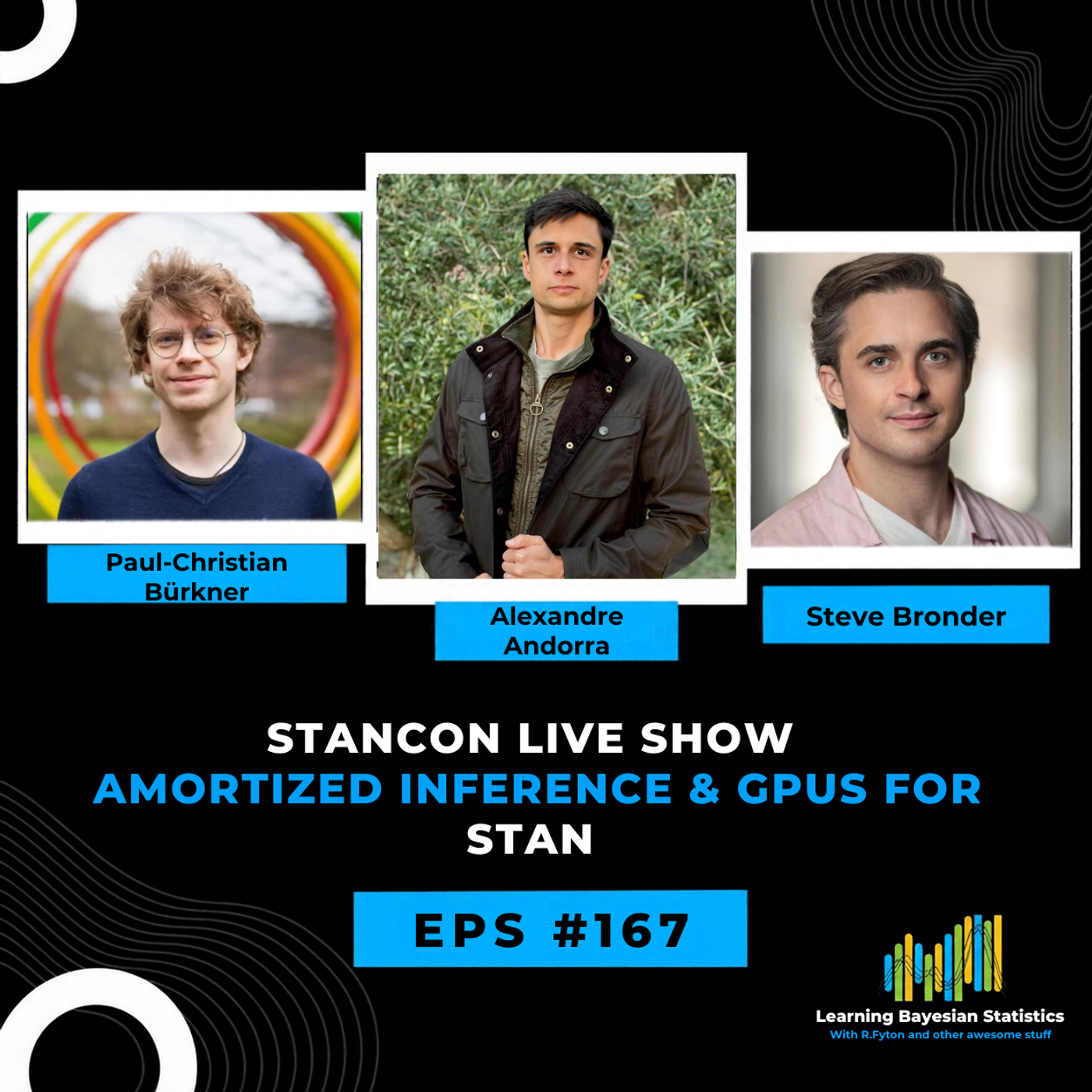
Today’s clip is from Episode 167 of Learning Bayesian Statistics, featuring Paul-Christian Bürkner and Steve Bronder, recorded live at StanCon 2026 in Uppsala, Sweden. Paul Bürkner, creator of brms and a leading researcher behind BayesFlow, explains how neural networks can replace MCMC for Bayesian inference. Instead of evaluating likelihood and prior densities, the networks are trained on simulated data, so you can do simulation-based inference (SBI) even when the likelihood is intractable. Once trained, they give you amortized, real-time posteriors for new datasets, and they have made SBI scalable well beyond what approximate Bayesian computation could handle. Paul is also candid about the limits. Neural methods come with unstable training and no guarantees, and they can be unreliable on out-of-distribution or misspecified data, which is why MCMC is still the more trustworthy option wherever you can apply it. He ends with how his group is building diagnostics to flag when a neural posterior can’t be trusted. Full discussion here Support & Resources → Support the show on Patreon → Bayesian Modeling Course (first 2 lessons free): Our theme music is « Good Bayesian », by Baba Brinkman (feat MC Lars and Mega Ran). Check out his awesome work!
4 min

Tue20Oct
Learning Bayesian Statistics

Learning Bayesian Statistics

#167 Amortized Inference & GPUs for Stan, with Paul-Christian Bürkner & Steve Bronder

Support & Resources → Support the show on Patreon → Bayesian Modeling Course (first 2 lessons free) Our theme music is « Good Bayesian », by Baba Brinkman (feat MC Lars and Mega Ran). Check out his awesome work! Takeaways: Q: What is amortized Bayesian inference and how does it differ from MCMC? Instead of running MCMC on each dataset, you train neural networks on data simulated from the model, so you don't need likelihood or prior densities. Once training is done, inference on a new dataset is essentially instant: new data in, posterior out. The price is everything neural networks bring with them, from unstable training to a lack of guarantees. Paul's stated goal is to make these methods as reliable and robust as MCMC while staying orders of magnitude faster, and he's candid that he doesn't know whether the field will ever get there. Q: Why would a Bayesian model not have a usable likelihood? A: Usually not because the likelihood can't be written down in principle, but because computing it is so expensive or numerically unstable that it's intractable in practice. Paul gives two cases. First, mechanistic models built on complicated differential equations, as in physical chemistry or biology, where you can't solve through the equations to get densities and gradients in a stable, fast way. Second, big latent variable models with thousands of latent variables between the parameters and the data, where marginalizing them out is hopeless. In both cases, simulating from the model is easy: simulate the parameters, the latents and the data, throw the latents away, and learn the relation between parameters and data from the simulations. Full takeaways here! Chapters: 15:33 What is amortized Bayesian inference and when should you use it instead of MCMC? 23:18 Why would a Bayesian model not have a usable likelihood? 26:03 What's holding back GPU computing in Stan? 31:14 What are sum-to-zero constraints and why do they make models sample faster? 35:55 What is a Jacobian adjustment in Bayesian statistics? 39:17 How do you diagnose failures in amortized Bayesian inference? 42:01 What is leave-one-group-out cross-validation for hierarchical models? 45:57 Do undertrained neural posteriors overestimate or underestimate uncertainty? 49:06 How do Stan developers use AI tools in their work? 55:47 Should Stan and brms hide the inference algorithm from users? Thank you to my Patrons for making this episode possible! Full links from the show here!

1 h 03 min