Bekomm eine E-Mail, wenn Cherian in einem Podcast zu Gast istPodAppear prüft neue Folgen, sobald sie erscheinen, und lässt die weg, in denen Cherian nur erwähnt wird. Bis zu 15 Personen kostenlos, ohne Kreditkarte.Bis zu 15 Personen kostenlos, ohne Kreditkarte.
Cherian kostenlos folgen
CK

Cherian Koshy

Cherian Koshy war in den letzten 12 Monaten in 3 Podcast-Folgen aus 3 verschiedenen Sendungen zu Gast. Zuletzt: A Modern Nonprofit Podcast, 15. Sept. 2026.

Zwei Jahre auf Sendung

GastHostErwähnt

Gastauftritte

Di15Sep
A Modern Nonprofit Podcast

A Modern Nonprofit Podcast

Ep. 166: Your Donors Can Tell: The Right and Wrong Ways to Use AI in Fundraising

Your Donors Can Tell: The Right and Wrong Ways to Use AI in Fundraising Your donors can tell when an email was written by AI. Cherian Koshy, VP at Kindsight and author of Neurogiving, returns to the show to talk about the right and wrong ways nonprofits are using AI in fundraising. Cherian shares data from his two year study of more than a thousand donors, why "human in the loop" has become a meaningless policy line, and what nonprofit leaders should actually do Monday morning if their team is already using AI without any rules in place. A practical, honest look at donor trust, nonprofit technology, and where the line should be. Cherian also shares his new Fundraising Judgment Benchmark study. Take it here: https://www.surveymonkey.com/r/8ZNJMMW Connect with Cherian Koshy🌐 https://kindsight.io/💼 https://www.linkedin.com/in/cheriankoshy/📘 https://www.amazon.com/Neurogiving-Science-Decision-Making-Cherian-Koshy/dp/1394370458/ref=tmm_hrd_swatch_0Follow Us Online 🌐 Website: ⁠⁠www.thecharitycfo.com⁠⁠ 📸 Instagram: @thecharitycfo 📘 Facebook:⁠⁠ /thecharitycfo⁠⁠ 💼 LinkedIn: ⁠⁠⁠ / the-charity-cfo⁠⁠ ⁠ 🎵 TikTok: @thecharitycfoJoin our newsletter: https://go.thecharitycfo.com/l/995872/2025-02-24/6ldn1Download The Charity CFO Financial Blueprint: https://go.thecharitycfo.com/financial-blueprint#nonprofitleadership #donorengagement #nonprofitstrategy #thecharitycfo

30 minAbspielen in:

Mo6Jul
Inner Propaganda with Owen Fitzpatrick

Inner Propaganda with Owen Fitzpatrick

The neuroscience of giving and donating with Cherian Koshy

When people give, they're not just transferring money. They're rehearsing a version of themselves. That insight, shared by my guest Cherian Koshy, cuts to the heart of why logical fundraising pitches so often fail, and why identity-driven communication changes everything. Cherian is the author of Neurogiving, a behavioral scientist, and one of the most original thinkers I've encountered on the question of generosity. His work applies neuroscience and behavioral science to the act of giving, and what he's uncovered reaches far beyond fundraising into every area where we try to move people. In this episode of Inner Propaganda, I sit down with Cherian to unpack the science behind why people give, how identity drives every donation decision, and what organizations consistently get wrong when they treat the giving brain like a buying brain. Cherian introduces the concept of generosity decay, based on research by Dr. Katy Milkman at the Wharton School, which shows that a donor's generous impulse drops by roughly 50% within 30 to 45 days if not reinforced. He also explores how pairing identity reaffirmation with the identifiable victim effect can dramatically increase the likelihood of a second gift, and why the most important thing you can tell a donor is not "thank you for your donation" but rather "you are a generous person." What you will discover: Why the giving brain operates on fundamentally different principles than the buying brain, and how to communicate accordingly How generosity decay works, what causes it, and what to do in the critical window before it sets in Why thanking a donor for the transaction is the least effective thing you can say, and what to say instead to reaffirm their identity How compassion fatigue and psychological reactance work in the nervous system, and how to strike the balance between reality and hope in your messaging Why generosity is not just an act of giving but, as Cherian puts it, agency in action, a way humans reclaim a sense of control and meaning in uncertain times Learn more about Cherian Koshy: https://cheriankoshy.com/ Get Cherian's book, Neurogiving: https://neurogivingbook.com/ Order my new book, Inner Propaganda: https://innerpropaganda.com/ Visit my website: https://owenfitzpatrick.com/ Join my newsletter: https://owenfitzpatrick.com/newsletter/

57 minAbspielen in:

Mi11Mär
Learning Bayesian Statistics

Learning Bayesian Statistics

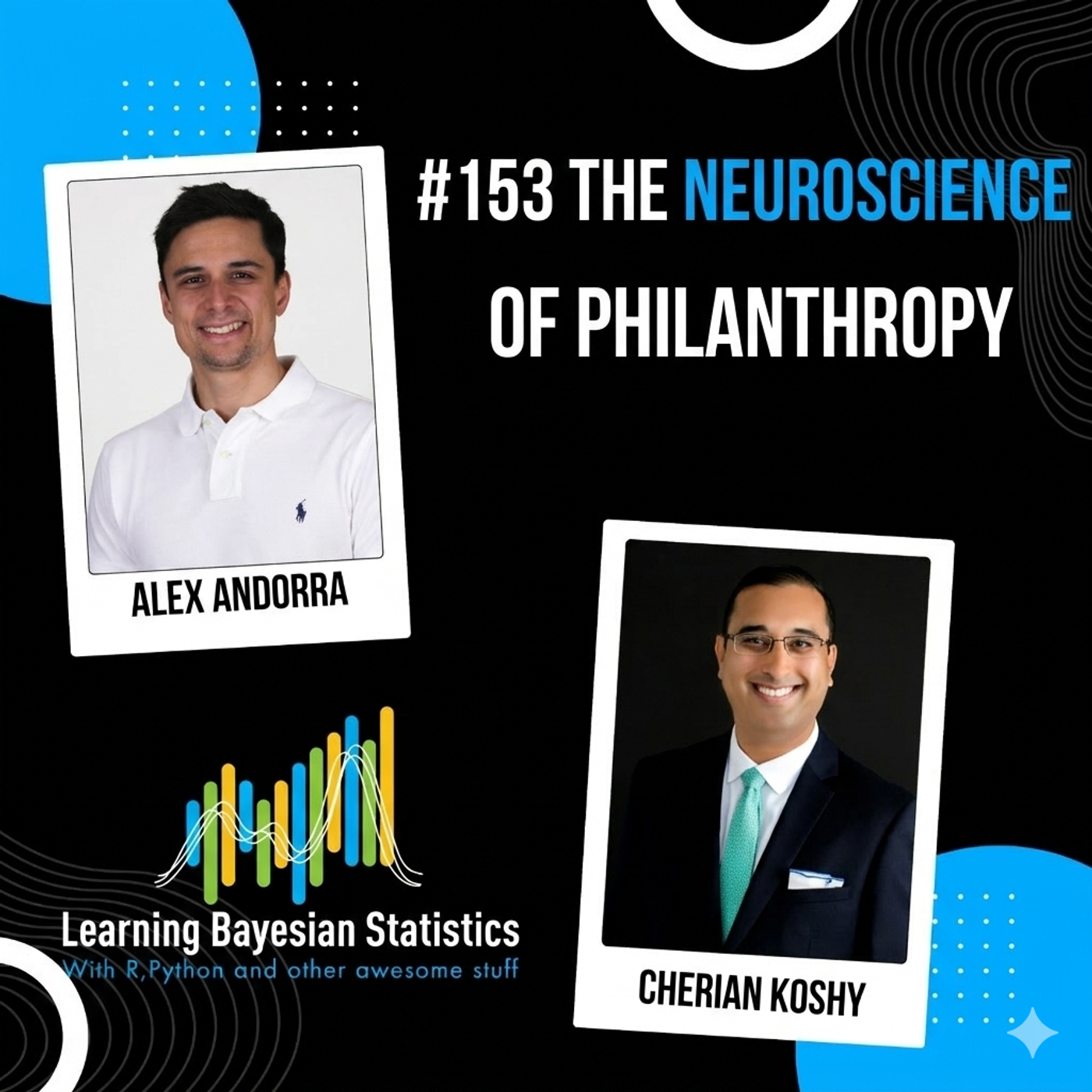
#153 The Neuroscience of Philanthropy, with Cherian Koshy

• Support & get perks! • Bayesian Modeling course (first 2 lessons free) Our theme music is « Good Bayesian », by Baba Brinkman (feat MC Lars and Mega Ran). Check out his awesome work ! Takeaways: Q: Is generosity a natural human trait? A: Yes, generosity is hardwired in our brains and is essential for social interaction. Q: Why do people say they care about causes but not act on it? A: There is often a disconnect between stated care for causes and actual action. Understanding the conditions under which generosity aligns with a person's identity is crucial for bridging this gap. Q: How should fundraising efforts be approached? A: Fundraising should primarily focus on belief updating rather than mere persuasion. Q: What are the benefits of being generous? A: Generosity has significant mental and physical health benefits, as the brain's reward systems activate when we give, making us feel good. Q: How do our beliefs relate to our actions? A: Our beliefs about ourselves strongly influence our actions and decisions, including our decision to be generous. Q: Can generosity impact a community? A: Yes, generosity can be a powerful tool for improving community dynamics. Q: How can technology like AI assist institutions with donors? A: AI could help institutions remember donors better, improving the donor-institution relationship. Chapters: 00:00 What's the role of Behavioral Science inPhilanthropy 19:57 What is The Neuroscience of Generosity? 24:40 How can we best understand Donor Decision-Making? 32:14 How can we achieve reframe Beliefs and Actions? 35:39 What is the role of Identity in Habit Formation? 38:06 What is the Generosity Gap in Philanthropy? 45:06 How can we reduce Friction in Donation Processes? 48:27 What is the role of AI and Trust in Nonprofits? 52:11 How can we build Predictive Models for Donor Behavior? 55:41 What is the role of Empathy in Sales and Stakeholder Engagement? 01:00:46 How can we best align ideas with Stakeholder Beliefs? 01:02:06 How can we explore Generosity and Memory? Thank you to my Patrons for making this episode possible! Links from the show: Come meet Alex at the Field of Play Conference in Manchester, UK, March 27, 2026! https://www.fieldofplay.co.uk/ Bayesian workflow agent skill Neurogiving, The Science of Donor Decision-Making Cherian's website Cherian's press kit LBS #89 Unlocking the Science of Exercise, Nutrition & Weight Management, with Eric Trexler

1 h 09 minAbspielen in:

Warum PodAppear

Folge Menschen, nicht Podcasts.

Du hast Cherian in einer Sendung gehört. PodAppear findet für dich die nächste, und genauso für alle anderen, die du hören willst.

  • Eine Meldung, wenn die Person zu Gast istPer E-Mail: sofort oder gebündelt als Tages- oder Wochenübersicht. Dann nur noch auf Play drücken.
  • Gäste statt bloßer ErwähnungenFolgen, in denen ein Name nur fällt, landen getrennt. Eine Meldung heißt: Die Person ist wirklich in der Sendung.
  • Alle in einem FeedGründerinnen, Autoren, Sportler, Forscherinnen. Folge allen mit Namen, quer durch jede Sendung, in der sie auftreten.

Bis zu 15 Personen kostenlos, ohne Kreditkarte.