Bekomm eine E-Mail, wenn Luigi in einem Podcast zu Gast istPodAppear prüft neue Folgen, sobald sie erscheinen, und lässt die weg, in denen Luigi nur erwähnt wird. Bis zu 15 Personen kostenlos, ohne Kreditkarte.Bis zu 15 Personen kostenlos, ohne Kreditkarte.
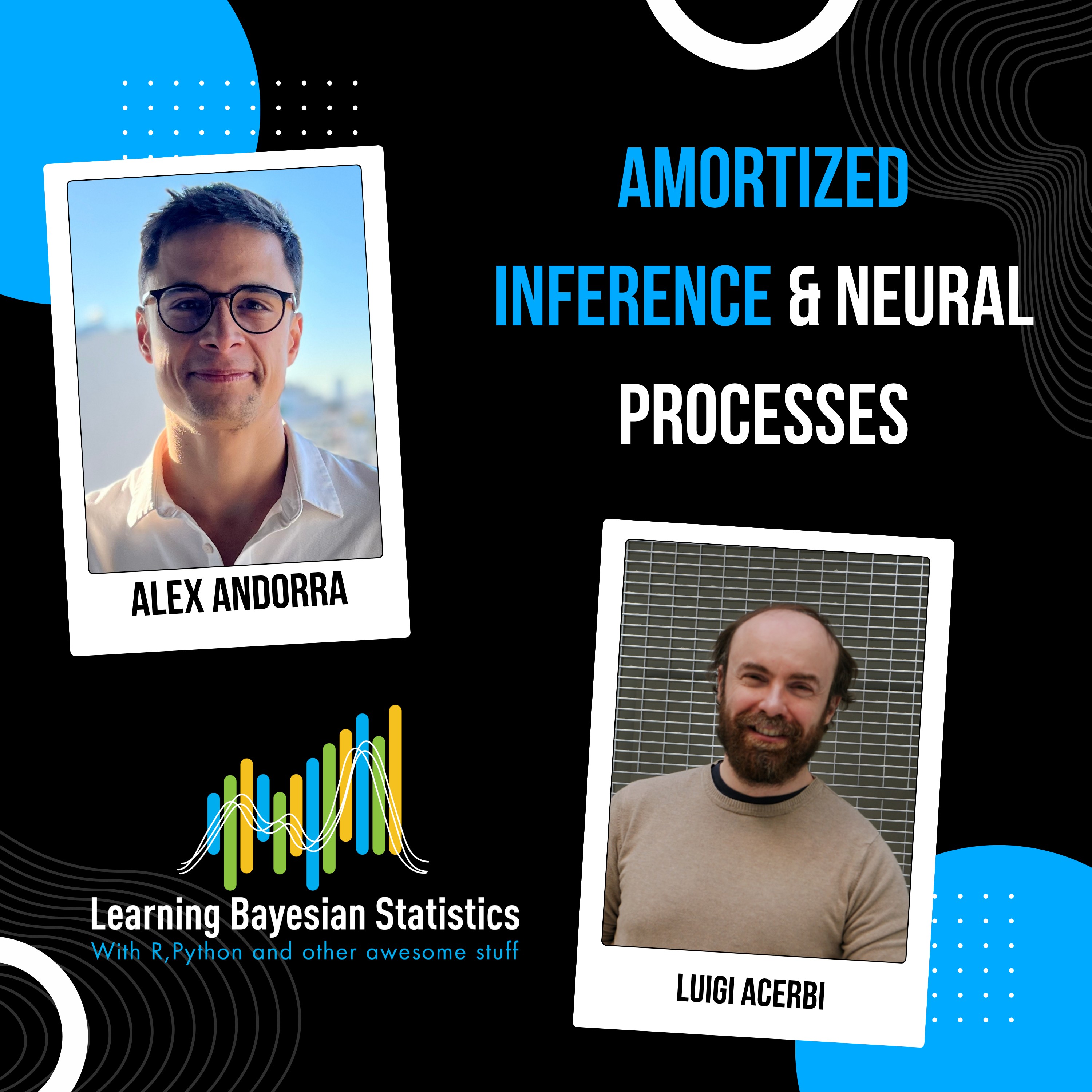
Today's clip is from episode 161, featuring Luigi Acerbi. In this conversation, Luigi explains one of the biggest engineering bottlenecks facing transformer-based probabilistic models—and how his group found a way around it.
The core challenge is that many inference models treat data as an unordered set, making them naturally permutation invariant. That's statistically elegant, but computationally painful: every time a new data point arrives, the model has to recompute attention over the entire dataset from scratch, preventing the kind of KV caching that makes modern language models so efficient.
Luigi walks through his team's solution: a hybrid architecture that keeps the original context fully set-based while introducing a causal-attention buffer for newly arriving data. The result is dramatically faster inference- up to 100× faster in some settings - opening the door to applications like reinforcement learning, active data acquisition, and, ultimately, Luigi's long-term vision of a foundation model for Bayesian inference.
Get the full discussion here
Support & Resources
→ Support the show on Patreon
→ Bayesian Modeling Course (first 2 lessons free)
Our theme music is « Good Bayesian », by Baba Brinkman (feat MC Lars and Mega Ran). Check out his awesome work
Support & Resources
→ Support the show on Patreon
→ Bayesian Modeling Course (first 2 lessons free)
Our theme music is « Good Bayesian », by Baba Brinkman (feat MC Lars and Mega Ran). Check out his awesome work
Takeaways:
Q: What is Variational Bayesian Monte Carlo (VBMC) and how is it different from Bayesian optimization?
A: VBMC borrows the machinery of Bayesian optimization but aims at a different target. Bayesian optimization fits a Gaussian process surrogate to an expensive function and uses it to hunt for the optimum. VBMC instead treats the log-posterior as the function to model, evaluates it at a few carefully chosen points, and keeps the whole reconstructed shape rather than just its peak. That gives you the full posterior, not a single best-fit value. Where MCMC might need tens of thousands to millions of evaluations, VBMC often reconstructs a good posterior approximation from a few hundred, which matters when each evaluation is slow.
Q: When should you reach for PyVBMC, and when is it the wrong tool?
A: Two symptoms tell you PyVBMC might help. First, speed: if a single evaluation of your log density takes on the order of a second, running MCMC over tens of thousands of evaluations becomes painful, and PyVBMC's few-hundred-evaluation budget pays off. Second, dimensionality: because it leans on a Gaussian process surrogate, it works well up to roughly 10 to 15 parameters and degrades beyond that. If your model already runs fine in Stan or PyMC, you do not need it. It shines for expensive, low-dimensional models common in science and engineering, where you are modeling a process rather than composing nice distributions.
Full takeaways here
Chapters:
00:18:13 What is Variational Bayesian Monte Carlo (VBMC) and how does it differ from Bayesian optimization?
00:30:21 When should you use VBMC versus BADS in practice?
00:31:20 What is Bayesian Adaptive Direct Search (BADS) and how does its hybrid optimization strategy work?
00:39:18 What are neural processes, and why are transformers a natural neural process architecture?
00:45:54 What is the Amortized Conditioning Engine (ACE) and what problem does it unify?
00:55:42 What do PriorGuide and the new autoregressive buffer paper solve for amortized inference?
01:02:03 How does the new autoregressive buffer speed up predictions in transformer probabilistic models?
01:06:11 What is Luigi Acerbi's vision for a foundation model for inference?
01:09:26 What is ALINE and how does it add active data acquisition to amortized inference?
01:12:43 How does Luigi Acerbi connect LLM agents, Bayesian decision theory, and the nature of intelligence?
01:18:44 For a PyMC, Stan, or NumPyro user, where should you start with VBMC, BADS, or BayesFlow?
Thank you to my Patrons for making this episode possible!
Links from the show here
1 h 32 minAbspielen in:
Warum PodAppear
Folge Menschen, nicht Podcasts.
Du hast Luigi in einer Sendung gehört. PodAppear findet für dich die nächste, und genauso für alle anderen, die du hören willst.
Eine Meldung, wenn die Person zu Gast istPer E-Mail: sofort oder gebündelt als Tages- oder Wochenübersicht. Dann nur noch auf Play drücken.
Gäste statt bloßer ErwähnungenFolgen, in denen ein Name nur fällt, landen getrennt. Eine Meldung heißt: Die Person ist wirklich in der Sendung.
Alle in einem FeedGründerinnen, Autoren, Sportler, Forscherinnen. Folge allen mit Namen, quer durch jede Sendung, in der sie auftreten.