Bekomm eine E-Mail, wenn Alex in einem Podcast zu Gast istPodAppear prüft neue Folgen, sobald sie erscheinen, und lässt die weg, in denen Alex nur erwähnt wird. Bis zu 15 Personen kostenlos, ohne Kreditkarte.Bis zu 15 Personen kostenlos, ohne Kreditkarte.
Today's clip is from Episode 165, featuring Alex Fengler. In this conversation, Alex introduces Bayesify , a tool that uses AI to analyze research papers and assess how well they follow a Bayesian workflow.
He explains how the tool breaks an analysis down step by step, identifies strengths and weaknesses, and provides suggestions for improving the paper. They also discuss how BasiFi can be used as an educational resource, a review engine for researchers, and potentially as a way to study how the quality of Bayesian analyses has changed over time.
Alex also explains why the team is building a human-rated "gold set" of papers to evaluate how well the tool's scoring aligns with expert judgment. It's an interesting example of how AI can be used not just to generate research, but to help verify and evaluate statistical workflows.
Full discussion here
Support & Resources
→ Support the show on Patreon
→ Bayesian Modeling Course (first 2 lessons free):
Our theme music is « Good Bayesian », by Baba Brinkman (feat MC Lars and Mega Ran). Check out his awesome work!
Support & Resources
→ Support the show on Patreon
→ Bayesian Modeling Course (first 2 lessons free)
Our theme music is « Good Bayesian », by Baba Brinkman (feat MC Lars and Mega Ran). Check out his awesome work!
Takeaways:
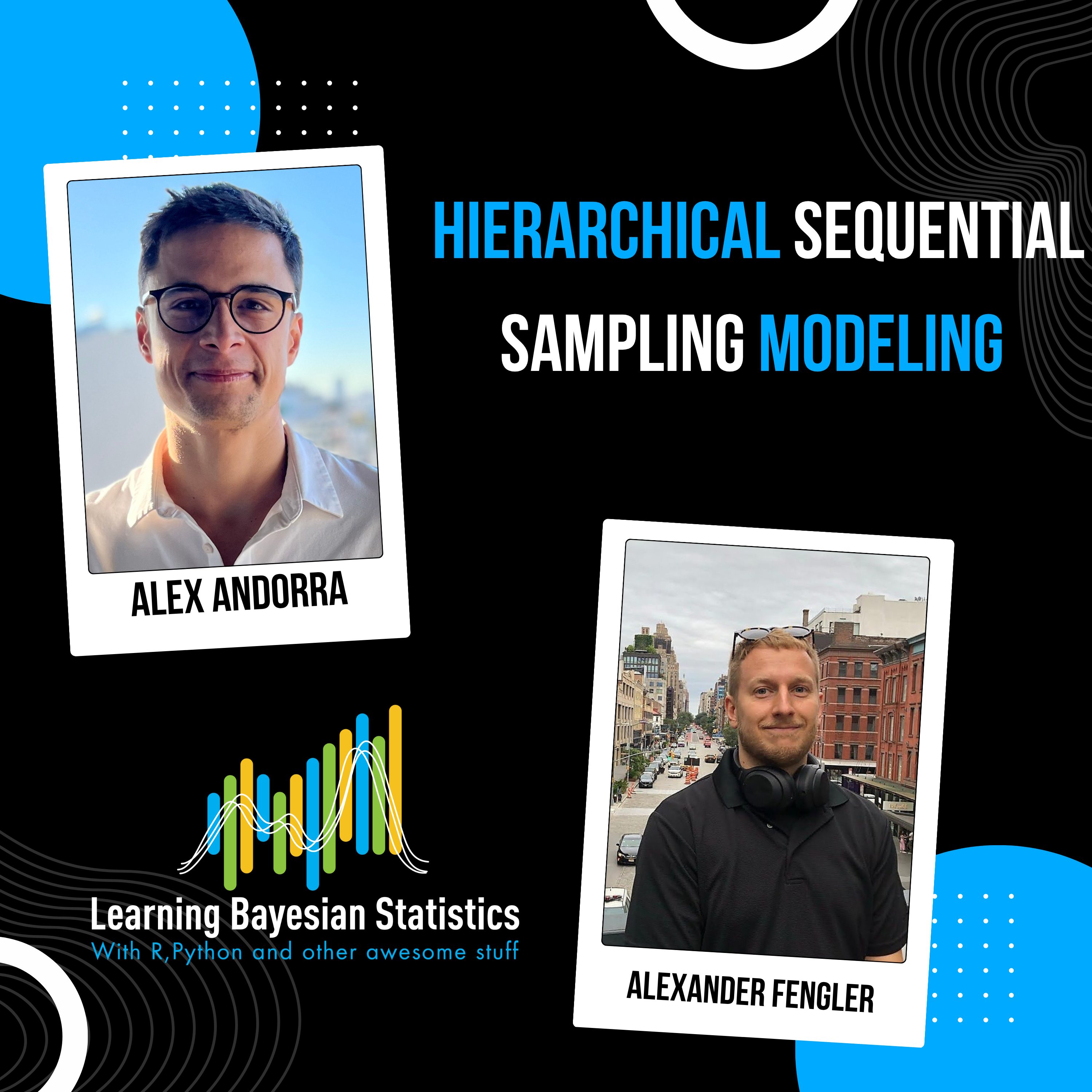
Q: What is HSSM and how does it relate to HDDM?
A: HSSM stands for hierarchical sequential sampling models, a generalization of HDDM (hierarchical drift diffusion models), the older toolbox for the same class of decision-making models, but HSSM is built from the ground up on simulation-based inference. That's what lets it handle any variation of the underlying process model, not just the ones with a tractable closed-form likelihood.
Q: What is the drift diffusion model and why has cognitive science relied on it so heavily?
A: The drift diffusion model treats a decision as a random walk that accumulates evidence until it crosses one of two boundaries, with parameters controlling boundary separation, starting bias, and drift rate. It's been used in thousands of published papers largely because it has a closed-form likelihood, which makes standard Bayesian and maximum-likelihood inference fast. Small variations on the model are often just as scientifically motivated, but if their likelihoods aren't analytically convenient, the literature using them stays sparse.
Q: What is a likelihood approximation network (LAN) and what does it actually learn?
A: A LAN is a neural network trained to take in a process's parameters and a trial's outcome and output how likely that outcome was, learned purely from repeated simulation rather than derived analytically. Once trained, it functions as a fast, reusable likelihood you plug directly into Bayes' rule, in place of a closed-form solution that may not exist for the model you actually want to fit.
Q: What's the difference between amortizing the likelihood and amortizing the posterior?
A: Amortizing the likelihood, HSSM's approach, means training a network once to approximate the likelihood, then reusing that same network across arbitrarily many downstream models: different priors, hierarchical structures, or regression backends, with no retraining. Amortizing the posterior directly, the approach tools like BayesFlow take, gives near-instant inference once trained, but locks the network into the specific scenario it was trained for.
Chapters:
00:00:00 What is HSSM and how does it fit into the Bayesian inference landscape?
00:12:09 How did HSSM evolve from HDDM, and what does it apply to?
00:30:25 How do neural networks learn likelihoods for Bayesian inference?
00:37:01 What makes amortized Bayesian inference so flexible?
00:41:04 What are the real computational costs of amortized inference?
00:55:16 How does HSSM integrate with libraries like BayesFlow?
00:58:57 What does a live demo of HSSM and BayesFlow look like?
01:18:33 What is Bayesify and how does it score a paper's Bayesian workflow?
01:23:12 What new model classes are coming to the HSSM ecosystem?
01:30:12 How is AI reshaping development in the HSSM ecosystem?
01:38:42 How should society incentivize keeping hard cognitive skills alive?
Thank you to my Patrons for making this episode possible!
Links from the show.
1 h 48 minAbspielen in:
Warum PodAppear
Folge Menschen, nicht Podcasts.
Du hast Alex in einer Sendung gehört. PodAppear findet für dich die nächste, und genauso für alle anderen, die du hören willst.
Eine Meldung, wenn die Person zu Gast istPer E-Mail: sofort oder gebündelt als Tages- oder Wochenübersicht. Dann nur noch auf Play drücken.
Gäste statt bloßer ErwähnungenFolgen, in denen ein Name nur fällt, landen getrennt. Eine Meldung heißt: Die Person ist wirklich in der Sendung.
Alle in einem FeedGründerinnen, Autoren, Sportler, Forscherinnen. Folge allen mit Namen, quer durch jede Sendung, in der sie auftreten.