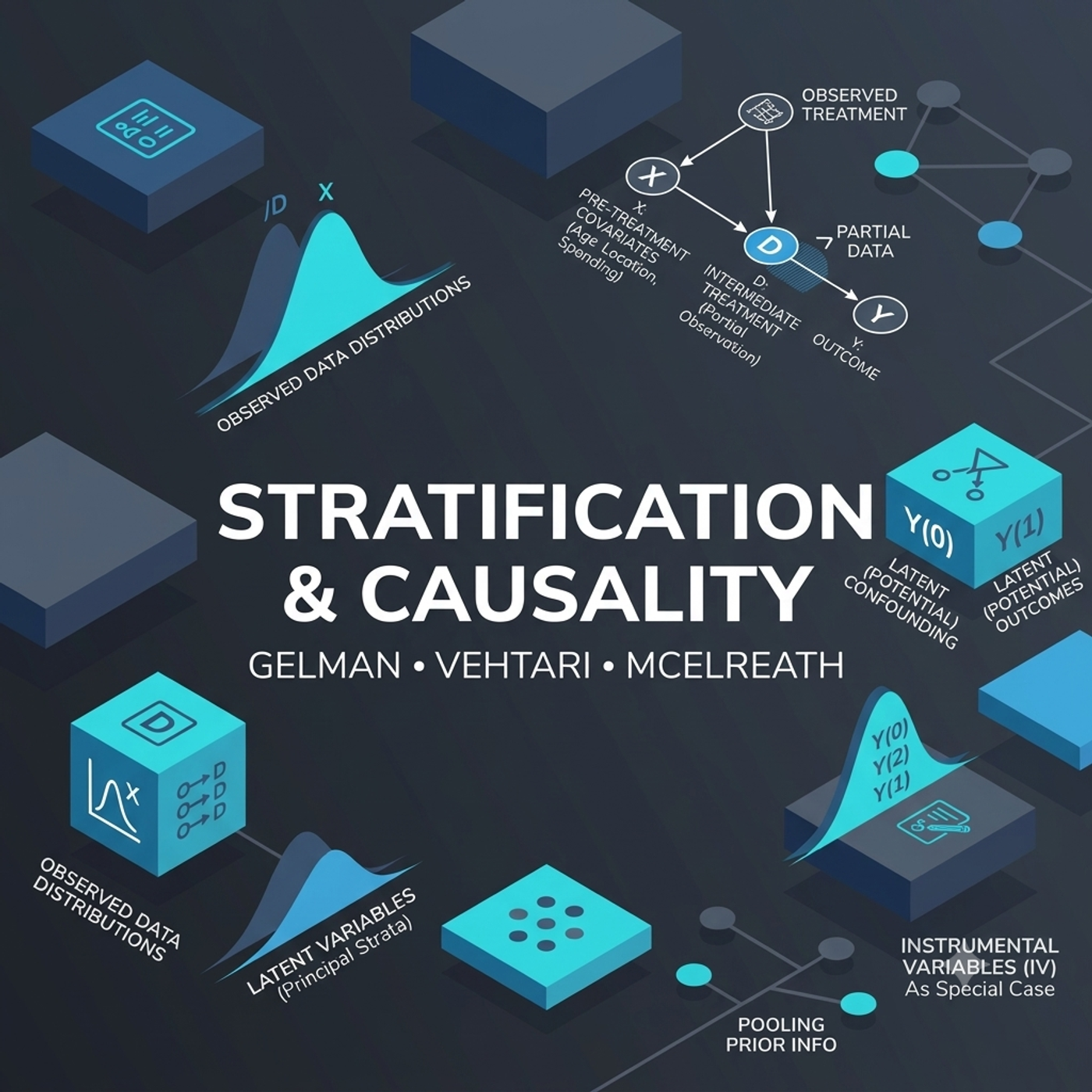
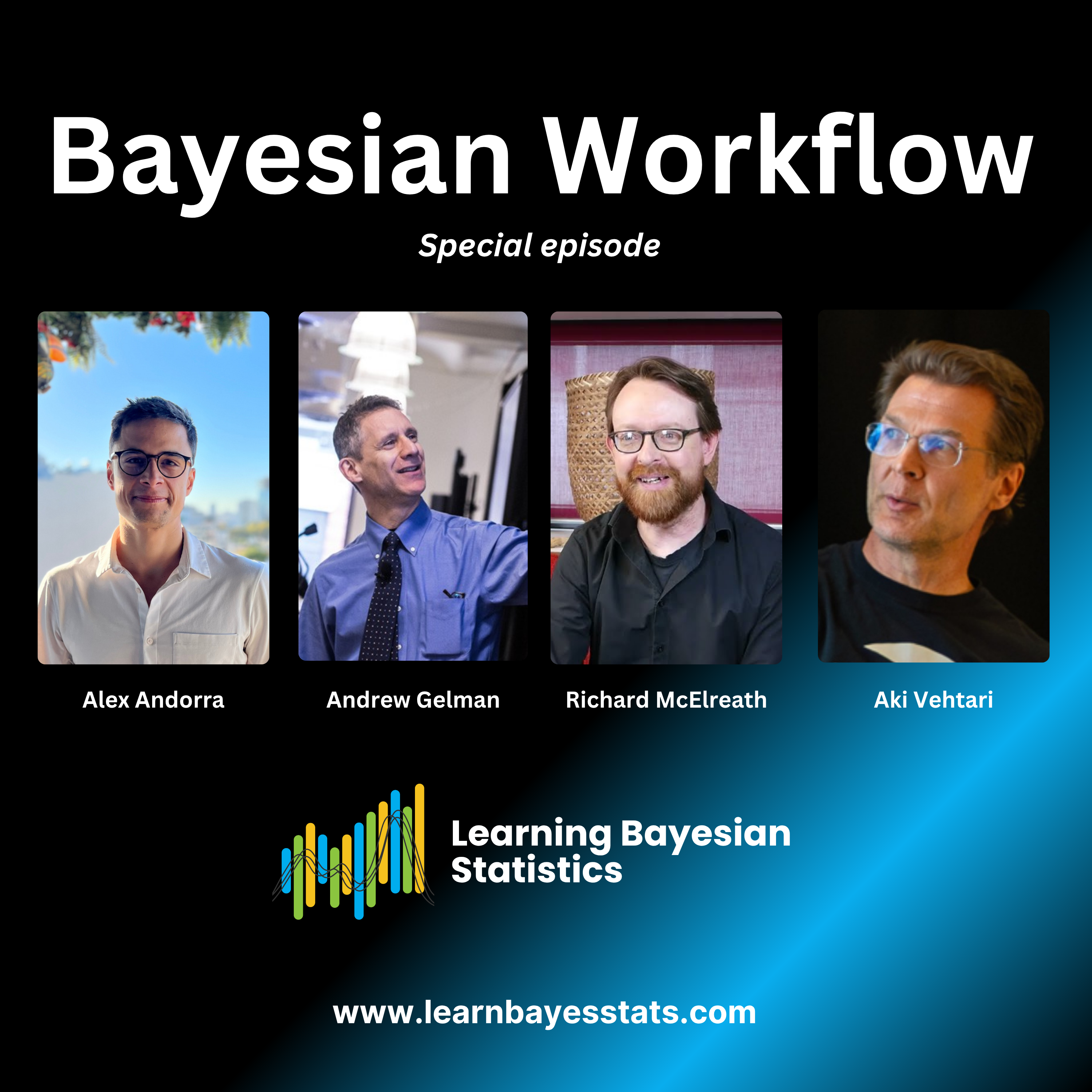
Today's clip is from Episode 164, featuring Andrew Gelman, Aki Vehtari & Richard McElreath. In this conversation, Andrew explains how Bayesian principal stratification can be used to reason about treatment effects when there is an intermediate treatment or outcome that is only partially observed.
He discusses how latent variables can represent whether someone would take a stage-two treatment, and how pre-treatment characteristics such as age, location, and past spending can help build a model for this process.
Richard connects the problem to the broader distinction between per-protocol and intent-to-treat analyses, and they discuss how standard approaches such as instrumental variables can be understood as special cases of more general Bayesian models. It's a useful example of how Bayesian modeling can represent the full process behind a causal question rather than relying on simplifying assumptions.
Full discussion here
Support & Resources
→ Support the show on Patreon
→ Bayesian Modeling Course (first 2 lessons free):
Our theme music is « Good Bayesian », by Baba Brinkman (feat MC Lars and Mega Ran). Check out his awesome work!
Today's clip is from Episode 164, featuring Andrew Gelman, Aki Vehtari & Richard McElreath. In this conversation, Andrew explains why a Bayesian workflow goes far beyond simply fitting a model.
He discusses the importance of building, fitting, and checking models, and why moving between simpler and more complicated models can reveal insights that a single model might miss.
He also explores how simulation and generative modeling can help researchers evaluate new models and gain confidence in their results, even when there isn't an established method or published study to rely on. It's a look at why good statistical practice isn't just about getting an answer, but knowing how much you can trust it.
Full discussion here
Support & Resources
→ Support the show on Patreon
→ Bayesian Modeling Course (first 2 lessons free):
Our theme music is « Good Bayesian », by Baba Brinkman (feat MC Lars and Mega Ran). Check out his awesome work!
Support & Resources
→ Support the show on Patreon
→ Bayesian Modeling Course (first 2 lessons free)
Our theme music is « Good Bayesian », by Baba Brinkman (feat MC Lars and Mega Ran). Check out his awesome work
Takeaways:
Q: What is the "Bayesian Workflow" book about, and who is it for?
A: It covers what the three authors know that isn't already in Bayesian Data Analysis (BDA3) or Statistical Rethinking, organized around case studies that walk through full analyses end to end rather than just giving a recommendation. It's not an introduction to Bayesian inference -- it assumes you already know the basics -- but a guide to making theoretically informed, professional decisions at the many branching points a real analysis involves that source books rarely acknowledge.
Q: What's a concrete way to report Bayesian results without just handing over a posterior distribution?
A: Report a few named scenarios from the distribution, such as pessimistic, median, and optimistic. This is easier to discuss than a full posterior and helps shift the conversation toward what would move outcomes from the median toward the optimistic case.
Full takeaways
Chapters:
00:18:22 What is the elevator pitch for the Bayesian Workflow book?
00:20:12 Where does workflow sit between statistical theory and case studies?
00:27:21 Why express your scientific background in a generative model?
00:36:43 How is a Bayesian workflow different from a pipeline?
00:39:03 What is reverse Bayes, and how does it help with prior sensitivity?
00:43:53 How do Bayesians reinterpret non-Bayesian methods?
00:45:02 How is the Bayesian Workflow book structured?
00:48:49 How do you model bat mortality at wind farms from zero-inflated carcass counts?
00:52:24 When does a hierarchical model stop being an innocuous assumption?
00:58:17 Can multilevel regression and poststratification pool detection across sites?
00:59:32 Why start with a big generative simulation before the statistical model?
01:02:05 What is the "secret weapon" of comparing shrinkage to fixed-effects estimates?
01:11:02 How do you detect which assumptions are actually driving your inference?
01:15:24 How do you get regulated industries to accept a posterior instead of a score?
01:22:04 Should statisticians soften uncertainty for decision makers?
01:23:11 Why report three scenarios instead of a single number?
01:27:51 How do you handle a leaky instrument in causal inference?
01:29:16 What is a principal stratification model?
01:34:47 What are the three authors working on next?
Thank you to my Patrons for making this episode possible!
Full show notes