
TP

Thomas Pinder

Thomas Pinder has been a guest on 3 podcast episodes in the last 12 months. Latest: Learning Bayesian Statistics, Aug 25, 2026.

Two years on the air

GuestHostMentioned

Guest appearances

Tue25Aug
Learning Bayesian Statistics

Learning Bayesian Statistics

Making Gaussian Processes Easier to Use

Today's clip is from Episode 154, featuring Thomas Pinder. In this conversation, Thomas shares what he sees as the next steps for GPJax and how the project could become easier to use beyond its original research-focused audience. He discusses creating a higher-level interface that could make fitting Gaussian processes possible in just a few lines of code, while still keeping the flexibility and infrastructure that GPJax provides. He also talks about making the documentation more engaging by moving beyond synthetic examples and showcasing real-world applications, such as modeling ocean currents with Gaussian processes. It's a look at how GPJax could evolve from a powerful research tool into something that's even more accessible and practical for a wider range of users. Full discussion here Support & Resources → Support the show on Patreon → Bayesian Modeling Course (first 2 lessons free): Our theme music is « Good Bayesian », by Baba Brinkman (feat MC Lars and Mega Ran). Check out his awesome work!

5 min

Thu2Apr
Learning Bayesian Statistics

Learning Bayesian Statistics

Bitesize | "What Would Have Happened?" - Bayesian Synthetic Control Explained

Today's clip is from Episode 154 of the podcast, with Thomas Pinder. In this conversation, Thomas Pinder explains how Bayesian methods naturally lend themselves to causal modeling, and why that matters for real-world business decisions. The key insight is that causal questions in industry are rarely black and white: instead of a single treatment effect, you get a full posterior distribution, credible intervals, and the ability to communicate the probability that an effect is positive, which is far more useful to stakeholders than a p-value. Thomas then dives into Bayesian Synthetic Control, a reframing of the classic synthetic control method from a constrained optimization problem into a Bayesian regression problem. Rather than optimizing weights on a simplex, you place a Dirichlet prior on the regression coefficients, which turns out to be not just mathematically elegant but practically richer: you can express prior beliefs about how many control units are informative, set the concentration parameter accordingly, or let a gamma hyperprior on that parameter let the data decide. The result is a more flexible, less fragile counterfactual, implemented cleanly in PyMC or NumPyro. Get the full discussion here Support & Resources → Support the show on Patreon: https://www.patreon.com/c/learnbayesstats → Bayesian Modeling Course (first 2 lessons free): https://topmate.io/alex_andorra/1011122 Our theme music is « Good Bayesian », by Baba Brinkman (feat MC Lars and Mega Ran). Check out his awesome work at https://bababrinkman.com/ !

5 min

Wed25Mar
Learning Bayesian Statistics

Learning Bayesian Statistics

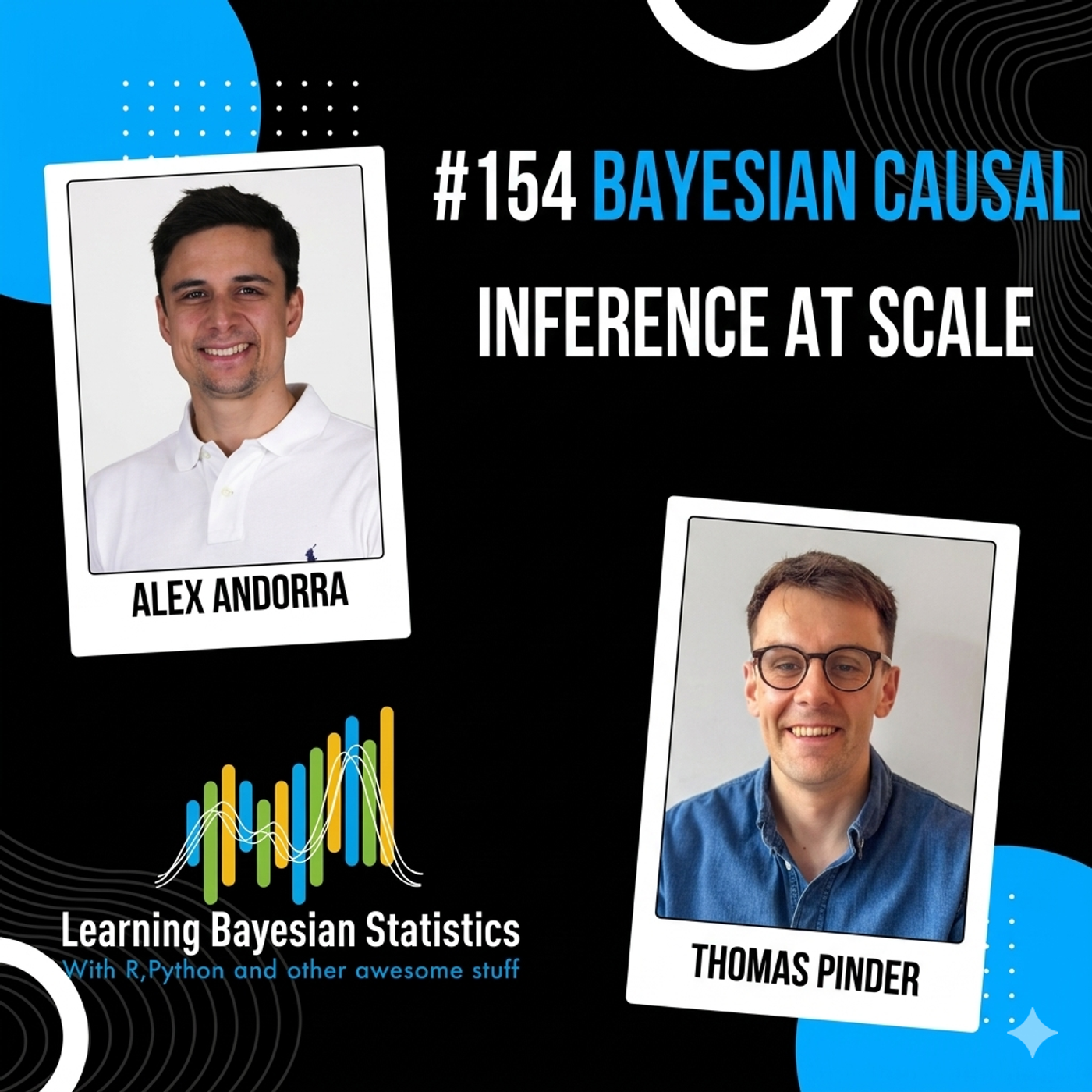
#154 Bayesian Causal Inference at Scale, with Thomas Pinder

• Support & get perks! • Bayesian Modeling course (first 2 lessons free) Our theme music is « Good Bayesian », by Baba Brinkman (feat MC Lars and Mega Ran). Check out his awesome work! Takeaways: Q: Why was GPJax created and how does it benefit researchers? A: GPJax was developed to provide a high-performance, flexible framework for Gaussian processes (GPs) within the JAX ecosystem. It allows researchers to move beyond black-box implementations and easily experiment with custom kernels and model structures while leveraging JAX’s automatic differentiation and GPU acceleration. Q: What are the primary advantages of using Gaussian processes for data modeling? A: Gaussian processes are highly effective at modeling complex, nonlinear relationships in data. Unlike many machine learning methods that only provide a point estimate, GPs offer built-in uncertainty quantification, which is essential for understanding the reliability of predictions in research and industry. Q: How does the GPJax and NumPyro integration enhance probabilistic modeling? A: The integration allows users to treat GPJax models as components within a larger NumPyro probabilistic program. This combination enables the use of advanced sampling techniques like NUTS (No-U-Turn Sampler), making it easier to build and fit complex hierarchical models that include Gaussian processes. Q: What are the main challenges when applying Gaussian processes to high-dimensional data? A: High-dimensional data significantly complicates GP modeling due to the curse of dimensionality and the cubic scaling of computational costs. In high dimensions, defining meaningful distance metrics for kernels becomes harder, often requiring specialized techniques like sparse GPs or dimensionality reduction to remain tractable. Full takeaways here! Chapters: 11:40 What is GPJax and how does it simplify Gaussian Process modeling? 15:48 How are Bayesian methods used for experimentation and causal inference in industry? 18:40 How do you implement Bayesian Synthetic Control? 32:17 What is Bayesian Synthetic Difference-in-Differences? 39:44 What are the research applications and supported methods for the GPJax library? 45:47 What are the primary software and computational bottlenecks when scaling Gaussian Processes? 49:02 What are the real-world industrial applications of Gaussian Process models? 54:36 How is Bayesian modeling applied to soccer and sports analytics? 58:43 What is the future development roadmap for the GPJax ecosystem? 01:05:37 What is Impulso and how does it integrate into a Bayesian modeling workflow? 01:13:42 How do you balance Bayesian computational overhead with industrial latency requirements? 01:20:26 Why is there optimism that scalable Bayesian methods for causal inference are now within reach? Thank you to my Patrons for making this episode possible! Links from the show here!

1 h 26 min