SR

Stefan Radev

Stefan Radev has been a guest on 5 podcast episodes in the last 12 months. Latest: Learning Bayesian Statistics, Jun 19, 2026.

Two years on the air

GuestHostMentioned

Guest appearances

Fri19Jun
Learning Bayesian Statistics

Learning Bayesian Statistics

Why Bayesian Statistics Is More Computational Than Ever

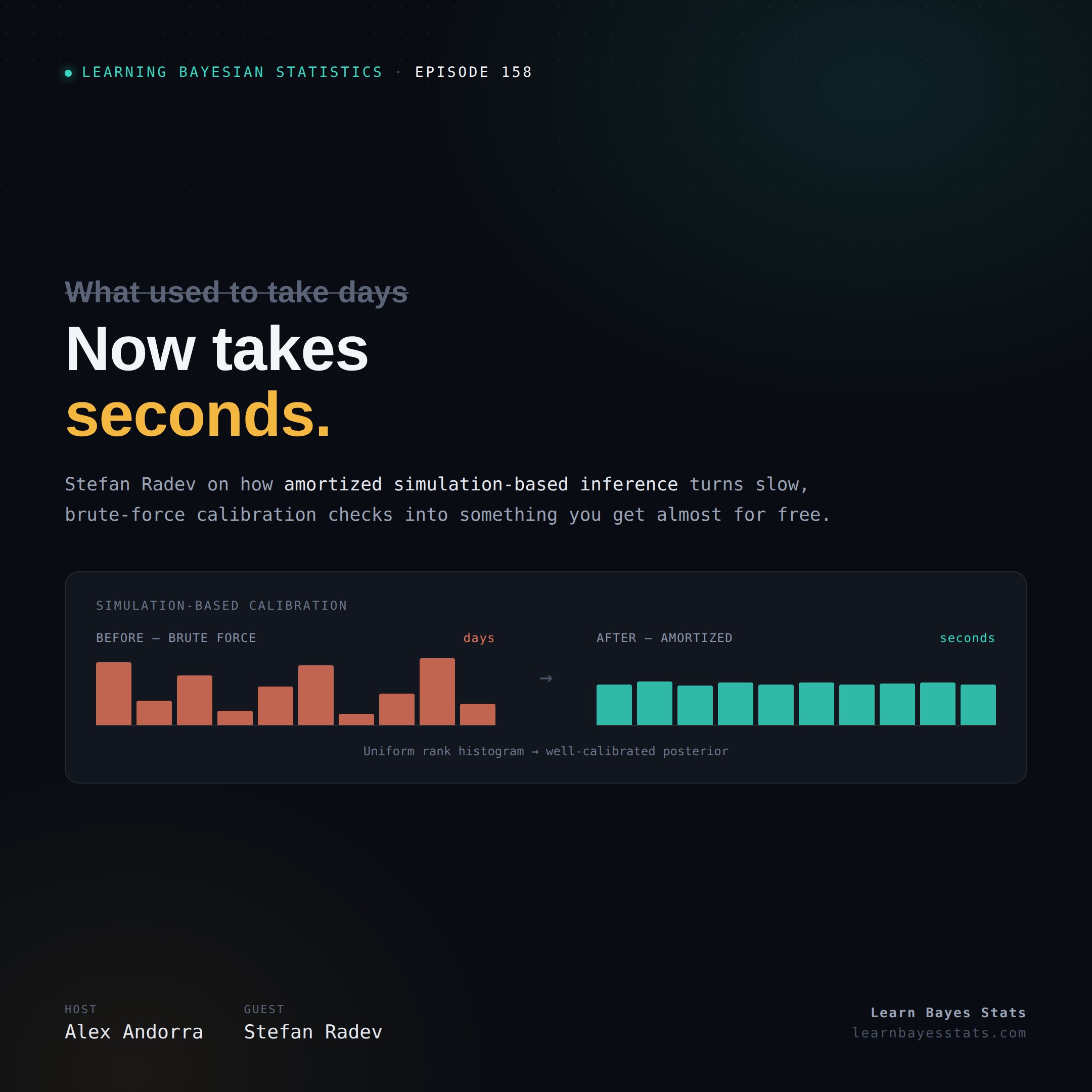
Today's clip is from Episode 158 featuring Stefan Radev. In this conversation, Alex Andorra and Stefan break down a core argument from their paper: Bayesian statistics has never been more computational than it is now, and simulation is the thread that ties the whole workflow together. Stefan parcellates the Bayesian workflow into four stages, and this clip covers the first two. Stage one is model specification, where the workflow community has long recommended prior predictive checks. You can do this informally, just running simulations from your model and eyeballing whether the output meets your expectations, or formally, à la Michael Betancourt, by pushing your model's high-dimensional output through a transformation into a low-dimensional, interpretable space and checking it against reality. The punchline: a surprising number of models can be discarded before you've even seen real data, yet Stefan notes these checks remain underused in practice. Stage two is model verification, where the question shifts to whether your inferences are well calibrated. This is the territory of simulation-based calibration and parameter recovery studies, classic tools that have always carried a steep computational price. You simulate thousands of synthetic datasets and run inference on every single one, which is exactly why these checks are so often skipped in papers, even though doing one well can be a contribution in its own right. Here's where amortized simulation-based inference changes the math entirely. Checks that used to take days now take seconds, and instead of laboriously running inference dataset by dataset, you get millions of posterior samples essentially for free. The calibration checks that the field has always known it should be doing finally become cheap enough to actually do. Get the full discussion here Support & Resources → Support the show on Patreon → Bayesian Modeling Course (first 2 lessons free) Our theme music is « Good Bayesian », by Baba Brinkman (feat MC Lars and Mega Ran). Check out his awesome work

5 min

Tue2Jun
Learning Bayesian Statistics

Learning Bayesian Statistics

Can AI Learn What Experts Know? Automating Prior Elicitation with Generative Models

Today's clip is from episode 158 featuring Stefan Radev. In this conversation, Alex and Stefan explore a genuinely fascinating problem: how do you turn an expert's intuition into a mathematically valid prior distribution - and can AI help automate that process? Alex explains that prior elicitation is essentially a translation problem. Experts don't walk around thinking in probability distributions - their knowledge lives in intuitions, rules of thumb, and rough ranges. The challenge is converting that into something a Bayesian model can actually use. The traditional approach? Ask an expert for quantiles or a mean, then parameterize your prior with hyperparameters and simulate until the model-implied quantities match what the expert described. If your pipeline is differentiable end-to-end, you use gradient descent. If not, you fall back to something like Bayesian optimization. Either way, you're iterating toward a prior that genuinely reflects expert knowledge - not just a convenient assumption. But the really exciting part is what came next. In a follow-up paper, they pushed this further: instead of optimizing within a fixed parametric family (say, a Gaussian), they replaced the prior entirely with a normalizing flow - a flexible generative network - and ran the same procedure. No assumed distribution family. Just let the data and the expert's knowledge shape the prior from scratch. The catch? More flexibility means more non-identifiability and stability headaches. But the direction is clear: a fully automated, end-to-end pipeline for building priors from non-probabilistic expert knowledge. And in 2026, that pipeline could theoretically be driven by an agent. Get the full discussion here Support & Resources → Support the show on Patreon → Bayesian Modeling Course (first 2 lessons free) Our theme music is « Good Bayesian », by Baba Brinkman (feat MC Lars and Mega Ran). Check out his awesome work

5 min

Thu21May
Learning Bayesian Statistics

Learning Bayesian Statistics

#158 Bayesian Workflows & Foundation Models, with Stefan Radev

Support & Resources → Support the show on Patreon → Bayesian Modeling Course (first 2 lessons free) Our theme music is « Good Bayesian », by Baba Brinkman (feat MC Lars and Mega Ran). Check out his awesome work Takeaways: Q: Why are prior predictive checks so underused in practice, and how do simulations help? A: They're underused because researchers don't always think to run them before seeing data -- but also because doing them rigorously (in the style Michael Betancourt advocates, with prior push-forward checks on interpretable summaries) takes effort. Simulations make it cheap to generate thousands of “what-if world” datasets from your model and check whether they look plausible, catching bad priors before you ever touch real data. Q: How can generative AI help with prior elicitation? A: Rather than forcing a domain expert to choose a distributional family and parameterize it, you can use a generative model to translate their qualitative knowledge directly into a prior. The expert describes what realistic data should look like; the generative model produces synthetic datasets matching that description; those datasets are used to fit a prior distribution. It removes the assumption that experts can think in terms of parameters and replaces it with the more natural question: does this look like your data? Q: What would a foundation model for Bayesian inference actually look like? A: Stefan's bet is that it won't be a fine-tuned general LLM. The right analogy is chess: you don't fine-tune GPT to play chess, you teach it when to call Stockfish. For Bayesian inference, you'd want a semantic layer – an LLM that understands the analysis goal – calling specialized numerical engines (MCMC samplers, amortized inference networks) that do the actual computation. Agent skills are already a step in this direction; the longer-term vision is engines that have been trained from scratch to generalize across large families of models and priors. Full takeaways here. Chapters: 00:00 How does amortized inference fit into modern Bayesian workflows? 06:01 What role do simulations play across the full Bayesian workflow? 12:12 How do you elicit priors from a domain expert who doesn't think in distributions? 19:01 What would a foundation model for Bayesian inference actually look like? 35:32 What is self-consistency in amortized inference and why does it matter? 39:22 How does semi-supervised learning improve simulation-based inference? 43:16 Why is sensitivity analysis so important yet so underused in Bayesian practice? 47:40 What is multiverse analysis and how does it change how we report Bayesian results? 51:32 How does amortized inference make sensitivity and multiverse analysis affordable? 01:02:47 How do amortized inference and classical MCMC complement each other? 01:10:08 What are the next major directions for BayesFlow and amortized inference research? Thank you to my Patrons for making this episode possible! Links from the show here.
1 h 19 min

Wed13May
Learning Bayesian Statistics

Learning Bayesian Statistics

The Hidden Geometry of Hierarchical Models

Today's clip is from Episode 157 featuring Stefan Radev. In this conversation, Alex and Stefan dig into one of the hardest open problems in simulation-based inference — hierarchical models. The core idea: when you move from flat to hierarchical models, you're no longer estimating one set of parameters. You have local parameters that vary by location (or subject, or city) and global parameters that capture what's shared across all of them. And you don't just want each separately — you want the full joint posterior, because that's where the Bayesian magic of shrinkage actually lives. Stefan builds the problem from the ground up. Start with the simplest hierarchical case: a two-level model. He uses electoral forecasting in France as the example — cities nested inside departments nested inside the whole country. Now your simulator has to cover all three levels. If that simulator is slow (think: brain emulators, minutes per sample), scaling to hundreds of groups becomes completely intractable. Memory issues, specialized network requirements, the works. The key insight: this problem has structure you can exploit. The joint posterior factorizes in a particularly nice way — each local parameter depends on its own local data and on the global parameters. That means instead of cramming everything into one giant high-dimensional vector and hoping a neural network figures it out, you can decompose the problem. Estimate local parameters conditioned on local data and the globals. Use composition. The takeaway: hierarchical models aren't just "harder flat models" - they have a geometry that demands a different architecture. Respecting that structure is what makes amortized inference scale. Get the full discussion here Support & Resources → Support the show on Patreon → Bayesian Modeling Course (first 2 lessons free) Our theme music is « Good Bayesian », by Baba Brinkman (feat MC Lars and Mega Ran). Check out his awesome work

4 min

Wed6May
Learning Bayesian Statistics

Learning Bayesian Statistics

#157 Amortized Inference & BayesFlow in Practice, with Stefan Radev

Support & Resources → Support the show on Patreon → Bayesian Modeling Course (first 2 lessons free) Our theme music is « Good Bayesian », by Baba Brinkman (feat MC Lars and Mega Ran). Check out his awesome work Takeaways: Q: What is simulation-based inference and what does "sim-to-real" mean? A: Simulation-based inference (SBI) uses a mechanistic simulator as an epistemic tool: you train a neural network on a large number of labeled simulations and then deploy it on real, unlabeled data. The "sim-to-real" framing captures the key asymmetry -- your network never sees real data during training, only simulations, but it generalizes to real observations at inference time. This is the opposite of the more common "synthetic-for-ML" approach, where fake data is used purely to augment real training data. Q: What is the amortized inference agent skill and what does it do? A: It's an open-source AI agent skill, co-developed by Stefan and Alexandre, that teaches an AI coding agent to run a complete, state-of-the-art amortized inference workflow. Because amortized inference is recent enough that it's underrepresented in LLM training data, vanilla agents tend to get it wrong. The skill injects the right methodology: it guides the agent to set up the simulator, choose the right network architecture, run a pilot, train with appropriate diagnostics, and produce an actionable report -- without the user needing to know the details. Q: What is calibration coverage and why should you never skip it? A: Calibration coverage tells you whether your posterior uncertainty is honest -- whether your credible intervals actually contain the true parameter at the right frequency. A model can show poor parameter recovery yet still be well-calibrated (because it's falling back on the prior), or it can appear to recover parameters while being poorly calibrated. Running calibration diagnostics both in-sample and out-of-sample is especially revealing for hierarchical models, which often appear to underfit in-sample but generalize much better out-of-sample thanks to shrinkage. Full takeaways here Chapters: 00:00:00 How does amortized inference fit into the Bayesian workflow? 00:12:03 What does "sim-to-real" mean in simulation-based inference? 00:15:57 Why is amortized inference particularly suited to psychology and neuroscience? 00:21:51 What is the amortized inference agent skill? 00:39:00 What is calibration coverage and how do you interpret it? 00:41:50 How do you decide what to do next after your first training run? 00:44:53 How do actionable insights make Bayesian workflows more usable? 00:49:08 What are the unique challenges of hierarchical models in amortized inference? 01:00:51 What is the current state of BayesFlow's support for hierarchical models? 01:05:00 What are the main failure modes of amortized inference and how do you handle model misspecification? Thank you to my Patrons for making this episode possible! Links from the show

1 h 19 min