VS

Vivek Suri

Vivek Suri has been a guest on 3 podcast episodes in the last 12 months. Latest: Supreme Court Oral Arguments, Nov 9, 2026.

Two years on the air

GuestHostMentioned

Guest appearances

Mon9Nov
Supreme Court Oral Arguments

Supreme Court Oral Arguments

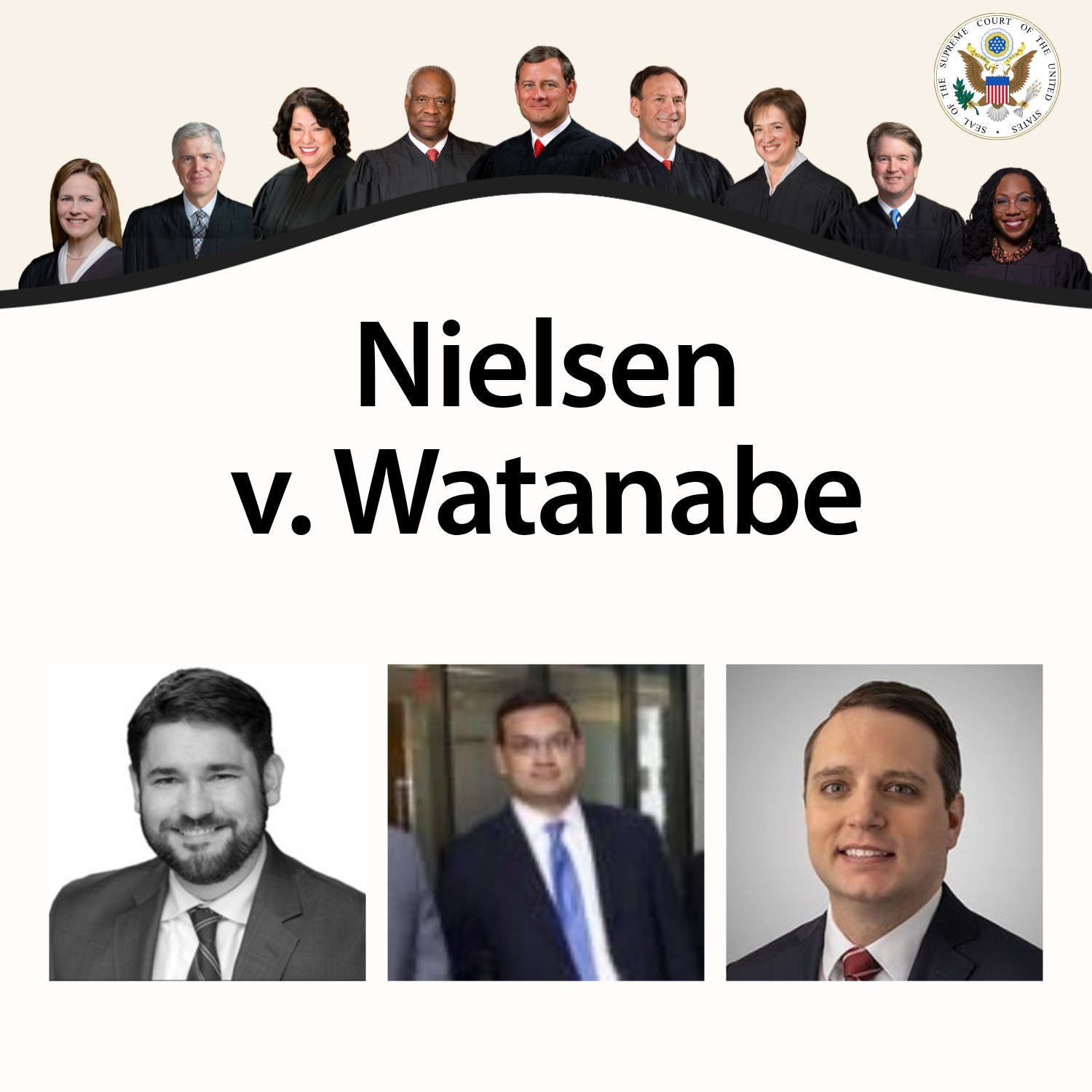
[25-417] Nielsen v. Watanabe

Nielsen v. Watanabe Justia · Docket · oyez.org · YouTube Argued on Nov 9, 2026. Petitioner: Francis Nielsen. Respondent: Kekai Watanabe . Advocates: Lucas M. Walker (for the Petitioner) Vivek Suri (for the United States, as amicus curiae, supporting the Petitioner) Joshua M. Wesneski (for the Respondent) Facts of the case (from oyez.org) Kekai Watanabe was a federal detainee at the Federal Detention Center in Honolulu when, in July 2021, rival gang members attacked him during a prison riot. After staff restored order, prison officials documented his visible injuries and placed him on sick call. Later that day, Watanabe told correctional officers he had headaches and pain and asked to see medical staff. He eventually described his condition to Francis Nielsen, a staff nurse at the facility, who denied his request to go to the hospital. Officials gave Watanabe over-the-counter pain medication. Months later, doctors diagnosed Watanabe with a fractured coccyx with bone chips in surrounding soft tissue, and prison officials agreed to refer him to a specialist. Watanabe then filed a pro se lawsuit alleging that Nielsen and others violated his Eighth Amendment rights by denying him adequate medical care and refusing to send him to the hospital, seeking $3 million in damages and injunctive relief. The district court dismissed Watanabe’s complaint, holding that his claim arose in a new Bivens context distinct from Carlson v. Green because he had access to an alternative administrative remedy—the Bureau of Prisons’ Administrative Remedy Program—that the Supreme Court had not considered in Carlson, and because his non-fatal injury differed meaningfully from the fatal asthma emergency in Carlson. A divided panel of the U.S. Court of Appeals for the Ninth Circuit reversed, holding that the availability of alternative remedies did not render the context new and that Carlson governed; the Ninth Circuit then denied rehearing en banc over eleven judges’ dissents. Question Can a federal prisoner sue prison officials for money damages under the Bivens doctrine for deliberate indifference to a non-life-threatening injury?

1 h 23 min

Tue21Apr
Supreme Court Oral Arguments

Supreme Court Oral Arguments

[25-406] Federal Communications Commission v. AT&T, Inc.

Federal Communications Commission v. AT&T, Inc. Justia · Docket · oyez.org Argued on Apr 21, 2026. Petitioner: Federal Communications Commission, et al. Respondent: AT&T, Inc. . Advocates: Jeffrey B. Wall (for AT&T, Inc. and Verizon Communications Inc.) Vivek Suri (for the FCC, et al.) Facts of the case (from oyez.org) Between 2014 and 2019, AT&T operated a location-based services program in which it collected and shared its customers’ mobile location data with third-party service providers such as Life Alert and AAA. To provide this data, AT&T contracted with “location aggregators,” who in turn resold the data to service providers. AT&T required those providers to obtain customer consent for each location request and reviewed their procedures, but it did not directly verify customer consent before transferring data. In 2018, news reports began revealing that some service providers misused or failed to adequately protect customers’ location data. In response, AT&T halted access for those providers, and by March 2019, shuttered the entire location-data program. Prompted by these reports, the Federal Communications Commission (FCC) initiated an investigation and in 2020 issued a Notice of Apparent Liability (NAL), proposing a $57 million fine for AT&T’s purported violations of Section 222 of the Communications Act of 1934 and corresponding FCC regulations. AT&T challenged the classification of location data as “customer proprietary network information” (CPNI), asserted it had acted reasonably, and raised constitutional objections. After reviewing AT&T’s written response, the FCC rejected its defenses and issued a forfeiture order. Significantly, the FCC imposed the fine without a hearing or trial; AT&T’s only opportunity to respond occurred through written submissions to the agency. AT&T paid the fine and petitioned the U.S. Court of Appeals for the Fifth Circuit for review. The Fifth Circuit vacated the forfeiture order, holding that the FCC’s in-house enforcement process violated AT&T’s rights under Article III and the Seventh Amendment. Question Are provisions of the Communications Act of 1934 that govern the Federal Communications Commission’s assessment and enforcement of monetary forfeitures consistent with the Seventh Amendment and Article III?

1 h 25 min

Tue24Mar
Supreme Court Oral Arguments

Supreme Court Oral Arguments

[25-5] Noem v. Al Otro Lado

Noem v. Al Otro Lado Justia · Docket · oyez.org Argued on Mar 24, 2026. Petitioner: Kristi Noem, Secretary of Homeland Security. Respondent: Al Otro Lado, a California Corporation. Advocates: Vivek Suri (for the Petitioners) Kelsi B. Corkran (for the Respondents) Facts of the case (from oyez.org) Beginning in 2016, U.S. Customs and Border Protection (CBP) implemented a “metering” policy at ports of entry along the United States-Mexico border to manage asserted capacity constraints. CBP officers stationed at the physical boundary line turned away asylum seekers lacking valid travel documents, preventing them from stepping onto U.S. soil to undergo mandatory inspection and processing. These officials instructed migrants to return to Mexico and wait for future processing opportunities, often without providing specific appointment times, forcing numerous asylum seekers to endure prolonged delays in Mexican border towns where they faced significant safety risks. While these asylum seekers waited, the federal government promulgated the “Asylum Transit Rule” in 2019, which generally rendered noncitizens ineligible for asylum if they traveled through a third country without first seeking protection there. This regulatory change prejudiced individuals previously turned away under the metering policy because, had CBP processed them upon their initial arrival, the Transit Rule would not have applied to their claims. Al Otro Lado, a legal aid organization, joined thirteen individual asylum seekers to file a class-action lawsuit challenging the metering policy and seeking to prevent the government from applying the Transit Rule to those who attempted to enter before its enactment. The U.S. District Court for the Southern District of California declared the metering policy unlawful under the Administrative Procedure Act and permanently enjoined the government from applying the Asylum Transit Rule to class members . The U.S. Court of Appeals for the Ninth Circuit affirmed the district court’s conclusion that the policy unlawfully withheld mandatory agency action, but narrowed the injunction to prevent the district court from forcing the government to unilaterally reopen past asylum denials. Question Does a noncitizen who is stopped on the Mexican side of the U.S.-Mexico border “arrive[] in the United States” within the meaning of Immigration and Nationality Act?

1 h 21 min