Bekomm eine E-Mail, wenn Kevin in einem Podcast zu Gast istPodAppear prüft neue Folgen, sobald sie erscheinen, und lässt die weg, in denen Kevin nur erwähnt wird. Bis zu 15 Personen kostenlos, ohne Kreditkarte.Bis zu 15 Personen kostenlos, ohne Kreditkarte.
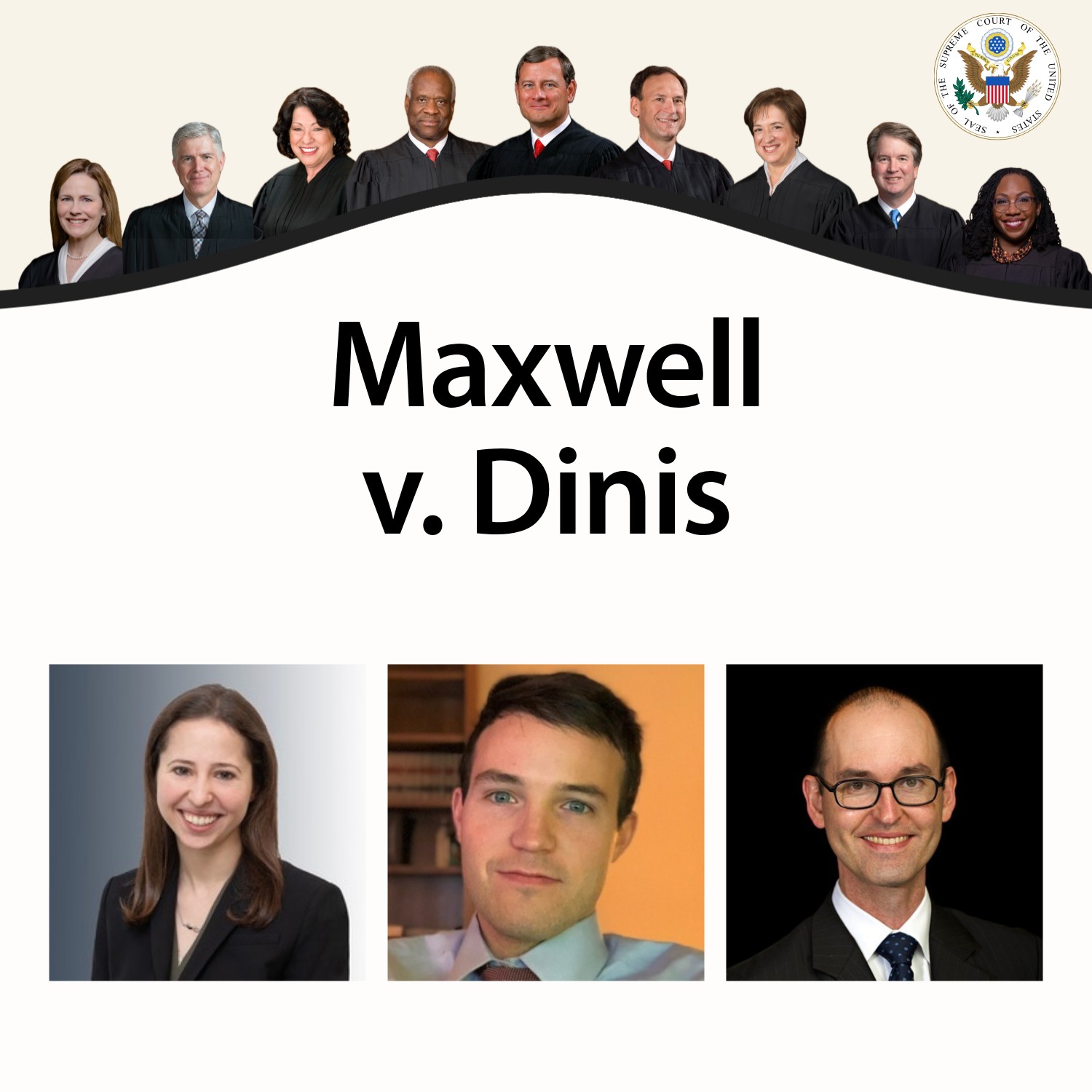
Maxwell v. Dinis
Justia · Docket · oyez.org · YouTube
Argued on Nov 2, 2026.
Petitioner: William Maxwell.
Respondent: Sandra Dinis, Acting Warden.
Advocates:
Masha G. Hansford (for the Petitioner)
Kevin J. Barber (for the Respondent supporting vacatur)
Brian W. Barnes (Court-appointed amicus curiae for the judgment below)
Facts of the case (from oyez.org)
William Maxwell is a federal prisoner housed at FCI Beaumont Low in Texas. In 2020, Maxwell asked prison officials to transfer him to a halfway house or home confinement, invoking several laws including the First Step Act's earned time credit provisions, which require the Bureau of Prisons (BOP) to apply credits prisoners earn through participation in rehabilitation programs toward earlier placement in prerelease custody. The BOP responded only to Maxwell's request under the separate CARES Act and denied it, ignoring his First Step Act arguments entirely. After Maxwell pushed through the BOP's administrative grievance process — a process he contends the BOP actively obstructed by losing filings, failing to respond, and submitting a false declaration claiming he never raised First Step Act claims — he filed a federal habeas corpus petition under 28 U.S.C. § 2241 seeking transfer to a halfway house or home confinement based on his earned First Step Act time credits.
The district court dismissed Maxwell's petition, ruling he had failed to exhaust his administrative remedies on his First Step Act claims. Maxwell appealed to the U.S. Court of Appeals for the Fifth Circuit, which sua sponte affirmed dismissal on a different ground — holding under its own bright-line rule that because a favorable ruling would not automatically accelerate Maxwell's release from prison, a civil rights lawsuit, not a habeas petition, was the only proper vehicle for his claims.
Question
Can a federal prisoner use a habeas corpus petition to challenge the government's calculation of First Step Act time credits in order to seek an earlier transfer to a halfway house or home confinement?
Johnson v. United States Congress
Justia · Docket · oyez.org · YouTube
Argued on Oct 5, 2026.
Petitioner: Floyd D. Johnson.
Respondent: United States Congress.
Advocates:
Jeffrey W. Chen (for the Petitioner)
Kevin J. Barber (for the Respondent)
Facts of the case (from oyez.org)
Floyd D. Johnson, a United States Army veteran, began receiving disability benefits for service-related post-traumatic stress disorder while serving a 40-year prison sentence in Florida. Although the Veterans Benefits Administration initially approved a high level of compensation, it later reduced Johnson’s monthly payments to a 10 percent rate. The agency cited a federal law, 38 U.S.C. § 5313, which limits disability compensation for veterans incarcerated for more than 60 days following a felony conviction.
Johnson filed a lawsuit against the United States Congress in federal district court to challenge the constitutionality of the benefits reduction law. He argued that the statute acted as an unconstitutional “bill of attainder”—a law that unfairly targets specific individuals for punishment—and violated the Equal Protection component of the Fifth Amendment. Johnson requested a court order to stop the government from reducing benefits for incarcerated veterans and sought retroactive pay for the withheld funds.
The district court dismissed Johnson’s complaint as frivolous after assuming it had jurisdiction to hear his constitutional claims. On appeal, the U.S. Court of Appeals for the Eleventh Circuit vacated that judgment and ordered the case dismissed for lack of jurisdiction, ruling that the Veterans’ Judicial Review Act strips district courts of the power to hear such challenges.
Question
Did the Veterans’ Judicial Review Act stripp district courts of the jurisdiction, recognized by this court in Johnson v. Robison, to hear challenges to the constitutionality of acts of Congress affecting veterans’ benefits?
1 h 07 minAbspielen in:
Warum PodAppear
Folge Menschen, nicht Podcasts.
Du hast Kevin in einer Sendung gehört. PodAppear findet für dich die nächste, und genauso für alle anderen, die du hören willst.
Eine Meldung, wenn die Person zu Gast istPer E-Mail: sofort oder gebündelt als Tages- oder Wochenübersicht. Dann nur noch auf Play drücken.
Gäste statt bloßer ErwähnungenFolgen, in denen ein Name nur fällt, landen getrennt. Eine Meldung heißt: Die Person ist wirklich in der Sendung.
Alle in einem FeedGründerinnen, Autoren, Sportler, Forscherinnen. Folge allen mit Namen, quer durch jede Sendung, in der sie auftreten.