FL

Frederick Liu

Frederick Liu has been a guest on 2 podcast episodes in the last 12 months. Latest: Supreme Court Oral Arguments, Mar 24, 2026.

Two years on the air

GuestHostMentioned

Guest appearances

Tue24Mar
Supreme Court Oral Arguments

Supreme Court Oral Arguments

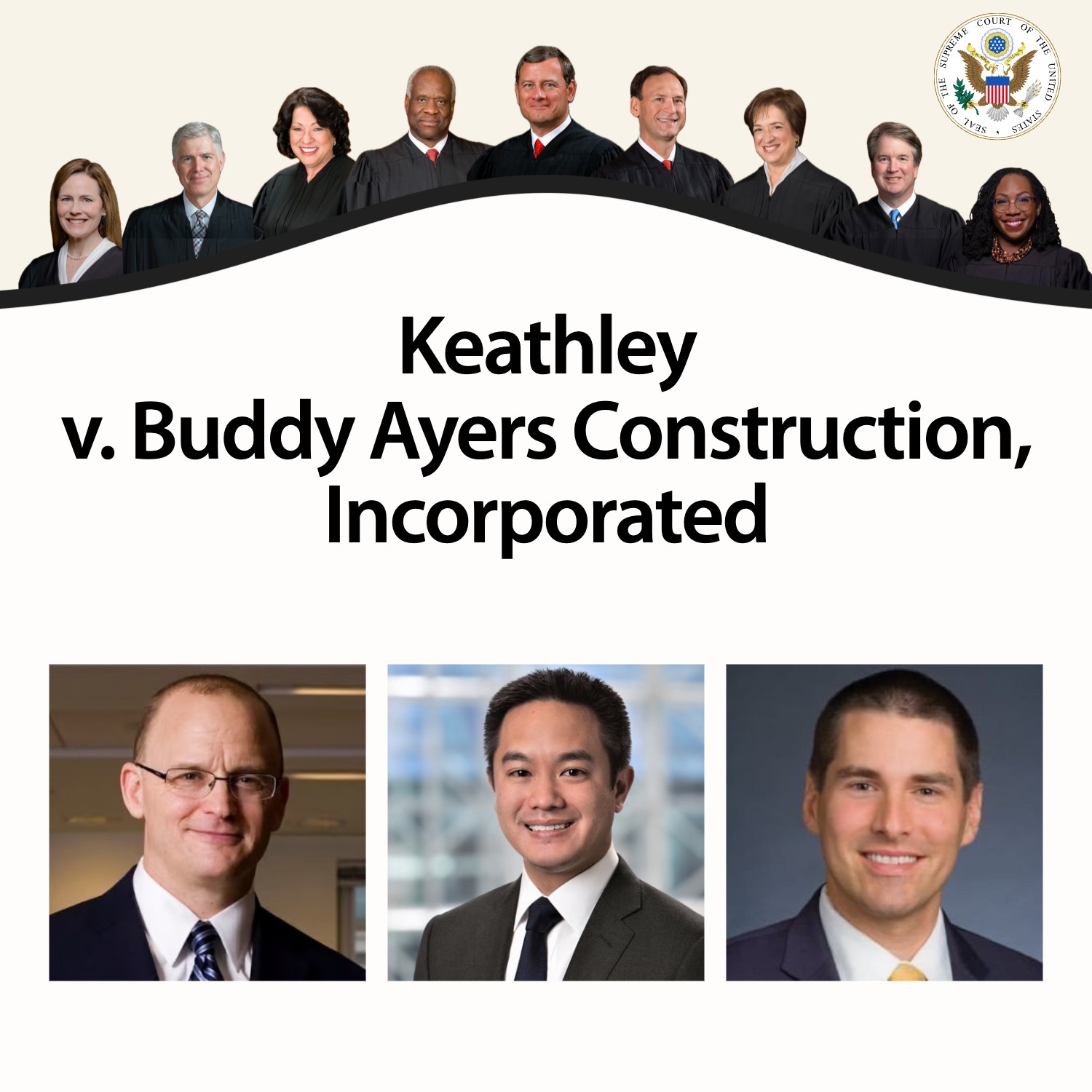
[25-6] Keathley v. Buddy Ayers Construction, Incorporated

Keathley v. Buddy Ayers Construction, Incorporated Justia · Docket · oyez.org Argued on Mar 24, 2026. Petitioner: Thomas Keathley. Respondent: Buddy Ayers Construction, Incorporated. Advocates: Gregory G. Garre (for the Petitioner) Frederick Liu (for the United States, as amicus curiae, supporting vacatur) William M. Jay (for the Respondent) Facts of the case (from oyez.org) Thomas Keathley filed for Chapter 13 bankruptcy in the U.S. Bankruptcy Court for the Eastern District of Arkansas in December 2019. In August 2021, while his bankruptcy case was ongoing, Keathley was in a motor vehicle collision with David Fowler, a truck driver employed by Buddy Ayers Construction, Inc. (BAC). Keathley hired a personal injury attorney the next day and subsequently filed a personal injury lawsuit against BAC in the U.S. District Court for the Northern District of Mississippi in December 2021, alleging negligence and vicarious liability. Keathley, however, failed to disclose this new personal injury lawsuit as a potential asset to the bankruptcy court. He submitted multiple amended bankruptcy plans in March 2022 and June 2022, none of which mentioned the pending lawsuit. The bankruptcy court confirmed Keathley’s modified plan in July 2022, unaware of the personal injury claim. Keathley only amended his bankruptcy schedule to include the lawsuit after BAC moved to dismiss the personal injury case. BAC moved for summary judgment in the personal injury suit, arguing that the doctrine of judicial estoppel barred Keathley’s claim because he failed to disclose it during his bankruptcy proceeding. The district court granted BAC’s motion, dismissing the lawsuit, and subsequently denied Keathley's motion for reconsideration. Keathley then appealed both of those decisions to the U.S. Court of Appeals for the Fifth Circuit, which affirmed the district court’s decisions. Question May the doctrine of judicial estoppel be invoked to bar a plaintiff who fails to disclose a civil claim in bankruptcy filings from pursuing that claim simply because there is a potential motive for nondisclosure, regardless of whether there is evidence that the plaintiff in fact acted in bad faith?

1 h 09 min

Wed25Feb
Supreme Court Oral Arguments

Supreme Court Oral Arguments

[25-95] Pung v. Isabella County

Pung v. Isabella County Justia · Docket · oyez.org Argued on Feb 25, 2026. Petitioner: Michael Pung, Personal Representative of the Estate of Timothy Scott Pung. Respondent: sabella County, Michigan. Advocates: Philip L. Ellison (for the Petitioner) Frederick Liu (for the United States, as amicus curiae, supporting neither party) Matthew T. Nelson (for the Respondent) Facts of the case (from oyez.org) This case involves a dispute over the foreclosure and sale of the Pung property in Isabella County, Michigan, following the death of its owner, Timothy Scott Pung, in 2004. The property had a Principal Residence Exemption (PRE) from local school taxes. In 2010, the township tax assessor, Patricia DePriest, retroactively denied the PRE for the years 2007-2009, asserting a new owner must file an affidavit. Although the Michigan Tax Tribunal overturned this decision in 2012, holding the PRE remained valid for the estate, DePriest subsequently revoked the PRE for the 2012 tax year based on the same unfiled-affidavit rationale. This denial created an unpaid tax bill of $2,241.93. The County Treasurer, Steven Pickens, initiated foreclosure proceedings for this delinquency. After a final judgment of foreclosure, the property sold at a public auction for $76,008. Isabella County and Pickens retained the entire $76,008 from the sale, refusing to return the surplus proceeds above the tax debt to Michael Pung, the estate's representative. Michael Pung sued, alleging this retention of the surplus violated the Fifth Amendment’s Takings Clause and the Eighth Amendment’s Excessive Fines Clause. The district court granted Pung summary judgment on the Takings Clause claim, ruling he was entitled to the surplus proceeds (the sale price minus the tax debt), but not to the greater loss in equity based on the property’s fair market value. The U.S. Court of Appeals for the Sixth Circuit affirmed the district court’s judgment on all claims, including the amount of compensation awarded. Question 1. When the government takes property for tax debt, does the Fifth Amendment require compensation based on the property’s true fair market value, or only on the lower amount it sold for at a tax foreclosure auction? 2. Does the Eighth Amendment’s Excessive Fines Clause prohibit the government from seizing and keeping a property worth far more than the small tax debt owed on it?

1 h 45 min