Bekomm eine E-Mail, wenn Emily in einem Podcast zu Gast istPodAppear prüft neue Folgen, sobald sie erscheinen, und lässt die weg, in denen Emily nur erwähnt wird. Bis zu 15 Personen kostenlos, ohne Kreditkarte.Bis zu 15 Personen kostenlos, ohne Kreditkarte.
Emily M. Ferguson war in den letzten 12 Monaten in 3 Podcast-Folgen aus 2 verschiedenen Sendungen zu Gast, am häufigsten bei Supreme Court Oral Arguments (2-mal). Zuletzt: Audio Arguendo, 9. Nov. 2026.
Death Penalty: May a death-row prisoner file a second federal habeas petition based on intellectual-disability standards that changed after his first petition? - Argued November 4, 2026
Arguing Counsel
William R. Peterson (Solicitor General), for the Petitioner
Emily M. Ferguson (Department of Justice), for the United States, as amicus curiae, supporting the Petitioner
Jeremy Schepers, for the Respondent
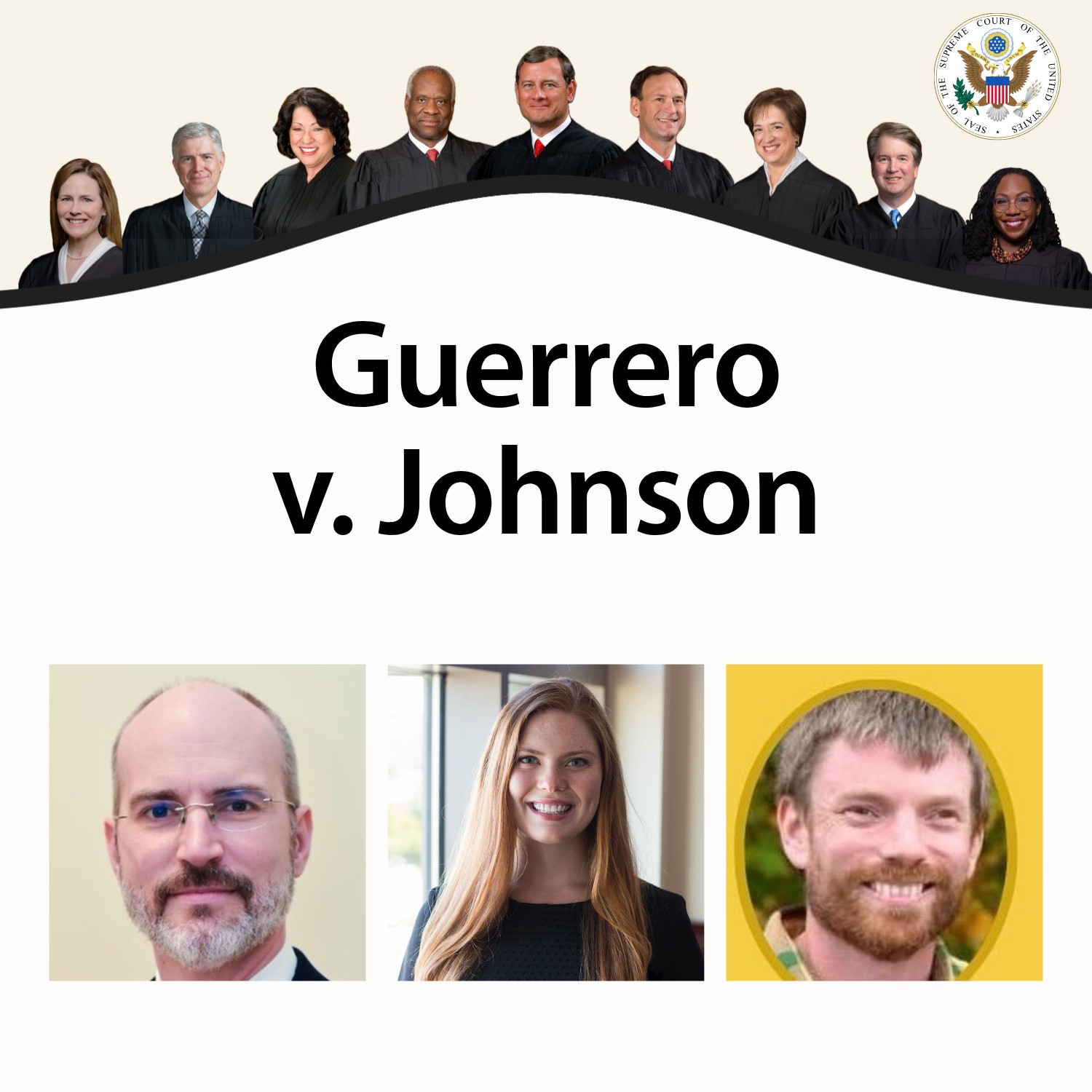
Guerrero v. Johnson
Justia · Docket · oyez.org · YouTube
Argued on Nov 4, 2026.
Petitioner: Eric Guerrero.
Respondent: Dexter Johnson.
Advocates:
William R. Peterson (for the Petitioner)
Emily M. Ferguson (for the United States, as amicus curiae, supporting the Petitioner)
Jeremy Schepers (for the Respondent)
Facts of the case (from oyez.org)
Dexter Johnson kidnapped, raped, and murdered Maria Aparece in June 2006, years after the Supreme Court decided Atkins v. Virginia, 536 U.S. 304 (2002), which held the Eighth Amendment prohibits executing intellectually disabled people. At trial, Johnson’s own defense expert tested his IQ between 74 and 88, concluded he showed no obvious adaptive deficits, and opined that he was not intellectually disabled. Johnson was convicted of capital murder and sentenced to death in June 2007. Johnson did not raise an Atkins claim in his initial state habeas application or his initial federal habeas petition filed in 2011. Instead, he argued that the Atkins principles should extend to the mentally ill. In May 2013, the American Psychiatric Association published the DSM-5, which substantially revised intellectual disability diagnosis by de-emphasizing IQ score cutoffs and recognizing that individuals with scores above 70 could still qualify. Johnson's federal habeas petition was denied in August 2013—just months after the DSM-5’s publication. Johnson’s counsel, aware of the DSM-5, chose not to develop an Atkins claim, citing concerns about unfavorable Texas state court standards and his strategic focus on other claims. With an execution date set for 2019, Johnson obtained new expert evaluations under the DSM-5 standards; those experts diagnosed him as intellectually disabled. Johnson then sought authorization to file a successive federal habeas petition, arguing that the DSM-5 had made his Atkins claim newly viable and therefore “previously unavailable” during his earlier habeas proceedings.
After the U.S. Court of Appeals for the Fifth Circuit authorized the successive petition in 2019, the district court denied the State's motion to dismiss and found Johnson’s Atkins claim was previously unavailable under the Fifth Circuit’s “futility exception” from In re Cathey. The district court certified that ruling for interlocutory appeal, the Fifth Circuit accepted, and a panel affirmed in July 2025, reaffirming Cathey’s holding that a claim is not “previously available” unless it had “some possibility of merit” at the time of the earlier petition. The Fifth Circuit denied rehearing en banc by a 9-7 vote in January 2026.
Question
Does a claim rely on a “previously unavailable” new rule of constitutional law, permitting a successive habeas petition, when the prisoner could have raised a claim based on that rule in an earlier petition?
Pitchford v. Cain
Justia · Docket · oyez.org
Argued on Mar 31, 2026.
Petitioner: Terry Pitchford.
Respondent: Burl Cain, Commissioner, Mississippi Department of Corrections.
Advocates:
Joseph J. Perkovich (for the Petitioner)
Scott G. Stewart (for the Respondents)
Emily M. Ferguson (for the United States, as amicus curiae, supporting the Respondents)
Facts of the case (from oyez.org)
Terry Pitchford was convicted of capital murder and sentenced to death for his involvement in the 2004 armed robbery and killing of Reuben Britt, a store owner in Grenada County, Mississippi. At the time of the crime, Pitchford was 18 years old. He confessed to participating in the robbery, although the fatal shot was fired by his accomplice. At Pitchford’s 2006 trial in the Grenada County Circuit Court, the jury was selected from a pool that included 36 white and five Black potential jurors. The prosecution used peremptory strikes to remove four of the five Black prospective jurors. Pitchford’s counsel raised a Batson objection, alleging that the strikes were racially discriminatory.
The trial court found Pitchford had made a prima facie showing of discrimination and required the prosecution to provide race-neutral reasons for each strike. The prosecutor cited explanations such as the venirepersons’ criminal histories, perceived mental health issues, or similarities to the defendant. The trial judge accepted those explanations and allowed the strikes, ultimately empaneling a jury that included only one Black juror. Pitchford’s counsel sought to preserve Batson-related objections during a bench conference, emphasizing the racial composition of the jury and the county, but did not conduct a further comparative analysis or expressly argue that the prosecution’s stated reasons were pretextual.
Pitchford’s conviction and sentence were affirmed on direct appeal by the Mississippi Supreme Court, which held that any pretext arguments had been waived for failure to raise them clearly at trial. A federal district court later granted habeas relief, but the U.S. Court of Appeals for the Fifth Circuit reversed, ruling the Mississippi Supreme Court had reasonably applied Batson and its waiver rule. The U.S. Supreme Court granted certiorari, limited to the question of whether the Mississippi Supreme Court unreasonably determined, under AEDPA, that Pitchford waived his right to rebut the prosecution’s race-neutral justifications for the challenged juror strikes.
Question
Did the Mississippi Supreme Court unreasonably decide—under the standards set by federal habeas law—that Terry Pitchford gave up his right to argue that the prosecutor’s explanations for striking four Black jurors were false or racially biased?
1 h 50 minAbspielen in:
Warum PodAppear
Folge Menschen, nicht Podcasts.
Du hast Emily in einer Sendung gehört. PodAppear findet für dich die nächste, und genauso für alle anderen, die du hören willst.
Eine Meldung, wenn die Person zu Gast istPer E-Mail: sofort oder gebündelt als Tages- oder Wochenübersicht. Dann nur noch auf Play drücken.
Gäste statt bloßer ErwähnungenFolgen, in denen ein Name nur fällt, landen getrennt. Eine Meldung heißt: Die Person ist wirklich in der Sendung.
Alle in einem FeedGründerinnen, Autoren, Sportler, Forscherinnen. Folge allen mit Namen, quer durch jede Sendung, in der sie auftreten.