Bekomm eine E-Mail, wenn Carissa in einem Podcast zu Gast istPodAppear prüft neue Folgen, sobald sie erscheinen, und lässt die weg, in denen Carissa nur erwähnt wird. Bis zu 15 Personen kostenlos, ohne Kreditkarte.Bis zu 15 Personen kostenlos, ohne Kreditkarte.
Carissa kostenlos folgen
CV

Carissa Véliz

Mexican-Spanish philosopher

Carissa Véliz war in den letzten 12 Monaten in 6 Podcast-Folgen aus 6 verschiedenen Sendungen zu Gast. Zuletzt: Legacy, 26. Nov. 2026.

Kurzbiografie aus Wikipedia

Zwei Jahre auf Sendung

GastHostErwähnt

Gastauftritte

Do26Nov
Legacy

Legacy

Inbox: The New Oracles of Silicon Valley | Carissa Véliz

Where did the claim that AI has a 10% chance of destroying the world come from? What do Silicon Valley’s predictions have in common with the Oracle of Delphi? And, what happens when an algorithm doesn't just predict your future, but decides it? Oxford philosopher Carissa Véliz joins Peter Frankopan and Afua Hirsch to challenge our faith in forecasts, drawing on her new book, Prophecy. From the seers who advised ancient rulers to the algorithms that decide who gets a job, Carissa argues that predictions can be a means of exercising power. Why do uncertain times make us so susceptible to prophets, and what might we gain by preparing for the future rather than trying to predict it? Join Legacy Plus for bonus episodes, early access, Q&As, fewer adverts and more. legacy.supportingcast.fm 00:00 - The problem with predicting the future 02:26 - Why we want to know what comes next 06:03 - Self-fulfilling prophecies 09:46 - Ancient oracles and political power 13:24 - The hidden commands in predictions 15:50 - Prophecy, science and the limits of knowledge 20:24 - The danger of believing the future is fixed 21:30 - How algorithms shape our lives 25:19 - Preparing instead of predicting 29:50 - What happens when we forget history 31:47 - A future worth building 34:15 - Final thoughts Stay connected with Legacy: Instagram: @originallegacypodcast TikTok: @legacy_productions Explore more from Peter and Afua — essays, sources and ideas: Substack: peterfrankopan.substack.com | afuahirsch.substack.com Join Legacy+ for bonus episodes, early access, Q&A's, fewer adverts and more. legacy.supportingcast.fm Stay connected with Legacy: Instagram: @originallegacypodcast TikTok: @legacy_productions Explore more from Peter and Afua — essays, sources, and ideas: Substack: peterfrankopan.substack.com | afuahirsch.substack.com Hosted on Acast. See acast.com/privacy for more information.

37 minAbspielen in:

Mo20Jul
Techtonic with Mark Hurst | WFMU

Techtonic with Mark Hurst | WFMU

Carissa Veliz, author, "Prophecy" from Jul 20, 2026

Carissa Veliz, author, "Prophecy" Kirk Pearson - "Theme from Techtonic" - n/a - "Mark's intro" Kirk Pearson - "Modem of Home" - n/a [0:01:44] - "Interview with Carissa Véliz" [0:01:49] Kirk Pearson - "Haptic Workshop" - n/a [0:23:11] - "Interview with Carissa Véliz" [0:25:02] Kirk Pearson - "Bio Magnification" - n/a [0:46:25] - "Mark's comments" [0:46:39] Dmitry_Milk - "We Are Vocoders" - DiHalt2026 summer party [A chiptune version of Kraftwerk's "Robots" played on a ZX Spectrum] [0:55:45] https://www.wfmu.org/playlists/shows/166591

Abspielen in:

Mi20Mai
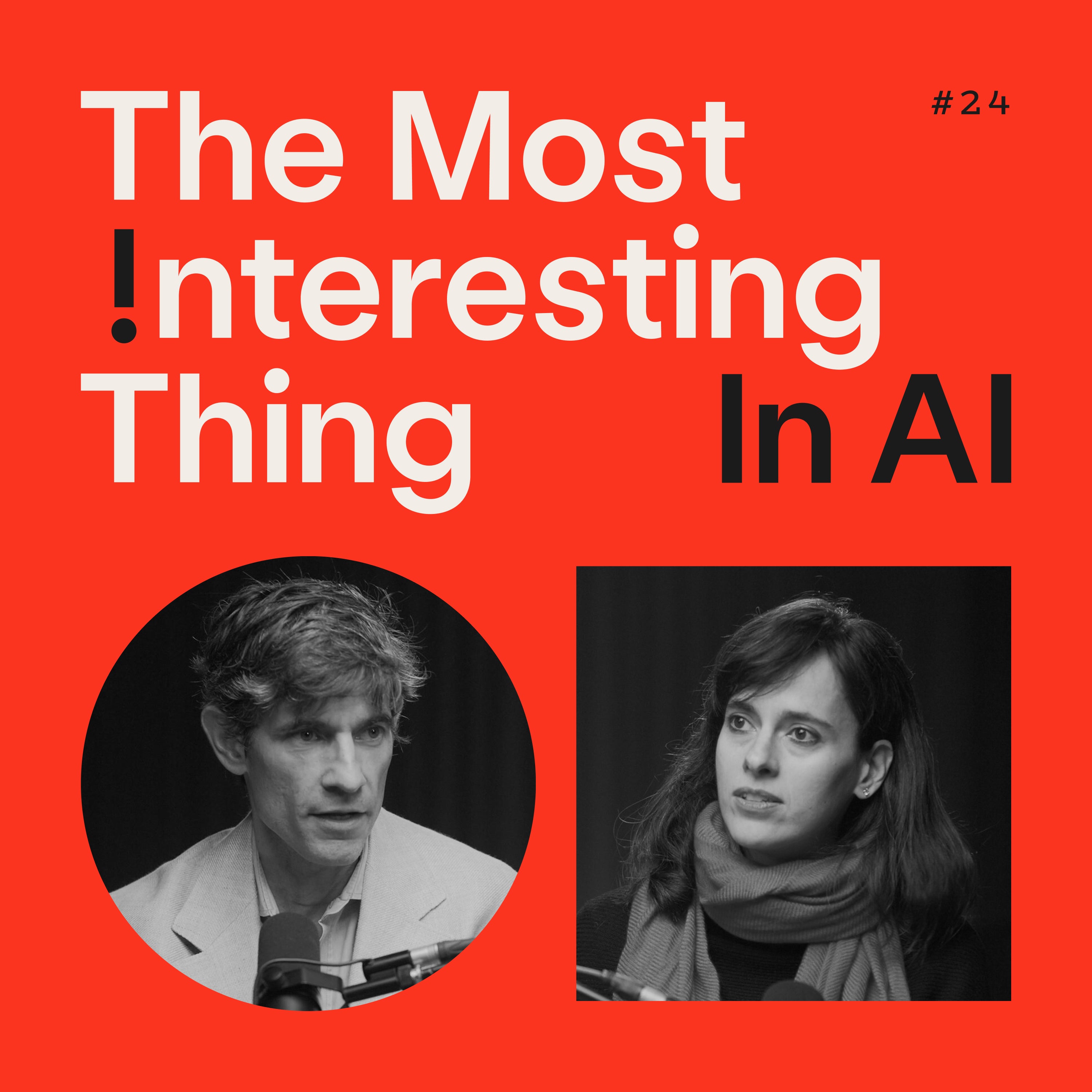
The Most Interesting Thing in AI

The Most Interesting Thing in AI

The Limits of Predictive AI - Carissa Véliz with Nicholas Thompson

Can AI predict a person’s future? It’s a promise often made by sales teams, but the technology’s record is far from spotless. Even if it did achieve perfect foresight, a practically-clairvoyant AI might be incompatible with democracy, says Oxford philosopher Carissa Véliz. In a spirited conversation with Nicholas Thompson, CEO of The Atlantic, Véliz traces the history of predictions from ancient oracles to the modern algorithms shaping everything from criminal sentencing to insurance premiums. What are the ethics of outsourcing such consequential decisions to machines? The risks of getting it wrong are obvious. Véliz warns of the dangers of getting it right. (00:00) Introduction to Carissa Véliz and her work on privacy and AI  (01:29) Why "less crime" is an illusion of safety  (02:30) How surveillance machinery enables prediction and social control  (03:06) Defense of autonomy: why resisting surveillance protects freedom  (04:02) Can mass surveillance ever be beneficial? (05:36) Ring cameras and the erosion of democratic anonymity  (07:01) Prediction versus prophecy: how forecasts shape reality  (08:52) Job displacement predictions and self-fulfilling prophecies  (13:15) The Gettier problem: why probabilistic AI lacks justification  (16:06) When probabilistic AI works and when it fails  (18:52) Do individualized health predictions defeat the purpose of insurance? (25:24) Areas where probabilistic reasoning is inadequate: insurance, justice  (27:48) The problems of effective altruism and utilitarian calculation  (32:37) AI company ethics: copyright, rights, and virtue ethics  (37:47) Can more data solve "the turkey problem?"  (39:15) Practical privacy advice: Signal, Proton, VPN, and mindful choices Learn more about your ad choices. Visit podcastchoices.com/adchoices

48 minAbspielen in:

Sa25Apr
The Human Risk Podcast

The Human Risk Podcast

Dr Carissa Véliz on Prophecy

What if prediction isn’t about knowing the future, but controlling it?  On this episode, I'm joined by a leading thinker on digital ethics, privacy and technology to explore the idea of prophecy. Episode Summary My guest is Dr Carissa Véliz and in our discussion, we talk about humanity’s long-standing obsession with predicting what comes next, and why today’s algorithms may be the most powerful (and dangerous) prophets we’ve ever created.  From ancient oracles and court astrologers to modern AI systems and tech executives, we explore how prediction has always been less about knowledge and more about power. What becomes clear is that while the tools have changed, the underlying dynamics haven’t. We still crave certainty, we still look for authority, and we’re still willing to trust those who claim to see the future. The difference now is scale: predictive technologies don’t just forecast behaviour; they shape it. And the more accurate they appear, the less likely we are to question them.  We then explore responsibility. If prediction influences reality, then our willingness to accept it matters. This episode is a reminder that the future isn’t something that simply happens to us, but something we’re actively participating in, whether we realise it or not. Guest Bio Dr Carissa Véliz is Associate Professor of Philosophy at the Institute for Ethics in AI and a Fellow at Hertford College at the University of Oxford. She is a leading thinker on digital ethics, privacy, and technology. She is the author of several books including her latest release 'Prophecy: Prediction, Power and the Fight for the Future, from Ancient Oracles to AI' and 'Privacy Is Power: Why and How You Should Take Back Control of Your Data ' Her work explores how data, AI, and predictive systems reshape society—often in ways that are invisible but deeply consequential. Drawing on philosophy, history, and real-world systems, she examines how power operates through technology and what individuals and institutions can do to resist it. AI-Generated TImestamped Summary [00:00:00] Opening: prediction as something that shapes—not reveals—the future [00:01:00] Why prophecy is a lens for understanding modern AI [00:04:00] Kings, prophets, and the risks of getting predictions wrong [00:06:00] Survival strategies of ancient astrologers [00:08:00] Why humans crave certainty—and who exploits it [00:10:00] The danger of mistaking wealth for wisdom [00:12:00] Prediction as a tool of power throughout history [00:14:00] Surveillance as the foundation of modern prediction [00:16:00] How predictions shape behaviour (self-fulfilling dynamics) [00:17:00] Publishing as a case study in manufactured success [00:21:00] The strange economics of pre-orders and attention [00:23:00] Insurance: from solidarity to individualised risk [00:26:00] The hidden systemic risks of personalised prediction [00:30:00] Why citizens need to reclaim agency [00:31:00] Laziness vs values: why we default to algorithms [00:33:00] Tech creating problems it then claims to solve [00:34:00] The role of humour as truth-telling [00:35:00] Why algorithms would have killed Seinfeld [00:40:00] Practical alternatives: preparation over prediction [00:42:00] The importance of serendipity [00:43:00] Rediscovering the analogue world [00:46:00] Algorithms shaping culture and environments [00:48:00] Optimism vs doom in thinking about technology [00:50:00] Writing as exploration, not prediction Links Carissa's website - https://www.carissaveliz.com/ Her new book, Prophecy - https://www.carissaveliz.com/prophecy Her previous book Privacy Is Power - https://www.carissaveliz.com/books Carissa's faculty page - https://www.oxford-aiethics.ox.ac.uk/dr-carissa-veliz Carissa on LinkedIn - https://www.linkedin.com/in/carissa-v%C3%A9liz-a5781555/

1 h 03 minAbspielen in:

Mi22Apr
Big Technology Podcast

Big Technology Podcast

Are We Too Obsessed With AI Predictions? — With Carissa Véliz

Carissa Véliz is an Oxford philosopher and the author of Prophecy: Prediction, Power, and the Fight for the Future, from Ancient Oracles to AI. Véliz joins Big Technology Podcast to discuss whether society has become dangerously naive about prediction as AI systems shape decisions around jobs, loans, justice, surveillance, and war. Tune in to hear a debate about predictive algorithms, generative AI, prediction markets, and whether forecasts are actually tools of knowledge or instruments of power. We also cover privacy, policing, protest anonymity, flood prediction, and why humor might be one of the best defenses against a prediction-obsessed world. --- Enjoying Big Technology Podcast? Please rate us five stars ⭐⭐⭐⭐⭐ in your podcast app of choice. More on Carissa: https://www.chartwellspeakers.com/speaker/carissa-veliz-2/ Find the book: https://www.amazon.com/Prophecy-Prediction-Future-Ancient-Oracles/dp/0385550979 Want a discount for Big Technology on Substack + Discord? Here’s 25% off for the first year: https://www.bigtechnology.com/subscribe?coupon=0843016b Learn more about your ad choices. Visit megaphone.fm/adchoices

55 minAbspielen in:

Mi15Apr
The We Society with Will Hutton

The We Society with Will Hutton

S10 Ep7: Whoever holds our data holds the power with Carissa Véliz

Professor Carissa Véliz is a philosopher who is examining the threats and possibilities of today’s digital world. She is an Associate Professor of Philosophy at the Institute for Ethics in AI at the University of Oxford – and fellow at Hertford College. She currently holds a Leverhulme Major Research Fellowship and her work has been featured by the Ada Lovelace Institute.  In her first landmark book, Privacy is Power (2020), she discussed the vital necessity of protecting our data as a precondition of sustaining our freedom. But the algorithms constructed by AI and data don’t just stop there; they have born a new era of data based predictions masquerading as objective. Like all predictions, they are shaped by human choices, assumptions, and incentives. In her latest book, Prophecy: Prediction, Power, and the Fight for the Future, from Ancient Oracles to AI (Out 21st April) Carissa Véliz challenges us to see predictions not as neutral forecasts, but as power over others.  In the We Society, join acclaimed journalist and Academy president Will Hutton, as he invites guests from the world of social science to explore the stories behind the news and hear their solutions to society’s most pressing problems. Don’t want to miss an episode? Follow the show on your favourite podcast platform and you can email us on wesociety@acss.org.uk and tell us who we should be speaking to.  The We Society podcast is brought to you by the Academy of Social Sciences in association with the Nuffield Foundation and the Leverhulme Trust.  Producer: Emily Uchida Finch Assistant Producer: Emily Gilbert A Whistledown Production for the Academy of Social Sciences

32 minAbspielen in:

Warum PodAppear

Folge Menschen, nicht Podcasts.

Du hast Carissa in einer Sendung gehört. PodAppear findet für dich die nächste, und genauso für alle anderen, die du hören willst.

  • Eine Meldung, wenn die Person zu Gast istPer E-Mail: sofort oder gebündelt als Tages- oder Wochenübersicht. Dann nur noch auf Play drücken.
  • Gäste statt bloßer ErwähnungenFolgen, in denen ein Name nur fällt, landen getrennt. Eine Meldung heißt: Die Person ist wirklich in der Sendung.
  • Alle in einem FeedGründerinnen, Autoren, Sportler, Forscherinnen. Folge allen mit Namen, quer durch jede Sendung, in der sie auftreten.

Bis zu 15 Personen kostenlos, ohne Kreditkarte.