The Growth Podcast cover
Podcast

The Growth Podcast

von Aakash Gupta

The Growth Podcast hatte in den letzten 12 Monaten 9 bestätigte Gäste in 9 Folgen. Zuletzt: Mark Pincus, 26. Okt. 2026.

Apple PodcastsSo werden Gäste bestätigt

Join 500K+ for deep dives on AI + product management. After spending a decade plus in product, I now interview PM's most insightful experts. www.news.aakashg.com

Gäste der Sendung

Mo26Okt
The Growth PodcastMark Pincus

Mark PincusGast

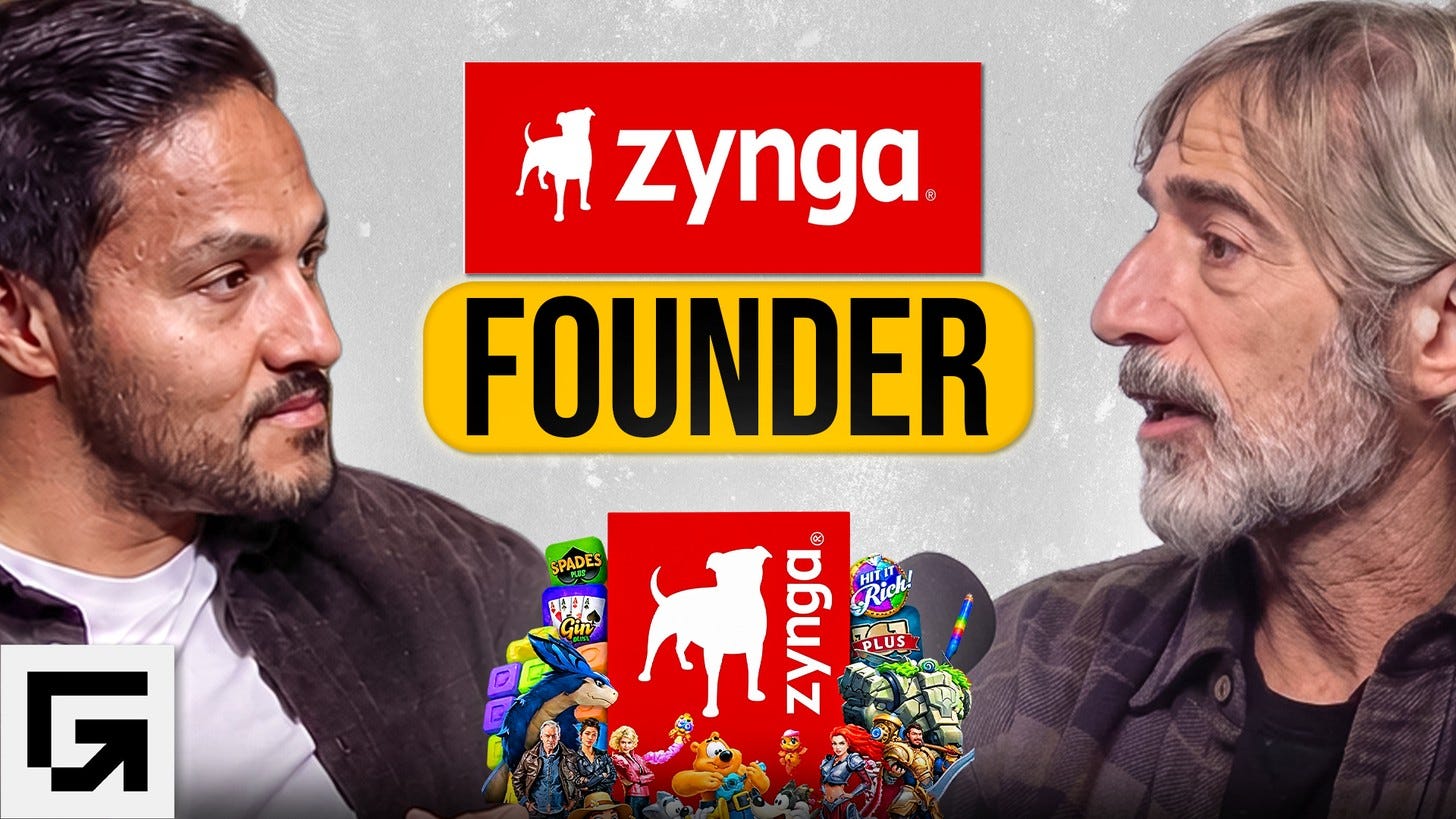
How to steal your way to a hit product, with Mark Pincus (founder, Zynga)

This is a public episode. If you'd like to discuss this with other subscribers or get access to bonus episodes, visit www.news.aakashg.com/subscribe Brought to you by Mobbin: The internet's best library of real design patterns Get a full year of Mobbin Pro, along with 8 other AI tools, at bundle.aakashg.com. Today's Episode I quote Mark Pincus more than almost anyone, and I still feel a little guilty every time I do. For years, the internet calls him a "FarmVillain," the founder who copies his way to the top. Today he owns it. Mark (founder of Zynga, author of Life at the Speed of Play) steps up to my whiteboard and draws Proven Better New, the framework I reach for every time I plan a product. He shows me how Zynga Poker copies the leading tables down to the chip sounds and still wins on one small new bet. Then he makes the case that most AI founders today are being too clever for the moment. If you're building anything consumer right now, this is the one episode to watch. 10 Key takeaways 1. Copying is what every product maker already does - Mark argues that all music, movies, stories and games are derivative work. The real skill is the magic trick: you learn from someone else's proven success and make it feel new. Steve Jobs did it better than Bill Gates, even though both copied Xerox PARC. 2. Trust your instinct, doubt your idea - Mark puts your instinct at about 95% right and your specific idea at maybe 25%. Proven Better New lets you act on both at once. 3. Proven means pixel-level, for this audience on this platform - You copy the experience click by click, legally. "Instagram" can't go in your proven column. Today's best version of the specific experience can. 4. Better is what 10 out of 10 existing users would choose - What you think is better is actually new. Better is usually small: no download, free, fewer clicks, a cleaner onboarding. 5. Isolate your new so you fail for the right reason - Zynga Poker copies the leading tables down to the chip sounds, drops the download and adds one new thing, your real friends from Facebook and MySpace. Mark says friends end up at the same table 25% of the time. 6. Onboarding belongs in proven - Zynga's PMs call social Civilization and SimCity Social dead on arrival because of their long tutorials. In casual games you need to reach the good stuff in three clicks, not three minutes. 7. All new fails - Zynga still repeats this mantra. Expect your new to fail so you kill it fast, and treat new that works in the market with reverence, because it just became proven. 8. Early in a platform shift, ship less new - Supercell's Hay Day launches with 0% new, just a FarmVille built for mobile. In the AI cycle, users sit in discovery mode, so an AI version of something they already do beats an idea that's too clever for the moment. 9. Copy everything by default, then cut on audience - FarmVille copies Farm Town's gifting and its two-way neighbor bar, friction included. It cuts only the stranger marketplace, because that doesn't fit its core audience of middle-aged women on Facebook. 10. Test the top of the funnel before you build - Mark's problem with the MVP is the word viable, because it fills you with hope. Test names and web ads first, and set a click-through bar before you write real code. Go Deeper How you need to think about product strategy in the age of AI (with Tim Herbig) The Ultimate Guide to Onboarding Ultimate Guide: Activation The Multiplayer Lever Ultimate Guide: Growth Loops The PM's Guide to Governance with Eric Ries Listen and watch on Apple, Spotify, and YouTube. If you want to advertise, email productgrowthppp[at]gmail[dot]com.
55 minAbspielen in:

Di20Okt
The Growth PodcastJM

James McAulayGast

Claude Code for Growth: Complete Masterclass with James McAulay

This is a public episode. If you'd like to discuss this with other subscribers or get access to bonus episodes, visit www.news.aakashg.com/subscribe Brought to you by Fingerprint: Identify good and bad visitors with industry-leading accuracy Ariso: Ship AI agents and features faster, with fewer regressions Customer.io: Send smarter messages using your product data Amplitude: The market leader in product analytics Product Faculty: Get $150 off their #1 AI PM Certification via code AAKASH150 Today's Episode "We no longer need to wait for engineers to build growth experiments." That's what James McAulay told me. Halfway through our recording, he showed me what he meant, on my own site. He ran one Claude Code skill, and a few minutes later I had a list of SEO fixes I'd been ignoring while my search traffic slid. So I made this episode for every PM and founder doing growth with no team behind them. James led Creator Growth at ElevenLabs, and now he runs his whole business from one folder in Claude Code. I asked him to open it up. He walks through: The goal cascade that stops Claude (and you) from building features nobody asked for An SEO audit skill wired to Firecrawl, DataForSEO and Lighthouse, run live on my site Multi-agent refine, the panel of critic agents he runs on every plan before anything gets built He runs his actual business on every piece of it, and that's why it holds up. If you own growth and never seem to have time for it, start here. Key Takeaways 1. Run growth from one folder - James's growth OS is one folder with three layers: tools with real APIs, skills he uses every day, and weekly routines that improve the setup. If the agent can't read a tool's data, the tool doesn't make the cut. That rule alone keeps the whole stack usable by an agent. 2. Tie every session to your goals - A goal cascade runs from a yearly mission file to quarterly OKRs, monthly and weekly retros, and a daily standup. A session hook shows Claude the mission at the start of every session. When you drift, it pushes back. 3. The weekly retro is the one that matters - James sometimes skips the standup, but never the Friday retro. Connected to his to-do list and GitHub, it caught him refactoring for fun while outreach tasks went stale for weeks. Your gut says one thing, the data checks it. 4. Do the long onboarding - The full setup is an interview with Claude that can run two hours. It feels like a slog. But once your context lives in files, every answer after it gets better. 5. Close every experiment - Each test starts from a template with a hypothesis, baseline, primary metric, confounders and stop conditions. The weekly retro and daily standup flag finished and stale tests. Every one ends in a documented learning instead of a forgotten dashboard. 6. Pull baselines, don't type them - When you set up a test, numbers like baseline conversion and traffic should come straight from PostHog, Mixpanel or Amplitude. James says nobody should be answering those questions by hand. Connect the analytics tool before you design the test. 7. Rebuild your SEO audit with cheap APIs - James's SEO audit skill adds Firecrawl to read any site, DataForSEO for keyword research at a few cents a term, and the Lighthouse CLI for page speed. Hand the report to the agent in your repo and it fixes the issues. What used to take an agency and a backlog weeks now takes hours. 8. Put critics in front of every build - Multi-agent refine sends a plan to 3 to 10 subagents, each with a different lens, then ranks the findings P0 to P3. The "what's missing" critic finds the most. Use Sonnet or Opus subagents so you don't burn through your limits. 9. Define every analytics event - James had Claude write definitions for all 350 of his PostHog events in about two hours. A CI test now blocks any PR that ships without tracking. Clean event data lets any agent or contractor measure your funnel correctly. 10. Ask your agent to improve itself - Ask Claude how to improve its own Claude.md, prompt or skill, and act on the answer. Most people miss this because chat can't edit its own instructions. Claude Code and Cowork can. Related content 1. Podcasts How to build a Company Operating System with Hermes and OpenClaw How to Build Effective Product Loops in Claude Code, with Tyler Folkman This CPO Uses Claude Code to Run his Entire Work Life, with Dave Killeen 2. Newsletters I spent 100s of hours building a PM OS for you How to build product-led growth in 2026 AI Agents: The Ultimate Guide for PMs Where to find James McAulay LinkedIn: https://www.linkedin.com/in/jamesmcaulay X: https://x.com/thejamesmcaulay YouTube: https://www.youtube.com/@JamesMcaulay0 Website: https://www.jamesmcaulay.co.uk Agent Accelerator: https://agentaccelerator.ai Where to find Aakash X: https://x.com/aakashgupta LinkedIn: https://www.linkedin.com/in/aagupta/ Newsletter: https://www.news.aakashg.com PS. Please subscribe on YouTube and follow on Apple & Spotify. It helps! If you want to advertise, please email productgrowthppp[at]gmail[dot]com. To hear more, visit news.aakashg.com
1 h 08 minAbspielen in:

Do8Okt
The Growth PodcastAS

Ankit ShuklaGast

The Roadmap to Becoming a Product Builder, with Ankit Shukla

Brought to you by Mobbin - Discover real-world design inspiration Get a full year of Mobbin Pro, along with 8 other AI tools, at bundle.aakashg.com. Today’s episode LinkedIn shut down its Associate Product Manager program and replaced it with an Associate Product Builder program. If you’re a regular reader, you know I’ve been writing about this shift for a long time. What’s new is that the market just gave it a full-fledged title. And a title in a job post comes with 3 things: a JD, interviews, and a comp range. So I brought back the one guest I knew would bring the best-case data. Ankit Shukla, founder of HelloPM, ran 12,500 PM job descriptions through Claude and GPT to see what top companies hire for. His AI PM roadmap is still my most popular episode ever. His evals episode is #2. This one goes further than both. 10 Key takeaways 1. The product builder role is real, and the data says so - 12,500 PM job postings analyzed with Claude and GPT. More than 30% now ask for hands-on AI building. The title has not caught up everywhere, but the requirements already have. 2. Judgment is the skill being paid for, not the tools - Across those postings, RAG, agentic AI and prompt engineering were not the number one skill. Identifying the right use case for AI was. The engineering part is what AI can already do for you. 3. The premium is real and it is bigger in India - More than 20% over traditional PM pay globally, with a $195,000 median in the US and senior roles reaching $250,000 to $560,000. Indian AI PM roles carry an even steeper premium over their non-AI counterparts. 4. Start with possibilities, not problems - Traditional product management starts with the problem. AI inverts that, because some problems you never framed as problems at all. You were treating them as harsh realities. Map what AI can do before you map what hurts. 5. Never start with the tool - The biggest takeaway Ankit gives is that POW comes before E. Possibilities, opportunities and workflows first. The moment you open n8n before you have done those three, you are building AI slop with extra steps. 6. The five levels, and why most people stall at level one - Prompting, then reusable Gems and custom GPTs, then skills and connectors, then vibe coding, then production builds with MCPs. Most people live at level zero and one. Level two is where the ROI actually starts. 7. Claude Code versus Codex is a settled debate - Ankit benchmarked both plus Cursor and a DeepSeek harness across e-commerce, social, and gaming builds. All of them shipped functional sites. For 90% of use cases the choice does not matter, so stop optimizing it. 8. The build was 20 minutes of human time and 20 hours of agent time - A production email platform on Node, TypeScript and AWS, built by someone who deliberately avoided the languages he already knew. He pulled the AWS MCP so he never touched the console, then slept while Claude shipped slices. 9. Audit what the agent spends - Claude proposed a $420 a month stack. Ankit knew AWS well enough to ask why it provisioned a machine that large and what Fargate was for. The revised stack came back at $110. The judgment is in the review, not the build. 10. The last 20% is where the job moved - Claude takes you 80% of the way overnight. Bug fixing, edge cases and errors are what remain, and in most companies the PM hands that part to an engineer. The PM's new job is producing the prototype that makes the conversation real. Please subscribe on YouTube and follow on Apple and Spotify. It helps! If you want to advertise, please email productgrowthppp[at]gmail[dot]com. This is a public episode. If you'd like to discuss this with other subscribers or get access to bonus episodes, visit www.news.aakashg.com/subscribe
1 h 08 minAbspielen in:

Do24Sep
The Growth PodcastWF

Wade FosterGast

How to Get a ‘Transformative’ AI Fluency Rating as a PM, with Wade Foster | CEO of Zapier

Brought to you by Arize - Ship AI agents and features faster with fewer regressions. Get a full year of Arize’s paid plan, along with 8 other AI tools, at bundle.aakashg.com. Today’s episode I wrote a PRD using ChatGPT, with a considerable number of iterations, and gave it to the CEO of Zapier to grade. In 2024, that PRD would have killed in any product review. But Wade Foster called it a little old-fashioned. In 2026, the work that made you look smart in 2024 is now the bare minimum. Shopify, Meta, and Microsoft have all tied AI to employee evaluations. Zapier took it a notch higher and published a whole rubric on AI fluency. Then reintroduced another one just 10 months later! Read the complete update here. Wade co-founded Zapier and took it to a $5B valuation on roughly $1.4M of venture money. His rubric is the one a lot of companies have modeled their own on. So I got him to share his grading structure live. If you want to know where you’d be when your company starts grading, I got you. Key takeaways 1. Basic AI use is the floor, not the bar - Summarizing, drafting, looking things up and generating a basic PRD are table stakes at Zapier in 2026. Everything above that line needs structured, reusable systems for specs, prototypes and research. Wade is looking for people operating at a meaningfully higher level than the tool's default. 2. Adaptive is where the curve should sit - Zapier wants most PMs at adaptive most of the time, with one transformative example to point to. Living at transformative full time means you are tuning your systems instead of shipping. Gaps in the capable band are normal, even for strong PMs. 3. Transformative means an n of one - Wade's bar is that you are the first person doing a new thing and figuring it out as you go. On a team of 30 to 40 PMs, that is roughly one rating a half. He grades his own fluency as adaptive in most places and admits he steals his transformative tactics from his team. 4. You should be ahead of your CEO inside your own discipline - Wade's rule of thumb is that he should be behind his PMs on PM-specific AI fluency. When he spots a technique that is obvious to him and new to the PM, he gets nervous. You breathe this every day and he does not. 5. Never stop at the PRD - A document alone reads old-fashioned in 2026. Fire up a coding agent and build the prototype, even though production code is not the PM's job. A picture is worth a thousand words and a prototype is worth ten of those. 6. Evidence got cheap, so there is no excuse - Sift Gong calls, Zendesk tickets, subreddits, LinkedIn and X before asking anyone for buy-in. AI makes a mountain of sources searchable in the time it used to take to read a handful. The buy-in conversation now happens after you have proof, not before you start. 7. Judgment separates a turbo brain from a slop cannon - AI plus judgment looks like watching a new species get invented. AI without judgment generates so much noise that it is harder to work with than a teammate who uses no AI at all. At least that person is quiet. 8. Label the effort level when you share AI-assisted work - Say whether you skimmed it once or stand behind every sentence. Handing over unreviewed output just moves the judgment onto the reader. Speed is a fine reason to share something rough, as long as you say it is rough. 9. The job shifts from doing tasks to auditing the factory - When agents handle spec, prototype, eval and first-draft code, your job is to ask why the machine produced a bad batch, not to fix widgets by hand. Where the human gates go is the design question nobody has solved. Wade sees teams still scratching their heads on the loop design. 10. The new no-code is code, and the user is now the agent - Wade's daily brief runs on generated code he has never read and does not care about. Zapier's bet is deterministic execution in the cloud, so workflows run reliably without burning tokens or keeping a laptop open. If your software cannot run headless, you are swimming against the current. Go Deeper If you ask me, start by shipping your first pull request. Then learn loops to automate your repetitive tasks. Give your system a memory on Claude Code or Hermes or OpenClaw. Then version everything you build for PMs on GitHub. You can also bring the whole org on the same page with an all-in-one team OS. And once the system is running, build your first eval, as auditing is the whole point here. I’ll see you in the next one :) If you want to advertise, please email productgrowthppp[at]gmail[dot]com. PS. Please subscribe on YouTube and follow on Apple and Spotify. It helps! This is a public episode. If you'd like to discuss this with other subscribers or get access to bonus episodes, visit www.news.aakashg.com/subscribe
1 h 14 minAbspielen in:

Fr28Aug
The Growth PodcastMS

Mikhail ShcheglovGast

How to build a Company Operating System with Hermes and OpenClaw

Today’s episode Today I’m showing you how to build a company operating system, with Mikhail Shcheglov, CPO at OLX Classifieds. After 5 months of continuous building on OpenClaw and Hermes, his entire product team now runs on it. His knowledge graph covers 54% of the company's product, business and customer context. That is a number he tracks as a personal KPI. At that level the agent already makes backlog decisions. Stakeholders pitch feature requests to it before they’re allowed near a PM. It runs his email, his calendar, his recruiting funnel and his design system. He opens his IDE on camera and shows all of it. 2 findings cut against everything you’ve been told. Summarizing your meeting transcripts costs you 20-25% recall, so he stores every single one raw. And letting Hermes write its own skills off repeated tasks produced a 31% accuracy lift in controlled testing. We also get into something heavier than architecture. What happens to PM headcount when one PM covers four domains? And what does a CPO actually screen for now when hiring? Don't miss.... Brought to you by Bolt.new - Ship AI-powered products 10x faster Product Faculty - Get $150 off their #1 AI PM Certification: code AAKASH150 Customer.io - Send smarter messages using your product data Land PM Job - 12-week live course to master the PM job search Viktor - Use $100 in starting credits to get 5x more done with this AI employee If you want access to my AI tool stack including Airtable, Speechify, Descript, Magic Patterns, Linear, Dovetail, Arize and Mobbin, that's $27,000 of value for $150, grab https://bundle.aakashg.com/.  Key Takeaways Context coverage is a CPO level KPI - Mikhail tracks what percentage of the company's industry, business model and customer knowledge his agent actually holds. It sits at 54%. That is enough for it to operate like a junior to mid PM and make backlog calls. At 70 to 90% he expects strategy level work. The real problem AI solves is knowledge leakage - A domain expert leaves and takes five years of context with them. Every company has this hole and almost nobody measures it. One store of business, customer, product and technical knowledge closes it, and the better your AI knows that context the more you can hand it. Do not summarize your transcripts - Summarization cost them 20 to 25% recall. You lose the granular detail where the answer usually lives, and you force every conversation into a template it was never shaped like. Store everything raw. Memory needs three layers, not one - A knowledge graph for structure, a vector database for fuzzy retrieval, and raw daily transcripts in MD files. Exact keyword matching fails on most real queries because real questions are ambiguous. The vector layer carries the load. Auto generated skills lifted recall by 31% - Hermes watches what you keep asking for and decides on its own that a skill is worth writing. Tested across five core topics with ten questions each, control group against treatment group. Plus 31% accuracy. Imperatives matter more than prompts - Their rules file runs 700 lines. No fabrications. Think before you act. Facts over guesswork. And a ban on what he calls fake helpful, where the agent can't do the thing so it explains how you could do it yourself. CLAUDE.md stays short, SOUL.md goes long - CLAUDE.md holds under 100 lines and carries the highest priority. SOUL.md runs 800 and sits second. Some of those 800 lines contradict each other and it still produces his most accurate output, because every imperative gets tested against real queries. Make the agent the gatekeeper - Stakeholders are trained to pitch the agent first. It asks clarifying questions, checks the request against priorities already set, declines politely if it doesn't clear the bar, and routes it to the right PM if it does. The org chart is mapped internally so it knows who owns what. Half of PM time is process, not thinking - Weekly reports, stakeholder updates, demos. Delegate that layer and one PM does the work of two, pointed entirely at discovery. He now runs one PM across three or four customer facing domains, and only keeps dedicated owners on monetization and search. Own the agent yourself or lose the advantage - Feedback arrives daily and he pushes changes from his phone straight into the repo. Hand it to an AI ops hire or an engineering team and you keep the tool but lose the speed. Nobody without skin in the game iterates fast enough. Related content I’ve already created all of the resources Mikhail mentioned in this episode. But I never mapped them all to one place. That changes today in this edition. PFA the map sorted by the parts you want to build. Memory first, I Built You Memory for Claude Code, Hermes and OpenClaw Once you've got a memory layer, put it in version control. GitHub for PMs has the 3-repo setup I use for skills and eval The Hermes Agent Guide for PMs is a 20-minute setup and a 30-day rollout with persona and skill templates included For OpenClaw, start with Mahesh Yadav on becoming a Builder PM For the org-wide version, watch my episode with Jiaona Zhang, CPO at Laurel, on building a Company OS My conversation with Hannah Stulberg of DoorDash on building a Team OS is the same thing one floor down, with a free starter kit 👨‍💻 Where to find Mikhail Shcheglov: LinkedIn: https://www.linkedin.com/in/scheglovm1/ Substack: https://corpwaters.substack.com/ 👨‍💻 Where to find Aakash: Twitter: https://x.com/aakashgupta LinkedIn: https://www.linkedin.com/in/aagupta/ Newsletter: https://www.news.aakashg.com/ If you want to advertise, email productgrowthppp@gmail.com. This is a public episode. If you'd like to discuss this with other subscribers or get access to bonus episodes, visit www.news.aakashg.com/subscribe

1 h 06 minAbspielen in:

Do6Aug
The Growth PodcastOU

Oji UdezueGast

3x CPO Oji Udezue on the Essential Claude Skills for PMs

This is a public episode. If you'd like to discuss this with other subscribers or get access to bonus episodes, visit www.news.aakashg.com/subscribe Whether you’re using a PM OS, or using regular Claude, or using another AI harness (like ChatGPT Work or Codex)… One of the most important parts of any PM’s AI setup is the skills you have. Today’s guest Oji Udezue, CPO at Typeform, Calendly, and Parsable, and he goes into a masterclass of what skills PMs should have, how to build them, and how to use them. Brought to you by: Bolt.new - Ship AI-powered products 10x faster Product Faculty - Get $150 off their #1 AI PM Certification: code AAKASH150 Customer.io - Send smarter messages using your product data Ariso - Ship AI agents and features faster, with fewer regressions Land PM Job - 12-week live course to master the PM job search Get More of Oji LinkedIn ProductMind The open-source skills repo Shipyard Building Rocketships Go Deeper I’ve done extensive testing on what makes a good skill and how to build a PM OS for paid newsletter subscribers (that go much deeper than this podcast). → Get the founding plan to get access. I also have several free podcasts on Claude Code that you may find helpful: my 3 part series with Carl Vellotti, PM OS with Dave Killeen, Team OS with Hannah Stullberg, Company OS with Jiaona Zhang, and Claude Code for CPOs. → To never miss an episode, subscribe on YouTube and follow on Apple & Spotify. Finally, in my live course, I teach you how to do extremely advanced PM automation Claude Code. → Join us.

1 h 05 minAbspielen in:

Di28Jul
The Growth PodcastDM

Daniel McKinnonGast

How to Build Frontier-Lab Quality Evals with Daniel McKinnon, ex-PM at Meta, Google

Today’s Episode A developer posted this workflow in March, and it is the clearest picture of where PM is heading that I’ve seen all year. Rasty Turek spent the past year building with coding agents, and he mapped how his process changed over that time. He reckons he now spends around 90% of his time on evals. His eval started as QA, and then it became the spec. Great, now everyone agrees evals are important and will become indispensable for PMs going forward. But there is very little on how to write one. That changes today. I’ve now done 6 episodes on evals, and all of them start with an agent that is running and failing. So what do you do on day 0? Daniel McKinnon was a PM on the Llama models at Meta, a boomerang who spent around 7 years there in total. He sat on Facebook’s central AI team for the entirety of its existence. He wrote enterprise evals for Gemini, Llama, and Ray-Ban Meta. His first job at Meta was on the speech recognition team. He had to figure out how to check whether the models were any good. They weren’t called evals back then. But he’s been writing them for his entire career anyway. In this episode you’ll learn: * How to build an eval set from nothing * The floor-and-ceiling method for calibrating * How to score it and make the shipping call Check it out: Please fill out this short survey on PM salaries. 🆓 I’m doing a free webinar Thursday on getting AI PM interviews. Join me: The next cohort of my LandPMJob program starts in August. If you want my 1:1 coaching, sign up. ---- Check out the conversation on Apple, Spotify, and YouTube. Brought to you by: * SerpApi - Get started with SerpApi using 250 free credits. * Product Faculty - Get $550 off their #1 AI PM Certification with code AAKASH550C7 * Ariso - Ship AI agents and features faster, with fewer regressions * Land PM Job - 12-week experience to master getting a PM job * Pendo - The #1 software experience management platform ---- Key Takeaways: 1. An eval is a trivia question for the model - At its core, an eval is a prompt with a correct or plausibly correct answer plus a way to score whether the output is good. It is the clearest way to communicate what your product should do in the AI era. 2. Offline evals catch problems before you ship - Test the model offline against a fixed prompt set before pushing to production. If it fails, you change the model, the prompt, or the approach before real users ever see it. 3. The best eval sits between too easy and too hard - An eval that scores 100% gives your engineering team nothing to optimize. An eval that scores 0% is equally useless. Aim for a 25% to 50% success rate so there is room to run. 4. Old benchmarks are already saturated - MMLU, HellaSwag, ARC and the rest were built for a simpler question-and-answer world. Frontier models now score effectively 100% on them, which is why you have to keep building new evals and throwing away old ones. 5. Writing an eval is mechanical once you understand the problem - Come up with roughly 100 prompts that match the real distribution of tasks. The hard part is not the writing. It is deeply understanding the domain first. 6. Subject matter expertise drives everything - The cystic fibrosis and congenital heart disease evals worked because Daniel understood the genetics, not because of any template or tool. There is no eval template the way there is a PRD template. 7. Modern evals are agentic, not just Q&A - The genetics eval hands the agent a file with billions of variants and asks it to find the cause of a disease. This is a task, not a lookup, and it mirrors how real AI products now work. 8. Find the model ceiling on purpose - The easy cystic fibrosis case gets solved by most models. The harder digenic congenital heart disease case exposes where even strong models fail. Knowing the ceiling is the point of the exercise. 9. Sample multiple times before you trust a result - Models are non-deterministic. Run the same task several times so you understand the real distribution of outcomes rather than a single lucky or unlucky pass. 10. Meta and Google build products very differently - Google is seen as more engineering-led, Meta as more product-led and far more aggressive culturally. Daniel worked on both Gemini and Llama and saw everything from Llama 3 highs to Llama 4 lows. ---- Where to find Daniel McKinnon * LinkedIn * X * Gamow Labs Related content Podcasts: * AI Evals with Hamel Husain and Shreya Shankar * How to Run Evals in Claude Code with Aparna Dhinakaran * Evals are the New PRD with Ankur Goyal Newsletters: * AI Evals for PMs: Everything You Need to Know to Get Started in 2026 * AI PM’s Guide to LLM Judges * AI Evals Explained Simply ---- PS. Please subscribe on YouTube and follow on Apple & Spotify. It helps! This is a public episode. If you'd like to discuss this with other subscribers or get access to bonus episodes, visit www.news.aakashg.com/subscribe

57 minAbspielen in:

Mo20Jul
The Growth PodcastEric Ries

Eric RiesGast

The PM's Guide to Governance with Eric Ries, author of The Lean Startup

Check out the conversation on Apple, Spotify, and YouTube. Brought to you by * Land PM Job - 12-week experience to master getting a PM job * Jira Product Discovery - Plan with purpose, ship with confidence * Amplitude - The market-leader in product analytics * Bolt - Ship AI-powered products 10x faster * Product Faculty - Get $550 off their #1 AI PM Certification with code AAKASH550C7 ---- Today’s episode Every startup founder picks up Zero to One. Reads the chapter on Delaware C-Corps. Files the paperwork. Moves on. That paperwork will outlast every product decision they ever make. I sat down with Eric Ries, the man who created Build, Measure, Learn. NYT bestselling author of The Lean Startup. Co-founder of Answer.AI with Jeremy Howard. Founder of the Long-Term Stock Exchange. Dario Amodei called him before Anthropic’s seed round. His new book Incorruptible drops May 26. It is the blueprint for building a company that the financial system cannot capture. He also demoed live how he wrote the book using Solve It, the AI platform from Answer.AI. Not prompting. Not generating. Editing the model’s responses directly. If you are building anything you want to outlast the next funding round, this is the one episode to watch. Check out the episode on Apple Podcast and Spotify. If you want access to my AI tool stack, grab Aakash’s bundle. ---- Key Takeaways: 1. Governance has four dimensions - Compliance is table stakes. Purpose, coherence, and integrity are the three most boards ignore. Companies that nail all four outperform the market over decades. 2. Financial gravity destroys good companies - The unconscious reflex to comply with the values of those who have more than you. Jim Senegal called it heroin. You compromise once and it gets baked into the forecast. 3. Costco's governance fortress is the blueprint - Staggered board terms, poison pills, fiduciary hierarchy. $10K at the Costco IPO is worth $8.7M today versus $151K in the S&P 500. 4. Stone does not enforce itself - Johnson & Johnson carved values into limestone. Asbestos ended up in the baby powder. $10B settlement. Structure protects ethos but does not create it. 5. Mission lock vehicles create 6x survival - A separate entity holding the for-profit board accountable. Novo Nordisk, IKEA, Patagonia, Hershey, Vanguard all use this structure. 60% survival to year 50 versus 10%. 6. Anthropic's LTBT took two years to defend - AI safety experts appoint board seats. The trust gains power as the company hits milestones. Structural protection is why Anthropic can afford to be courageous. 7. Public Benefit Corporations write mission into the charter - Legal permission to pursue purpose over shareholder value. Not the B-Corp certification sticker. A legal structure. 8. LLMs are conformity machines - They produce the center of the outcome distribution. For competitive advantage you must change how you use AI. 9. Solve It enables human-in-the-loop writing - Edit the model's responses directly. 600 test readers, 10K structured comments, Python scripts organizing feedback per chapter. 10. Build Measure Learn works at any timescale - Not about absolute speed. Relative velocity versus your industry convention. The AI labs that release more quickly create decisive trust advantages. ---- Where to find Eric Ries * LinkedIn * Incorruptible * Answer.AI / Solve It * Long-Term Stock Exchange * Lean Startup ---- Related content Podcasts: * AI Product Strategy with Aman Khan * The Marty Cagan Episode on Product Management * How to Succeed as a Head of Growth with Dan Olsen Newsletters: * AI product strategy in 2026 * How Cursor grows * PLG in 2026 ---- PS. Please subscribe on YouTube and follow on Apple & Spotify. It helps! If you want to advertise, email productgrowthppp at gmail. This is a public episode. If you'd like to discuss this with other subscribers or get access to bonus episodes, visit www.news.aakashg.com/subscribe

1 h 20 minAbspielen in:

Do9Jul
The Growth PodcastMT

Meng ToGast

The PM's Guide to AI Design that isn't Slop

Today’s episode Today I’m showing you, advanced Codex workflows with Meng To, founder of Design+Code. He told me early on that he’s barely touched Claude. He’s been living inside Codex every day since launch, running a setup most PMs have never seen up close. Plan mode and a fleet of 20 agents running at once while he steps away from his desk entirely. Slides, charts, and full brainstorms generated inside the same chat window, reviewed, regenerated, and shipped, all without writing a line of code. We also get into something heavier than workflows. Why PMs are losing their jobs to layoffs right now? And how to future proof your career? Don’t miss.... ---- Brought to you by: Arize: Trace, evaluate, and fix your AI agents before broken behavior ships to users ---- If you want access to my AI tool stack - Dovetail, Arize, Linear, Descript, Reforge Build, Relay.app, Magic Patterns, Speechify, Bolt.new and Mobbin - become an annual subscriber ($150), and grab Aakash’s bundle. If you want access to my AI PM customizations - PM OS, Job Search OS, and Prompt Library - become a founding subscriber ($250). ---- Key Takeaways: 1. Codex is a fleet operator - Meng runs 20 agents at once while stepping away from his desk entirely. Each one works on something different, slides, charts, brainstorms, while he does something else completely. 2. Plan mode isn't optional - Skipping it means paying twice, once to build the wrong thing, once to undo it. Codex returns a full breakdown, architecture, steps, and open questions, before touching anything. 3. A screenshot beats a paragraph every time - It shows the AI what you mean instead of what you think you mean. A simple two-key shortcut drops any window straight into the chat as context. 4. The taste skill is the real differentiator - Without it, AI design defaults to generic. With it, the output looks like something a senior designer with years of experience actually made. 5. Trust is earned in tiers - Read only first, then supervised access, then full access. Skipping straight to full access before learning where the AI tends to fail is how people get burned. 6. HTML beats Figma for speed - Every extra tool is a login, a subscription, and a context switch the AI can't do for you. Keep your blast radius small. 7. UGC won because audiences are tired of corporate polish - A synthetic version of you, used honestly, reads as more human than a generic message. Ten old photos is all it takes to build a digital twin. 8. Technical PMs aren't surviving layoffs because they write code - Meng hasn't written a single line in six months. They're surviving because they're fluent enough to direct a fleet of agents and catch a wrong output before it ships. 9. Meng builds his own tools when nothing off the shelf fits - His own video editor, his own SaaS templates, his own design brainstorming app. The tool built for your exact workflow beats the popular one every time. 10. The bar isn't five star anymore - Five star is just the floor everyone clears by default now. The real question is what six, seven, all the way to eleven star looks like, because that ceiling rises exactly as fast as the floor does. ---- Related content Podcasts: How to Design with AI - YouTube | Spotify | Apple How to Use Codex Like an OpenAI PM - YouTube | Spotify | Apple The Ultimate Guide to ChatGPT Codex - YouTube | Spotify | Apple Newsletters: OpenAI’s Codex is the Best Way to Use ChatGPT I spent 100s of hours building a PM OS for you How to build product strategy in the age of AI ---- 👨‍💻 Where to find Meng To: LinkedIn: https://www.linkedin.com/in/mengto Design+Code: https://designcode.io Aura: https://aura.build 👨‍💻 Where to find Aakash: Twitter/X: https://x.com/aakashgupta LinkedIn: https://www.linkedin.com/in/aagupta/ Newsletter: https://www.news.aakashg.com --- PS. Please subscribe on YouTube and follow on Apple & Spotify. It helps! If you want to advertise, email productgrowthppp at gmail. This is a public episode. If you'd like to discuss this with other subscribers or get access to bonus episodes, visit www.news.aakashg.com/subscribe

1 h 15 minAbspielen in:

Gäste, die länger als 12 Monate zurückliegen, gibt es mit Pro. Pläne ansehen