The Growth Podcast
How to Get a ‘Transformative’ AI Fluency Rating as a PM, with Wade Foster | CEO of Zapier
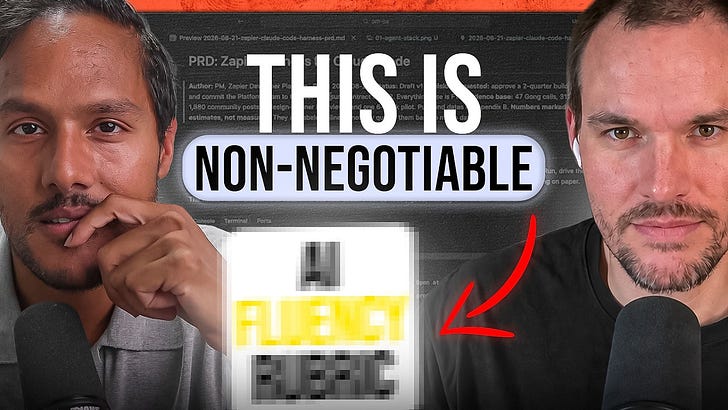
Brought to you by Arize - Ship AI agents and features faster with fewer regressions. Get a full year of Arize’s paid plan, along with 8 other AI tools, at bundle.aakashg.com. Today’s episode I wrote a PRD using ChatGPT, with a considerable number of iterations, and gave it to the CEO of Zapier to grade. In 2024, that PRD would have killed in any product review. But Wade Foster called it a little old-fashioned. In 2026, the work that made you look smart in 2024 is now the bare minimum. Shopify, Meta, and Microsoft have all tied AI to employee evaluations. Zapier took it a notch higher and published a whole rubric on AI fluency. Then reintroduced another one just 10 months later! Read the complete update here. Wade co-founded Zapier and took it to a $5B valuation on roughly $1.4M of venture money. His rubric is the one a lot of companies have modeled their own on. So I got him to share his grading structure live. If you want to know where you’d be when your company starts grading, I got you. Key takeaways 1. Basic AI use is the floor, not the bar - Summarizing, drafting, looking things up and generating a basic PRD are table stakes at Zapier in 2026. Everything above that line needs structured, reusable systems for specs, prototypes and research. Wade is looking for people operating at a meaningfully higher level than the tool's default. 2. Adaptive is where the curve should sit - Zapier wants most PMs at adaptive most of the time, with one transformative example to point to. Living at transformative full time means you are tuning your systems instead of shipping. Gaps in the capable band are normal, even for strong PMs. 3. Transformative means an n of one - Wade's bar is that you are the first person doing a new thing and figuring it out as you go. On a team of 30 to 40 PMs, that is roughly one rating a half. He grades his own fluency as adaptive in most places and admits he steals his transformative tactics from his team. 4. You should be ahead of your CEO inside your own discipline - Wade's rule of thumb is that he should be behind his PMs on PM-specific AI fluency. When he spots a technique that is obvious to him and new to the PM, he gets nervous. You breathe this every day and he does not. 5. Never stop at the PRD - A document alone reads old-fashioned in 2026. Fire up a coding agent and build the prototype, even though production code is not the PM's job. A picture is worth a thousand words and a prototype is worth ten of those. 6. Evidence got cheap, so there is no excuse - Sift Gong calls, Zendesk tickets, subreddits, LinkedIn and X before asking anyone for buy-in. AI makes a mountain of sources searchable in the time it used to take to read a handful. The buy-in conversation now happens after you have proof, not before you start. 7. Judgment separates a turbo brain from a slop cannon - AI plus judgment looks like watching a new species get invented. AI without judgment generates so much noise that it is harder to work with than a teammate who uses no AI at all. At least that person is quiet. 8. Label the effort level when you share AI-assisted work - Say whether you skimmed it once or stand behind every sentence. Handing over unreviewed output just moves the judgment onto the reader. Speed is a fine reason to share something rough, as long as you say it is rough. 9. The job shifts from doing tasks to auditing the factory - When agents handle spec, prototype, eval and first-draft code, your job is to ask why the machine produced a bad batch, not to fix widgets by hand. Where the human gates go is the design question nobody has solved. Wade sees teams still scratching their heads on the loop design. 10. The new no-code is code, and the user is now the agent - Wade's daily brief runs on generated code he has never read and does not care about. Zapier's bet is deterministic execution in the cloud, so workflows run reliably without burning tokens or keeping a laptop open. If your software cannot run headless, you are swimming against the current. Go Deeper If you ask me, start by shipping your first pull request. Then learn loops to automate your repetitive tasks. Give your system a memory on Claude Code or Hermes or OpenClaw. Then version everything you build for PMs on GitHub. You can also bring the whole org on the same page with an all-in-one team OS. And once the system is running, build your first eval, as auditing is the whole point here. I’ll see you in the next one :) If you want to advertise, please email productgrowthppp[at]gmail[dot]com. PS. Please subscribe on YouTube and follow on Apple and Spotify. It helps! This is a public episode. If you'd like to discuss this with other subscribers or get access to bonus episodes, visit www.news.aakashg.com/subscribe