The Nasdaq is taking another step toward trading around the clock. Prediction markets are offering odds on everything from election results to reality TV. Meanwhile, A.I. agents are fanning out across the internet, placing autonomous bets. Is this the new normal? Andrew Ross Sorkin sits down with Polymarket C.E.O. Shayne Coplan, Nasdaq chair and C.E.O. Adena Friedman and Robinhood chairman and C.E.O. Vlad Tenev to talk about where investing ends and speculation begins, how they think about regulation and investor protection and the growing role of retail investors in the market. Filmed live in 2026 at The New York Times DealBook Summit.
Subscribe today at nytimes.com/podcasts or on Apple Podcasts, Spotify and Amazon Music. You can also subscribe via your favorite podcast app here https://www.nytimes.com/activate-access/audio?source=podcatcher. For more podcasts and narrated articles, download The New York Times app at nytimes.com/app.
Hosted by Simplecast, an AdsWizz company. See pcm.adswizz.com for information about our collection and use of personal data for advertising.
David Senra
Intro
Check out the episode page
Read the full notes @ podcastnotes.org
Vlad Tenev is the co-founder and CEO of Robinhood. He was born in Bulgaria in 1987 and moved to the US at age five, a few years before hyperinflation wiped out his grandparents' savings. His parents kept the family afloat on a grad student's budget, and Vlad grew up as a latchkey kid teaching himself computers and tracking stocks on Yahoo Finance. When he scored 1,370 on the SAT at 12, his dad gave him that many dollars to invest. He went on to Stanford and then a math PhD at UCLA under Terence Tao, before his friend Baiju Bhatt convinced him to start a company during the 2008 financial crisis. Vlad tells the story of the near-collapse of Robinhood during the GameStop frenzy in January 2021: how a deposit requirement jumped from under $100 million to $3 billion overnight, why he called Micky Malka of Ribbit Capital first, and how a term sheet they had drafted after the outage in March 2020 made the rescue possible. He also explains why Micky passed on Robinhood's seed round but later became the only investor promoted to its public board, what his first startup taught him, and the legacy test that led him from selling trading software to hedge funds to building Robinhood.
Made possible by
Ramp: https://router.com
AppLovin: https://applovin.com/senra
WorkOS: https://workos.com
Deel: https://deel.com/senra
Chapters
(00:00:00) Why Ribbit passed on Robinhood's seed round
(00:02:19) "You're going to want me on your board"
(00:05:35) The day-long trading outage of March 2020
(00:09:22) A term sheet for a crisis that hadn't happened yet
(00:15:00) Crypto goes from zero to a top revenue stream
(00:16:27) The $3 billion deposit requirement
(00:18:35) "Vlad, you have to call work right away"
(00:21:34) The first call: Micky Malka
(00:24:31) "Time kills all deals"
(00:25:33) Number one app in the App Store, ahead of Instagram and TikTok
(00:27:01) $10 billion of demand
(00:29:33) Hyperinflation and copper cookware in Bulgaria
(00:35:34) "Manhattan just seemed like science fiction"
(00:47:15) His SAT score in dollars to invest
(00:50:53) Studying under Terence Tao
(01:00:22) "You want to be businessman, huh?"
(01:03:48) The best parts of math without the bullshit
(01:05:56) Would I be proud of this in 50 years?
Learn more about your ad choices. Visit megaphone.fm/adchoices
A critical day for Wall Street as investors await the Fed’s latest rate decision and earnings from Alphabet and Microsoft. Plus, SK Hynix surges after reporting a 630% jump in profit, fueling fresh debate over the AI trade. And Robinhood CEO Vlad Tenev joins Squawk on the Street in a first-on-CNBC interview as shares tumble following mixed earnings, with weaker crypto revenue weighing on results.
Squawk on the Street Disclaimer
Hosted by Simplecast, an AdsWizz company. See pcm.adswizz.com for information about our collection and use of personal data for advertising.
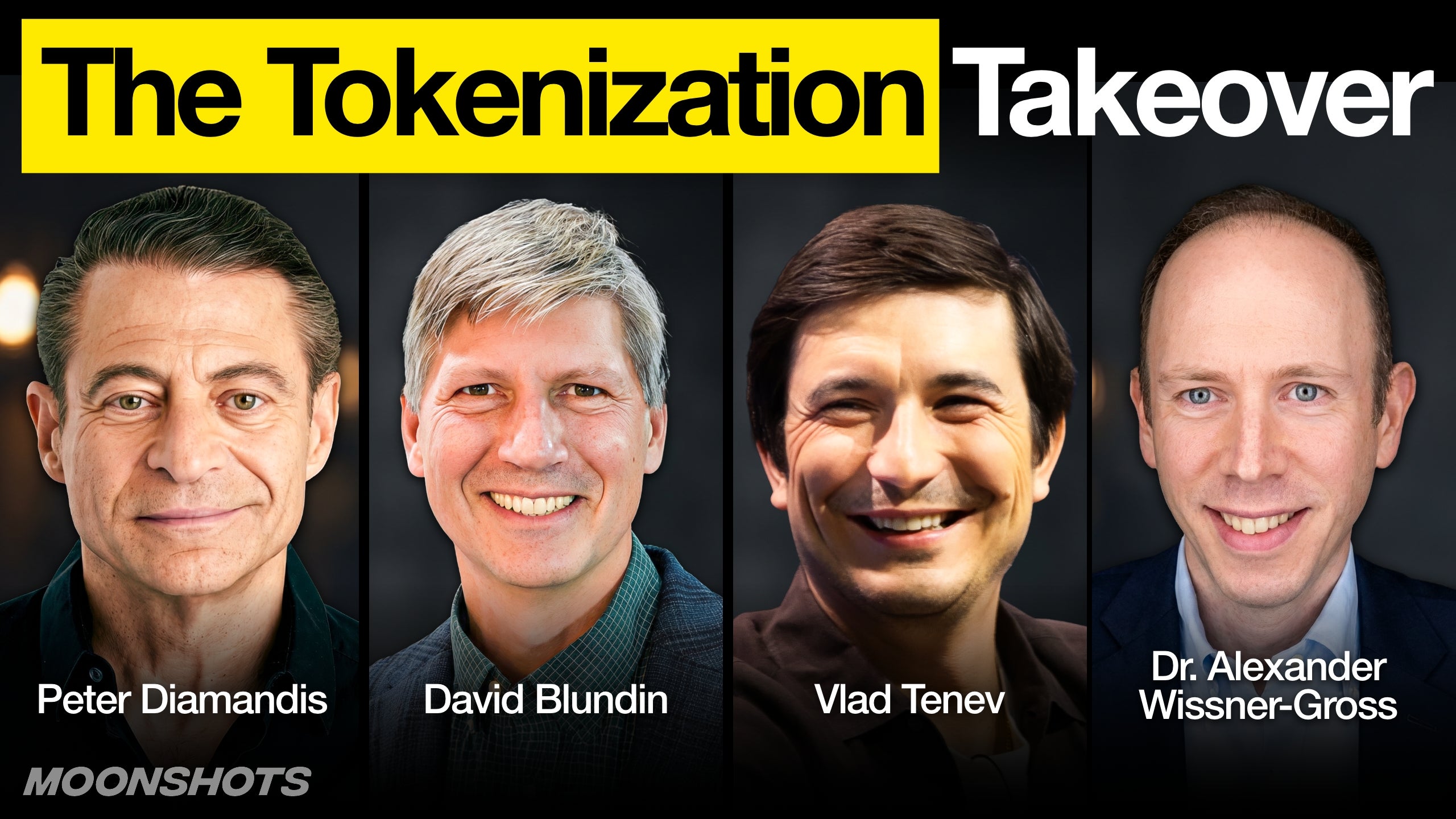
The mates sit down with Robinhood co-founder and CEO Vlad Tenev to discuss the tokenization takeover, the future of AI-powered trading, Trump Accounts, and what happens when 100,000 AI agents enter the market.
Get access to metatrends 10+ years before anyone else - https://qr.diamandis.com/metatrends
Peter H. Diamandis, MD, is the Founder of XPRIZE, Singularity University, ZeroG, and A360
Dave Blundin is the founder & GP of Link Ventures
Dr. Alexander Wissner-Gross is a computer scientist and founder of Reified
Vlad Tenev is the co-founder and CEO of Robinhood, the financial services company known for popularizing commission-free stock trading among retail investors.
–
This episode is brought to you by:
Get the blueprint for generative media https://goo.gle/startupgenmedia
Go to Blitzy to book a free demo and start building today: https://qr.diamandis.com/blitzy
Your body is incredibly good at hiding disease. Schedule a call with Fountain Life to add healthy decades to your life, and to learn more about their Memberships: https://www.fountainlife.com/peter
_
Connect with Peter:
X
Instagram
Substack
Website
Xprize
A360
Connect with Dave:
Web
X
LinkedIn
Instagram
TikTok
Connect with Alex
Website
LinkedIn
X
Email
Substack
Spotify
Threads
Connect with Vlad
Website
X
Listen to MOONSHOTS:
Apple
YouTube
Follow MOONSHOTS:
Instagram
TikTok
X
Threads
–
*Recorded on September 18th, 2026
*The views expressed by me and all guests are personal opinions and do not constitute Financial, Medical, or Legal advice.
Learn more about your ad choices. Visit megaphone.fm/adchoices
Vlad Tenev (Robinhood co-founder/CEO) and Tudor Achim (former helm.ai CTO) are the founders of Harmonic, an AI lab pioneering the path toward mathematical superintelligence. Together, they developed Aristotle, a model that eliminates hallucinations by reasoning in Lean code rather than natural language. By shifting from probabilistic guesses to formal logic, Aristotle produces 100% verified mathematical outputs. The model recently demonstrated its breakthrough capabilities by achieving gold-medal performance at the International Math Olympiad.
In this episode of Summation, Vlad, Tudor, and Auren discuss:
Why AI models struggled at math for so long
How Aristotle helped 10x the total corpus of formally verified Erdos problems in just a few months
Why formal verification will make all software dramatically safer
How the first Millennium Prize problem will be solved by 2027-2028
You can find Auren Hoffman on X at @auren, Vlad Tenev on X at @vladtenev, and Tudor Achim on X at @tachim
49 min
1 guest appearance from before November 2025The free plan shows the last 12 months. Unlimited opens the full history.