Sven Beckert

Sven Beckert

German-American historian

Sven Beckert has been a guest on 3 podcast episodes across 3 shows in the last 12 months. Latest: WDR 5 Das philosophische Radio, Jul 13, 2026.

Bio from WikipediaPhoto: Photo by Jessica Picard for the Massachusetts Daily Collegian, CC BY 2.0, via Wikimedia Commons

Two years on the air

GuestHostMentioned

Guest appearances

Mon13Jul
WDR 5 Das philosophische Radio

WDR 5 Das philosophische Radio

Sven Beckert: Wie der Kapitalismus die Welt verändert

Wie ist der Kapitalismus entstanden, wie hat er sich verändert und welche Zukunft hat er? Jürgen Wiebicke spricht mit dem Historiker Sven Beckert über die Rolle des Staates, das Verhältnis zur Demokratie und soziale Ungleichheit. Sven Beckert (*1965) ist ein deutsch-amerikanischer Historiker und Professor an der Harvard University. Er forscht vor allem zur Geschichte der USA im 19. Jahrhundert, zur Geschichte des Kapitalismus und zur Globalgeschichte. In Beckerts Arbeiten geht es oft darum, Kapitalismus nicht nur als Wirtschafts-, sondern auch als politisches und soziales System zu verstehen. Entstehung und Bedeutung des Kapitalismus (03:06) Kapitalismus und die Natur des Menschen (07:30) Vor- und Nachteile des Kapitalismus (10:54) Forderung: Kapitalismus global denken, nicht nur europäisch (17:08) Wie sich der Kapitalismus im Laufe der Zeit geändert hat (20:40) Zentrale Rolle des Staates im Kapitalismus (28:10) Liberale Demokratie und Kapitalismus (34:02) Grenzen und Zukunft des Kapitalismus (42:04) Politik und soziale Ungleichheiten (47:17) Literatur: Sven Beckert: Kapitalismus. Geschichte einer Weltrevolution. Rowohlt Verlag (2025). 1280 Seiten. Mehr zum Thema im Philosophischen Radio: Carsten Lotz: Kritik der ökonomischen Vernunft Hanno Sauer: Was soziale Klassen heute ausmacht Philosophieren Sie mit über die großen Themen unserer Zeit. Das philosophische Radio mit Jürgen Wiebicke immer montags um 19:04 Uhr live in WDR 5. Im nächsten Podcast sprechen wir mit dem Autoren und Rechtsphilosophen Bernhard Schlink über Gerechtigkeit. Sie haben Fragen oder Kritik? Schreiben Sie an philo@wdr.de. Wenn Ihnen diese Folge gefallen hat, bewerten Sie uns gerne und empfehlen Sie uns auf ihrer liebsten Podcast-Plattform weiter. Unser Podcast-Tipp: "Alles Geschichte – Der History-Podcast“. Hier werden historische Ereignisse behandelt, spannend und abwechslungsreich.
52 min

Wed6May
Epicenter

Epicenter

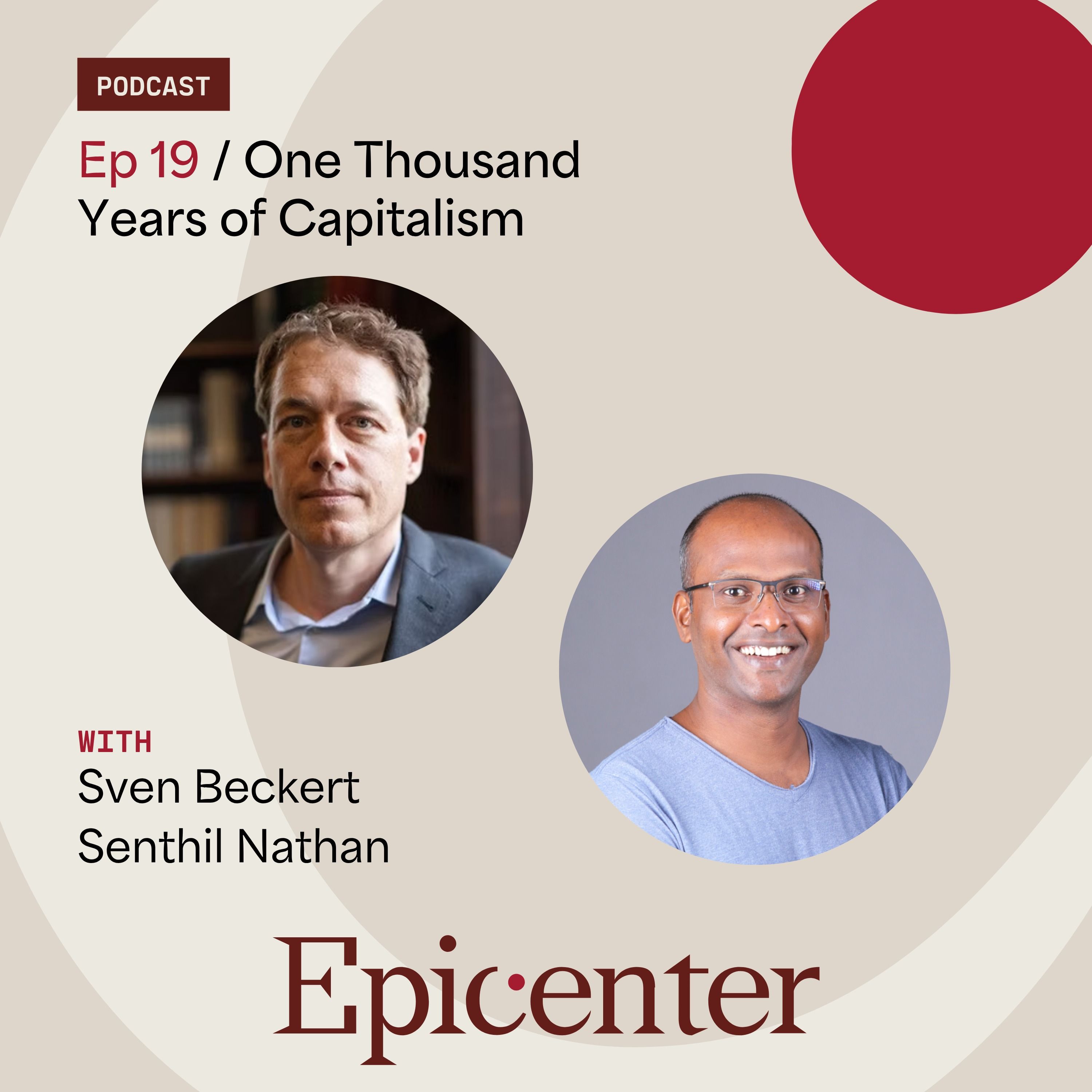
One Thousand Years of Capitalism (with Sven Beckert)

Sven Beckert, a history professor at Harvard, has written an epic book about the history of capitalism over roughly a millennium: it’s called Capitalism: A Global History. Beckert believes the only way to understand one’s place in the world is through understanding how we arrived at the system we currently live in: global capitalism. In this episode, guest host Senthil Nathan interviews Sven Beckert about the major developments in history and expansion of capitalism. Almost all of life is organized around capitalist logic, says Beckert, and the capitalist model has changed and evolved over more than one thousand years. Capitalism’s history begins with merchant communities eight hundred or so years ago, long-distance traders who connected various small cities. The drive to expand and create more capital led to the large-scale production of agriculture in the countryside and development of extraction industries such as silver in Potosí, Bolivia. Europeans took advantage of power differentials in other parts of the world to recast production in profound ways, including mobilizing labor in the practice of slavery, which quickly expanded production into the countryside. Sugar, cotton, oil, and rubber are all commodities that emerged via the forces that drove the capitalist expansion—particularly in Africa, the Americas, and the Caribbean. The book ends in the year 2023, and Beckert remarks on the responsibilities humans have to acknowledge the consequences of capitalism’s expansion, such as slavery and environmental degradation. He notes the purpose of the book is not to make judgments about whether or not capitalism is a net benefit or harm to humanity but to understand how we arrived at the present moment. Beckert also speculates on how quickly capitalism will change and adapt in the future. This is a joint production with the Business and Society podcast by Senthil Nathan. Nathan is a visiting fellow with the Weatherhead’s Scholar’s Program and joins us as a guest host. Guest Sven Beckert, Faculty Associate; Chair, Weatherhead Research Cluster on Global History. Laird Bell Professor of History, Department of History, Harvard University. Host Senthil Nathan, Fellow, Weatherhead Scholars Program. CEO, Fairtrade Australia/New Zealand; Board Member, Australian Council for International Development; Host, Business and Society podcast. Related Links Capitalism: A Global History, by Sven Beckert (Penguin Random House, 2025) Empire of Cotton: A Global History, by Sven Beckert (Penguin Random House, 2015) Harvard and Slavery: Seeking a Forgotten History, coauthored by Sven Beckert "War, Work, and the Fragile Ladder of Dignity," by Senthil Nathan on Epicenter Business and Society Podcast Music “African Moon” by John Bartmann. Source: Free Music Archive (CC0 1.0 Universal License) This episode was produced, edited, and mixed by Michelle Nicholasen, Editor and Content Producer at the Weatherhead Center. Follow the Weatherhead Center for International Affairs: Weatherhead Center Website Epicenter Website Facebook LinkedIn Instagram Bluesky Simplecast YouTube

45 min

Thu18Dec 25
Capitalisn't

Capitalisn't

How Capitalism Became Global ft. Sven Beckert

Is capitalism a force of nature, or a human-made order that we have the power to shape? In this episode, Luigi and Bethany sit down with Sven Beckert, a Harvard historian and author of the new book A Global History of Capitalism, to tackle a question that seems basic but remains surprisingly difficult to answer: what exactly is capitalism? Beckert argues that capitalism is not defined simply by the existence of markets—which are found in all human societies—but rather by a specific economic logic of privately owned capital productively invested to produce more capital. He challenges the popular narrative that capitalism and the state are antithetical, suggesting instead that the state has been constitutive of capitalism throughout its history, from the colonization of the Americas to the industrial expansion of the 19th century. Beckert also argues that capitalism is fundamentally "undogmatic", pointing out that it has thrived under radically different political systems from the British Empire and the slave plantations of the Caribbean to modern liberal democracies and authoritarian city-states. Rather than existing in opposition to the state, does capitalism actually rely on state power to construct markets and enforce the expansion of its logic?  Hosted by Simplecast, an AdsWizz company. See pcm.adswizz.com for information about our collection and use of personal data for advertising.

53 min