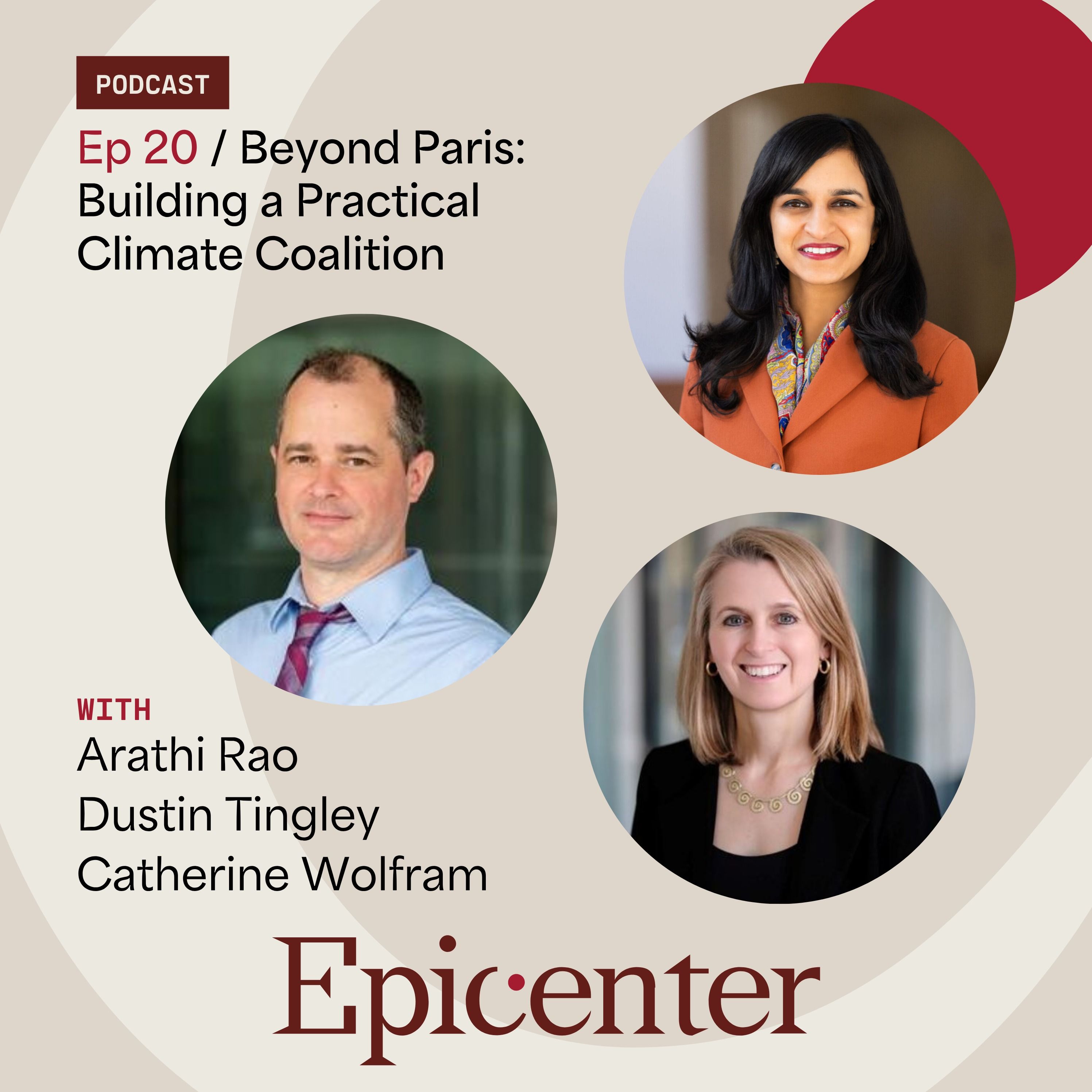
Epicenter cover
Podcast

Epicenter

by Weatherhead Center for International Affairs at Harvard University

Epicenter has had 4 confirmed guests across 2 episodes in the last 12 months. Latest: Catherine Wolfram, Sep 2, 2026.

Show websiteApple PodcastsHow guests are confirmed

Epicenter is produced by the Weatherhead Center for International Affairs at Harvard University. Wrapping our minds around profound global issues can be daunting. Where does one begin to unpack responsibility for climate change or human rights? How does one account for social inequalities or the endurance of…

Guests on the show

Wed2Sep
Epicenter

Arathi RaoCatherine WolframDustin TingleyGuest

Beyond Paris: Building a Practical Climate Coalition (with Arathi Rao, Dustin Tingley, and Catherine Wolfram)

Aluminum, steel, and concrete are some of the most carbon-intensive industries, and many countries already have a tax on them. But not the United States. That fact hasn’t stopped the social scientists in the Weatherhead Research Cluster on Global Climate Policy from spearheading worldwide cooperation on carbon pricing. In this episode, we speak to three scholars in the cluster to learn about their progress at COP30—the thirtieth UN Climate Change Conference held last fall in Brazil—and also about the state of renewable energy technology in the US. Catherine Wolfram recounts the launch of the Declaration on the Open Coalition on Compliance Carbon Markets (the Open Coalition), a pact with middle- and lower-income countries to collaborate on carbon pricing. Launched at COP30 last fall, the coalition currently has eighteen member countries signed on. Arathi Rao explains the challenges and opportunities of bringing together countries with different capacities and industrial policies to the table. She describes the willingness of middle-income and low-income countries to become larger players in what she hopes to be a growing coalition. Reflecting on the process of bringing theory into practice, Dustin Tingley notes the kinds of expertise and strategy needed to approach world leaders in person and truly understand their needs. He notes that offering help elicits more collaboration than imposing a predetermined formula. The scholars also recognize China’s leadership in renewable energy and point out the technologies that could move the US more prominently into the renewable energy technology market. Guests Arathi Rao, Director, Global Climate Policy Project, The Salata Institute for Climate and Sustainability, Harvard University. Dustin Tingley, Faculty Associate; Chair, Weatherhead Research Cluster on Global Climate Policy. Thomas D. Cabot Professor of Public Policy, Department of Government, Harvard University and Harvard Kennedy School; Deputy Vice Provost for Advances in Learning, Harvard University. Catherine Wolfram, Chair, Weatherhead Research Cluster on Global Climate Policy. William Barton Rogers Professor in Energy; Professor of Applied Economics, MIT Sloan School of Management. Host Jessica Barnard, Administrator, Weatherhead Research Clusters on Global History and on Global Climate Policy. Related Links “America’s Surprising Energy Advantage: How to Beat China on Clean Power,” by Joseph E. Aldy, Motoy Kuno-Lewis, and Dustin Tingley (Foreign Affairs, July 29, 2026) “How Will Energy Demand Develop in the Developing World?” by Catherine Wolfram, Orie Shelef, and Paul Gertler (Journal of Economic Perspectives, 2012) “Building a Climate Coalition: Aligning Carbon Pricing, Trade, and Development,” a Global Climate Policy Project flagship report Music “Soft Calm Background Music” by Inplusmusic. Source: Pixabay (Content License Summary) This episode was produced, edited, and mixed by Michelle Nicholasen, Editor and Content Producer at the Weatherhead Center. Follow the Weatherhead Center for International Affairs: Weatherhead Center Website Epicenter Website Facebook LinkedIn Instagram Bluesky Simplecast YouTube
41 min

Wed6May
Epicenter

Sven BeckertGuest

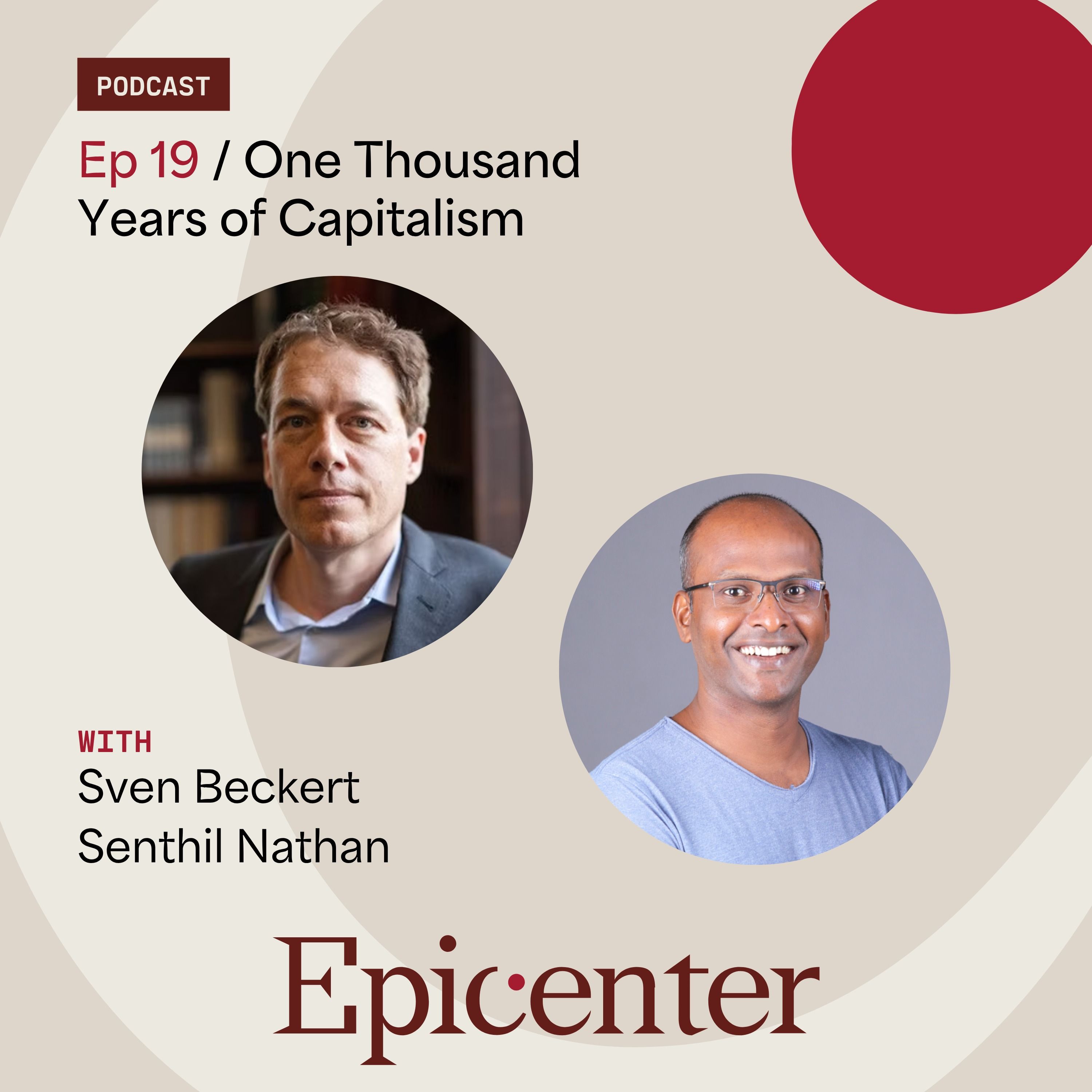
One Thousand Years of Capitalism (with Sven Beckert)

Sven Beckert, a history professor at Harvard, has written an epic book about the history of capitalism over roughly a millennium: it’s called Capitalism: A Global History. Beckert believes the only way to understand one’s place in the world is through understanding how we arrived at the system we currently live in: global capitalism. In this episode, guest host Senthil Nathan interviews Sven Beckert about the major developments in history and expansion of capitalism. Almost all of life is organized around capitalist logic, says Beckert, and the capitalist model has changed and evolved over more than one thousand years. Capitalism’s history begins with merchant communities eight hundred or so years ago, long-distance traders who connected various small cities. The drive to expand and create more capital led to the large-scale production of agriculture in the countryside and development of extraction industries such as silver in Potosí, Bolivia. Europeans took advantage of power differentials in other parts of the world to recast production in profound ways, including mobilizing labor in the practice of slavery, which quickly expanded production into the countryside. Sugar, cotton, oil, and rubber are all commodities that emerged via the forces that drove the capitalist expansion—particularly in Africa, the Americas, and the Caribbean. The book ends in the year 2023, and Beckert remarks on the responsibilities humans have to acknowledge the consequences of capitalism’s expansion, such as slavery and environmental degradation. He notes the purpose of the book is not to make judgments about whether or not capitalism is a net benefit or harm to humanity but to understand how we arrived at the present moment. Beckert also speculates on how quickly capitalism will change and adapt in the future. This is a joint production with the Business and Society podcast by Senthil Nathan. Nathan is a visiting fellow with the Weatherhead’s Scholar’s Program and joins us as a guest host. Guest Sven Beckert, Faculty Associate; Chair, Weatherhead Research Cluster on Global History. Laird Bell Professor of History, Department of History, Harvard University. Host Senthil Nathan, Fellow, Weatherhead Scholars Program. CEO, Fairtrade Australia/New Zealand; Board Member, Australian Council for International Development; Host, Business and Society podcast. Related Links Capitalism: A Global History, by Sven Beckert (Penguin Random House, 2025) Empire of Cotton: A Global History, by Sven Beckert (Penguin Random House, 2015) Harvard and Slavery: Seeking a Forgotten History, coauthored by Sven Beckert "War, Work, and the Fragile Ladder of Dignity," by Senthil Nathan on Epicenter Business and Society Podcast Music “African Moon” by John Bartmann. Source: Free Music Archive (CC0 1.0 Universal License) This episode was produced, edited, and mixed by Michelle Nicholasen, Editor and Content Producer at the Weatherhead Center. Follow the Weatherhead Center for International Affairs: Weatherhead Center Website Epicenter Website Facebook LinkedIn Instagram Bluesky Simplecast YouTube

45 min

Guests from more than 12 months ago are part of Pro. See plans