Two years on the air
GuestHostMentioned
Dec 2024MarJunSepDec 2025MarJunNov 2026
Guest appearances
Wed25Nov
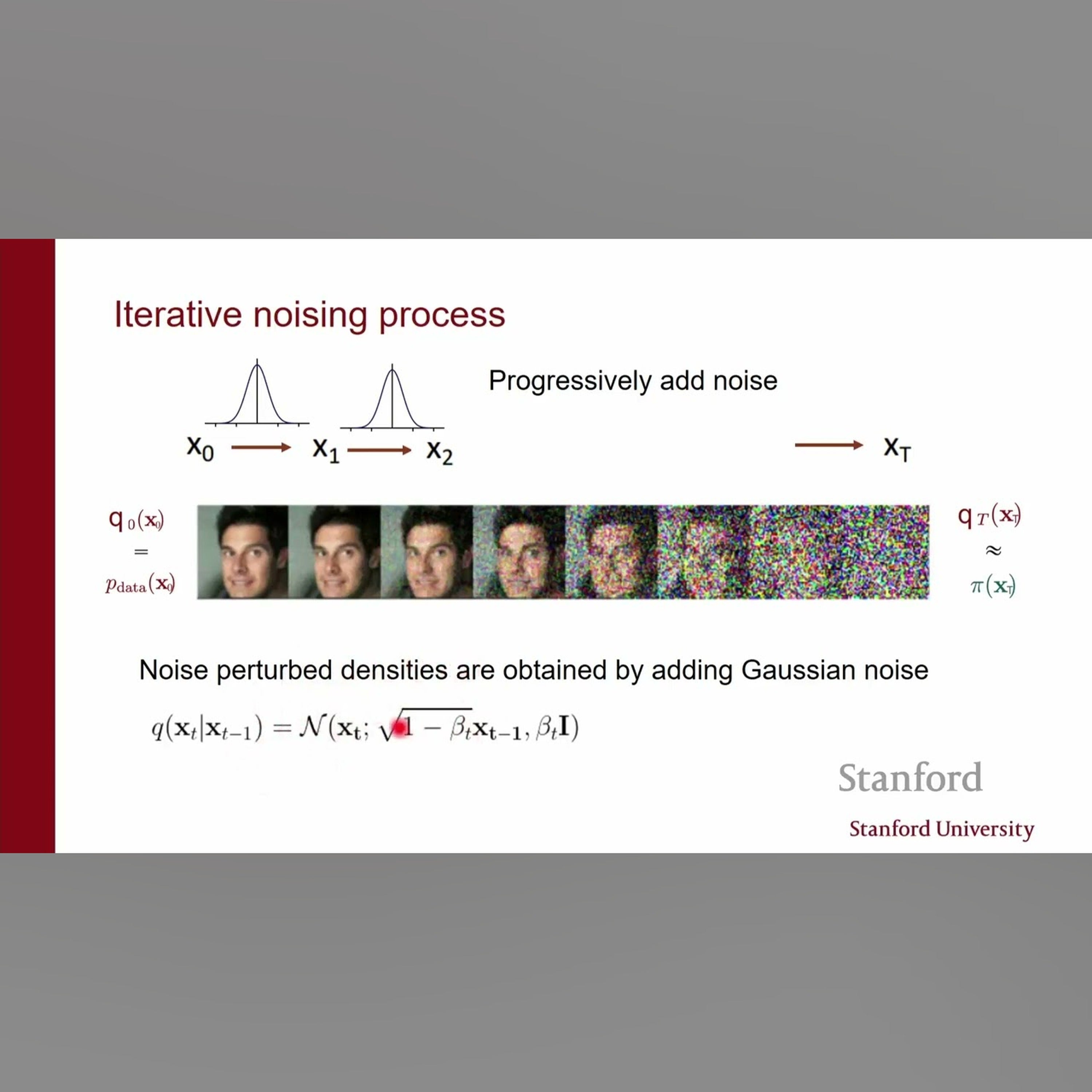
Stanford Online: University Courses & Lectures
For more information about Stanford's Artificial Intelligence programs, visit: https://stanford.io/ai
Uploaded 06-05-24
To follow along with the course, visit the course website:
https://deepgenerativemodels.github.io/
Stefano Ermon
Associate Professor of Computer Science, Stanford University
https://cs.stanford.edu/~ermon/
Learn more about the online course and how to enroll: https://online.stanford.edu/courses/cs236-deep-generative-models
To view all online courses and programs offered by Stanford, visit: https://online.stanford.edu/
Learn more about your ad choices. Visit megaphone.fm/adchoices
1 h 16 min
Fri18Sep

No Priors: Artificial Intelligence | Technology | Startups
As generative AI hits hardware and latency bottlenecks, Stanford professor, diffusion pioneer, and Inception co-founder and CEO Stefano Ermon is betting on a radical new architecture. Stefano joins Sarah Guo to talk about Inception, and how his team is applying diffusion architecture beyond images and video into discrete text and code generation. Stefano explains the limitations of autoregressive LLMs, as well as why parallel token generation in diffusion models offers superior inference scaling and hardware utilization on standard GPUs. He also shares details about Inception’s Mercury models, real-world voice agent applications, the software stack required to serve diffusion-based models at scale, academia’s role at the frontier of AI innovations, and why the next era of AI competition will be defined by efficiency.
Sign up for new podcasts every week. Email feedback to show@no-priors.com
Follow us on Twitter: @NoPriorsPod | @Saranormous | @EladGil | @StefanoErmon | @_inception_ai
Chapters:
00:00 – Stefano Ermon Introduction
00:35 – Research Background
02:54 – Starting Inception
05:59 – Why Diffusion Beats Autoregressive
11:10 – Discrete vs. Continuous Modalities
13:19 – Inception Today
16:45 – Where Speed Wins
17:31 – Inception Customer Base
18:49 – Interaction with Hardware Landscape
19:34 – Inception and the Broader Industry
21:41 – Data Compression and Structure
24:45 – Controllability of Diffusion Modeles
27:25 – Emergent Capabilities at Scale
29:02 – Future Workload Split Between Diffusion vs. Traditional
30:03 – Adoption Challenges
31:44 – Hiring and Team Organization
32:50 – Recursive Self Improvement
34:02 – Resource Allocation
35:10 – Impact of Academia
38:13 – Conclusion
38 min
Thu26Mar
The TWIML AI Podcast (formerly This Week in Machine Learning & Artificial Intelligence)
Today, we're joined by Stefano Ermon, associate professor at Stanford University and CEO of Inception Labs to discuss diffusion language models. We dig into how diffusion approaches—traditionally used for images—are being adapted for text and code generation, the technical challenges of applying continuous methods to discrete token spaces, and how diffusion models compare to traditional autoregressive LLMs. Stefano introduces Mercury 2, a commercial-scale diffusion LLM that can generate multiple tokens simultaneously and achieve inference speeds 5-10x faster than small frontier models, paving the way for latency-sensitive applications like voice interactions and fast agentic loops. We also cover the open research challenges in diffusion LLM training, serving infrastructure requirements, and post-training for diffusion-based systems. Finally, Stefano shares his perspective on whether diffusion models can rival or surpass autoregressive LLMs at scale, the advantages for highly controllable generation, and what the future of multimodal diffusion models might look like.
The complete show notes for this episode can be found at https://twimlai.com/go/764.
1 h 03 min