SS

Stanford Seminar

Stanford Seminar war in den letzten 12 Monaten in 5 Podcast-Folgen zu Gast. Zuletzt: Stanford Online: University Courses & Lectures, 25. Nov. 2026.

Zwei Jahre auf Sendung

GastHostErwähnt

Gastauftritte

Mi25Nov
Stanford Online: University Courses & Lectures

Stanford Online: University Courses & Lectures

Stanford Seminar: Living in Information Everywhere

EE380: Computer Systems Colloquium Seminar Living in Information Everywhere Speaker: Quentin Hardy, Head of Editorial Google Cloud Uploaded 13-04-17 The term cloud computing increasingly describes not just the technology of large networked data centers, but is a proxy term for the unification of smartphones, apps, IoT, Big Data, and Artificial Intelligence -- in effect, the deployment of computational intelligence to virtually every point on the planet. One may view this as a fulfillment of Moore's Law, or the start of decades-long project that is likely to reshape civilization. As someone who both covers this topic and has been profoundly affected by it, I will speak about the technology, and what historical parallels tell us about the likely impact. About the Speaker: Quentin Hardy is Head of Editorial at Google Cloud. As the head of editorial at Google Cloud, Quentin Hardy writes about the technology and impact of cloud computing, both inside Google and for other publications. He was previously Deputy Technology Editor at The New York Times, National Editor at Forbes, and a reporter at The Wall Street Journal. He frequently appears on television and moderates panels at The Computer History Museum and The World Affairs Council. His article, "Hope and Profit in Africa" received an Overseas Press Club Citation. He has degrees from Kenyon College, The School of Oriental and African Studies, and Columbia University. For more information about this seminar and its speaker, you can visit http://ee380.stanford.edu/Abstracts/170412.html Support for the Stanford Colloquium on Computer Systems Seminar Series provided by the Stanford Computer Forum. Colloquium on Computer Systems Seminar Series (EE380) presents the current research in design, implementation, analysis, and use of computer systems. Topics range from integrated circuits to operating systems and programming languages. It is free and open to the public, with new lectures each week. Learn more: http://bit.ly/WinYX5 Learn more about your ad choices. Visit megaphone.fm/adchoices
1 h 07 min

Mi25Nov
Stanford Online: University Courses & Lectures

Stanford Online: University Courses & Lectures

Stanford Seminar: Solve the Problem You Have

Tracy Young, Plan Grid Doug Leone, Sequoia Entrepreneur Tracy Young and Doug Leone, global managing partner at Sequoia, discuss the nature of a harmonious relationship between a startup’s founders and the VC firm investing in them. Young is co-founder and CEO of PlanGrid, which allows construction managers to oversee projects via their device. She and Leone speak with Toby Corey, a lecturer in Stanford University’s School of Engineering. Uploaded 19-04-17 Prior to PlanGrid, Tracy Young was a construction field engineer and helped build and deliver several hospitals and heavy civil projects. She also spent time managing coordination of MEPF systems and bidding projects. She jokes that, with PlanGrid, she went from working for one superintendent to hundreds of thousands of them. Leone emigrated from Italy with his family aged 11, and they settled in Mount Vernon, New York. Leone earned a BS in mechanical engineering from Cornell University in 1979, an MS in industrial engineering from Columbia University in 1986, and an MS in management from the MIT Sloan School of Management in 1988. Leone joined Sequoia Capital in 1988, and became a managing partner in 1996. He was ranked in the top 10 investors in the United States by Forbes Magazine. He led Sequoia's international expansion into China and India. Leone, who previously worked for Hewlett-Packard, Prime Computer, and Sun Microsystems, earned a mechanical engineering degree from Cornell University. He was responsible for investments including ServiceNow, Aruba, Meraki, Rackspace, Netezza, Arbor/Hyperion, RingCentral and MedExpress. He sits on the board of PlanGrid, NuBank, Medallia, ZirMed, ActionIQ, Numerify, Birst and Lattice Engines. Learn more about Stanford's eCorner: https://ecorner.stanford.edu Learn more about Stanford's online classes and certificates: https://online.stanford.edu/programs See the full playlist: https://www.youtube.com/playlist?list=PLoROMvodv4rPE-kcGtKBgYtSMqEJKbESC Learn more about your ad choices. Visit megaphone.fm/adchoices
1 h 08 min

Mi25Nov
Stanford Online: University Courses & Lectures

Stanford Online: University Courses & Lectures

Stanford Seminar: Writing Software Faster with Crowds, Anand Kulkarni of Crowbotics

Anand Kulkarni Crowbotics Crowd computing systems are now capable of doing more sophisticated work than ever before, accelerating the pace of creative work such as creating movies, carrying out research, and writing stories. How can crowds be used to accelerate software creation? This is a complex problem, requiring good methods for expert selection, program synthesis and collaboration. We’ll discuss strategies for accelerating software creation using crowds of geographically-diverse communities of software engineers, as well as the cultural and technical challenges that emerge. Uploaded 19-04-17 Anand is founder of Crowdbotics, a startup using crowdsourcing and machine intelligence to accelerate the process of software development. Crowdbotics brings developers worldwide into a global community of software engineers that collaborate 1-1 with technology companies. Prior to that, Anand was Chief Scientist of LeadGenius, a Y Combinator-backed startup using human computation and deep learning to automate account-based marketing (ABM). Anand has been named as one of Forbes Magazine's "30 under 30" Top 30 Entrepreneurs Under 30. Anand has published in ACM, AAAI and IEEE magazines, journals, and conferences. Anand previously held a National Science Foundation graduate research fellowship in mathematics. He holds degrees in Industrial Engineering and Operations Research, Mathematics, and Physics from UC Berkeley. Learn more about Stanford's Human-Computer Interaction Group: https://hci.stanford.edu Learn about Stanford's Graduate Certificate in HCI: https://online.stanford.edu/programs/human-computer-interaction-graduate-certificate View the full playlist: https://www.youtube.com/playlist?list=PLoROMvodv4rMyupDF2O00r19JsmolyXdD&disable_polymer=true Learn more about your ad choices. Visit megaphone.fm/adchoices
1 h 11 min

Mi25Nov
Stanford Online: University Courses & Lectures

Stanford Online: University Courses & Lectures

Stanford Seminar: Neuromorphic Chips: Addressing the Nanostransistor Challenge

EE380: Computer Systems Colloquium Seminar Neuromorphic Chips: Addressing the Nanostransistor Challenge by Combining Analog Computation with Digital Communication Speaker: Kwabena Boahen, Stanford University Uploaded 06-04-17 As transistors shrink to nanoscale dimensions, trapped electrons--blocking "lanes" of electron traffic--are making it difficult for digital computers to work. In stark contrast, the brain works fine with single-lane nanoscale devices that are intermittently blocked (ion channels). Conjecturing that it achieves error-tolerance by combining analog dendritic computation with digital axonal communication, neuromorphic engineers (neuromorphs) began emulating dendrites with subthreshold analog circuits and axons with asynchronous digital circuits in the mid-1980s. Three decades in, they achieved a consequential scale with Neurogrid, the first neuromorphic system with billions of synaptic connections. Neuromorphs then tackled the challenge of mapping arbitrary computations onto neuromorphic chips in a manner robust to lanes intermittently--or even permanently--blocked by trapped electrons. Having demonstrated scalability and programmability, they now seek to encode continuous signals with spike trains in a manner that promises greater energy efficiency than all-analog or all-digital computing across a five-decade precision range. About the Speaker: Kwabena Boahen is a Professor of Bioengineering and Electrical Engineering at Stanford University, where he directs the Brains in Silicon Lab. He is a neuromorphic engineer who is using silicon integrated circuits to emulate the way neurons compute, and linking the seemingly disparate fields of electronics and computer science with neurobiology and medicine. His lab developed Neurogrid, a specialized hardware platform created at Stanford that enables the cortex's inner workings to be simulated in real time--something outside the reach of even the fastest supercomputers. His interest in neural nets developed soon after he left his native Ghana to pursue undergraduate studies in Electrical and Computer Engineering at Johns Hopkins University, Baltimore, in 1985. He went on to earn a doctorate in Computation and Neural Systems at the California Institute of Technology in 1997. From 1997 to 2005 he was on the faculty of University of Pennsylvania, Philadelphia PA. With over ninety publications to his name, including a cover story in the May 2005 issue of Scientific American, his scholarship has been recognized by several distinguished honors, including the National Institute of Health Director's Pioneer Award in 2006. In 2016, he was named a fellow of the Institute of Electrical and Electronic Engineers and of the American Institute for Medical and Biological Engineering. His 2007 TED talk, A Computer that Works like the Brain, has been viewed over half-a-million times. For more information about this seminar and its speaker, you can visit http://ee380.stanford.edu/Abstracts/170405.html Support for the Stanford Colloquium on Computer Systems Seminar Series provided by the Stanford Computer Forum. Colloquium on Computer Systems Seminar Series (EE380) presents the current research in design, implementation, analysis, and use of computer systems. Topics range from integrated circuits to operating systems and programming languages. It is free and open to the public, with new lectures each week. Learn more: http://bit.ly/WinYX5 0:00 Introduction 0:18 Acknowledgments 0:57 A dollar bought more and more transistors until 2014 5:55 Beware of potholes! 6:30 Accidents happen! 16:32 Combining digital communication with analog computation 23:43 Digital versus Analog versus Neuromorphic 25:56 Neuromorphs' Five-Point "Secret" Master Plan 1. Implement dendritic computation with subthreshold analog 27:37 Overlapping dendrites eliminate axon's terminal branches 30:31 Hierarchical Learn more about your ad choices. Visit megaphone.fm/adchoices

1 h 27 min

Mi25Nov
Stanford Online: University Courses & Lectures

Stanford Online: University Courses & Lectures

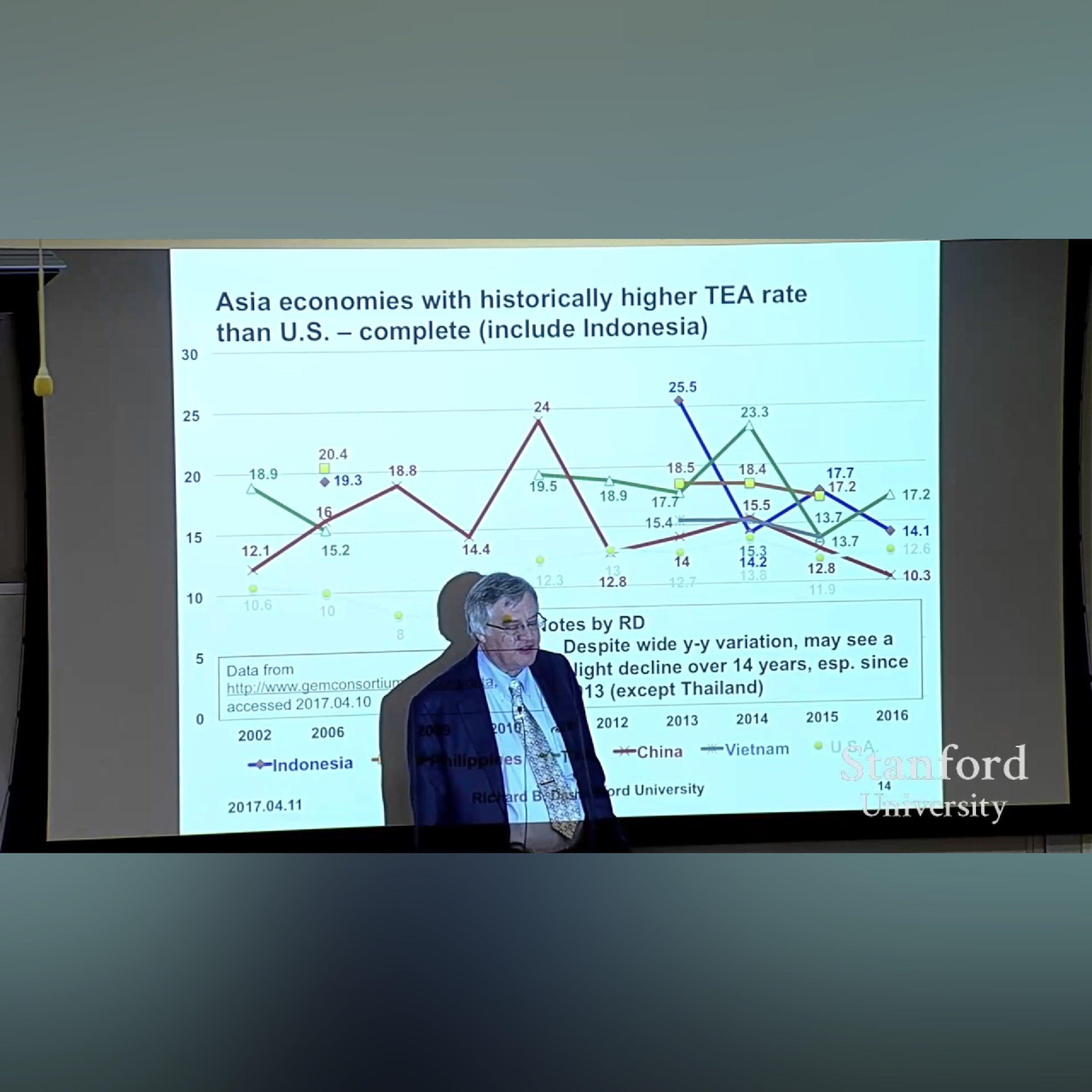
Stanford Seminar: Asia Entrepreneurship Update 2017 - Current Ecosystem Trends

EE402T: Entrepreneurship in Asian High-Tech Industries Asia Entrepreneurship Update 2017: Current Ecosystem Trends Speaker: Richard Dasher, Stanford University Uploaded 13-04-17 Dr. Richard Dasher, Director or the US-Asia Technology Management Center, introduces current attitudes toward entrepreneurship and participation in entrepreneurial activities in major Asia economies, before discussing ecosystem trends such as investment data, career patterns, and the growth of other aspects of supporting infrastructure. About the Speaker: Dr. Dasher has directed the US-ATMC since 1994. He serves on advisory and review boards of major government S and T funding programs and research institutes in Canada, Japan, and Thailand. He is an advisor to incubators, VC funds, innovation initiatives, and startup companies in China, Japan, S. Korea, and Silicon Valley. Dr. Dasher is the first non-Japanese person ever named to the senior governance of a Japanese national university, serving a term on the Board of Directors of Tohoku University. Learn more about your ad choices. Visit megaphone.fm/adchoices

1 h 25 min