Bekomm eine E-Mail, wenn Rob in einem Podcast zu Gast istPodAppear prüft neue Folgen, sobald sie erscheinen, und lässt die weg, in denen Rob nur erwähnt wird. Bis zu 15 Personen kostenlos, ohne Kreditkarte.Bis zu 15 Personen kostenlos, ohne Kreditkarte.
Rob kostenlos folgen
RM

Rob Mark

Zwei Jahre auf Sendung

GastHostErwähnt

Selbst moderierte Folgen

Di20Okt
NTSB News Talk – Aviation Accidents, Safety Investigations & Pilot Lessons

NTSB News Talk – Aviation Accidents, Safety Investigations & Pilot LessonsHost

Miami Boeing 767 Overrun: Tailwind Questions & Cirrus SR22 Go-Around Stall

A Boeing 767 lands more than 3,700 feet down a Miami runway and overruns the pavement, killing five people on the ground. A Cirrus SR22 crashes during a second go-around, killing all five aboard. And a Cessna 421 loses both engines after being fueled with Jet A instead of avgas. In Episode 41 of NTSB News Talk, aviation safety experts Max Trescott and Rob Mark examine the critical decisions behind these accidents and the lessons pilots can take away. The newly released Miami Boeing 767 preliminary report raises serious questions about tailwinds, unstable approaches, airspeed warnings, and a go-around attempted far too late. A new NTSB final report on a fatal Cirrus SR22 crash at Kill Devil Hills reveals striking flight-data evidence of excessive pitch and an aerodynamic stall. The hosts also discuss Diamond DA40 crashed in mountainous terrain near Eldorado Springs, Colorado, a deadly Piper JetProp icing encounter over Wisconsin, a Gulfstream air ambulance crash following reported electrical problems, a Beech Bonanza fuel-starvation accident involving a congressman, a fatal nighttime Piper crash, and a midair collision between gliders. From fuel management and emergency procedures to stall prevention and go-around proficiency, this episode highlights a fundamental truth: even experienced pilots cannot afford to skip the basics.

39 minAbspielen in:

Mi7Okt
NTSB News Talk – Aviation Accidents, Safety Investigations & Pilot Lessons

NTSB News Talk – Aviation Accidents, Safety Investigations & Pilot LessonsHost

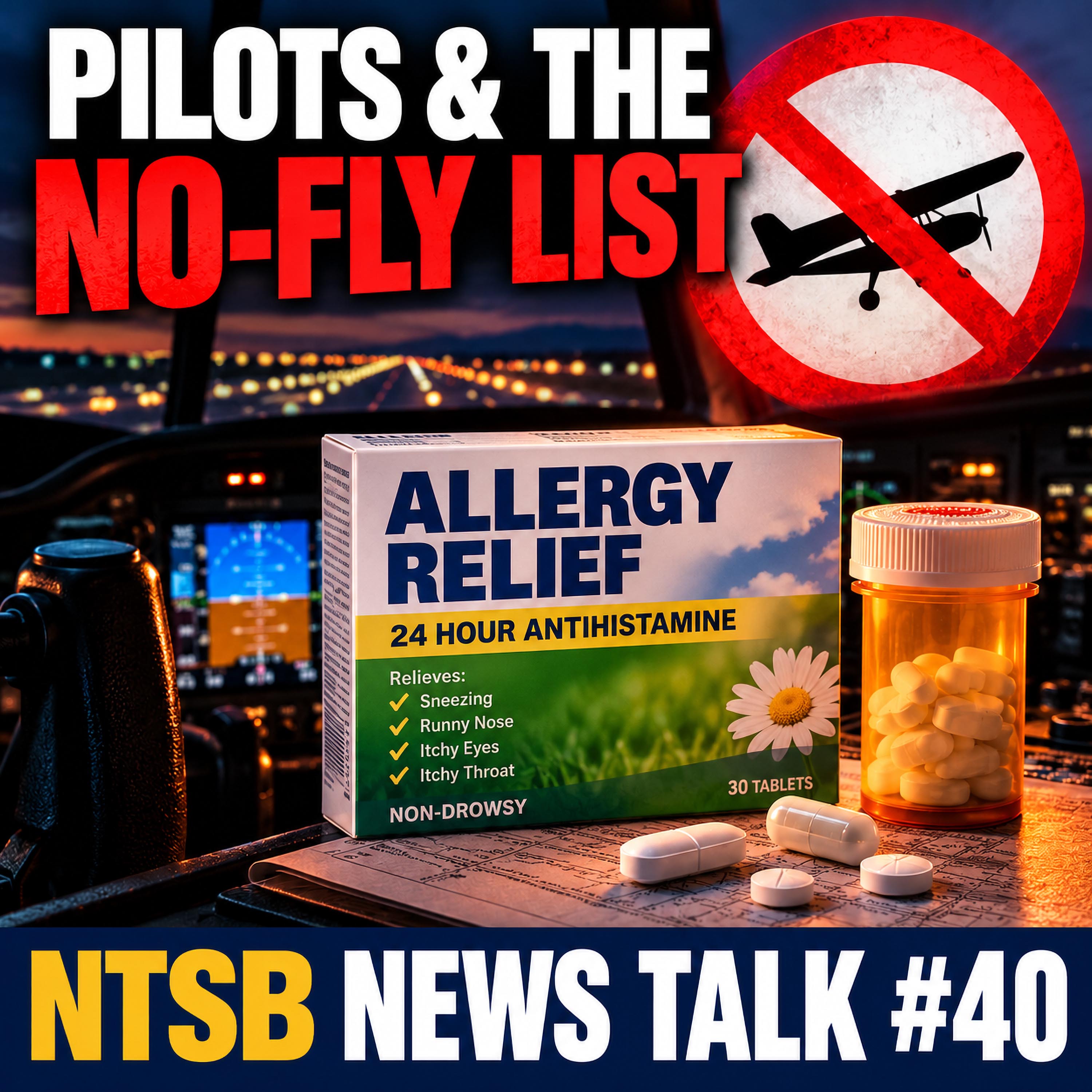
Benadryl, Cannabis & the FAA No-Fly List: Fatal Lessons for Pilots

Episode 40 examines a wide range of recent accidents before focusing on a troubling pattern: pilots flying with impairing OTC medications or drugs in their systems. Max Trescott and Rob Mark begin with a fatal nighttime crash of C-GPTX, a Cessna 172 in Saskatchewan and the runway overrun of Eclipse 500 N816KD at Auburn, California. They also discuss Beech Travel Air N529RB, which was flown in repeated low-level circles about 100 feet above the Pacific before crashing into the ocean, raising the possibility of an intentional act. Preliminary reports include Piper Seneca N212ML, lost near the Bahamas in convective weather; C-IFBY, a Para-Ski VX powered parachute carrying three people even though its U.S. operation did not qualify under Part 103; and Lake Amphibian N6185V, which apparently ran out of fuel just miles from Ithaca. Final reports include a fatal VFR-into-IMC accident involving N9626K, a Piper PA-28 and the crash of Ameriflight Beech C99 N130GP after a partial engine-power loss. The episode closes with four fatal-accident reports involving the active ingredients in Benadryl and Zyrtec, or cyclobenzaprine, cannabis, or morphine. The takeaway is simple: “over the counter” does not mean “safe to fly,” and pilots need to understand the FAA’s medication waiting-period guidance. Max also explains why medication effects can undermine a pilot’s own self-assessment.

37 minAbspielen in:

Di25Aug
NTSB News Talk – Aviation Accidents, Safety Investigations & Pilot Lessons

NTSB News Talk – Aviation Accidents, Safety Investigations & Pilot LessonsHost

Philadelphia Learjet 55 Crash: Spatial Disorientation Clues & Wrong-Runway Landings

In Episode 37 of NTSB News Talk, Max Trescott and Rob Mark examine new evidence from the fatal Learjet 55 air ambulance crash in Philadelphia and several other accidents with important lessons for pilots. Brought to you by AVEMCO aircraft insurance. Support Rob and Max by making a donation at Patreon.com The Learjet 55 departed Northeast Philadelphia Airport at night into a roughly 400-foot overcast. Newly released NTSB docket material shows the aircraft initially beginning its assigned right turn before slowly rolling left. The exceptionally gradual roll raises the possibility of somatogyral illusion—a form of spatial disorientation in which the inner ear may fail to detect slow rotational movement. Investigators also examined somatogravic illusion, cockpit workload, pitch trim, and the captain’s previous training history. Both engines appeared to be producing takeoff power, making an engine failure less likely. Max and Rob also discuss two wrong-runway landings near Chicago that illustrate continuation bias and task saturation. Other accidents include a Cirrus Vision Jet striking a pipe across a closed portion of a runway at Driggs, Idaho; a fatal Cessna 150 collision with a Pennsylvania State Police helicopter; N1850N a Beechcraft Duchess accident during simulated single-engine training; and a photographer fatally struck by the wing of glider N8217W. Also, two wrong-runway landings near Chicago, N772MR (Envoy 3936) and N1128M Learjet 60. Those final incidents highlight a recurring human-factors problem: once pilots commit mentally to a plan, contradictory evidence can become surprisingly difficult to recognize.

38 minAbspielen in:

Di14Jul
NTSB News Talk – Aviation Accidents, Safety Investigations & Pilot Lessons

NTSB News Talk – Aviation Accidents, Safety Investigations & Pilot LessonsHost

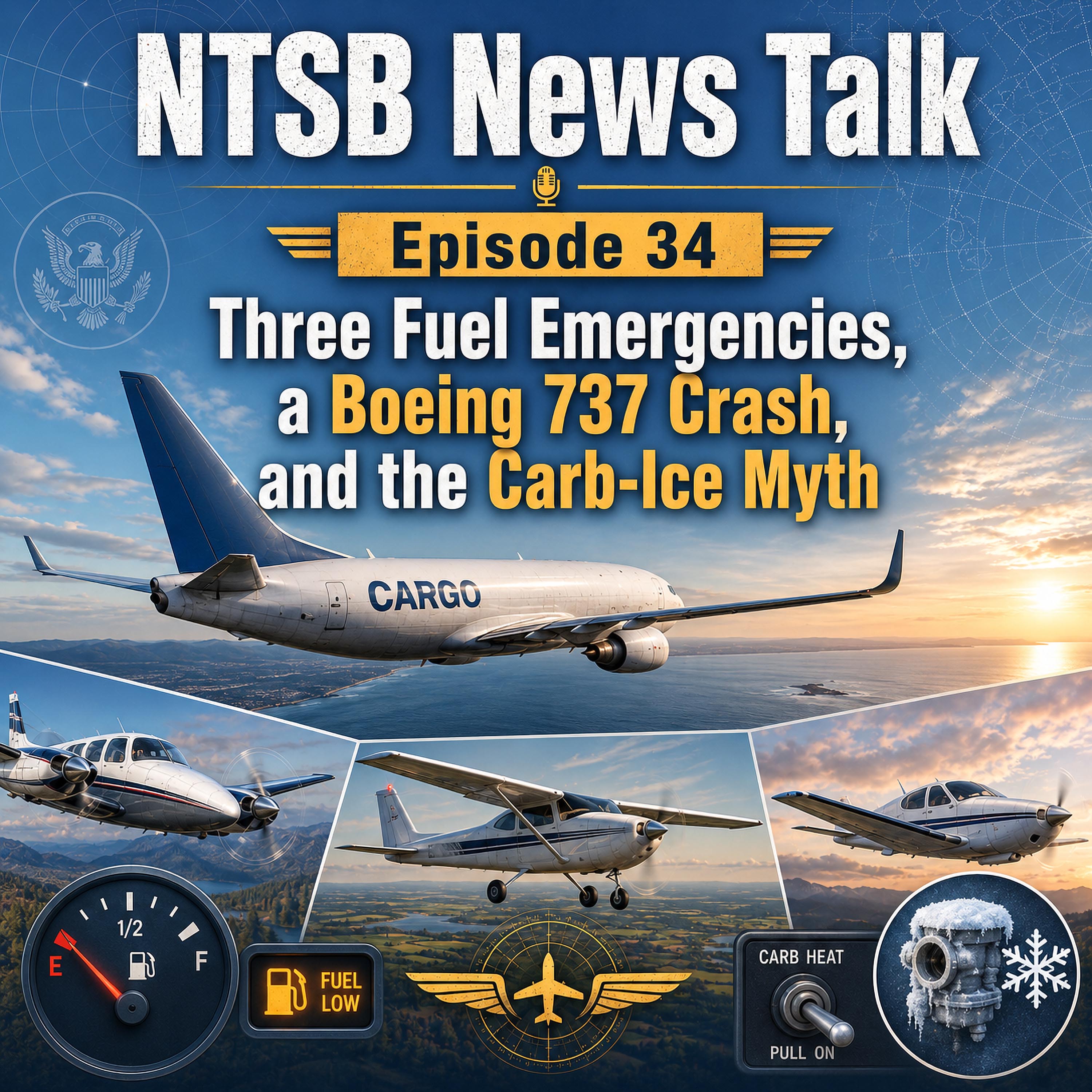
Three Fuel Emergencies, a Boeing 737 Crash, and the Carb-Ice Myth

Max Trescott and Rob Mark review a mysterious Boeing 737 cargo crash, several fuel-related accidents, loss of control, and a dangerous carb-ice misconception. K2 Airways Flight KTA1732, Boeing 737-400F AP-BOI, reported a navigation problem before plunging into the Arabian Sea. The hosts analyze Beechcraft 95-A55 Baron N7501S after an apparent dual-engine failure near Lancaster, South Carolina, following an 18-hour flying day, raising questions about fuel endurance, fatigue, and nighttime hypoxia. Preliminary reports include Cessna 150L N156KA, where the instructor tried to select a nonexistent right-tank position and investigators found a striking fuel imbalance; Cessna P210N N54CC, which stalled and spun above a 9,550-foot runway; Pacific Aerospace 750XL N221BN, whose engine was producing power before a fatal skydiving crash; and experimental Piper PA-20 N7635K, which struck mountainous terrain while flying toward instrument conditions with a suspended certificate and expired medical. Final reports cover Cessna 172M N4464R, whose seat slid aft during takeoff, and Cessna 182 N8580T, which lost power on final after the left tank ran dry despite fuel remaining in the right tank. Listener Sam Dawson closes with a warning that no carbureted airplane should be assumed immune from carb ice or what its POH may imply alone.

36 minAbspielen in:

Di19Mai
NTSB News Talk – Aviation Accidents, Safety Investigations & Pilot Lessons

NTSB News Talk – Aviation Accidents, Safety Investigations & Pilot LessonsHost

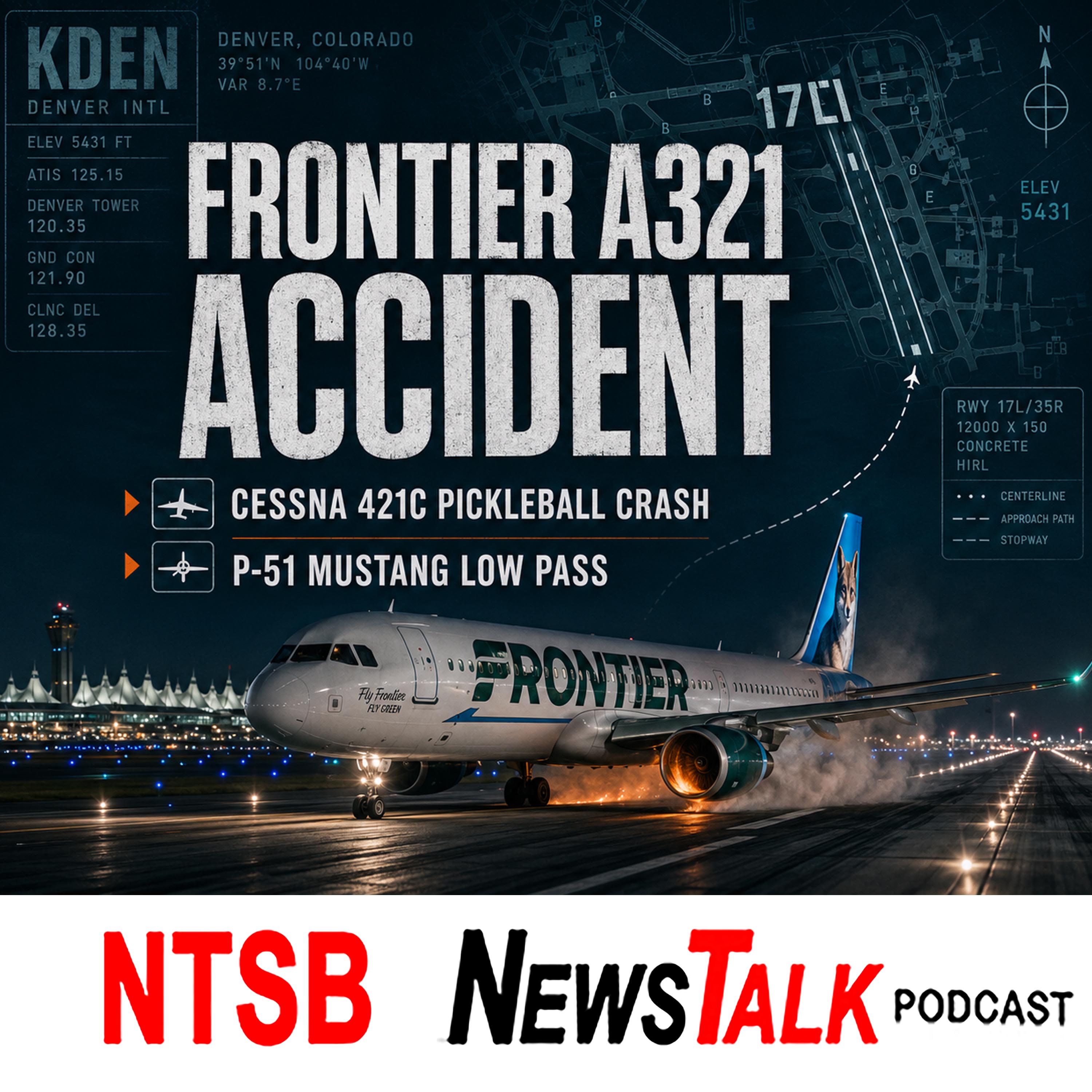
Frontier A321 Accident, Cessna 421C Pickleball Crash & More

Max Trescott and Rob Mark discuss several recent aviation accidents and new NTSB reports, beginning with a tragic Frontier Airlines A321 accident at Denver International Airport, where a man entered the runway environment and was struck during takeoff. The crew rejected the takeoff at high speed, the right engine caught fire, and multiple passengers reported minor injuries. Brought to you by AVEMCO aircraft insurance. Support Rob and Max by making a donation at Patreon.com The episode then examines the fatal crash of Cessna 421C N291AN near Wimberley, Texas. The aircraft was carrying people reportedly traveling to a pickleball tournament when it crashed at night in IMC with thunderstorms in the area. The pilot reportedly told ATC that the pitot heat had iced up, that the airplane was on backup gauges, and that pitot heat was not working. Max and Rob also discuss other accidents include Cirrus SR22 N39VF, which deployed CAPS and was later dragged by the parachute across fields, fences, and a highway; Cessna 401B N122AT, which crashed after takeoff before reaching blue line speed; Beech 58 Baron N2063G during an instrument proficiency check; a King Air 300 ditching in the Atlantic; a Quad City Challenger ultralight issue; and Cessna 152 N588BR fuel exhaustion.

30 minAbspielen in:

Mi11Mär
NTSB News Talk – Aviation Accidents, Safety Investigations & Pilot Lessons

NTSB News Talk – Aviation Accidents, Safety Investigations & Pilot LessonsHost

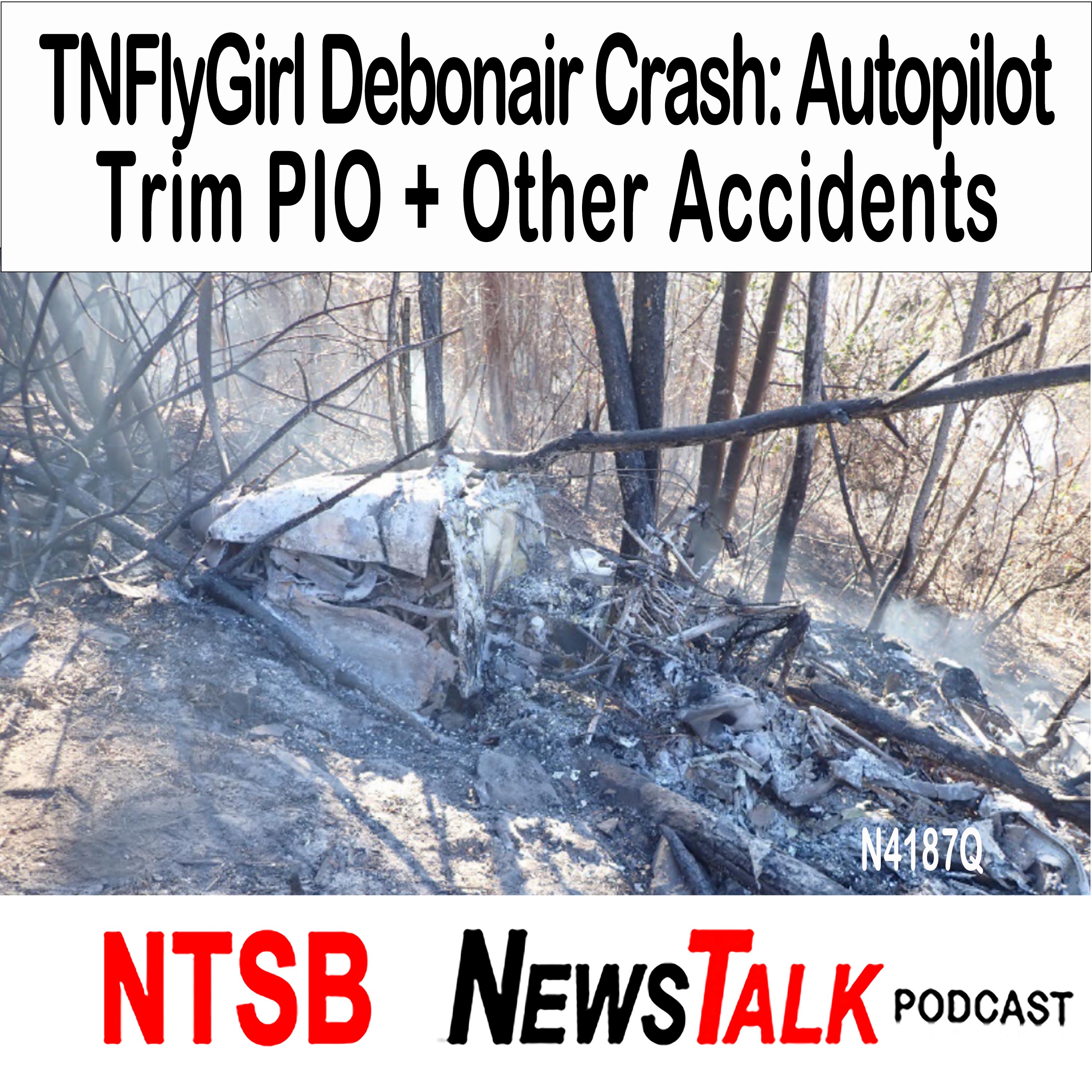
TNFlyGirl Debonair Crash: Autopilot/Trim PIO + Icing & Night IMC

In episode 25 of NTSB News Talk, Max Trescott and Rob Mark break down seven NTSB reports with a common theme: the accident often starts long before the impact. Brought to you by AVEMCO aircraft insurance. Support Rob and Max by making a donation at Patreon.com They begin with an experimental Carbon Cub (N126C) that appears to have struck power lines during very low flight along the Payette River near Montour, Idaho—another reminder that wires are nearly invisible until they aren’t. Next is a Cessna 310R (N252DL) that descended into terrain on an IFR flight after the pilot stopped responding to ATC, pointing toward possible pilot incapacitation amid icing concerns and other red-flag gaps. The episode then tackles the Beech 35-C33 Debonair crash (N5891J) near Pulaski, Tennessee, where ADS-B data showed worsening pitch oscillations consistent with an autopilot/trim misunderstanding and pilot-induced oscillations. Two more reports highlight night risk: a Zenith CH 701 (N4209W) lost to spatial disorientation after VFR flight into deteriorating conditions, and a Cozy Mk IV (N656TE) that departed Half Moon Bay into night IMC and went into the ocean. Finally, they cover a Cirrus SR22 (N253BC) overweight takeoff with distraction from alerts, and a Piper Saratoga (N4187Q) engine power loss at night IFR that left the pilot with few runway options.

36 minAbspielen in:

Di10Feb
NTSB News Talk – Aviation Accidents, Safety Investigations & Pilot Lessons

NTSB News Talk – Aviation Accidents, Safety Investigations & Pilot LessonsHost

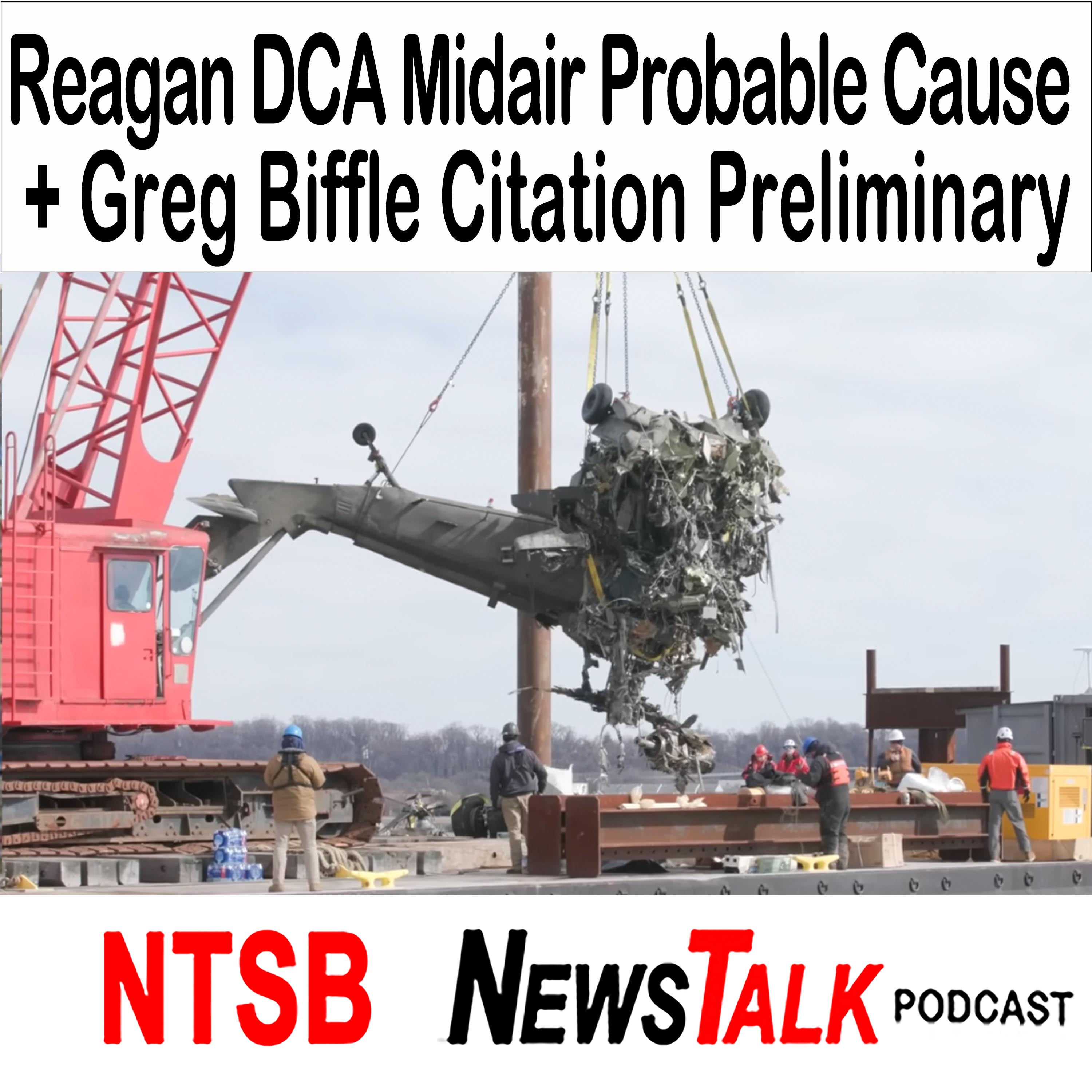
Reagan National (DCA) Midair Collision Probable Cause + Greg Biffle Citation 550 Preliminary Report

Max talks with co-host Rob Mark about two headline-making NTSB threads: the DCA midair collision and the preliminary report on the Greg Biffle crash. First, they react to the NTSB’s day-long public hearing on the DCA midair and the board’s newly adopted probable-cause statement—an unusually long, multi-factor finding that points toward fixes in airspace design, controller procedures, ADS-B policy, and military aviation governance. Then they pivot to the Cessna Citation 550 accident involving NASCAR driver Greg Biffle (N257BW) near Statesville, North Carolina. The preliminary report raises hard questions about cockpit workload and decision-making: instrument anomalies, an apparent electrical/power issue, and a “second in command required” limitation that wasn’t satisfied by the right-seat occupant. The episode also rounds up several other investigations: a Cirrus SR20 CAPS deployment in England where the parachute lines may have separated after snagging power lines, a Cirrus SR22 engine-failure diversion in South Carolina, an IFR Bonanza crash in rain near Sabine, Texas, a Mexican Navy King Air 350i accident near Galveston, and final reports covering a training stall/spin in Georgia and a Musketeer engine failure after an undetected oil-system leak. If you care about real-world lessons—and what the NTSB is signaling for the next wave of safety changes—hit play and share it with another pilot. Support Support the work that Rob and Max do creating the NTSB News Talk podcast by making a monthly donation via Patreon.

54 minAbspielen in:

Mo12Jan
NTSB News Talk – Aviation Accidents, Safety Investigations & Pilot Lessons

NTSB News Talk – Aviation Accidents, Safety Investigations & Pilot LessonsHost

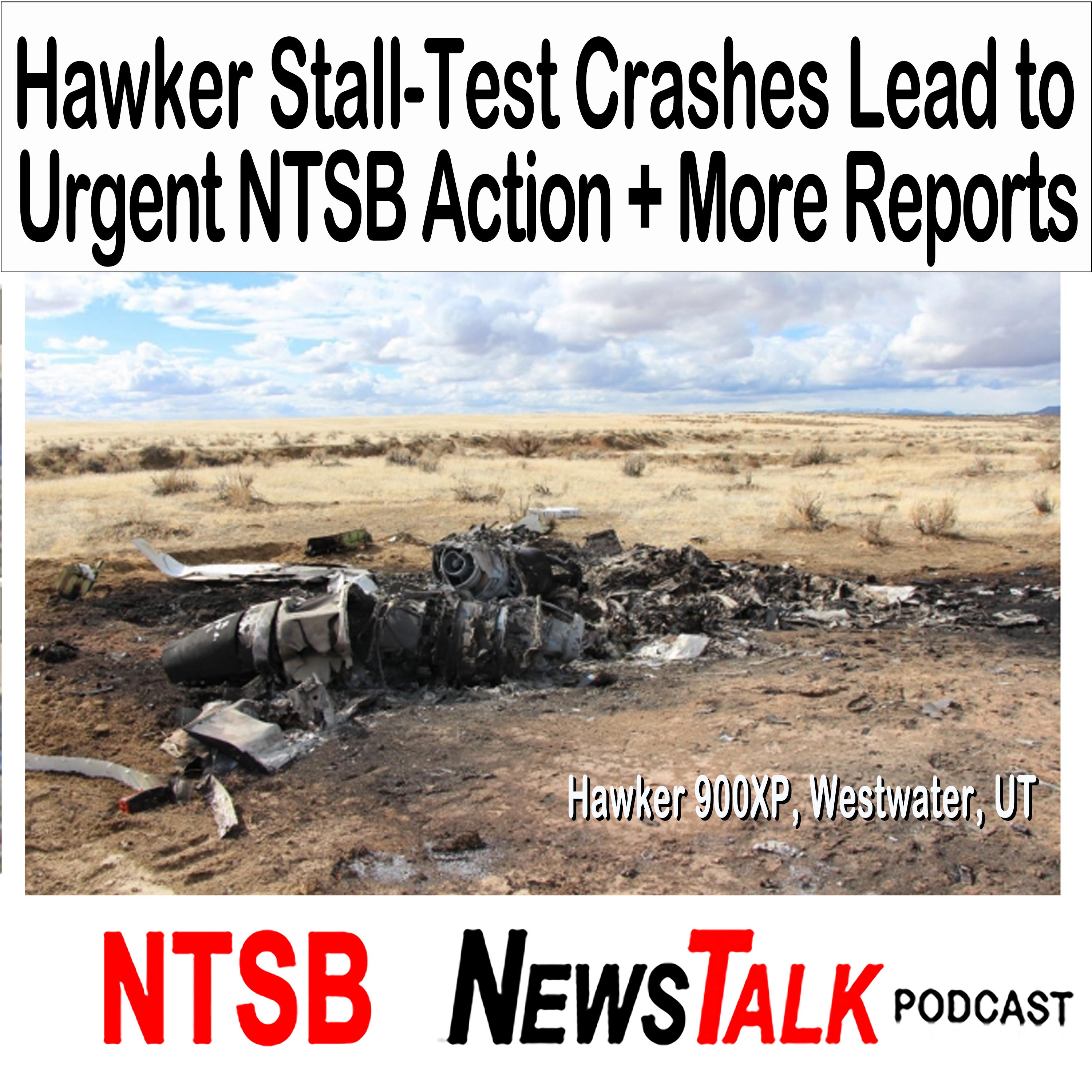
Hawker Stall-Test Crashes: Urgent NTSB Action + NOTAM Slackline Tragedy

Max Trescott and Rob Mark connect a string of very different accidents with one shared theme: safety margin usually disappears one “reasonable” choice at a time—until the airplane (or the environment) collects the debt. They open with a major development: the NTSB’s urgent recommendation to Textron after two fatal post-maintenance stall test flights in Hawker business jets. Max and Rob explain why stall testing in swept-wing jets can be uniquely unforgiving, and why “unacceptable stall characteristics” should make every pilot sit up straight. The takeaway: if a flight requires test-pilot skills, then “maintenance requires it” doesn’t make it safe—it demands the right training, the right crew, and the right conditions. Max then shares NTSB news: a public board meeting on Tuesday, January 27, 2026 at 9:00 a.m. ET to determine probable cause for the January 29, 2025 midair collision over the Potomac River near Reagan National (PSA CRJ700 and an Army UH-60L Black Hawk). Max and Rob will be watching closely and will share clips in a future episode. From there they break down recent accidents and reports, including: the Dassault Falcon 50, 9H-DFS, crash near Haymana, Turkey; an MD530F helicopter, N3502P, near Superior, Arizona where a slackline/highline may have been a factor; a TBM 700, N700PT, near Monroe, Wisconsin involving an approach continued below minimums; the Hawker 900XP, N900VA, fatal post-maintenance stall test crash; a Cessna P210, N1400, fuel exhaustion accident in San Diego in IMC with low recent flying; and a Bonanza G36, N360FV, near Tracy, California that illustrates the engine-emergency dilemma: choose the ugly, certain option—or gamble for the “better” airport you might not reach.

53 minAbspielen in:

Warum PodAppear

Folge Menschen, nicht Podcasts.

Du hast Rob in einer Sendung gehört. PodAppear findet für dich die nächste, und genauso für alle anderen, die du hören willst.

  • Eine Meldung, wenn die Person zu Gast istPer E-Mail: sofort oder gebündelt als Tages- oder Wochenübersicht. Dann nur noch auf Play drücken.
  • Gäste statt bloßer ErwähnungenFolgen, in denen ein Name nur fällt, landen getrennt. Eine Meldung heißt: Die Person ist wirklich in der Sendung.
  • Alle in einem FeedGründerinnen, Autoren, Sportler, Forscherinnen. Folge allen mit Namen, quer durch jede Sendung, in der sie auftreten.

Bis zu 15 Personen kostenlos, ohne Kreditkarte.