Get an email when Rob is a guest on a podcastPodAppear checks new episodes as they come out and leaves out the ones that only mention Rob. Free for up to 15 people, no card needed.Free for up to 15 people, no card needed.
Rob Mark has been a guest on 4 podcast episodes across 2 shows in the last 12 months, most often on NTSB News Talk – Aviation Accidents, Safety Investigations & Pilot Lessons (2 times). Latest: NTSB News Talk – Aviation Accidents, Safety Investigations & Pilot Lessons, Apr 22, 2026.
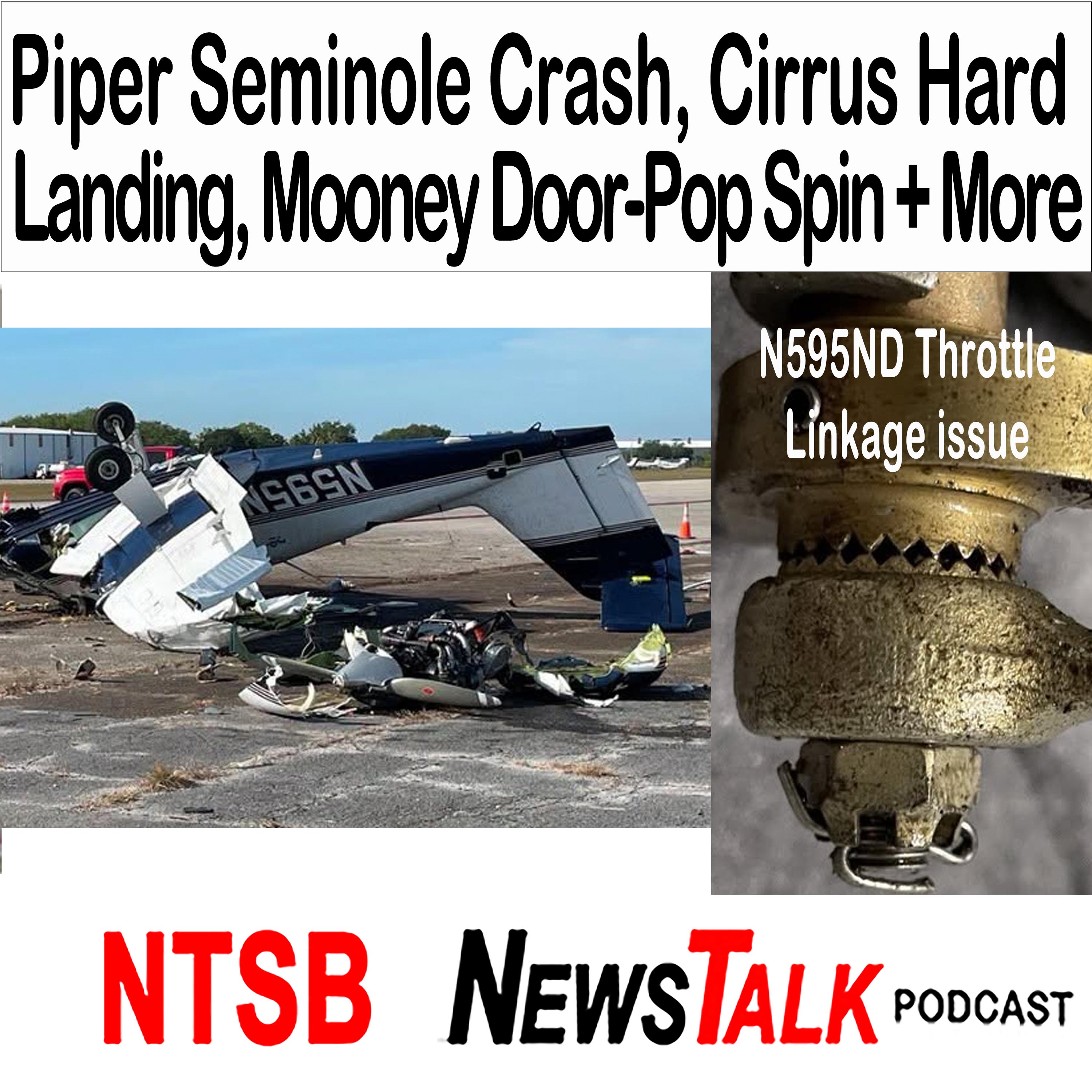
Max talks with Rob Mark about a dense lineup of recent accidents and final reports, led by the Piper PA-44 Seminole N595ND crash in Fort Pierce, Florida, the Cirrus SR22 N124SP hard landing in St. Paul, Minnesota, and the Mooney M20K N4387W stall-spin in St. Augustine, Florida, after a cabin door popped open shortly after takeoff. They also examine the Beech 58 Baron N2063G crash in Tennessee, which appears consistent with a VMC demo that turned into a stall-spin, the Sling N166TW crash on Catalina Island after apparent low-level terrain maneuvering, and the Piper Saratoga N4190E runway overrun in Arizona after an excessively fast approach.
Brought to you by AVEMCO aircraft insurance.
Support Rob and Max by making a donation at Patreon.com
In the final-report segment, they break down how distraction likely contributed to the Mooney M20K N4387W crash, why the Piper PA-44 Seminole N595ND shows the danger of trying to salvage a one-engine go-around in a light twin, and how Cessna 172P N781FM likely lost power because of carb ice during a low-power descent. They close with one of the strangest cases in the episode: a damaged battery pack that later ignited and destroyed Mooney M20E N5632Q in Hornell, NY. A brief additional mention covers a separate Cirrus SR22 N285AH that departed the runway in Fullerton, California after the pilot seat slid back on takeoff.
43 minPlay in:
Sun1Feb
Aviation News Talk – Pilot Stories, Safety Tips & General Aviation News
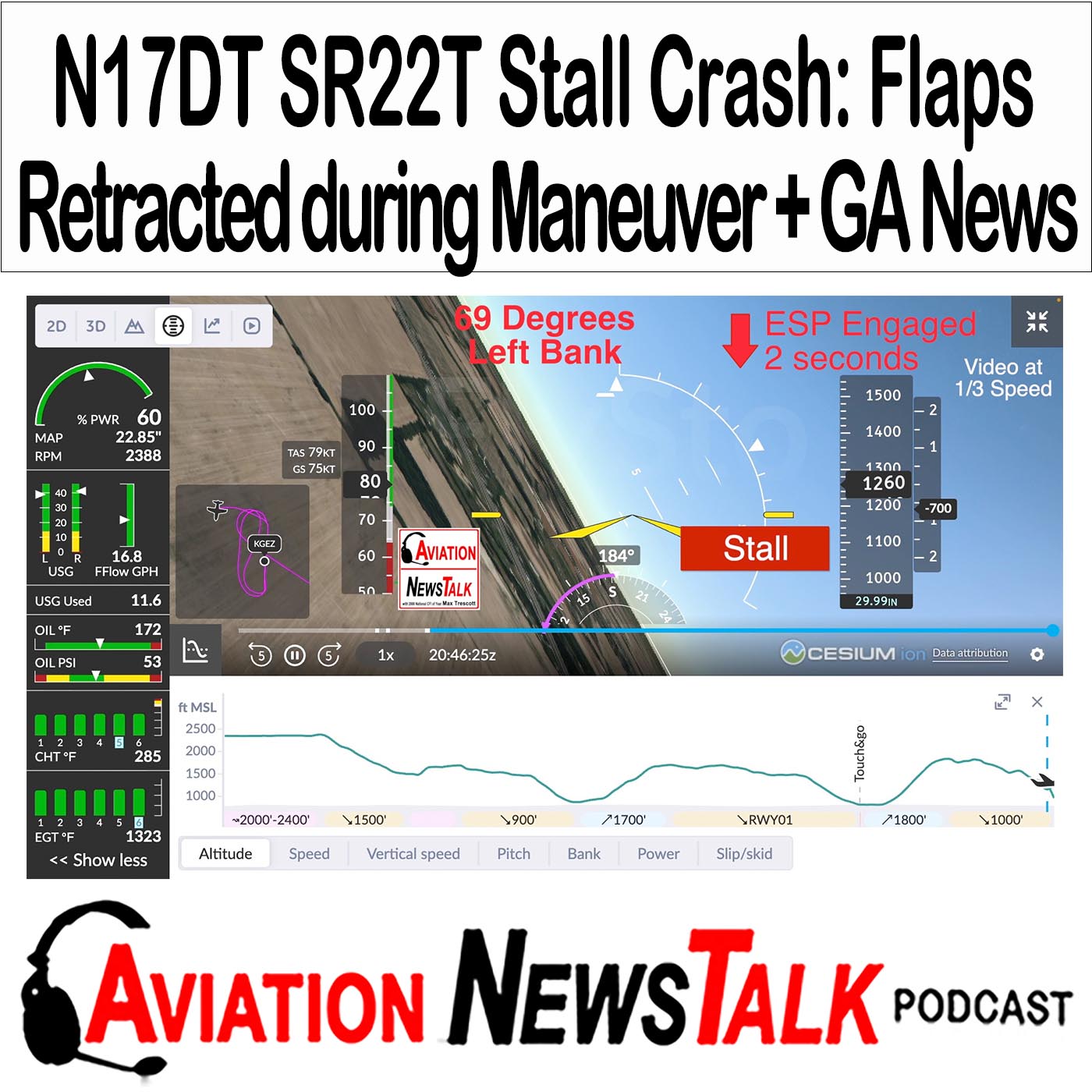
Max talks with Rob Mark about the fatal crash of Cirrus SR22T N17DT near Shelbyville, Indiana, and why this accident is so instructive for any pilot who flies approaches at low altitude with high workload. The NTSB's probable cause centers on inadequate airspeed and an aerodynamic stall, but the real value is in the flight data that shows how the airplane got there: low power held for an extended period, repeated stall warnings, multiple ESP interventions, and flaps that ultimately remained retracted until impact.
This episode matters because it's rare to have this level of detail. The NTSB recovered onboard data that captures dozens of parameters multiple times per second—far more than you usually get from ADS-B alone. Max describes how the NTSB published extensive graphs and also released a spreadsheet of recorded parameters. The spreadsheet didn't include position data, so Max combined it with ADS-B track points and interpolated the missing locations to create a second-by-second reconstruction. The result is a cockpit-style view that shows airspeed, pitch attitude, power, flap position, stall warning activations, and ESP engagement together—so you can see the chain of events, not just the endpoint.
The key factual finding: the engine was operating normally. The "partial engine failure" theories that circulated right after the crash don't hold up against the final report and recorded parameters. Instead, power was pulled back to a very low setting—about 15%, roughly 10–11 inches of manifold pressure—and held there. That's close to a landing-power setting, which means airspeed and energy must be managed carefully to avoid drifting toward stall, especially if configuration changes.
The second key finding is configuration. The flap record shows the flaps briefly at about 50% and then transitioning to 0%. Later, the data shows the flaps again toggling, but ultimately the airplane ends up with flaps retracted and stays that way until the crash. That detail is not cosmetic—stall speed is strongly affected by flap setting. In a low-power approach, retracting flaps increases stall speed and requires a different pitch picture and energy plan. If the airplane is flown as if it has more lift available than it actually does, airspeed can silently bleed away.
As the airplane slowed, the recorded data shows repeated stall warning activations in the final minute, and ESP (Envelope Stability Protection) engaging multiple times. ESP is designed to help discourage pilots from exceeding the envelope by nudging pitch and roll back toward safer values, but it can't create airspeed or altitude. It's a guardrail, not an autopilot that can save a low-altitude slow-speed situation once the margin is gone. In the reconstruction, stall warnings and ESP engagement cluster around the periods when the airplane is slow, pitched up, and operating near the edge of the envelope.
Witness observations align with a low-altitude stall sequence. A driver on a nearby interstate described the airplane as very low, appearing to "hang," then making a sharp turn. The witness observed a wing drop and rapid rocking from one wing vertical to the other before the aircraft disappeared behind trees and a fireball was seen seconds later. The NTSB's recorded data similarly shows the airplane slowing near stall speed followed by a loss of control consistent with a stall at low altitude.
The practical lessons are direct and transferable to any airplane, not just a Cirrus. First, treat any stall warning on approach as a command—not a suggestion. You don't troubleshoot while the airplane is approaching the critical angle of attack. Your first move is to reduce angle of attack (unload) and regain airspeed. Second, make configuration errors harder to commit and easier to catch. Flap position is not a "set it and forget it" item when workload is high. Use callouts, verify indications, and confirm the pitch picture matches the configuration you think you have. Third, recognize that "low-power" plus "slow" plus "turning" is the classic trap. Bank increases stall speed, and when you're low, you don't have the altitude budget to recover from a stall break and wing drop.
Finally, this episode reinforces a mindset: the accident wasn't one bad second; it was a sequence of small choices and small drifts that added up to zero margin. The data shows multiple warning opportunities—stall horn and ESP events—before the final loss of control. The goal for listeners is not to judge the pilots. It's to build habits that make this chain harder to start, easier to detect, and easy to abandon early. When the airplane is telling you it's running out of margin, believe it—then reset the approach while you still have altitude to spare.
If you're getting value from this show, please support the show via PayPal, Venmo, Zelle or Patreon.
Support the Show by buying a Lightspeed ANR Headsets Max has been using only Lightspeed headsets for nearly 25 years! I love their tradeup program that let's you trade in an older Lightspeed headset for a newer model. Start with one of the links below, and Lightspeed will pay a referral fee to support Aviation News Talk. Lightspeed Delta Zulu Headset $1299NEW – Lightspeed Zulu 4 Headset $1099 Lightspeed Zulu 3 Headset $949Lightspeed Sierra Headset $749 My Review on the Lightspeed Delta Zulu
Send us your feedback or comments via email
If you have a question you'd like answered on the show, let listeners hear you ask the question, by recording your listener question using your phone.
News Stories
NTSB: Greg Biffle Crash Followed Instrument Failure
Reagan National Midair Collision Probable Cause
AOPA Air Safety Institute suggests icing as factor in Challenger crash
Burbank Airport at risk of a midair collision, according to NTSB
Pomona Man Arrested in Connection with Aircraft Thefts
Mentioned on the ShowBuy Max Trescott's G3000 Book Call 800-247-6553 Video of the Week: Max's FLYING Magazine article: Pattern Problems
Free Index to the first 282 episodes of Aviation New Talk
So You Want To Learn to Fly or Buy a Cirrus seminars Online Version of the Seminar Coming Soon – Register for Notification
Check out our recommended ADS-B receivers, and order one for yourself. Yes, we'll make a couple of dollars if you do.
Get the Free Aviation News Talk app for iOS or Android.
Check out Max's Online Courses: G1000 VFR, G1000 IFR, and Flying WAAS & GPS Approaches. Find them all at: https://www.pilotlearning.com/
Social Media Like Aviation News Talk podcast on Facebook Follow Max on Instagram Follow Max on Twitter Listen to all Aviation News Talk podcasts on YouTube or YouTube Premium
"Go Around" song used by permission of Ken Dravis; you can buy his music at kendravis.com If you purchase a product through a link on our site, we may receive compensation.
1 h 13 minPlay in:
Sat24Jan
Aviation News Talk – Pilot Stories, Safety Tips & General Aviation News
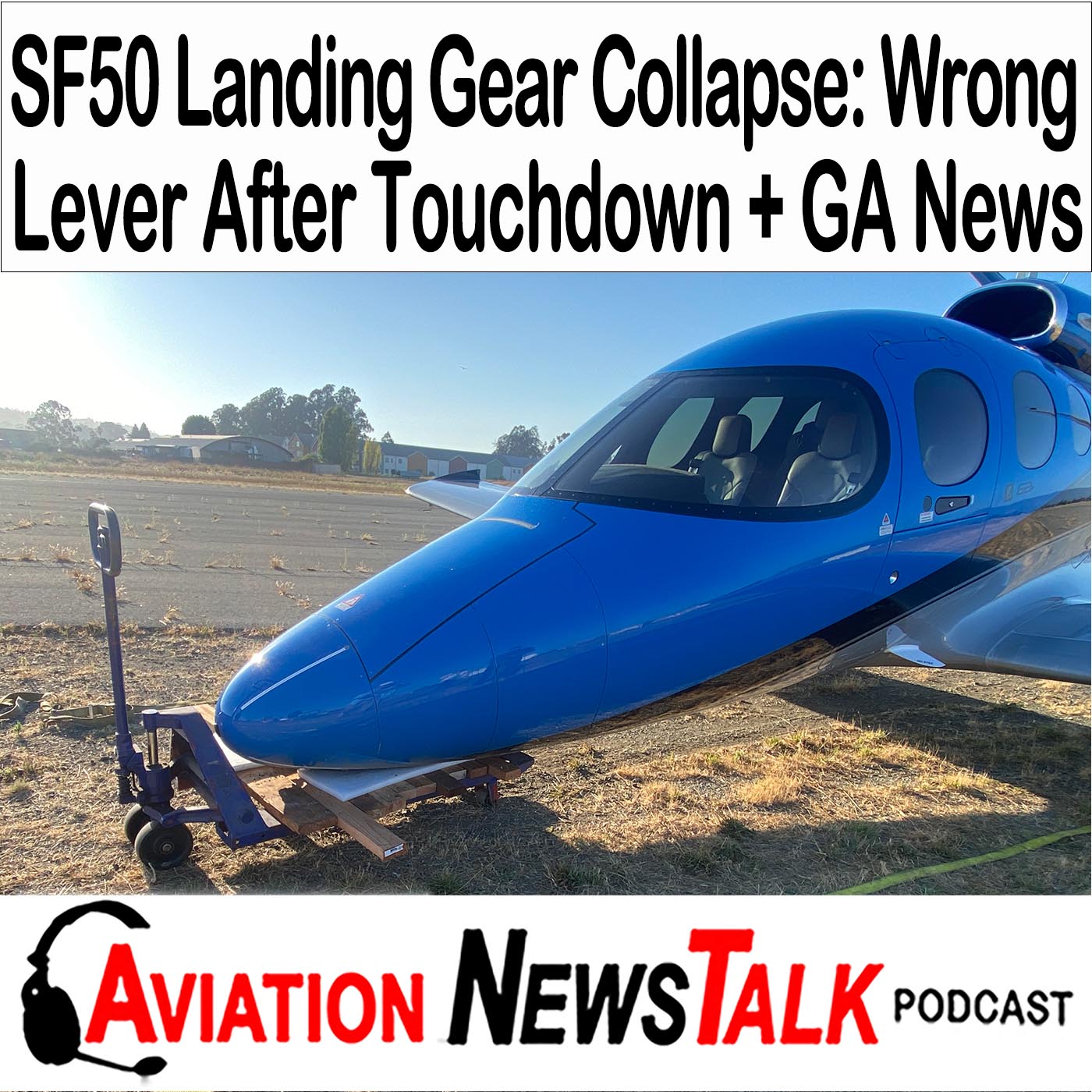
Max talks with Rob Mark about a classic "simple mistake with big consequences" scenario: a pilot who possibly raised the landing gear handle instead of selecting flaps up during the landing roll in a Cirrus Vision Jet. The event looks minor on the surface—no injuries and the airplane stayed on the runway—but it exposes a human-factors trap that can bite any retractable-gear pilot, especially when you're trying to be quick and efficient right after touchdown.
The discussion centers on the NTSB's final report for a Cirrus SF50 Vision Jet that landed at Watsonville Municipal Airport (Watsonville, California) on August 9, 2024. The pilot reported a normal approach and landing. Before touchdown, he had the flaps set to 100% and saw three green landing gear indications. Touchdown itself was uneventful. But during the landing roll—right about when braking began—the nose landing gear collapsed.
Max and Rob walk through what the data showed. On short final, the airplane was properly configured: flaps at 100% and the landing gear down and locked. During rollout, both weight-on-wheels switches were briefly "unloaded," and the landing gear handle was raised and then lowered. That sequence unlocked the nose gear and allowed it to collapse. The main gear also unlocked, but it re-locked before collapsing. The probable cause boiled down to an inadvertent control selection: the pilot likely moved the gear handle instead of selecting the flap switch to 0%.
From there, they unpack why this kind of error is so believable. The flap selector switch sits below the landing gear handle, and many pilots develop a post-touchdown habit of "cleaning up" quickly. Some of that comes from short-field technique: retracting flaps can put more weight on the wheels, increase braking effectiveness, and reduce stopping distance. But the exact moment you're tempted to do it is also the moment you have the least spare attention. You're still fast, directional control still matters, braking is being modulated, and you're managing the transition from flight to rollout. Add fatigue, distraction, or a slightly different cockpit flow than usual, and a wrong-control grab becomes completely plausible.
A big takeaway is that landing isn't over at touchdown. Many pilots subconsciously relax as soon as the mains touch, as if the hard part is done. In reality, the landing roll is when you still have a lot of kinetic energy and limited margin for distraction. Looking down, changing configuration, or reaching for cockpit controls before you're stabilized is how small errors turn into big repair bills. Max and Rob emphasize that "post-landing tasks" are optional until the airplane is clearly under control and slowing.
So what should pilots do differently? Their answer is intentionally boring: slow the flow down. On most runways there is no operational need to rush flap retraction during rollout. Keep your eyes outside, keep the airplane tracking straight, and let speed decay. If you choose to retract flaps on rollout, treat it like a checklist item, not a reflex. Touch the correct control deliberately, verify what you're touching, and use a short verbal callout ("flaps zero") before you move it. Better yet, tie configuration changes to safer triggers—below taxi speed, after exiting the runway, or after stopping and running the after-landing checklist—so you're not doing "extra tasks" while still managing high speed and directional control.
They also discuss building habits that are resistant to error. If your technique is "as soon as I touch down, I do X," you're training your hands to move before your brain has finished verifying the right target. Replace that with a pause that forces confirmation, or a flow that keeps critical controls physically and mentally separated in time. The goal isn't to be fast; it's to be consistent and correct.
If you're getting value from this show, please support the show via PayPal, Venmo, Zelle or Patreon.
Support the Show by buying a Lightspeed ANR Headsets Max has been using only Lightspeed headsets for nearly 25 years! I love their tradeup program that let's you trade in an older Lightspeed headset for a newer model. Start with one of the links below, and Lightspeed will pay a referral fee to support Aviation News Talk. Lightspeed Delta Zulu Headset $1299NEW – Lightspeed Zulu 4 Headset $1099 Lightspeed Zulu 3 Headset $949Lightspeed Sierra Headset $749 My Review on the Lightspeed Delta Zulu
Send us your feedback or comments via email
If you have a question you'd like answered on the show, let listeners hear you ask the question, by recording your listener question using your phone.
News Stories
ForeFlight and Jeppesen announce Layoffs
AOPA asks pilots to contact Congress to Support PAPA
FAA makes permanent restrictions for helicopters near DCA
House passes bill that would block ATC privatization
Report Shows Rise in DPE Supply
Super Bowl LX: What General Aviation Pilots Need to Know
New glider distance record - Instagram video
Stolen Plane Crashes Into Hangar
FBI investigates stolen planes, one found at Auburn airport
Authorities looking for couple in connection with thefts
Pilot in crash near Boise charged with operating under the influence
Mentioned on the ShowBuy Max Trescott's G3000 Book Call 800-247-6553 Video of the Week: Max's video showing ADS-B data for NASCAR driver crash
Free Index to the first 282 episodes of Aviation New Talk
So You Want To Learn to Fly or Buy a Cirrus seminars Online Version of the Seminar Coming Soon – Register for Notification
Check out our recommended ADS-B receivers, and order one for yourself. Yes, we'll make a couple of dollars if you do.
Get the Free Aviation News Talk app for iOS or Android.
Check out Max's Online Courses: G1000 VFR, G1000 IFR, and Flying WAAS & GPS Approaches. Find them all at: https://www.pilotlearning.com/
Social Media Like Aviation News Talk podcast on Facebook Follow Max on Instagram Follow Max on Twitter Listen to all Aviation News Talk podcasts on YouTube or YouTube Premium
"Go Around" song used by permission of Ken Dravis; you can buy his music at kendravis.com If you purchase a product through a link on our site, we may receive compensation.
Max talks with Rob Mark about the fatal crash of a Citation 550 in Statesville, North Carolina, that killed six people, including a NASCAR driver Greg Biffle and members of his family. The accident occurred shortly after takeoff, making it one of the most closely watched aviation tragedies of the week and a focal point of this episode.
Preliminary information indicates the Citation 550 departed Runway 10 at Statesville Airport and soon reported engine trouble. The crew attempted to return to land on Runway 28. ADS-B data shows the aircraft remained airborne for approximately seven minutes and came remarkably close to completing the return. The jet maneuvered back toward the airport, descended unusually low on downwind—likely to remain below cloud ceilings—and successfully aligned with the runway before crashing just short of the pavement following a rapid descent and post-impact fire.
Weather conditions at the time were poor but not extreme, with drizzle, reduced visibility, and broken ceilings reported near the time of the accident. Max and Rob discuss how emergency returns immediately after takeoff create one of the highest workload scenarios pilots face, especially when compounded by weather, low altitude, and potential mechanical failures. While twin-engine aircraft are designed to continue flight after an engine problem, this accident highlights how quickly margins disappear when multiple stressors converge.
The episode then places the Statesville crash within a broader context of recent fatal accidents involving business jets. Max and Rob examine a Citation III crash in Toluca, Mexico, that killed all ten people on board. Although weather at the time was VFR, the airport’s high elevation—approximately 8,500 feet—dramatically reduced aircraft performance. ADS-B data revealed excessive airspeed on short final, followed by an attempted go-around that showed no sustained climb. The hosts note that go-arounds at high density altitude are particularly unforgiving, and that many pilots underestimate how marginal climb performance can be when aircraft are heavy.
Attention then turns to an unusually blunt public statement from NTSB Chair Jennifer Homendy, who criticized proposed military exemptions to ADS-B requirements in Washington, D.C. airspace. Homendy warned that maintaining separate rules for military aircraft risks repeating history, referencing a fatal midair collision nearly a year earlier involving a military helicopter operating without ADS-B. Max and Rob discuss how exceptions intended for rare circumstances can become normalized, undermining the very safety systems designed to prevent collisions.
Several additional accidents are reviewed, including a fatal Twin Comanche crash in Illinois and a night training flight in Louisiana that ended when a Cessna 172 crashed into Lake Pontchartrain. In the Louisiana accident, ADS-B data showed a gradual descent toward the airport, followed by a tight 180-degree turn and a sudden acceleration. In the final seconds, the aircraft’s descent rate increased dramatically, consistent with somatogravic illusion—a powerful and often deadly sensory illusion caused by acceleration in dark or instrument conditions.
Max explains how somatogravic illusion can trick pilots into believing the aircraft is pitching up when it is not, prompting them to push forward on the controls. In visual conditions, outside references correct the error. At night or in IMC, the illusion can persist unchecked, leading to controlled flight into terrain. Max connects this accident to several historic crashes, emphasizing that the only reliable defense is strict reliance on instruments and verification of a positive rate of climb.
The episode also covers a preliminary NTSB report involving a King Air B100 that crashed in Florida during a humanitarian relief flight. The aircraft carried significant cargo and fuel and entered clouds shortly after departure before descending at extreme speed. With no early signs of icing or engine failure, Max and Rob discuss possible pilot incapacitation and the risks associated with cargo loading and securing. Even relatively modest shifts in unsecured cargo can have catastrophic consequences in flight.
Two final preliminary reports underscore recurring themes. In Ohio, a Jabiru Sport aircraft crashed after repeated low-altitude passes over a residence, consistent with hazardous low-level maneuvering. In California, a Cessna 172 struck rising terrain in a narrow mountain canyon after departing Bishop Airport, illustrating the dangers of mountain flying without sufficient altitude or specialized training.
Throughout the episode, Max and Rob return to a central message: many of these accidents—despite their differing aircraft types and circumstances—share common threads of workload, human limitations, and decision-making under pressure. As winter approaches and daylight hours shorten, they urge pilots to exercise extra caution, particularly during night operations and high-stress departures.
The fatal Citation 550 crash in Statesville serves as a sobering reminder that even well-equipped aircraft and experienced crews can be overwhelmed in minutes, and that understanding both aircraft performance and human physiology remains essential to aviation safety.
38 minPlay in:
Why PodAppear
Follow people, not podcasts.
You heard Rob on one show. PodAppear finds the next one for you, and every other person you want to hear.
An alert when they are a guestBy email as it happens, or as a daily or weekly digest. Then press play.
Guests, not name-dropsEpisodes that only mention a name are kept apart, so an alert means they are really on the show.
Everyone in one feedFounders, authors, athletes, scientists. Follow anyone by name, across every show they visit.