Bekomm eine E-Mail, wenn Melissa in einem Podcast zu Gast istPodAppear prüft neue Folgen, sobald sie erscheinen, und lässt die weg, in denen Melissa nur erwähnt wird. Bis zu 15 Personen kostenlos, ohne Kreditkarte.Bis zu 15 Personen kostenlos, ohne Kreditkarte.
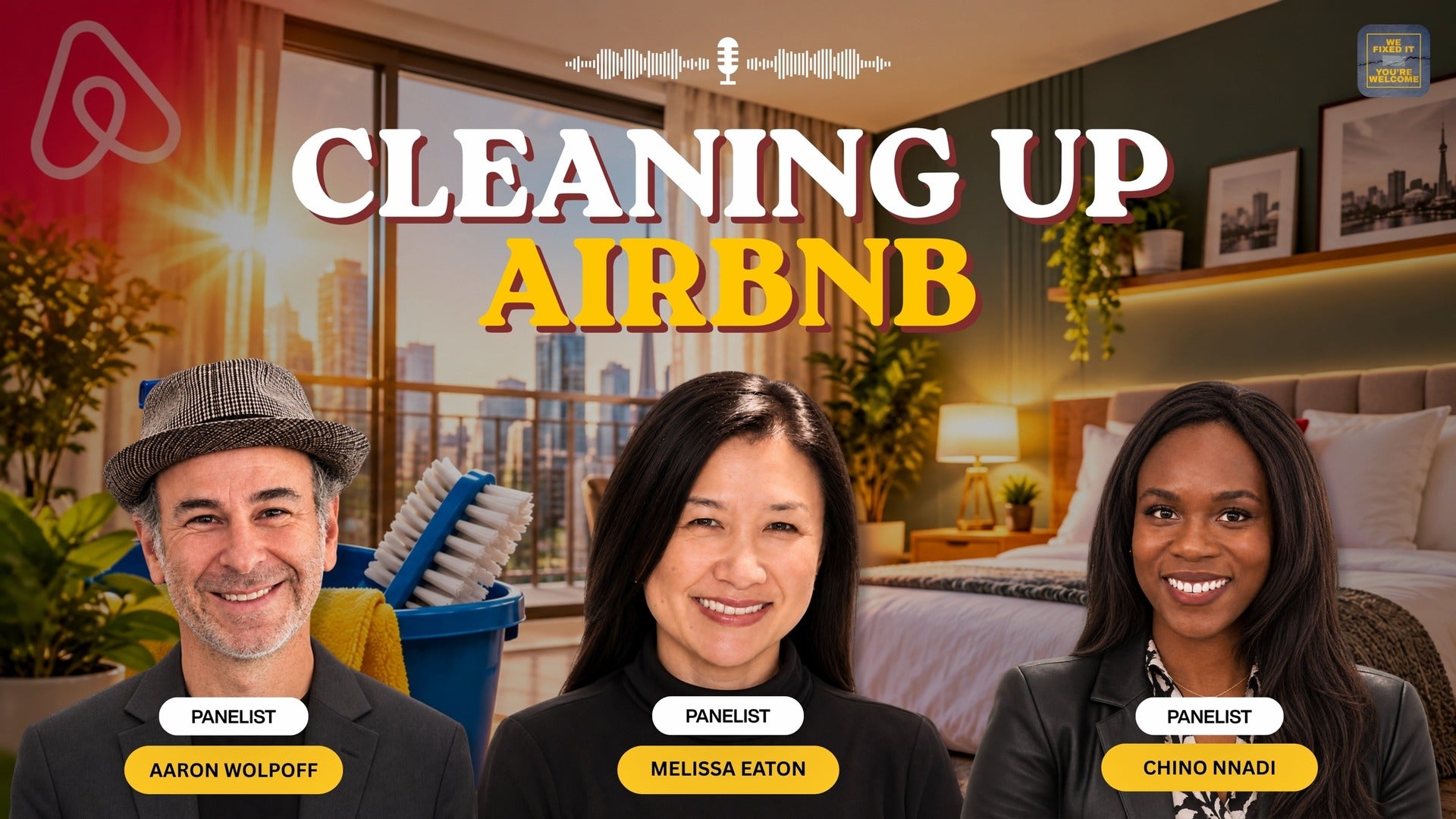
For a long time, Airbnb guests have been asked to clean up at checkout. Wash the dishes, strip the beds, maybe take the trash with you. That all sounds reasonable. But wait, didn't you also pay a $100+ cleaning fee? Starting November 20, Airbnb will no longer enforce a guest chore list, and hosts can't fine you for skipping a request. Guests are thrilled. Plenty of hosts are furious. So who's right?
Join Chino Nnadi, Aaron Wolpoff and Melissa Eaton as they uncover what this fight is really about: trust, transparency, and what happens when a powerful marketplace makes one side happier at the other side's expense. The panel looks at how Airbnb and VRBO made staying in a stranger's home feel normal, why a cleaning fee that's itemized stings more than one baked into the price, and where the line sits between fair house rules and unpaid housework. They also ask whether Airbnb punished every host for the behavior of a few, and how viral one-star stories shape a brand even while bookings keep growing.
The conversation lands on a clear fix: standard checkout basics that are shown before you book, room for reasonable house rules that are explained up front, a "five-star guest" checklist for the extras, and a small reward for guests who choose to tidy up anyway. Clear expectations beat surprise chores.
Panelists:
Chino Nnadi – https://www.linkedin.com/in/chino-talentstrategist/
Melissa Eaton – https://www.linkedin.com/in/mseaton/
Aaron Wolpoff – https://www.linkedin.com/in/marketingaaron/
Connect With the Show
Subscribe for more deep dives where we fix big business problems with fresh perspectives.
• Website – www.wefixeditpod.com
• Follow us on:
Instagram – https://www.instagram.com/wefixeditpod
LinkedIn – https://www.linkedin.com/company/wefixeditpod
YouTube – https://www.youtube.com/@WeFixedItPod
If you liked this episode, don't forget to subscribe, leave a review, and share it with your friends! Keep listening to find out how we fix companies and put them back better than we found them.
Disclaimer
A quick disclaimer. We are going into this somewhat cold and nothing we say should be construed as legal advice, financial advice or anything that would get us in trouble. These are our views and opinions. We're here to ask the kinds of questions everyone's thinking, have an engaging conversation and maybe come to some conclusions that we feel are worth exploring.
By the end, if we fixed it, you're welcome.
All trademarks, IP and brand elements discussed are property of their respective owners.
Learn more about your ad choices. Visit megaphone.fm/adchoices
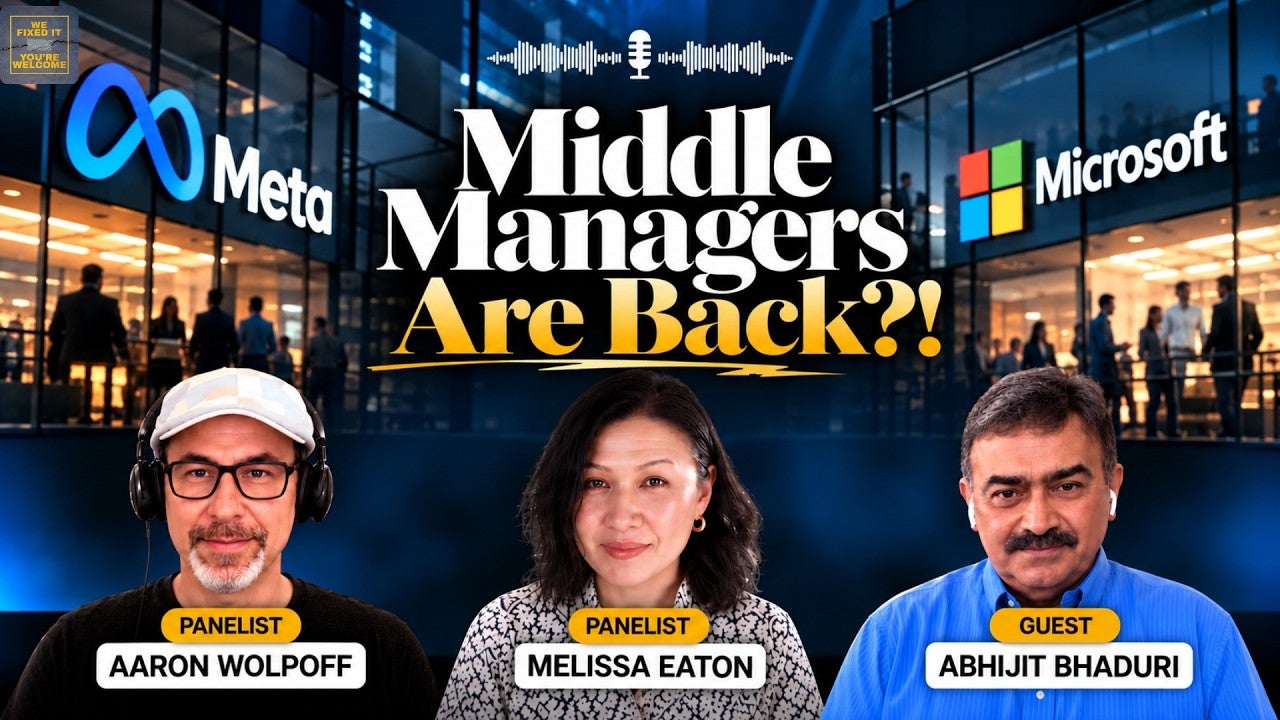
Middle managers were supposed to be one of the layers companies could do without. Organizations flattened their org charts, invested heavily in AI, and removed roles in the name of efficiency. Now the question is whether they also removed the people who help teams think, learn, and work effectively.
Abhijit Bhaduri joins Aaron Wolpoff and Melissa Eaton to unpack the management reset happening in an AI-enabled workplace. Drawing on his experience in talent management and global learning and development, he explains why efficiency and effectiveness are not the same, how repeated restructures erode trust, and why employees need enough security to learn new skills.
The conversation explores the future of middle management, the entry-level talent pipeline, the human cost of treating employees as interchangeable line items, and why AI needs thoughtful human escalation when systems fail. The answer is not to stop using AI. It is to redesign work so technology and people can make each other more effective.
In this episode:
Why companies are reconsidering middle management
Efficiency versus effectiveness
How layoffs and reversals damage trust
Why fear makes learning harder
The role of managers in coaching, culture, and escalation
What happens when entry-level jobs disappear
Why AI needs human judgment and customer-service escalation
How employers can invest in employees’ next roles
Connect with Abhijit Bhaduri:
LinkedIn: https://www.linkedin.com/in/abhijitbhaduri/
Connect With the Show
Subscribe for more deep dives where we fix big business problems with fresh perspectives.
• Website – www.wefixeditpod.com
• Follow us on:
Instagram – https://www.instagram.com/wefixeditpod
LinkedIn – https://www.linkedin.com/company/wefixeditpod
YouTube – https://www.youtube.com/@WeFixedItPod
If you liked this episode, don’t forget to subscribe, leave a review, and share it with your friends! Keep listening to find out how we fix companies and put them back better than we found them.
Disclaimer
A quick disclaimer. We are going into this somewhat cold and nothing we say should be construed as legal advice, financial advice or anything that would get us in trouble. These are our views and opinions. We’re here to ask the kinds of questions everyone’s thinking, have an engaging conversation and maybe come to some conclusions that we feel are worth exploring.
By the end, if we fixed it, you’re welcome. All trademarks, IP and brand elements discussed are property of their respective owners.
Learn more about your ad choices. Visit megaphone.fm/adchoices
Apple has a new CEO. But should John Ternus try to change Apple — or protect what already works?
Chris Deaver, former Apple and Disney leader and co-founder of BraveCore, joins Aaron Wolpoff and Melissa Eaton to unpack one of the biggest questions facing Apple's next chapter: how do you evolve a company without losing the culture that made it great?
Chris brings an unusually close perspective to the conversation. He worked in leadership development at Apple and worked extensively with John Ternus over more than a decade as Ternus developed into the leader Apple ultimately chose to succeed Tim Cook.
The conversation explores why Steve Jobs and Tim Cook were so different, why that difference actually helped Apple, and why John Ternus doesn't need to become either one.
They discuss Apple's collaborative culture, the shift from "Think Different" to "Different Together," the company's approach to AI and privacy, the future of AR, the challenge of creating Apple's next major product category, and the pressure on a new CEO to deliver a "mic drop" moment.
Chris also explains why Apple's current transition is less about fixing a broken company and more about preemptively positioning a healthy company for its next phase.
In this episode:
Why Steve Jobs chose a fundamentally different successor in Tim Cook
What Apple actually needs from John Ternus
Why culture may be Apple's most important product
The shift from "Think Different" to "Different Together"
Why Apple promotes people based on principles, not just results
The danger of a CEO trying to control every function
Apple's "category one" philosophy
What Disney's succession problems can teach Apple
Why Apple's approach to AI is different
Privacy vs. AI's dependence on massive amounts of data
Why Apple doesn't need to be first
The future of AR glasses
What would make consumers actually want Apple's next wearable
Why Apple's next major product doesn't have to replace the iPhone
The pressure on John Ternus to deliver a major signal
Why Apple should preserve its culture while evolving its operating mechanics
Why Apple needs to sell the thesis, not just live it
What you will learn
Why Steve Jobs and Tim Cook were intentionally different leaders
Why Apple needs the right leader for the right phase, rather than another Steve Jobs
Why Apple's culture may actually be its most important "product"
How Apple shifted from **"Think Different" to "Different Together"
Why John Ternus's biggest challenge isn't hardware — it's becoming a truly enterprise-wide CEO
Why Apple promotes leaders who demonstrate its principles, not just performance
How Apple's "category one" philosophy allows leaders to own their expertise while trusting other leaders to own theirs
Why CEOs can damage companies by trying to have their hands in everything
What Apple's approach to AI reveals about its commitment to privacy
Why Apple may deliberately refuse to be first in AI
Why "we don't care about being the first, we care about being the best" is central to Apple's strategy
Why AR could become Apple's next meaningful product category
What Apple needs to prove before consumers will actually want AR glasses
Why Apple's biggest challenge may be explaining the use case, not building the technology
Why the pressure for a "mic drop" product announcement could become a problem for Ternus
What Apple can learn from its failed succession stories
Why Chris sees the current situation as preemptive positioning rather than fixing a broken company
Why Ternus needs to become a deeper collaborator rather than trying to impose a singular vision
Why Apple should "sell the thesis, don't just live it"
Why the best future for Apple may involve preserving its culture while changing the mechanics around it
Notable quotes
"The culture is the gift that keeps on giving." — Chris Deaver
"For Apple, incremental is revolutionary." — Chris Deaver
"Apple's always been a company that is first about getting the principles right." — Chris Deaver
"We don't care about being the first, we care about being the best." — Chris Deaver
"You don't want to be educating the consumer about this. You want them to experience it." — Chris Deaver
"There's not really a broken per se." — Chris Deaver
"It's almost a preemptive, like, let's not let it break." — Chris Deaver
"Do you really wanna rush Michelangelo's sculpture?" — Chris Deaver
About our guest
Chris Deaver is the co-founder of BraveCore, a leadership and culture consultancy focused on helping organizations build cultures around co-creation and collaboration. His LinkedIn describes his work as spanning two decades inside organizations including Apple and Disney
Connect with Chris Deaver:
Linkedin - LinkedIn
Website - BraveCore
Connect with We Fixed It
, You're Welcome: Website- https://www.wefixeditpod.com
Instagram - https://www.instagram.com/wefixeditpod
Linkedin - https://www.linkedin.com/company/wefixeditpod
YouTube -https://www.youtube.com/@WeFixedItPod
If you liked this episode, don’t forget to subscribe, leave a review, and share it with your friends! Keep listening to find out how we fix companies and put them back better than we found them.
Disclaimer
A quick disclaimer. We are going into this somewhat cold and nothing we say should be construed as legal advice, financial advice or anything that would get us in trouble. These are our views and opinions. We’re here to ask the kinds of questions everyone’s thinking, have an engaging conversation and maybe come to some conclusions that we feel are worth exploring.
By the end, if we fixed it, you’re welcome. All trademarks, IP and brand elements discussed are property of their respective owners.
Learn more about your ad choices. Visit megaphone.fm/adchoices
1 h 02 minAbspielen in:
Warum PodAppear
Folge Menschen, nicht Podcasts.
Du hast Melissa in einer Sendung gehört. PodAppear findet für dich die nächste, und genauso für alle anderen, die du hören willst.
Eine Meldung, wenn die Person zu Gast istPer E-Mail: sofort oder gebündelt als Tages- oder Wochenübersicht. Dann nur noch auf Play drücken.
Gäste statt bloßer ErwähnungenFolgen, in denen ein Name nur fällt, landen getrennt. Eine Meldung heißt: Die Person ist wirklich in der Sendung.
Alle in einem FeedGründerinnen, Autoren, Sportler, Forscherinnen. Folge allen mit Namen, quer durch jede Sendung, in der sie auftreten.