Get an email when Matthieu is a guest on a podcastPodAppear checks new episodes as they come out and leaves out the ones that only mention Matthieu. Free for up to 15 people, no card needed.Free for up to 15 people, no card needed.
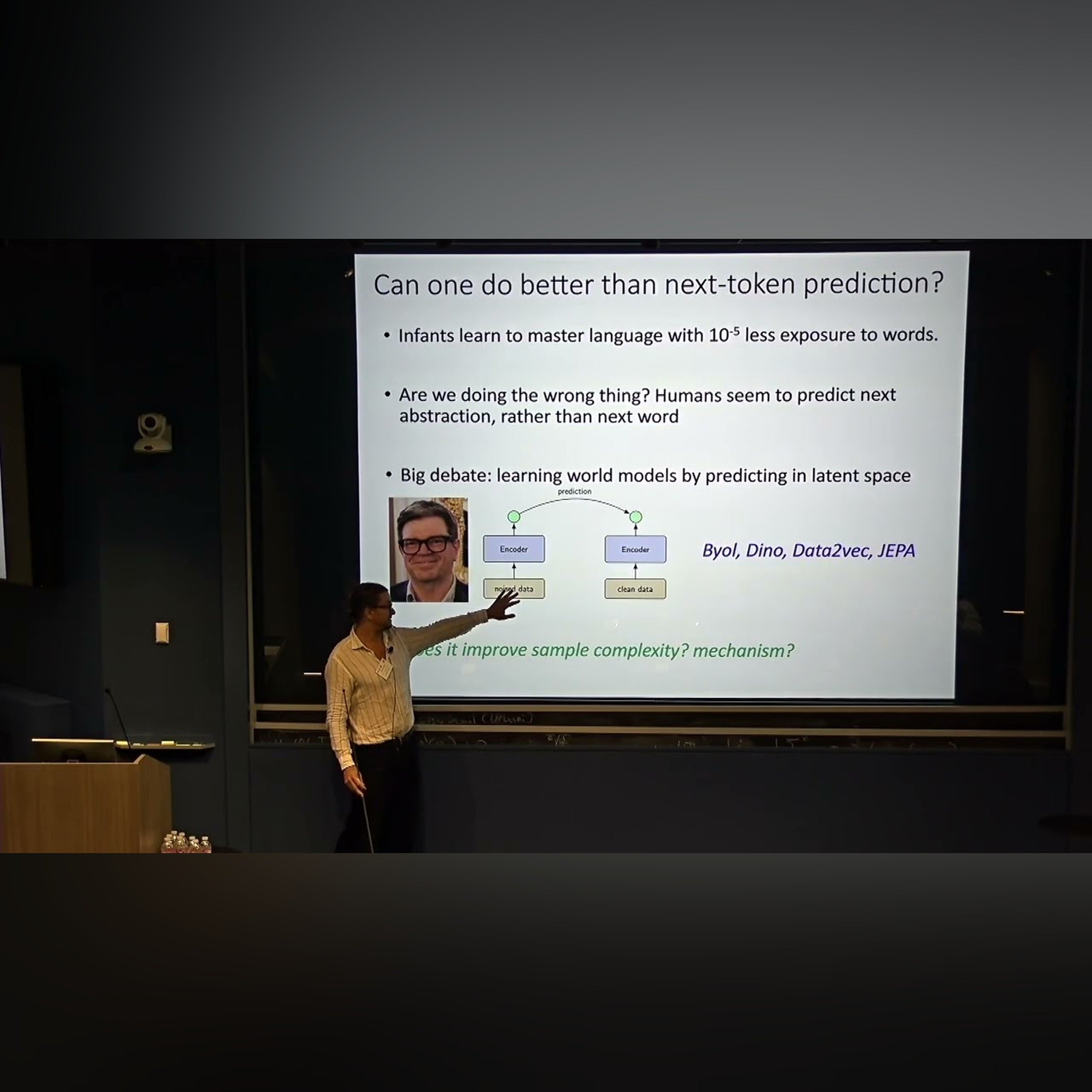
Despite the fact that experimental neural scaling laws have substantially guided empirical progress in large-scale machine learning, no existing theory can quantitatively predict the exponents of these important laws for any modern LLM trained on natural languages. It is also unclear whether they can be beaten by training with other objectives. Matthieu Wyart will review the efforts of the collaboration in studying this phenomenon, including the first such theory in the case of data-limited scaling laws. Wyart will then introduce synthetic languages displaying a hidden hierarchy (a central notion in both linguistics and computer vision), and discuss how these languages are learnt by deep, but not shallow, nets. Scaling laws in these synthetic languages follow from the same principle as in natural languages when trained at the token level, but these languages can be learnt much more efficiently by machines predicting in an abstract space — justifying the success of joint embedding predictive architectures (JEPA) and other machines learning from their own latents.
Uploaded 06-11-26
For more information please visit: https://www.simonsfoundation.org/events/simons-collaboration-on-the-physics-of-learning-and-neural-computation-annual-meeting-2026/
Learn more about your ad choices. Visit megaphone.fm/adchoices
This episode is sponsored by Notion. Learn more about Notion's Developer Platform today at https://notion.com/mlstWhy can deep networks discover abstractions that shallow models miss? Statistical physicist Matthieu Wyart joins Tim Scarfe to argue that the answer lies in the hidden hierarchy of data. Language and images are built from parts within parts; depth lets a network recover those coarse-grained variables and escape the curse of dimensionality.The conversation moves from jamming transitions and rough loss surfaces to Chomsky, context-free grammars and machine creativity. Wyart explains why next-token prediction can still recover compositional structure, where current systems fall short of genuine scientific invention, and why predicting latent representations rather than raw tokens could make learning far more sample-efficient.They also examine diffusion models, neural scaling laws and the limits of physics-inspired theory. The final question is on a personal note: if mistakes are the price of leaving the beaten path, how much scientific risk is worth taking?---TIMESTAMPS:00:00:00 Can machines learn abstractions from data?00:02:00 Notion agentic workspace00:02:49 From statistical physics to machine learning00:06:40 What physics can explain about learning00:16:37 From Carnot to Chomsky bulldozer00:21:21 How deep networks recover hidden hierarchies00:32:43 Where machine creativity still falls short00:40:48 How deep nets escape the curse of dimensionality00:52:19 Why predict latents instead of tokens01:02:49 The sample-efficiency case for latent prediction01:08:31 Diffusion, scaling laws and text entropy01:16:40 The scientists we learn from and the mistakes we make---REFERENCES:person:[00:00:43] Noam Chomskyhttps://linguistics.mit.edu/user/chomsky/tool:[00:02:08] Notion Developer Platformhttps://www.notion.com/en-gb/blog/introducing-developer-platformpaper:[00:04:43] Mastering the game of Go with deep neural networks and tree searchhttps://www.nature.com/articles/nature16961[00:05:52] Reconciling modern machine-learning practice and the bias-variance trade-offhttps://arxiv.org/abs/1812.11118[00:25:54] How Deep Neural Networks Learn Compositional Data: The Random Hierarchy Modelhttps://arxiv.org/abs/2307.02129[00:42:12] Efficient Estimation of Word Representations in Vector Spacehttps://arxiv.org/abs/1301.3781[00:52:46] Self-Supervised Learning from Images with a Joint-Embedding Predictive Architecturehttps://arxiv.org/abs/2301.08243[00:52:54] Learn from your own latents and not from tokens: A sample-complexity theoryhttps://arxiv.org/abs/2605.27734[01:08:31] A Phase Transition in Diffusion Models Reveals the Hierarchical Nature of Datahttps://arxiv.org/abs/2402.16991[01:11:39] Scaling Laws for Neural Language Modelshttps://arxiv.org/abs/2001.08361[01:12:17] Deriving Neural Scaling Laws from the statistics of natural languagehttps://arxiv.org/abs/2602.07488[01:13:34] Prediction and Entropy of Printed Englishhttps://ieeexplore.ieee.org/document/6773263---LINKS:Download PDF transcript: https://app.rescript.info/share/f7644cdaa86c5cc1e41e484e290f2bd4
1 h 19 minPlay in:
Why PodAppear
Follow people, not podcasts.
You heard Matthieu on one show. PodAppear finds the next one for you, and every other person you want to hear.
An alert when they are a guestBy email as it happens, or as a daily or weekly digest. Then press play.
Guests, not name-dropsEpisodes that only mention a name are kept apart, so an alert means they are really on the show.
Everyone in one feedFounders, authors, athletes, scientists. Follow anyone by name, across every show they visit.