The Simons Foundation’s mission is to advance the frontiers of research in mathematics and the basic sciences.Co-founded in New York City by Jim and Marilyn Simons, the foundation exists to support basic — or discovery-driven — scientific research undertaken in the pursuit of understanding the phenomena of our…
More details: https://www.simonsfoundation.org/event/lsstc-data-science-fellowship-program/
Uploaded 31-10-19
Learn more about your ad choices. Visit megaphone.fm/adchoices
The Subspace Flatness Conjecture
The covering radius $\mu(\Lambda,K)$ of a convex body $K \subseteq \setR^n$ with respect to a full rank lattice $\Lambda \subseteq \setR^n$ is the minimum scaling needed so that translates of $K$ placed at every lattice point cover the whole $\setR^n$. A question going back to work of Kannan and Lov\'asz (1988) is how well the covering radius is described solely by the volume of $K$ and the density of the lattice, after projecting both into a suitable subspace.
We report on significant progress on this question due to Regev and Stephens-Davidowitz (2016) who resolve this problem for ellipsoids and Reis and Rothvoss (2023) who cover the general case.
We also survey applications of these results that give near-optimal bounds on the flatness constant as well as a $(\log n)^{O(n)}$-time algorithm for solving $n$-variable integer programs, following work of Dadush (2012). This is based on joint work with Victor Reis.
Uploaded 06-10-26
Learn more about your ad choices. Visit megaphone.fm/adchoices
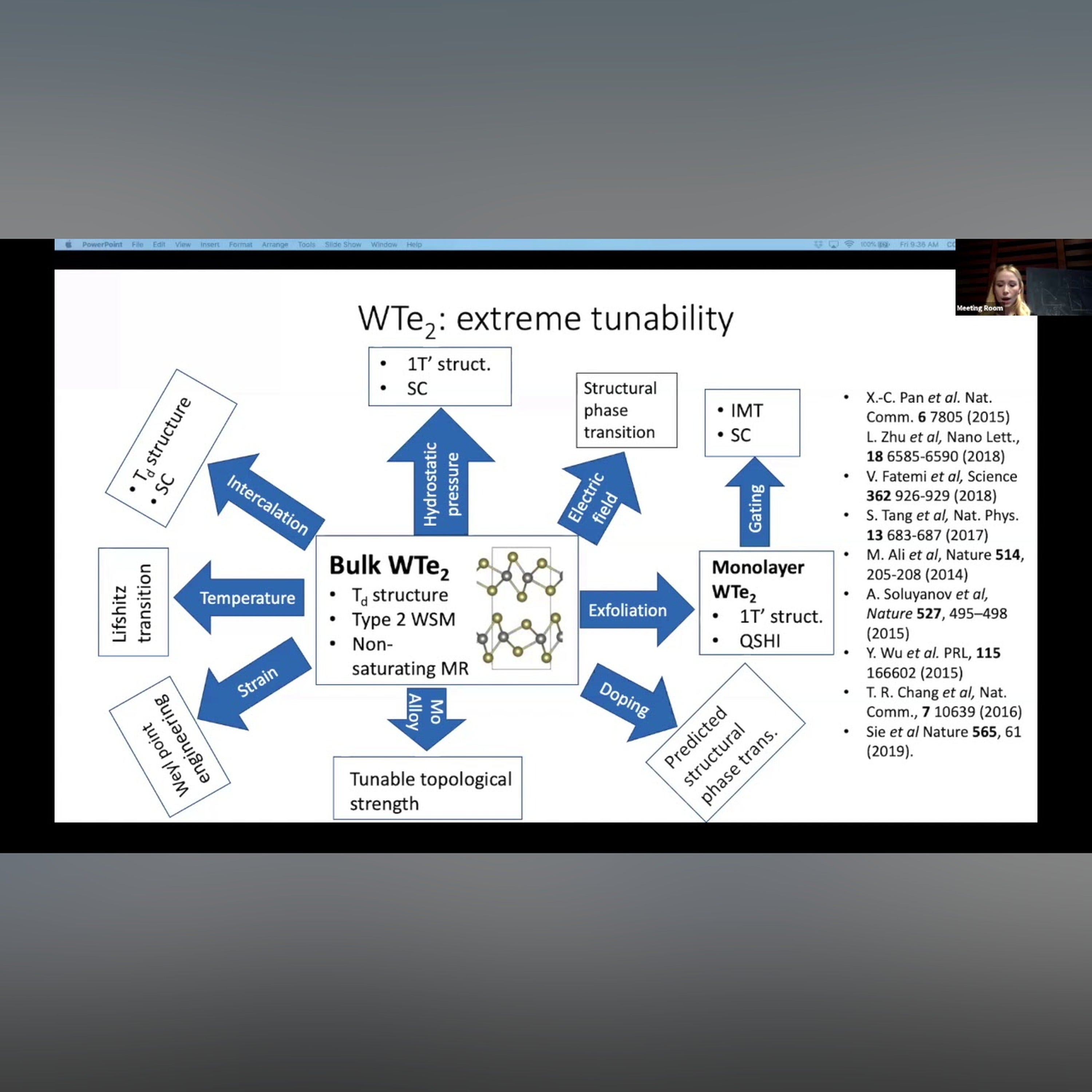
More details: https://www.simonsfoundation.org/event/workshop-on-materials-in-quantum-cavities/
Uploaded 08-08-19
Learn more about your ad choices. Visit megaphone.fm/adchoices
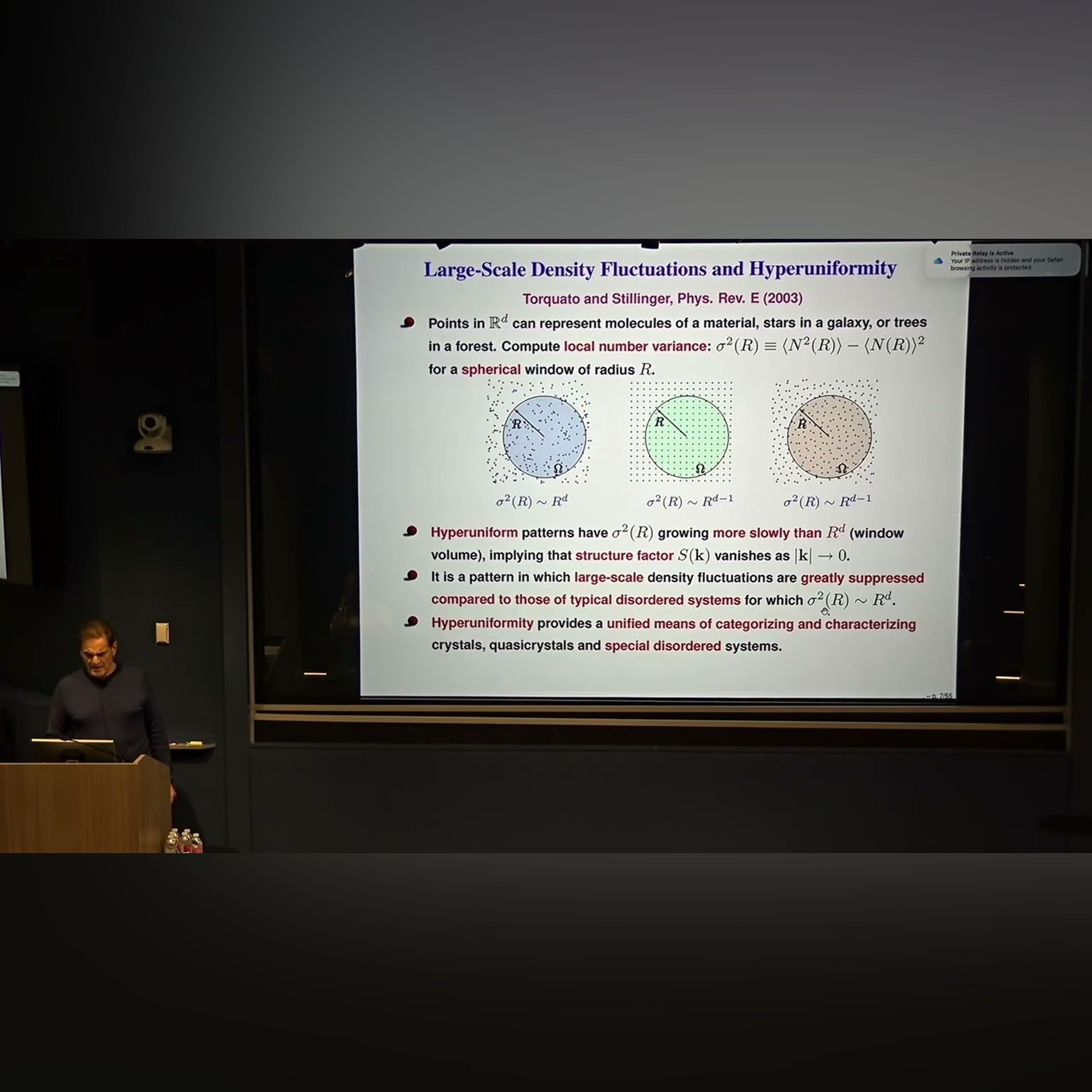
In this Presidential Lecture, Salvatore Torquato will discuss how the ‘hyperuniformity’ concept sheds light on these fascinating questions. In a hyperuniform point pattern, density fluctuations become small over large distances relative to those in garden-variety random systems. This single idea provides a unified framework for understanding the structure and geometry of periodic and quasiperiodic systems, as well as exotic disordered systems. Examples from physics, mathematics and biology will reveal surprising connections among optimization problems in discrete geometry, disordered ground states, sphere packings, quantum mechanics, number theory, the structure of the universe and avian photoreceptor mosaics. Torquato will also introduce ‘order metrics’ — mathematical measures that place periodic, quasiperiodic and correlated disordered patterns along a spectrum from greater order to greater disorder, for objective structural comparisons.
Uploaded 05-10-26
For more information please visit: https://www.simonsfoundation.org/event/hidden-order-the-geometry-of-complex-patterns/
Learn more about your ad choices. Visit megaphone.fm/adchoices
Stability Problems in Collisionless Kinetic Theory
The Vlasov-Poisson system is the simplest non-collisional kinetic model. It describes the evolution of a distribution of particles influenced only by a force induced by their mean-field. We survey recent advances in the stability of stationary states and the asymptotic behavior of solutions for various variants of this system.
Uploaded 14-09-26
Learn more about your ad choices. Visit megaphone.fm/adchoices
Minimal Surfaces and Comparison Geometry
We discuss applications of area-minimization to the study of curvature in Riemannian geometry.
Uploaded 06-10-26
Learn more about your ad choices. Visit megaphone.fm/adchoices
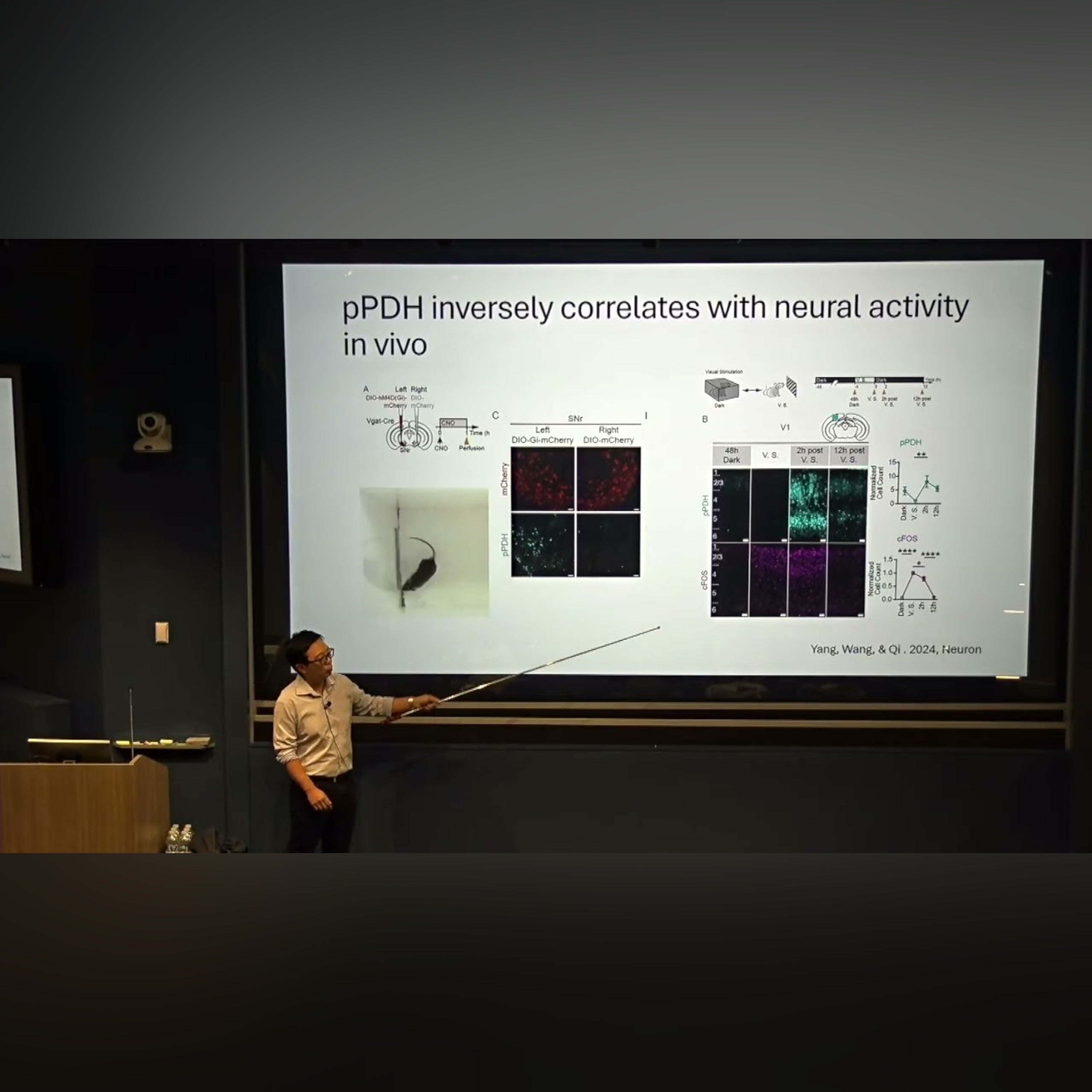
In this Presidential Lecture, Li Ye will discuss his research program, which seeks to understand the brain by investigating how neural circuits monitor, allocate, and utilize energy throughout the body. By combining innovative imaging technologies, chemical biology and neural circuit mapping, he and his colleagues have uncovered previously unknown pathways linking metabolism, behavior and brain activity. These discoveries reveal fundamental principles of brain-body communication and may ultimately provide new opportunities to understand and treat obesity, diabetes, neurodegenerative disorders and other diseases shaped by metabolic dysfunction.
Uploaded 26-10-26
For more information please visit: https://www.simonsfoundation.org/events/energetics-of-integrating-the-brain-and-body/
Learn more about your ad choices. Visit megaphone.fm/adchoices
Unramified Automorphic Forms
We will discuss recent progress on understanding everywhere unramified automorphic forms over function fields. The main application, joint with D. Gaitsgory and V. Lafforgue, is a proof of the Arthur-Ramanujan conjecture in this setting, , which describes the magnitudes of Hecke eigenvalues of cusp forms. This is ultimately obtained as a consequence of the geometric Langlands conjecture for D-modules in characteristic 0. In this talk, we will give an introduction to this circle of ideas.
Uploaded 06-10-26
Learn more about your ad choices. Visit megaphone.fm/adchoices
More details: https://www.simonsfoundation.org/event/cca-summer-school-lectures/
Uploaded 07-08-19
Learn more about your ad choices. Visit megaphone.fm/adchoices
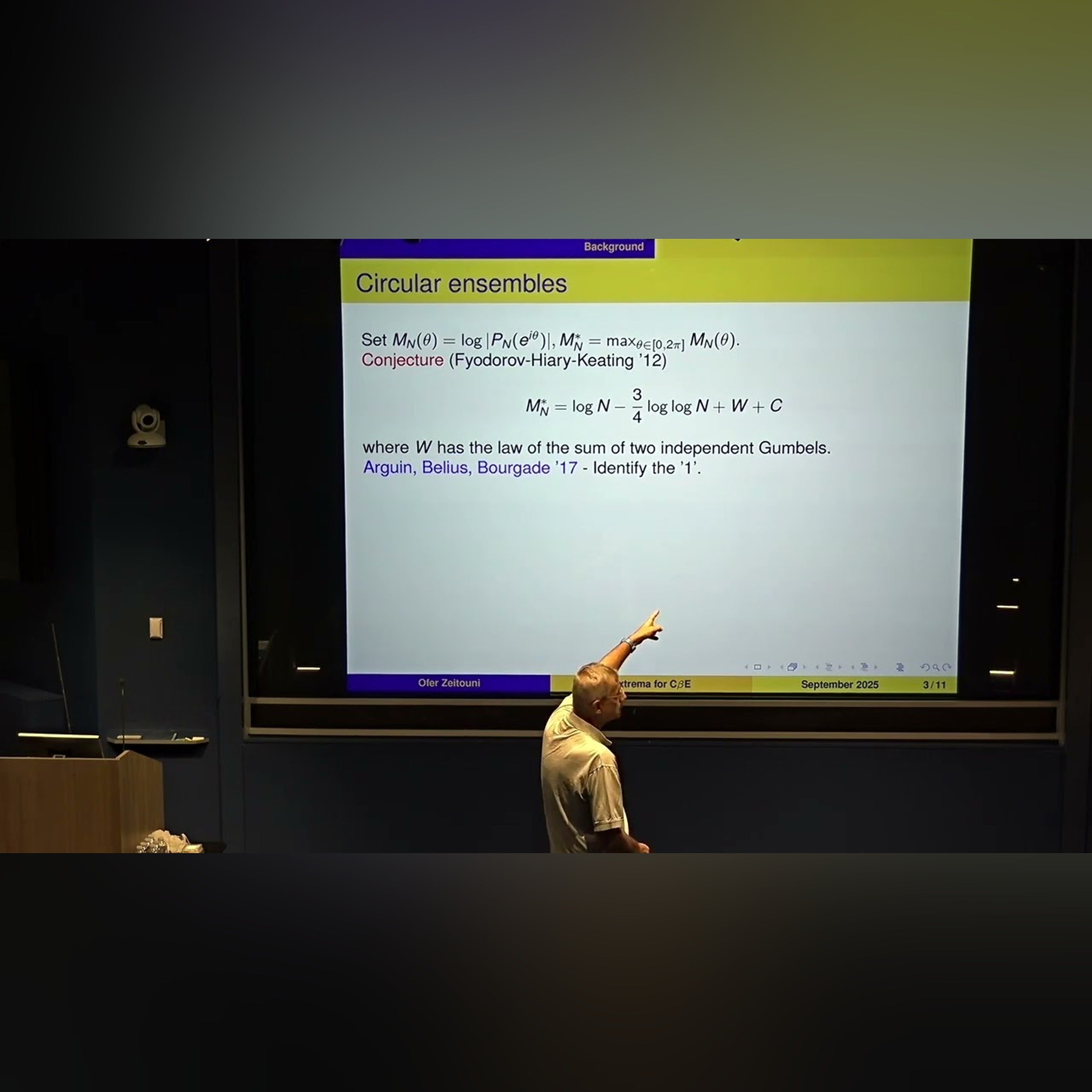
The logarithm of the characteristic polynomial of Cβ
E matrices, viewed as a function on the unit circle in the complex plane, is a logarithmically correlated field. Ofer Zeitouni will describe joint work with Elliot Paquette, where we prove that properly centered, the maximum of this field converges to the sum of a Gumbel random variable and an independent random variable Z, thus validating a famous conjecture of Fyodorov–Hiary–Keating. If time permits, Zeitouni will describe recent work identifying the random variable Z
Uploaded 28-10-25
Learn more about your ad choices. Visit megaphone.fm/adchoices
The Future of Prediction: in Conversation with Oskar Morgenstern
A century ago, economist Oskar Morgenstern studied what he called one of the most central and most difficult problems in the theory of prediction: predictions that actively influence outcomes. Self-fulfilling and self-negating prophecies are two extreme cases of a fundamental problem that arises with all predictions about social outcomes. People act on predictions in ways that change the course of events, a phenomenon called performativity. Morgenstern argued that performativity doomed prediction in the social world to guesswork with unforeseeable results. This talk gives an entry point to the emerging area of performative prediction that provides counterpoints to Morgenstern's pessimistic prophecy. The standard formulation of machine learning as risk minimization assumes a fixed data-generating distribution. Performative prediction extends risk minimization toward data-generating distributions that depend on the predictive model. This extension leads to the powerful algorithmic principle of repeated risk minimization, alternating risk minimization and model deployment indefinitely. Under suitable conditions, repeated risk minimization converges to a stable point, a kind of equilibrium at which the predictive model minimizes risk on the distribution it entails. We'll discuss three perspectives on performativity using ideas from economic modeling, optimization, and the theory of forecasting that contribute principled ways to reason about predictions that influences outcomes.
Uploaded 06-10-26
Learn more about your ad choices. Visit megaphone.fm/adchoices
Energy Lagrangian Flows for Singular SPDEs and Applications
Energy Lagrangian flows are a formulation of the Lagrangian flows of Di Perna-Lions and their stochastic counterparts by Le Bris-Lions and Figalli in the setting of singular stochastic dynamics, partly in regimes where classical and pathwise theories break down. A key notion is "probabilistic subcriticality": even for scaling critical or supercritical equations, regularity of the law combined with coercivity of the generator may yield existence and uniqueness. I will outline the construction and well-posedness results, the relation to pathwise constructions, and applications to hydrodynamics and numerical analysis.
Uploaded 05-10-26
Learn more about your ad choices. Visit megaphone.fm/adchoices
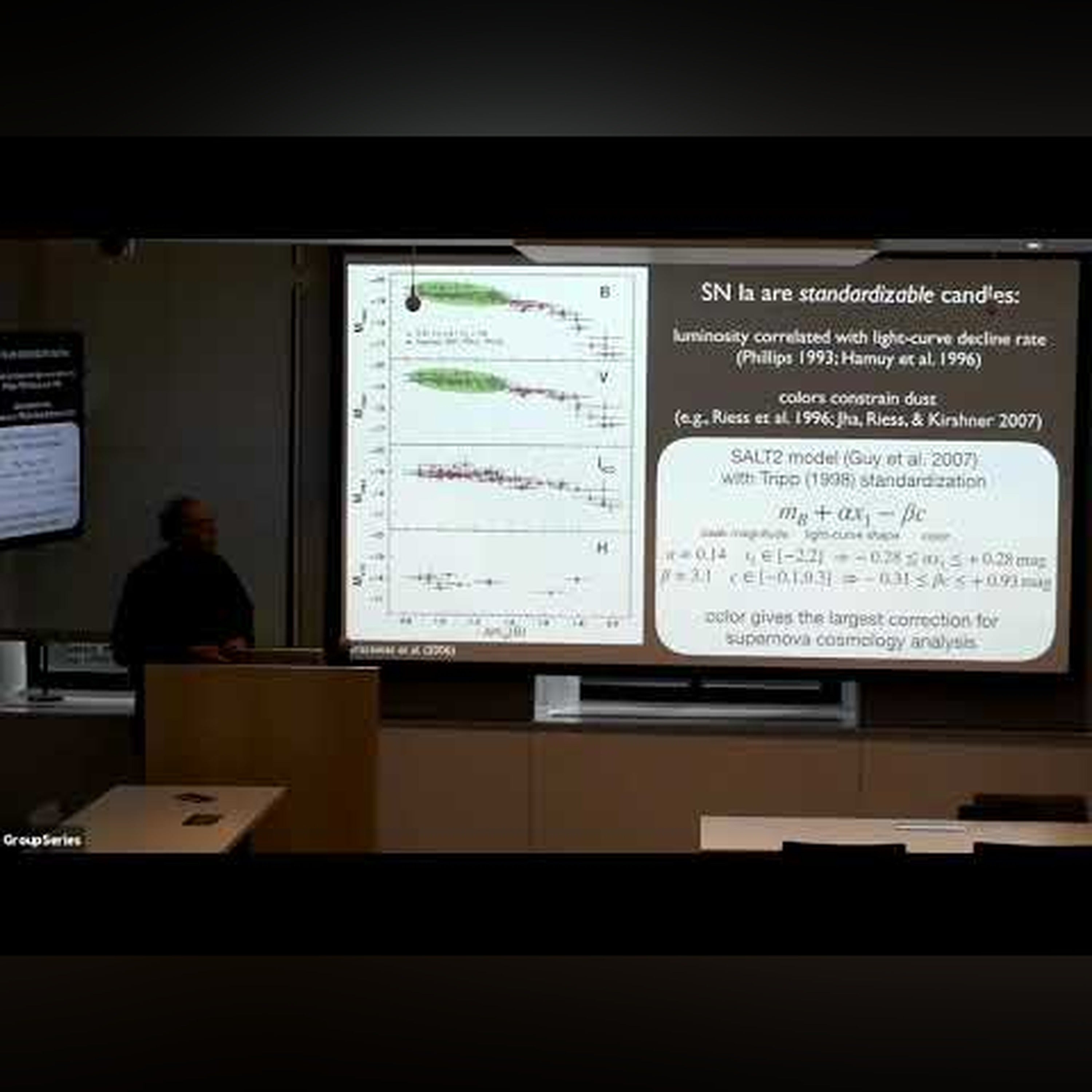
Observations of type Ia supernovae (SN Ia) ushered in a cosmological revolution: the expansion of the Universe is accelerating, driven by dark energy. I will describe current cosmological applications of SN Ia to measure the Hubble constant and constrain the nature of dark energy, with an emphasis on the limiting factors in these measurements. Some of these limits come from our lack of detailed understanding of the progenitors and explosion physics of SN Ia; I will review these open questions and their potential implications for current and future surveys. More details: https://www.simonsfoundation.org/event/2020-spring-cca-friday-colloquium-saurabh-jha/
Uploaded 13-03-20
Learn more about your ad choices. Visit megaphone.fm/adchoices
https://www.simonsfoundation.org/event/simons-collaboration-on-moduli-of-varieties-annual-meeting-2025/
2025 Annual Meeting of the Simons Collaboration on Moduli of Varieties
Simons Foundation
October 2-3, 2025
Uploaded 27-10-25
Learn more about your ad choices. Visit megaphone.fm/adchoices
Algebraic Cohomology of Ring Spectra
Homotopy theory studies generalizations of commutative rings, called ring spectra, in which addition and multiplication are not necessarily strictly associative or commutative. Instead, addition and multiplication are required to be associative and commutative only up to canonical isomorphism, in the same sense that the ordered set {a,b} is in bijection with, but not equal to, the set {b,a}. I will describe a program for generalizing cohomological invariants of rings and schemes to invariants of ring spectra and spectral schemes. Perhaps surprisingly, understanding these cohomological invariants plays an essential role in a modern accounting of the homotopy groups of spheres (as reflected in the disproof of Ravenel's Telescope Conjecture).
Uploaded 14-09-26
Learn more about your ad choices. Visit megaphone.fm/adchoices
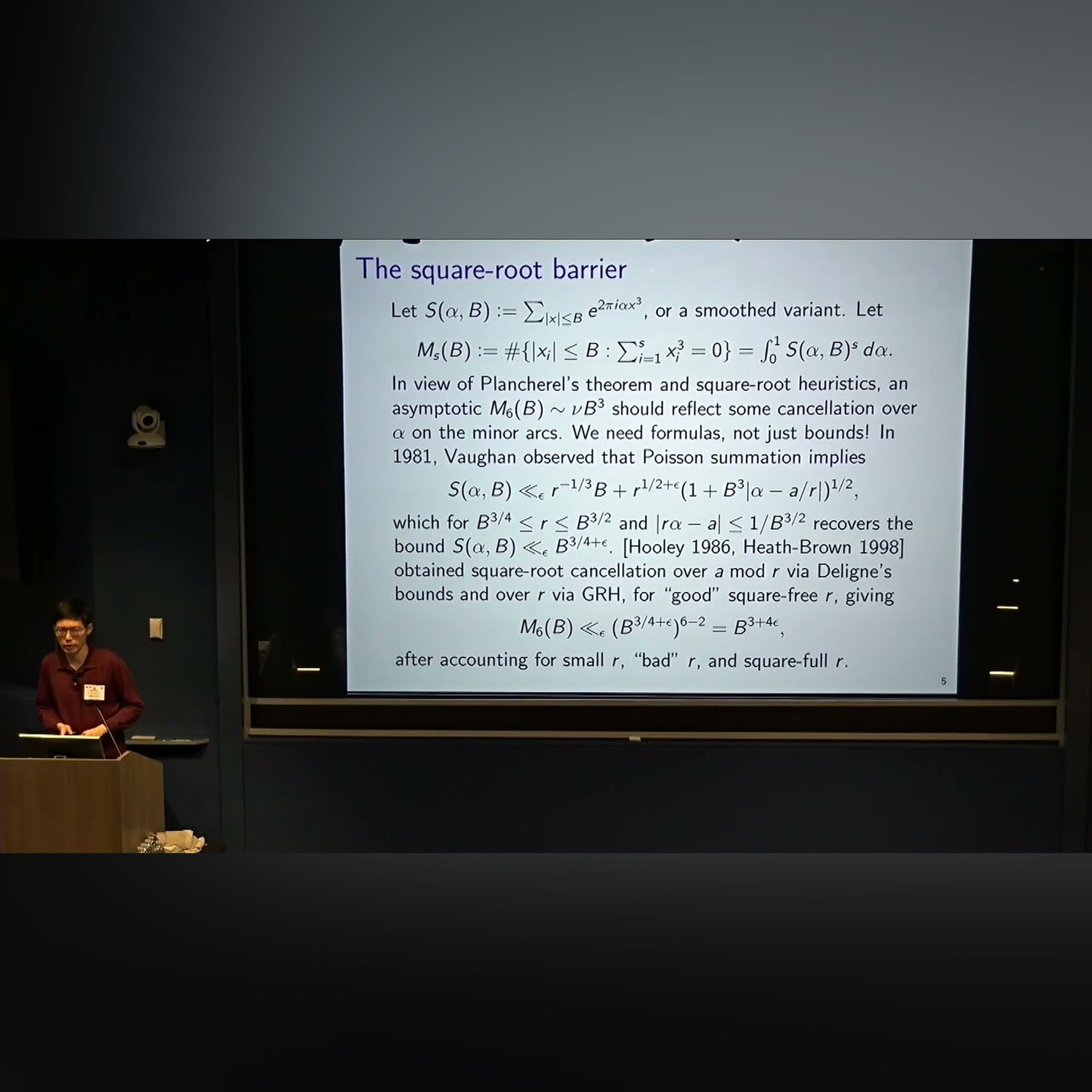
Victor Wang will discuss some Diophantine counting problems for which an analysis via the circle method features the multiplicative statistics of an associated polynomial. Particular focus will be given to a Perazzo cubic fourfold, the subject of joint work in progress with Tim Browning and Ritabrata Munshi.
Uploaded 25-09-25
For more information go here: https://www.simonsfoundation.org/event/mps-conference-on-universal-statistics-in-number-theory/
Learn more about your ad choices. Visit megaphone.fm/adchoices
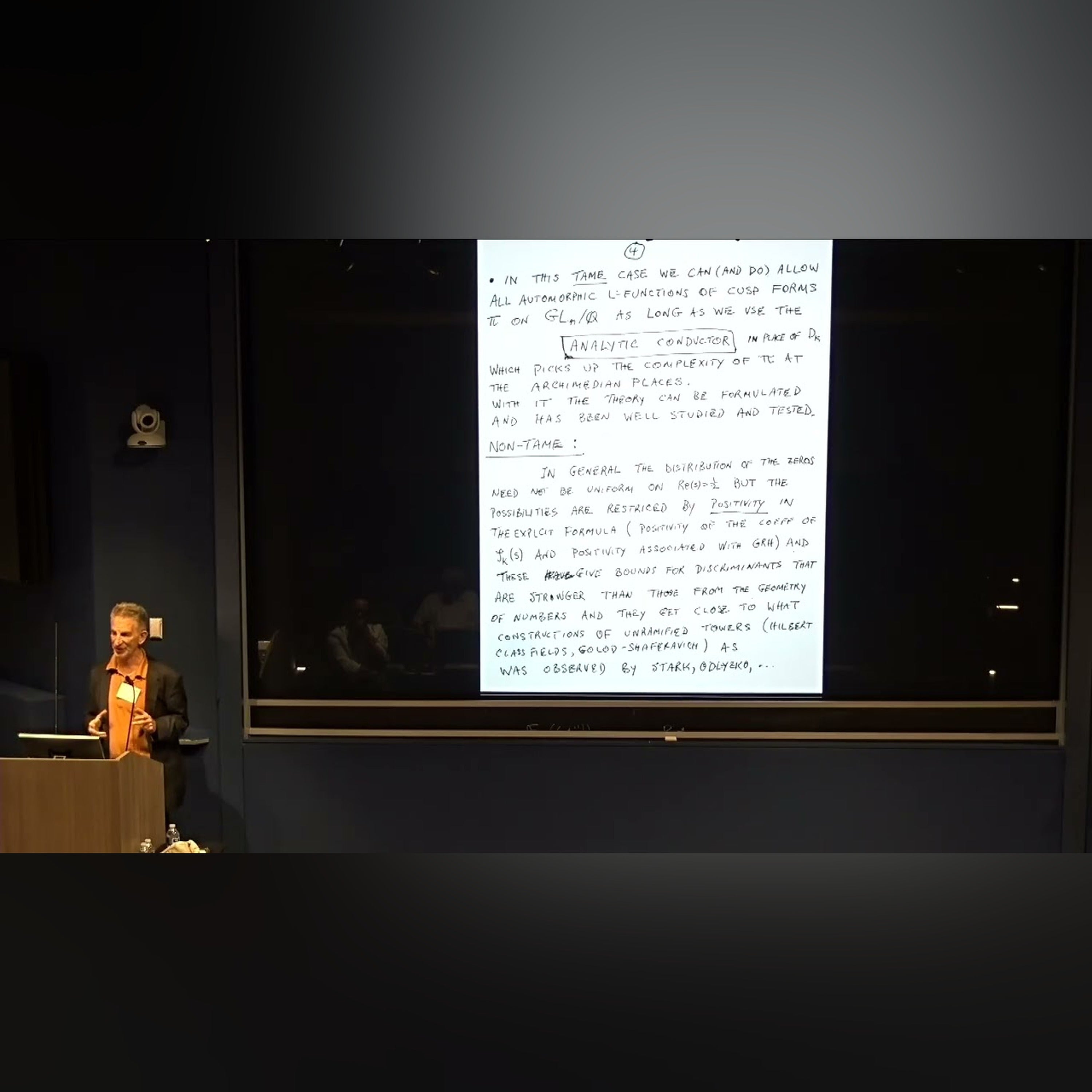
Distribution of Zeros, Eigenvalues and Eigenfunctions in Number Theory
~
We review some of the statistical laws that appear to govern zeta functions and automorphic forms, and in particular the extent to which they are observed numerically and their impact on extremal properties of arithmetical invariants.
Uploaded 25-09-25
For more information go here: https://www.simonsfoundation.org/event/mps-conference-on-universal-statistics-in-number-theory/
Learn more about your ad choices. Visit megaphone.fm/adchoices
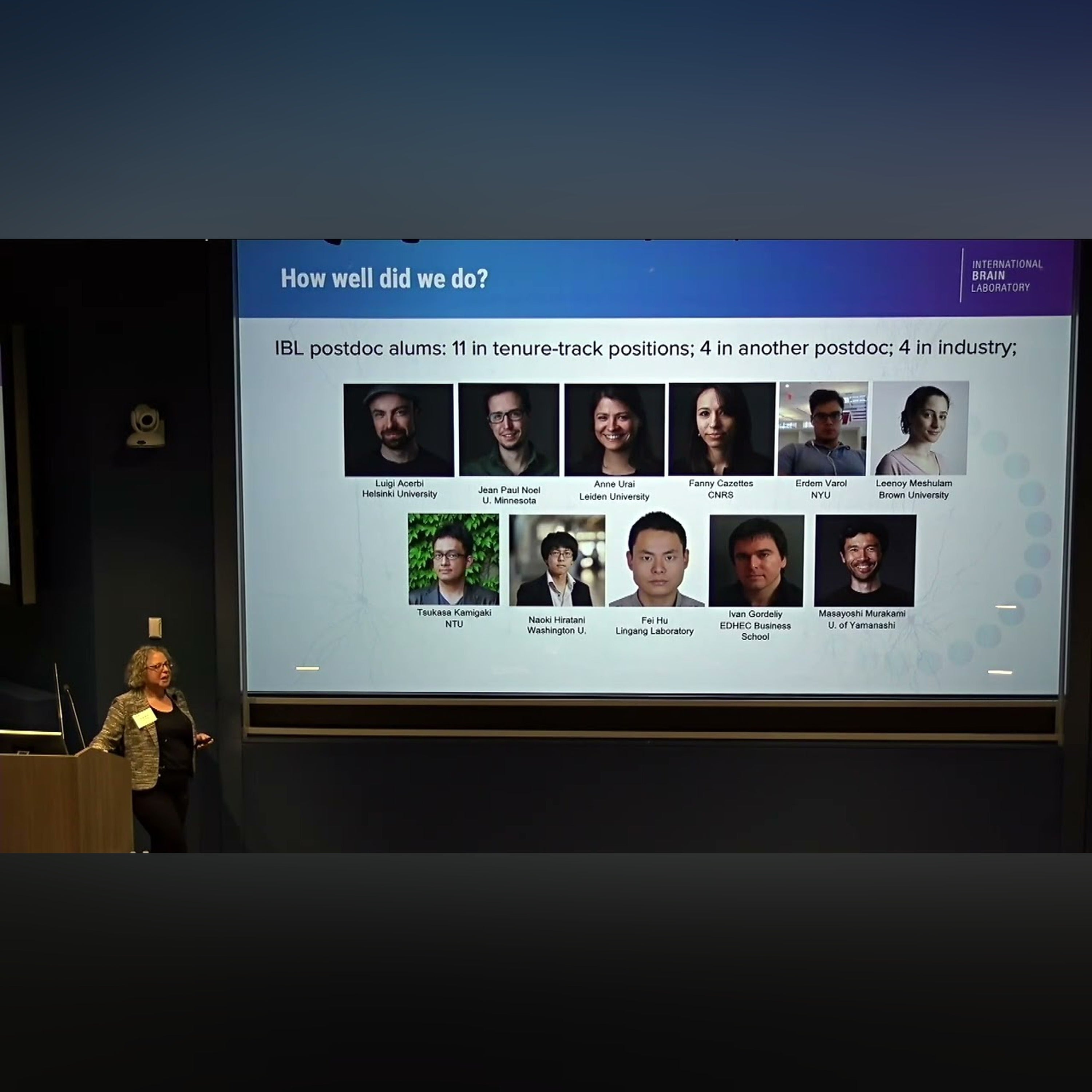
The International Brain Laboratory is an experiment in building a large-scale distributed collaboration committed to open science. To achieve its goals, IBL had to address problems faced by collaborations of all sizes: shared decision making, the division of labor, authorship and credit assignment, and supporting career progression. In this talk I describe some of the lessons we have learned that we hope other scientists may find applicable to their own efforts.
Uploaded 20-10-25
Learn more about your ad choices. Visit megaphone.fm/adchoices
https://www.simonsfoundation.org/event/simons-collaboration-on-moduli-of-varieties-annual-meeting-2025/
2025 Annual Meeting of the Simons Collaboration on Moduli of Varieties
Simons Foundation
October 2-3, 2025
Uploaded 27-10-25
Learn more about your ad choices. Visit megaphone.fm/adchoices
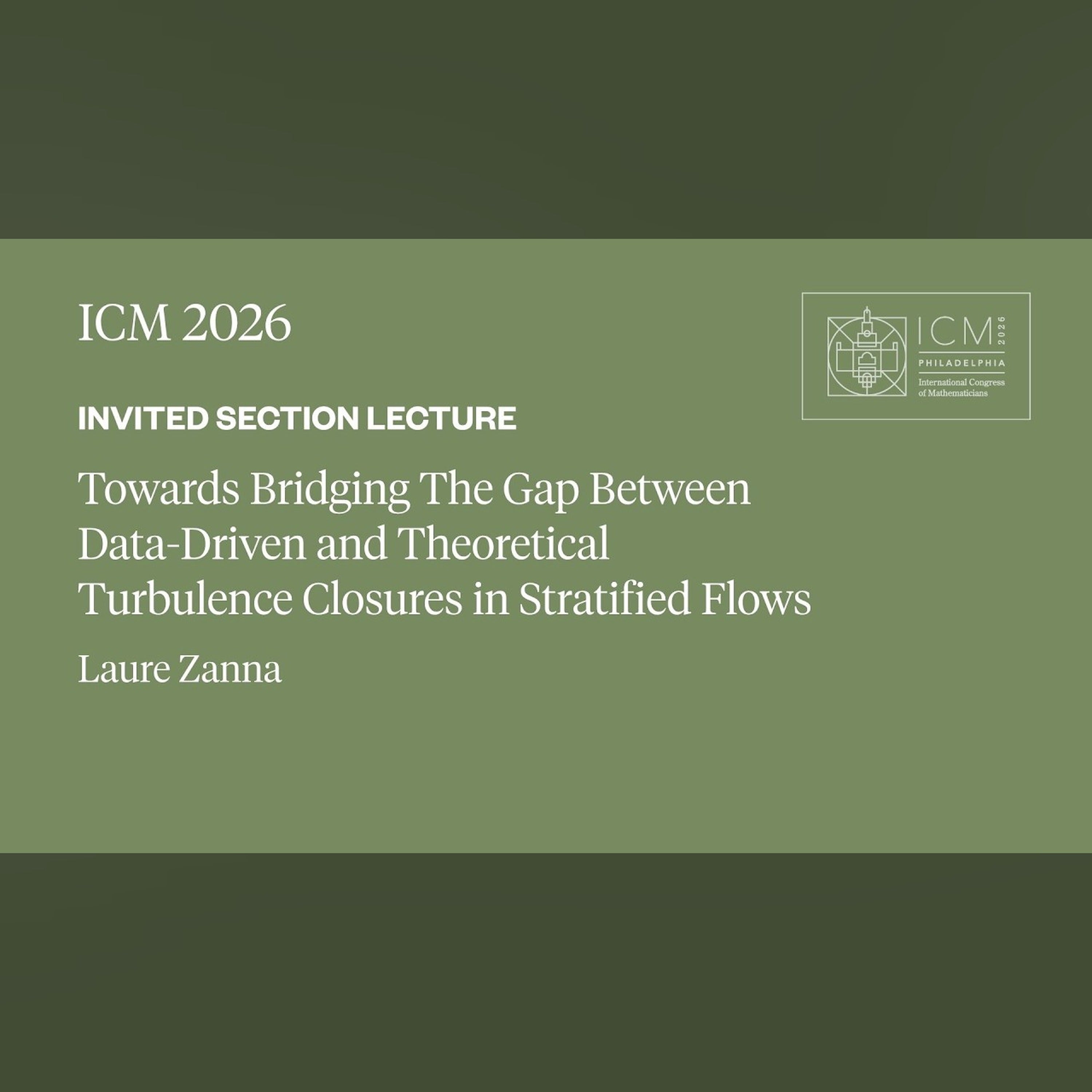
Towards Bridging The Gap Between Data-Driven and Theoretical Turbulence Closures in Stratified Flows
Developing turbulence closures remains one of the most challenging problems in fluid dynamics. Turbulence closure models are essential for solving the equations of motion in realistic systems, where fully resolving all relevant scales of motion is computationally infeasible. The Navier–Stokes equations, when filtered to isolate large-scale motions, introduce new terms representing the influence of subgrid-scale turbulent stresses. These terms, which can only be computed directly by resolving the turbulence itself, therefore lead to the closure problem: we must add new equations or introduce assumptions to relate the unresolved scales of motions to the resolved flow. Here we consider the closure problem for oceanic flows, i.e., stratified, Boussinesq, incompressible on a rotating frame of reference. In particular, we focus on a closure for ocean mesoscale eddies, which have horizontal scales of 10-100km and are key to the redistribution of momentum, energy, and tracers in the ocean. In particular, mesoscale eddies can reinject energy and momentum into the large-scale flow through an inverse energy cascade. Specifically, we will explore a range of ocean mesoscale closures - theoretical and data-driven - and explore their connection using analysis and data-driven methods. This talk aims to bridge the gap between novel methods in AI and machine learning and theoretical fluid dynamics to address significant challenges in the physics of turbulence.
Uploaded 05-10-26
Learn more about your ad choices. Visit megaphone.fm/adchoices
https://www.simonsfoundation.org/event/simons-collaboration-on-moduli-of-varieties-annual-meeting-2025/
2025 Annual Meeting of the Simons Collaboration on Moduli of Varieties
Simons Foundation
October 2-3, 2025
Uploaded 27-10-25
Learn more about your ad choices. Visit megaphone.fm/adchoices
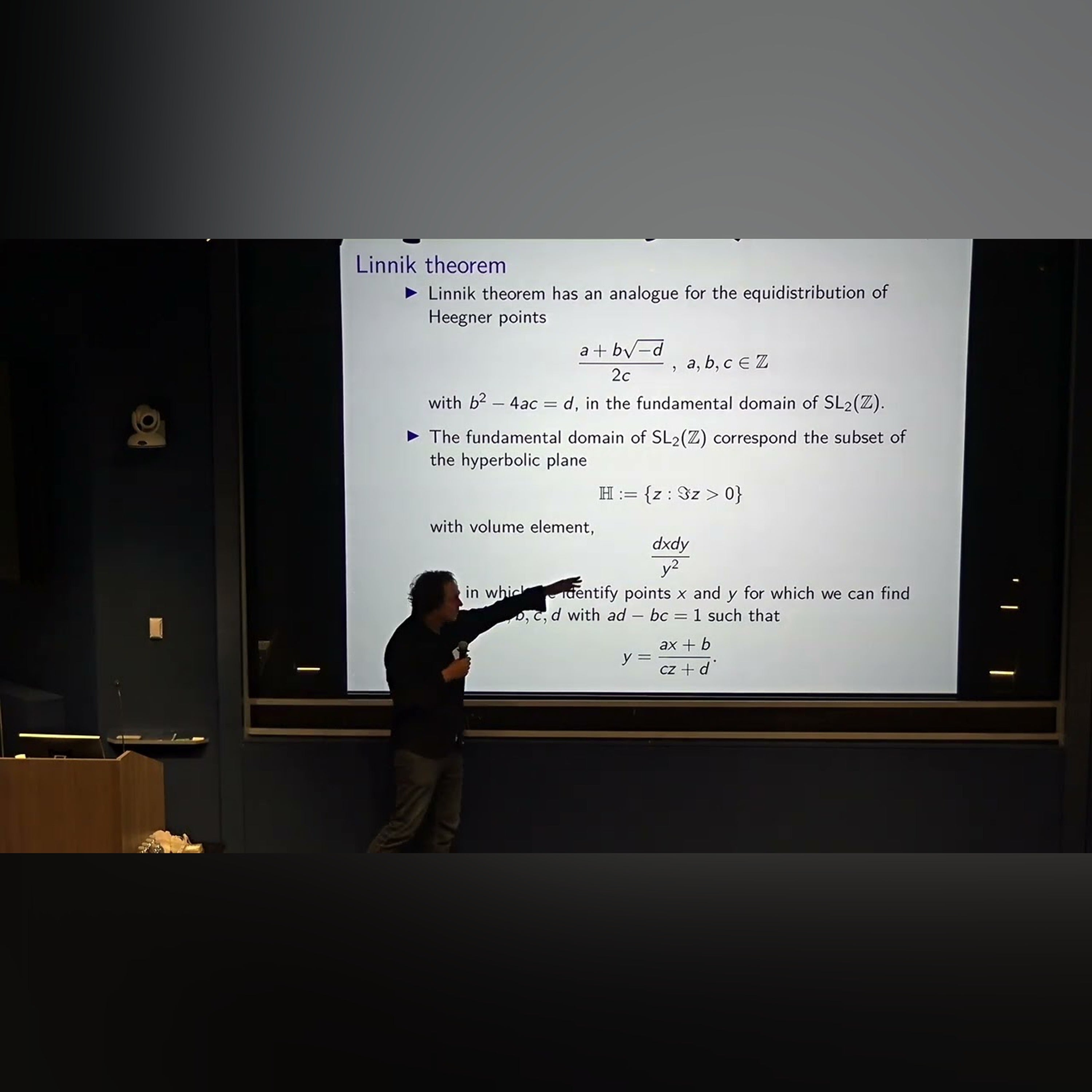
We prove the simultaneous equidistribution conjecture of Michel and Venkatesh for the embedding of a torus into two distinct inner forms of PGL_2 assuming a o(1) strengthening of the non-existence of Siegel zeros for quadratic characters.
Uploaded 25-09-25
Since the number of such exceptional characters is essentially O(1) per dyadic interval, our approach improves the previous analytic approach of Blomer–Brumley and the ergodic Aka–Einsiedler–Shapira approach, which covers at best 99% discriminants in [X, 2X] due to a double splitting condition.
The relevance of this topic to the workshop is that an essential tool in the proof are bounds for fractional moments of L-functions; in fact, we uncover a non-trivial intersection with the work of Harper on random multiplicative functions, but we end up not needing it at the end of the day for our specific application (although it would be needed for certain generalizations of our result).
For more information go here: https://www.simonsfoundation.org/event/mps-conference-on-universal-statistics-in-number-theory/
Learn more about your ad choices. Visit megaphone.fm/adchoices
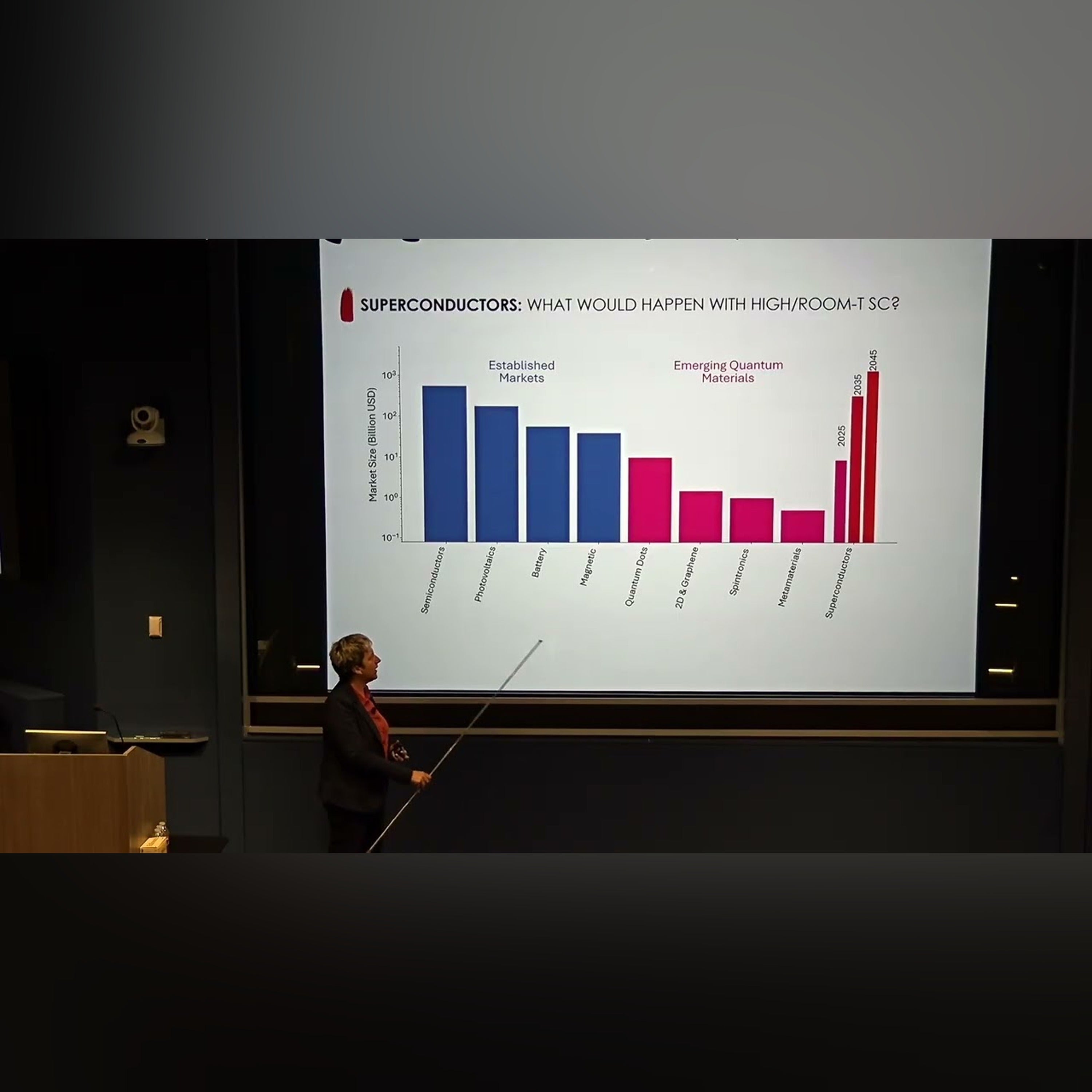
In this Presidential Lecture, Lilia Boeri will present cutting-edge research related to superconductivity. Eremets’ discovery of near room-temperature superconductivity in high-pressure hydrides marked a major turning point in the history of superconductivity, demonstrating that extreme pressure can stabilize phases with unprecedented properties that are unthinkable at ambient conditions. Ten years after the discovery of hydrogen sulfide superconductors, pressure quenching is emerging as a practical strategy to retain high-temperature phases at ambient pressure by preserving structures formed under extreme conditions.
Uploaded 20-10-25
For more information go here: https://www.simonsfoundation.org/event/designing-next-generation-superconductors-through-pressure-quenching/
Learn more about your ad choices. Visit megaphone.fm/adchoices
I will discuss how black holes can become nature's laboratories for new ultralight particles and ongoing observations of gravitational waves can inform models of particle physics. When a particle's Compton wavelength is comparable to the horizon size of a black hole, energy and angular momentum from the black hole are converted into exponentially growing clouds of bosons, creating a gravitational atom in the sky. Theories beyond the Standard Model often include new, light, feebly interacting particles -- including the QCD axion -- whose discovery requires novel observations and search strategies. I will show how previously open parameter space of axions which interact only gravitationally can be constrained by observations of rapidly spinning black holes. I will also show how such `gravitational atoms' may source up to thousands of monochromatic gravitational wave signals, and discuss my ongoing work to search for these signals in current data, enabling LIGO to discover or exclude new particles. More details: https://www.simonsfoundation.org/event/cca-special-seminar-masha-baryakhtar/
Uploaded 13-03-20
Learn more about your ad choices. Visit megaphone.fm/adchoices
https://www.simonsfoundation.org/event/simons-collaboration-on-moduli-of-varieties-annual-meeting-2025/
2025 Annual Meeting of the Simons Collaboration on Moduli of Varieties
Simons Foundation
October 2-3, 2025
Uploaded 27-10-25
Learn more about your ad choices. Visit megaphone.fm/adchoices
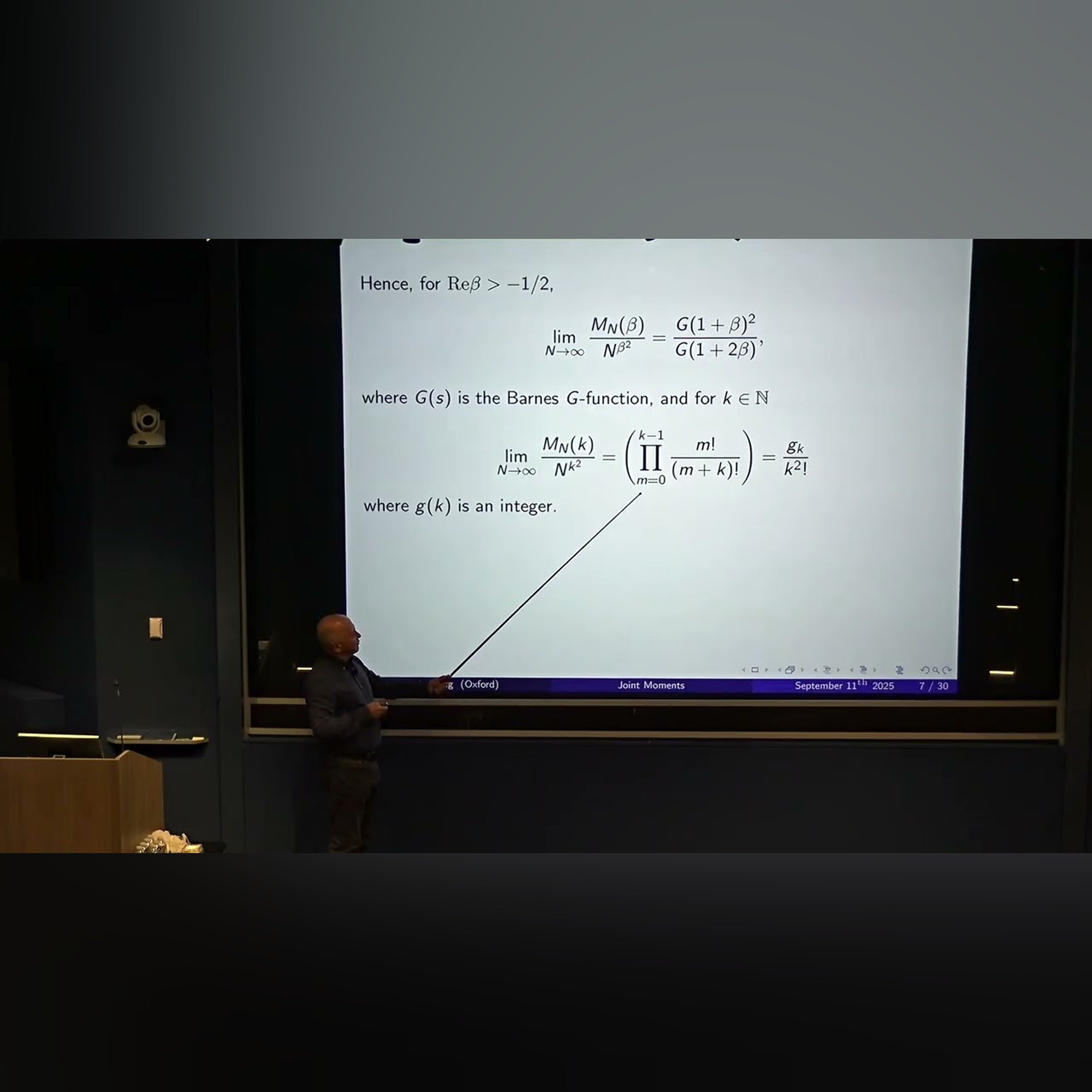
Jonathan Keating will discuss the evaluation of the joint moments of the characteristic polynomials of random unitary matrices and their derivatives, and in this context the joint moments of the Riemann zeta-function and its derivates, on the critical line. I also hope to discuss extensions to other symmetry classes.
Uploaded 25-09-25
For more information go here: https://www.simonsfoundation.org/event/mps-conference-on-universal-statistics-in-number-theory/
Learn more about your ad choices. Visit megaphone.fm/adchoices
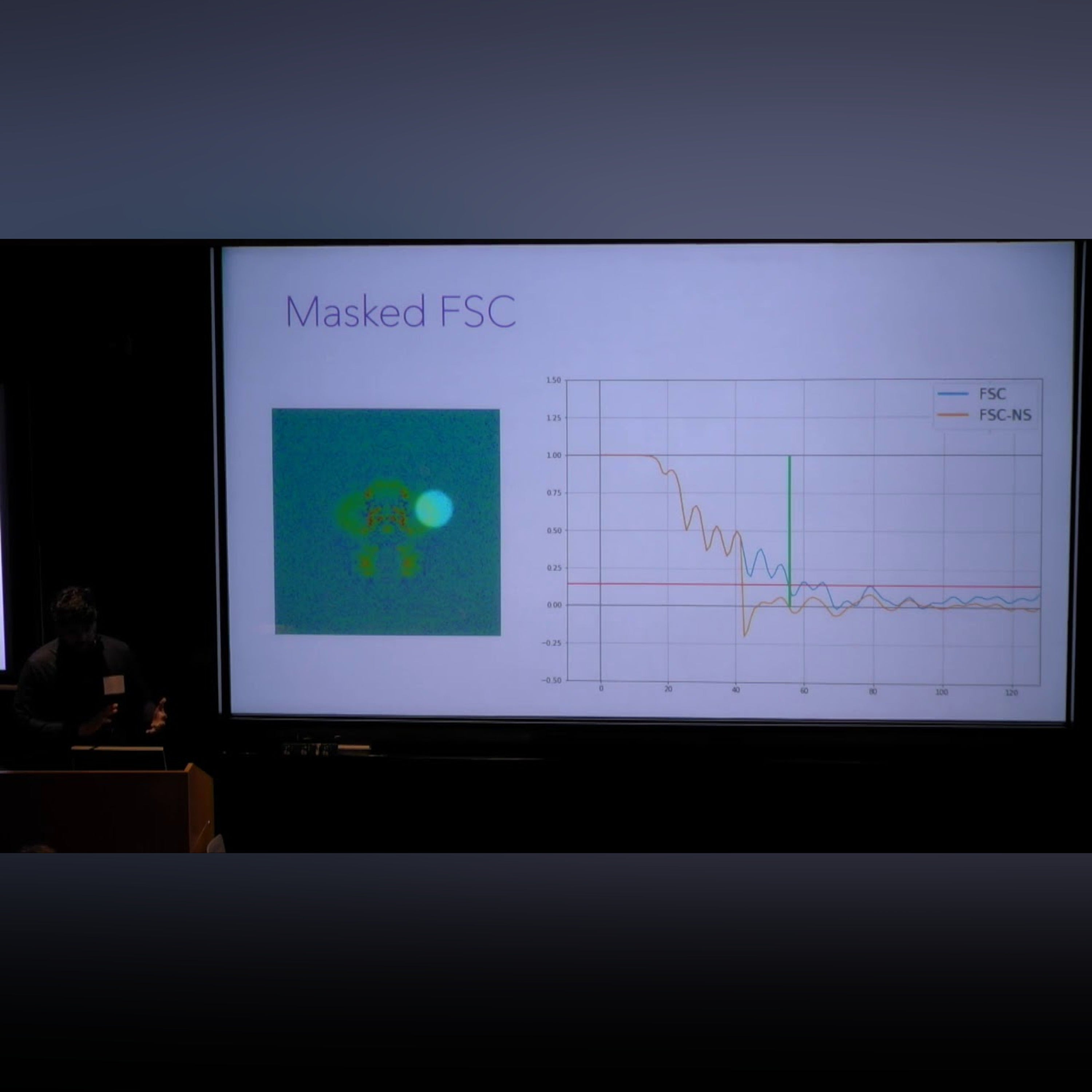
More details: https://www.simonsfoundation.org/event/nyc-computational-cryo-em-summer-workshop/
Uploaded 26-08-19
Learn more about your ad choices. Visit megaphone.fm/adchoices
More details: https://www.simonsfoundation.org/event/workshop-on-materials-in-quantum-cavities/
Uploaded 08-08-19
Learn more about your ad choices. Visit megaphone.fm/adchoices
The Square of the Riemann Zeta Function Gives Rise to Critical Multiplicative Chaos
~
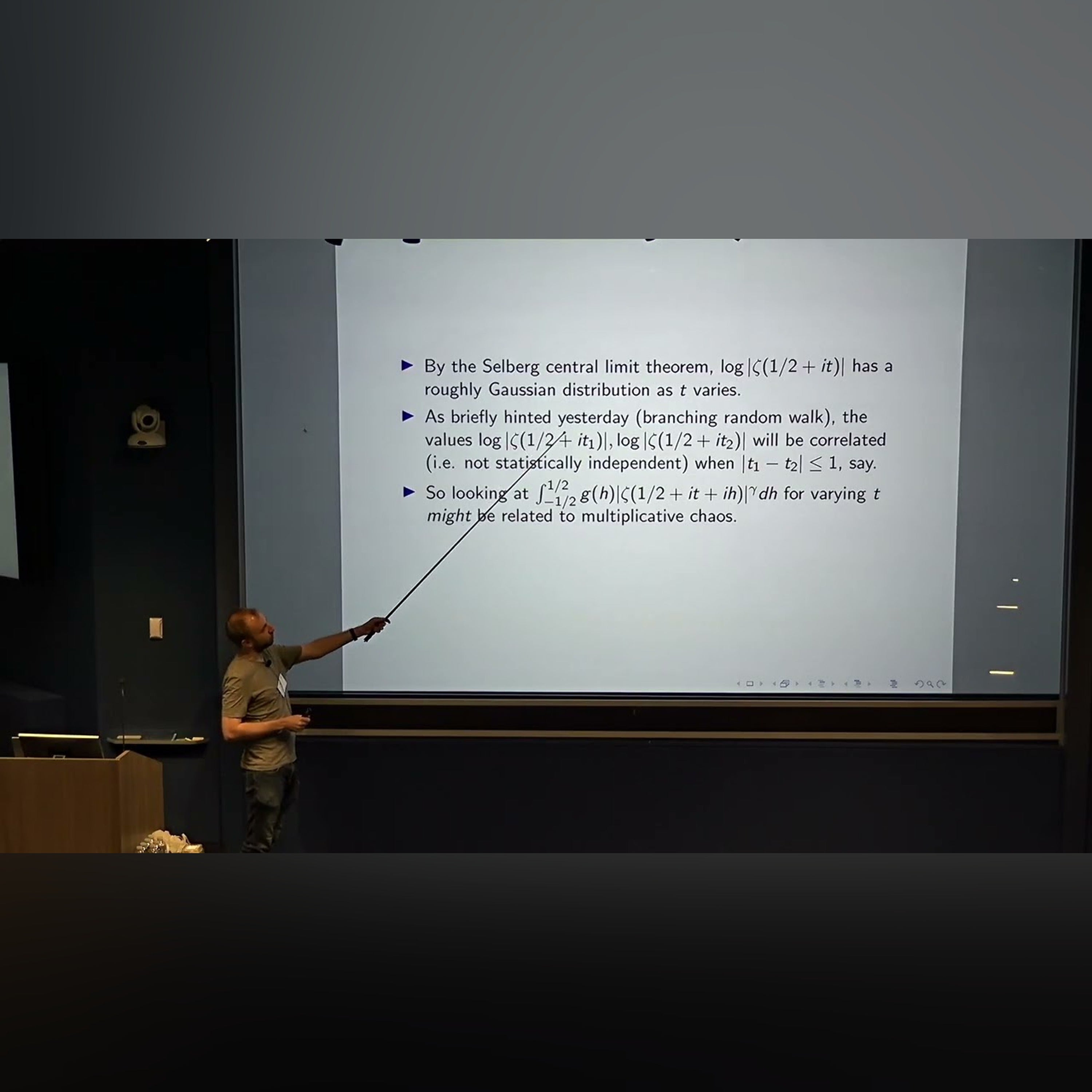
Multiplicative chaos is a class of random measures that have recently been found to have strong connections with number theoretic objects like L-functions and character sums and the phenomenon of “better than square-root cancellation.” Saksman and Webb have conjectured that integrating test functions against absolute powers of the Riemann zeta function should give rise to these measures. The square of the zeta function is particularly interesting, since this should correspond to the so-called critical chaos. Adam Harper will report on joint work (in preparation) with Saksman and Webb, which proves their conjecture for zeta squared. Harper will try to give a gentle introduction to these problems, and indicate some of the main proof ideas, which may be of independent interest.
Uploaded 25-09-25
For more information go here: https://www.simonsfoundation.org/event/mps-conference-on-universal-statistics-in-number-theory/
Learn more about your ad choices. Visit megaphone.fm/adchoices
https://www.simonsfoundation.org/event/simons-collaboration-on-moduli-of-varieties-annual-meeting-2025/
2025 Annual Meeting of the Simons Collaboration on Moduli of Varieties
Simons Foundation
October 2-3, 2025
Uploaded 27-10-25
Learn more about your ad choices. Visit megaphone.fm/adchoices
More details: https://www.simonsfoundation.org/event/nyc-computational-cryo-em-summer-workshop/
Uploaded 26-08-19
Learn more about your ad choices. Visit megaphone.fm/adchoices
To understand the “usual” behaviour of functions in multiplicative number theory, it is often useful to bound extreme behaviours, Halasz’s theorem being proto-typical. In this talk, we report on several projects on explicit bounds in more general settings, mean values of multiplicative functions whose values at primes are, for example (a) the kth roots of unity or (b) in [-m,m] for fixed m (greater then) or =1. Also, Halasz’s theorem is known for multiplicative functions that are k-bounded at primes, but the uniformity is poor, and we will see how this can be improved.
Uploaded 25-09-25
This talk includes joint work with Kaisa Matomäki, K. Soundararajan, Kevin Church and Daodao Yang.
For more information go here: https://www.simonsfoundation.org/event/mps-conference-on-universal-statistics-in-number-theory/
Learn more about your ad choices. Visit megaphone.fm/adchoices
More details: https://www.simonsfoundation.org/event/quantum-matter-computation-meets-experiments/
Uploaded 24-03-20
Learn more about your ad choices. Visit megaphone.fm/adchoices
More details: https://www.simonsfoundation.org/event/workshop-on-materials-in-quantum-cavities/
Uploaded 08-08-19
Learn more about your ad choices. Visit megaphone.fm/adchoices
More details: https://www.simonsfoundation.org/event/nyc-computational-cryo-em-summer-workshop/
Uploaded 26-08-19
Learn more about your ad choices. Visit megaphone.fm/adchoices
https://www.simonsfoundation.org/event/simons-collaboration-on-moduli-of-varieties-annual-meeting-2025/
2025 Annual Meeting of the Simons Collaboration on Moduli of Varieties
Simons Foundation
October 2-3, 2025
Uploaded 27-10-25
Learn more about your ad choices. Visit megaphone.fm/adchoices
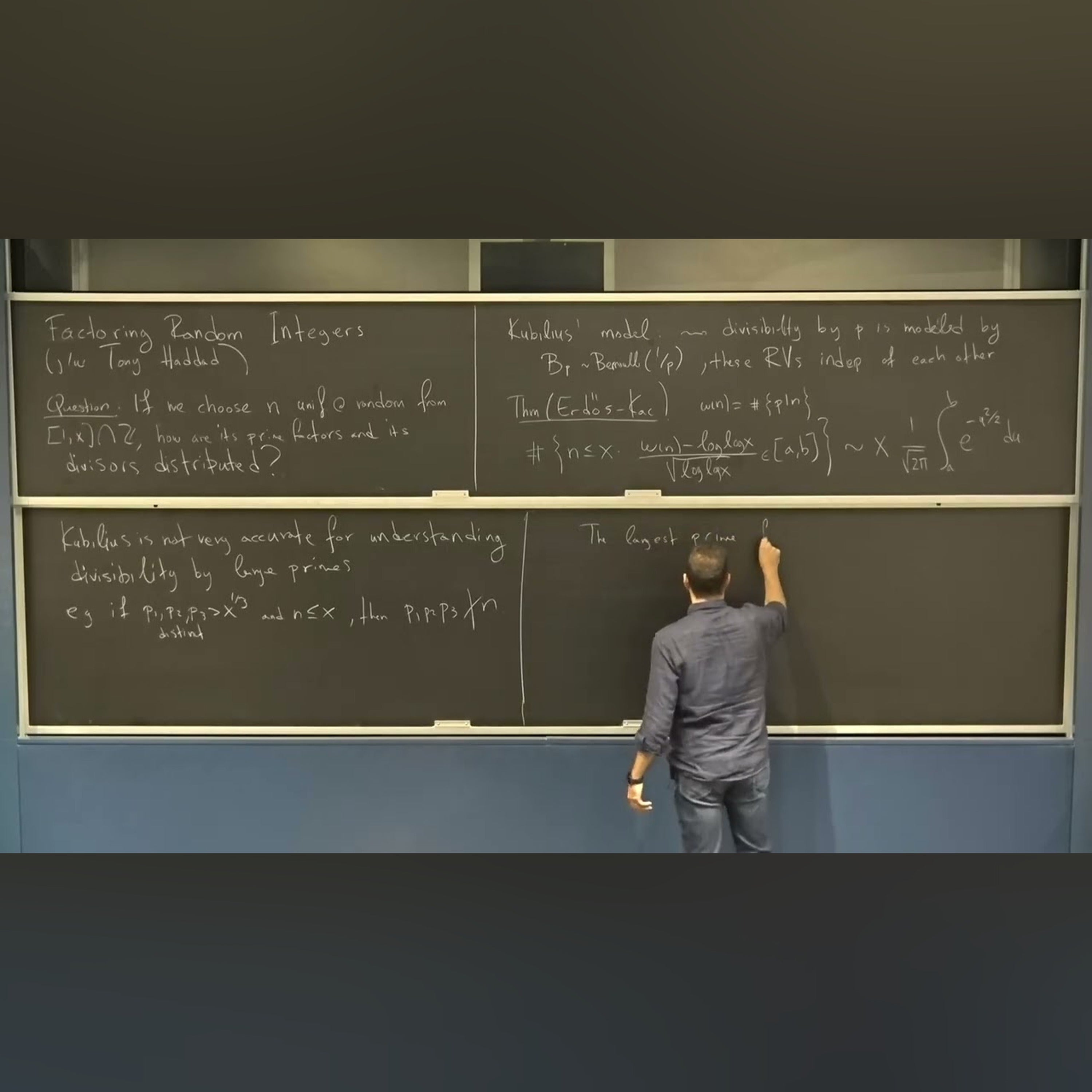
Billingsley proved that the prime factors of a random integer are known to follow the Poisson–Dirichlet distribution of parameter 1. Arratia gave a new proof of this result by constructing a coupling between the prime factors of a random integer and a Poisson–Dirichlet distribution. His proof furnished a quantitative version of Billingsley’s theorem, which he conjectured could be improved. In this talk, Dimitris Koukoulopoulos will present recent work with Tony Haddad, where we proved Arratia’s conjecture. Furthermore, Koukoulopoulos will explain how to use these methods to deduce various other results about the distribution of divisors of integers.
Uploaded 25-09-25
For more information go here: https://www.simonsfoundation.org/event/mps-conference-on-universal-statistics-in-number-theory/
Learn more about your ad choices. Visit megaphone.fm/adchoices
More details: https://www.simonsfoundation.org/event/quantum-matter-computation-meets-experiments/
Uploaded 24-03-20
Learn more about your ad choices. Visit megaphone.fm/adchoices
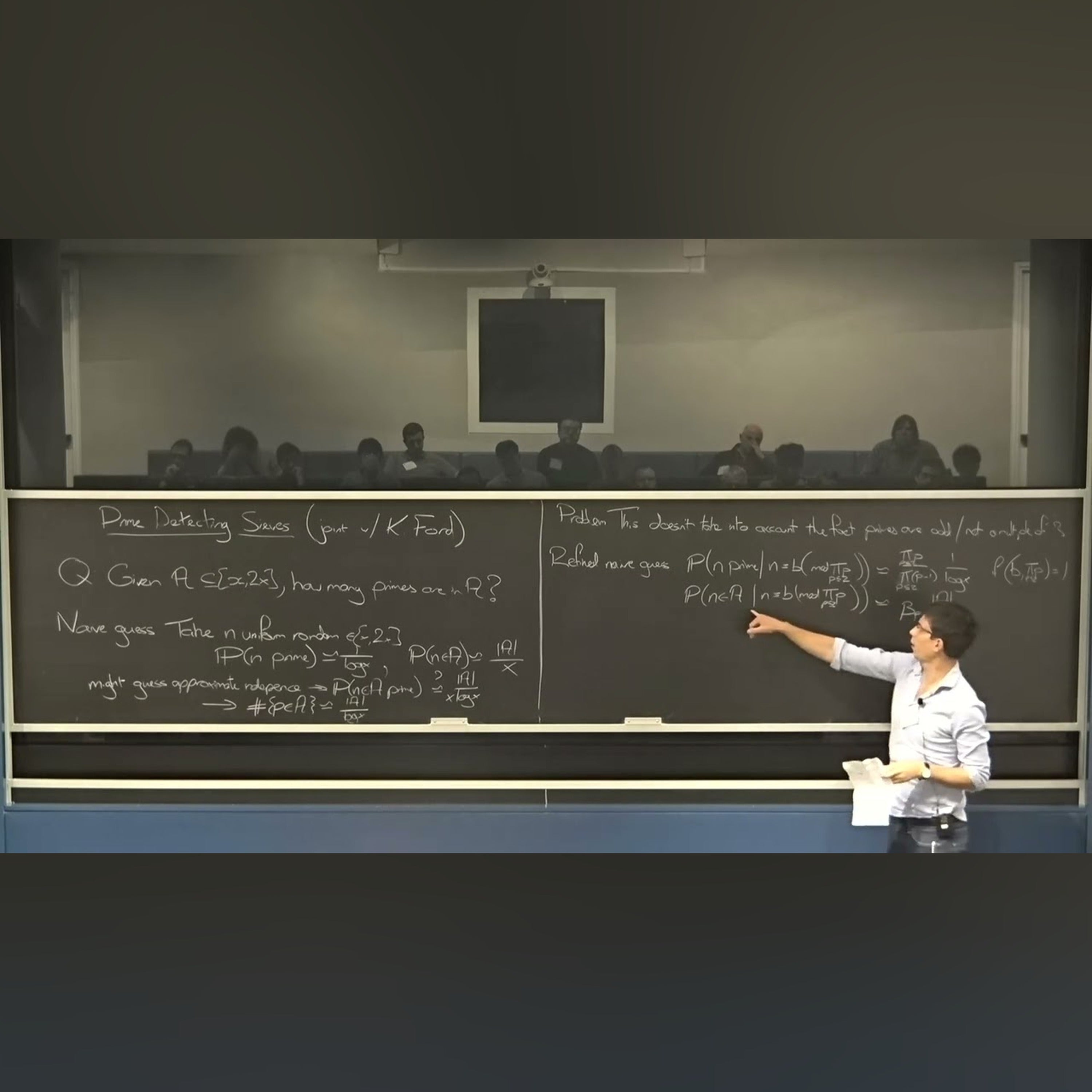
Many of the most famous open questions on primes are examples of a simple universal statistics phenomenon where we expect the number of primes in a set to be (well-approximated by) a product of local densities of the set. A key reason that proving these guesses appears hard is that there are possible ‘global’ obstructions even for fairly well-understood sets. I’ll talk about joint work with Kevin Ford (in progress) which aims to obtain a better understanding of the nature of these global obstructions.
Uploaded 25-09-25
For more information go here: https://www.simonsfoundation.org/event/mps-conference-on-universal-statistics-in-number-theory/
Learn more about your ad choices. Visit megaphone.fm/adchoices
2025 Mathematical and Scientific Foundations of Deep Learning Annual Meeting
https://www.simonsfoundation.org/event/mathematical-and-scientific-foundations-of-deep-learning-annual-meeting-2025/
Uploaded 22-10-25
Learn more about your ad choices. Visit megaphone.fm/adchoices
More details: https://www.simonsfoundation.org/event/quantum-matter-computation-meets-experiments/
Uploaded 24-03-20
Learn more about your ad choices. Visit megaphone.fm/adchoices
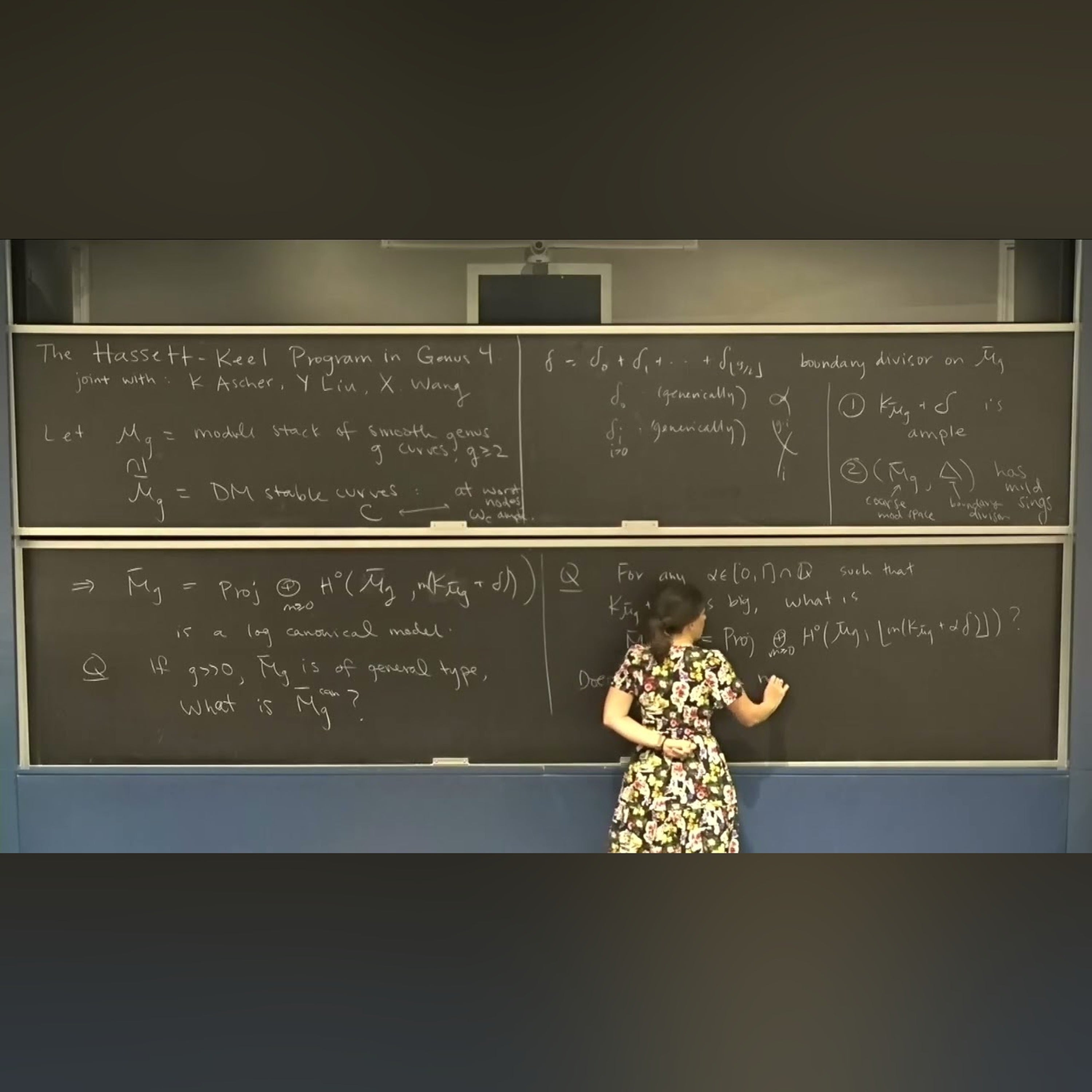
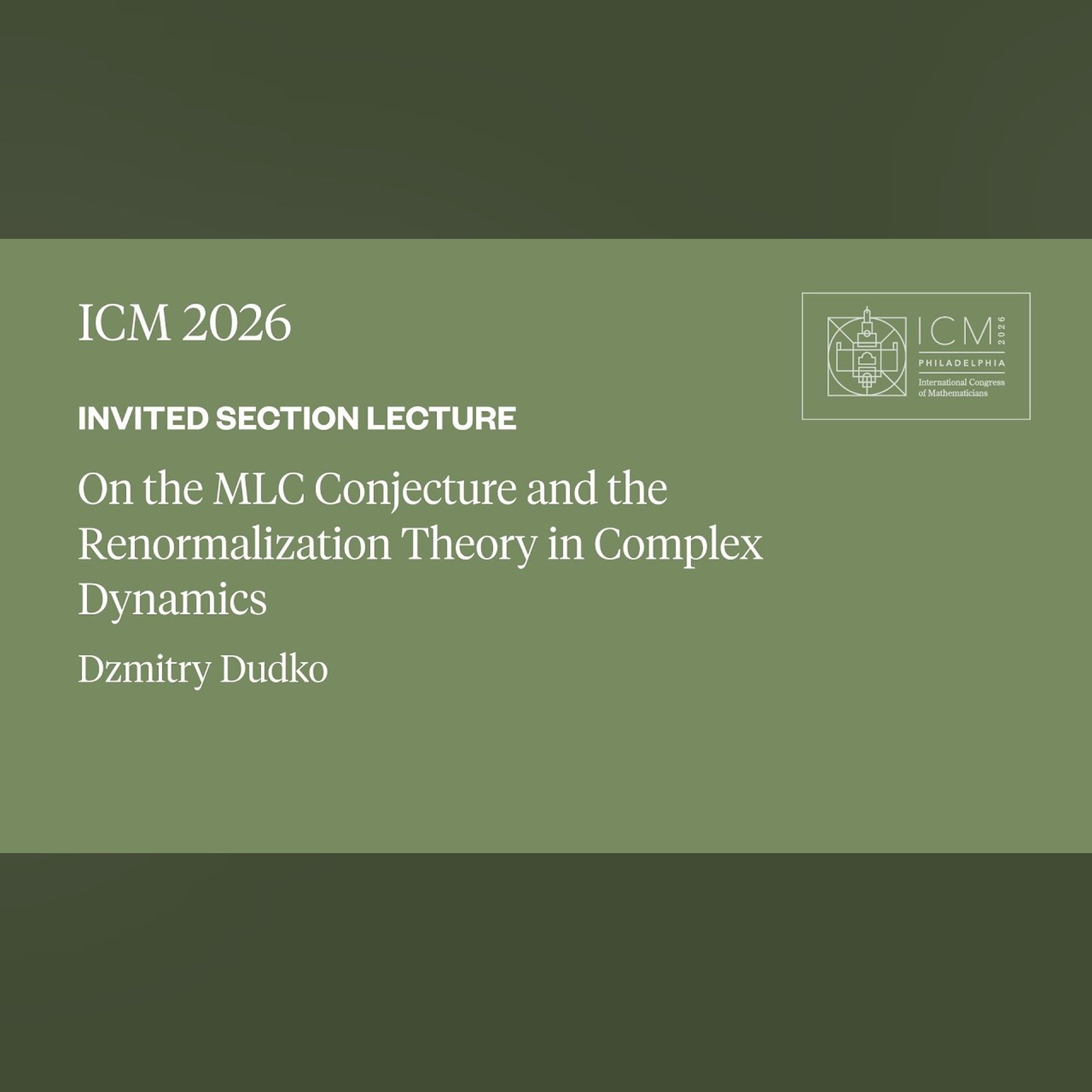
On the MLC Conjecture and the Renormalization Theory in Complex Dynamics
The MLC Conjecture (the Mandelbrot set is Locally Connected) describes how quadratic polynomials depend topologically on a parameter. The Conjecture has many geometric and probabilistic counterparts; all of them are the subject of the Renormalization Theory, which analyzes first-return maps to small neighborhoods of special points. In this talk, we outline the current state of this theory, with particular emphasis on the (near-) zero-entropy or Molecule (satellite and neutral) regimes.
Uploaded 14-09-26
Learn more about your ad choices. Visit megaphone.fm/adchoices
We’ll describe connections between probabilistic models for primes, the Hardy–Littlewood k-tuples conjectures, the distribution of primes in very short intervals, the interval sieve, and hypothetical Landau–Siegel zeros of Dirichlet L-functions. We will emphasize the role and limitations of probabilistic ideas.
Uploaded 25-09-25
For more information go here: https://www.simonsfoundation.org/event/mps-conference-on-universal-statistics-in-number-theory/
Learn more about your ad choices. Visit megaphone.fm/adchoices
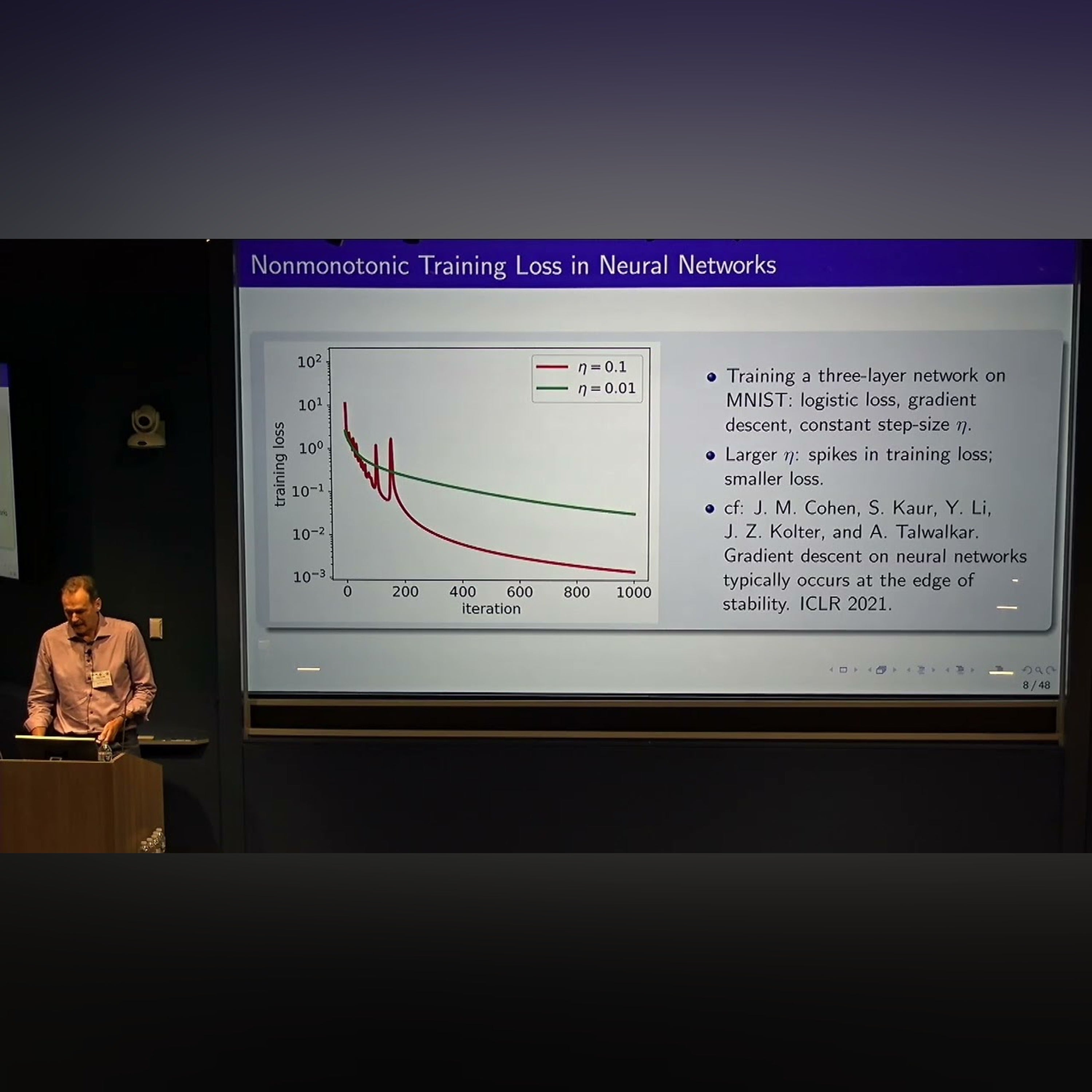
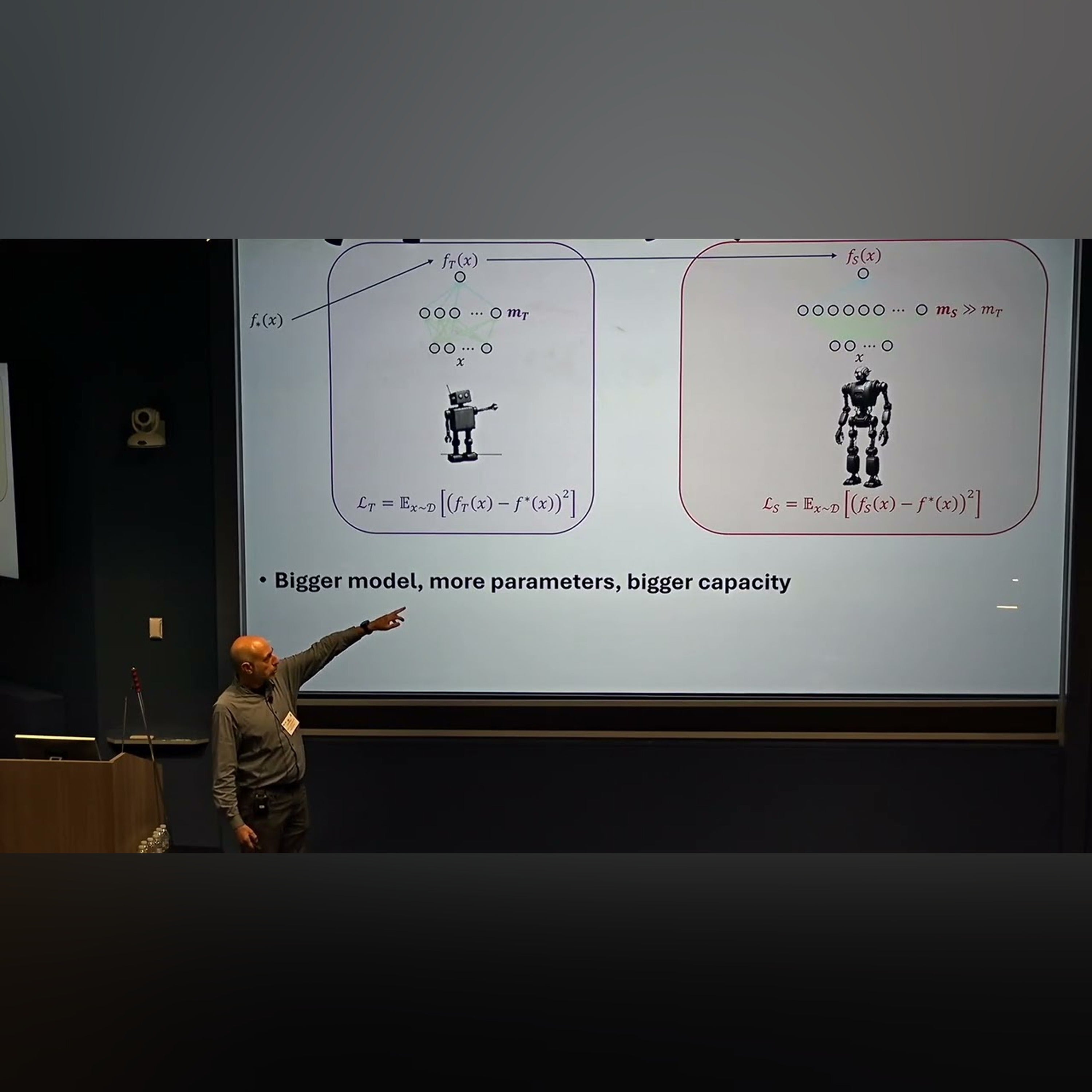
Peter Bartlett — Gradient Optimization Methods: Implicit Bias and Benefits of Early Stopping (Sept. 26, 2025)
Uploaded 22-10-25
2025 Mathematical and Scientific Foundations of Deep Learning Annual Meeting
https://www.simonsfoundation.org/event/mathematical-and-scientific-foundations-of-deep-learning-annual-meeting-2025/
Learn more about your ad choices. Visit megaphone.fm/adchoices
More details: https://www.simonsfoundation.org/event/quantum-matter-computation-meets-experiments/
Uploaded 24-03-20
Learn more about your ad choices. Visit megaphone.fm/adchoices
More details: https://www.simonsfoundation.org/event/workshop-on-materials-in-quantum-cavities/
Uploaded 08-08-19
Learn more about your ad choices. Visit megaphone.fm/adchoices
More details: https://www.simonsfoundation.org/event/quantum-matter-computation-meets-experiments/
Uploaded 24-03-20
Learn more about your ad choices. Visit megaphone.fm/adchoices
2025 Mathematical and Scientific Foundations of Deep Learning Annual Meeting
https://www.simonsfoundation.org/event/mathematical-and-scientific-foundations-of-deep-learning-annual-meeting-2025/
Uploaded 22-10-25
Learn more about your ad choices. Visit megaphone.fm/adchoices
Restricted Orthogonal Projections
Projection theorems study how Hausdorff dimension of fractal sets behaves under orthogonal projections from Euclidean space to its subspaces. We will survey some of the recent results on orthogonal projections to restricted families of subspaces and their connections to restriction theory in harmonic analysis and incidence geometry in combinatorics.
Uploaded 14-09-26
Learn more about your ad choices. Visit megaphone.fm/adchoices
Moments of One-Level Densities for a Large Orthogonal Family of L-functions
~
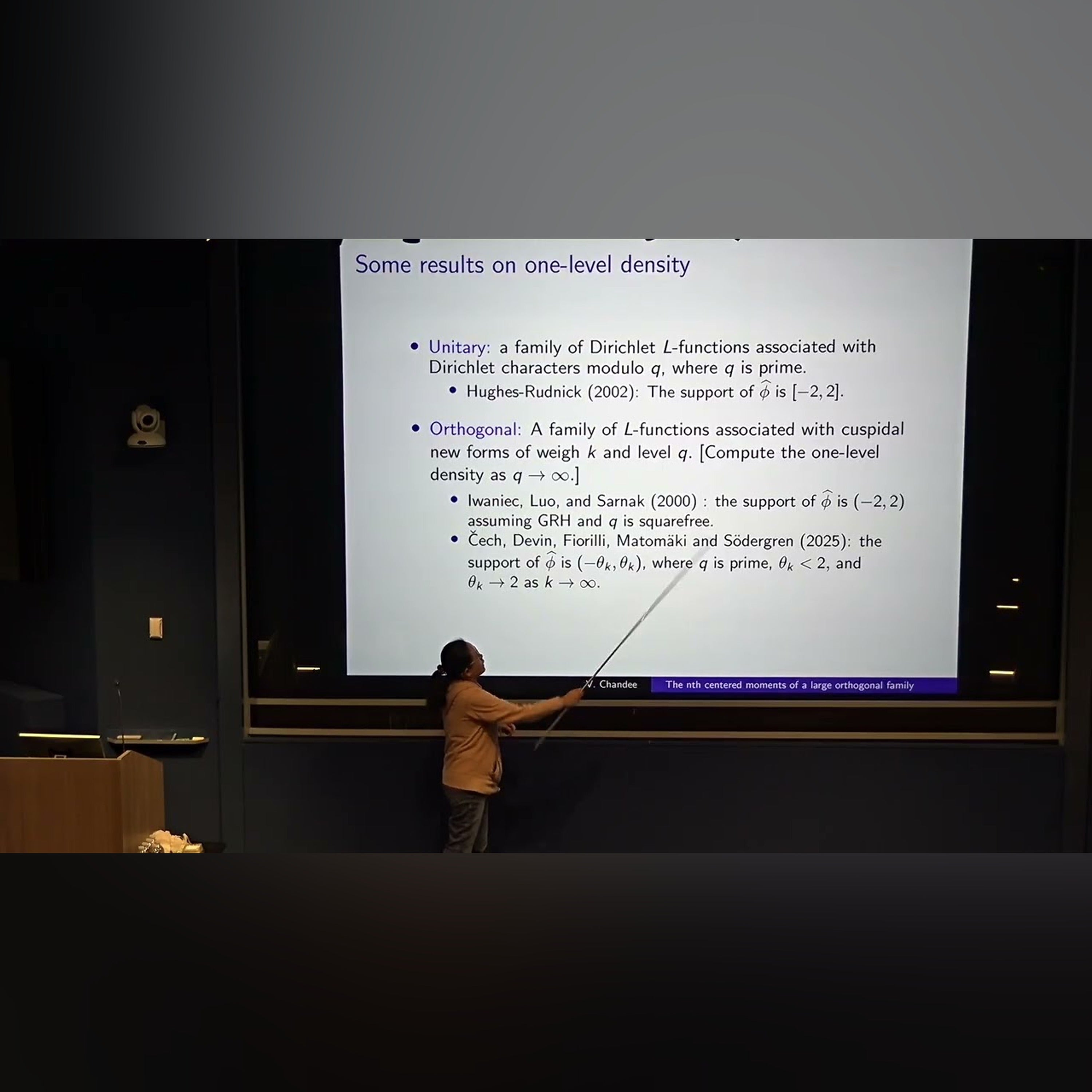
Katz and Sarnak conjectured that the statistics of low-lying zeros of families of L-functions match with the scaling limit of eigenvalues from the random matrix theory. In this talk, I will discuss recent joint work with Yoonbok Lee and Xiannan Li on the nth-centered moments of one level densities of a large orthogonal family of L-functions associated with holomorphic Hecke newforms of level q, averaged over q~Q. The nth centered moments are closely related to the n-level densities of low-lying zeros of L-functions. We verify the Katz–Sarnak conjecture for these statistics, in the range where the sum of the supports of the Fourier transforms of test functions lies in (-4, 4). Key challenges include identifying off-diagonal main terms and resolving a combinatorial problem in matching number-theoretic results with predictions from random matrix theory.
Uploaded 25-09-25
For more information go here: https://www.simonsfoundation.org/event/mps-conference-on-universal-statistics-in-number-theory/
Learn more about your ad choices. Visit megaphone.fm/adchoices
More details: https://www.simonsfoundation.org/event/nyc-computational-cryo-em-summer-workshop/
Uploaded 26-08-19
Learn more about your ad choices. Visit megaphone.fm/adchoices
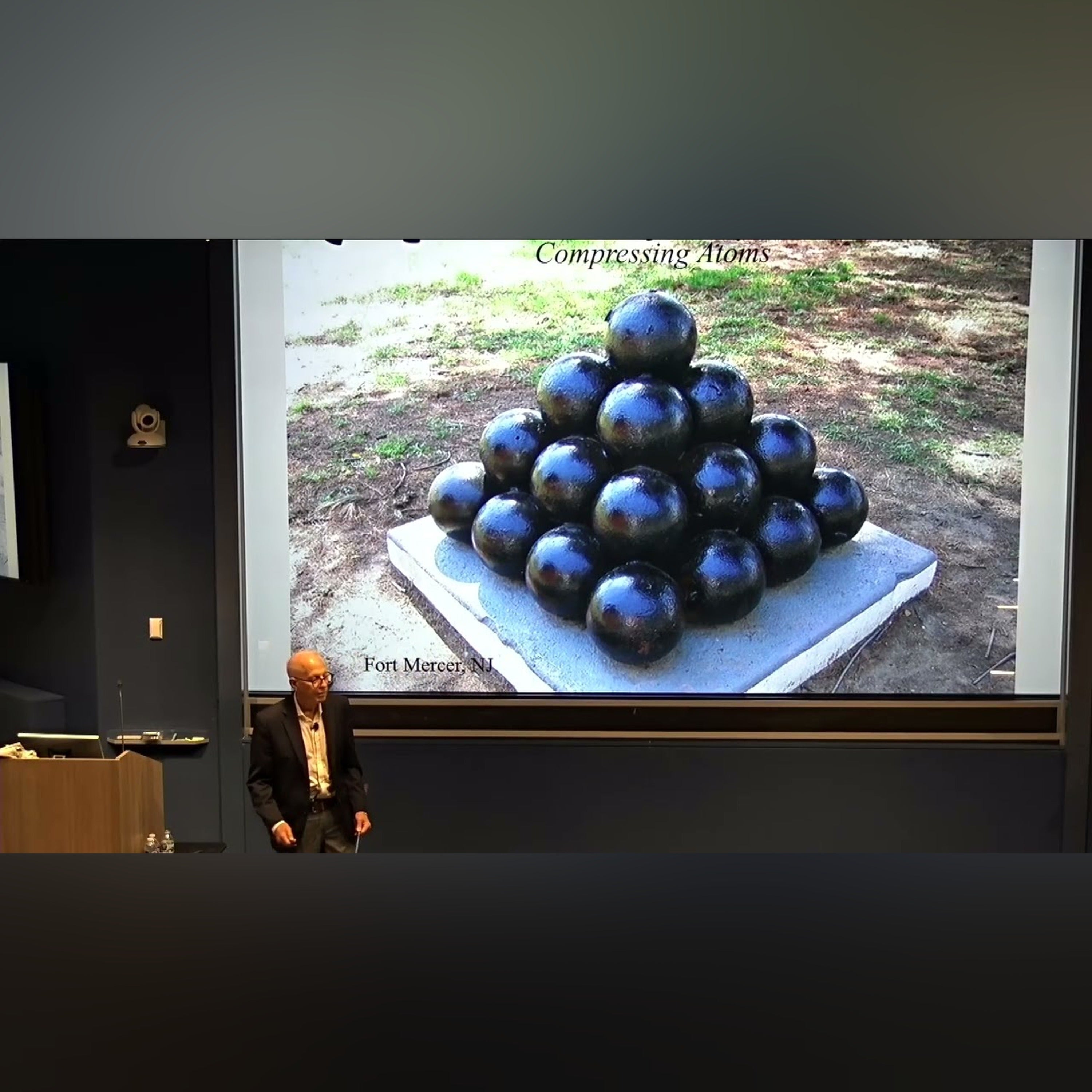
In this Presidential Lecture, Russell J. Hemley will discuss the new regimes of emergent quantum phenomena arising from the collective many-body interactions of electrons and nuclei in high-pressure conditions. Among the most profound are potentially new states of electron order and enhanced coupling of electrons and nuclei, leading to unprecedented superconductivity in the vicinity of room temperature. First envisioned for the ‘simple’ many-body system of protons and electrons, the unveiling of this remarkable superconductivity is now well established experimentally at ever-increasing temperatures in a growing variety of chemical environments under pressure. Made possible by important advances in experimental techniques, these developments are leading to the prospects of ‘hot’ superconductivity at ambient conditions, inspiring prospects for both quantum energy technologies of the future as well as for the discovery of still new physical phenomena under pressure.
Uploaded 23-09-25
For more information go here: https://www.simonsfoundation.org/sf-events/?type=simons-foundation-presidential-lectures
Learn more about your ad choices. Visit megaphone.fm/adchoices
2025 Mathematical and Scientific Foundations of Deep Learning Annual Meeting
https://www.simonsfoundation.org/event/mathematical-and-scientific-foundations-of-deep-learning-annual-meeting-2025/
Uploaded 22-10-25
Learn more about your ad choices. Visit megaphone.fm/adchoices
1 h 02 minPlay in:
Guests from more than 12 months ago are part of Pro. See plans