Bekomm eine E-Mail, wenn Margaret in einem Podcast zu Gast istPodAppear prüft neue Folgen, sobald sie erscheinen, und lässt die weg, in denen Margaret nur erwähnt wird. Bis zu 15 Personen kostenlos, ohne Kreditkarte.Bis zu 15 Personen kostenlos, ohne Kreditkarte.
Margaret Cullen war in den letzten 12 Monaten in 2 Podcast-Folgen aus 2 verschiedenen Sendungen zu Gast. Zuletzt: Therapist Uncensored Podcast, 14. Apr. 2026.
Explore the role of equanimity, mindfulness, and compassion in navigating an increasingly complex world. Special guest
Margaret Cullen alongside co-host Sue Marriott discuss the evolution of mindfulness in modern culture, the foundations of compassion-based practices, and how these approaches can support resilience and emotional balance. Grounded in both clinical insight and lived practice, this conversation offers a thoughtful, accessible perspective on cultivating steadiness and clarity in the midst of ongoing challenges. Listen to the full episode now at TherapistUncensored.com/TU296
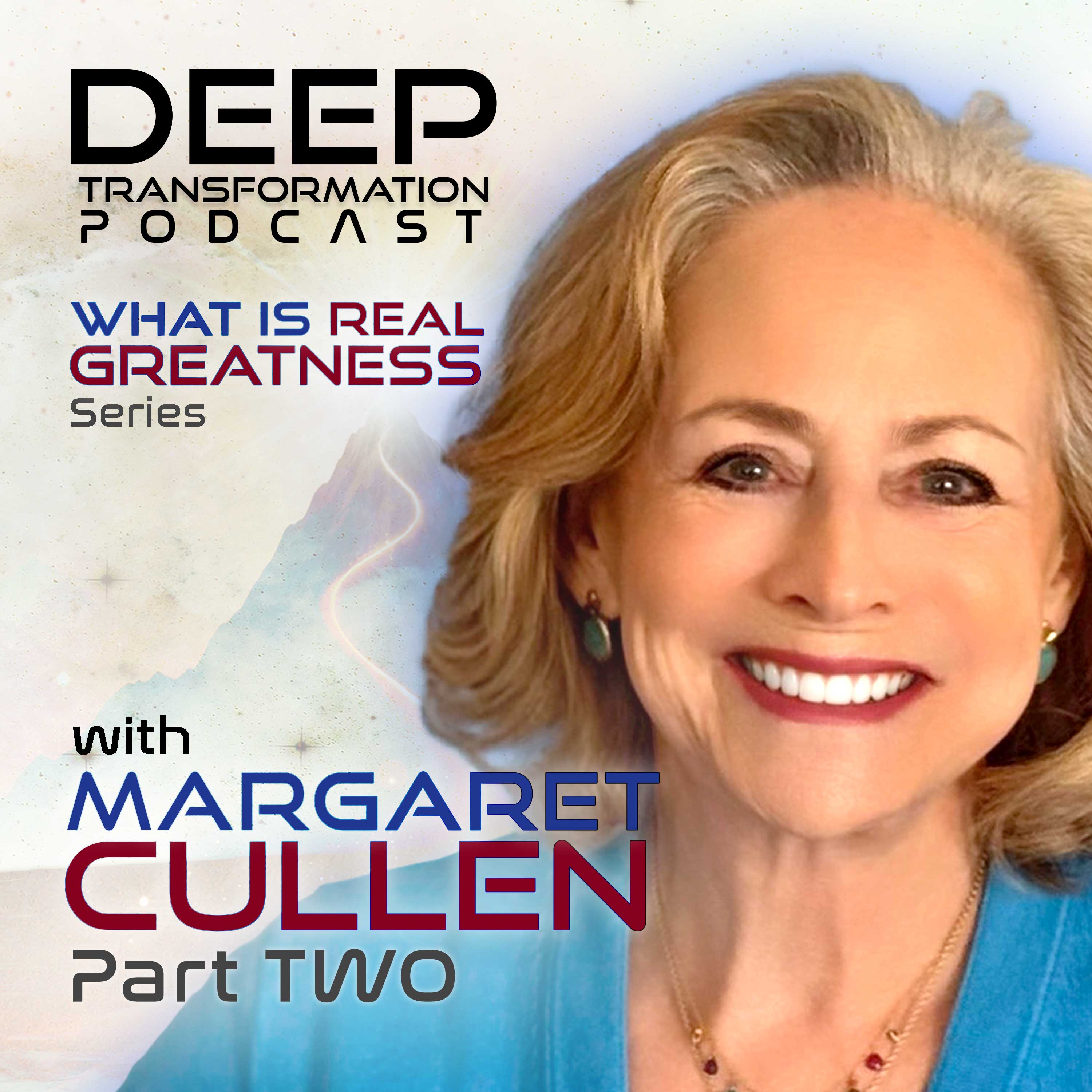
Ep. 229 (Part 2 of 2) | In part 2 of our What is Real Greatness Series podcast with Margaret Cullen, author of Quiet Strength, Margaret continues to enlighten us about equanimity: its power, its wisdom, and its practice. She relates some of the history of equanimity—first considered a supreme virtue in Stoicism, then passed on to Sufism and Judaism—and explains that throughout time, equanimity (and humility) have always been an integral part of people who have made a true difference in the world. Margaret talks about how humor can break the spell of our trance (“when we lose equanimity, we get caught in a trance, believing in something that has us prisoner—humor breaks the spell”), and, in the spirit of “The Serenity Prayer” (“Grant me the serenity to accept the things I cannot change, courage to change the things I can, and wisdom to know the difference”), she encourages us to make peace with what we can realistically do and let the rest go.
While Part 1 of this dialogue focuses on the power of equanimity in relation to the big picture and what is going on now politically, in Part 2 Margaret looks at practicing equanimity in personal relationships and in our individual lives. She marvels at Thoreau’s equanimous approach to his own death, and shares that she has found forgiveness to be the most important equanimity tool in relationships. “We reclaim our wisdom when we say ‘I’m sorry,’” Margaret explains. Margaret’s deep and nuanced understanding of the power and practice of equanimity is inspiring and illuminating, and bringing this virtue to our attention as a pragmatic tool we can use is also incredibly timely, leaving us with a sense of hope and empowerment. Recorded January 14, 2026.
“What aids in my equanimity more than anything else is self-forgiveness.”
Topics & Time Stamps – Part 2
Welcome teacher, what am I supposed to be learning? (00:59)
How humor can break the spell that holds us prisoner (03:03)
The relationship between equanimity and peace (05:17)
The praise and blame algorithm has exponentially increased our reactivity (08:14)
Equanimity was a supreme virtue in Stoicism; the Stoics passed it on to the Sufis, who passed it on to Judaism (11:11)
Thoreau’s equanimous approach to death (12:24)
Nature’s effect on one’s equanimity (13:29)
Equanimity is an integral part of true change makers, also humility (14:27)
What practice would Margaret most recommend to cultivate equanimity? (17:19)
Making peace with what you can do and letting the rest go (21:03)
Practicing equanimity in relationships (22:13)
Using self-forgiveness as an equanimity tool (23:44)
In relationships, softening where we’re most triggered helps more than imposing ideals of how we should be (26:25)
One key flavor of equanimity is non-defensiveness (28:51)
Resources & References – Part 2
Margaret Cullen, Quiet Strength: Find Peace, Feel Alive, and Love Boundlessly Through the Power of Equanimity
Swami Beyondanda on the Deep Transformation podcast: Laugh Yourself Sane, Enlighten Up & Awaken to Cosmic Comic Consciousness
Maimonides introduced the concept of equanimity to Judaism
Stoicism, a philosophical movement & practical guide to living originating in ancient Greece
When asked about facing death, Thoreau said, “One world at a time.” Henrietta Christian Wright, American Men of Letters
Sri Aurobindo, The Synthesis of Yoga
Sufi teacher Habīb Boerger, “Rather than making the ego your boss, make it your personal assistant”
The Serenity Prayer (Reinhold Niebuhr’s original version)
Richard Davidson & Daniel Goleman, Altered Traits: Science Reveals How Meditation Changes Your Mind, Brain, and Body
Paul & Eve Ekman’s Cultivating Emotional Balance training
“We could not help contrasting the equanimity of Nature with the bustle and impatience of man. His words and actions presume always a crisis near at hand, but she is forever silent and unpretending.” – Henry David Thoreau
---
Margaret Cullen, a Licensed Psychotherapist (MFT), has been at the cutting edge of translating contemplative trainings into universal and accessible formats in mainstream settings ranging from elite military to maximum security prisons. She was one of the first certified Teachers of Mindfulness-Based Stress Reduction (MBSR); is the founder of Mindfulness-Based Emotional Balance; and is co-developer of Compassion Cultivation Training at the Stanford School of Medicine (with Thupten Jinpa). Margaret also co-developed Mindfulness Based Attention Training for military spouses with neuroscientist Amishi Jha at the University of Miami, and is the founder of Compassion Corps, offering free compassion and mindfulness programs to under-resourced communities around the world. Margaret is a Fellow of the Mind & Life Institute.
---
Podcast produced by Vanessa Santos and Show Notes by Heidi Mitchell
37 minAbspielen in:
Warum PodAppear
Folge Menschen, nicht Podcasts.
Du hast Margaret in einer Sendung gehört. PodAppear findet für dich die nächste, und genauso für alle anderen, die du hören willst.
Eine Meldung, wenn die Person zu Gast istPer E-Mail: sofort oder gebündelt als Tages- oder Wochenübersicht. Dann nur noch auf Play drücken.
Gäste statt bloßer ErwähnungenFolgen, in denen ein Name nur fällt, landen getrennt. Eine Meldung heißt: Die Person ist wirklich in der Sendung.
Alle in einem FeedGründerinnen, Autoren, Sportler, Forscherinnen. Folge allen mit Namen, quer durch jede Sendung, in der sie auftreten.