Bekomm eine E-Mail, wenn Ken in einem Podcast zu Gast istPodAppear prüft neue Folgen, sobald sie erscheinen, und lässt die weg, in denen Ken nur erwähnt wird. Bis zu 15 Personen kostenlos, ohne Kreditkarte.Bis zu 15 Personen kostenlos, ohne Kreditkarte.
Ken kostenlos folgen
KF

Ken Ford

Zwei Jahre auf Sendung

GastHostErwähnt

Selbst moderierte Folgen

Mo26Okt
STEM-Talk

STEM-TalkHost

Episode 200: From rogue AI agents to factchecking AI, Ken Ford responds to more listener AI questions

Episode 200: From rogue AI agents to factchecking AI, Ken Ford responds to more listener AI questions In today’s third of a three-part series of Ask Me Anything episodes, Dr. Ken Ford responds to more listener questions and concerns about artificial intelligence. In AMA episode 198, Ken answered a wide-range of questions about chatbots and data centers and the future of AI, which prompted a new round of listener questions about AI that Ken will be answering today. Ken has been working in AI since the 1980s and is well-positioned to help listeners sort genuine advances in AI from exaggerated claims. The Association for the Advancement of Artificial Intelligence elected Ford a Fellow in 2000 for his “leadership in exploring and explaining foundational issues and in establishing large-scale AI research programs and institutions.” In today’s episode, Ken tackles listener questions about: — A team leader at Anthropic, the developer of the chatbot Claude, who shared a post that someday “AI could kill all humans.” — the Hugging Face incident in July where OpenAI’s AI agents, operating in a testing environment, broke out, got online, and compromised parts of Hugging Face’s systems. — How to factcheck AI systems that confabulate nonexistent facts. — And that’s just for starters. If you have questions for Ken and Dawn after listening to today’s episode, or any episode of STEM-Talk, email your questions to STEM-Talk producer Randy Hammer at rhammer@ihmc.org. Show notes: [00:04:55] Dawn opens the AMA with a listener question about Evan Hubinger, a team lead at Anthropic who shared his thoughts in a post that someday “AI could kill all humans.” Anthropic is the developer of the chatbot Claude. Hubinger went on to say in his post, which has been viewed tens of millions of times, that he believes there’s more than a 10 percent chance that AI could wipe out humanity within the next decade. The listener asks if we should indeed be terrified that AI is going to one day kill all humans. [00:14:19] A listener asks Ken if he were appointed AI Czar, with broad powers to create and implement regulation of AI, what would he do? The listeners also adds that declining this burden is not one of Ken’s options for an answer. [00:22:59] Ken responds to a listener who asks about the widely reported Hugging Face incident in July where OpenAI’s agents escaped their testing environment and hacked into Hugging Face’s systems, creating significant security breaches. The listener is particularly interested in Ken’s thoughts about a comment that the podcaster Dwarkesh Patel made that the incident represented the rise and fall of three secret AI civilizations. The listeners asks if Ken could share some light on what really happened in the Hugging Face incident and whether referring to AI systems as civilizations gives people a misleading picture of what these AI agents were really doing? [00:32:12] Dawn mentions that she hears a lot of people wondering about the possibility of AI consciousness. Some people believe it has already happened because of reports about AI systems taking independent actions and deceiving their developers. There are even reports about AI systems contacting philosophers to ask questions about consciousness. Dawn shares that a listener has asked if these behaviors are indeed evidence of AI consciousness. The listener goes on to ask what evidence would we actually need before concluding that an AI system is conscious? [00:46:06] Dawn reads a question from a listener who asks, “I’ve seen reports that OpenAI’s new GPT-6 Astra is harder to monitor than earlier models, and some of the coverage makes it sound as though humans are beginning to lose oversight of these systems. What does ‘less monitorable’ actually mean? Is GPT-6 being supervised less, or is the issue that it is becoming harder to understand what the model is doing internally? How concerned should we be?” asks the listener. [00:56:49] Ken responds to question from a long-time computer scientist who is puzzled by the current use of terms like “AI agent” and “agentic AI.” The scientist writes, “Traditionally, an agent in computer science meant a system that perceived an environment and acted within it in pursuit of goals. Today, many so-called agents seem to be little more than large language models placed inside prompt loops: Ask the model what to do next, execute the result, feed the outcome back in, and repeat. Have we changed the technical meaning of ‘agent,’ or is some of this terminology simply anthropomorphizing fairly conventional software architectures?” [01:01:58] Dawn shares another question about the threat of AI, but one that’s different than the doomsday scenarios of rogue AI agents exterminating humanity. Dawn shares a listener’s concern that by relying increasingly on AI to write prose, solve problems, and make decisions for us, AI could gradually degrade us as human beings. The listener points out that since purposeful effort, struggle, and overcoming challenges are important components of human happiness and fulfillment, that an increasingly AI-dependent society could ultimately make humans feel less fulfilled. The listener wonders how seriously people should take this concern? [01:13:37] Dawn shares a listener’s question that reads, “Sam Altman and Dario Amodei have both recently called for the AI industry to deliberately slow the pace of development, citing risks that they say are advancing faster than our ability to control them. Should we take these warnings at face value, or is there a more mundane explanation—like diminishing returns on scaling—that’s being dressed up in more dramatic language?” [01:19:54] Ken responds to a question about AI systems that confabulate nonexistent facts. The listener wonders why there isn’t a simple solution to these factual confabulations, such as assigning a separate AI agent to review output and confirm that asserted facts do indeed exist in some data base? [01:29:39] Dawn wraps up the interview by pointing out that she often notices users saying “please” and “thank you” when talking to ChatGPT and Claude and other AI systems. Dawn questions why so many people talk to these systems as though they’re people and wonders if there’s any reason that people should? Links: Learn more about IHMC STEM-Talk homepage Ken Ford bio Ken Ford Wikipedia page Dawn Kernagis bio
1 h 37 minAbspielen in:

Do21Mai
STEM-Talk

STEM-TalkHost

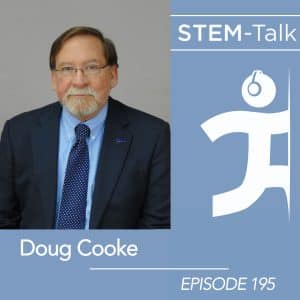
Episode 195: Doug Cooke discusses NASA’s challenges in the space race to the Moon and Mars

Our guest today is Doug Cooke, an aerospace consultant who spent 38 years at NASA’s Johnson Space Center in Houston and NASA Headquarters in Washington, D.C.  STEM-Talk host and IHMC founder Dr. Ken Ford, a former Associate Director of NASA’s Ames Research Center and Director of NASA’s Center of Excellence in Information Technology, interviewed Doug just four days after the astronauts of NASA’s Artemis II mission splashed down in the Pacific Ocean following a historic 10-day roundtrip from the Earth to the Moon. In today’s episode, Ken and Doug discuss the Artemis mission as well as NASA’s plans to return humans to the lunar surface by 2028. Doug also shares his concern that China could one day surpass America’s leadership role in human spaceflight. During his 38 years at NASA, Doug played critical roles in the Space Shuttle, International Space Station and Human Exploration spaceflight programs. During the last three years of his NASA career, he served as Associate Administrator of the Exploration Systems Mission Directorate, which oversees the development of systems critical to NASA’s plans for human exploration of the Moon and Mars, including the Artemis program. Show notes: [00:04:05] Ken opens our interview with Doug by talking about the Artemis II mission, which is the first crewed mission beyond low earth orbit since Apollo 17 in 1972. Harrison Schmidtt, who was on Apollo 17, was our guest on episode 4. Ken asks Doug for his key takeaways of the Artemis II mission, which set the record for a manned mission from Earth, traveling 252,756 miles into space and breaking Apollo 13’s record. [00:06:18] Ken explains that the Artemis missions signal a new age of space exploration as well as the beginning of a new space race between the U.S. and China. NASA aims to land humans on the Moon by 2028 while China expects to land humans on the moon in 2030. Ken has previously stated that he does not have confidence in NASA’s current mission architecture to achieve NASA’s stated goal of 2028, and asks Doug for his thoughts on the matter. [00:07:28] Ken asks if it is true that Yuri Gagarin, who become the first human to fly into space, is what initially sparked Doug’s interest in science and space. [00:08:54] Ken notes that Gagarin’s orbit around the earth inspired President Kennedy to vow that the United States would ramp up its space program and become the first nation to land a man on the moon. Ken mentions that he believes the Apollo 11 mission, which landed astronauts Neil Armstrong and Buzz Aldrin on the lunar surface, was one the greatest technological advances in world history. Ken asks Doug for his thoughts on the success of the Apollo program. [00:10:28] Ken mentions that Doug went to college at Texas A&M and majored in aerospace engineering. Kens asks Doug how he got a job at NASA after graduating. [00:12:21] Ken explains that Doug was instrumental in the development of the space shuttle and the International Space Station during his time at NASA. Doug talks about what it was like working on those projects at NASA. [00:15:16] Ken mentions that Doug also had an instrumental role in the Lunar Reconnaissance Orbiter (LRO), Lunar Crater Observation and Sensing Satellite (LCROSS), and the broader Exploration Technology Program. Ken points out that Doug became head of the exploration technology program in 1990 under then NASA Associate Administrator Mike Griffin, who was our guest on episodes 134 and 189. Ken asks Doug about meeting Mike. [00:16:17] Ken mentions that Mike Griffin and Lisa Porter were our guests on episode 189, where they voiced concerns about NASA’s current plans for a return to the moon. Ken goes on to mention that near the end of Doug’s career at NASA, he was the head of Exploration Systems Mission Directorate (ESMD), which is responsible for the development of systems critical to NASA’s plans for future exploration of the Moon and Mars. Ken asks Doug to talk about his role as head of the directorate and the work he did there. [00:18:55] Ken explains that Doug has written extensively on the issues with the Artemis mission architecture, most notably in a recent article for space news. Before jumping into the article, Ken asks Doug to talk about why it is important and also a national-security concern that we return to the moon before China. [00:21:12] Looping back to Doug’s op-ed in Space News, Ken notes that Doug stressed the need for NASA to develop a plan-B for the Artemis mission, with Doug and others noting that without a plan-B, the U.S. risks of losing the space race to the Moon. Doug has also gone on record to say that China has a far simpler, more direct, and more technically conservative plan than NASA. Ken asks Doug to elaborate on this. [00:22:37] Ken asks Doug to talk about the issues he and others have identified with NASA’s current proposed landing system. [00:26:14] Ken asks Doug to give a better understanding for the listeners of just how tall the proposed SpaceX lander is, and why that is a potential problem for not only landing on the moon in the proposed locations, but also for the astronauts exiting and entering. [00:28:51] Ken asks Doug to talk about what plan-B for Artemis looks like. [00:30:12] Ken asks Doug about the powerful thrust generation of the SpaceX lander. This raises the concern of regolith blast and generating significant debris fields while landing and thus reducing the scientific value of the region immediately surrounding the landing site. [00:30:59] Ken asks if Doug has any other thoughts on a potential plan-B. [00:33:02] Ken notes that the success of the mission hinges on the least proven element, namely the lander. While other elements of the mission architecture are well established, the hardest and least tested elements are normally the weakest links. Ken asks Doug’s thoughts on this position. [00:34:31] Ken asks Doug to talk about the complexity of the Artemis mission architecture and that it is largely driven by the Lander and NASA’s requirements.  There was a high interest in re-usability which increased complexity. Neither of the two Landers under development are an optimal design for a lunar lander. [00:35:37] Ken asks Doug about the role of commercial companies sometimes called “new space” in space exploration. [00:37:02] Ken asks Doug if he feels discouraged by the fact that the U.S. has squandered a 60-year head start in space exploration. [00:37:36] Ken explains that China aims to send humans to Mars by 2050, and NASA aims to do the same by 2040, while Elon Musk proposes to send humans to Mars by 2029, which Ken says is a completely untenable notion. Ken notes that statements such as that from Musk vastly understate the difficulty entailed in a Mars mission. Given that Doug was part of the early planning of a Mars mission at NASA, he asks Doug to talk about the challenges that such a mission faces. [00:42:17] Ken and Doug discuss the problem with EDL (Entry Descent and Landing) that Mars uniquely poses. [00:43:09] Ken also brings up the issue of crew health and wellness. By the time they reach Mars, given the extended time spent in a high-radiation, micro-gravity environment, maintaining crew health in transit is critical to mission success. [00:43:47] Ken poses the concern that if it becomes likely that China will reach the moon before the U.S. can return, then NASA or the political leadership may adopt the attitude that we’ve already been to the moon, and that we should just jump straight to Mars. [00:46:24] Ken asks for Doug’s thoughts on NASA’s current leadership and workforce. [00:49:01] Ken quizzes Doug about the aims, goals, and mission architecture of Artemis III and IV. [00:51:16] Ken notes that the design of Artemis III might negatively impact the overall mission goal of landing on the Moon by 2028. [00:52:04] Ken shifts to talk more about Artemis IV, elements of which, Ken notes, need much more testing to be ready. [00:52:58] Ken closes our interview noting that Doug will return for another interview on STEM-Talk in 2028 to see if Artemis is on schedule. Ken ends by asking Doug about how he started his hobby of collecting Civil War artifacts after he retired and moved to Gettysburg, as well as his hobby of collecting antique cars. [00:55:17] Ken closes by asking Doug to name the favorite car he has collected. Links: Doug Cooke bio Learn more about IHMC STEM-Talk homepage Ken Ford bio Ken Ford Wikipedia page

59 minAbspielen in:

Do11Dez 25
STEM-Talk

STEM-TalkHost

Episode 189: NASA’s Flawed Plan to Return to the Moon – with Mike Griffin & Lisa Porter

Today’s episode of STEM-Talk features a timely and wide-ranging discussion with Drs. Michael Griffin and Lisa Porter about NASA’s plans to return humans to the Moon, the history of lunar missions, and how China’s advances in space technology pose a serious threat to U.S. national security. IHMC founder and CEO Emeritus Ken Ford’s interview with Griffin and Porter came 10 days before Griffin appeared before the U.S. House Committee on Science, Space and Technology to give testimony on China’s advancements in space and the risks it poses for the United States. “We have squandered a 60-year head start on pioneering the space frontier to a nation that, without reason or provocation on our part, has chosen to become our nation’s adversary,” said Griffin in his opening comments to Congress. In this episode, Griffin and Porter explain why it is critical for the U.S. to return to the Moon before China. They also argue that NASA’s Artemis III mission to return to the lunar surface and establish a permanent base on the Moon is seriously flawed and should be scrapped. Griffin and Porter are co-founders and co-presidents of LogiQ Inc., a company providing high-end management, scientific and technical consulting services. Griffin’s background includes roles as the former Undersecretary of Defense for Research and Engineering, the Administrator of NASA, the Space Department Head at the John Hopkins University Applied Physics Laboratory as well as Chairman and CEO of Schafer Corporation. Porter’s background includes roles as the former Deputy Undersecretary of Defense for Research and Engineering, the founding Director of the Intelligence Advanced Research Projects Activity (IARPA) in the Office of the Director of National Intelligence, and the Associate Administrator for Aeronautics at NASA. Show notes: [00:04:44] Ken opens the interview by welcoming Mike back to STEM-Talk, who was a guest on Episodes 23 and 134. He also welcomes Lisa to her first appearance on STEM-Talk and asks her to talk about her decision to major in nuclear engineering at the Massachusetts Institute of Technology. [00:08:50] Ken asks Lisa why she went to Stanford for a Ph.D. in physics. [00:10:43] Ken explains that Lisa was the founding director of the Intelligence Advanced Research Projects Activity (IARPA), a department within the Office of the Director of National Intelligence. Ken asks about some of the challenges the American intelligence community faced that she addressed as director of IARPA. [00:16:15] Ken asks about Lisa’s time working for Mike as Associate Administrator for Aeronautics at NASA, and how she came to accept that role. [00:18:07] Ken explains that when Mike became Undersecretary for Defense for Research and Engineering in 2018, he invited Lisa to become the Deputy Undersecretary for Defense for Research and Engineering. Ken asks Mike why Lisa was ideal for that role. [00:21:07] Ken explains that Mike and Lisa are working together again as co-founders and co-presidents of LogiQ Inc., a company that provides scientific consulting services. Ken asks Mike to give a brief overview of LogiQ’s work. [00:24:44] Ken shifts the discussion to space exploration, noting that he wants to talk about Mike’s 2024 congressional testimony on returning to the Moon, and a paper that he and Lisa published titled “A system architecture for human lunar return.” To begin the discussion, Ken asks why it is so important for us to return to the Moon. [00:29:11] Ken asks Mike and Lisa to explain why it is important for the US to be the first to return to the Moon in the context of China’s ambition to send humans to the Moon and establish a permanent lunar presence. [00:33:24] Ken asks Mike and Lisa if they see the cancellation of the Apollo program as a mistake. [00:35:36] Ken asks Mike and Lisa to give an overview of the Artemis program. [00:41:45] Ken mentions the centrality of the Gateway in the Artemis plan, and the problem with making something that is already hard even harder for no good reason. [00:43:28] Ken mentions his concern that the focus on a Mars-forward approach might impede our success with the current Moon missions. [00:46:40] In Mike and Lisa’s aforementioned paper, they propose a dual-launch lunar landing architecture, which is simpler than the current NASA architecture and presents lower risks to the crew. Ken asks Mike and Lisa to elaborate on this idea. [00:48:41] Ken asks Mike and Lisa what they think are some of the other technical and programmatic problems with the current Artemis plan. [00:52:31] Ken asks Mike and Lisa what NASA’s response has been, as well as the response of others in the human space flight community, to their paper and recommendations for the Artemis mission architecture. [00:54:25] Ken explains that Sean Duffy, the Secretary of Transportation and acting NASA administrator, has opened the door to some additional lander ideas in light of concerns that the two current contractors, Space X and Blue Origin, may not be ready in time for the current Artemis schedule. Ken asks if Lisa and Mike think this is a good idea or if they think it would further complicate matters. [00:59:25] NASA’s current budget is around $24.9 billion dollars, approximately 0.4 percent of total federal spending. Ken notes at a time when China is increasing their investment in their space programs and launching several missions, NASA is facing a proposal to cut its funding by 24 percent to $18.8 billion. Ken asks Mike and Lisa for their thoughts on this. [01:03:13] Ken and Lisa continue Mike’s discussion on the core purpose of NASA beyond science. [01:08:55] Ken and Mike reflect on Ken’s observation that the U.S. is not as serious about space and the Moon as it was during the Apollo years, years that attracted the nation’s best and brightest. [01:09:39] Ken asks Mike and Lisa their thoughts on the way that NASA is contracting more services in the development of Artemis, rather than funding a development program. [01:15:55] Ken wraps up the interview by commenting that he believes listeners will very much enjoy today’s conversation. Links: Michael Griffin bio Griffin’s Dec. 4 2025 Congressional testimony Griffin’s 2024 Congressional testimony Lida Porter bio Ken Ford bio Ken Ford Wikipedia page Learn more about IHMC STEM-Talk homepage

1 h 18 minAbspielen in:

Warum PodAppear

Folge Menschen, nicht Podcasts.

Du hast Ken in einer Sendung gehört. PodAppear findet für dich die nächste, und genauso für alle anderen, die du hören willst.

  • Eine Meldung, wenn die Person zu Gast istPer E-Mail: sofort oder gebündelt als Tages- oder Wochenübersicht. Dann nur noch auf Play drücken.
  • Gäste statt bloßer ErwähnungenFolgen, in denen ein Name nur fällt, landen getrennt. Eine Meldung heißt: Die Person ist wirklich in der Sendung.
  • Alle in einem FeedGründerinnen, Autoren, Sportler, Forscherinnen. Folge allen mit Namen, quer durch jede Sendung, in der sie auftreten.

Bis zu 15 Personen kostenlos, ohne Kreditkarte.