
 DC
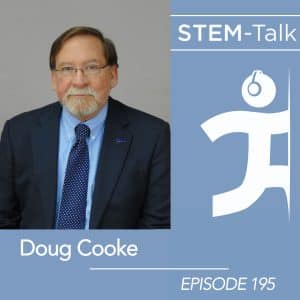
Doug CookeGast
Episode 195: Doug Cooke discusses NASA’s challenges in the space race to the Moon and Mars
Our guest today is Doug Cooke, an aerospace consultant who spent 38 years at NASA’s Johnson Space Center in Houston and NASA Headquarters in Washington, D.C. STEM-Talk host and IHMC founder Dr. Ken Ford, a former Associate Director of NASA’s Ames Research Center and Director of NASA’s Center of Excellence in Information Technology, interviewed Doug just four days after the astronauts of NASA’s Artemis II mission splashed down in the Pacific Ocean following a historic 10-day roundtrip from the Earth to the Moon. In today’s episode, Ken and Doug discuss the Artemis mission as well as NASA’s plans to return humans to the lunar surface by 2028. Doug also shares his concern that China could one day surpass America’s leadership role in human spaceflight. During his 38 years at NASA, Doug played critical roles in the Space Shuttle, International Space Station and Human Exploration spaceflight programs. During the last three years of his NASA career, he served as Associate Administrator of the Exploration Systems Mission Directorate, which oversees the development of systems critical to NASA’s plans for human exploration of the Moon and Mars, including the Artemis program. Show notes: [00:04:05] Ken opens our interview with Doug by talking about the Artemis II mission, which is the first crewed mission beyond low earth orbit since Apollo 17 in 1972. Harrison Schmidtt, who was on Apollo 17, was our guest on episode 4. Ken asks Doug for his key takeaways of the Artemis II mission, which set the record for a manned mission from Earth, traveling 252,756 miles into space and breaking Apollo 13’s record. [00:06:18] Ken explains that the Artemis missions signal a new age of space exploration as well as the beginning of a new space race between the U.S. and China. NASA aims to land humans on the Moon by 2028 while China expects to land humans on the moon in 2030. Ken has previously stated that he does not have confidence in NASA’s current mission architecture to achieve NASA’s stated goal of 2028, and asks Doug for his thoughts on the matter. [00:07:28] Ken asks if it is true that Yuri Gagarin, who become the first human to fly into space, is what initially sparked Doug’s interest in science and space. [00:08:54] Ken notes that Gagarin’s orbit around the earth inspired President Kennedy to vow that the United States would ramp up its space program and become the first nation to land a man on the moon. Ken mentions that he believes the Apollo 11 mission, which landed astronauts Neil Armstrong and Buzz Aldrin on the lunar surface, was one the greatest technological advances in world history. Ken asks Doug for his thoughts on the success of the Apollo program. [00:10:28] Ken mentions that Doug went to college at Texas A&M and majored in aerospace engineering. Kens asks Doug how he got a job at NASA after graduating. [00:12:21] Ken explains that Doug was instrumental in the development of the space shuttle and the International Space Station during his time at NASA. Doug talks about what it was like working on those projects at NASA. [00:15:16] Ken mentions that Doug also had an instrumental role in the Lunar Reconnaissance Orbiter (LRO), Lunar Crater Observation and Sensing Satellite (LCROSS), and the broader Exploration Technology Program. Ken points out that Doug became head of the exploration technology program in 1990 under then NASA Associate Administrator Mike Griffin, who was our guest on episodes 134 and 189. Ken asks Doug about meeting Mike. [00:16:17] Ken mentions that Mike Griffin and Lisa Porter were our guests on episode 189, where they voiced concerns about NASA’s current plans for a return to the moon. Ken goes on to mention that near the end of Doug’s career at NASA, he was the head of Exploration Systems Mission Directorate (ESMD), which is responsible for the development of systems critical to NASA’s plans for future exploration of the Moon and Mars. Ken asks Doug to talk about his role as head of the directorate and the work he did there. [00:18:55] Ken explains that Doug has written extensively on the issues with the Artemis mission architecture, most notably in a recent article for space news. Before jumping into the article, Ken asks Doug to talk about why it is important and also a national-security concern that we return to the moon before China. [00:21:12] Looping back to Doug’s op-ed in Space News, Ken notes that Doug stressed the need for NASA to develop a plan-B for the Artemis mission, with Doug and others noting that without a plan-B, the U.S. risks of losing the space race to the Moon. Doug has also gone on record to say that China has a far simpler, more direct, and more technically conservative plan than NASA. Ken asks Doug to elaborate on this. [00:22:37] Ken asks Doug to talk about the issues he and others have identified with NASA’s current proposed landing system. [00:26:14] Ken asks Doug to give a better understanding for the listeners of just how tall the proposed SpaceX lander is, and why that is a potential problem for not only landing on the moon in the proposed locations, but also for the astronauts exiting and entering. [00:28:51] Ken asks Doug to talk about what plan-B for Artemis looks like. [00:30:12] Ken asks Doug about the powerful thrust generation of the SpaceX lander. This raises the concern of regolith blast and generating significant debris fields while landing and thus reducing the scientific value of the region immediately surrounding the landing site. [00:30:59] Ken asks if Doug has any other thoughts on a potential plan-B. [00:33:02] Ken notes that the success of the mission hinges on the least proven element, namely the lander. While other elements of the mission architecture are well established, the hardest and least tested elements are normally the weakest links. Ken asks Doug’s thoughts on this position. [00:34:31] Ken asks Doug to talk about the complexity of the Artemis mission architecture and that it is largely driven by the Lander and NASA’s requirements. There was a high interest in re-usability which increased complexity. Neither of the two Landers under development are an optimal design for a lunar lander. [00:35:37] Ken asks Doug about the role of commercial companies sometimes called “new space” in space exploration. [00:37:02] Ken asks Doug if he feels discouraged by the fact that the U.S. has squandered a 60-year head start in space exploration. [00:37:36] Ken explains that China aims to send humans to Mars by 2050, and NASA aims to do the same by 2040, while Elon Musk proposes to send humans to Mars by 2029, which Ken says is a completely untenable notion. Ken notes that statements such as that from Musk vastly understate the difficulty entailed in a Mars mission. Given that Doug was part of the early planning of a Mars mission at NASA, he asks Doug to talk about the challenges that such a mission faces. [00:42:17] Ken and Doug discuss the problem with EDL (Entry Descent and Landing) that Mars uniquely poses. [00:43:09] Ken also brings up the issue of crew health and wellness. By the time they reach Mars, given the extended time spent in a high-radiation, micro-gravity environment, maintaining crew health in transit is critical to mission success. [00:43:47] Ken poses the concern that if it becomes likely that China will reach the moon before the U.S. can return, then NASA or the political leadership may adopt the attitude that we’ve already been to the moon, and that we should just jump straight to Mars. [00:46:24] Ken asks for Doug’s thoughts on NASA’s current leadership and workforce. [00:49:01] Ken quizzes Doug about the aims, goals, and mission architecture of Artemis III and IV. [00:51:16] Ken notes that the design of Artemis III might negatively impact the overall mission goal of landing on the Moon by 2028. [00:52:04] Ken shifts to talk more about Artemis IV, elements of which, Ken notes, need much more testing to be ready. [00:52:58] Ken closes our interview noting that Doug will return for another interview on STEM-Talk in 2028 to see if Artemis is on schedule. Ken ends by asking Doug about how he started his hobby of collecting Civil War artifacts after he retired and moved to Gettysburg, as well as his hobby of collecting antique cars. [00:55:17] Ken closes by asking Doug to name the favorite car he has collected. Links: Doug Cooke bio Learn more about IHMC STEM-Talk homepage Ken Ford bio Ken Ford Wikipedia page