Bekomm eine E-Mail, wenn Jure in einem Podcast zu Gast istPodAppear prüft neue Folgen, sobald sie erscheinen, und lässt die weg, in denen Jure nur erwähnt wird. Bis zu 15 Personen kostenlos, ohne Kreditkarte.Bis zu 15 Personen kostenlos, ohne Kreditkarte.
Jure Leskovec war in den letzten 12 Monaten in 5 Podcast-Folgen aus 5 verschiedenen Sendungen zu Gast. Zuletzt: Stanford Online: University Courses & Lectures, 28. Nov. 2026.
Jure Leskovec
Stanford University
This seminar series features dynamic professionals sharing their industry experience and cutting edge research within the human-computer interaction (HCI) field. Each week, a unique collection of technologists, artists, designers, and activists will discuss a wide range of current and evolving topics pertaining to HCI.
Uploaded 16-02-13
Learn more about Stanford's Human-Computer Interaction Group: https://hci.stanford.edu
Learn about Stanford's Graduate Certificate in HCI: https://online.stanford.edu/programs/human-computer-interaction-graduate-certificate
View the full playlist: https://www.youtube.com/playlist?list=PLoROMvodv4rMyupDF2O00r19JsmolyXdD&disable_polymer=true
0:00 Introduction
0:38 People Express Opinions
1:41 Opinions and the Web
3:30 Evaluations on the Web
4:52 User-User Evaluations
6:22 Natural Analogies
7:08 U-U Evaluations: Some Issues
8:31 This Talk: Setting
10:34 This Talk: Data
11:15 This Talk: Overview
12:07 Human Evaluations
12:45 Definitions
16:13 Relative vs. Absolute Assessment
20:46 Effects of Similarity
24:10 Status and Similarity
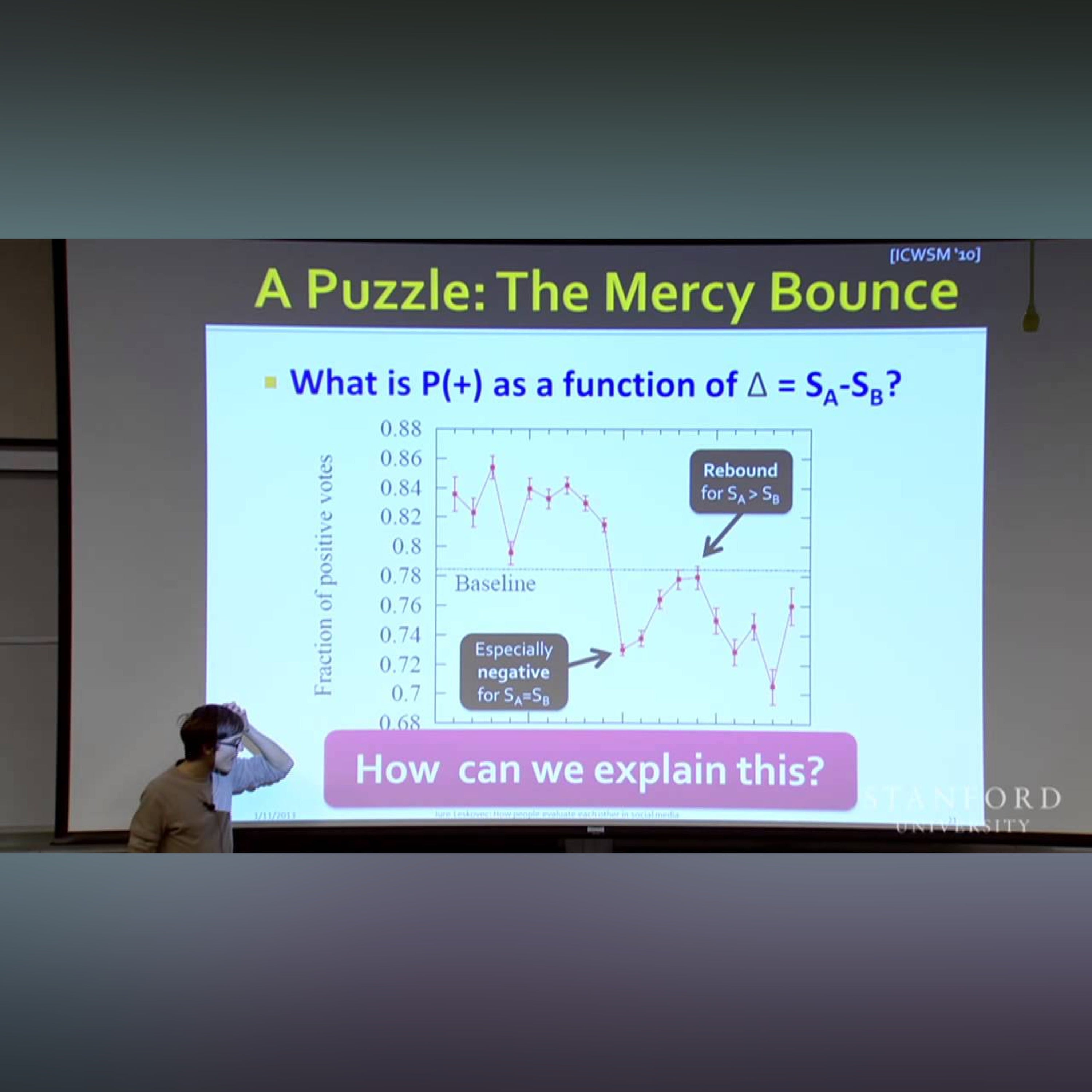
28:40 A Puzzle: The Mercy Bounce
30:28 Aggregating Evaluations
32:33 Ballot-blind: The Model
35:58 Ballot-blind Prediction
37:35 Evaluations in a Context
38:22 Status Theory
39:48 Structural Balance
41:41 Status vs. Balance
45:36 Global Structure
46:26 Embeddedness
47:39 Application: Predicting Signs
54:31 Future Directions
Learn more about your ad choices. Visit megaphone.fm/adchoices
1 h 09 minAbspielen in:
Di24Nov
Super Data Science: ML & AI Podcast with Jon Krohn
In Episode #1047, Jure Leskovec (Professor of Computer Science at Stanford and co-founder of Kumo AI, now part of NVIDIA) joins Jon Krohn to explain how a foundation model that has never seen real data can beat hand-built models on enterprise tables. These models need no feature engineering and no training. Jure pioneered graph neural networks, and since NVIDIA acquired Kumo, his team has released the full Kumo family as open weights under a license that allows commercial use. In this episode, Jure breaks down the four Kumo models for tabular, relational, forecasting and anomaly-detection tasks, explains how they are pre-trained on synthetic data, describes how Biomni came to be used by more than 10,000 scientists within weeks and lays out why he believes human judgment has never been more valuable.
Additional materials: www.superdatascience.com/1047
Interested in sponsoring a SuperDataScience Podcast episode? Email natalie@superdatascience.com for sponsorship information.
In this episode you will learn:
(00:06:18) How Kumo Tabular makes predictions without any training
(00:15:20) Pre-training tabular models on purely synthetic data
(00:26:28) Kumo Relational and treating a database as a graph
(00:51:47) Why human judgment is becoming more valuable
What happens when AI starts doing science? We talk with Stanford computer scientist Jure Leskovec about AI agents that find patterns in large datasets, come up with hypotheses and try to kill them with more data, enduring the tedious work human scientists would rather avoid. What are we human scientists still uniquely good for? Taste, judgment, intuition, emotion, procrastination? And we discuss whether AI might be opening up a whole new continent of discoveries, a terra incognita with plenty of ways to get lost and found.
Worth a look: 50×50: Science Across America – 50 creators, 50 scientists, 50 states, 50 videos over ten weeks in 2026, from the Independent Media Initiative. It goes where science actually happens, with the people who actually do it – which is the part we're always most curious about. https://www.5050science.com/
The Night Science Podcast is produced by the Night Science Institute. For more information on Night Science, visit night-science.org .
36 minAbspielen in:
Mi10Jun
Software Engineering Radio - the podcast for professional software developers
Jure Leskovec, Professor of Computer Science at Stanford University and Chief Scientist at Kumo.ai, speaks with host Sriram Panyam about relational and graph language models and their transformative impact on enterprise decision-making and predictive modeling.
Jure begins by establishing the critical importance of predictive modeling across industries - from fraud detection in financial institutions to customer churn prediction, lifetime value estimation, product recommendations, and healthcare risk assessment. He notes that while AI has made remarkable advances in natural language understanding and computer vision, predictive modeling over enterprise operational data stored in relational databases has been largely left behind, still relying on 30-year-old machine learning approaches that are expensive, time-consuming, and require manual feature engineering.
His proposed solution to the fundamental problem with current approaches is relational deep learning and relational transformers. The discussion explores how this approach differs from traditional graph neural networks (GNNs), which Jure pioneered and deployed successfully at Pinterest. Jure concludes with practical guidance for software engineers and data scientists interested in exploring this technology.
1 h 02 minAbspielen in:
Do21Mai
The TWIML AI Podcast (formerly This Week in Machine Learning & Artificial Intelligence)
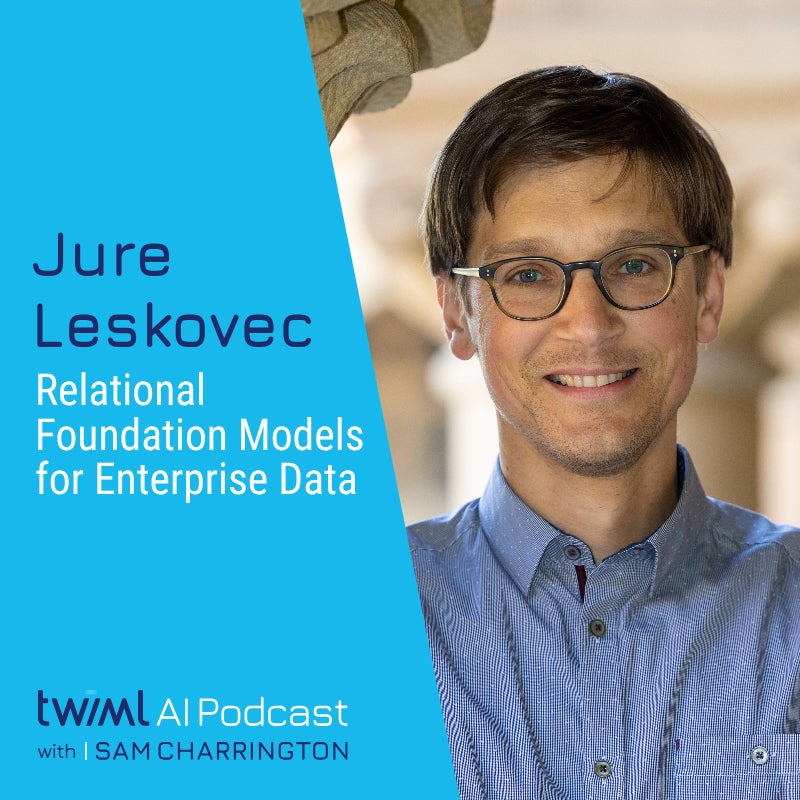
In this episode, Jure Leskovec, co-founder and chief scientist at Kumo and professor of computer science at Stanford, joins us to explore two fronts of his work: AI for science and relational deep learning. We begin with AI Virtual Cell, a multiscale effort to learn data-driven representations from proteins to cells to patients using single-cell RNA-seq data, protein language models like ESM, and structure models like AlphaFold—without hand-encoding biology. Jure then dives into relational deep learning, reframing enterprise databases as graphs and training neural networks directly on raw multi-table data. He explains Kumo’s Relational Foundation Model (RFM2), which performs in-context learning over subgraphs to make accurate predictions on new databases and tasks with no training, and how this approach benchmarks against RelBench and other multi-table datasets. We also discuss real-world deployments at companies like Reddit, DoorDash, and Coinbase, explainability via attention over tables and columns, integration with agentic systems, deployment options, and practical limitations.
The complete show notes for this episode can be found at https://twimlai.com/go/768.
1 h 06 minAbspielen in:
Warum PodAppear
Folge Menschen, nicht Podcasts.
Du hast Jure in einer Sendung gehört. PodAppear findet für dich die nächste, und genauso für alle anderen, die du hören willst.
Eine Meldung, wenn die Person zu Gast istPer E-Mail: sofort oder gebündelt als Tages- oder Wochenübersicht. Dann nur noch auf Play drücken.
Gäste statt bloßer ErwähnungenFolgen, in denen ein Name nur fällt, landen getrennt. Eine Meldung heißt: Die Person ist wirklich in der Sendung.
Alle in einem FeedGründerinnen, Autoren, Sportler, Forscherinnen. Folge allen mit Namen, quer durch jede Sendung, in der sie auftreten.