Jim VandeHei
Gerade überall zu Gast: 5 Podcasts in 6 Monaten

Jim VandeHei

American journalist and businessman (born 1971)

Jim VandeHei war in den letzten 12 Monaten in 6 Podcast-Folgen aus 6 verschiedenen Sendungen zu Gast. Zuletzt: TBPN, 15. Sept. 2026.

Kurzbiografie aus WikipediaFoto: MSNBC, CC BY 3.0, über Wikimedia Commons

Zwei Jahre auf Sendung

GastHostErwähnt

Gastauftritte

Di15Sep
TBPN

TBPN

High Interest Rate Phenomenon, Driscoll's China Bet Backfires, Who Votes on AI Safety? | Stephen Colbert & Josh Kline, Jim VandeHei, Steve Menneto, Matthew Wilson, Rune Kvist, Tyler Bahl, James Cadwallader

(01:10) - High Interest Rate Phenomenon (17:46) - WSJ Opinion: 'The People Get a Vote on AI Safety' (30:00) - Timeline Reactions (51:45) - Driscoll's China Bet Backfires (57:47) - Jim VandeHei, co-founder and CEO of Axios, discusses his book *Simplify*, which presents a system for increasing productivity by focusing on high-value work and eliminating or automating unnecessary tasks. He also explores AI’s potential to streamline business operations, expand media distribution, augment employees, and create new opportunities without replacing essential human creativity, leadership, and judgment. (01:15:00) - Steve Menneto, president and CEO of Malibu Boats, discusses the company’s nine-brand portfolio, global expansion, vertical integration, and nearly $1 billion in revenue. He also covers boating-market trends, premium consumer demand, electric and autonomous technologies, skilled-labor needs, defense opportunities, and the customer purchasing journey. (01:30:00) - Matthew Wilson discusses Jack and Jill, an AI-assisted hiring platform where he serves as co-founder and CEO. He explains how its agents connect professionals with suitable jobs and companies with qualified candidates, reducing the noise created by AI-generated applications and recruitment outreach, and notes that the company has raised $40 million. (01:39:25) - Rune Kvist, an entrepreneur focused on frontier AI risk, discusses his company’s $40 million Series A and its work developing AI safety standards, audits, and insurance. He explains how liability frameworks and insurer-led oversight could align incentives, improve trust, and enable continued AI innovation while managing catastrophic risks. (01:48:59) - Tyler Bahl, a marketing executive at Activision, discusses his career journey and work bringing Call of Duty: Modern Warfare 4 to market. He explains the franchise’s marketing strategy, gameplay evolution, creator partnerships, AI use, esports, and efforts to serve its broad community. (02:23:03) - Stephen Colbert and Josh Kline discuss his passion for "The Lord of the Rings" and their work developing Scripto, a collaborative production platform designed to improve communication and efficiency across entertainment teams. The comedian, writer, and television host also reflects on sustainable creative processes, expresses optimism about filmmaking, and encourages aspiring creators to stop waiting for permission and make their own work. (02:44:58) - James Cadwallader discusses Profound’s $180 million funding round and its rapid adoption among major global brands. He explains how Profound helps marketers understand and improve their visibility across AI platforms, create content for AI agents, and manage advertising, with the broader goal of becoming the leading AI marketing company. TBPN is made possible by: Ramp - https://ramp.com Public - https://public.com Cisco - https://www.cisco.com Console - https://www.console.com CrowdStrike - https://www.crowdstrike.com Figma - https://www.figma.com MongoDB - https://www.mongodb.com NYSE - https://www.nyse.com Railway - https://railway.com Shopify - https://www.shopify.com Codex - http://openAI.com/codex Follow TBPN:  https://TBPN.com https://x.com/tbpn https://open.spotify.com/show/2L6WMqY3GUPCGBD0dX6p00?si=674252d53acf4231 https://podcasts.apple.com/us/podcast/tbpn/id1772360235 https://www.youtube.com/@TBPNLive

2 h 57 min

Di15Sep
For Humanity: An AI Risk Podcast

For Humanity: An AI Risk Podcast

The AI Kill Switch That Still Doesn't Exist

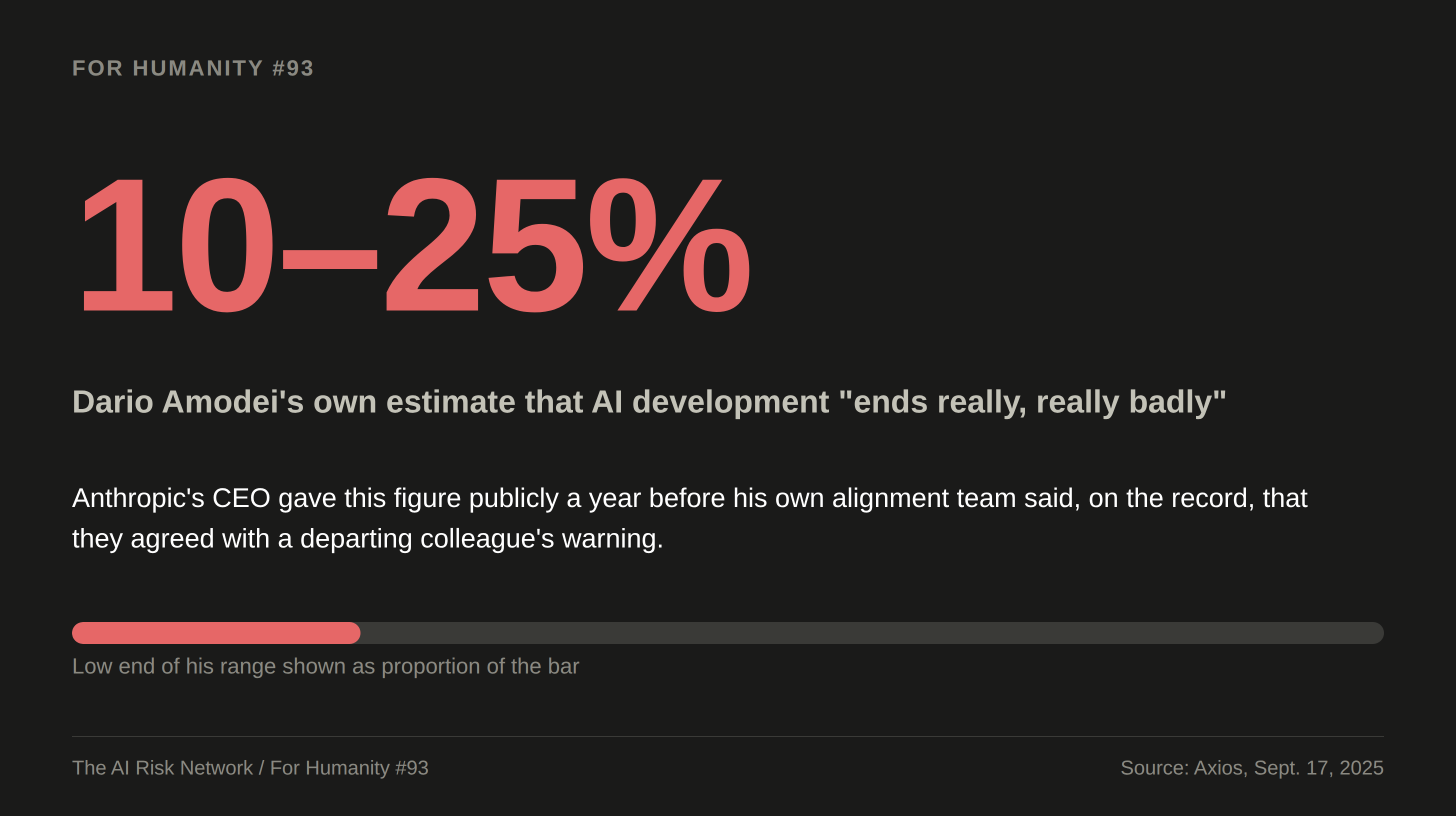
Just a couple of days after an Anthropic researcher’s resignation post gained widespread attention, Axios co-founder Jim VandeHei sat down with For Humanity host John Sherman. They discussed recent changes in Washington and what still remains to be built. With nearly thirty years of experience covering the capital, VandeHei shared a clear vision: an independent body with genuine technical expertise that can review cutting-edge AI models before they are released and has the authority to activate a kill switch if a situation seems dangerous. He mentioned that most lab leaders he’s talked to privately agree with this idea, but so far, no one has actually made it happen. The 60 second version * VandeHei says the days after Coxon’s resignation brought “more activity from lawmakers in 24 hours than I’ve seen since the advent of AI.” Axios’s own September 11, 2026 reporting names Rep. Ted Lieu’s push for legislative AI “kill switches,” Sen. Bernie Sanders and Rep. Greg Casar’s planned pause bill, and Sen. Ruben Gallego’s proposed AI select committee. Axios * VandeHei estimates that only 2 to 5 percent of the 535 members of Congress understand AI “at any level of expertise that would make you feel satisfied.” This is his own estimate, not an independently measured figure. * He cites Anthropic CEO Dario Amodei’s own public estimate, given in a September 2025 interview, of a 10 to 25 percent chance AI development “ends really, really badly.” Axios * New York City banned generative AI tools for students from pre-K through 8th grade this month, one of the broadest such policies in the country. Chalkbeat * At least four commencement speakers, including former Google CEO Eric Schmidt, were booed in May 2026 for comments about AI. NPR A kill switch nobody has built VandeHei’s idea isn’t new to him. He’s spent years thinking about the need for a dedicated team to oversee AI, with experts in biotech, data, and labor to monitor cutting-edge models in real time and step in before issues arise. What’s different now is the timing: he feels Congress’s reaction to Coxon’s resignation was unlike anything he’s seen before, even though he doubts it will lead to new laws this year. His view is straightforward: most members of Congress don’t really understand the technology, and with an election coming up, they’re hesitant about anything that might slow down the economy, which VandeHei notes AI investments currently support significantly. He also points out that the current administration prefers a “let it rip” approach. Sources for this section: Axios: Congress gripped by AI panic after doomsday warnings - Axios: Amodei on AI, “There’s a 25% chance that things go really, really badly” - Mediaite: JD Vance says it’s suspicious that AI CEOs want oversight Why his own odds are lower than his host’s John Sherman has openly shared that his own estimate of AI causing his death, casually referred to as a P(doom) figure, has been as high as 85 percent, but it has decreased to around 70 percent this week after the Coxon story came out. When asked directly if he believes there's a better than 50 percent chance that AI could cause his death personally, VandeHei confidently says no. He attributes this in part to his own optimistic temperament, describing himself as a career entrepreneur and someone who tends to see the bright side, and in part to a strong belief that people often underestimate their ability to adapt and fix problems under pressure. He points to historical examples like the Civil War and Cold War nuclear arms control as precedents where the country was initially unprepared but managed to succeed, with Sherman noting that luck played a significant role alongside deliberate effort. Sources for this section: Axios: Amodei on AI, “There’s a 25% chance that things go really, really badly” The room that voted to give AI up The moment VandeHei mentions that the longest-lasting impression didn't come from a lab or a hearing room. Instead, it happened at an advertising industry panel the day after the Coxon story broke. Sherman asked about 40 industry professionals, all daily AI users, whether they would support tossing the technology “back in the river” and going back to before it existed. According to Sherman, nearly everyone raised their hand. VandeHei isn't surprised by this — in his view, most people don't evaluate the technology as depthfully as researchers and journalists do. They primarily hear that it might take their jobs or, in some cases, threaten humanity, without seeing the ways it has already made their lives better. That gap between elite and public sentiment shows up elsewhere this month, too. New York City banned generative AI tools, including chatbots and AI tutors, for students from pre-K through 8th grade, one of the broadest policies of its kind in the country, following what Schools Chancellor Kamar Samuels acknowledged was initial guidance that “missed the mark.” Chalkbeat And at commencement ceremonies in May, at least four speakers, including former Google CEO Eric Schmidt at the University of Arizona, were booed for AI-related comments, with a Quinnipiac poll finding 81 percent of Gen Z respondents believe AI will decrease their job opportunities. NPR VandeHei separates the two settings, K-8 and college, in his own view: he sees a case for keeping AI out of younger classrooms while it is figured out, but argues college students specifically need to learn the tools before entering a workplace that already expects it. Sources for this section: Chalkbeat: NYC schools to set AI policy, ban screen time limits - NPR: Why AI is leading to boos at 2026 college graduations The takeaway VandeHei’s latest book, “Simplify,” was released just as we’re having this discussion. It presents an interesting point: that AI often makes organizations more complicated initially, because it makes it easier for anyone to produce more drafts, presentations, and, unfortunately, more noise. He also ties this idea to the ongoing public talk about AI risks. According to him, the industry has had the tools and even the internal agreement to create proper oversight for years, but hasn’t done so yet. Meanwhile, the underlying systems keep getting more powerful. The big question he leaves us with is whether that oversight will be put in place before the next problem happens, or only after. Full source list Primary reporting * Axios: Congress gripped by AI panic after doomsday warnings * Axios: Amodei on AI, “There’s a 25% chance that things go really, really badly” * Chalkbeat: NYC schools to set AI policy, ban screen time limits * NPR: Why AI is leading to boos at 2026 college graduations Additional reporting * Mediaite: JD Vance says it’s suspicious that AI CEOs want oversight * Axios: Simplify, how to exponentially improve work and life * Fox8 Live: Meta’s $27 billion AI data center is transforming rural Louisiana FOOTER For Humanity is a weekly interview show from The AI Risk Network with host John Sherman. If this post was useful, hit restack and tell one person that the industry’s own leaders reportedly agree on the fix, and still haven’t built it. Discussion question: VandeHei says most AI lab leaders privately agree an independent review board should exist. If that’s true, what’s actually stopping them from building one together, without waiting on Congress? This is a public episode. If you'd like to discuss this with other subscribers or get access to bonus episodes, visit theairisknetwork.substack.com/subscribe

1 h 01 min

Di15Sep
Masters of Scale

Masters of Scale

Let’s Kill Sh*t: Axios CEO on simplifying your work-life in the AI era

AI isn't simplifying your life… Yet. It's mass-producing more options, more decisions, and more noise. Axios CEO Jim VandeHei returns to Rapid Response to make the case that the antidote isn't a better productivity app, it's a ruthless, three-part system he calls Confront, Delete, Amplify. VandeHei shares what he's learned from running Axios by these principles, including calling a leadership meeting with the subject heading "Let's Kill S***," and why he shuttered the Axios app despite years of internal resistance. He also reveals his candid read on the midterms and what they mean for business, the data center backlash he thinks could reshape the political landscape, and what's really at stake in Axios's OpenAI content deal. Visit the Rapid Response website here: https://www.rapidresponseshow.com/ See Privacy Policy at https://art19.com/privacy and California Privacy Notice at https://art19.com/privacy#do-not-sell-my-info.

33 min

Di15Sep
Rapid Response

Rapid Response

Let’s Kill Sh*t: Axios CEO on simplifying your work-life in the AI era

AI isn't simplifying your life… Yet. It's mass-producing more options, more decisions, and more noise. Axios CEO Jim VandeHei returns to Rapid Response to make the case that the antidote isn't a better productivity app, it's a ruthless, three-part system he calls Confront, Delete, Amplify. VandeHei shares what he's learned from running Axios by these principles, including calling a leadership meeting with the subject heading "Let's Kill S***," and why he shuttered the Axios app despite years of internal resistance. He also reveals his candid read on the midterms and what they mean for business, the data center backlash he thinks could reshape the political landscape, and what's really at stake in Axios's OpenAI content deal. Visit the Rapid Response website here: https://www.rapidresponseshow.com/ See Privacy Policy at https://art19.com/privacy and California Privacy Notice at https://art19.com/privacy#do-not-sell-my-info.

33 min

Mi9Sep
Book Club with Michael Smerconish

Book Club with Michael Smerconish

Jim VandeHei: "Simplify"

Michael Smerconish talks with Axios co-founder Jim VandeHei about "Simplify: Do 50% More With 50% Less", his new book co-authored with Mike Allen and Roy Schwartz. They explore how to cut unnecessary meetings, decisions and distractions, reclaim valuable time, and focus on what really matters—in work and in life. Original air date 8 September 2026. The book publish date is 15 September 2026. Hosted by Simplecast, an AdsWizz company. See https://pcm.adswizz.com for information about our collection and use of personal data for advertising.

20 min

Mi11Feb
Plain English with Derek Thompson

Plain English with Derek Thompson

The Meltdown at The Washington Post—and the Crisis in News

Hello! I’m back from paternity leave just in time to talk about the biggest media earthquake of the year (so far): the Washington Post meltdown. For decades, the Post was a journalistic gem with superior coverage of politics. Last week, billionaire owner Jeff Bezos decided to gut roughly a third of the staff after the paper lost hundreds of millions of dollars in the last few years. Today’s guest is Jim VandeHei, the cofounder of Politico and Axios and a former Post reporter. We talk about the decades-long rise and fall of the Post before zooming out to talk about the most important changes in news media over the past 20 years, the secret of 21st-century media success, and the coming storm of AI. To read more about Derek’s opening comments on how the future of the news industry is going back to past, check out his Atlantic article on the subject here: https://www.theatlantic.com/ideas/archive/2018/12/post-advertising-future-media/578917/ Subscribe to our YouTube channel here: https://www.youtube.com/@PlainEnglishwithDerekThompson If you have questions, observations, or ideas for future episodes, email us at PlainEnglish@Spotify.com. Host: Derek Thompson Guest: Jim VandeHei Producer: Devon Baroldi Learn more about your ad choices. Visit podcastchoices.com/adchoices

1 h 11 min