Get an email when Jeremy is a guest on a podcastPodAppear checks new episodes as they come out and leaves out the ones that only mention Jeremy. Free for up to 15 people, no card needed.Free for up to 15 people, no card needed.
Follow Jeremy free
JB

Jeremy Bradley

Two years on the air

GuestHostMentioned

Episodes they host

Wed5Aug
Data & AI Mastery

Data & AI MasteryHost

DAIM: Inside The Algorithm | Alberto Romero on Engineering AI at scale at Aviva

👉 Discover how Cambridge Spark helps organisations build the data and AI capabilities needed to turn strategy into measurable impact: cambridgespark.com What does it actually take to ship machine learning inside one of the UK's largest insurers? Jeremy Bradley sits down with Alberto Romero, director of AI engineering at Aviva, to trace his path from InsurTech founder to enterprise AI leader. Alberto explains why prototypes are so often mistaken for finished products and what production readiness really demands once edge cases, drift and adversarial behaviour enter the picture. The conversation covers how to get genuine explainability out of large language models rather than plausible-sounding justification, when fine-tuning earns its place in a regulated stack, and why Aviva built its own internal platform to govern AI use cases at scale. Alberto also shares his take on fraud detection as an adversarial ML problem and the one failure mode he sees engineering teams repeat most often. Follow Data & AI Mastery so you never miss an episode, and share it with a colleague working through similar production challenges. If you enjoyed this conversation, you might also like this episode featuring Sarah Self. She joined us on Data and AI Mastery to explore what most organisations get wrong when deploying AI. Apple: https://podcasts.apple.com/gb/podcast/from-cybersecurity-to-ai-director-sarah-self-on-leading/id1779783413?i=1000764247007 Spotify: https://open.spotify.com/episode/0BpSq5X1ZP8ctIYTxWVAJT?si=1264586e79f3446f YouTube: https://www.youtube.com/watch?v=2jgM095SYG0 Glossary Terms RAG: Retrieval-Augmented Generation is an AI methodology that enhances Large Language Models by pulling factual context from external knowledge bases. GAN: Generative Adversarial Network is a deep learning architecture in which two neural networks compete against each other to create highly realistic synthetic data from a training dataset Non-deterministic: describes a process, algorithm, or system whose outcome is inherently unpredictable and cannot be guaranteed to repeat exactly, even when it starts from the exact same initial conditions ReAct (Reasoning + Acting) approach: a prompting technique that enables AI models to solve complex problems by alternating between thinking and taking action Chapter Markers (00:00) - Cold open: why prototypes get mistaken for production (02:53) - Avoiding common AI adoption pitfalls in regulated sectors (05:44) - Real explainability versus post-hoc justification in LLMs (09:18) - From startup founder to enterprise: the mindset shift (11:38) - Managing AI across 70+ use cases at Aviva (13:31) - Standards first, technology second (17:19) - Where fine-tuning earns its place (20:33) - Building Aviva's own governed AI platform (23:51) - Fraud detection as an adversarial ML problem (28:34) - Quick fire: the most common AI failure mode (29:37) - What deserves more attention as AI scales Useful Links Connect with Alberto Romero on LinkedIn: https://uk.linkedin.com/in/albertoromero-uk For more AI insights follow Jeremy on LinkedIn: https://uk.linkedin.com/in/jeremy-bradley Explore Cambridge Spark’s AI upskilling programmes at https://www.cambridgespark.com
32 minPlay in:

Wed8Jul
Data & AI Mastery

Data & AI MasteryHost

DAIM: Inside The Algorithm | Why Neurosymbolic AI Solves What Scaling Alone Cannot with Dr Vaishak Belle

👉 Discover how Cambridge Spark helps organisations build the data and AI capabilities needed to turn strategy into measurable impact: cambridgespark.com Large language models are surprisingly good at producing fluent, plausible text. So why do they still confidently get simple things wrong? In this episode, Dr Jeremy Bradley is joined by Dr Vaishak Belle, Reader at the University of Edinburgh's School of Informatics, Alan Turing Institute Faculty Fellow and Director of Research and Innovation at the Bayes Centre. Vaishak has spent 16 years working at the intersection of logic, probability and machine learning and brings that lens to one of AI's most persistent problems: hallucination. The conversation traces why scaling alone will not solve reliability, what neurosymbolic AI actually is and why tools like Claude Code quietly depend on it, how theory of mind is being engineered into language models, and where reinforcement learning fits into the future of AI reasoning. If you work at the frontier of AI research or engineering, this is a grounded, technically rich conversation worth your time. Follow Data & AI Mastery so you never miss an episode. If you enjoyed this conversation, you might also like this episode featuring Dr Petar Veličković. Petar joined us on Data and AI Mastery to explore how graph neural networks bring structured reasoning into systems like Google Maps and how AI is being used as a genuine discovery partner in mathematics. Apple: https://podcasts.apple.com/gb/podcast/bridging-ai-research-and-real-world-impact-dr-petar/id1779783413?i=1000734000576 Spotify: https://open.spotify.com/episode/7qA0AY9MlLS2L9PANqlXNi?si=37d8a8fb43c14cc9 YouTube: https://www.youtube.com/watch?v=GwMUSNidnvE Glossary Terms Neurosymbolic AI: an emerging field that merges the intuitive pattern recognition of neural networks with the logical, rule-based reasoning of symbolic AI. Theory of Mind: refers to an AI’s capacity to attribute mental states to humans or other agents and understand that these states may differ from its own. Confabulation: In AI, it is the generation of factually incorrect, distorted, or entirely fabricated information presented as absolute truth. Delegation Module: a software component that allows users or systems to assign tasks, roles, or access rights to others. Retrieval Augmented Graphs: an advanced AI framework that enhances large language models by grounding their responses in interconnected data networks, such as knowledge graphs. Reinforcement Learning: a machine learning method where an AI agent learns to make decisions through trial and error. Dynamic Pathway Analysis: a computational method used in systems biology and bioinformatics to model and simulate how biological processes change over time. Chapter Markers (00:00) - Why LLM hallucinations happen (02:12) - The biggest shift in AI over the last 16 years (07:42) - How logic and probability shaped Vaishak's path into AI (10:11) - Introducing neurosymbolic AI (11:27) - Claude Code, algebraic delegation and the theory of mind problem (20:01) - Theory of mind in robotics and human computer interaction (21:54) - Confabulation versus hallucination (26:42) - Why AI errors are not the same as human dishonesty (27:24) - Reinforcement learning, reward signals and learned behaviour (32:36) - Syntax checks and the engineering behind reliable code (37:52) - What happens to the software engineer's role (40:49) - Advice for early career AI thinkers Useful Links Connect with Dr Vaishak Belle on LinkedIn: https://uk.linkedin.com/in/vaishakbelle Learn more about Vaishak’s work here: https://www.vaishakbelle.org/ Read Vaishak's report on The Future of Neuro-Symbolic AI: https://ojs.aaai.org/index.php/AAAI/article/view/42130 For more AI insights follow Jeremy on LinkedIn: https://uk.linkedin.com/in/jeremy-bradley Explore Cambridge Spark’s AI upskilling programmes at https://www.cambridgespark.com
43 minPlay in:

Wed3Jun
Data & AI Mastery

Data & AI MasteryHost

DAIM: Inside The Algorithm | Network Forecasting & Data Science Leadership with Dr Judit Guimera Busquets

👉 Discover how Cambridge Spark helps organisations build the data and AI capabilities needed to turn strategy into measurable impact: cambridgespark.com This week, Dr Judit Guimera Busquets, Head of Data Science at Datasparq, joins Dr Jeremy Bradley to trace the journey from her PhD on air traffic network forecasting through to leading data science teams delivering real-world AI projects. Judit explains why forecasting inside a complex network is fundamentally different from standard demand prediction: when a single airport pair is removed, the cascade effect ripples across an entire system. She walks through the multi-stage modelling framework she developed, covering city pair demand generation, network evolution, itinerary assignment, and long-term scenario planning. The conversation then turns to what actually happens when structural shocks like a pandemic break a model's core assumptions and why human-in-the-loop design is not optional. Judit also sets out what she looks for in data scientists: pragmatism over perfection, simplicity over complexity, and a production-first mindset from day one. She closes with her view on where applied AI is heading, including the rise of small, fine-tuned specialist models and why AI governance remains the most overlooked challenge in the field. Follow Data & AI Mastery on Apple Podcasts, Spotify, or YouTube to stay ahead of the algorithm.  If you enjoyed this episode, why not check out the Data & AI Mastery episode with Richard Masters, VP of Data and AI at Virgin Atlantic. You will learn more about how the airline leverages AI and data-driven strategies to enhance operations, optimise pricing, and deliver premium customer experiences: Apple: https://podcasts.apple.com/gb/podcast/mastering-data-ai-insights-from-virgin-atlantics-vp/id1779783413?i=1000697801419 Spotify: https://open.spotify.com/episode/1MY3AZCvDr5eS1HlfBudHy?si=ca5ec9b2fe6d44b1 YouTube: https://www.youtube.com/watch?v=DQ3mTwTzJvA Glossary Terms Hub-and-spoke Model: a centralised organisational architecture where a central core connects to multiple peripheral nodes. Traffic, communication, or inventory flows through the hub rather than directly between spokes. Network Theory: a multidisciplinary framework used to analyse complex systems by representing them as mathematical graphs Econometrics: the application of statistical and mathematical models to economic data Human-in-the-Loop: a collaborative AI approach where humans actively participate in an automated system's training, refinement, or operation. Linear Regression Model: a fundamental statistical and machine learning algorithm that models the relationship between a dependent variable and one or more independent variables by fitting a straight line to the data. Chapter Markers (00:00) - What makes network forecasting different from standard demand prediction (05:54) - How historical data fails when the network itself evolves (10:05) - Modelling link addition and removal as classification problems (13:26) - Designing for medium and long-term policy evaluation, not daily operations (17:57) - What happens to a model when a structural shock like a pandemic hits (22:22) - Human-in-the-loop: adjusting elasticities and running what-if scenarios (27:20) - What great data scientists actually look like in a consulting environment (30:03) - Getting stakeholders to use AI: champions, end users and change readiness (32:00) - Where applied AI is heading: small specialist models and the governance gap Useful Links Connect with Dr Judit Guimera Busquets on LinkedIn: https://uk.linkedin.com/in/judit-guimera-busquets-696ab74a Learn more about Judit’s PHD here: https://openaccess.city.ac.uk/id/eprint/24689/1/Busquets%2C%20Guimera.pdf For more AI insights follow Jeremy on LinkedIn: https://uk.linkedin.com/in/jeremy-bradley Explore Cambridge Spark’s AI upskilling programmes at https://www.cambridgespark.com
34 minPlay in:

Wed20May
Data & AI Mastery

Data & AI MasteryHost

DAIM: Inside The Algorithm | AI in Industrial Manufacturing: Inventory Optimisation and Real-Time Process Control

👉 Discover how Cambridge Spark helps organisations build the data and AI capabilities needed to turn strategy into measurable impact: cambridgespark.com In this episode of Inside the Algorithm, Dr Jeremy Bradley sits down with Dr Gueorgui Mihaylov, Principal Data Scientist at Haleon and Visiting Research Fellow at King's College London, to explore what happens when rigorous mathematics meets the messy reality of a global consumer health supply chain. Gueorgui walks through two of the most technically ambitious AI projects running inside Haleon today. First, the AI Inventory Planner, an ensemble of machine learning models, survival analysis, and stochastic simulation designed to reduce inventory holdings by double digits while maintaining or improving service levels. Second, the Golden Batch project, an attempt to bring real-time process control to pharmaceutical manufacturing using data-driven corridor modelling of a highly non-stationary, non-Newtonian fluid system. The conversation covers global forecasting algorithms, Weibull-based delivery modelling, principal component analysis for process visualisation, and the long road from working prototype to enterprise adoption. Follow Data & AI Mastery so you never miss a future episode of Inside The Algorithm. If you want to learn more about how AI is revolutionising demand forecasting and supply chain optimisation, listen to the Data & AI Mastery episode between host Dr Raoul Gabriel Urma and Peter Laflin, Director of Data and Analytics at Morrisons:  Apple: https://podcasts.apple.com/gb/podcast/bringing-art-to-science-using-ai-to-build-customer/id1779783413?i=1000677504555  Spotify: https://open.spotify.com/episode/6HcwcdIGOguBZp1vADE1Z0  YouTube: https://www.youtube.com/watch?v=NKdjiYVC9H8  Glossary Terms: Inventory Management: The systematic process of ordering, storing, tracking, and controlling a company’s goods to ensure the right items are available in the right quantity, place, and time. Stochastic Phenomena: Events, processes, or systems that are inherently random, unpredictable, or probabilistic in nature, rather than deterministic. Demand Forecasting: The process of predicting future customer demand for products or services using historical sales data, market trends, and analytical methods.   Out-of-sample bootstrapping: A resampling technique used to estimate a model's performance on unseen data by generating multiple datasets through sampling with replacement from the original data. Non-Newtonian Fluid: A substance whose viscosity changes when subjected to stress, agitation, or shear force, rather than remaining constant.   IoT Device: A physical object embedded with technology, software, and sensors that allow it to connect, collect, and exchange data over the internet or networks without human intervention. Chapter Markers (00:00) - Episode Introduction and opening insight from Dr Gueorgui Mihaylov (04:37) - Setting the scene: What is the AI Inventory Planner solving? (07:17) - The challenge of supply chain unpredictability and stochastic buffering (12:26) - Scenario simulation engine and constraint optimisation (17:00) - Scaling the tool across a global enterprise (19:17) - Introducing the Golden Batch project in pharmaceutical manufacturing (25:00) - System architecture: data historian, execution environment and visualisation (30:57) - From monitoring to closed-loop control: stages of adoption (34:28) - Open problems at the frontier: geometric deep learning and LLM orchestration (37:02) - Advice for practitioners entering industrial AI Useful Links Connect with Dr Gueorgui Mihaylov on LinkedIn: https://www.linkedin.com/in/gueorgui-mihaylov-891278197/  For more AI insights follow Jeremy on LinkedIn: https://uk.linkedin.com/in/jeremy-bradley Explore Cambridge Spark’s AI upskilling programmes at https://www.cambridgespark.com

40 minPlay in:

Wed6May
Data & AI Mastery

Data & AI MasteryHost

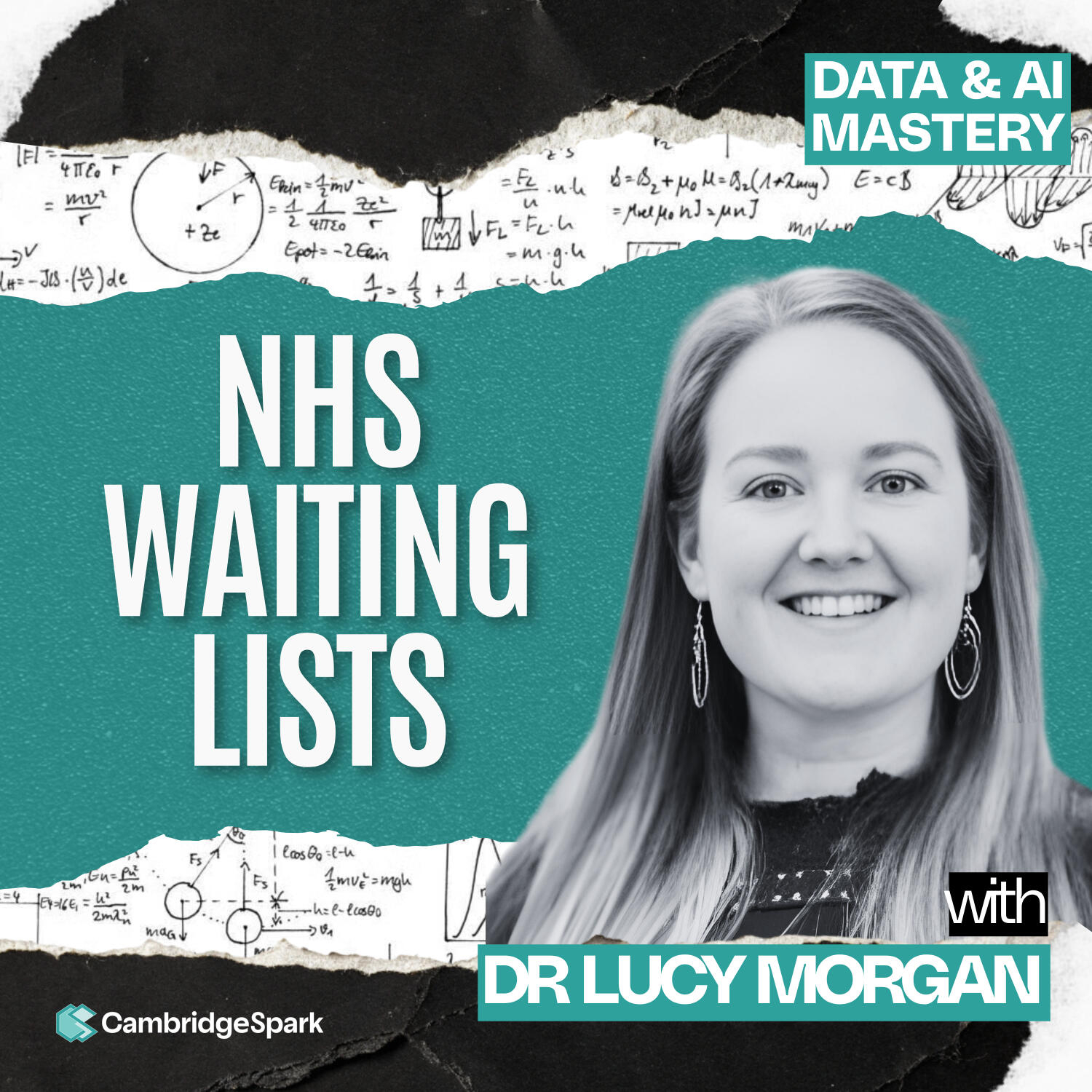
DAIM: Inside The Algorithm | Hybrid Simulation, Model Reuse and AI in NHS Planning

👉 Discover how Cambridge Spark helps organisations build the data and AI capabilities needed to turn strategy into measurable impact: cambridgespark.com Planning healthcare at scale is one of the most consequential challenges facing the NHS. In this inaugural episode of our new show, Inside The Algorithm, Cambridge Spark’s Chief AI Officer, Dr Jeremy Bradley, is joined by Dr Lucy Morgan, Head of Simulation at the NHS Strategy Unit, to explore how simulation modelling and AI are being used to tackle that challenge head-on. Lucy led the development of a hybrid simulation model for renal replacement therapy, which began with the Midlands Kidney Network and is now being rolled out nationally. She breaks down how the model works, combining system dynamics with discrete event simulation to project future demand and model patient pathways through dialysis and transplant. The conversation moves into the harder questions: how do you validate a model in a live healthcare environment, how do you rebuild trust with new organisations who weren't part of the original build, and where does AI fit into making models more portable and reproducible? Lucy also shares her current research interest in using AI agents to help NHS staff query and interrogate analytical models directly, without needing deep modelling expertise themselves. A rich, technically substantive episode for anyone working at the intersection of AI, simulation and real-world deployment. Follow Data & AI Mastery so you never miss a future episode of Inside The Algorithm. Liked this episode? Why not listen to the conversation Dr Raoul Gabriel Urma had with Ming Tang from the NHS on the Data & AI Mastery podcast:  Apple: https://podcasts.apple.com/gb/podcast/transforming-healthcare-through-data-ai-human-centred/id1779783413?i=1000736381325 Spotify: https://open.spotify.com/episode/27wqHT0dnRMwKMedj2uoTw?si=5aabd4015dfa425d YouTube: https://www.youtube.com/watch?v=JERGmZUumvA Glossary Terms Model reproducibility: the ability to obtain consistent computational results using the same input data, code, and environment Neural Network: a method in artificial intelligence that teaches computers to process data in a way that is inspired by the human brain Sequential Hybrid Simulation Model: a modeling approach that combines two or more distinct simulation paradigms (such as System Dynamics, Discrete-Event Simulation, or Agent-Based Simulation) by running them in a specific order, where the output of the first model acts as the input for the next System Dynamics: a computer-aided modeling methodology used to understand, analyse, and manage complex, dynamic systems over time Stock-flow System: a foundational system dynamics modelling concept mapping how quantities (stocks) accumulate over time, influenced by rates of change (flows) Chapter Markers (00:00) - Opening: The case for AI-assisted simulation in the NHS (02:11) - About the NHS Strategy Unit and the backwards consultancy model (05:04) - Tackling NHS waiting lists with queuing theory (10:26) - Complexity of scheduling: theatre capacity, rotas and prioritisation (13:42) - Introducing the renal replacement therapy planning model (18:32) - Data sources, model calibration and validation (23:00) - Rolling the model out nationally: trust, workshops and participative modelling (26:47) - A call to the community: sharing best practices in model reproducibility Useful Links Connect with Dr Lucy Morgan on LinkedIn: https://www.linkedin.com/in/lucy-morgan-97072041/ For more AI insights follow Jeremy on LinkedIn: https://uk.linkedin.com/in/jeremy-bradley Explore Cambridge Spark’s AI upskilling programmes at https://www.cambridgespark.com

29 minPlay in:

Why PodAppear

Follow people, not podcasts.

You heard Jeremy on one show. PodAppear finds the next one for you, and every other person you want to hear.

  • An alert when they are a guestBy email as it happens, or as a daily or weekly digest. Then press play.
  • Guests, not name-dropsEpisodes that only mention a name are kept apart, so an alert means they are really on the show.
  • Everyone in one feedFounders, authors, athletes, scientists. Follow anyone by name, across every show they visit.

Free for up to 15 people, no card needed.