In the age of rapid technological change, how can you harness the power of data and AI to transform your business? Welcome to Data & AI Mastery, the podcast where cutting-edge insights meet practical strategies for success. Hosted by Dr Raoul-Gabriel Urma, founder of Cambridge Spark, this show dives deep into how…
👉 Discover how Cambridge Spark helps organisations build the data and AI capabilities needed to turn strategy into measurable impact: [cambridgespark.com](https://www.cambridgespark.com/?utm_campaign=6955829-Podcast%202024%20-%20Onwards&utm_source=Podcast&utm_medium=RSS)
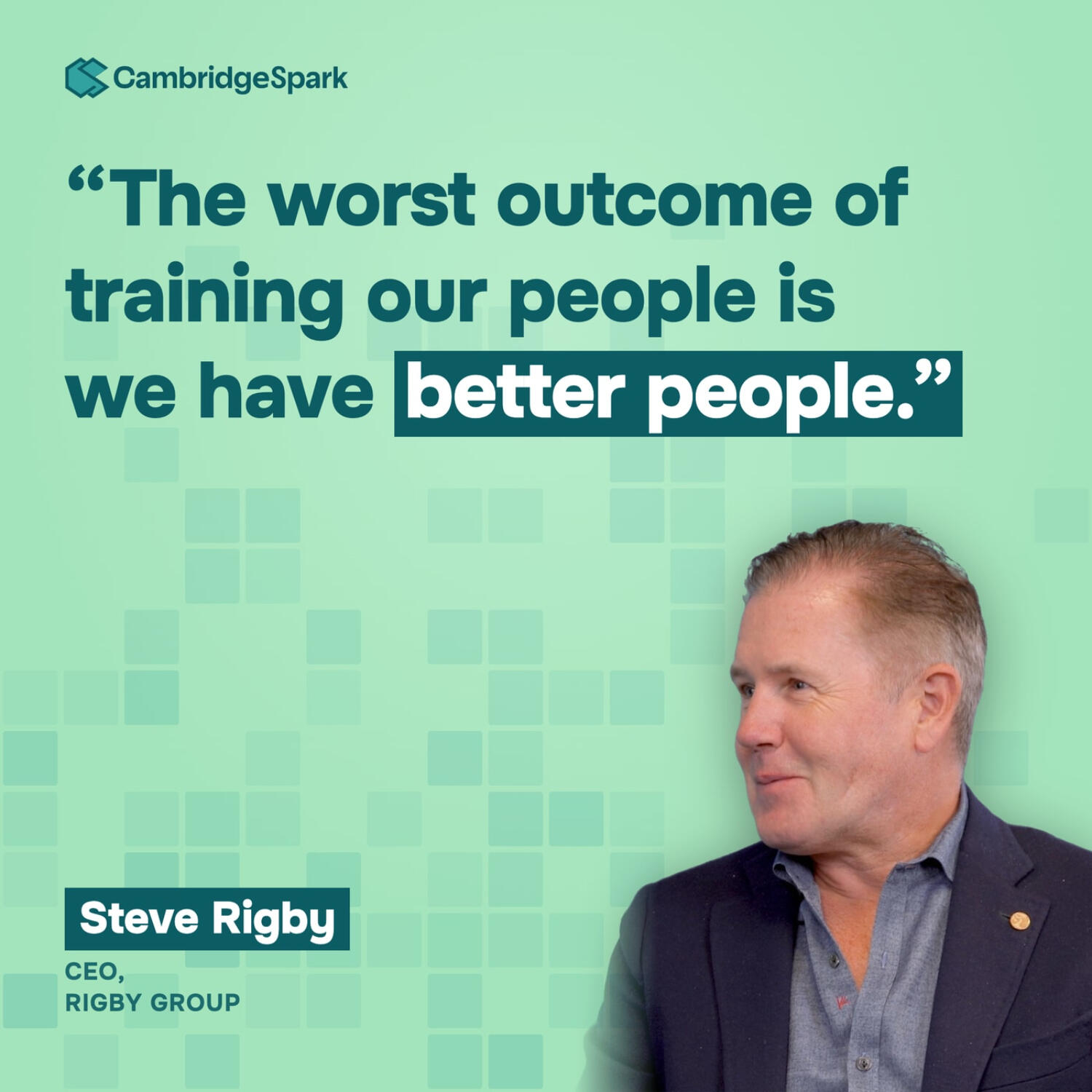
Steve Rigby, says AI is an order of magnitude bigger than the move to cloud, the internet or mobile. Is your workforce ready for it?
Your teams use ChatGPT every day, yet your AI transformation still feels stuck in the foothills. Legacy systems won't talk to each other, managers aren't sure how to redesign a process, and some people hope they can outlast the technology.
Steve Rigby is CEO of Rigby Group, one of Europe's top three technology resellers, with around 9,000 people. He is also a later-stage investor, chairs the Rigby Foundation and works with the Department for Business and Trade on the mid-market.
You'll come away with a sharper definition of real enterprise AI adoption: agents that complete specific tasks, such as bid writing and quote to cash. Steve makes the case for leadership skills first, industry-specific skills credits and a more international outlook for UK businesses.
This conversation is for L&D, HR and data leaders shaping workforce upskilling and AI strategy at UK enterprises and in government. It covers skills policy, the 7.5 million UK knowledge workers facing change, the next generation and the UK's compute gap.
## Key Takeaways
- Asking staff whether they use ChatGPT measures nothing. Steve explains what real AI adoption looks like inside his business, and why current surveys ask the wrong question.
- Leadership comes before tooling. Steve says most managers aren't yet skilled at reimagining a process, which is why leadership skills sit so high on his agenda.
- 800,000 UK contact centre workers already hold skills that employers rate highly, such as communication and problem solving. Those skills need recognising before the jobs go.
## Chapter Markers
00:00 Why using ChatGPT isn't using AI
00:21 Introducing Steve Rigby and Rigby Group
00:49 The AI opportunity inside a 9,000-person group
03:07 Technical debt, legacy systems and quote to cash
03:42 What Steve expects from his executive team
05:53 Why AI dwarfs the internet and cloud shifts
07:33 Skills credits and skills parachutes
09:58 Rigby Foundation research on UK knowledge workers
11:50 Industry-specific credits in the Growth and Skills Levy
13:18 The 800,000 contact centre workers at risk
16:30 Global leading sectors and going international
18:39 An entrepreneur in every school
22:59 Why AI won't be regulated away
23:28 Why small companies lag on adoption
25:49 Real adoption: bid writing and AI agents
28:14 Sovereignty and the UK's compute gap
30:07 Closing thoughts
## Useful Links & Resources
- Cambridge Spark, data and AI training for enterprises: https://www.cambridgespark.com
- Rigby Group: https://www.rigbygroupplc.com
- Dr. Raoul-Gabriel Urma on LinkedIn: https://uk.linkedin.com/in/raoulurma
## Connect With the Show
- LinkedIn: https://www.linkedin.com/school/cambridge-spark/
- Website: https://www.cambridgespark.com
Should companies that fail to train their people pay for that training when staff leave? Steve calls skills parachutes a controversial idea for a business leader to back. Tell us where you stand in the comments, and share one AI use case that has moved the needle in your organisation.
Subscribe to Data & AI Mastery so you never miss an episode. Then visit cambridgespark.com to transform your workforce with cutting-edge data and AI training.
#DataAndAIMastery #EnterpriseAI #AITransformation #WorkforceUpskilling #CambridgeSpark
👉 Discover how Cambridge Spark helps organisations build the data and AI capabilities needed to turn strategy into measurable impact: [cambridgespark.com](https://www.cambridgespark.com/?utm_campaign=6955829-Podcast%202024%20-%20Onwards&utm_source=Podcast&utm_medium=RSS)
Attackers now exploit a newly public vulnerability in under three hours. Six months used to be normal.
Your developers are shipping code with Claude Code and Codex. Your security teams were trained to look for error messages, and in some companies the AI security budget now sits with a chief AI officer rather than the CISO.
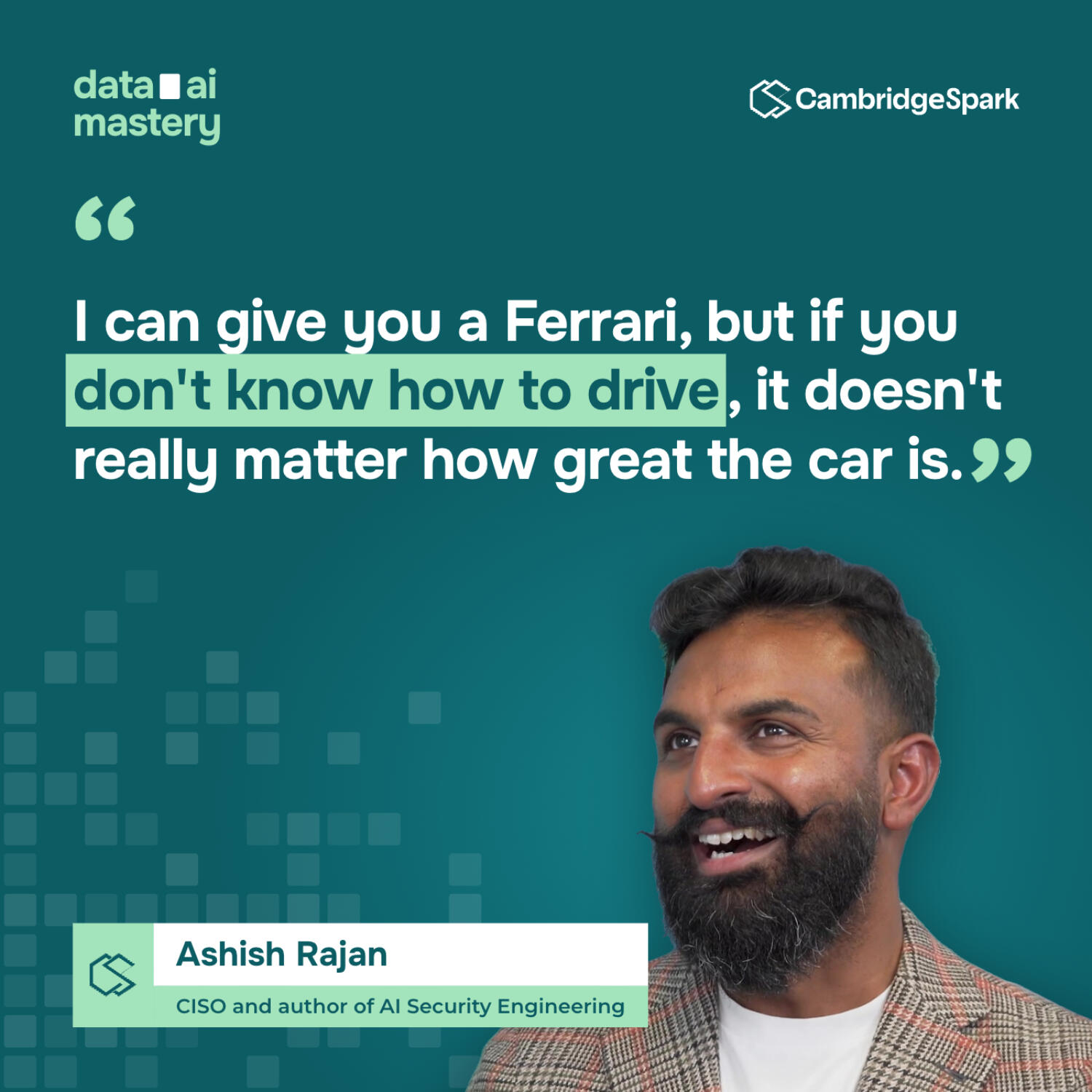
Ashish Rajan is CISO at TechRiot and author of AI Security Engineering, published by Wiley. He hosts the Cloud Security Podcast and the AI Security Podcast, and advises Fortune 500 companies on security.
Ashish gives you a practical way to decide which AI risks to accept, where to focus first, and what skills your security teams need next. You'll hear why the confidentiality, integrity and availability principles still hold. You'll also hear why a vibe-coded tool needs the same security thinking as any application once it touches production data.
This episode is for CISOs, CIOs, Chief Data and AI Officers, and the L&D leaders responsible for workforce upskilling during AI transformation. It suits anyone who wants an honest read on enterprise AI security from someone working inside it. If you want a vendor shortlist, this one isn't for you.
## Key Takeaways
- An agent asking for a password throws no error code. Ashish explains why judging intent in plain English breaks the traditional security playbook.
- A bank with 400+ applications can't secure them all on day one. Ashish shares how to pick the crown jewels and where compensating controls fit.
- Building your own security tool in two hours with Claude Code is easy. Maintaining it after the builder leaves for a better offer is the cost few teams plan for.
- A framework like NIST shows you have the basics covered. Ashish argues boards should ask their CISO a harder question: could you patch a critical flaw in under three hours?
## Chapter Markers
00:00 The three-hour exploit window
01:13 Ashish's start: a hacked Hotmail account
03:08 Why he wrote AI Security Engineering
05:28 Rewriting the book when agents arrived
07:02 Launching the AI Security Lab
08:08 First principles versus new AI risks
12:48 Who owns AI security
17:29 Advice for CEOs: protect the crown jewels
20:21 Workforce upskilling and build versus buy
23:52 Cross-functional security teams and harnesses
28:52 Personal apps versus enterprise tools
30:14 Offensive AI and the agentic SOC
33:39 Why frontier red-team models need a harness
35:57 From six months to three hours
37:00 Reasons for hope
37:34 The wake-up call that came and went
38:27 What boards should ask their CISO
41:28 Wrap-up
## Useful Links & Resources
- AI Security Engineering by Ashish Rajan (Wiley)
- Cloud Security Podcast and AI Security Podcast, hosted by Ashish Rajan
- Cambridge Spark data and AI training: https://www.cambridgespark.com
- Dr. Raoul-Gabriel Urma on LinkedIn: https://uk.linkedin.com/in/raoulurma
## Connect With the Show
- LinkedIn: https://www.linkedin.com/school/cambridge-spark/
- Website: https://www.cambridgespark.com
Who owns AI security in your organisation: the CISO, the CIO or a Chief AI Officer? Tell us in the comments. If your team has built its own security harness or tackled agent risk head on, we'd like to hear how it went.
Visit cambridgespark.com to transform your workforce with cutting-edge data and AI training. Subscribe so you never miss an episode.
#DataAndAIMastery #AISecurity #EnterpriseAI #CyberSecurity #CambridgeSpark
👉 Discover how Cambridge Spark helps organisations build the data and AI capabilities needed to turn strategy into measurable impact: cambridgespark.com
In this episode of Data & AI Mastery, host Dr Raoul-Gabriel Urma is joined by Simona Paravani-Mellinghoff, Chief Investment Officer at BlackRock, to explore why data quality and accessibility sit at the heart of every serious AI strategy.
Simona explains what good data infrastructure looks like when overseeing hundreds of billions in mandates and why relevant data, not just volume, drives better investment insights. She shares her Ferrari and Fiat Punto analogy for deciding when to use large generative AI models versus smaller, specialised ones and outlines a three-layer skill pyramid, prompting, critical thinking and creative thinking, that leaders and their teams will need to thrive in an AI-driven world.
The conversation also covers AI's role in expanding financial inclusion, why Simona funds scholarships and teaches at Cambridge, and her advice for anyone starting a career in data or finance today.
If you enjoyed this episode, follow Data & AI Mastery and share it with a colleague thinking through their own data and AI strategy.
Chapter Markers
(00:00) - Introduction: no data, no AI party
(01:16) - Simona's journey from Italy to global CIO
(03:40) - What academia and industry learn from each other
(05:21) - Building good data infrastructure at scale
(08:56) - Frontier models vs specialised models: the Ferrari and Fiat Punto analogy
(11:42) - Why education and scholarships matter to Simona
(15:03) - The three-layer skill pyramid for the AI era
(17:19) - Will AI threaten jobs or create new ones
(21:04) - AI's role in advancing financial inclusion
(23:22) - Advice for the next generation
(24:06) - Quickfire round
(27:22) - Closing thoughts and key takeaways
Useful Links
Connect with Simona Paravani-Mellinghoff on LinkedIn: https://uk.linkedin.com/in/simona-paravani-cfa-5129524
Follow Dr Raoul-Gabriel Urma on LinkedIn: https://uk.linkedin.com/in/raoulurma
Visit the Cambridge Spark Website: https://cambridgespark.com/
👉 Discover how Cambridge Spark helps organisations build the data and AI capabilities needed to turn strategy into measurable impact: cambridgespark.com
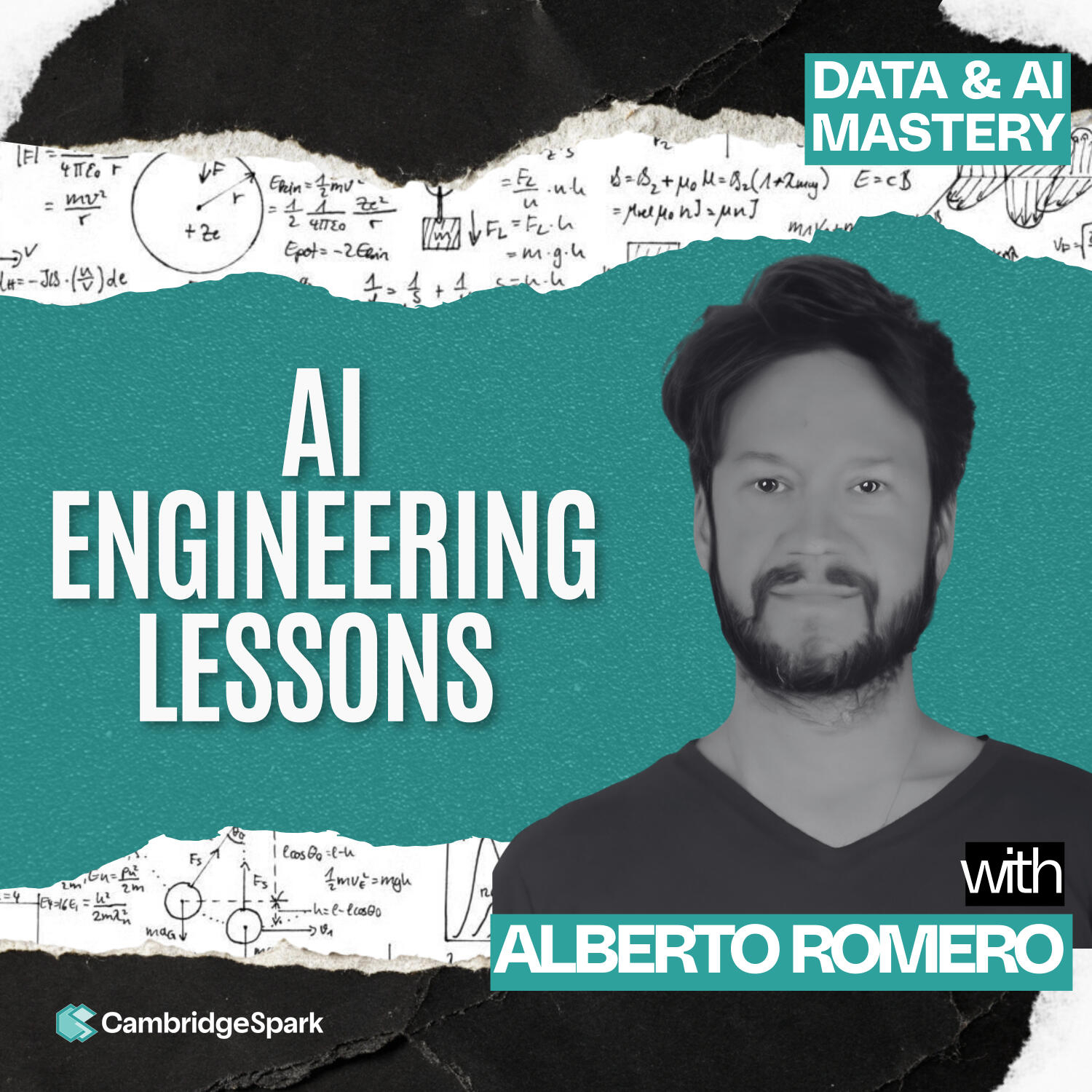
What does it actually take to ship machine learning inside one of the UK's largest insurers? Jeremy Bradley sits down with Alberto Romero, director of AI engineering at Aviva, to trace his path from InsurTech founder to enterprise AI leader.
Alberto explains why prototypes are so often mistaken for finished products and what production readiness really demands once edge cases, drift and adversarial behaviour enter the picture. The conversation covers how to get genuine explainability out of large language models rather than plausible-sounding justification, when fine-tuning earns its place in a regulated stack, and why Aviva built its own internal platform to govern AI use cases at scale.
Alberto also shares his take on fraud detection as an adversarial ML problem and the one failure mode he sees engineering teams repeat most often.
Follow Data & AI Mastery so you never miss an episode, and share it with a colleague working through similar production challenges.
If you enjoyed this conversation, you might also like this episode featuring Sarah Self. She joined us on Data and AI Mastery to explore what most organisations get wrong when deploying AI.
Apple: https://podcasts.apple.com/gb/podcast/from-cybersecurity-to-ai-director-sarah-self-on-leading/id1779783413?i=1000764247007
Spotify: https://open.spotify.com/episode/0BpSq5X1ZP8ctIYTxWVAJT?si=1264586e79f3446f
YouTube: https://www.youtube.com/watch?v=2jgM095SYG0
Glossary Terms
RAG: Retrieval-Augmented Generation is an AI methodology that enhances Large Language Models by pulling factual context from external knowledge bases.
GAN: Generative Adversarial Network is a deep learning architecture in which two neural networks compete against each other to create highly realistic synthetic data from a training dataset
Non-deterministic: describes a process, algorithm, or system whose outcome is inherently unpredictable and cannot be guaranteed to repeat exactly, even when it starts from the exact same initial conditions
ReAct (Reasoning + Acting) approach: a prompting technique that enables AI models to solve complex problems by alternating between thinking and taking action
Chapter Markers
(00:00) - Cold open: why prototypes get mistaken for production
(02:53) - Avoiding common AI adoption pitfalls in regulated sectors
(05:44) - Real explainability versus post-hoc justification in LLMs
(09:18) - From startup founder to enterprise: the mindset shift
(11:38) - Managing AI across 70+ use cases at Aviva
(13:31) - Standards first, technology second
(17:19) - Where fine-tuning earns its place
(20:33) - Building Aviva's own governed AI platform
(23:51) - Fraud detection as an adversarial ML problem
(28:34) - Quick fire: the most common AI failure mode
(29:37) - What deserves more attention as AI scales
Useful Links
Connect with Alberto Romero on LinkedIn: https://uk.linkedin.com/in/albertoromero-uk
For more AI insights follow Jeremy on LinkedIn: https://uk.linkedin.com/in/jeremy-bradley
Explore Cambridge Spark’s AI upskilling programmes at https://www.cambridgespark.com
👉 Discover how Cambridge Spark helps organisations build the data and AI capabilities needed to turn strategy into measurable impact: cambridgespark.com
Large language models are surprisingly good at producing fluent, plausible text. So why do they still confidently get simple things wrong?
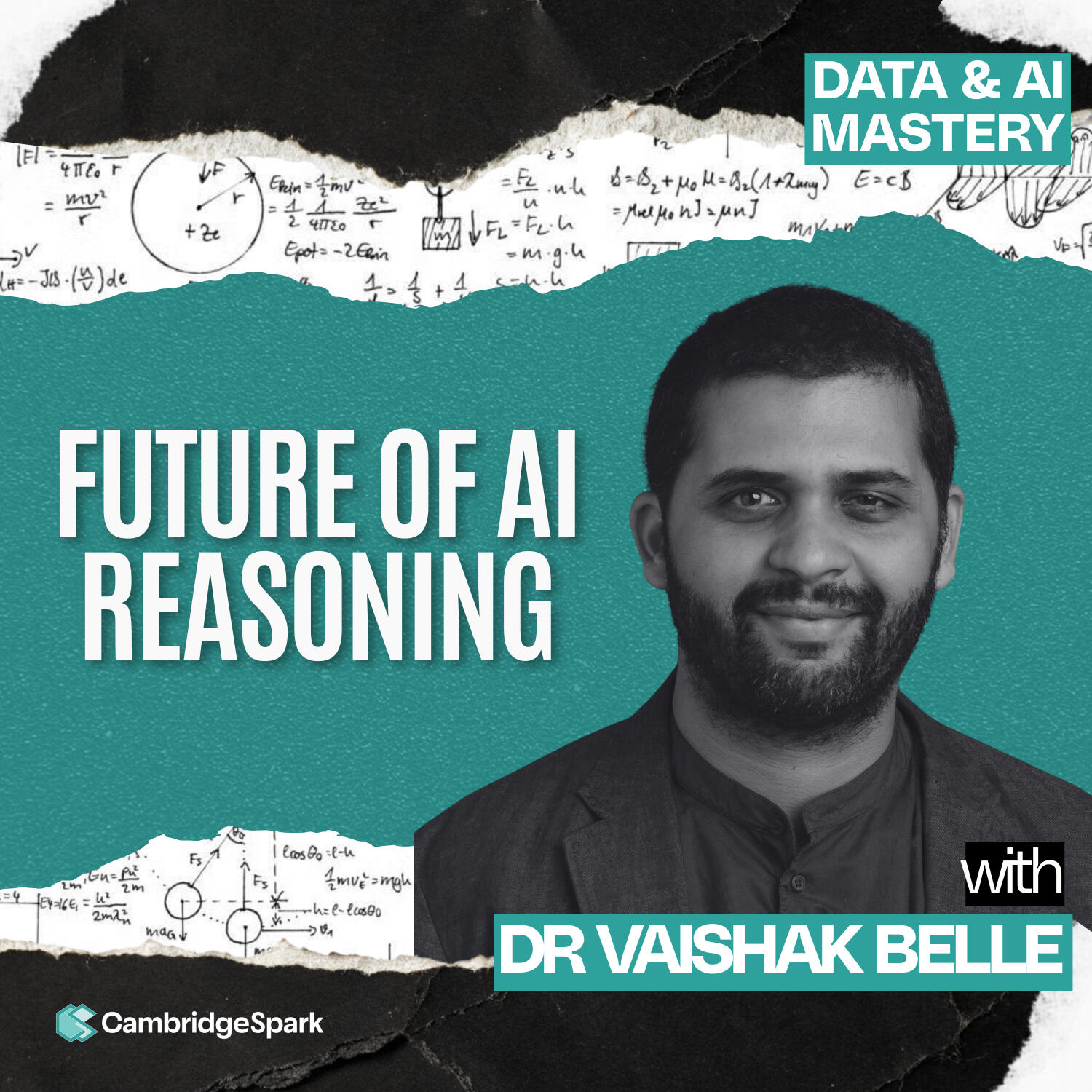
In this episode, Dr Jeremy Bradley is joined by Dr Vaishak Belle, Reader at the University of Edinburgh's School of Informatics, Alan Turing Institute Faculty Fellow and Director of Research and Innovation at the Bayes Centre. Vaishak has spent 16 years working at the intersection of logic, probability and machine learning and brings that lens to one of AI's most persistent problems: hallucination.
The conversation traces why scaling alone will not solve reliability, what neurosymbolic AI actually is and why tools like Claude Code quietly depend on it, how theory of mind is being engineered into language models, and where reinforcement learning fits into the future of AI reasoning.
If you work at the frontier of AI research or engineering, this is a grounded, technically rich conversation worth your time.
Follow Data & AI Mastery so you never miss an episode.
If you enjoyed this conversation, you might also like this episode featuring Dr Petar Veličković. Petar joined us on Data and AI Mastery to explore how graph neural networks bring structured reasoning into systems like Google Maps and how AI is being used as a genuine discovery partner in mathematics.
Apple: https://podcasts.apple.com/gb/podcast/bridging-ai-research-and-real-world-impact-dr-petar/id1779783413?i=1000734000576
Spotify: https://open.spotify.com/episode/7qA0AY9MlLS2L9PANqlXNi?si=37d8a8fb43c14cc9
YouTube: https://www.youtube.com/watch?v=GwMUSNidnvE
Glossary Terms
Neurosymbolic AI: an emerging field that merges the intuitive pattern recognition of neural networks with the logical, rule-based reasoning of symbolic AI.
Theory of Mind: refers to an AI’s capacity to attribute mental states to humans or other agents and understand that these states may differ from its own.
Confabulation: In AI, it is the generation of factually incorrect, distorted, or entirely fabricated information presented as absolute truth.
Delegation Module: a software component that allows users or systems to assign tasks, roles, or access rights to others.
Retrieval Augmented Graphs: an advanced AI framework that enhances large language models by grounding their responses in interconnected data networks, such as knowledge graphs.
Reinforcement Learning: a machine learning method where an AI agent learns to make decisions through trial and error.
Dynamic Pathway Analysis: a computational method used in systems biology and bioinformatics to model and simulate how biological processes change over time.
Chapter Markers
(00:00) - Why LLM hallucinations happen
(02:12) - The biggest shift in AI over the last 16 years
(07:42) - How logic and probability shaped Vaishak's path into AI
(10:11) - Introducing neurosymbolic AI
(11:27) - Claude Code, algebraic delegation and the theory of mind problem
(20:01) - Theory of mind in robotics and human computer interaction
(21:54) - Confabulation versus hallucination
(26:42) - Why AI errors are not the same as human dishonesty
(27:24) - Reinforcement learning, reward signals and learned behaviour
(32:36) - Syntax checks and the engineering behind reliable code
(37:52) - What happens to the software engineer's role
(40:49) - Advice for early career AI thinkers
Useful Links
Connect with Dr Vaishak Belle on LinkedIn: https://uk.linkedin.com/in/vaishakbelle
Learn more about Vaishak’s work here: https://www.vaishakbelle.org/
Read Vaishak's report on The Future of Neuro-Symbolic AI: https://ojs.aaai.org/index.php/AAAI/article/view/42130
For more AI insights follow Jeremy on LinkedIn: https://uk.linkedin.com/in/jeremy-bradley
Explore Cambridge Spark’s AI upskilling programmes at https://www.cambridgespark.com
43 minPlay in:
Guests from more than 12 months ago are part of Pro. See plans