Bekomm eine E-Mail, wenn Brett in einem Podcast zu Gast istPodAppear prüft neue Folgen, sobald sie erscheinen, und lässt die weg, in denen Brett nur erwähnt wird. Bis zu 15 Personen kostenlos, ohne Kreditkarte.Bis zu 15 Personen kostenlos, ohne Kreditkarte.
Research studies are essential to advancing our understanding of multiple sclerosis, but recruiting and retaining participants remains a major challenge for many projects. How can we make research more accessible, inclusive and relevant to people living with MS?
In this episode of the ECTRIMS Podcast, host Brett Drummond is joined by Jennifer Graves from the University of California San Diego and Emma Tallantyre from Cardiff University to explore the challenges and opportunities of improving recruitment into MS studies.
Together, they discuss the practical barriers people can face when taking part in research, from travel and time commitments to the challenges of fitting it around everyday life. They also explore why involving patients in the design process is so important to identifying opportunities to make research more accessible and achievable.
Looking ahead, the conversation explores promising approaches, including patient registries, digital biomarkers, remote assessments and decentralised trials, that could make participation easier and help researchers reach more diverse populations.
Listen to discover how putting patients at the centre of study design could help accelerate MS research and improve future care.
This ECTRIMS podcast episode is supported by an educational grant from Alexion, AstraZeneca Rare Diseases. Bristol Myers Squibb, Novartis, Roche, Sanofi, and UCB. Educational grant providers have no input into the podcast series content.
MS nurses are at the heart of MS care, but as treatments become more complex and demands grow, what support do they need to keep going? In this special MSToronto2026 episode, host Brett Drummond is joined by Colleen Harris, Nurse Practitioner at the University of Calgary MS Program, and Jenny Slough, Lead MS Specialist Nurse at UCLH, Queen Square. Together, they reflect on MSToronto2026's Nurses' Sessions, the opportunities and challenges facing MS nurses today, and the value of a global nursing network. How are complex new therapies changing the nurse's role? How do nurses make the most of short appointment times? And why do nurses themselves so urgently need support? Whether you're an MS nurse, work alongside one, or simply want to understand the vital role they play, this is a conversation worth hearing.
This ECTRIMS podcast episode is supported by an educational grant from Alexion, AstraZeneca Rare Diseases. Bristol Myers Squibb, Novartis, Roche, Sanofi, and UCB. Educational grant providers have no input into the podcast series content.
🎙️ What does the future hold for people living with NMOSD and MOGAD? With new treatments emerging and research advancing, there are important reasons for hope.
As part of Patient Community Day 2026, we're pleased to share the second episode in our two-part ECTRIMS Podcast series, exploring the latest research and the perspectives of people living with MS and related neurological conditions.
Host Brett Drummond sits down with Taylor Ann Macey, Director of Patient Engagement at the Sumaira Foundation who lives with NMOSD, and Dr Eoin Flanagan, Professor of Neurology at Mayo Clinic, for a conversation about scientific progress and lived experience.
What are the challenges of living with a rare neuroimmune condition?
How are new treatments changing the outlook for NMOSD and MOGAD?
And why are the involvement of people with lived experienceand so important in shaping future research?
From the isolation that can come with a rare diagnosis to the growing optimism around treatment and research, this conversation highlights both the challenges and the possibilities ahead.
This ECTRIMS podcast episode is supported by an educational grant from Alexion, AstraZeneca Rare Diseases. Bristol Myers Squibb, Novartis, Roche, Sanofi, and UCB. Educational grant providers have no input into the podcast series content.
Three days of science, debate and discovery.
For the final episode in our special MSToronto2026 podcast series, ECTRIMS Executive Committee member Jaume Sastre-Garriga joins host Brett Drummond direct from Toronto.
Together, they unpack the key insights from Day Three, including the Late Breaking Abstract session, before stepping back to reflect on the Joint Meeting as a whole.
What stood out across the week? Which developments and conversations could have lasting significance? And as thousands of researchers and clinicians prepare to leave Toronto, what comes next for the MS field?
Recorded at the 10th Joint ACTRIMS-ECTRIMS Meeting, this is our final dispatch from Toronto – bringing together the science, conversations and ideas that shaped an extraordinary week.
This ECTRIMS podcast episode is supported by an educational grant from Alexion, AstraZeneca Rare Diseases. Bristol Myers Squibb, Novartis, Roche, Sanofi, and UCB. Educational grant providers have no input into the podcast series content.
Day One at MSToronto2026 – and we're taking you inside one of the meeting's headline lectures.
Our special MSToronto2026 podcast series continues with Daniel Reich – the MSToronto2026 Lecturer – as he joins host Brett Drummond to reflect on some of the key takeaways from the first full day in Toronto.
Then, we go deeper. What if imaging could help us connect the dots in MS - from disease mechanisms to networks to the person living with MS?
Fresh from his lecture, Unifying Multiple Sclerosis: Imaging from Teams to Tissue to Biology, Daniel takes the conversation beyond the stage:
· What can imaging reveal about the biology driving MS?
· How is it changing the way we understand what is happening in the brain?
· And where could the next generation of imaging take MS research?
Recorded direct from Toronto, our MSToronto2026 series is only getting started. Follow the ECTRIMS Podcast as we bring you new conversations and highlights direct from Toronto throughout the Joint Meeting.
---
This ECTRIMS podcast episode is supported by an educational grant from Alexion, AstraZeneca Rare Diseases. Bristol Myers Squibb, Novartis, Roche, Sanofi, and UCB. Educational grant providers have no input into the podcast series content.
21 minAbspielen in:
Warum PodAppear
Folge Menschen, nicht Podcasts.
Du hast Brett in einer Sendung gehört. PodAppear findet für dich die nächste, und genauso für alle anderen, die du hören willst.
Eine Meldung, wenn die Person zu Gast istPer E-Mail: sofort oder gebündelt als Tages- oder Wochenübersicht. Dann nur noch auf Play drücken.
Gäste statt bloßer ErwähnungenFolgen, in denen ein Name nur fällt, landen getrennt. Eine Meldung heißt: Die Person ist wirklich in der Sendung.
Alle in einem FeedGründerinnen, Autoren, Sportler, Forscherinnen. Folge allen mit Namen, quer durch jede Sendung, in der sie auftreten.
The ECTRIMS Podcast is on the ground at MSToronto2026 – bringing you the conversations, insights and highlights as they happen.
Kicking off our special MSToronto2026 Joint Meeting Series, Ann Yeh joins host Brett Drummond direct from Toronto to unpack the highlights of Pre-Day.
Before the 10th Joint ACTRIMS-ECTRIMS Meeting officially begins, Pre-Day puts the spotlight on paediatric MS and related neuroinflammatory diseases – and some of the important questions shaping the field right now.
What stood out? What should clinicians and researchers take away? And which conversations are already setting the stage for the meeting ahead?
🎙️ This is just the beginning. Listen now, and follow the ECTRIMS Podcast throughout MSToronto2026 as we bring you new episodes direct from Toronto across the week.
---
LAND ACKNOWLEDGEMENT
MSToronto2026 takes place in Toronto, Canada, on the traditional territory of many nations, including the Mississaugas of the Credit, the Anishnabeg, the Chippewa, the Haudenosaunee and the Wendat peoples. Toronto is now home to many diverse First Nations, Inuit and Métis peoples. We also acknowledge that Toronto is covered by Treaty 13 with the Mississaugas of the Credit.
---
This ECTRIMS podcast episode is supported by an educational grant from Alexion, AstraZeneca Rare Diseases. Bristol Myers Squibb, Novartis, Roche, Sanofi, and UCB. Educational grant providers have no input into the podcast series content.
Can growing amounts of real-world MS data help clinicians predict disease progression and make more personalised treatment decisions?
In this episode of the ECTRIMS Podcast, host Brett Drummond speaks with Dr. Will Brown from Cambridge University and Dr. Carmen Tur from CEMCAT about the rapidly evolving field of predictive modelling in multiple sclerosis.
They explore why MS is particularly difficult to predict, from its biological and clinical heterogeneity to the lack of sufficiently sensitive, specific and widely available biomarkers. They also discuss how increasingly rich, long-term datasets are allowing researchers to study disease outcomes, treatment journeys and populations traditionally underrepresented in clinical trials.
The conversation examines the methodological challenges that come with real-world data, including missing data, non-random treatment allocation, clinical outcome selection and bias, as well as the opportunities and limitations of AI and machine learning.
Finally, they ask what must happen before predictive models can enter routine clinical care — including robust external validation, calibration, interpretability, equitable representation and evidence that using these tools actually improves clinical decisions and long-term patient outcomes.
---
This podcast episode is supported by an educational grant from Alexion, AstraZeneca Rare Diseases, Bristol Myers Squibb, Novartis, Roche, Sanofi, and UCB. Educational grant providers have no input into the podcast series content.
New Phase 3 data presented at the AAN conference 2026 provide compelling evidence that fenebrutinib may represent a high-efficacy oral treatment option for people living with relapsing multiple sclerosis.
In this exclusive episode, leading experts Prof. Ludwig Kappos from University of Basel and Dr. Jiwon Oh from Barlo MS Centre join host Brett Drummond to unpack the full FENhance 1 & 2 trial results.
Together, they explore:
How fenebrutinib performed against teriflunomide in relapsing MS
Why BTK inhibition continues to generate strong interest across the MS treatment landscape
What the results reveal about relapse reduction, MRI outcomes, and disability progression
What the safety profile of fenebrutinib looked like in this cohort of patients
Listen for a deep dive into the science, clinical context, and future implications for MS care.
-----------------------------
This ECTRIMS podcast episode is supported by an educational grant from Alexion, AstraZeneca Rare Diseases. Bristol Myers Squibb, Novartis, Roche, Sanofi, and UCB. Educational grant providers have no input into the podcast series content.
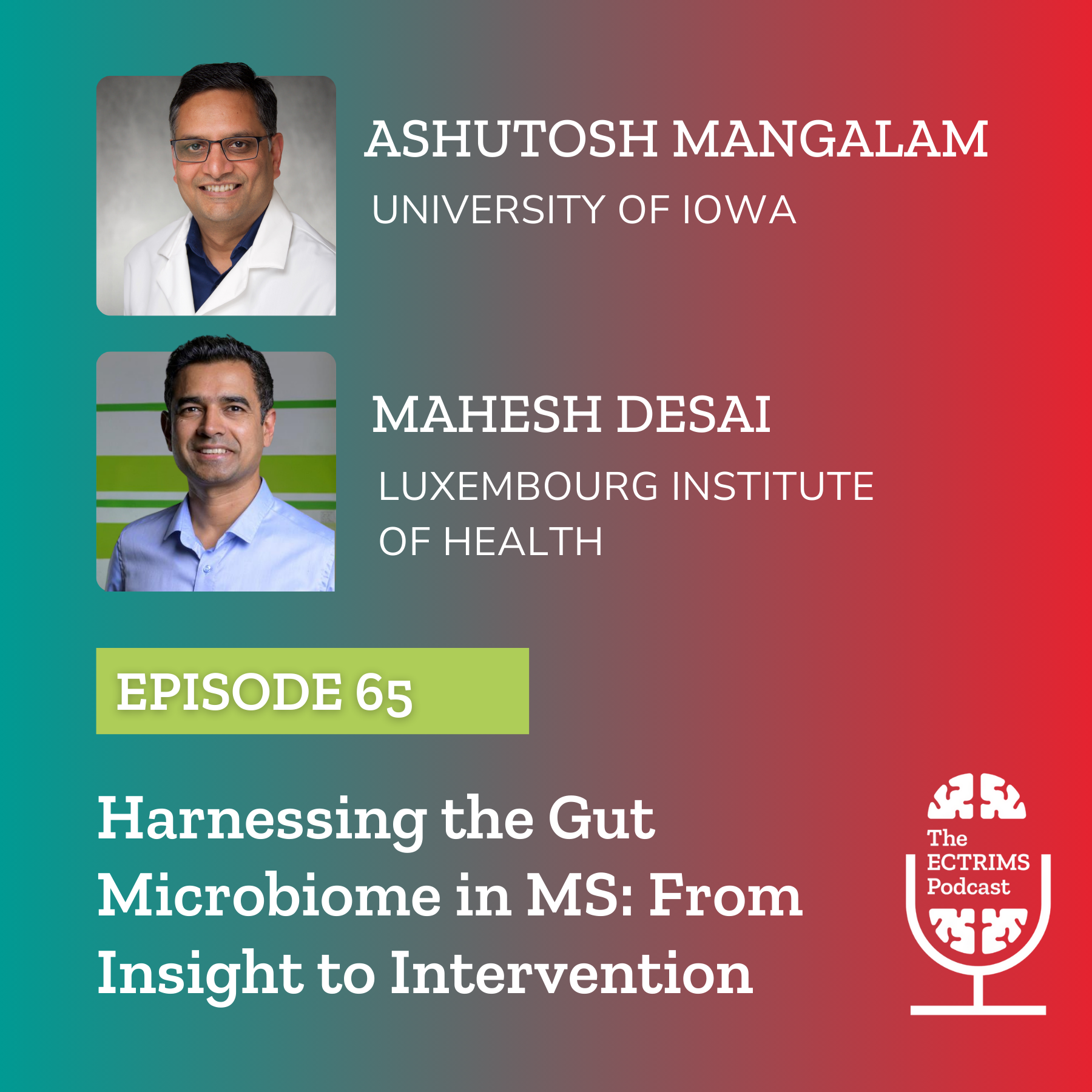
What role does the gut microbiome play in multiple sclerosis — and how close are we to translating microbiome research into meaningful clinical interventions?
In this episode of the ECTRIMS Podcast, host Brett Drummond is joined by Mahesh Desai (Luxembourg Institute of Health) and Ashutosh Mangalam (University of Iowa), two internationally recognised leaders in microbiome and MS research, to explore how gut microbes influence disease susceptibility, progression, and immune regulation in MS.
The discussion moves beyond simple "good vs bad bacteria" narratives, highlighting why microbial function, community structure, and host–microbiome dialogue are far more informative than individual taxa alone. The speakers examine evidence from animal models and human studies, including twin studies, microbial networks, and immune markers such as IgA coating, to understand whether microbiome changes are drivers or consequences of disease.
They also explore the potential of the gut microbiome as a predictive biomarker, the challenges of causality, and why diet and personalised approaches may be key to restoring immune balance in MS.
--------------------------------
This ECTRIMS podcast episode is supported by an educational grant from Alexion, AstraZeneca Rare Diseases. Bristol Myers Squibb, Novartis, Roche, Sanofi, and UCB. Educational grant providers have no input into the podcast series content.