The ECTRIMS Podcast is a sounding board for MS experts & advocates to discuss innovative work in MS research, treatment and care with the greater MS research community, while offering a collaborative platform for MS and healthcare experts to promote & nurture the advancement of research.
Research studies are essential to advancing our understanding of multiple sclerosis, but recruiting and retaining participants remains a major challenge for many projects. How can we make research more accessible, inclusive and relevant to people living with MS?
In this episode of the ECTRIMS Podcast, host Brett Drummond is joined by Jennifer Graves from the University of California San Diego and Emma Tallantyre from Cardiff University to explore the challenges and opportunities of improving recruitment into MS studies.
Together, they discuss the practical barriers people can face when taking part in research, from travel and time commitments to the challenges of fitting it around everyday life. They also explore why involving patients in the design process is so important to identifying opportunities to make research more accessible and achievable.
Looking ahead, the conversation explores promising approaches, including patient registries, digital biomarkers, remote assessments and decentralised trials, that could make participation easier and help researchers reach more diverse populations.
Listen to discover how putting patients at the centre of study design could help accelerate MS research and improve future care.
This ECTRIMS podcast episode is supported by an educational grant from Alexion, AstraZeneca Rare Diseases. Bristol Myers Squibb, Novartis, Roche, Sanofi, and UCB. Educational grant providers have no input into the podcast series content.
MS nurses are at the heart of MS care, but as treatments become more complex and demands grow, what support do they need to keep going? In this special MSToronto2026 episode, host Brett Drummond is joined by Colleen Harris, Nurse Practitioner at the University of Calgary MS Program, and Jenny Slough, Lead MS Specialist Nurse at UCLH, Queen Square. Together, they reflect on MSToronto2026's Nurses' Sessions, the opportunities and challenges facing MS nurses today, and the value of a global nursing network. How are complex new therapies changing the nurse's role? How do nurses make the most of short appointment times? And why do nurses themselves so urgently need support? Whether you're an MS nurse, work alongside one, or simply want to understand the vital role they play, this is a conversation worth hearing.
This ECTRIMS podcast episode is supported by an educational grant from Alexion, AstraZeneca Rare Diseases. Bristol Myers Squibb, Novartis, Roche, Sanofi, and UCB. Educational grant providers have no input into the podcast series content.
🎙️ What does the future hold for people living with NMOSD and MOGAD? With new treatments emerging and research advancing, there are important reasons for hope.
As part of Patient Community Day 2026, we're pleased to share the second episode in our two-part ECTRIMS Podcast series, exploring the latest research and the perspectives of people living with MS and related neurological conditions.
Host Brett Drummond sits down with Taylor Ann Macey, Director of Patient Engagement at the Sumaira Foundation who lives with NMOSD, and Dr Eoin Flanagan, Professor of Neurology at Mayo Clinic, for a conversation about scientific progress and lived experience.
What are the challenges of living with a rare neuroimmune condition?
How are new treatments changing the outlook for NMOSD and MOGAD?
And why are the involvement of people with lived experienceand so important in shaping future research?
From the isolation that can come with a rare diagnosis to the growing optimism around treatment and research, this conversation highlights both the challenges and the possibilities ahead.
This ECTRIMS podcast episode is supported by an educational grant from Alexion, AstraZeneca Rare Diseases. Bristol Myers Squibb, Novartis, Roche, Sanofi, and UCB. Educational grant providers have no input into the podcast series content.
What does the MS community need from research – and how can we make sure the voices of people living with MS help shape what comes next?
As part of Patient Community Day 2026, we're sharing a special collaborative episode from RealTalk MS and the ECTRIMS Podcast, hosted by Jon Strum.
Jon is joined by Karen Jacoby, MS advocate and person living with MS, and Peter Feys, Professor of Rehabilitation Sciences and Neurorehabilitation at Hasselt University – for a conversation that puts the patient perspective at the centre – exploring the relationship between research, lived experience and the priorities that matter to people affected by MS.
Recorded at Patient Community Day in Toronto, the episode forms part of the wider conversations taking place during the 10th Joint ACTRIMS-ECTRIMS Meeting – but this one is specifically for, and about, the MS community.
This episode was produced and hosted by RealTalk MS – a Supporting Partner of Patient Community Day – and is being shared across ECTRIMS channels with permission from Jon Strum to help the conversation reach as many people as possible.
This ECTRIMS podcast episode is supported by an educational grant from Alexion, AstraZeneca Rare Diseases. Bristol Myers Squibb, Novartis, Roche, Sanofi, and UCB. Educational grant providers have no input into the podcast series content.
Three days of science, debate and discovery.
For the final episode in our special MSToronto2026 podcast series, ECTRIMS Executive Committee member Jaume Sastre-Garriga joins host Brett Drummond direct from Toronto.
Together, they unpack the key insights from Day Three, including the Late Breaking Abstract session, before stepping back to reflect on the Joint Meeting as a whole.
What stood out across the week? Which developments and conversations could have lasting significance? And as thousands of researchers and clinicians prepare to leave Toronto, what comes next for the MS field?
Recorded at the 10th Joint ACTRIMS-ECTRIMS Meeting, this is our final dispatch from Toronto – bringing together the science, conversations and ideas that shaped an extraordinary week.
This ECTRIMS podcast episode is supported by an educational grant from Alexion, AstraZeneca Rare Diseases. Bristol Myers Squibb, Novartis, Roche, Sanofi, and UCB. Educational grant providers have no input into the podcast series content.
Day One at MSToronto2026 – and we're taking you inside one of the meeting's headline lectures.
Our special MSToronto2026 podcast series continues with Daniel Reich – the MSToronto2026 Lecturer – as he joins host Brett Drummond to reflect on some of the key takeaways from the first full day in Toronto.
Then, we go deeper. What if imaging could help us connect the dots in MS - from disease mechanisms to networks to the person living with MS?
Fresh from his lecture, Unifying Multiple Sclerosis: Imaging from Teams to Tissue to Biology, Daniel takes the conversation beyond the stage:
· What can imaging reveal about the biology driving MS?
· How is it changing the way we understand what is happening in the brain?
· And where could the next generation of imaging take MS research?
Recorded direct from Toronto, our MSToronto2026 series is only getting started. Follow the ECTRIMS Podcast as we bring you new conversations and highlights direct from Toronto throughout the Joint Meeting.
---
This ECTRIMS podcast episode is supported by an educational grant from Alexion, AstraZeneca Rare Diseases. Bristol Myers Squibb, Novartis, Roche, Sanofi, and UCB. Educational grant providers have no input into the podcast series content.
The ECTRIMS Podcast is on the ground at MSToronto2026 – bringing you the conversations, insights and highlights as they happen.
Kicking off our special MSToronto2026 Joint Meeting Series, Ann Yeh joins host Brett Drummond direct from Toronto to unpack the highlights of Pre-Day.
Before the 10th Joint ACTRIMS-ECTRIMS Meeting officially begins, Pre-Day puts the spotlight on paediatric MS and related neuroinflammatory diseases – and some of the important questions shaping the field right now.
What stood out? What should clinicians and researchers take away? And which conversations are already setting the stage for the meeting ahead?
🎙️ This is just the beginning. Listen now, and follow the ECTRIMS Podcast throughout MSToronto2026 as we bring you new episodes direct from Toronto across the week.
---
LAND ACKNOWLEDGEMENT
MSToronto2026 takes place in Toronto, Canada, on the traditional territory of many nations, including the Mississaugas of the Credit, the Anishnabeg, the Chippewa, the Haudenosaunee and the Wendat peoples. Toronto is now home to many diverse First Nations, Inuit and Métis peoples. We also acknowledge that Toronto is covered by Treaty 13 with the Mississaugas of the Credit.
---
This ECTRIMS podcast episode is supported by an educational grant from Alexion, AstraZeneca Rare Diseases. Bristol Myers Squibb, Novartis, Roche, Sanofi, and UCB. Educational grant providers have no input into the podcast series content.
Can clinicians identify MS progression as it happens, or does confirming meaningful disability worsening require months of observation?
Early recognition of multiple sclerosis (MS) progression is critical to informing clinical decisions. Yet distinguishing genuine disease progression from temporary fluctuations remains one of the challenges in routine MS care.
In this episode of the ECTRIMS Podcast, produced in collaboration with the Multiple Sclerosis Journal, host Associate Professor Anneke van der Walt is joined by Professor Helmut Butzkueven (Monash University, Australia) and Professor Tjalf Ziemssen (University Hospital Dresden, Germany) to explore both sides of a timely clinical controversy: Can we detect a progression event in an MS clinic in real time?
Drawing on opposing perspectives published in the Multiple Sclerosis Journal, the discussion examines the value and limitations of disability assessments, longitudinal patient registries, digital monitoring tools and patient-reported changes.
Can routinely collected clinical data help clinicians recognise progression earlier? How reliable are current measures such as the Expanded Disability Status Scale (EDSS)? And what can clinicians do to identify meaningful change when consultation time and resources are limited?
The conversation highlights the importance of balancing early recognition with diagnostic certainty, while keeping the patient's lived experience central to clinical assessment.
Read the accompanying publications in the Multiple Sclerosis Journal:
YES – Can we detect a progression event in an MS clinic in real time? https://journals.sagepub.com/doi/full/10.1177/13524585251409568
NO – Can we detect a progression event in an MS clinic in real time?https://journals.sagepub.com/doi/full/10.1177/13524585251409547
Accompanying commentary https://journals.sagepub.com/doi/full/10.1177/13524585251409579
This ECTRIMS podcast episode is supported by an educational grant from Alexion, AstraZeneca Rare Diseases. Bristol Myers Squibb, Novartis, Roche, Sanofi, and UCB. Educational grant providers have no input into the podcast series content.
Can growing amounts of real-world MS data help clinicians predict disease progression and make more personalised treatment decisions?
In this episode of the ECTRIMS Podcast, host Brett Drummond speaks with Dr. Will Brown from Cambridge University and Dr. Carmen Tur from CEMCAT about the rapidly evolving field of predictive modelling in multiple sclerosis.
They explore why MS is particularly difficult to predict, from its biological and clinical heterogeneity to the lack of sufficiently sensitive, specific and widely available biomarkers. They also discuss how increasingly rich, long-term datasets are allowing researchers to study disease outcomes, treatment journeys and populations traditionally underrepresented in clinical trials.
The conversation examines the methodological challenges that come with real-world data, including missing data, non-random treatment allocation, clinical outcome selection and bias, as well as the opportunities and limitations of AI and machine learning.
Finally, they ask what must happen before predictive models can enter routine clinical care — including robust external validation, calibration, interpretability, equitable representation and evidence that using these tools actually improves clinical decisions and long-term patient outcomes.
---
This podcast episode is supported by an educational grant from Alexion, AstraZeneca Rare Diseases, Bristol Myers Squibb, Novartis, Roche, Sanofi, and UCB. Educational grant providers have no input into the podcast series content.
Welcome to MS Research Briefs, a new ECTRIMS podcast series delivering an expert guided tour of important new studies in multiple sclerosis research.
In each episode, leading MS experts will take a small number of recently published studies and go beyond the headline findings – exploring what the research shows and how it may influence clinical practice and future discovery.
In this inaugural episode, Prof. Alan Thompson and Prof. Olga Ciccarelli discuss two studies exploring how advanced MRI biomarkers and machine learning may transform the diagnosis and prognosis of multiple sclerosis.
Featured Publications
Paramagnetic Rim Lesions and Development of Clinical MS in Radiologically Isolated Syndrome.JAMA Neurology. 2026;83(3):250–258.
Machine learning-based combination of the central vein sign, cortical lesions and paramagnetic rim lesions: a web-based tool for the diagnosis of multiple sclerosis.Brain Communications. 2026;8(2):fcag079.
Discussed in this episode
Can paramagnetic rim lesions identify individuals with radiologically isolated syndrome (RIS) who are most likely to develop clinical MS?
Why do paramagnetic rim lesions appear to be stronger prognostic biomarkers while the central vein sign remains a powerful diagnostic biomarker?
Can machine learning models combining MRI biomarkers outperform traditional dissemination-in-space criteria?
What role might advanced MRI biomarkers play in future diagnostic criteria and treatment decisions?
How close are we to AI-supported diagnosis and automated biomarker detection in routine clinical practice?
As advanced MRI biomarkers move from research tools towards clinically meaningful decision-making, this episode explores one of the most important developments in contemporary MS research.
--------------------------------
This ECTRIMS podcast episode is supported by an educational grant from Alexion, AstraZeneca Rare Diseases. Bristol Myers Squibb, Novartis, Roche, Sanofi, and UCB. Educational grant providers have no input into the podcast series content.
In this episode of the ECTRIMS Podcast, recorded in collaboration with the Multiple Sclerosis Journal "Controversies in MS" series, host Prof. Anneke van der Walt moderates a discussion between Prof. Andy Solomon and Prof. Enrique Gómez on one of the most debated developments in modern multiple sclerosis diagnosis.
Together, they explore:
• Why misdiagnosis remains a major challenge in MS care • The role of the central vein sign (CVS) and paramagnetic rim lesions (PRLs) in improving specificity • Whether expanding diagnostic sensitivity may increase false positives • The practical realities of implementing advanced MRI biomarkers globally • The importance of radiology training, implementation science, and AI-assisted imaging • How clinicians should approach MRI interpretation in real-world practice
This conversation examines the balance between earlier diagnosis, diagnostic accuracy, and equitable implementation of emerging diagnostic tools across different healthcare settings.
This episode is part of the MS Journal Controversies in MS series on The revised 2024 McDonald criteria can solve the misdiagnosis problem in MS. The accompanying Yes, No, and Commentary articles are available to read open access for the next month, compliments of MS Journal.
New Phase 3 data presented at the AAN conference 2026 provide compelling evidence that fenebrutinib may represent a high-efficacy oral treatment option for people living with relapsing multiple sclerosis.
In this exclusive episode, leading experts Prof. Ludwig Kappos from University of Basel and Dr. Jiwon Oh from Barlo MS Centre join host Brett Drummond to unpack the full FENhance 1 & 2 trial results.
Together, they explore:
How fenebrutinib performed against teriflunomide in relapsing MS
Why BTK inhibition continues to generate strong interest across the MS treatment landscape
What the results reveal about relapse reduction, MRI outcomes, and disability progression
What the safety profile of fenebrutinib looked like in this cohort of patients
Listen for a deep dive into the science, clinical context, and future implications for MS care.
-----------------------------
This ECTRIMS podcast episode is supported by an educational grant from Alexion, AstraZeneca Rare Diseases. Bristol Myers Squibb, Novartis, Roche, Sanofi, and UCB. Educational grant providers have no input into the podcast series content.
How much do the labels used to describe multiple sclerosis actually reflect the lived experience of people affected by the disease?
In this first episode of the new ECTRIMS–MS Journal collaboration series, host Dr. Anneke van der Walt, Controversies Editor at the Multiple Sclerosis Journal, speaks with Jon Strum, MS caregiver and host of the RealTalk MS podcast, and Kathryn Smith, patient advocate and volunteer with the National MS Society, and person living with MS.
Together they explore a deceptively simple question: does the label given to an MS disease course actually matter?
Jon argues that disease labels shape perception, communication and expectations for people living with MS and their families. Kathryn explains why those same labels increasingly fail to capture the day-to-day reality of living with the disease.
They discuss:
Why traditional MS disease course labels can feel disconnected from lived experience
The emotional and practical impact of terms such as relapsing-remitting and secondary progressive
The concept of PIRA (progression independent of relapse activity) and what it reveals about MS progression
Why functional outcomes and patient experience should play a greater role in how MS is described
The importance of patient voice in research, clinical conversations and scientific publishing
Although they begin from opposing viewpoints, Jon and Kathryn ultimately arrive at a shared conclusion: the MS community may need a new language — one that better reflects biology, individual experience and the realities of living with the disease.
Note: This episode is part of the MS Journal Controversies in MS series, specifically its new Controversies: Patient Voice section – a dedicated space highlighting the lived experiences of people affected by MS. Please see the following articles for more information:
"Yes" – The label does matter
"No" – The label does not matter
Commentary
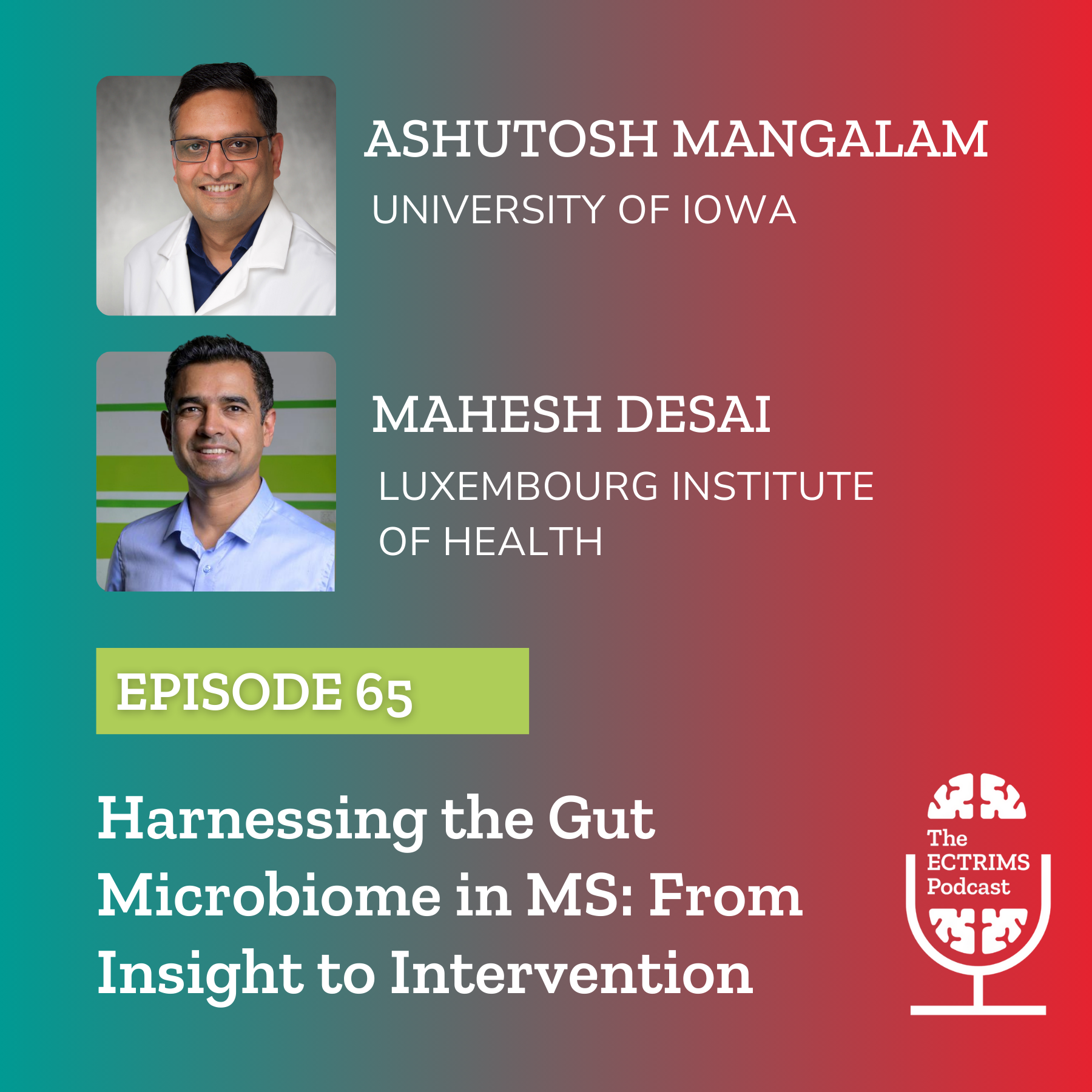
What role does the gut microbiome play in multiple sclerosis — and how close are we to translating microbiome research into meaningful clinical interventions?
In this episode of the ECTRIMS Podcast, host Brett Drummond is joined by Mahesh Desai (Luxembourg Institute of Health) and Ashutosh Mangalam (University of Iowa), two internationally recognised leaders in microbiome and MS research, to explore how gut microbes influence disease susceptibility, progression, and immune regulation in MS.
The discussion moves beyond simple "good vs bad bacteria" narratives, highlighting why microbial function, community structure, and host–microbiome dialogue are far more informative than individual taxa alone. The speakers examine evidence from animal models and human studies, including twin studies, microbial networks, and immune markers such as IgA coating, to understand whether microbiome changes are drivers or consequences of disease.
They also explore the potential of the gut microbiome as a predictive biomarker, the challenges of causality, and why diet and personalised approaches may be key to restoring immune balance in MS.
--------------------------------
This ECTRIMS podcast episode is supported by an educational grant from Alexion, AstraZeneca Rare Diseases. Bristol Myers Squibb, Novartis, Roche, Sanofi, and UCB. Educational grant providers have no input into the podcast series content.
33 minAbspielen in:
Gäste, die länger als 12 Monate zurückliegen, gibt es mit Pro. Pläne ansehen

 ET