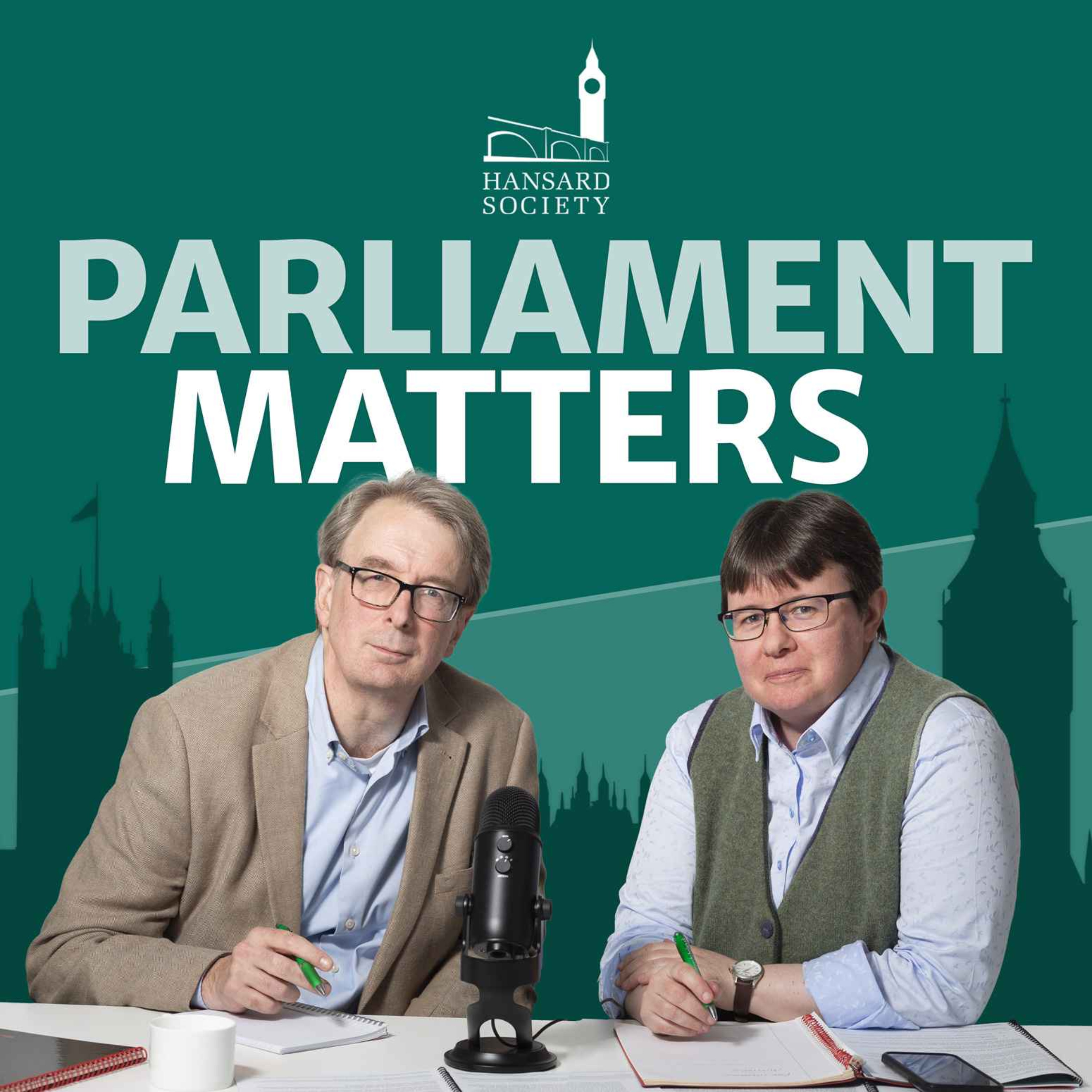
Parliament Matters cover
Podcast

Parliament Matters

von Hansard Society

Parliament Matters hatte in den letzten 12 Monaten 18 bestätigte Gäste in 15 Folgen. Zuletzt: Jesse Norman, 20. Nov. 2026.

Website der SendungApple PodcastsSo werden Gäste bestätigt

Join two of the UK's leading parliamentary experts, Mark D'Arcy and Ruth Fox, as they guide you through the often mysterious ways our politicians do business and explore the running controversies about the way Parliament works. Each week they will analyse how laws are made and ministers held accountable by the people…

Gäste der Sendung

Fr20Nov
Parliament MattersJN

Jesse NormanGast

Why can’t Parliament fix its own home? A conversation with Jesse Norman MP

Who’s in charge of fixing the Palace of Westminster? With projected costs potentially running into tens of billions of pounds and a parliamentary decision still awaited, Conservative Shadow Leader of the House of Commons Jesse Norman MP tells us why he thinks the Restoration and Renewal project needs an urgent rethink. He blames successive failures of political leadership for allowing the scope and costs to grow. He calls for a three-month review to pin down what work is essential, what it should cost and who should be accountable for delivering it. Ruth and Mark press him on what another review would achieve, the Conservatives’ share of responsibility for past delays and whether a project that could span several parliaments needs a government minister to drive it forward. They also discuss why comparisons with the renovation of the Cathedral of Notre Dame and Buckingham Palace only go so far. The conversation also turns to what happens inside the Commons chamber. Norman argues that speeches designed to yield a 30-second social media clip make it harder for MPs to build on each other’s arguments. Could shorter questions and a firmer steer from the Speaker help? He makes the case for more time to examine legislation on the floor of the House and for select committees to use their influence more assertively. Finally, Norman reflects on what writing about Edmund Burke and adapting his political novel The Winding Stair for the stage bring to his work as an MP. ___ Chapters 00:00 Introduction 02:00 Jesse Norman on becoming Shadow Commons Leader 03:00 What happened to the art of Commons debate? 05:00 Shorter questions and a firmer steer from the Speaker 08:00 What the Commons loses when experienced MPs leave 14:00 How well does Parliament examine legislation? 15:00 Treaty scrutiny and Parliament’s role in military decisions 18:00 Should select committees throw their weight around? 19:00 Why has the cost of restoring Westminster risen? 22:00 What would a three-month review achieve? 24:00 Who should lead the project? Lessons from London 2012 28:00 Which repairs are essential? 30:00 Does Westminster need a minister in charge? 33:00 A possible vote and the question of party whipping 35:00 Who bears responsibility for the delays? 39:00 From Edmund Burke to The Winding Stair 42:00 Ruth and Mark on whether another review would help 45:00 What can Westminster learn from Notre Dame and Buckingham Palace? ___ 🎓 Learn more using our resources for the issues mentioned in this episode. ❓ Send us your questions about Parliament: ✅ Subscribe to our newsletter. 📱 Follow us across social media @HansardSociety / @hansardsociety.bsky.social £ - Support the Hansard Society and this podcast by making a donation today. Parliament Matters is a Hansard Society production supported by the Joseph Rowntree Charitable Trust. Presenters: Mark D’Arcy and Ruth Fox Producer: Richard Townsend Hosted on Acast. See acast.com/privacy for more information.

50 minAbspielen in:

Di10Nov
Parliament MattersBeeban Kidron

Beeban KidronGast

Taking on Big Tech: Beeban Kidron on the art of legislating

How do you turn a campaign into law when some of the world’s richest companies are determined to stop you? Filmmaker and crossbench peer Baroness Beeban Kidron joins us to discuss the art of legislating for the digital world. From protecting children online to defending creators’ copyright against AI companies, she explains how she built support, won amendments and persuaded reluctant ministers to act. But winning a vote is only part of the battle. Kidron contrasts her experience of the children’s privacy code with Ofcom’s implementation of the Online Safety Act, arguing that Parliament needs stronger powers to hold regulators to its intentions. She also describes Big Tech’s tactics for resisting regulation, the pressure to back down during parliamentary “ping-pong”, and why she rejects the claim that technology moves too fast for lawmakers. Her new book is Users: How Big Tech Took Control and How to Fight Back. ___ Chapters 00:00 Introduction 01:00 From filmmaking to campaigning 04:00 Turning children’s rights into legislation 09:00 Winning amendments and building support 13:00 Delegated legislation and regulatory accountability 18:00 Can Parliament keep up with technology? 22:00 Challenging “tech exceptionalism” 27:00 Reforming Parliament’s legislative machinery 32:00 Big Tech’s resistance playbook 40:00 AI, copyright and celebrity allies 43:00 Parliamentary ping-pong: when should peers give way? 47:00 Is the political tide turning against Big Tech? 51:00 Book details and closing remarks ____ 🎓 Learn more using our resources for the issues mentioned in this episode. ❓ Send us your questions about Parliament: ✅ Subscribe to our newsletter. 📱 Follow us across social media @HansardSociety / @hansardsociety.bsky.social £ - Support the Hansard Society and this podcast by making a donation today. Parliament Matters is a Hansard Society production supported by the Joseph Rowntree Charitable Trust. Presenters: Mark D’Arcy and Ruth Fox Hosted on Acast. See acast.com/privacy for more information.

52 minAbspielen in:

Fr6Nov
Parliament MattersDS

Daniel SchumanGast

Inside the new Congress

Winning the election is one thing. Making Congress work is another. How will the Democrats now turn electoral success into effective congressional power to constrain Donald Trump and advance their own policy agenda? Daniel Schuman of the American Governance Institute joins us to explain how the new Congress will organise itself between election day and January, when the new House of Representatives and Senate are sworn in. The outgoing “lame duck” Congress faces the prospect of last-minute confirmation battles and an urgent funding deadline if a government shutdown before Christmas is to be avoided. Next year will bring fresh battles over the budget and spending. Meanwhile, incoming representatives must recruit staff, establish offices and learn the ropes of an unfamiliar institution. For Democrats, there are decisions to be made about leadership positions, who gets coveted committee places, and agree the rules that will govern the House. Their choices will shape whose priorities advance, who can block them and how effectively the party can work together. Daniel explains how these internal party bargains distribute power and why a stronger Speaker may not mean a stronger Congress. The conversation examines Democratic factions, Congress’s strongest levers, especially appropriations, and the limits of oversight, subpoenas, contempt and impeachment when an administration resists compliance and courts take time. Then comes the confrontation with the White House. Can lawmakers use the power of the purse to curb Trump’s foreign adventures and reinstate support for Ukraine? Could the Senate block appointments to the courts and federal agencies? And how should committees balance investigating the administration with advancing legislation that delivers for voters? We explore what happens if officials refuse to testify, why contempt proceedings can stall, and how immunity, presidential pardons and lengthy court battles complicate accountability. Daniel offers a stark assessment of checks and balances under strain: Congress has formidable powers on paper, but making them work depends on more than an election victory. From induction to internal bargaining, this is a guide to the decisions, procedures and pressure points that will determine what the new Congress can achieve and where its limits lie. ______ 00:00 Introduction: Inside the new Congress 01:49 Why the outgoing Congress stays in power 03:39 Shutdown deadlines and last-minute Supreme Court appointments 07:16 Learning the job: How new representatives are inducted 10:40 New Congress, new House rules: An opening for reform? 15:32 Who runs the House? The Speaker, committees and members 19:50 The Democrats’ internal battles: Factions, leadership and reform 23:10 What powers can Congress use against Trump? 26:09 Ukraine funding and the limits of impeachment 27:35 The power of the purse: How spending deals get made 30:07 Investigations, subpoenas and officials who refuse to cooperate 33:40 Investigate or legislate? Delivering the Democrats’ agenda 36:54 Immunity, pardons and running down the clock 40:03 Can America’s checks and balances be repaired? 43:46 Blocking nominees and debating Supreme Court reform 47:08 A crisis moment: What happens when presidential power defies the rules? 48:00 Our next episode: Baroness Kidron talks about her work at the centre of parliamentary efforts to regulate the online world ____ 🎓 Learn more using our resources for the issues mentioned in this episode. ❓ Send us your questions about Parliament: ✅ Subscribe to our newsletter. 📱 Follow us across social media @HansardSociety / @hansardsociety.bsky.social £ - Support the Hansard Society and this podcast by making a donation today. Parliament Matters is a Hansard Society production supported by the Joseph Rowntree Charitable Trust. Presenters: Mark D’Arcy and Ruth Fox Producer: Richard Townsend Hosted on Acast. See acast.com/privacy for more information.

49 minAbspielen in:

Fr30Okt
Parliament MattersNG

Nusrat GhaniGast

Order! Order! Nusrat Ghani on how she keeps MPs in line during the Budget debate

How do you keep order when the House of Commons is packed, passions are running high and the country is watching? Deputy Speaker Nusrat Ghani joins us for an exclusive interview the morning after chairing the Budget debate. She takes us inside the preparation, nerves and split-second decisions involved in managing one of Parliament’s biggest occasions. From spotting where trouble might erupt to using eye contact and humour to keep MPs in line, she explains how she balances authority with allowing the Chamber to express itself. She reflects on her experience of John Bercow’s approach, why she wants to avoid undermining MPs’ confidence, and what occupying the historic Chair means to her and her family. And could chairing the Budget be an audition for the speakership? Beyond the Chair, we assess a Budget that offered breathing room but postponed bigger decisions. What should select committees do now to test the Government’s spending promises? We also untangle the curious case of Nigel Farage’s missing prayer card: does losing your reserved seat really prevent you from attending the Budget? And why were details of an energy announcement shared with Martin Lewis before Parliament heard them? Finally, we reveal a proposal buried in the Budget paperwork to downgrade parliamentary scrutiny of future changes to tax-clearance rules for major investment projects. With 108 Ways and Means motions awaiting approval, what else might MPs miss in the small print? ______ 🎓 Learn more using our resources for the issues mentioned in this episode. ❓ Send us your questions about Parliament: ✅ Subscribe to our newsletter. 📱 Follow us on social media: @HansardSociety / @hansardsociety.bsky.social Support the Hansard Society and Parliament Matters by making a donation. Parliament Matters is a Hansard Society production supported by the Joseph Rowntree Charitable Trust. Presenters: Mark D’Arcy and Ruth Fox Producer: Richard Townsend Hosted on Acast. See acast.com/privacy for more information.

51 minAbspielen in:

Fr23Okt
Parliament MattersMeg Hillier

Meg HillierGast

The Budget: Who checks the Chancellor?

How do you respond to a Budget you’ve only just heard, and spot what the Chancellor would rather you missed? Treasury Committee Chair Meg Hillier joins us to explain how she prepares for Budget day and how her Committee tests the promises behind the headlines. She weighs the benefits of Budget secrecy against the risk of policies going untested, argues for tougher scrutiny of sensitive defence spending, and explains why Parliament needs to look beyond the annual set piece event to how public money is actually spent. Her central challenge: can MPs and ministers give long-term financial choices the attention they deserve? The Chancellor’s speech is only the beginning. Ruth and Mark offer a “cut out and keep” guide to what happens next: the days of Budget debate, the Ways and Means resolutions and the Finance Bill that turns the announcements into law. How can some tax changes take effect that very night? What can MPs amend and how does the Government limit their options? It’s your essential companion to following the Budget through the Commons. Beyond the Budget, we discuss Darren Jones’s striking evidence to the Public Administration and Constitutional Affairs Committee. His account of trying to make Whitehall work across departmental boundaries raises an uncomfortable question: are constitutional safeguards protecting accountability, or being used to resist change? From funding the Government’s missions to getting departments’ financial systems to talk to one another, he describes a system in which even apparently straightforward reforms become a battle. Jones argues that senior civil servants have become more political without facing sufficient parliamentary scrutiny. But where should responsibility lie when ministers’ ambitions collide with officials’ advice about what the constitution permits? We explore his challenge to Whitehall’s accountability arrangements and his concerns about scrutiny of increasingly powerful mayors. ____ 🎓 Learn more using our resources for the issues mentioned in this episode. ❓ Send us your questions about Parliament: ✅ Subscribe to our newsletter. 📱 Follow us across social media @HansardSociety / @hansardsociety.bsky.social £ - Support the Hansard Society and this podcast by making a donation today. Parliament Matters is a Hansard Society production supported by the Joseph Rowntree Charitable Trust. Presenters: Mark D’Arcy and Ruth Fox Producer: Gareth Jones Hosted on Acast. See acast.com/privacy for more information.

1 h 00 minAbspielen in:

Do1Okt
Parliament MattersJM

Johnny MercerGast

This is No Way to Run a Country: A conversation with former veterans minister Johnny Mercer

Former veterans minister Johnny Mercer joins us to discuss his new book, No Way to Run a Country: An Outsider’s Journey into the Heart of our Broken Politics, and his struggle to change veterans’ policy from inside Westminster and Whitehall. Mercer entered Parliament after serving in Afghanistan, determined to improve support for former service personnel. He recalls arriving with little knowledge of parliamentary politics, the unexpected impact of his maiden speech, and how he used his role on the Defence Select Committee and the media to press for change. He takes us behind the scenes at Prime Minister’s Questions: what happens when an MP is chosen to ask a question, and why do so many use the opportunity to ask a planted question? He explains why select committees offered him a more effective way to hold people to account than exchanges in the Commons Chamber, and how party discipline and the pursuit of ministerial office can shape an MP’s choices. Mercer also explains why he fought to establish an Office for Veterans’ Affairs outside the Ministry of Defence, and how political instability helped him win commitments from successive Prime Ministers. He is candid about the relationships he damaged, the mistakes he made, and what he learned about working with people whose priorities differed from his own. Finally, he offers his prescription for a more effective Parliament, assesses the current government’s approach to veterans and the Northern Ireland legacy debate, and considers whether he would ever return to politics and Parliament. 🎓 Learn more using our resources for the issues mentioned in this episode. ❓ Send us your questions about Parliament: ✅ Subscribe to our newsletter. 📱 Follow us across social media @HansardSociety / @hansardsociety.bsky.social £ - Support the Hansard Society and this podcast by making a donation today. Parliament Matters is a Hansard Society production supported by the Joseph Rowntree Charitable Trust. Presenters: Mark D’Arcy and Ruth Fox Producer: Richard Townsend Hosted on Acast. See acast.com/privacy for more information.

40 minAbspielen in:

Do17Sep
Parliament MattersCH

Catherine HaddonDaniel GoverRobert SaundersGast

PMQs: Parliament Matters Questions

Recorded at Queen Mary University of London as part of Student Week, welcoming students at the start of the new academic year, this special live edition features three expert guests: historian Dr Robert Saunders; Private Members’ Bill specialist Dr Daniel Gover; and historian Dr Catherine Haddon, a senior fellow at the Institute for Government and former Queen Mary student. The panel begins by assessing the new Burnham Government. Has the Prime Minister’s more optimistic, personable style marked a substantive break with Keir Starmer or merely improved the presentation? They consider the fiscal and geopolitical constraints facing the Government; Burnham’s management of Labour MPs; the balance of power among senior ministers and advisers; relations with the civil service; and whether experience as a metro mayor is useful preparation for Downing Street. The students then put the questions. Should Britain cap political donations after Reform UK received unprecedented sums from two billionaires, and would retrospective legislation be justified? Is the emerging five-party system here to stay, and can Parliament’s rules properly accommodate smaller parties? Will social media displace traditional journalism, or make trusted scrutiny and fact-checking more important? The discussion also covers whether Parliament has too many recesses; the tension between national infrastructure needs and local opposition; devolution, separatism and the future of the Union; and reform of Private Members’ Bills. Finally, the panel recommends essential reading for students of Parliament, from political diaries and Anthony Trollope to contemporary accounts by Rory Stewart and Jess Phillips. _____ 🎓 Learn more using our resources for the issues mentioned in this episode. ❓ Send us your questions about Parliament: ✅ Subscribe to our newsletter. 📱 Follow us across social media @HansardSociety / @hansardsociety.bsky.social £ - Support the Hansard Society and this podcast by making a donation today. Parliament Matters is a Hansard Society production supported by the Joseph Rowntree Charitable Trust. Presenters: Mark D’Arcy and Ruth Fox Producer: Richard Townsend Sound mixing: Matthew Kowalczuk, Queen Mary University of London Hosted on Acast. See acast.com/privacy for more information.

1 h 09 minAbspielen in:

Fr11Sep
Parliament MattersAL

Andrew LewinMatthew EnglandGast

MPs reject the assisted dying bill: What happened, and what next?

MPs have rejected the assisted dying bill – but why did a proposal they had previously supported lose this time, and what happens now? Andrew Lewin MP, a supporter of the bill, hot-foots it from the Chamber to give us his immediate reaction. He describes the atmosphere when the result was announced, offers his explanation for the bill’s defeat and considers whether and how the campaign to change the law might continue. Back in the studio, Hansard Society researcher Matthew England joins us to crunch the numbers. Turnout proved crucial to the final result: was the bill defeated because MPs changed their minds, or because previous supporters stayed away? We explore why support has slowly ebbed in the Commons and examine the substantive and procedural problems that confronted the bill. Could there now be a backlash against the House of Lords over the role Peers played in derailing the legislation? Might the Commons seek to curb the Upper House’s powers or was the Lords simply doing its job by scrutinising a deeply consequential and technically complex bill? And with this latest proposal defeated, is assisted dying now off Parliament’s agenda for the foreseeable future? Plus, Nigel Farage told Reform UK’s conference that he would declare a “national emergency” over the small boats crisis. But would such a declaration actually give a Prime Minister any additional legislative powers? And Lee Anderson accused MPs of being lazy and suggested that, under a Reform government, Parliament would sit seven days a week to force through its legislative programme. What would that mean in practice for the management – and, more importantly, the scrutiny – of parliamentary business? Would MPs, officials and the wider parliamentary machinery be able to sustain it? And even if legislation were driven rapidly through the Commons, what would happen when it reached the House of Lords? ______ 🎓 Learn more using our resources for the issues mentioned in this episode. ❓ Send us your questions about Parliament: ✅ Subscribe to our newsletter. 📱 Follow us across social media @HansardSociety / @hansardsociety.bsky.social £ - Support the Hansard Society and this podcast by making a donation today. Parliament Matters is a Hansard Society production supported by the Joseph Rowntree Charitable Trust. Presenters: Mark D’Arcy and Ruth Fox Producer: Richard Townsend Hosted on Acast. See acast.com/privacy for more information.

54 minAbspielen in:

Do20Aug
Parliament MattersJC

Joanna CherryGast

Joanna Cherry: The SNP, Westminster, and a decade of political battles

Joanna Cherry joins us this week to discuss her newly published memoir, in which she looks back on some of the most contentious battles in British and Scottish politics in the last two decades. She arrived at Westminster in 2015 as one of 56 SNP MPs elected in a historic landslide that transformed Scottish politics and made the SNP the third-largest party in the House of Commons. She describes the excitement – and occasional hostility – that greeted the new contingent and explains why her experience at Westminster left her believing that the Scottish Parliament could learn a lot from the Commons, particularly when it comes to cross-party working, debate, dissent, and committee scrutiny. One of the central arguments of Cherry’s memoir is that the SNP repeatedly failed to exploit moments of political leverage and that it pursued the wrong strategy for securing another Scottish independence referendum after the loss in 2014. She sets out what she thinks the party could have done differently and why she believes support for independence has now become increasingly detached from support for the SNP itself. Her national profile grew dramatically during the Brexit years. As a constitutional lawyer, Cherry became the lead petitioner in the Scottish legal challenge to Boris Johnson’s 2019 prorogation of Parliament. She explains why the case was brought in Scotland, why she believed the challengers would ultimately win, and what it felt like when the Supreme Court unanimously ruled the prorogation unlawful. The conversation also turns to the bitter internal disputes that marked Cherry’s later years in the SNP. She discusses her relationship with Nicola Sturgeon, her concerns about the SNP’s governance and finances, the treatment of her former mentor Alex Salmond, and the fierce arguments over reform of Scotland’s gender recognition laws. Having lost her seat at Westminster in 2024 and subsequently left the SNP, is Joanna Cherry finished with frontline politics? Perhaps not. She doesn’t rule out a return under a new party leader and a new culture of independent thinking. 🎓 Learn more using our resources for the issues mentioned in this episode. ❓ Send us your questions about Parliament: ✅ Subscribe to our newsletter. 📱 Follow us across social media @HansardSociety / @hansardsociety.bsky.social £ - Support the Hansard Society and this podcast by making a donation today. Parliament Matters is a Hansard Society production supported by the Joseph Rowntree Charitable Trust. Presenters: Mark D’Arcy and Ruth Fox Producer: Richard Townsend Hosted on Acast. See acast.com/privacy for more information.

42 minAbspielen in:

Fr19Jun
Parliament MattersPC

Philip CowleyGast

Andy Burnham’s March on Westminster: How Could He Become Prime Minister?

Three by-elections delivered three very different results this week. To discuss the implications, we are joined by Professor Philip Cowley, a leading expert on MPs, party discipline and the realities of parliamentary power. The Conservatives secured their first Scottish by-election victory since 1967, taking Aberdeen South from the SNP. Meanwhile, the SNP held on in Arbroath and Broughty Ferry, limiting the damage from what could have been a bruising night. But it is Andy Burnham’s Labour victory in Makerfield that could have the biggest long-term consequences for British politics. We examine the political and parliamentary choreography required as Burnham begins his march back to Westminster, and we assess whether a carefully managed transition from Keir Starmer is possible, or even desirable. Are we witnessing the opening moves in a political dance of death between a sitting Prime Minister and the man many now see as his likely successor? And if Labour’s leadership question is approaching a decisive moment, which historical precedent is most relevant? Will it resemble the swift but dignified end of Margaret Thatcher’s premiership; the chaotic collapse of Boris Johnson’s government; or the slower, more managed departure of Theresa May? We explore the strategic arguments for and against a full Labour leadership contest. Would a competitive election strengthen Burnham’s authority and legitimacy, or expose divisions within the party at precisely the wrong moment? How much influence will Labour’s members, affiliates, and MPs have over the process? And would Burnham be better served by assuming the leadership quickly, or by using a managed transition to develop a governing programme and build a team around him? We also discuss the challenges Burnham could face if he does reach Number 10. Despite his prominence, relatively little is known about how he would govern nationally. What difficulties might he encounter in managing the parliamentary party? And what would a change in leadership mean for the wider workings of Parliament, from ministerial reshuffles to the balance of power across the select committee corridor? Finally, attention turns to Parliament’s agenda. The priority order for Private Members’ Bills in both the Commons and Lords is now clear. MPs will return to the assisted dying bill on 11 September, but it enters the new session only second in the queue rather than first. What difference could that make to the parliamentary tactics surrounding the legislation? And which other Private Members’ Bills deserve close attention in the months ahead? _______________ 🎓 Learn more using our resources for the issues mentioned in this episode. ❓ Send us your questions about Parliament: ✅ Subscribe to our newsletter. 📱 Follow us across social media @HansardSociety / @hansardsociety.bsky.social £ - Support the Hansard Society and this podcast by making a donation today. Parliament Matters is a Hansard Society production supported by the Joseph Rowntree Charitable Trust. Presenters: Mark D’Arcy and Ruth Fox Producer: Richard Townsend Hosted on Acast. See acast.com/privacy for more information.

1 h 06 minAbspielen in:

Do28Mai
Parliament MattersDH

Duncan HamesGast

The £5m question: Who funds our politicians?

In this episode, we explore the rules governing MPs’ financial interests, gifts and donations, as Reform UK leader Nigel Farage faces questions over a £5 million gift from cryptocurrency billionaire Christopher Harborne. Ruth and Mark are joined by Duncan Hames, a former MP and now Director of UK Policy at Transparency International, to ask whether the current transparency regime is working, whether a requirement to declare large gifts is enough on its own to protect public confidence, and whether a fixed cap on donations should also be put in place. At a time when political donations, gifts and hospitality are under intense scrutiny, we look at what the House of Commons Code of Conduct says MPs must declare, and why the rules require members to register financial interests and benefits that might reasonably be thought to influence their actions, speeches or votes. We also examine the wisdom of moving from a rules-based system to a principles-based system. Duncan Hames says that transparency matters because it offers a crucial safeguard against corruption and dependency. But while transparency is essential, he argues that it is no longer sufficient. With political parties and individual politicians increasingly reliant on wealthy donors, he says the real question is not just whether money is declared, but whether gifts and donations of this scale should be permitted at all. He points to international examples of donation caps and argues that the case for limits applies to domestic as well as overseas donors. We also explore the practical dilemmas MPs face when deciding what to register, the role of advice from parliamentary authorities, and whether the sanctions for breaches of the rules in both Houses are strong enough. 🎓 Learn more using our resources for the issues mentioned in this episode. ❓ Send us your questions about Parliament: ✅ Subscribe to our newsletter. 📱 Follow us across social media @HansardSociety / @hansardsociety.bsky.social £ - Support the Hansard Society and this podcast by making a donation today. Parliament Matters is a Hansard Society production supported by the Joseph Rowntree Charitable Trust. Presenters: Mark D’Arcy and Ruth Fox Producer: Richard Townsend Hosted on Acast. See acast.com/privacy for more information.

22 minAbspielen in:

Fr20Mär
Parliament MattersJF

Jonathan FeatonbyGast

Who really decides Immigration Rules: Parliament or the Home Secretary?

The Home Secretary, Shabana Mahmood MP, is planning sweeping changes to the immigration system. So, this week we put immigration law under the microscope. Jonathan Featonby of the Refugee Council joins us to explain how major shifts to refugees’ rights, settlement routes and visa rules can be pushed through using Immigration Rules, with Parliament left largely powerless to influence or block them. Meanwhile, in the House of Lords, Peers are wrestling with the ever-growing Crime and Policing Bill - a legislative “Christmas tree” laden with policy baubles covering everything from abortion to terrorism proscription to artificial intelligence. We explore why Ministers want broad new powers to rewrite the Online Safety Act by regulation to tackle AI harms, and why efforts to overturn a Commons amendment to decriminalise women who have a late-term abortion failed despite concerns about a lack of scrutiny. And with the assisted dying bill set to run out of time in the Lords, Labour MP Peter Prinsley discusses his initiative to persuade the Prime Minister to back efforts to secure time for a renewed attempt to bring back the bill in the next Session and the possibility of using the Parliament Act to force it through if necessary. _____ 🎓 Learn more using our resources for the issues mentioned in this episode. ❓ Send us your questions about Parliament. ✅ Subscribe to our newsletter. 📱 Follow us across social media @HansardSociety / @hansardsociety.bsky.social £ - Support the Hansard Society and this podcast by making a donation today. Parliament Matters is a Hansard Society production supported by the Joseph Rowntree Charitable Trust. Presenters: Mark D’Arcy and Ruth Fox Producer: Richard Townsend Hosted on Acast. See acast.com/privacy for more information.

53 minAbspielen in:

Fr20Feb
Parliament MattersNS

Nan SloaneGast

The forgotten pioneer: Who was Margaret Bondfield, Britain’s first female Cabinet Minister?

Why is Britain’s first female cabinet minister almost invisible in our political memory? In this episode we are joined by historian and author Nan Sloane, whose new biography of Margaret Bondfield has just been published, to uncover the remarkable and largely forgotten story of this pioneering figure. Bondfield – a working-class trade unionist – became the first woman to serve in the British Cabinet yet is rarely mentioned alongside figures such as Nancy Astor or Ellen Wilkinson. She did not enter politics through the suffrage movement. Instead, she rose through the male-dominated trade union movement, often as the only woman in the room. Born into a large working-class family in Somerset, she left school at thirteen to work in shops where staff were legally treated as domestic servants and endured punishing conditions. Driven by a fierce commitment to social justice, she became a powerful organiser, accomplished public speaker and a leading national figure within the labour movement. Elected to Parliament in 1923, she made history in 1929 when she was appointed Minister of Labour, becoming the first woman to serve in the Cabinet and the first female Privy Counsellor. But it was, as one colleague put it, the worst job in government. In the grip of a deep economic crisis, unemployment was soaring, the national insurance system was stretched to breaking point, and painful decisions had to be taken. By 1931 the crisis had split the Labour Party and brought down the Government. Bondfield lost her seat and never returned to Parliament. Rather than being remembered as a trailblazer, her legacy was overshadowed by economic crisis and party division. Was she a pioneer, a pragmatist caught in impossible circumstances, or a woman judged more harshly than her male colleagues? In conversation with Nan Sloane, we explore Bondfield’s character, her relationships and international networks, and the political choices that shaped both her career and her reputation. Nan Sloane, Margaret Bondfield: The life and times of Britain’s first Cabinet Minister (Bloomsbury Publishing) 🎓 Learn more using our resources for the issues mentioned in this episode. ❓ Send us your questions about Parliament: ✅ Subscribe to our newsletter. 📱 Follow us across social media @HansardSociety / @hansardsociety.bsky.social £ - Support the Hansard Society and this podcast by making a donation today. Parliament Matters is a Hansard Society production supported by the Joseph Rowntree Charitable Trust. Presenters: Mark D’Arcy and Ruth Fox Producer: Richard Townsend Hosted on Acast. See acast.com/privacy for more information.

1 h 11 minAbspielen in:

Fr13Feb
Parliament MattersND

Neil Duncan-JordanGast

What happens when you lose the party whip?

What happens when you lose the party whip? A conversation with Neil Duncan-Jordan MP Labour MP Neil Duncan-Jordan joins us this week to reflect on his experience as one of the new intake’s most prominent rebels. He describes defying the whip over the means-testing of the Winter Fuel Allowance and proposed disability benefit cuts, the fallout from his suspension from the Parliamentary Labour Party, and the personal and political pressures that come with rebellion. He also discusses his relationship with the Whips and explains why he has twice called for Sir Keir Starmer to step down, most recently in the wake of the Mandelson affair. In this week’s episode, we also assess Starmer’s increasingly fragile position following the Mandelson–Epstein controversy, examining the risk of further damaging disclosures about Mandelson’s contact with Ministers and the potential implications for the Government’s legislative programme. We untangle the constitutional confusion surrounding proposals to strip Peter Mandelson and other disgraced peers of their titles, exploring weaknesses in the House of Lords’ Code of Conduct, and the broader dangers of legislating in response to a single scandal. Gordon Brown has called for sweeping “root and branch” standards reform – from a new anti-corruption commission to greater use of citizens’ juries on parliamentary standards and enhanced select committee scrutiny of ministerial and other public appointments. Ruth and Mark question whether such changes would genuinely rebuild public trust, pointing to nearly two decades of Hansard Society polling showing consistently low levels of trust in politicians and in the effectiveness of the political system. They also argue that the current focus on expelling disgraced Peers from the House of Lords misses a fundamental issue: the Prime Minister’s largely unchecked power to appoint them in the first place. We return to the slow progress of the assisted dying bill in the House of Lords, where disagreement continues over whether the pace of debate reflects legitimate scrutiny or amounts to filibustering. Some MPs are calling for accelerated Lords reform in response – but would a wholly elected second chamber be more likely to block legislation rather than less? Finally, we discuss two significant reports from the Procedure Committee: one recommending against the introduction of call lists for debates in the Commons Chamber, and another proposing changes to the way select committee chairs and deputy speakers are elected in the House of Commons. 🎓 Learn more using our resources for the issues mentioned in this episode. ❓ Send us your questions about Parliament: ✅ Subscribe to our newsletter. 📱 Follow us across social media @HansardSociety / @hansardsociety.bsky.social £ - Support the Hansard Society and this podcast by making a donation today. Parliament Matters is a Hansard Society production supported by the Joseph Rowntree Charitable Trust. Presenters: Mark D’Arcy and Ruth Fox Producer: Richard Townsend Hosted on Acast. See acast.com/privacy for more information.

1 h 09 minAbspielen in:

Mi21Jan
Parliament MattersRL

Richard LloydGast

Who really sets MPs’ pay – And why you might be wrong about it

What are MPs actually paid and what does the public fund to help them do their job? In this conversation with Richard Lloyd, chair of the Independent Parliamentary Standards Authority (IPSA) we explore the delicate balance between supporting MPs to do their jobs effectively and enforcing strict standards on the use of public money. We discuss how IPSA has shifted from a rule-heavy “traffic cop” to a principles-based regulator, why compliance is now very high, and the security risks and pressures facing MPs‘ offices as workloads rise and abuse becomes more common. _____ Sixteen years after the expenses scandal that reshaped British politics, Richard Lloyd offers a rare insider’s account of how Parliament is now regulated from the outside. Drawing on his experience in government, regulation and civil society, he explains why MPs’ pay and expenses were taken out of politicians’ hands, how IPSA evolved from a body widely seen as hostile and bureaucratic into a more service-focused regulator, and why independence remains essential even when it attracts controversy. Richard explains the basic package of salary and pension, and how this compares with those of parliamentarians in other countries, but also the less well-understood support that sits behind an MP’s work: travel between Westminster and constituency, accommodation for those far from London, and – most of all – the funding that pays for staff, offices and equipment. We revisit how the 2008–09 expenses scandal changed everything, and how IPSA’s early reforms tightened the rules on housing costs, ending practices like mortgage interest claims and “flipping” second homes. Richard also addresses more recent controversies, including MPs renting to other MPs, and why IPSA has moved to stop new arrangements where public confidence and perceived conflicts of interest are at stake. Richard argues that today’s system is delivering: spending is now close to 100% compliant, serious wrongdoing is rare, and IPSA’s approach is evolving from dense rulebooks to clearer principles – parliamentary purpose, integrity, value for money and accountability – backed by enforcement when needed. We also explore the strain on MPs’ offices, the separation between parliamentary and party-political activity, the rising security threat, and the growing impact of AI on constituent correspondence. Finally, Richard discusses the politically charged question of MPs’ pay, the Citizens’ Panel work that shifted views once the reality of the job was understood, and the wider role independent regulators can play in rebuilding trust in our democratic institutions. _____ 🎓 Learn more using our resources for the issues mentioned in this episode. ❓ Send us your questions about Parliament: ✅ Subscribe to our newsletter. 📱 Follow us across social media @HansardSociety / @hansardsociety.bsky.social £ - Support the Hansard Society and this podcast by making a donation today. Parliament Matters is a Hansard Society production supported by the Joseph Rowntree Charitable Trust. Presenters: Mark D’Arcy and Ruth Fox Producer: Richard Townsend Hosted on Acast. See acast.com/privacy for more information.

50 minAbspielen in:

Gäste, die länger als 12 Monate zurückliegen, gibt es mit Pro. Pläne ansehen