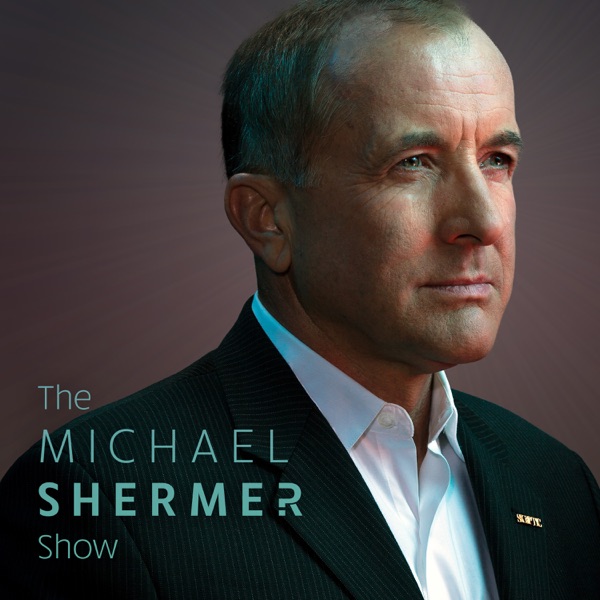
The Michael Shermer Show is a series of long-form conversations between Dr. Michael Shermer and leading scientists, philosophers, historians, scholars, writers and thinkers about the most important issues of our time.
Some of the people building AI say it could kill us all. Steven Pinker thinks their arguments deserve a lot more scrutiny.
Does greater intelligence come with a desire for power? What does "superintelligence" actually mean? And where do those precise-sounding estimates of our odds of extinction come from?
Ashley Madison's 2015 hack threatened to destroy the company. Yet at the height of the scandal, daily sign-ups more than tripled, according to its Chief Strategy Officer Paul Keable.
Keable joins Michael Shermer to talk about how dating apps are changing relationships and why people seek sex outside their marriages.
What do you owe a spouse who no longer wants sex? Can an open marriage work? Why are women judged more harshly than men for wanting sexual variety? And how much of anyone else's sex life is our business?
The U.S. government built houses, dressed pigs in military clothing, and detonated atomic bombs to see what would survive. Jon H. Else, director of The Day After Trinity and author of Frenchman Flat: The Rise and Fall of Atomic Bombs, joins Michael Shermer to discuss the extraordinary history of nuclear testing in America's backyard.
Jon H. Else is a documentary filmmaker and professor emeritus at the UC Berkeley Graduate School of Journalism. He holds an MA from Stanford University. A MacArthur Fellow, he has won five Emmy Awards and received two Academy Award nominations. His new book is Frenchman Flat: The Rise and Fall of Atomic Bombs.
We tend to explain success by looking at what people did right, while overlooking everyone who made the same choices and failed.
Philosopher Duncan Pritchard joins Michael Shermer to discuss his book, Tempting Fate: A Philosophical Guide to Risk, Luck, and a Meaningful Life, and how to make decisions when even the best preparation can't guarantee a good outcome.
Duncan Pritchard is UC Distinguished Professor of Philosophy at the University of California, Irvine. He works mainly in epistemology, and has published widely in this area, including the application of epistemological ideas to such domains as religion, law, and cognitive science. His new book is Tempting Fate: A Philosophical Guide to Risk, Luck, and a Meaningful Life.
What do you make of an experience you can't explain? A strange light in the sky, a book flying off a desk, a coincidence that feels too improbable to be chance? Social psychologist Barry Markovsky joins Michael Shermer to discuss his new book Everyday Extraordinary and the experiences that have kept him studying paranormal beliefs for decades—including his own childhood UFO sighting and a supposedly haunted vape shop.
Markovsky explains how friends, communities, and our sense of who we are shape what we believe—and why changing someone's mind can take more than better evidence.
Barry Markovsky is Distinguished Professor Emeritus of Sociology at University of South Carolina. His articles on ghosts, UFOs, and coincidences appear at TheConversation.com, which disseminates them to major news outlets worldwide. To date, more than a million readers have downloaded them. His new book is Everyday Extraordinary.
Would World War II have happened without Hitler? Would someone else have built Apple without Steve Jobs? Jared Diamond joins Michael Shermer to ask how much history depends on particular people.
From Darwin's discoveries to the rise of Christianity, Diamond considers when someone is truly irreplaceable, when someone else would have done much the same thing, and how we can tell the difference.
Jared Diamond is the Pulitzer Prize-winning author of the seminal million-copy-bestseller Guns, Germs, and Steel, which was named one of Time magazine's best non-fiction books of all time, Collapse, a No. 1 international bestseller, and The World Until Yesterday, among other books. A professor of geography at UCLA and noted polymath, Diamond's work has been influential in the fields of anthropology, biology, ornithology, ecology and history, among others. His new book is Profits, Prophets, Coaches, and Kings: (When) Do Leaders Matter?
How did 19 hijackers evade the world's most advanced intelligence apparatus despite years of warnings? Twenty-five years after 9/11, journalist Gerald Posner joins Michael Shermer to explain the security failures that left America vulnerable. Those failures, compounded by government secrecy, have helped sustain suspicions that officials orchestrated the attacks or deliberately allowed them to happen.
What does the evidence show, and have we learned the right lessons?
Most of us think of ourselves as honest. But would we still tell the truth if lying got us what we wanted—and nobody would ever find out? Philosopher Christian Miller joins Michael Shermer to discuss his new book The Honesty Crisis and the uncomfortable gap between having a reputation for honesty and actually being honest.
Christian B. Miller is the A.C. Reid Professor of Philosophy at Wake Forest University. He is the author of over 130 articles as well as several books. Thanks to a $4.4 million grant from the John Templeton Foundation, he directed The Honesty Project, one of the largest research initiatives ever undertaken on honesty. His new book is The Honesty Crisis: Preserving Our Most Treasured Virtue in an Increasingly Dishonest World.
What if uncertainty isn't a temporary problem science will eventually solve, but a fundamental feature of reality? Neuroscientist Stuart Firestein joins Michael Shermer to make the case that the universe may be far less deterministic—and the future far less predictable—than we like to imagine.
Firestein and Shermer discuss chaos and complexity, Darwin and randomness, free will, scientific progress, the replication crisis, COVID and the problem of communicating uncertainty, why humans are so bad at probability, and why even enormous amounts of data can fail to predict individual people or events.
Stuart Firestein is a professor of neuroscience at Columbia University and a member of the Santa Fe Institute. He has published over one hundred scientific papers in journals such as Nature, Science, Cell, and Neuron. He is a Guggenheim fellow, a member of the advisory committee for the Alfred P. Sloan Foundation, and an elected fellow of the American Association for the Advancement of Science. His new book is It Could Be Otherwise: Science in the Age of Uncertainty.
Robert Wright joins Michael Shermer to discuss his new book, The God Test: Artificial Intelligence and Our Coming Cosmic Reckoning, and why he thinks the AI revolution may be moving much faster than most people realize. Wright argues that deep learning is not just a new way of programming computers. In an important sense, it resembles evolution: neural networks discover solutions for themselves, sometimes recreating cognitive functions that natural selection built into human brains. That helps explain why AI capabilities have advanced so quickly, and why increasingly autonomous systems and recursive self-improvement could accelerate the process even further.
Shermer presses Wright on what all of this actually means. Does an AI understand what it says? Could it be conscious? Why would a superintelligence ever seek power? Is human extinction a realistic possibility, or science-fiction doomerism? They discuss AI deception and theory of mind, John Searle's Chinese Room, bioweapons and cyberattacks, the risk of a U.S.-China AI arms race, regulation, surveillance, and the growing concentration of power in governments and tech companies.
The conversation ends with Wright's larger philosophical question: if humanity really is building something with godlike power, what kind of god are we going to build, and are we mature enough to survive it?
Robert Wright is the New York Times bestselling author of The Evolution of God (a finalist for the Pulitzer Prize), Nonzero, The Moral Animal, and Three Scientists and their Gods (a finalist for the National Book Critics Circle Award). He has taught at the University of Pennsylvania and at Princeton University, where he also created the popular online course "Buddhism and Modern Psychology." He is currently Visiting Professor of Science and Religion at Union Theological Seminary in New York.
Michael Shermer speaks with political scientist Marlene Laruelle about Russia's turbulent transformation during the 1990s and the rise of Vladimir Putin, why the Kremlin so badly misjudged Ukraine, China's rise and its ambitions regarding Taiwan, why killing Iran's Supreme Leader and much of its senior leadership did not bring down the regime, the limits of foreign aid and sanctions, mass surveillance, economic nationalism, and whether Western democracy can survive an age of economic pessimism and technological control.
Marlene Laruelle is a professor in the Department of Political Science at Luiss University in Rome. From 2011 to 2025, she served as research professor of international affairs and political science at George Washington University. She directs the Illiberalism Studies Program, a transatlantic initiative based in Washington, D.C., and Paris at Inalco. A specialist in Russia and the post-Soviet region, her work examines ideology, geopolitics, and culture, with a current focus on the rise of illiberal and postliberal ideologies in Europe and the United States.
John Demjanjuk lived for decades as a retired autoworker in suburban Cleveland. Then investigators accused him of being "Ivan the Terrible," one of the most notorious guards at Treblinka. What followed was one of the strangest and most troubling Nazi war-crimes cases of the postwar era: extradition, eyewitness testimony, a death sentence, a reversal, and a final prosecution many years later.
In this episode, Michael Shermer talks with Lawrence Douglas, professor at Amherst College and author of The Criminal State: War Atrocity and the Dream of International Justice, about Demjanjuk, Eichmann, Nuremberg, Holocaust denial, and the problem of proving atrocities decades after they happened.
How reliable is eyewitness memory after 40 or 50 years? What did Nuremberg actually establish? Was Eichmann really just a bureaucrat? And can a courtroom ever deliver justice for crimes almost too large to comprehend?
Lawrence Douglas is the James J. Grosfeld Professor of Law, Jurisprudence, and Social Thought at Amherst College and a Guggenheim fellow. His many books include The Right Wrong Man and The Memory of Judgment. His writing has appeared in leading publications such as Harper's, The Wall Street Journal, and The Economist. His new book is The Criminal State: War Atrocity and the Dream of International Justice.
What does it mean to live well when certainty is unavailable?
Michael Shermer speaks with Massimo Pigliucci about moral character, ancient philosophy, and the difficult art of making decisions without easy answers. The conversation moves from Cicero and Stoicism to the legacy of the New Atheism, asking why rejecting religion is not the same as having a philosophy of life.
They discuss virtue ethics, moral dilemmas, effective altruism, faith, free will, democracy, human flourishing, and the uneasy relationship between facts and values.
From the trolley problem and Peter Singer's drowning child thought experiment to the ethics of charity, the limits of utilitarian thinking, and the dangers of tribalism, this episode asks how we should act when rules fail, consequences are uncertain, and good intentions are not enough.
Massimo Pigliucci is a bestselling author, philosopher, evolutionary biologist, and the K.D. Irani Professor of Philosophy at the City College of New York. His work spans evolutionary biology, philosophy of science, pseudoscience, and practical philosophy. His latest book is How to Be a Happy Skeptic: The Power of Doubt in a Meaningful Life.
Cathy Young returns to the show for a wide-ranging conversation about free speech, institutional trust, and the strange incentives shaping public debate today. What happens when universities, media outlets, political movements, and online personalities trade careful thinking for moral certainty, tribal loyalty, or attention?
Michael and Cathy discuss the pressure to excuse bad ideas when they come from "your side," the rise of activist thinking in education and journalism, and the growing appeal of contrarian figures who seem to thrive on distrust.
They also get into the war in Ukraine, Israel and Gaza, Iran, isolationism, and why defending open inquiry matters most when it becomes inconvenient.
Batya Ungar-Sargon joins Michael Shermer for a wide-ranging conversation about the historical relationship between Jews and the American left, and why that relationship has become increasingly strained in recent years.
The discussion begins with the reaction to October 7 and the political language that quickly emerged around Israel, Palestine, power, oppression, and resistance. From there, Ungar-Sargon traces a longer history: Jewish life in early America, Jewish involvement in the labor movement, the Triangle Shirtwaist Factory fire, the civil rights movement, and the role many Jews played in shaping progressive politics in the 20th century.
Batya Ungar-Sargon is a columnist for The Free Press and the host of Batya! on NewsNation, where she is a weekend anchor. She holds a PhD in English from the University of California, Berkeley. Her new book is The Jews and the Left.
Gad Saad returns to discuss his new book Suicidal Empathy: Dying to Be Kind, a provocative argument that empathy is not a moral trump card. Empathy can illuminate suffering, but it can also distort judgment when it is treated as an unquestionable virtue, applied selectively, or insulated from consequences.
Saad's central claim is that many Western institutions have learned to treat compassion as a substitute for judgment. In practice, he argues, this can mean extending sympathy toward the wrong targets (for example, criminals over victims), excusing destructive behavior, rewarding ideological conformity over truth, or denying uncomfortable facts in the name of kindness. The result is a moral framework that feels humane in the moment but can produce outcomes that are unfair, irrational, or even dangerous.
The conversation covers cultural relativism, islamism, suicide cults, kamikaze pilots, immigration and foreign aid, forbidden knowledge, and why some ideas spread and take hold while others fade away.
Gad Saad is a professor and an evolutionary behavioral scientist. He has authored numerous scientific papers and pioneered the use of evolutionary psychology in marketing and consumer behavior. In addition to his scientific work, he often writes and speaks about idea pathogens that are destroying logic, science, reason, and common sense. He is the host of The Saad Truth podcast. His new book is Suicidal Empathy: Dying to Be Kind.
Neil deGrasse Tyson returns to The Michael Shermer Show to talk UFOs, aliens, government files, eyewitness testimony, and his new book Take Me to Your Leader: Perspectives on Your First Alien Encounter.
The conversation moves from the limits of eyewitness testimony to why secret military files are not evidence of hidden alien bodies, why high-G turns would turn biological pilots into "a pile of goo," why the universe almost certainly contains life elsewhere, and why the real question is not whether aliens exist—but whether anyone has actually produced one.
Neil deGrasse Tyson is an astrophysicist and the director of the Hayden Planetarium at the American Museum of Natural History, where he has served since 1996. Dr. Tyson is also the host and cofounder of the Emmy-nominated popular podcast StarTalk and its spinoff StarTalk Sports Edition, which combine science, humor, and pop culture. He is a recipient of twenty-three honorary doctorates, the Public Welfare Medal from the National Academy of Sciences, and the Distinguished Public Service Medal from NASA. Asteroid 13123 Tyson is named in his honor. His new book is Take Me to Your Leader: Perspectives on Your First Alien Encounter.
Journalist and author Ashley Rindsberg returns to The Michael Shermer Show for a wide-ranging conversation about the new media world: influencers with audiences larger than cable networks, conspiracy theories built for engagement, and the collapse of trust that followed COVID, censorship, and years of institutional overreach.
Ashley Rindsberg is an investigative journalist and author focused on digital information platforms. He is the founder and editor of NPOV, which looks at how knowledge platforms like Wikipedia are used to distort information and seed damaging narratives online. He is the author of The Gray Lady Winked, an expose on The New York Times, and serves as Editor-at-Large at Pirate Wires, a leading tech, politics, and culture outlet.
Free speech was supposed to be the great settled achievement of liberal democracy. Then came social media, cancel culture, campus speech battles, hate-speech laws, authoritarian tech control, and a new era of governments pressuring platforms from every direction.
Michael Shermer speaks with free speech scholar Jacob Mchangama about why speech protections are weakening around the world—not only in dictatorships, but inside democracies. Their conversation moves from the First Amendment and January 6 to hate speech laws in Europe, Section 230, Elon Musk and X, online anonymity, social media bans for minors, and the enormous promise and danger of AI.
Mchangama argues that censorship is less a left-wing or right-wing impulse than a human one: once people gain power, the urge to silence enemies becomes almost irresistible. The real test of free speech is not whether we defend ideas we like, but whether we resist using state power against speech we despise.
Jacob Mchangama is the founder and executive director of The Future of Free Speech and a research professor at Vanderbilt University. His new book is The Future of Free Speech: Reversing the Global Decline of Democracy's Most Essential Freedom.
Stewart Brand has spent a lifetime thinking about tools, systems, civilization, and the long future. Best known as the creator of the Whole Earth Catalog and co-founder of the Long Now Foundation, Brand joins Michael Shermer to discuss his new book, Maintenance of Everything, a sweeping look at what it takes to keep bodies, machines, buildings, institutions, planets, and civilizations from falling apart.
The conversation ranges from the hidden work of maintenance to electric vehicles, bicycles, nuclear power, AI, and even human populations.
Brand makes the case that life itself is maintenance: everything alive must keep itself going, and everything humans build must be repaired, improved, updated, and cared for.
Stewart Brand is the cofounder and president of The Long Now Foundation and cofounder of Global Business Network, the Hackers Conference, and the WELL. He created and edited the National Book Award-winning Whole Earth Catalog from 1968 to 1998. He was the subject of the documentary We Are As Gods (2020). He graduated from Stanford with a degree in biology and served as an infantry officer in the US Army. His new book is Maintenance of Everything.
What kind of person helps build a regime like the Third Reich? A monster? A madman? Or something far more unsettling?
Michael Shermer sits down with author Jack El-Hai to talk about the true story behind Nuremberg. At the center is Dr. Douglas Kelley, the American psychiatrist assigned to evaluate the top Nazi defendants after World War II, including Hermann Göring. What he found was not comforting: many of these men were intelligent, ambitious, psychologically functional, and disturbingly normal.
This conversation gets into the strange duel between Kelley and Göring, the psychological testing at Nuremberg, the limits of psychiatry, the difference between leaders and followers, and the question that still won't go away: how do power-hungry people rise and do evil, and why do so many others go along with them?
Jack El-Hai is an author and journalist whose work has appeared in The Atlantic, Smithsonian, GQ, Wired, Scientific American, and Discover. His books, including The Lobotomist, The Lost Brothers, and Face in the Mirror, have been translated into twenty languages. He lectures widely on writing and medical history. His book The Nazi and the Psychiatrist was recently adapted into the feature film Nuremberg, starring Russell Crowe and Rami Malek.
1 h 25 minAbspielen in:
Gäste, die länger als 12 Monate zurückliegen, gibt es mit Pro. Pläne ansehen