Robinson's Podcast cover
Podcast

Robinson's Podcast

von Robinson Erhardt

Robinson's Podcast hatte in den letzten 12 Monaten 27 bestätigte Gäste in 36 Folgen. Zuletzt: Timothy Snyder, 28. Nov. 2026.

Website der SendungApple PodcastsSo werden Gäste bestätigt

Robinson Erhardt researches symbolic logic and the foundations of mathematics at Stanford University. Join him in conversations with philosophers, scientists, weightlifters, artists, and everyone in-between. https://linktr.ee/robinsonerhardt

Gäste der Sendung

Sa28Nov
Robinson's PodcastTimothy Snyder

Timothy SnyderGast

309 - Timothy Snyder: Trump Is ROBBING America | On Musk, Putin, Hitler, Stalin, and Tyrannical Oligarchy

Timothy Snyder holds the Temerty Chair in Modern European History at the University of Toronto. In this episode, Tim and Robinson discuss how Vladimir Putin brought Russia’s oligarchs to heel and why Tim thinks Donald Trump sees the United States as a collection of assets ripe for the taking. They also ask when the American dream became a measure of wealth, whether Elon Musk could get everything he wants and still be unfree, and whom freedom of speech is meant to protect. Tim’s latest book is On Freedom (Crown, 2024). Tim’s Website: https://timothysnyder.org/ Tim’s Substack: https://snyder.substack.com/ On Freedom: https://www.penguinrandomhouse.com/books/744574/on-freedom-by-timothy-snyder/ OUTLINE 00:00:00 What Is Corruption? 00:05:04 How the American Dream Was Corrupted 00:10:44 What Drives Trump and Putin? 00:16:45 Does Musk Want to Change the Universe? 00:19:37 Why Musk Thinks AI Will Make Work Unnecessary 00:26:21 What Could Make Elon Musk Happy? 00:32:28 Why Freedom Requires Empathy 00:34:43 The Bolsheviks and the Longtermists 00:38:52 How Can Freedom Survive Concentrated Wealth? 00:42:20 Can Government Stand Up to Billionaires? 00:48:01 Why Putin Can Ignore Russia’s Oligarchs 00:50:59 What Are Trump and Musk Good At? 00:55:20 What the Naive View of Free Speech Gets Wrong Robinson’s Website: https://robinsonerhardt.com/ Robinson Erhardt researches symbolic logic and the foundations of mathematics at Stanford University, where he is also a JD candidate in the Law School. Disclaimer: Robinson’s Podcast is a forum for open discussion. Guests’ views are their own and do not necessarily reflect Robinson's. Hosting a guest does not imply that he endorses the views or opinions they express.
1 h 05 minAbspielen in:

Mi25Nov
Robinson's PodcastMichael McFaul

Michael McFaulGast

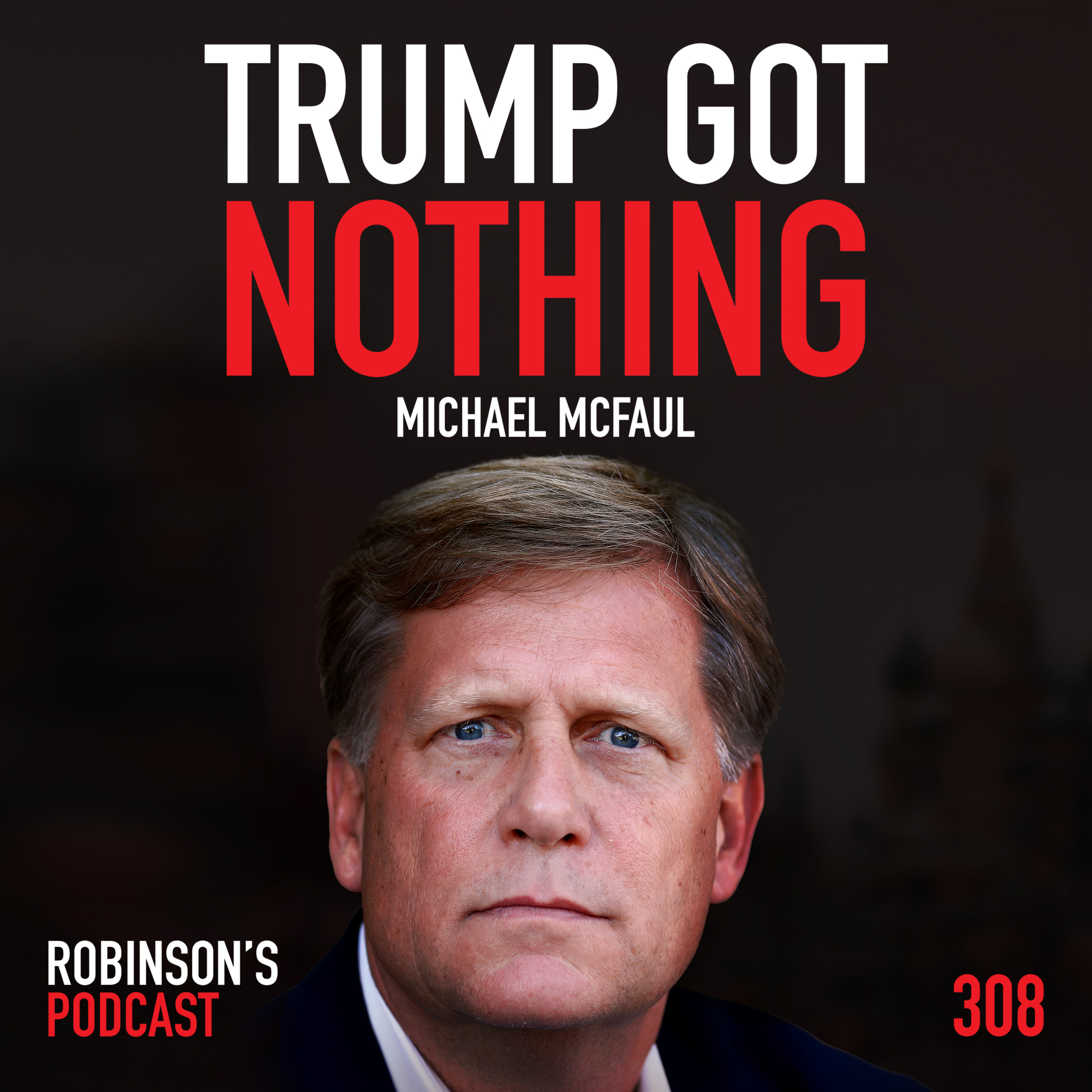
308 - Ex-Ambassador Michael McFaul: Is Putin PLAYING Trump? | On NATO, Ukraine, Russia, and Zelenskyy

Support the Show: https://www.youtube.com/channel/UCsxwneBx6apV1mQ7CbWKfXQ/join Michael McFaul served as U.S. ambassador to Russia from 2012 to 2014 and is a professor of international studies at Stanford University. He earned his bachelor’s and master’s degrees at Stanford and his doctorate in international relations at Oxford, where he was a Rhodes Scholar. In this episode, Michael and Robinson discuss Putin’s grip on power, Trump’s negotiations over Ukraine, and Zelenskyy’s decision to stay in Kyiv. Michael’s most recent book is Autocrats vs. Democrats: China, Russia, America, and the New Global Disorder (Mariner Books, 2025). Michael’s Website: https://michaelmcfaul.com/ Michael’s Substack: https://michaelmcfaul.substack.com/ Autocrats vs. Democrats: https://www.harpercollins.com/products/autocrats-vs-democrats-michael-mcfaul OUTLINE 00:00 What McFaul Learned Sitting Across from Putin 04:01 What Has Trump Gotten in Return for Concessions to Putin? 09:00 What Would Get Putin to Agree to a Ceasefire? 12:11 Why Putin’s War Divides Russia’s Oligarchs 16:33 Who Can Say No to Putin? 20:10 How Putin Took Control of Russia, One Institution at a Time 25:48 Is Putin a Political Genius? 30:10 Why the Kremlin Thinks It Can Outlast Washington in Ukraine 33:13 How Zelenskyy Went from TV President to Wartime Leader 38:18 The Daily Casualty Report That Weighs on Zelenskyy 40:12 The Message That Moved McFaul to Push for Sanctions on Russia Robinson’s Website: https://robinsonerhardt.com/ Robinson Erhardt researches symbolic logic and the foundations of mathematics at Stanford University, where he is also a JD candidate in the Law School. Disclaimer: Robinson’s Podcast is a forum for open discussion. Guests’ views are their own and do not necessarily reflect Robinson's. Hosting a guest does not imply that he endorses the views or opinions they express.

47 minAbspielen in:

Sa21Nov
Robinson's PodcastRW

Richard WolffGast

307 - Richard Wolff: Trump Is LOSING the World | On China, Iran, and Victor Davis Hanson

Pre-Order Rick’s Upcoming Book: https://linktr.ee/RickWolffQEBook Support Democracy at Work: https://institute.coop/node/3436 Support the Show: https://www.youtube.com/channel/UCsxwneBx6apV1mQ7CbWKfXQ/join Richard Wolff is Professor of Economics Emeritus at the University of Massachusetts Amherst and a visiting professor at The New School. He studied at Harvard, Stanford, and Yale, where he earned his PhD in economics, and he is a co-founder of Democracy at Work. In this episode, Richard and Robinson discuss China’s rise, Victor Davis Hanson’s view of its economy, and the future of the American empire. Richard’s most recent book is Understanding Capitalism (Democracy at Work, 2024). Richard’s Website: https://www.rdwolff.com/ Democracy at Work: https://www.democracyatwork.info/ Democracy at Work’s Substack: https://democracyatwork.substack.com/ Understanding Capitalism: https://www.democracyatwork.info/understanding_capitalism OUTLINE 00:00:00 How Xi Jinping’s China Changed America’s Place in the World 00:10:33 What Did Trump and Netanyahu Misjudge About Iran and Gaza? 00:15:03 Why Do Economists Agree So Much About Capitalism? 00:23:13 What Does Victor Davis Hanson Miss About China? 00:29:56 Where Does China Fit Between Markets and State Planning? 00:39:51 Why Does China’s Rise Make Americans Uneasy? 00:45:25 Does Faster GDP Growth Prove China Has the Better Economic Model? 00:51:30 How China Rebuilt Its Economy After Invasion and Civil War 00:58:30 Could AI Give America a New Empire? 01:09:03 Why Studying Marx Meant Looking Outside Harvard’s Classrooms 01:14:13 How America Inherited Europe’s Empires After World War II 01:23:22 Why Anticolonial Anger Turned Toward Washington 01:29:59 Who Really Called the Shots Under Bush and Reagan? 01:38:44 What Does Money Buy in American Politics? 01:46:33 What Does Elon Musk Reveal About America’s Decline? 01:55:48 How Did Elon Musk Go from Tech Hero to Trump Ally? 02:01:24 Why Europe and America See Putin Differently 02:10:32 What Trump’s Welcome for Xi Jinping Signaled 02:13:43 Has Netanyahu’s Alliance with Washington Isolated Both Countries? 02:24:53 Has the War in Iran Exposed the Limits of American Power? 02:34:25 How to Support Democracy at Work 02:38:03 Outroduction Robinson’s Website: https://robinsonerhardt.com/ Robinson Erhardt researches symbolic logic and the foundations of mathematics at Stanford University, where he is also a JD candidate in the Law School. Disclaimer: Robinson’s Podcast is a forum for open discussion. Guests’ views are their own and do not necessarily reflect Robinson's. Hosting a guest does not imply that he endorses the views or opinions they express.
2 h 57 minAbspielen in:

Do19Nov
Robinson's PodcastRo Khanna

Ro KhannaGast

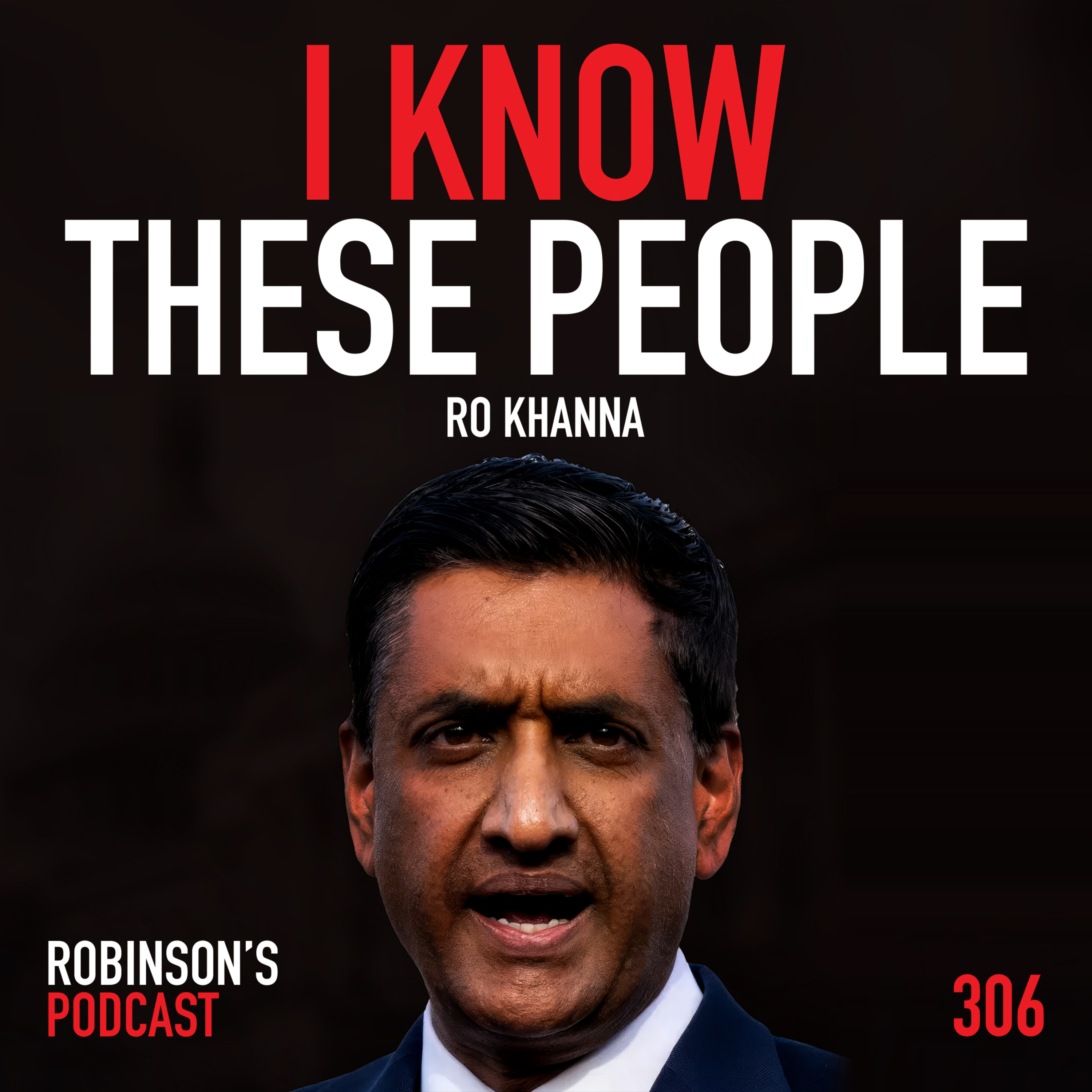
306 - Ro Khanna: You CAN’T Trust AI Billionaires | On Musk, Altman, and Silicon Valley

Support the Show: https://www.youtube.com/channel/UCsxwneBx6apV1mQ7CbWKfXQ/join Ro Khanna is a United States congressman representing California’s 17th District in Silicon Valley. In this episode, Ro and Robinson discuss corruption in the Democratic Party, AIPAC’s influence, Israel, Gaza, and the Iran war. They also talk about Sam Altman, Dario Amodei, Elon Musk, and the power of Silicon Valley. They consider the risks artificial intelligence poses to jobs and human safety, and what governments can do to hold technology companies accountable. Other topics include billionaire political donations, super PACs, and Ro’s changing views on AI safety. His most recent book is Progressive Capitalism: How to Make Tech Work for All of Us (2023). Ro’s Website: https://khanna.house.gov/ Progressive Capitalism: https://www.simonandschuster.com/books/Progressive-Capitalism/Ro-Khanna/9781982163358 OUTLINE 00:00 Introduction 01:32 Corruption Among the Democrats 03:47 Pressure on the Government from Israel 06:54 Does Israeli Intelligence Pressure U.S. Politicians? 08:05 Silicon Valley vs. The United States 09:47 Talking with Tech Billionaires 11:02 Why Ro Doesn’t Trust AI Executives 13:07 Who Gets to Decide How Much AI Risk Is Acceptable? 15:33 How to Regulate AI 18:12 Does AI Keep Ro Up at Night? 20:10 What Does Trump Think of AI? 21:56 Aligning Risk Incentives 23:52 Keeping Money Out of Politics 27:49 Outro 28:34 Can You Get a Straight Answer from a Politician? 33:07 Who Would Benefit from Giving Children SpaceX Shares? 35:50 What Makes a Podcast Trustworthy? 40:43 What Changed After the Jiang Xueqin Interview? 44:39 Rethinking Marx and Free Will 47:57 Why Are There So Many Ads on the Podcast? Robinson’s Website: https://robinsonerhardt.com/ Robinson Erhardt researches symbolic logic and the foundations of mathematics at Stanford University, where he is also a JD candidate in the Law School. Disclaimer: Robinson’s Podcast is a forum for open discussion. Guests’ views are their own and do not necessarily reflect Robinson's. Hosting a guest does not imply that he endorses the views or opinions they express.

50 minAbspielen in:

Sa14Nov
Robinson's PodcastXJ

Xueqin JiangGast

305 - Professor Jiang: They Want the AI Crash | On Altman, Zuckerberg, & Silicon Valley

Support the Show: https://www.youtube.com/channel/UCsxwneBx6apV1mQ7CbWKfXQ/joinJiang Xueqin, known online as Professor Jiang, is a Chinese-Canadian educator and the creator of Predictive History on YouTube and Substack. In this third and final conversation, Jiang and Robinson discuss artificial intelligence, the AI investment bubble, Silicon Valley, and Jiang’s claims about occult beliefs and the ambitions of technology executives. They talk about Sam Altman, Mark Zuckerberg, data centers, surveillance, religion, and the limits of current AI systems.Jiang’s YouTube: https://www.youtube.com/@PredictiveHistoryJiang’s Substack: https://predictivehistory.substack.com/OUTLINE00:00:00 Introduction 00:03:14 How Does AI Work? 00:13:45 How Will AI Companies Make Money? 00:18:04 Is the AI Boom a Bubble? 00:22:32 Why Does Jiang Think AI Companies Want a Crash? 00:24:31 Could AI Become a Surveillance State? 00:27:06 What Does AI Reveal About the Elites? 00:34:30 Jiang’s Theory of Kabbalah and Freemasonry 00:47:45 Profit—or a New God? 00:52:38 What Does the New Yorker Quote Actually Say? 00:56:37 Can We Disagree Without Being Disrespectful? 01:02:15 Can AI Replace Skilled Workers? 01:08:36 Silicon Valley vs. Wall Street 01:16:07 What Happened at Hugging Face? 01:19:58 Who Bears the Burden of Proof? 01:24:56 Does Jiang Mean Demons Literally? 01:33:35 Are Spirits Real—or Metaphors? 01:38:50 Why Jiang Thinks AI Control Will Fail 01:44:45 Outro 01:45:44 Hume, Miracles, and Testimony 01:49:31 Data Centers: Business or the Occult? 01:51:31 Can We Trust Newspaper Reports? 01:54:38 What I Learned from the Jiang SeriesRobinson’s Website: https://robinsonerhardt.com/Robinson Erhardt researches symbolic logic and the foundations of mathematics at Stanford University, where he is also a JD candidate in the Law School.Disclaimer: Robinson’s Podcast is a forum for open discussion. Guests’ views are their own and do not necessarily reflect Robinson's. Hosting a guest does not imply that he endorses the views or opinions they express. HOW LARGE LANGUAGE MODELS WORK 3Blue1Brown — Large Language Models explained brieflyhttps://www.youtube.com/watch?v=LPZh9BOjkQs Andrej Karpathy — Intro to Large Language Models https://www.youtube.com/watch?v=zjkBMFhNj_gSUPPLEMENTARY SOURCES David Hume — Of Miracleshttps://davidhume.org/texts/e/10 Ronan Farrow and Andrew Marantz — Sam Altman May Control Our Future—Can He Be Trusted? https://www.newyorker.com/magazine/2026/04/13/sam-altman-may-control-our-future-can-he-be-trusted Hugging Face — Technical timeline of the incident https://huggingface.co/blog/agent-intrusion-technical-timeline OpenAI — The Hugging Face incident and the road aheadhttps://openai.com/index/hugging-face-incident-and-the-road-ahead/ METR — Investigation of the OpenAI/Hugging Face incidenthttps://metr.org/blog/2026-08-26-openai-hugging-face-incident-investigation/

1 h 58 minAbspielen in:

Sa7Nov
Robinson's PodcastXJ

Xueqin JiangGast

304 - Professor Jiang: Trump Was Never The Real Problem | On Musk, Secret Societies, & Conspiracy Theories

Support the Show: https://www.youtube.com/channel/UCsxwneBx6apV1mQ7CbWKfXQ/joinJiang Xueqin, known online as Professor Jiang, is a Chinese-Canadian educator and the creator of Predictive History on YouTube and Substack. In this second of three conversations, Jiang and Robinson discuss secret societies, conspiracy theories, and the relationship between money and political power. They talk about Donald Trump, Elon Musk, Mark Zuckerberg, and Sam Altman, as well as capitalism, the Opium Wars, the Spanish conquest of Mexico, and Sabbatean Frankism. Throughout the conversation, Robinson challenges Jiang on the evidence for his claims, the limits of historical analogies and thought experiments, and what would distinguish a plausible story from an established explanation.Jiang’s YouTube: https://www.youtube.com/@PredictiveHistoryJiang’s Substack: https://predictivehistory.substack.com/OUTLINE00:00 Introduction09:10 Who Can Tell the President No?18:50 The Bank of England and the British Empire26:20 Conquistadors and the Opium Wars36:09 What Counts as Historical Evidence?43:33 Elites and Counterelites48:25 Secret Societies and the Rothschilds55:54 Jiang’s Account of the Sabbatean Frankists1:05:35 Sabbatai Zevi and Messianic Movements1:11:18 The Kabbalah1:17:27 Esther, Jacob Frank, and Redemption Through Sin1:27:55 How Would Historians Assess Jiang’s Account?1:35:10 Are Secret Societies Active Today?1:43:05 Can People Coordinate Without Meeting?1:49:49 Could Trump’s Comeback Have Been Predicted?1:58:05 Zuckerberg, Altman, and the Meaning of Genius2:07:24 Facebook’s Investors, Data, and Control2:11:53 Business Success or Conspiracy?2:20:29 Skull and Bones: Existence vs. Influence2:31:06 The Gilded Age and Foreign Capital2:37:29 Which Conspiracy Theories Are Credible?2:47:52 OutroFURTHER READINGThese scholarly histories provide context and alternative accounts of topics raised in the interview. I’m not a specialist in these subjects, and I offer them as starting points for further reading. They do not resolve every claim made in the conversation.Matthew Restall, Seven Myths of the Spanish Conquesthttps://global.oup.com/academic/product/seven-myths-of-the-spanish-conquest-9780197537299Paweł Maciejko, The Mixed Multitude: Jacob Frank and the Frankist Movement, 1755–1816https://www.pennpress.org/9780812204582/the-mixed-multitude/A. B. Bosworth, Conquest and Empire: The Reign of Alexander the Greathttps://www.cambridge.org/core/books/conquest-and-empire/EBAE6ADF5821A05DA6B3ADE3BC49F356Context from Robinson: Virtually every speculative conclusion Jiang reaches strikes me as unsupported, or less well-supported than a competing explanation. The existence of social connections or a historical movement does not establish that a particular group is secretly coordinating to control institutions. Listening to a guest or granting a premise for the sake of argument does not mean that I accept it.Disclaimer: Robinson’s Podcast is a forum for open discussion. Guests’ views are their own and do not necessarily reflect Robinson’s. Hosting a guest does not imply that he endorses the views or opinions they express.Robinson’s Website: https://robinsonerhardt.com/Robinson Erhardt researches symbolic logic and the foundations of mathematics at Stanford University, where he is also a JD candidate in the Law School.

3 h 16 minAbspielen in:

Sa31Okt
Robinson's PodcastJiang Xueqin

Jiang XueqinGast

303 - Professor Jiang: Trump Picked the Wrong War | On Iran, Israel, and America’s Decline

Support the Show: https://www.youtube.com/channel/UCsxwneBx6apV1mQ7CbWKfXQ/join Jiang Xueqin, known online as Professor Jiang, is an educator and the creator of the YouTube channel Predictive History. In this episode, Jiang and Robinson discuss the war in Iran, the limits of American power, and the economic and political pressures facing China. More particularly, they talk about Trump’s strategy in the Middle East, Israel, the Strait of Hormuz, the Houthis, Saudi Arabia, and Jiang’s predictions about the war’s consequences for the global economy. They also discuss Xi Jinping, Chinese corruption and debt, Richard Wolff and Michael Hudson’s views on China, and how to test Jiang’s approach to history and geopolitical forecasting. Jiang’s YouTube: https://www.youtube.com/@PredictiveHistory Jiang’s Substack: https://predictivehistory.substack.com/ OUTLINE 00:00 Introduction 05:53 Can the Iran War End America's Empire? 09:20 How America Lost Its Global Appeal 18:55 America's Three Pillars of Soft Power 29:54 Why Jiang Calls China Neoliberal 34:08 From Rural China to Yale and Back 41:05 Jiang's Critique of Wolff on China 51:28 China's Property Bubble and Debt Crisis 58:44 What Unites Trump, Xi, and Putin? 1:08:49 From Mao to Xi: China's Power Struggle 1:17:01 Zero-COVID and China's Economic Crisis 1:24:14 Taiwan, Uyghurs, and Chinese Rule 1:27:53 Criticizing China While Living There 1:32:57 Arendt, Kafka, and Authoritarianism 1:37:12 Why Jiang Calls Canada Authoritarian 1:43:06 How Jiang Predicted the Iran War 1:51:01 Israel and the Clean Break Memo 1:54:44 Trump's Coalition and the Iran War 1:57:18 Jiang's Original Iran War Forecast 2:02:01 Why Regime Change in Iran Is So Hard 2:07:41 Can Drones and Insurgents Beat Empires? 2:12:02 Iran and the Strait of Hormuz 2:14:45 How the Houthis Disrupt Global Trade 2:18:59 Why Saudi Arabia Struggles in Yemen 2:25:36 Could the Iran War Trigger Collapse? 2:31:02 Would Elites Let the System Collapse? 2:36:55 Rat Utopia and Social Collapse 2:41:01 Canada: Breakup or US Annexation? 2:44:52 Could the Iran War Become a World War? 2:49:30 Jiang on Wolff, Hudson, and Collapse 2:53:27 Conspiracies and Testing Jiang's Ideas 3:02:49 The Iran War: What Can't Be Predicted? 3:07:49 What Would Prove Jiang Wrong? Robinson’s Website: https://robinsonerhardt.com/ Robinson Erhardt researches symbolic logic and the foundations of mathematics at Stanford University, where he is also a JD candidate in the Law School. Disclaimer: Robinson’s Podcast is a forum for open discussion. Guests’ views are their own and do not necessarily reflect Robinson's. Hosting a guest does not imply that he endorses the views or opinions they express.
3 h 13 minAbspielen in:

Sa24Okt
Robinson's PodcastMichael Hudson

Michael HudsonGast

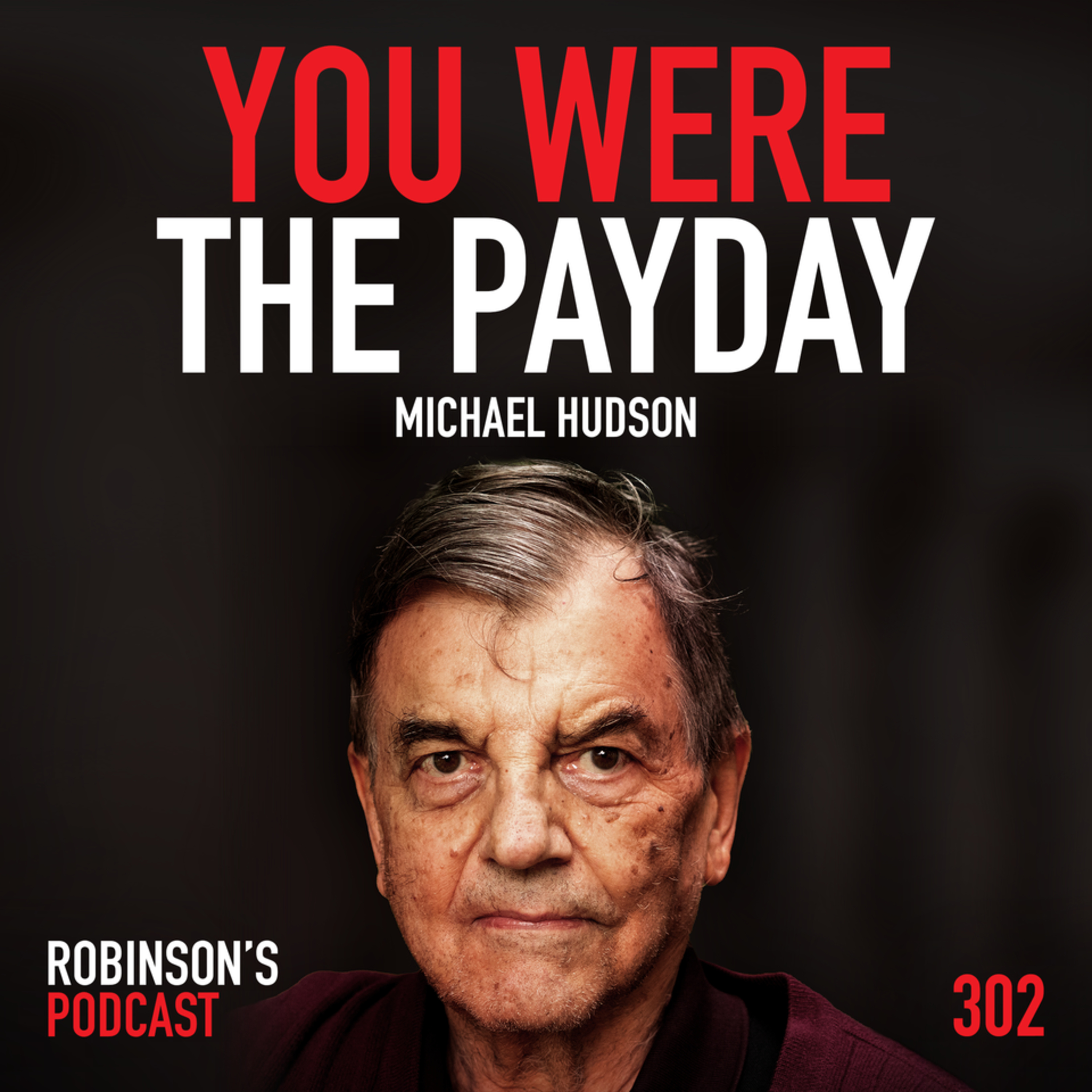
302 - Michael Hudson: Trump Is Looting America | On Billionaires, Wall Street, and the Oil Wars

Support the Show: https://www.youtube.com/channel/UCsxwneBx6apV1mQ7CbWKfXQ/join Michael Hudson is an economist, financial historian, and distinguished research professor of economics at the University of Missouri–Kansas City. In this episode, Michael and Robinson discuss how financialization has changed the American economy, why working for a living has become harder, and the growing power of billionaires. More particularly, they talk about Trump and political influence, oil wars involving Iran and Russia, their consequences for fuel and food prices, and Hudson’s argument that China is using the industrial model America abandoned. They also discuss private equity, public banking, de-dollarization, AI, ancient debt jubilees, and the difference between creating wealth and collecting economic rent. Michael’s most recent published book is Temples of Enterprise (2024). Michael’s Website: https://michael-hudson.com/ Temples of Enterprise: https://michael-hudson.com/2024/05/temples-of-enterprise/ OUTLINE 00:00 Highlights 00:39 Inherited Wealth and Earning a Living 07:03 Financialization, Bank Bailouts, and Private Equity 13:05 Industrial Capitalism, Banking, and Colonial Debt 25:39 Public Investment, Technology, and the Managerial Class 33:18 Reagan, Thatcher, and Privatization 46:35 Oil Wars, Fuel Shortages, and Food Prices 54:06 Debt Jubilees and the Rise of Ancient Oligarchies 1:00:42 Empire, Oil, and Economic Dependence 1:06:24 De-Dollarization, BRICS, and Public Money 1:13:08 Economic Rent, Value, and the Cost of Living 1:27:51 Neoliberalism and the Rejection of Classical Economics 1:39:19 Pension Funds and the Financialization of Retirement 1:45:06 China’s Industrialization and Public Banking 1:59:15 China’s Property Bubble and Evergrande 2:11:16 Billionaires and Wealth Concentration 2:15:22 Trump, Political Influence, and Regulatory Capture 2:26:59 AI, Intellectual Property, and Social Costs 2:30:58 Billionaires in China and Russia 2:36:21 Gulf Monarchies, Oil Wealth, and the United States 2:45:45 Democracy, Oligarchy, and US Foreign Policy 2:55:41 Alternatives to the Rentier Economy 3:01:16 Michael’s Outlook for the Next Few Years Robinson’s Website: https://robinsonerhardt.com/ Robinson Erhardt researches symbolic logic and the foundations of mathematics at Stanford University, where he is also a JD candidate in the Law School. Disclaimer: Robinson’s Podcast is a forum for open discussion. Guests’ views are their own and do not necessarily reflect Robinson's. Hosting a guest does not imply that he endorses the views or opinions they express.
3 h 06 minAbspielen in:

Do22Okt
Robinson's PodcastJessica Tarlov

Jessica TarlovGast

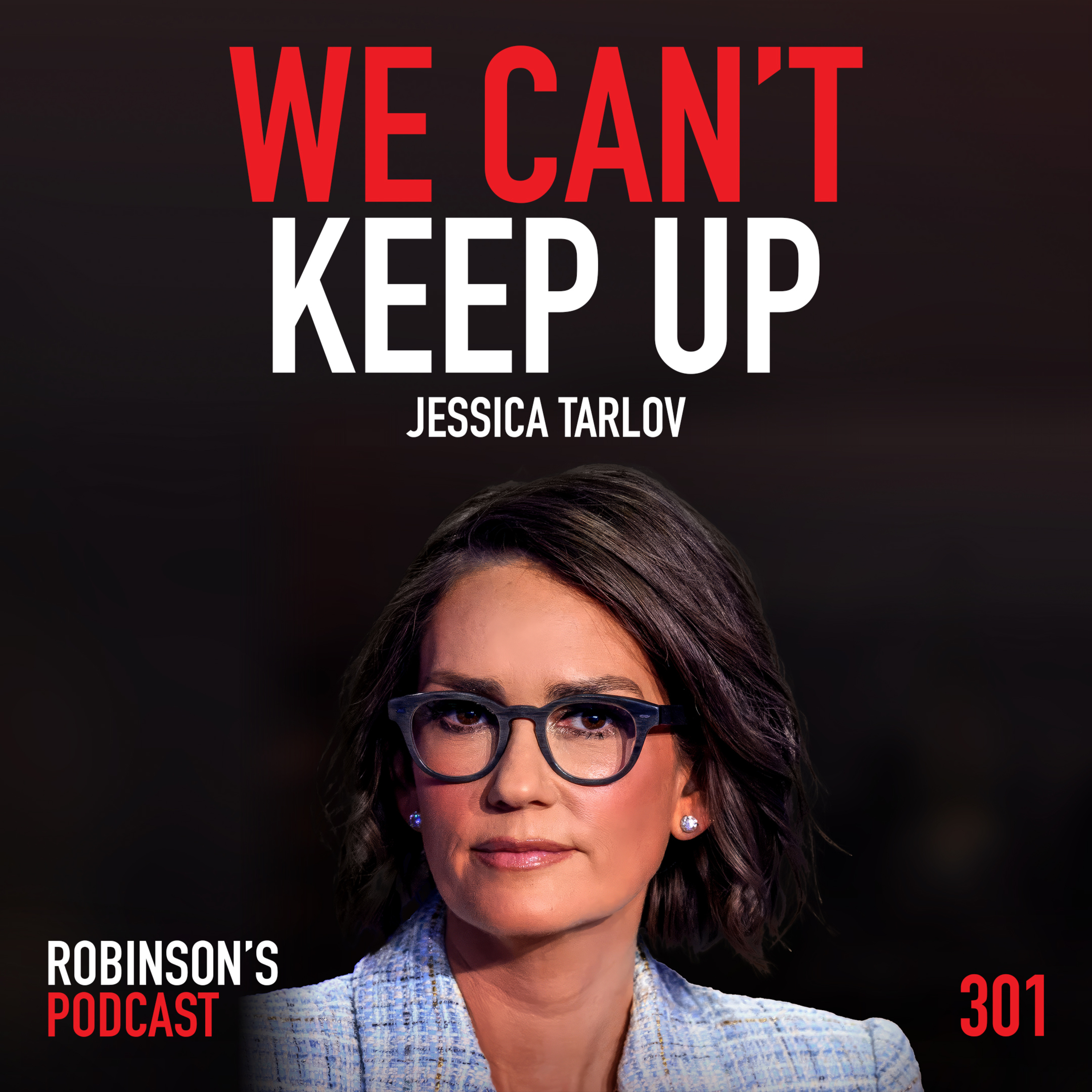
301 - Jessica Tarlov: Trump’s Economy Is Pricing You Out | On Fox News, Healthcare, Billionaires, and 2026

Support the Show: https://www.youtube.com/channel/UCsxwneBx6apV1mQ7CbWKfXQ/join Jessica Tarlov is a political strategist and co-host of The Five on Fox News and Raging Moderates with Scott Galloway. She holds a PhD in political science from the London School of Economics. In this episode, Jessica and Robinson discuss Trump’s political vulnerabilities, the Democrats’ prospects in the 2026 midterms, and how to argue across political divides. More particularly, they talk about immigration and ICE, healthcare costs, the debate over billionaire donors, and Jessica’s view that Trump’s corruption is catching up with him. They also discuss Democratic purity tests, criticism of Trump from the right, Jessica’s career on Fox News, and the cases for James Talarico, Abdul El-Sayed, Jon Ossoff, and Mary Peltola. Jessica’s latest book is I Disagree: Winning Arguments Without Losing Friends (Random House, 2026). Jessica on Fox News: https://www.foxnews.com/person/t/jessica-tarlov Raging Moderates: https://podcasts.voxmedia.com/show/raging-moderates I Disagree: https://www.penguinrandomhouse.com/books/803493/i-disagree-by-jessica-tarlov/ OUTLINE 00:00 Is Immigration Trump’s Greatest Strength? 03:34 Why Admitting You’re Wrong Makes You More Persuasive 06:04 What Do Democrats Stand For? 08:32 How to Disagree Without Losing Friends 10:10 Healthcare, Billionaires, and the Democrats’ Dilemma 12:25 Why Do Billionaires Back Democrats? 17:39 How Jessica Tarlov Found Her Voice on Fox News 26:19 Can Democrats Win Over Conservative Voters? 27:21 Should Voting Be Mandatory? 32:59 Why Talarico Wants to Turn Texas Purple 34:47 How to Win Progressives Without Passing Every Purity Test 39:02 Nick Fuentes, Trump’s Weakness, and the Limits of Debate 42:01 Why Jon Ossoff Is a Democrat to Watch 44:42 Why Jessica Tarlov Is Backing Mary Peltola 47:16 Bobby Pulido, Cait Conley, and the Democrats to Watch 54:42 The Case for El-Sayed and Talarico Robinson Erhardt researches symbolic logic and the foundations of mathematics at Stanford University, where he is also a JD candidate in the Law School. Disclaimer: Robinson’s Podcast is a forum for open discussion. Guests’ views are their own and do not necessarily reflect Robinson's. Hosting a guest does not imply that he endorses the views or opinions they express.

1 h 01 minAbspielen in:

Do15Okt
Robinson's PodcastPR

Prof Robert PapeGast

299 - Robert Pape: Trump Is Making Iran STRONGER—and America WEAKER

Support the Show: https://www.youtube.com/channel/UCsxwneBx6apV1mQ7CbWKfXQ/join Robert Pape is Professor of Political Science at the University of Chicago and director of the Chicago Project on Security and Threats. In this episode, Robert and Robinson discuss why the Iran war has become an escalation trap for Donald Trump, the United States, and Israel. More particularly, they talk about Pape’s argument that the war has strengthened Iran while weakening America’s regional position, Iran’s leverage over the Strait of Hormuz, and how cheap drones and precision weapons are changing the balance of military power. They also discuss how the 2026 midterms could prolong escalation, the limits of predicting war, how AI could make political assassinations easier, and the risks of weapons operating without human oversight. Robert’s latest book is Our Own Worst Enemies: America in the Age of Violent Populism (The New Press, 2026). Robert’s Substack (Prof Robert Pape): https://professorrobertpape.substack.com/ Robert’s Substack (Escalation Trap): https://escalationtrap.substack.com/ Robert’s YouTube: https://www.youtube.com/@ProfRobertPape Our Own Worst Enemies: https://thenewpress.org/books/our-own-worst-enemies/ OUTLINE 00:00 Introduction 00:45 Why the Iran War Is Nowhere Near Over 08:08 How Iran Can Defy a Superpower 15:22 How Cheap Drones Changed the Balance of Power 20:31 Is America Building Weapons for the Wrong War? 29:00 Why War Experts Must Risk Being Wrong 40:25 Has Pape Been Wrong About Iran? 45:33 How Time Shifts the Balance of Power 51:23 Why the 2026 Midterms May Prolong the Iran War 55:16 How a Leader’s Health Can Change a War 1:01:40 How Assassinations and Elections Can Upend the World 1:05:28 Is AI Making Iran’s Attacks More Deadly? 1:07:38 Could AI Make Assassinations Easier? 1:13:36 Could Hezbollah Shut Down Israel’s Ports? 1:18:25 When Weapons Act Without Human Control Robinson Erhardt researches symbolic logic and the foundations of mathematics at Stanford University, where he is also a JD candidate in the Law School.

1 h 25 minAbspielen in:

Di13Okt
Robinson's PodcastRick Wilson

Rick WilsonGast

298 - Rick Wilson: Trump Killed the Republican Party | On MAGA, Tucker Carlson, and 2028

Rick Wilson is a political strategist, author, and co-founder of The Lincoln Project. After decades working in Republican politics, he became a prominent conservative critic of Donald Trump. In this episode, Rick and Robinson discuss the Republican Party Rick believes Trump has destroyed, America’s changing position in the world, and the struggle to defeat Trumpism. More particularly, they talk about the GOP’s competing factions, Trump’s relationships with Benjamin Netanyahu and Vladimir Putin, and American policy toward Iran and Venezuela. They also discuss divisions among Democrats, Bernie Sanders and the progressive left, Abdul El-Sayed and James Talarico, the influence of podcasts and social media, and the prospects for the 2026 and 2028 elections. Rick’s books include Running Against the Devil (Forum Books, 2020). Rick’s Website: https://www.therickwilson.com/ Running Against the Devil: https://www.penguinrandomhouse.com/books/623822/running-against-the-devil-by-rick-wilson/ OUTLINE 00:00 Introduction 00:47 The Best Reasons for Voting Trump 02:16 The Republican Party Is Broken into Three Pieces 09:16 Why Rick Left the Republican Party 13:58 The United States' Fall from Grace 24:27 How Netanyahu Plays Trump 28:21 Deconstructing Trump's Takeover of Venezuela 31:43 Why Democrats Can’t Get Their Act Together 35:35 Why Progressives Struggle to Win the Presidency 39:46 El-Sayed Has 'The Gift' 42:40 Podcasts and Elections 45:06 Nick Fuentes and the Groypers 51:58 Will Trump Be President Forever? 53:33 Talarico and the Republicans' Loss 56:38 Why Trump Could Cost Republicans 2028 Robinson Erhardt researches symbolic logic and the foundations of mathematics at Stanford University, where he is also a JD candidate in the Law School.

1 h 02 minAbspielen in:

Sa10Okt
Robinson's PodcastAnne Applebaum

Anne ApplebaumGast

297 - Anne Applebaum: Trump Is Building an Autocracy | On Putin, Kushner, and America’s Future

Anne Applebaum is a Pulitzer Prize-winning historian and staff writer at The Atlantic. Her work focuses on authoritarianism, democracy, and the history of Central and Eastern Europe. In this episode, Anne and Robinson discuss corruption, foreign policy, and the threat of autocracy in Donald Trump’s America. More particularly, they talk about Anne’s assessment of unprecedented corruption, Trump’s relationship with Vladimir Putin, and Jared Kushner and Steve Witkoff’s involvement in diplomacy and business negotiations. They also discuss China’s mass surveillance system, the power of tech companies to suppress political campaigns, retaliation against political opponents, and whether the 2026 elections can slow America’s democratic decline. Anne’s recent book is Autocracy, Inc.: The Dictators Who Want to Run the World (Doubleday, 2024). Anne’s Website: https://www.anneapplebaum.com/ Autocracy, Inc.: https://www.anneapplebaum.com/book/autocracy/ OUTLINE00:00 Introduction00:40 Trump’s Latest Corruption Is Unprecedented07:56 Trump’s Foreign Policy Has No Strategy10:41 Trump Is Anti-Isolationist13:32 Donald Trump’s Greatest Enemies18:57 Trump’s USA Is Becoming an Autocracy26:17 Trump Is Copying China’s Mass Surveillance31:09 How Tech Billionaires Secretly Control Politicians35:46 Are Assassinations Coming to the USA?39:22 The 2026 Elections Will Limit Donald Trump42:41 Will Trump’s USA Become a New Russia? Robinson Erhardt researches symbolic logic and the foundations of mathematics at Stanford University, where he is also a JD candidate in the Law School.

48 minAbspielen in:

Mi7Okt
Robinson's PodcastNorman Finkelstein

Norman FinkelsteinGast

296 - Norman Finkelstein: Gaza SHATTERED Israel’s Story | October 7, Three Years Later

Norman Finkelstein is a political scientist and author who received his PhD in politics from Princeton University. His work focuses on political theory, the Israel-Palestine conflict, and the Holocaust. In this episode, Norman and Robinson discuss Gaza, Israel, and the Middle East three years after October 7. More particularly, they talk about changing public opinion, free speech on American campuses, Norman’s rejection of the claim that Netanyahu knowingly allowed the attacks, Israel’s goals in Gaza and the wider region, and Iran’s confrontation with Israel and the United States. They also discuss Donald Trump’s political appeal, Bernie Sanders, China’s role in the conflict, Hannah Arendt, Norman’s mother’s testimony at a Nazi war-crimes trial, and his friendship with Noam Chomsky. Norman’s recent book is Gaza’s Gravediggers: An Inquiry into Corruption in High Places (OR Books, 2026). Norman’s Website: https://www.normanfinkelstein.com/ Gaza’s Gravediggers: https://orbooks.com/catalog/gazas-gravediggers/ OUTLINE 00:00:00 Introduction 00:01:02 What We’ve Learned Since October 7, 2023 00:06:00 The Sheer Insanity of Israel’s War on Gaza 00:09:06 Why Young People See Themselves in Gaza 00:12:51 Jewish-Muslim Unity 00:14:02 How Free Speech Crumbled Over Gaza 00:24:05 Why Won’t Anyone Review Norman Finkelstein’s New Book? 00:29:04 Did Netanyahu Allow Hamas to Attack on October 7th? 00:35:31 Why Israel Still Backs Netanyahu 00:41:12 Finkelstein: Israel Is a Lunatic Society 00:53:55 How Did Hamas Get Past Israeli Intelligence? 00:59:06 Israel’s Three Goals After October 7 01:07:53 What Hezbollah Lost With Nasrallah 01:09:32 Think Twice Before You Play with Iran 01:11:10 Can Anyone Control Israel? 01:13:36 Israel Underestimated Iran’s 5,000-Year-Old Civilization 01:30:01 The Two Things Trump Really Cares About 01:40:17 Trump Isn’t Media-Savvy—His Opponents Are Phony 01:54:43 Talking About Trump Is a Waste of Time Robinson Erhardt researches symbolic logic and the foundations of mathematics at Stanford University, where he is also a JD candidate in the Law School.

2 h 15 minAbspielen in:

Sa3Okt
Robinson's PodcastRW

Richard WolffGast

295 - Richard Wolff: Trump’s America Is OVER

Richard D. Wolff is Professor of Economics Emeritus at the University of Massachusetts Amherst and a visiting professor in the Graduate Program in International Affairs at The New School. He is also co-founder of Democracy at Work and host of Economic Update. In this episode, Richard and Robinson discuss Donald Trump, socialism in the United States, and Richard’s disagreements with Victor Davis Hanson. More particularly, they talk about Richard’s case against Trump, his criticisms of Hanson’s understanding of socialism, American power, European colonialism, Russia and NATO, and Israel. They also discuss James Talarico and Abdul El-Sayed, the history of American socialism, the minimum wage, money in politics, Thomas Massie, JD Vance’s relationship with Peter Thiel, and Richard’s experience running for city council. Richard’s books include Understanding Capitalism (Democracy at Work, 2024). Richard’s Website: rdwolff.com Democracy at Work: democracyatwork.info Understanding Capitalism: democracyatwork.info/understanding_capitalism OUTLINE00:00:00 Introduction00:01:03 Republicans Should Vote (About) Trump!!!00:07:05 America Is Getting Weaker!00:11:53 Trump’s America Is Over00:14:14 Trump’s America Has Forgotten Its History00:19:12 Is There Still a Good Case for Trump?00:26:23 Trump’s Promises He Cannot Keep!00:34:53 Recap: Richard Wolff vs Victor Davis Hanson 202600:41:06 The Red Scare in the Cold War00:44:23 Victor Davis Hanson Doesn’t Understand Socialism!00:48:06 Victor Davis Hanson Equates Socialism and Immigrants01:05:01 Trump and Europe’s Colonialism Is Over!01:08:48 Russia Is a Victim of NATO01:11:24 Israel Has Been Bombed01:15:52 Richard Wolff’s Problem with James Talarico01:25:22 Socialists Ruled the United States01:28:28 The Rich Screwed the Poor on the Minimum Wage01:33:08 Why Don’t Socialists Want Trump’s Free $5,000?01:35:18 Why Money Must Get Out of Politics01:44:41 Does Abdul El-Sayed Have “the Gift”?01:48:27 French Socialism vs American Socialism01:54:43 Why Americans Can’t Get into Socialism02:03:16 Richard Wolff Is Struck by Thomas Massie02:04:50 When Richard Wolff Ran for City Council02:09:20 JD Vance Is Funded by Peter Thiel!02:16:53 What Is Democracy at Work? Robinson Erhardt researches symbolic logic and the foundations of mathematics at Stanford University, where he is also a JD candidate in the Law School.

2 h 29 minAbspielen in:

Mo28Sep
Robinson's PodcastMichael Hudson

Michael HudsonGast

294 - Michael Hudson: Iran, Oil, and Global Depression

Michael Hudson is Distinguished Research Professor of Economics at the University of Missouri, Kansas City and President of the Institute for the Study of Long-Term Economic Trends. He researches domestic and international finance, economic history, and the role of debt in shaping economies and societies. In this episode, Michael and Robinson discuss the war in Iran and Michael’s prediction that it will cause a global depression. More particularly, they talk about oil and the Strait of Hormuz, which countries Michael thinks will suffer most, his skepticism about the changes the 2026 elections can deliver, and his criticisms of how economists describe the American economy. They also discuss AI and the future of employment, Donald Trump’s foreign policy, China’s role in the international economic order, instability in Europe, and the future of the United States. Michael’s recent book is Temples of Enterprise (ISLET, 2024). Michael’s Website: https://michael-hudson.com Temples of Enterprise: https://a.co/d/a3c53dm OUTLINE00:00 Introduction00:23 Iran War Will Cause a Global Depression10:57 The 2026 Elections Mean Nothing19:45 2026 Voters Can Do Nothing About AI, Israel, or Iran30:51 Economists Are Lying About the State of the Economy38:02 Different Economic Metrics42:25 AI and an Employment Collapse48:35 Trump Is Choking the World's Oil59:32 The Strait of Hormuz1:04:16 The Iran War Will Destroy These Countries First1:12:27 Trump Wants the World to Pay Tribute1:17:43 Is China the Hero?1:28:16 Destabilization in Europe1:37:32 Anti-Protest Drone1:40:20 What Does Chinese Dominance Look Like?1:46:15 Where Does History Go from Here?1:55:39 Where Does the United States Go from Here? Robinson Erhardt researches symbolic logic and the foundations of mathematics at Stanford University, where he is also a JD candidate in the Law School.

2 h 02 minAbspielen in:

Sa26Sep
Robinson's PodcastJustin Wolfers

Justin WolfersGast

293 - Justin Wolfers: AI, Inflation, & The 2026 Elections

Platypus Economics on YouTube: https://www.youtube.com/@PlatypusEconomics Justin Wolfers is Professor of Public Policy and Economics at the University of Michigan, where his research spans macroeconomics, labor economics, political economy, and behavioral economics. He is also affiliated with the Brookings Institution, Peterson Institute for International Economics, and National Bureau of Economic Research, and in 2026 launched Platypus Economics, a new media platform devoted to making economics accessible to a broad audience. In this episode, Robinson and Justin discuss the intersection of economics, technology, and American politics. More particularly, they talk about Elon Musk and the influence of extreme wealth on elections, how artificial intelligence could transform the labor market, whether current economic data accurately reflects Americans’ experiences, and political bias in economics. They also discuss inflation, Justin’s criticisms of the Trump administration’s economic policies, proposed $5,000 checks, and how economic considerations shape political choices. Platypus Economics: https://platypuseconomics.com Justin’s University of Michigan Profile: https://fordschool.umich.edu/faculty/justin-wolfers Justin’s X: https://x.com/JustinWolfers Justin’s Bluesky: https://bsky.app/profile/justinwolfers.bsky.social Platypus Economics Newsletter: https://newsletter.platypuseconomics.com 00:00 Introduction 00:25 Elon Musk Can Buy ANY Election He Wants 07:21 AI Could DESTROY Jobs If We Don’t Do This 14:28 Is Current Econ Data Misleading? 19:36 Political Bias in Economics 28:35 Corruption in the Trump Admin 36:33 Understanding Inflation and Cheap Candy 44:58 Is Trump Personally Responsible for Inflation? 51:40 Trump’s 5k Checks Are IDIOTIC LIES 56:50 How to Vote If Trump Were on Ballot Robinson Erhardt researches symbolic logic and the foundations of mathematics at Stanford University, where he is also a JD candidate in the Law School.

1 h 04 minAbspielen in:

Mi23Sep
Robinson's PodcastJS

Jason StanleyGast

292 - Jason Stanley: Breaking Down Trump’s Propaganda

Jason Stanley is the Bissell-Heyd-Associates Chair in American Studies at the Munk School of Global Affairs & Public Policy at the University of Toronto, where he is also Professor of Philosophy. Before moving to Toronto in 2025, he was the Jacob Urowsky Professor of Philosophy at Yale University. Jason’s work focuses on propaganda, authoritarianism, democracy, free speech, and political language. In this episode, Robinson and Jason discuss Jason’s account of how political propaganda has changed during the Trump era. More particularly, they talk about soft and hard propaganda, social media and political bots, Trump’s political communication, Jason’s decision to leave Twitter and later the United States, and the effects of online attacks. They also discuss artificial intelligence and democracy, the political influence of tech billionaires, Elon Musk and Peter Thiel, and Jason’s transition toward the philosophy of propaganda. Jason’s most recent book is Erasing History: How Fascists Rewrite the Past to Control the Future (Atria/One Signal, 2024). Jason’s Website: https://jasonstanley.org How Propaganda Works: https://www.amazon.com/s?k=Jason+Stanley+How+Propaganda+Works Erasing History: https://www.amazon.com/s?k=Jason+Stanley+Erasing+History OUTLINE 00:00 How Propaganda Has Changed with Donald Trump 10:42 Soft and Hard Propaganda 13:56 Defining Propaganda 25:01 Is Trump Trying to Broaden Popular Support? 30:12 Trump Is Ruining Democracy 33:15 Social Media is Political Theater for BOTS 45:39 Why Jason Left Twitter 49:54 Attacks Against Jason on Twitter 53:20 The Terrible Cost of Leaving the US 01:04:56 How AI Threatens Democracy 01:08:26 Tech Billionaires Want to Wipe Out Humanity 01:12:02 Elon Musk's Secret Plans  01:14:30 Does Peter Thiel Want All Humans Dead? 01:17:37 Jason's Transition to Philosophy of Propaganda Robinson Erhardt researches symbolic logic and the foundations of mathematics at Stanford University, where he is also a JD candidate in the Law School.

1 h 24 minAbspielen in:

So20Sep
Robinson's PodcastDaron Acemoglu

Daron AcemogluGast

291 - Daron Acemoglu: AI Is Destroying American Democracy

Daron Acemoglu is an Institute Professor of Economics at MIT and a recipient of the 2024 Nobel Memorial Prize in Economic Sciences, which he shared with Simon Johnson and James Robinson for research on how institutions shape prosperity. He is also the bestselling co-author of Why Nations Fail, The Narrow Corridor, and Power and Progress. In this episode, Robinson and Daron discuss the future of liberal democracy in an age of artificial intelligence. More particularly, they talk about how AI could undermine democratic institutions, whether tech billionaires have accumulated too much power, and why Daron believes current approaches to AI could produce an increasingly unequal, two-tier American society. They also discuss the importance of the 2026 elections, Zohran Mamdani, disagreements between the center and far left, and Daron’s proposal for a renewed “working-class liberalism.” Daron’s latest book is What Happened to Liberal Democracy?: Remaking a Politics of Shared Prosperity (Dutton, 2026). Daron’s Website: https://www.daronacemoglu.com What Happened to Liberal Democracy?: https://a.co/d/0f0qGMxt OUTLINE 00:00 What Is Liberal Democracy? 09:30 How Does AI Undermine Democracy? 18:30 Are the Tech Billionaires Out of Control? 24:50 AI Is an Existential Threat 27:18 How AI Will Turn the USA into a Two-Tier Dystopia 35:17 Other Views on AI 38:19 Why the 2026 Elections Are So Important for the Left 42:30 What Makes Mamdani a Great Politician? 45:58 The Far Left vs the Center Left: Who Should Win? 52:00 Working Class Liberalism

1 h 00 minAbspielen in:

So13Sep
Robinson's PodcastNH

Nicholas HumphreyGast

290 - Nicholas Humphrey: Why Does Beauty Exist?

Why Is the World So Beautiful?: https://a.co/d/0d3LsupA Nicholas Humphrey is a theoretical psychologist and Emeritus Professor of Psychology at the London School of Economics, where his work has focused on the evolution of intelligence and consciousness. Among his many contributions, he was the first to demonstrate “blindsight” in monkeys, studied mountain gorillas with Dian Fossey, and developed influential theories about the social evolution of intelligence. In this episode, Robinson and Nicholas discuss the evolutionary origins of beauty and why human beings are so drawn to it. More particularly, they talk about rhyme, pattern-recognition, the adaptive value of aesthetic experience, the relationship between beauty and social life, and the methodology of evolutionary psychology. They also discuss whether beauty implies agency or creation, difficult cases for an evolutionary theory of aesthetics, spirituality and transcendence, and why some art is deliberately ugly. Nicholas’s upcoming book is Why Is the World So Beautiful? Our Minds in Search of Nature’s Rhymes (MIT Press, 2026). Nicholas’s Website: https://humphrey.org.uk OUTLINE 00:00 Why Is the World So Beautiful? 08:48 What Is Rhyme? 18:47 The Utility of Beauty 24:09 Beauty and Pattern-Recognition 34:26 Beauty and Society 41:21 The Methodology of Evolutionary Psychology 49:20 Creation and Agency 56:24 Problem Cases 01:02:26 Spirituality and Transcendence 01:07:34 Ugly Art

1 h 18 minAbspielen in:

So6Sep
Robinson's PodcastJH

Joe HenrichGast

289 - Joe Henrich: How Culture Made Humans Weird

Joe Henrich is the Ruth Moore Professor of Biological Anthropology and Professor of Human Evolutionary Biology at Harvard University. His research focuses on cultural evolution, human psychology, sociality, prestige, cooperation, and the emergence of complex societies. In this episode, Robinson and Joe discuss how culture transformed human evolution and enabled our species to build increasingly large and complex societies. More particularly, they talk about the tools of paleoanthropology, hunter-gatherer societies, the rise of massive cities, and why Western, Educated, Industrialized, Rich, and Democratic—or WEIRD—people are psychologically unusual. They also discuss dominance hierarchies, attractiveness and prestige, the evolution of morality, and the importance of punishment in human societies. Joe’s most recent popular book is The WEIRDest People in the World: How the West Became Psychologically Peculiar and Particularly Prosperous (Farrar, Straus and Giroux, 2020). Joe’s Website: https://henrich.fas.harvard.edu The WEIRDest People in the World: https://amzn.to/3F3wUY7 OUTLINE 00:00 Tools of Paleoanthropology 07:31 Two Hunter-Gatherer Societies 13:12 How Culture Enabled Massive Cities 19:08 The WEIRDEST People in the World 25:59 Dominance Hierarchies 35:40 Attractiveness and Prestige 46:01 The Evolution of Morality 52:33 Punishment Robinson Erhardt researches symbolic logic and the foundations of mathematics at Stanford University, where he is also a JD candidate in the Law School.

1 h 01 minAbspielen in:

So30Aug
Robinson's PodcastRW

Richard WranghamGast

288 - Richard Wrangham: How Humans Caught Fire

Richard Wrangham is the Ruth Moore Professor of Biological Anthropology, Emeritus, at Harvard University. A primatologist and biological anthropologist, he has studied wild chimpanzees in Uganda since 1987 and is known for his work on human evolution, the origins of violence, and the role of cooking in shaping our species. In this episode, Robinson and Richard discuss how humans diverged from our primate ancestors and the evolutionary importance of learning to control fire. More particularly, they talk about Richard’s cooking hypothesis, how cooking may have transformed the human brain and body, the relationship between fire and culture, and what chimpanzee behavior can teach us about the origins of human violence. Richard’s books include Catching Fire: How Cooking Made Us Human, Demonic Males: Apes and the Origins of Human Violence, and The Goodness Paradox: The Strange Relationship Between Virtue and Violence in Human Evolution.Richard’s Harvard Profile: https://heb.fas.harvard.edu/people/richard-w-wranghamCatching Fire: How Cooking Made Us Human: https://a.co/d/0iaxEBhyOUTLINE00:00 Puzzles Posed by Human Beings09:32 The Cooking Hypothesis17:54 Cooking and the Brain22:12 Diverging From Our Ancestors28:27 Playing with Fire35:19 How Cooking Shaped Culture51:29 What Does Chimpanzee Warfare Look Like?01:04:50 Chimpanzee vs Human ViolenceRobinson Erhardt researches symbolic logic and the foundations of mathematics at Stanford University, where he is also a JD candidate in the Law School.

1 h 14 minAbspielen in:

So23Aug
Robinson's PodcastDaniel Lieberman

Daniel LiebermanGast

287: Daniel Lieberman: Evolution and the Human Diet

Daniel Lieberman is the Edwin M. Lerner II Professor of Biological Sciences and Professor of Human Evolutionary Biology at Harvard University, where he studies the evolution of the human body and its relevance to health. In this episode, Robinson and Dan discuss the evolution of the human diet. More particularly, they talk about our last common ancestors with chimpanzees, how changes in the gut shaped human evolution, what Homo sapiens actually ate during the Paleolithic, and the transformative role of cooking. They also discuss whether there is such a thing as a natural human diet, why junk food is so appealing, and what an evolutionary perspective can teach us about weight loss and eating well. Dan’s latest book is Fed Up: What Evolution Reveals About Food, Diet, Health, and Eating Well (Knopf, 2026). Fed Up: https://www.amazon.com/dp/0593537998 OUTLINE 00:00 Dan’s Interest in Human Evolution 04:43 Why Our Heads Don’t Topple Over When We Run 07:41 Human Evolution and “Fed Up” 10:40 Understanding the Evolution of the Human Diet 19:12 Our Last Common Ancestors with Chimpanzees 30:05 Evolutionary Changes in the Gut 38:51 Homo Sapiens and the Paleolithic Diet 48:18 The Transformative Power of Cooking 54:30 The Most Important Diets 59:19 Why Are Junk Foods So Appealing? 01:03:19 Weight Loss Robinson Erhardt researches symbolic logic and the foundations of mathematics at Stanford University, where he is also a JD candidate in the Law School.

1 h 12 minAbspielen in:

So16Aug
Robinson's PodcastAM

Adam MocklerGast

286: Adam Mockler: Trump, Newsom, and the Dark Future of American Politics

Adam Mockler is a liberal political commentator, YouTube host, and digital media creator who has become one of the most prominent Gen Z voices in American political media. He hosts The Adam Mockler Show and has built an audience of more than two million subscribers on YouTube, where he produces daily political commentary and reporting. In this episode, Robinson and Adam discuss the changing relationship between politics, media, and the internet. More particularly, they talk about Adam’s liberal values, why independent media can outperform legacy media, the battle for attention online, how clipping has become a new form of political canvassing, and what Democrats need to do to win elections in 2026. They also discuss Charlie Kirk, political conspiracy theories and death threats, what Nick Fuentes is doing effectively as a communicator, Gavin Newsom’s media strategy, and whether Generation Alpha speaks a fundamentally different political language. Adam’s Website: https://www.adammockler.com Adam’s Instagram: https://www.instagram.com/adammockler/ Adam’s YouTube Channel: https://www.youtube.com/@adammockler Adam’s TikTok: https://www.tiktok.com/@adammockler Adam’s X: https://x.com/adammocklerr OUTLINE 00:45 Adam’s Expertise 10:53 Adam’s Liberal Values 14:30 Why Independent Media Beats Legacy Media 18:26 Clipping Is the New Canvassing 20:39 The Battle for the Attention Economy 26:06 How to Win Elections in 2026 31:16 What Constraints Are There on Independent Media? 38:44 On Charlie Kirk, Conspiracies, and Death Threats 41:46 What Is Nick Fuentes Doing Right? 47:18 Gavin Newsom’s Media Strategy, Explained 52:46 Does Gen Alpha Speak a New Political Language? Robinson Erhardt researches symbolic logic and the foundations of mathematics at Stanford University, where he is also a JD candidate in the Law School.

1 h 02 minAbspielen in:

Sa1Aug
Robinson's PodcastSteve Keen

Steve KeenGast

284 - Steve Keen: The Economics of Global Warfare

Steve Keen is an economist and was most recently Head of the School of Economics, History and Politics at Kingston University in London. He has done research on a wide variety of topics, including Marxist economics, debt, complexity theory, and systems dynamics. In this episode, Steve and Robinson discuss his economic framework in relation to wars around the globe. More particularly, the discuss the importance of oil in the Iran War, the cold war with China, the war in Ukraine, and more. OUTLINE 00:00 The Crucial Importance of Oil in the Iran War 08:54 Systems Dynamics and Economics 14:22 How Much Inflation Will the Iran War Cause? 18:17 Will the Iran War Cause Famine? 28:56 Conspiracy and the Iran War 30:48 Tariffs and Trade Deficits 46:03 Will Trump’s Tariffs Bring Manufacturing Back to the United States 52:49 Steve’s Motivation 59:25 The Crucial Flaw in Marxism 01:12:43 Understanding the War in Ukraine’s Impact on Europe 01:16:38 On Putin’s Motivations in Ukraine 01:26:32 Understanding Trump through Narcissistic Personality Disorder 01:32:52 Trump and the Takeover of Venezuela 01:38:11 Economists Misunderstand Everything About China 01:53:01 Why Will China Survive Global Warming? 01:57:18 AI and the Future Economics of the World Robinson Erhardt researches symbolic logic and the foundations of mathematics at Stanford University, where he is also a JD candidate in the Law School.

2 h 03 minAbspielen in:

So19Jul
Robinson's PodcastTimothy Snyder

Timothy SnyderGast

283 - Timothy Snyder: Donald Trump and the End of America

Timothy Snyder holds the inaugural Temerty Chair in Modern European History at the Munk School of Global Affairs and Public Policy at the University of Toronto. Snyder’s work has appeared in forty languages and has received a number of prizes, including the Emerson Prize in the Humanities. Snyder was a Marshall Scholar at Oxford, has received the Carnegie and Guggenheim fellowships, and holds state orders from Estonia, Lithuania, and Poland. He is researching a family history of nationalism and finishing a philosophical book about freedom. In this episode, Robinson and Timothy discuss the future of the United States. More particularly, they delve into AI, rebellion, conspiracy theory, our relationship with Russia and Ukraine, Donald Trump, and more. Timothy’s most recent book is On Freedom (Crown, 2024). Timothy’s Website: https://timothysnyder.org On Freedom: https://timothysnyder.org/books/ OUTLINE 00:00 Will the United States Cease to Exist? 13:47 Is Trump Breaking the United States Apart? 21:09 Will AI Prevent Armed Rebellion Against the Government? 30:20 Trump, Conspiracy Theories, and the Politics of Small Numbers 39:46 Putin Does Not Think Ukraine Is Real 45:57 What Are Trump’s Soft Spots? 50:26 How Tim Organizes His Thought 57:59 Donald Trump and the Superloser Robinson Erhardt researches symbolic logic and the foundations of mathematics at Stanford University, where he is also a JD candidate in the Law School.

1 h 05 minAbspielen in:

So12Jul
Robinson's PodcastRW

Richard WolffGast

282 - Richard Wolff: China, Russia, Iran, and World War III

Richard Wolff is Professor Emeritus of Economics at the University of Massachusetts Amherst and a visiting professor at The New School, where he works on economics in the Marxist tradition. This is Richard’s eleventh appearance on Robinson’s Podcast. In this episode, Richard and Robinson discuss the ongoing war in Iran, as well as the war in Russia and Ukraine, our cold war with China, and the future possibilities of World War III. Richard’s latest book is Understanding Capitalism (Democracy at Work, 2024). Understanding Capitalism (Book): https://www.democracyatwork.info/understanding_capitalism Richard’s Website: https://www.rdwolff.com Economic Update: https://www.democracyatwork.info/economicupdate OUTLINE 00:00 China, Iran, and the Implosion of the West 13:00 The Irreconcilable Gulf Between Russia and the West 16:01 Europe’s Hard World War II Lesson 21:20 Europe’s Final Collapse Is Coming 28:42 How China Is Methodically Conquering the World 35:44 Russia’s Siberian Advantage 39:15 Marx, War, and Economic Decline 52:39 Why Iran Will Always Control the Strait of Hormuz 01:02:02 How the United States Already Failed in Iran 01:06:37  What the United States Can Learn from the Collapse of the British Empire 01:12:19 Why the War in Iran Will Not Lead to Nuclear War 01:14:44 John Mearsheimer’s Escalation Ladder and the Threat of Nuclear War in Russia 01:29:53 What Would World War Look Like in the 21st Century? 01:36:17 Donald Trump, The Isolator 01:41:40 The Sad Legacy of the League of Nations 01:51:04 Is World War III Inevitable?

2 h 04 minAbspielen in:

Mo6Jul
Robinson's PodcastMichael Hudson

Michael HudsonGast

281 - Michael Hudson: How Debt Destroys Empires

Michael Hudson is Distinguished Research Professor of Economics at the University of Missouri, Kansas City and President of the Institute for the Study of Long-Term Economic Trends. He researches domestic and international finance, the history of economics, and the role of debt in shaping class stratification, among many other topics. This is Michael’s Seventh appearance on the show. On past episodes, including with Richard Wolff, he and Robinson have neoliberalism, industrial capitalism, the rentier economy, Marxism, and the role of economics in political history. In this episode, Michael and Robinson talk about debt and the destruction of empires. Michael’s most recent book is Temples of Enterprise (ISLET, 2024).  Michael’s Website: https://michael-hudson.com Temples of Enterprise: https://a.co/d/a3c53dm OUTLINE 00:00 Keeping Governments Under Control 07:01 Understanding the Church 17:27 Why Debts Grow Too Fast to Be Paid 22:57 Understanding the BRICS 26:50 How Can Countries Get Rich? 32:47 Where Is the United States’ Debt Dragging Us? 46:26 Why Michael Hudson Is Not a Mainstream Economist 48:59 The Historical Approach to Economics 01:06:01 Controlling Governments Through Tax Policy 01:23:55 How Michael Researches 01:33:31 The Myth of Economic Rent 01:38:47 The United States’ Hereditary Oligarchy 01:41:04 Why the United States Can’t Go Bankrupt 01:44:42 Closing Thoughts Robinson Erhardt researches symbolic logic and the foundations of mathematics at Stanford University, where he is also a JD candidate in the Law School.

1 h 50 minAbspielen in:

So14Jun
Robinson's PodcastPaul Davies

Paul DaviesGast

279 - Paul Davies: The Second Quantum Mechanics Revolution

Paul Davies is a theoretical physicist and Regents’ Professor at Arizona State University. Paul works on quantum mechanics, astrophysics, and cosmology, with emphasis on the origin and early stages of the universe, the quantum properties of black holes and the nature of time. He is interested in the nature and origin of life – including extraterrestrial life – beyond Earth, and in complex systems. In this episode of Robinson’s Podcast, Paul and Robinson discuss the second revolution in quantum mechanics. Among other things, they dig into the origin of quantum theory, how we should interpret it, various quarks of quantum physics, such as teleportation and entanglement, quantum computing, and more. Paul’s recent book is Quantum 2.0 (Pelican, 2025). Quantum 2.0: https://a.co/d/0ckzsWav OUTLINE 00:00 Why Quantum Mechanics? 11:59 How Should We Interpret Quantum Mechanics? 22:22 Complexity and Quantum Theory 30:59 What Will Be the Next Quantum Revolution? 39:59 The Next Generation of Quantum Technology? 49:47 Can Quantum Teleportation Move Macroscopic Objects? 52:47 Supercomputers vs Quantum Computers 01:04:16 The Fine-Tuning Problem? 01:12:37 Do We Have a Scientific Theory of Life? Robinson Erhardt researches symbolic logic and the foundations of mathematics at Stanford University, where he is also a JD candidate in the Law School.

1 h 20 minAbspielen in:

So31Mai
Robinson's PodcastPN

Priyamvada NatarajanGast

278 - Priyamvada Natarajan: The Mystery of Dark Matter

Priyamvada Natarajan is the Joseph S. and Sophia S. Fruton Professor of Astronomy and Professor of Physics at Yale University, where she is also the Chair of Astronomy. Priya researches broadly across astrophysics and cosmology; some topics she has worked on include gravitational lensing, black hole physics, the philosophy of science, and dark matter. In this conversation, Priya and Robinson largely stick to the latter. They discuss her interest in cosmology writ large, as well as how the scientific community tackles the unknown. Priya’s most recent book is Mapping the Heavens: The Radical Scientific Ideas that Reveal the Cosmos (Yale, 2016). Mapping the Heavens: https://a.co/d/02HPcMB1 OUTLINE 00:00 A Paradox of Cosmology 06:16 Investigating Invisibilia 11:25 The Sociology of Astrophysics 16:52 Phenomenology in Physics 19:47 What Is the Mystery of Dark Matter? 29:07 The Problem of Dark Energy 36:38 Models and Simulations 46:17 Modifying the Standard Model to Explain Dark Matter 58:20 The Crisis in Dark Matter 01:12:22 Alternative Explanations of Dark Matter 01:19:51 Fine-Tuning and the Multiverse 01:25:24 Black Holes Robinson Erhardt researches symbolic logic and the foundations of mathematics at Stanford University, where he is also a JD candidate in the Law School.

1 h 31 minAbspielen in:

So17Mai
Robinson's PodcastTim Maudlin

Tim MaudlinGast

277 - Tim Maudlin: What Is Philosophy?

Tim Maudlin is Professor of Philosophy at NYU and Founder and Director of the John Bell Institute for the Foundations of Physics. In this episode, Robinson and Tim discuss the nature of philosophy. More particularly, they discuss philosophy’s origin, its connections to physics, what characterizes some of its well-known sub disciplines, and some of its biggest problems. If you’re interested in the foundations of physics, then please check out the JBI, which is devoted to providing a home for research and education in this important area. Any donations are immensely helpful at this early stage in the institute’s life. Tim’s Website: www.tim-maudlin.site The John Bell Institute: https://www.johnbellinstitute.org OUTLINE 00:00 The Beginning of Philosophy 06:53 Where Physics and Philosophy Diverged 14:07 Quantum Gravity 18:30 Physicists and Philosophers on Space and Time 23:10 Is Metaphysics Different From Physics? 34:54 Why Don’t Universities Have Departments of Metaphysics? 49:27 Are Numbers Real? 01:07:50 What Are Continental and Analytic Philosophy? 01:14:58 The Age-Old Puzzle of the Statue and the Clay 01:28:05 What Is Epistemology? 01:38:57 Is the World Around Us an Illusion? 01:49:13 What Are the Biggest Open Problems in Philosophy? 01:57:00 A John Bell Institute Update Robinson Erhardt researches symbolic logic and the foundations of mathematics at Stanford University, where he is also a JD candidate in the Law School.

2 h 01 minAbspielen in:

So3Mai
Robinson's PodcastCC

Craig CallenderGast

276 - Craig Callender: Lab-Grown Meat, De-Extinction, and the Tolman-Ehrenfest Effect

Craig Callender is Professor of Philosophy and Co-Director of the Institute for Practical Ethics at UC San Diego, where he is a leading philosopher of science and physics. Craig also appeared on episode 73, in which he and Robinson discussed pseudoscience and conspiracy theories, and epidote 114, where he, Robinson, and Tim Maudlin discussed the philosophy of time, including the reality of the past, present, and future, the direction of time, its relationship to relativity and quantum mechanics, and time travel. In this episode, Robinson and Craig turn to a different assortment of topics. They talk about disinformation, lab-grown meat, de-extinction, scientific communication, quantum mechanics, and the Tolman-Ehrenfest Effect. Craig’s Website: https://www.craigcallender.com OUTLINE 00:00 Craig’s Interest in Lab-Grown Meat 04:25 Disinformation and the Philosophy of Science 18:18 The Root of the Error 23:43 The Importance of Science Communication 31:12 What Is De-Extinction? 47:28 What Is the Tolman-Ehrenfest Effect? 1:00:00 Tolman-Ehrenfest, Continued 01:15:07 A Philosopher’s Perspective 01:23:05 What Is The Problem with Quantum Mechanics? 01:24:56 What’s the Best Interpretation of Quantum Mechanics? Robinson’s Website: http://robinsonerhardt.com Robinson Erhardt researches symbolic logic and the foundations of mathematics at Stanford University, where he is also a JD candidate in the Law School.

1 h 31 minAbspielen in:

So19Apr
Robinson's PodcastNate Soares

Nate SoaresGast

275 - Nate Soares: AI Will Kill Us All If We Don’t Change Course

Nate Soares is the President of the Machine Intelligence Research Institute, and plays a central role in setting MIRI’s vision and strategy. Soares has been working in the field for over a decade, and is the author of a large body of technical and semi-technical writing on AI alignment, including foundational work on value learning, decision theory, and power-seeking incentives in smarter-than-human AIs. Prior to MIRI, Soares worked as an engineer at Google and Microsoft, as a research associate at the National Institute of Standards and Technology, and as a contractor for the US Department of Defense. In this episode, Nate and Robinson discuss the problems of AI from the ground up. They touch on how AI is trained, why it will surpass human intelligence, why this is dangerous, how it could wipe out humankind, and more. Nate’s recent book, co-written with Eliezer Yudkowsky, is If Anyone Builds It, Everyone Dies (Little, Brown and Company, 2025). If Anyone Builds It, Everyone Dies Nate’s X: https://x.com/So8res MIRI: https://intelligence.org OUTLINE 00:00 Nate’s Existential Dread 07:11 What’s the REAL Problem with Artificial Intelligence? 11:39 How Is AI Trained? 17:15 The Vital Importance of Interpreting AI 20:53 Why AI Will Soon Surpass Human Intelligence 32:58 Why Solving the AI Alignment Problem is Crucial to Human Survival 38:40 Will AI Render Human Software Engineers Obsolete? 48:03 Does It Make Sense to Say AI Has Goals? 01:00:02 Why AI Consciousness Is Unimportant 01:11:33 How, Realistically, Could AI Wipe Out Humanity? 01:35:27 A Sci-Fi (But Realistic) AI Doomsday Scenario 01:44:34 Is There Hope that Humans Will Survive AI?

2 h 04 minAbspielen in:

So29Mär
Robinson's PodcastNorman Finkelstein

Norman FinkelsteinGast

274 - Norman Finkelstein: Trump, Netanyahu, Putin, and the War in Iran

Norman's Upcoming Book, Gaza's Gravediggers: https://orbooks.com/catalog/gazas-gravediggers/ Norman Finkelstein received his PhD from the Princeton University Politics Department, and is best known for his research on Israel and Palestine.  Norman also appeared on episodes 192, 218, 228, 244, and 250, where he addressed the facts and fictions generated by the Israel-Hamas War, October 6th, allegations of genocide and apartheid, Hezbollah, the Holocaust, and more. In this episode, Robinson and Norman discuss Trump, Netanyahu, Putin, the wars in Ukraine and Iran, and more. Norman’s new book is Gaza’s Gravediggers: An Inquiry into Corruption in High Places (OR Books, 2026). Norman’s Website: https://www.normanfinkelstein.com OUTLINE 00:00 No Investigation, No Right to Speak 02:15 Why the War with Iran is Unjustified 09:07 Israel Violated Article II of the UN Charter 13:44 Will the Iran War the End the World in Nuclear War? 21:03 Why Trump Is Underestimating Iran 30:55 How Israel and the United States Tried to Deceive the World About Iran 38:27 Is Israel’s Mentality “Homicidal”? 44:43 What’s Less Justified: Putin’s War on Ukraine or Netanyahu’s on Iran? 01:00:00 More on Ukraine 01:12:31 What Should We Make of Joe Kent? 01:21:00 More on Kent Robinson’s Website: http://robinsonerhardt.com Robinson Erhardt researches symbolic logic and the foundations of mathematics at Stanford University, where he is also a JD candidate in the Law School.

1 h 35 minAbspielen in:

So22Mär
Robinson's PodcastRW

Richard WolffGast

273 - Richard Wolff: Iran, Israel, and the End of the American Empire

Richard Wolff is Professor Emeritus of Economics at the University of Massachusetts Amherst and a visiting professor at The New School, where he works on economics in the Marxist tradition. This is Richard’s tenth  appearance on Robinson’s Podcast. In this episode, Richard and Robinson discuss the ongoing war in Iran. More particularly, they discuss whether it was predictable, how it will affect the United States, Israel, and Europe, what really motivated the war, and more. Richard’s latest book is Understanding Capitalism (Democracy at Work, 2024). Understanding Capitalism (Book): https://www.democracyatwork.info/understanding_capitalism Richard’s Website: https://www.rdwolff.com Economic Update: https://www.democracyatwork.info/economicupdate OUTLINE 00:00 Was the Iran War Predictable? 05:43 How History Made Trump’s War with Iran Inevitable 15:00 The Historical Perspective 24:45 The War in Iran Is a Catastrophic Mistake for Israel 32:03 Will Europe Survive the War in Iran? 46:32 Is the Iran War the Last Straw for Donald Trump? 53:48 Why China Is Obliterating American Companies 01:03:17 How Trump and Israel Are Ending the American Empire 01:08:35 Is the United States Turning on Donald Trump? 01:13:54 Why Mamdani Is Winning Over New Yorkers 01:17:20 The Iran War Is Really About Oil 01:28:20 What Happens When The People of Iran Say “No More”? 01:39:13 Does AI Mean the End of Capitalism? 01:50:55 Will the United States Lose the War in Iran? Robinson’s Website: http://robinsonerhardt.com Robinson Erhardt researches symbolic logic and the foundations of mathematics at Stanford University, where he is also a JD candidate in the Law School.

2 h 05 minAbspielen in:

So15Mär
Robinson's PodcastMichael Hudson

Michael HudsonGast

272 - Michael Hudson: Iran, Israel, and World War III

Michael Hudson is Distinguished Research Professor of Economics at the University of Missouri, Kansas City and President of the Institute for the Study of Long-Term Economic Trends. He researches domestic and international finance, the history of economics, and the role of debt in shaping class stratification, among many other topics. This is Michael’s sixth appearance on the show. On past episodes, including with Richard Wolff, he and Robinson have neoliberalism, industrial capitalism, the rentier economy, Marxism, and the role of economics in political history. In this episode, Michael and Robinson talk about Donald Trump, the war in Iran, Russia and Ukraine, Israel, China, and the possibility of World War III. Michael’s most recent book is Temples of Enterprise (ISLET, 2024).  Michael’s Website: https://michael-hudson.com Temples of Enterprise: https://a.co/d/a3c53dm OUTLINE 00:10 How Oil Controls US Foreign Policy 10:44 How American Foreign Policy Is Leading to World War III 31:03 Trump’s Neocon War Strategy 34:56 Why Does the United States Need Israel for its Iran War? 41:26 Does the US Finance Terrorism in Ukraine and Israel? 44:16 How the West Provoked Russia’s War in Ukraine 52:53 Why Does the US Support Ukraine? 56:10 How China Became an Economic Superpower 59:49 AI and the Economic War for Global Dominance 01:10:21 Oil, Renewable Energy, and the Shifting Global Power Structure 01:12:25 The US Economy After WWI 01:24:21 Why Europe Fell from WWII to the Present 01:36:45 How Trump Ignores the First Amendment 01:40:20 The Apex of American Power after WWII 01:43:12 Who Will Win the Economic World War? 01:49:25 Why Iran Is Crucial to the World’s Future 01:53:38 The Dismal Future of the American Empire Robinson’s Website: http://robinsonerhardt.com Robinson Erhardt researches symbolic logic and the foundations of mathematics at Stanford University, where he is also a JD candidate in the Law School.

1 h 57 minAbspielen in:

So1Feb
Robinson's PodcastScott Aaronson

Scott AaronsonGast

269 - Scott Aaronson: What Is Quantum Computing?

Scott Aaronson is the Schlumberger Centennial Chair of Computer Science at The University of Texas at Austin, and director of its Quantum Information Center. He researches the capabilities and limits of quantum computers, and computational complexity theory more generally. For the 2022-2023 and 2023-2024 academic years, he was on leave to work at OpenAI on the theoretical foundations of AI safety. In this episode of Robinson’s Podcast, Scott answers a host of questions about the basics of quantum computing. He and Robinson discuss the physics- and computer science elements of the field, how it connects to the foundations of quantum mechanics, the biggest myths about quantum computing, and whether quantum computers will every actually be built. Scott’s Blog: https://scottaaronson.blog OUTLINE 00:00 Scott’s Interest in Quantum Computing 07:10 Distinguishing the Physics from the Computer Science 14:43 What Is Quantum Computation? 39:41 The Interpretations of Quantum Mechanics 53:31 Quantum Information 55:54 Prime Factorization 01:03:19 The Biggest Myths About Quantum Computing 01:14:06 Can Quantum Computers Actually Be Built? Robinson’s Website: http://robinsonerhardt.com Robinson Erhardt researches symbolic logic and the foundations of mathematics at Stanford University, where he is also a JD candidate in the Law School.

1 h 25 minAbspielen in:

Gäste, die länger als 12 Monate zurückliegen, gibt es mit Pro. Pläne ansehen