Bekomm eine E-Mail, wenn Tom in einem Podcast zu Gast istPodAppear prüft neue Folgen, sobald sie erscheinen, und lässt die weg, in denen Tom nur erwähnt wird. Bis zu 15 Personen kostenlos, ohne Kreditkarte.Bis zu 15 Personen kostenlos, ohne Kreditkarte.
Tom kostenlos folgen
TV

Tom Vozzo

Zwei Jahre auf Sendung

GastHostErwähnt

Selbst moderierte Folgen

Mi18Nov
The Homeboy Way

The Homeboy WayHost

Life After Prison and the Power of Second Chances with Medran Robinson

Medran Robinson was 20 when he first walked into Homeboy Industries. He needed a paycheck and wanted his parole officer off his back. He stayed about a month. Today, he works at The Well, the front desk where people often arrive unsure what to ask for or whether they can trust anyone enough to ask. In this episode of The Homeboy Way, Medran tells host Tom Vozzo what changed by the time he returned to Homeboy in 2022. A type 2 diabetes diagnosis in jail made him rethink where his life was headed. This time, he spoke up in self-help classes, used therapy to make sense of his anger, and began to understand how much of his identity he’d built around gang life. Now, Medran draws on that experience when he welcomes people coming home from prison or looking for a way out of gang life. He shares how Fr. Greg Boyle gave him another chance, why it took practice to accept love, and what can happen when someone at the front desk offers a meal, a conversation, or simply a reason to come back tomorrow. Key Takeaways Therapy helped him understand his anger. Medran connects how quickly he used to get angry with what he’d kept to himself since childhood. Anger management classes and meditation helped him pay attention to those reactions. The first few minutes at The Well matter. When someone comes in overwhelmed, Medran might step outside with them so they can talk privately. From there, he can help them figure out what they need and connect them with the right person. Learning to accept care took practice. Medran explains why kindness felt hard to trust and how therapy helped him feel more comfortable receiving the same care he now offers others. Leaving gang life changed how he could help his friends. He worried that walking away would cost him their respect. Some of those same friends later saw the change in him and turned to him for help finding work at Homeboy. Faith gave him a reason to keep showing up. While dealing with homelessness and struggling to manage diabetes, Medran kept praying and returning to Homeboy. He describes that daily effort as living out his prayers. In This Episode [00:00] Episode preview [01:17] Meeting Fr. Greg Boyle at the California Youth Authority [04:09] The diagnosis that brought Medran back to Homeboy [06:58] What changed when he started speaking up in class [08:09] How therapy helped him understand his anger [10:47] From trainee to welcoming people at The Well [12:03] The mentor who taught him how to help people feel at ease [14:00] What happens when former rivals become family [16:12] How Medran responds when someone walks in angry [19:52] What readiness for change looks like after prison [22:12] Why it can be hard to accept love [25:11] Leaving gang life and earning his friends’ trust [26:31] How a health crisis changed his priorities [34:16] His first flight with Fr. Greg Boyle [36:14] The phone calls, texts, and second chance that stayed with him [37:42] Facing grief at a Homeboy staff retreat [40:51] What Medran hopes for next Notable Quotes [07:29] “I started seeing that I had a lot of past trauma that I never dealt with.” - Medran [22:12] “A lot of people never had love, so it's hard to accept love.” - Medran [31:42] “I just kept praying, and then showing up to live out the prayers.” - Medran [35:36] “I don't judge people no more. I don't think I'm better than people. I don't think I'm less than a person. I just wanna show love.” - Medran Resources and Links Homeboy Industries https://homeboyindustries.org/ https://www.youtube.com/@HomeboyIndustries_LA/videos Donate: https://homeboyindustries.org/donate/donate-online/ Homeboy Media  https://homeboyindustries.org/social-enterprises/homeboy-media/ Thomas Vozzo https://www.linkedin.com/in/thomasvozzo The Homeboy Way: A Radical Approach to Business and Life: https://www.amazon.com/Homeboy-Way-Radical-Approach-Business/dp/082945456X Credits: Hosted by: Tom Vozzo Produced by: Podify, and Alexa Rousso and Melody Carter of Homeboy Media
37 minAbspielen in:

Mi4Nov
The Homeboy Way

The Homeboy WayHost

Finding Purpose Through Dog Grooming at Puppy Fades

At Puppy Fades, a fresh start happens one dog at a time. Inside Homeboy Industries’ dog grooming business in Pasadena, people rebuilding their lives after homelessness, incarceration, and addiction are finding careers, confidence, and connection. For Hilda, working with dogs has brought something deeply personal: peace of mind. In this episode of The Homeboy Way, host Tom Vozzo goes behind the scenes with store manager Iris Chen and the Puppy Fades team. From the reception desk to the grooming tables, they share how hands-on training, supportive leadership, and daily problem-solving help employees build skills and take pride in their work. Groomers Evelyn and David share their recovery, stability, and the patience they bring to caring for anxious dogs. Through their stories, this episode explores how Homeboy Industries’ social enterprise model creates opportunities for meaningful employment, personal growth, and second chances, guided by hope, kinship, and compassion. Key Takeaways A new career can create a fresh start. Puppy Fades gives Homeboy participants a path to skilled work and greater independence. Working with dogs brings connection. Groomers describe finding calm, practicing patience, and building trust with animals. Stability supports lasting change. Evelyn shares how emotional and mental support helped her prepare for employment. Small successes build confidence. Iris explains how solving everyday challenges helps employees become more resilient. Compassion extends to shelter dogs. The team brings its skills to animals who need care and reassurance. In This Episode [00:00] Introduction [00:10] Inside Puppy Fades with store manager Iris Chen [00:35] Rosemary and the power of a personal welcome [02:28] A tour of the grooming room [03:09] Helping anxious dogs build trust [05:50] Hilda’s path through grooming training [08:08] Finding peace through working with dogs [10:04] Iris on leading the Puppy Fades team [11:15] Building confidence and learning from mistakes [12:55] Earning a reputation for the best bath in Pasadena [14:15] Meet groomers Evelyn and David [14:48] Recovery, reentry, and choosing a fresh start [16:28] Finding emotional support and stability [17:32] Discovering a connection with animals [22:06] Helping pet parents understand their dogs’ needs [23:35] Teamwork and the demands of dog grooming [25:12] Hope, kinship, and compassion at work [26:12] Bringing care to shelter dogs [28:38] Gratitude for Father Greg and Homeboy Industries Notable Quotes “The dogs are very therapeutic for me.It feels good to have that peace of mind now.”- Hilda [08:08] “From day one, we've come in and we've made sure that our quality and our safety standards lead as number one, and we follow that with a really good work ethic and positive attitude.”- Iris [12:36] “I gave Homeboy two years of my life. I said, ‘Y'all do whatever you want for two years, and if I'm not in a good place then, the street's right there.’”- David [20:20] “My family's proud of me. They see me as really dedicated to my job and really responsible.”- Evelyn [21:43] Resources and Links Homeboy Industries https://homeboyindustries.org/ https://www.youtube.com/@HomeboyIndustries_LA/videos Donate: https://homeboyindustries.org/donate/donate-online/ Homeboy Media  https://homeboyindustries.org/social-enterprises/homeboy-media/ Thomas Vozzo https://www.linkedin.com/in/thomasvozzo The Homeboy Way: A Radical Approach to Business and Life: https://www.amazon.com/Homeboy-Way-Radical-Approach-Business/dp/082945456X Credits: Hosted by: Tom Vozzo Produced by: Podify, and Alexa Rousso and Melody Carter of Homeboy Media
30 minAbspielen in:

Di27Okt
The Homeboy Way

The Homeboy WayHost

Mayor Karen Bass on Poverty, Homelessness, and Real Second Chances

What happens when someone serves their sentence, comes home, and still can’t get a job or find a place to live? For Los Angeles Mayor Karen Bass, that isn’t a second chance. It’s another barrier to survival. In this episode of The Homeboy Way, she joins Tom Vozzo to discuss poverty, criminal justice reform, and why helping people rebuild their lives takes more than releasing them from prison. Mayor Bass reflects on the violence and loss that led her to found Community Coalition, her shared commitment to redemption with Father Greg Boyle, and the fight to remove employment barriers for formerly incarcerated people. She shares one striking example: people could train as barbers in prison but were denied the licenses they needed to work after coming home. The conversation also explores homelessness in Los Angeles, the financial incentives that can undermine efforts to end poverty, and why practical results matter more than political ideology. Through it all, Mayor Bass returns to the people who keep her grounded, explaining how visits to Homeboy Industries restore her hope and strengthen her commitment to the next generation of leaders. Key Takeaways Second chances require a path forward. Employment and housing barriers can leave formerly incarcerated people struggling to survive, even after they have completed their sentences. Practical reforms can open doors. Her work on barber licensing shows how removing a specific restriction can help people turn training into legitimate employment. Examine the incentives behind poverty programs. Mayor Bass argues that businesses, nonprofits, and government agencies can develop financial interests that conflict with solving the problems they address. Challenge assumptions about who becomes poor. She pushes back on the idea that hard work alone overcomes structural barriers and explains how contempt shapes public support for services. Stay connected to the people the work serves. Homeboy visits and street outreach help Mayor Bass remain grounded, resist cynicism, and remember her purpose. In This Episode [00:00] Introduction [00:23] Welcoming Mayor Karen Bass [01:12] Finding common ground with Father Greg Boyle [03:45] Choosing redemption over punishment [04:59] Preventing gang involvement and creating second chances [05:30] Addiction, treatment, and unequal responses [06:27] Why Mayor Bass initially resisted electoral politics [07:05] Community Coalition and youth leadership [09:33] Removing barriers after incarceration [10:59] Connecting criminal justice reform and homelessness [12:43] Trained in prison, denied a barber’s license [14:37] Making a point versus making a difference [15:19] How poverty became a business [17:18] Challenging the myths about poverty [18:27] Why community organizations are set up to struggle [19:25] Term limits, bureaucracy, and political power [20:19] How Homeboy Industries restores hope [20:56] A life’s calling and preparing future leaders [21:46] Finding strength through faith in people [22:35] Closing reflections Notable Quotes “I believed that addiction was a health problem, not a criminal problem.” - Mayor Karen Bass [05:30] “There is always something that you can do to make life better, even for people who have been incarcerated for years and years.” - Mayor Karen Bass [14:05] “You look for things that provide tangible results to people who are suffering.” - Mayor Karen Bass [16:51] Resources and Links Homeboy Industries https://homeboyindustries.org/ https://www.youtube.com/@HomeboyIndustries_LA/videos Donate: https://homeboyindustries.org/donate/donate-online/ Homeboy Media  https://homeboyindustries.org/social-enterprises/homeboy-media/ Thomas Vozzo https://www.linkedin.com/in/thomasvozzo The Homeboy Way: A Radical Approach to Business and Life: https://www.amazon.com/Homeboy-Way-Radical-Approach-Business/dp/082945456X Credits: Hosted by: Tom Vozzo Produced by: Podify, and Alexa Rousso and Melody Carter of Homeboy Media
23 minAbspielen in:

Mi14Okt
The Homeboy Way

The Homeboy WayHost

Inside Homeboy’s Approach to Youth Therapy and Mental Health with Fajima Bedran and Jason Delgadillo

At Homeboy Industries, a young person can push a therapist away and still find the door open when they return. Tom Vozzo sits down with therapists Fajima Bedran and Jason Delgadillo to explore how trust, belonging, and consistent care help young people heal from childhood trauma. Together, they discuss youth therapy, complex trauma, EMDR, and the relief of realizing that abuse and neglect were never your fault. Fajima and Jason also examine how food insecurity, unstable housing, substance use, and social media perfectionism complicate youth mental health. They share how Homeboy’s community extends support beyond therapy, why forgiveness should never be forced, and how avoiding painful feelings can keep those wounds active. Their conversation reveals what becomes possible when people have both practical support and someone who keeps showing up. Key Takeaways Youth therapy requires patience and persistence. Young people may initially challenge or reject a therapist. Keeping the relationship available gives them a chance to return when they are ready. Recognizing trauma can ease self-blame. Fajima and Jason discuss how understanding childhood abuse and neglect can help people recognize that they did not deserve what happened to them. Community carries healing beyond the session. At Homeboy, people leave therapy and return to a community that encourages treatment and reinforces the care they experience in the room. Avoiding pain does not make it disappear. Fajima and Jason explain how suppressed feelings can surface elsewhere, including in relationships, and why acknowledging pain matters to healing. In This Episode [00:00] Introduction [00:25] Tom welcomes Fajima Bedran and Jason Delgadillo [02:13] How mental health therapy began at Homeboy Industries [04:50] Understanding complex trauma and early relationships [06:59] What it means to do therapy the Homeboy way [08:03] Judgment, authenticity, and unconditional positive regard [11:54] Why Jason wanted to work at Homeboy [13:59] How youth therapy differs from adult therapy [15:41] Childhood neglect, abuse, and attachment wounds [17:15] The relief of realizing it was not your fault [19:05] What keeps young people coming back to therapy [22:06] How Homeboy’s community reinforces therapy [24:39] Helping young people explore their emotional wounds [27:25] Why suppressed emotions come out in other ways [30:33] Are love, forgiveness, and mercy essential to healing? [32:58] Care, intimacy, and boundaries in therapy [35:10] Faith, self-love, and healing [37:54] Food insecurity, housing, and substance use [40:34] Combining emotional support with practical help [42:29] Social media misinformation and youth perfectionism [45:34] Why avoiding painful feelings can get in the way [47:19] What gives Fajima and Jason hope [49:13] Recognizing Homeboy’s mental health team Notable Quotes “There's a caring that happens in the room and outside of the room at Homeboy, which we're lucky to have, that is really important in terms of the client feeling like this person really cares for me.” - Fajima [31:39] “I like to think sometimes that I hold the torch for hope that things are gonna get better, because they really are, if you think about it. There are places like Homeboy. There's really a lot of hope in the world, and I would argue that although there's a lot of things that are bad, there are also a lot of things getting better.” - Jason [48:20] Resources and Links Homeboy Industries https://homeboyindustries.org/ https://www.youtube.com/@HomeboyIndustries_LA/videos Donate: https://homeboyindustries.org/donate/donate-online/ Homeboy Media  https://homeboyindustries.org/social-enterprises/homeboy-media/ Thomas Vozzo https://www.linkedin.com/in/thomasvozzo The Homeboy Way: A Radical Approach to Business and Life: https://www.amazon.com/Homeboy-Way-Radical-Approach-Business/dp/082945456X Credits: Hosted by: Tom Vozzo Produced by: Podify, and Alexa Rousso and Melody Carter of Homeboy Media
46 minAbspielen in:

Mi7Okt
The Homeboy Way

The Homeboy WayHost

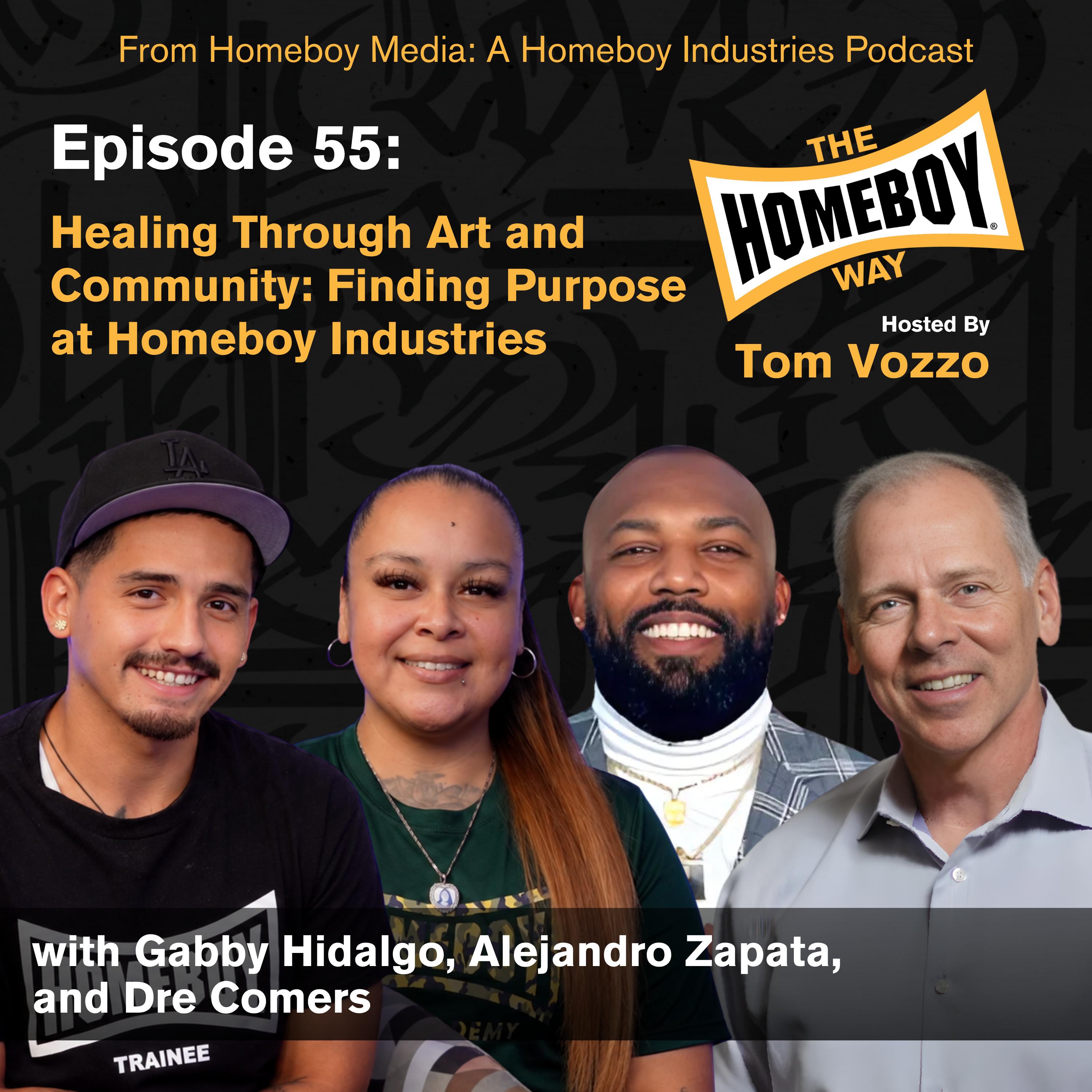
Healing Through Art and Community: Finding Purpose at Homeboy Industries with Gabby Hidalgo, Alejandro Zapata, and Dre Comers

After 17 years in prison, Gabby Hidalgo came home to a family that still saw the person she used to be. Alejandro Zapata returned to Homeboy after a second prison term, determined to leave behind the fast money and experiences he never wanted to repeat. At Homeboy Industries, both found people willing to believe in their future, even when rebuilding their lives felt overwhelming. In this episode of The Homeboy Way, Tom Vozzo and co-host Dre Comers, Director of the Homeboy Art Academy, join Gabby and Alejandro for an honest conversation about life after prison, youth mentorship, and healing through art. Gabby shares how she graduated college at 40, became a navigator supporting young adults, and turned to photography after losing her best friend. Alejandro discusses finishing high school, pursuing a career as an electrician, and finding focus through graffiti and drawing. Together, they explore the challenges of prison reentry, the importance of mental health support, and why creative expression can matter even when becoming an artist is not the goal. From Father Greg’s unconditional welcome to Gabby’s determination to interrupt cycles of gang violence and abuse, their stories reveal how consistent support, compassion, and second chances help people build a different life. Key Takeaways Consistency creates belonging. Support groups, education, and dependable relationships helped Gabby find a sense of family at Homeboy Industries. Fast money comes with a long-term cost. Alejandro reflects on how incarceration changed his thinking about income, lost time, and the opportunities he wants to pursue. Lived experience can guide youth mentorship. Gabby draws on her own history to speak honestly with young adults and help them recognize paths that could lead to incarceration. Art can support healing without becoming a career. Dre explains the value of creative expression, while Alejandro describes the focus he finds in graffiti and working with pastels. In This Episode [00:00] Introduction [01:04] Meet Gabby, Alejandro, and Homeboy Art Academy director Dre [02:06] Dre’s full-circle return to working with youth [02:53] Gabby finds Homeboy after 17 years in prison [04:13] Reentry anxiety and finding support through women’s empowerment [06:58] Returning to Homeboy and graduating college at 40 [08:06] Alejandro’s journey from juvenile camp to a second chance [10:09] Rethinking fast money and the cost of incarceration [11:42] Showing up with intention at the Homeboy Art Academy [12:23] The prison experiences Alejandro never wants to repeat [15:48] Why Gabby wants to interrupt gang violence and abuse [18:01] Honest conversations and support for young adults [21:15] What makes the Homeboy Art Academy different [23:40] Why creative expression matters beyond earning money [24:58] Father Greg’s help and an open door to return [28:38] How Homeboy changed Dre’s approach to compassion [31:25] Finding joy in family, nature, and everyday life Notable Quotes “You could meet new people, new opportunities. You just never know what's in store for you.” Alejandro [11:23] “I'm grateful to be here. I'm grateful with the kids. I'm grateful for the opportunity, like being able to share my life story because I don't want none of them to go through that.” - Gabby [17:30] “Not everyone is gonna be an artist and go into a pathway that they're gonna start making money from.” - Dre [23:46] Resources and Links Homeboy Industries https://homeboyindustries.org/ https://www.youtube.com/@HomeboyIndustries_LA/videos Donate: https://homeboyindustries.org/donate/donate-online/ Homeboy Media  https://homeboyindustries.org/social-enterprises/homeboy-media/ Thomas Vozzo https://www.linkedin.com/in/thomasvozzo The Homeboy Way: A Radical Approach to Business and Life: https://www.amazon.com/Homeboy-Way-Radical-Approach-Business/dp/082945456X Credits: Hosted by: Tom Vozzo Produced by: Podify, and Alexa Rousso and Melody Carter of Homeboy Media
32 minAbspielen in:

Warum PodAppear

Folge Menschen, nicht Podcasts.

Du hast Tom in einer Sendung gehört. PodAppear findet für dich die nächste, und genauso für alle anderen, die du hören willst.

  • Eine Meldung, wenn die Person zu Gast istPer E-Mail: sofort oder gebündelt als Tages- oder Wochenübersicht. Dann nur noch auf Play drücken.
  • Gäste statt bloßer ErwähnungenFolgen, in denen ein Name nur fällt, landen getrennt. Eine Meldung heißt: Die Person ist wirklich in der Sendung.
  • Alle in einem FeedGründerinnen, Autoren, Sportler, Forscherinnen. Folge allen mit Namen, quer durch jede Sendung, in der sie auftreten.

Bis zu 15 Personen kostenlos, ohne Kreditkarte.

Mi30Sep
The Homeboy Way

The Homeboy WayHost

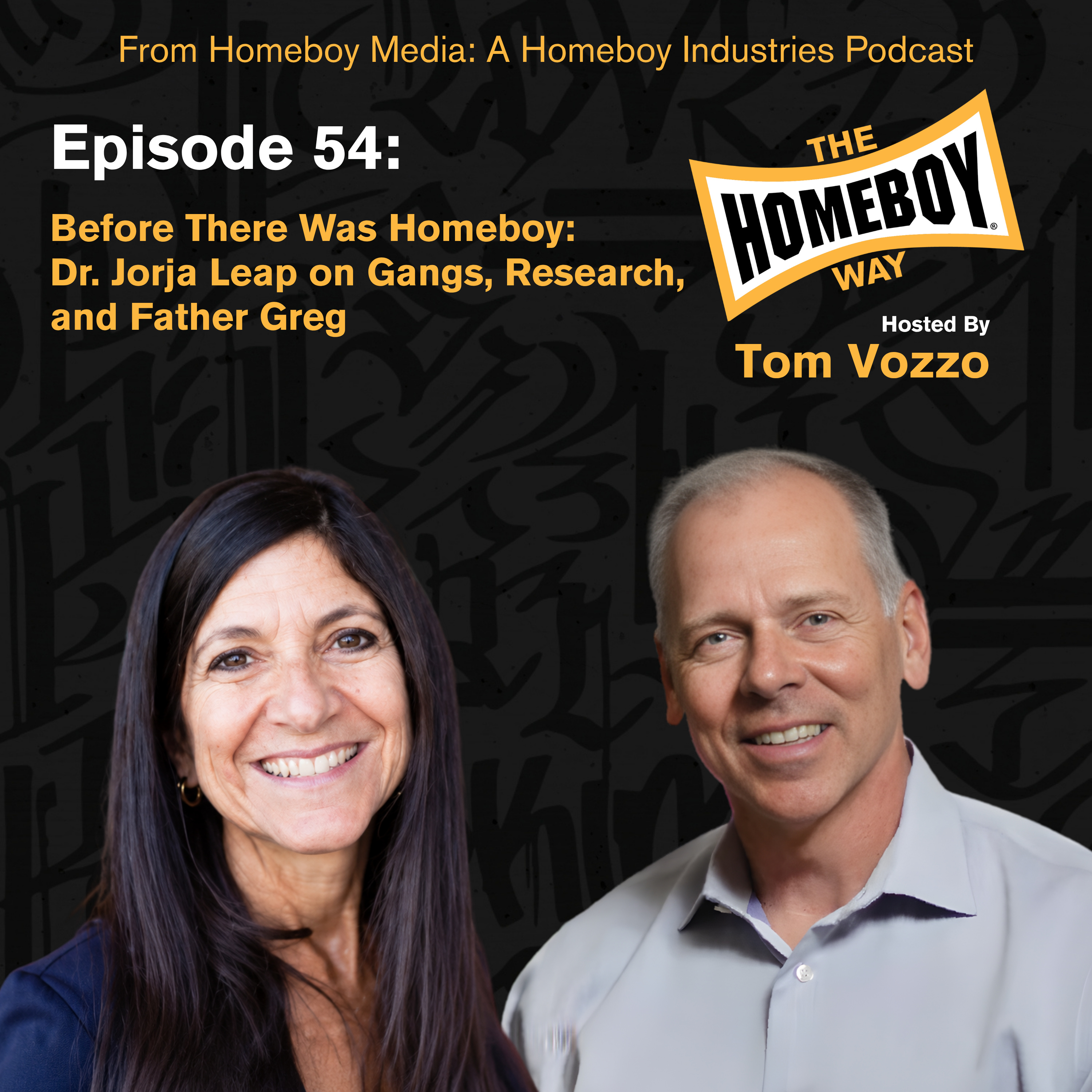
Before There Was Homeboy: Dr. Jorja Leap on Gangs, Research, and Father Greg

In the late 1980s, a young social worker in Watts kept hearing she had to meet a priest in Boyle Heights. She didn't like priests. She didn't like religion. But she finally made the call. What happened in that first meeting, and in the decades that followed, changed how Dr. Jorja Leap saw gangs, research, and her own life. In this episode of The Homeboy Way, Tom Vozzo, former CEO of Homeboy Industries, sits down with Jorja, a UCLA professor, longtime friend of Father Greg Boyle, and a self-described "Homeboy elder." She takes us back to a time when there was no Homeboy, when a city was afraid, and when almost no one believed in the people Greg did. She shares what she discovered by simply showing up, why funders and government kept Homeboy at arm's length, and what she'd tell any nonprofit fighting for support. She also gets personal about how Homeboy became her chosen family, a woman who has stayed in her heart for years, and the one time she and Fr. Greg really fought. Key Takeaways Violence is multifaceted, so the response has to be too.  Jorja compares gang violence to cancer: cutting out the tumor never worked on its own. She says no single approach, and no "typical" gang member, exists.  Relationships were the intervention.  Her early research at Homeboy found that no specific strategy explained the results. Community, transferable skills, and seeing other former gang members succeed gave people the confidence to believe they could change too.  Relapse is part of the process, not a failure.  Jorja prefers "relapse" to "recidivism" and describes people as "struggling," not failing. She advises nonprofits to put a comma in place of the period: "We have an 18-month program, and very few people make it through the first time."  Bring in a researcher early, but don't let a rigid funder rewrite your mission.  She urges nonprofits to partner with a university researcher early and often. She and Tom also criticize control groups that deny services to people in need, and she argues that if a funder insists on one, "you don't want their money."   Homeboy never gives up on anyone.  Jorja describes a woman she has watched at Homeboy since 2008 who is still struggling and still trying. To her, that is what Homeboy stands for: hope, not just success.  In This Episode: [00:00] Introduction [01:32] Meeting Father Greg before Homeboy existed [03:37] The "super predator" myth [06:40] Why violence is multifaceted [11:40] Pitching Fr. Greg on research [14:48] Relapse, not recidivism [18:07] What the research found: relationships [21:05] The study's results [23:06] Why foundations hesitated [26:37] LA County, the "bad boyfriend" [30:28] Advice for nonprofits [31:40] The trouble with control groups [35:19] Explaining an 18-month program [36:28] How Homeboy changed Jorja [41:20] Being Fr. Greg’s friend  [43:24] Closing  Notable Quotes "The effectiveness was based on relationships." - Jorja Leap [00:18:18] "Homeboy never gives up on anyone." - Jorja Leap [00:39:50]  "Greg Boyle has taught me in the purest sense, the meaning of unconditional love." - Jorja [42:32]  Resources and Links Homeboy Industries https://homeboyindustries.org/ https://www.youtube.com/@HomeboyIndustries_LA/videos Donate: https://homeboyindustries.org/donate/donate-online/ Homeboy Media  https://homeboyindustries.org/social-enterprises/homeboy-media/ Jorja Leap https://luskin.ucla.edu/profile/jorja-leap/ https://www.linkedin.com/in/jorja-leap-a30a451a5/ Thomas Vozzo https://www.linkedin.com/in/thomasvozzo The Homeboy Way: A Radical Approach to Business and Life: https://www.amazon.com/Homeboy-Way-Radical-Approach-Business/dp/082945456X Credits: Hosted by: Tom Vozzo Produced by: Podify, and Alexa Rousso and Melody Carter of Homeboy Media
44 minAbspielen in:

Mi23Sep
The Homeboy Way

The Homeboy WayHost

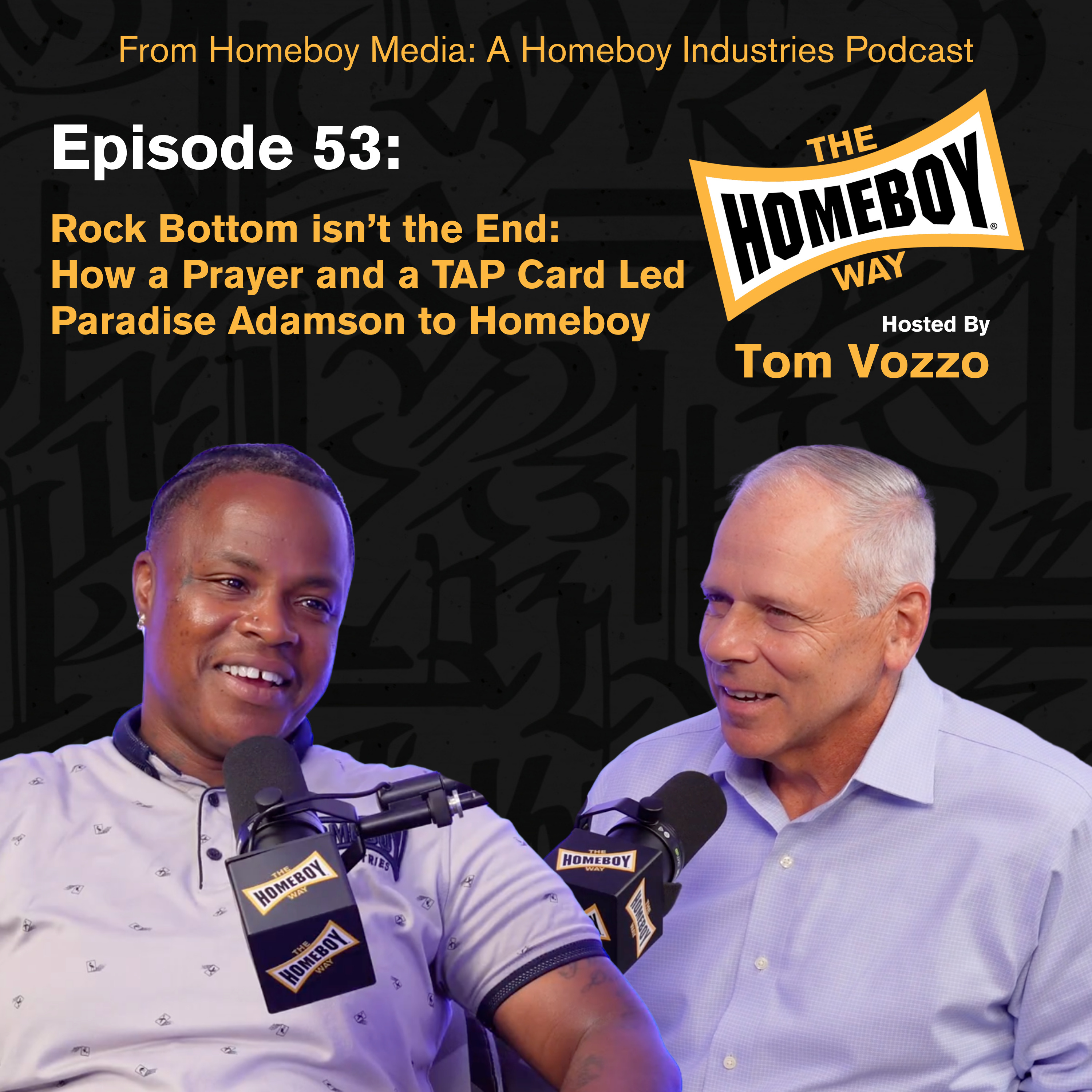
Rock Bottom Isn't the End: How a Prayer and a TAP Card Led Paradise Adamson to Homeboy

What do you do when you're tired of the life you're living but have no idea where to start? Paradise Adamson asked that question in a prayer on a dirt hillside beside the freeway, at what she calls her rock bottom. What followed was an arrest over a missing TAP card, time in county jail and in treatment, and a string of people telling her she should check out Homeboy. In this episode, Tom Vozzo sits down with Paradise, now a navigator at Homeboy Industries who went through the 18-month trainee program herself. She shares how she went from rock bottom to walking through Homeboy's doors for the first time. She talks about what it meant to be honest in an interview when every past job had taught her to hold something back, and how she learned to treat anger as a signal instead of a flaw. She also explains why she believes healing works best as a toolbox rather than a single fix, and what it takes to guide new trainees through the same fears she once had. Her story is a reminder that transformation doesn't require a plan. It can begin with showing up, telling the truth, and letting yourself be accepted as you are. Key Takeaways Sometimes the hardest part is finding a starting point.  Paradise reflects on reaching rock bottom and struggling to figure out where to begin. Homeboy became the opportunity she had been praying for.  Honesty was the game changer.  She feared that being open about her past would work against her. At Homeboy it was exactly what was asked of her, and she says being that honest for the first time gave her room to grow.  Addiction takes many forms.  Paradise learned that anything not used in moderation can become an addiction, including anger, harsh self-talk, and even depression.  Grief isn't something to stop; it's something to carry well.  She doesn't try to stop missing her loved ones. She focuses on how she represents them.  Healing is a toolbox.  Rather than expecting one class or one insight to fix everything, Paradise takes what fits from each and leaves the rest.  In This Episode: [00:00] Introduction [01:00] A prayer near the train tracks, and an arrest over a TAP card [04:24] Hearing about Homeboy in jail and in treatment [06:27] Showing up for intake and interview [07:10] Being honest about her past for the first time [08:38] Celebrating one year of sobriety at Homeboy [10:09] What was different about this prayer [13:15] Learning through hardship and changing how she prays for her siblings [14:42] Advice for avoiding addiction: everything in moderation [16:04] Why she vents out loud in the morning [17:41] Being tired of the life and having no starting point [19:23] Still working on her emotions as a trainee [20:58] Understanding anger as a secondary emotion [22:01] Embracing grief instead of trying to stop it [23:26] Building a toolbox from Homeboy's classes [24:15] Working in the Homeboy Cafe [26:05] Why trainees should embrace the social enterprises [27:11] What keeps her grounded [27:48] Why navigator may be the hardest job at Homeboy [29:23] Where she sees herself in the next few years [30:31] What Father Greg means to her  Notable Quotes "If I'm always pretending, then I can never authentically grow." - Paradise [09:26]  "Anything that's not used in moderation could become addiction." - Paradise [15:04]  Resources and Links Homeboy Industries https://homeboyindustries.org/ https://www.youtube.com/@HomeboyIndustries_LA/videos Donate: https://homeboyindustries.org/donate/donate-online/ Homeboy Media  https://homeboyindustries.org/social-enterprises/homeboy-media/ Thomas Vozzo https://www.linkedin.com/in/thomasvozzo The Homeboy Way: A Radical Approach to Business and Life: https://www.amazon.com/Homeboy-Way-Radical-Approach-Business/dp/082945456X Credits: Hosted by: Tom Vozzo Produced by: Podify, and Alexa Rousso and Melody Carter of Homeboy Media
32 minAbspielen in:

Mi16Sep
The Homeboy Way

The Homeboy WayHost

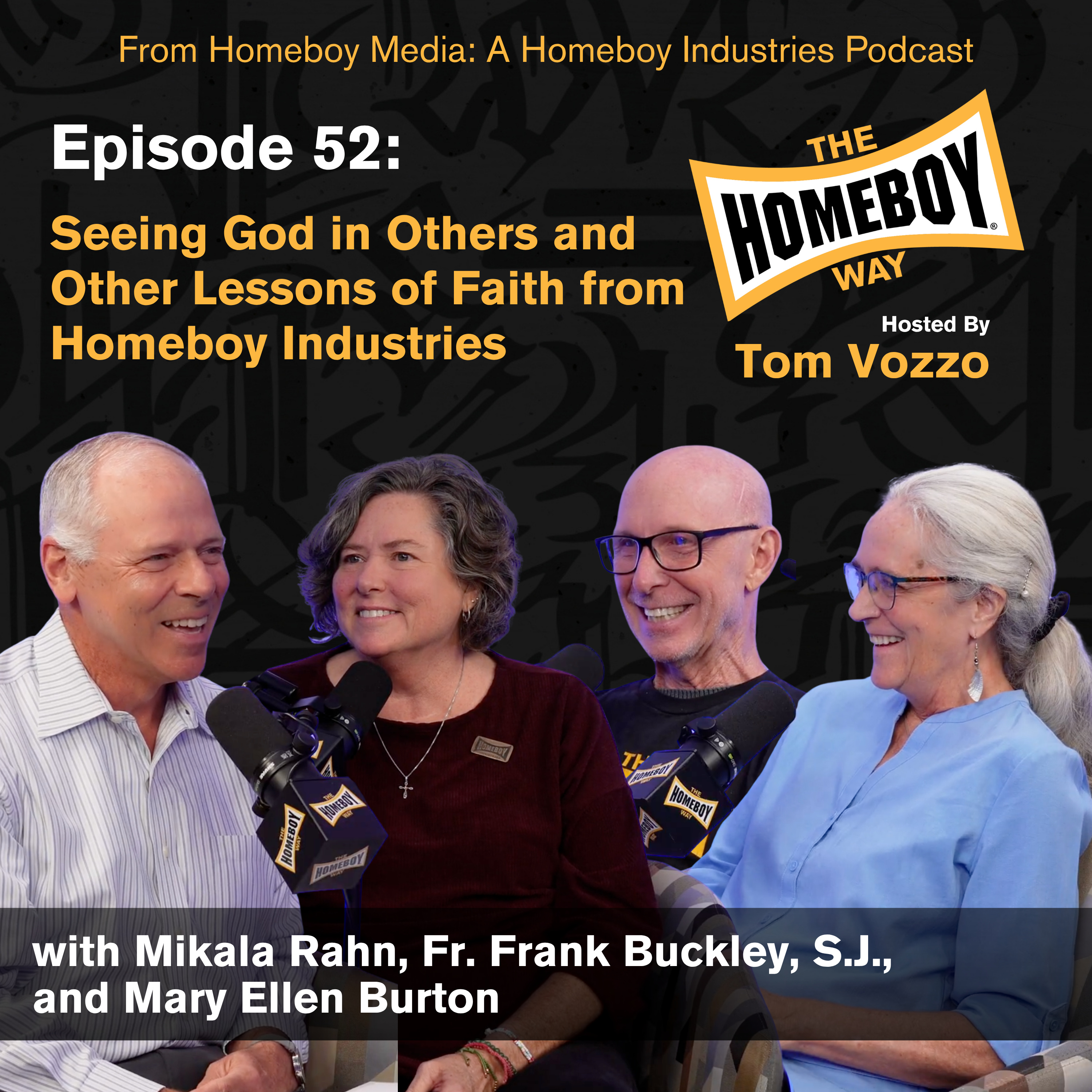
Seeing God in Others and Other Lessons of Faith from Homeboy Industries with Mikala Rahn, Fr. Frank Buckley, S.J., and Mary Ellen Burton

After surviving a brain hemorrhage and facing stage-four metastatic cancer, Fr. Frank Buckley, S.J. describes the past year as both the hardest and the best of his life. His experience revealed something he had spent years searching for: God was not somewhere “out there.” God was already present within him, and in the people surrounding him at Homeboy Industries. In this deeply personal conversation, Tom Vozzo is joined by Mikala Rahn, Fr. Frank Buckley, S.J., and Mary Ellen Burton to explore how Homeboy Industries has transformed their understanding of God, faith, and unconditional love. Mikala shares why curiosity protects us from judgment and how loving ourselves is inseparable from accepting God’s love. Mary Ellen reflects on arriving at Homeboy broken, being welcomed into the community, and discovering a God who is “relaxed and smiling.” Together, they examine faith in action, the relationship between suffering and joy, and the difference between helping people and walking alongside them in kinship. They also discuss spiritual doubt, contemplative practice, cherished belonging, and why Homeboy can feel more like church than church itself. This episode is an honest exploration of what becomes possible when faith moves beyond belief and becomes a way of being with others. Key Takeaways God can be found in the chaos. Homeboy Industries may not look peaceful from the outside, but its relationships reveal a deeply present, loving, and nonjudgmental God. Accepting God’s love requires self-love. Believing that God loves us unconditionally is only part of the journey. We must also confront the barriers that prevent us from loving ourselves. Kinship is different from rescuing people. The goal is not to fix or save someone. It is to stand beside them and allow both people to be changed through the relationship. Homeboy offers a different model of leadership. Humble leadership is rooted in relationships, openness, and a willingness to be corrected while staying grounded in the mission. In This Episode [00:00] Introduction to The Homeboy Way [01:28] How Homeboy changed Mikala’s understanding of God [03:25] Mary Ellen arrives at Homeboy broken and finds love [04:18] Discovering a God who is relaxed and smiling [08:35] Fr. Frank’s hardest and best year [10:58] Experiencing the kingdom of God in a Homeboy classroom [11:38] A God too busy loving us to judge us [13:05] Finding unexpected joy after a devastating diagnosis [14:01] The dream that changed Fr. Frank’s surgery experience [19:04] The daily practices that keep Mary Ellen grounded [20:19] Finding Jesus in Homeboy’s “secure village” [21:46] Why Homeboy can feel more powerful than Sunday church [24:40] Mikala receives an unexpected “ticket to heaven” [27:13] Why suffering and resurrection belong together [28:13] Cherished belonging and the Homeboy model of healing [36:38] Fr. Richard Rohr, Henri Nouwen, Rumi, and belovedness [38:15] Finding spiritual teachers in everyday life Notable Quotes “All you need to do in this life is take in that you are beloved and support anybody who comes across your path in taking that in for themselves.” - Mary Ellen Burton [05:39] “At Homeboy, we learn to meet what Fr. Greg says, ‘A God who is way too busy loving us to judge us.’” - Fr. Frank Buckley, S.J. [11:38] “I’m a kinship person. I wanna be with someone so that I’m transformed as much as they’re transformed.” - Mikala Rahn [26:14] Resources and Links Homeboy Industries https://homeboyindustries.org/ https://www.youtube.com/@HomeboyIndustries_LA/videos Donate: https://homeboyindustries.org/donate/donate-online/ Homeboy Media  https://homeboyindustries.org/social-enterprises/homeboy-media/ Thomas Vozzo https://www.linkedin.com/in/thomasvozzo The Homeboy Way: A Radical Approach to Business and Life: https://www.amazon.com/Homeboy-Way-Radical-Approach-Business/dp/082945456X Credits: Hosted by: Tom Vozzo Produced by: Podify, and Alexa Rousso and Melody Carter of Homeboy Media
41 minAbspielen in:

Mi26Aug
The Homeboy Way

The Homeboy WayHost

Carla Javits on Scaling Social Enterprise Across America

What if the most effective response to incarceration, homelessness, and economic instability isn’t another temporary program, but a real job? Carla Javits has spent nearly two decades helping employment social enterprises turn overlooked talent into meaningful work, sustainable businesses, and pathways toward a better life. In this episode of The Homeboy Way, host Tom Vozzo sits down with Carla to explore how Redefine Alliance, formerly REDF, helped strengthen a national movement of purpose-driven businesses. Carla shares the scale of that impact: 350 social enterprises supported, $4 billion in revenue generated, and 176,000 people employed. Together, Tom and Carla unpack what it takes to build a viable social enterprise, why employers keep screening out capable people, and how government procurement can create thousands of second-chance jobs. They also discuss Homeboy Industries’ transitional employment model, the value of lived expertise, and why belonging and compassion aren’t just good for people; they’re good for business. Key Takeaways Employment creates a pathway forward. Support services matter, but people also need the opportunity to earn income, demonstrate their abilities, and build meaningful lives through work. Social enterprise requires a real business model. A strong mission cannot rescue an idea with no customers, market, or reliable source of revenue. Business and social impact must work together.  Successful employment social enterprises balance revenue generation with meaningful support, skill development, and opportunity. Clear employment goals shape the entire enterprise. Organizations must decide whether they are creating transitional jobs, permanent employment, or another specific pathway for workers. Belonging is good business. Valuing lived expertise, nurturing employees, and creating a genuine sense of connection can strengthen both people and organizations. In This Episode [00:00] Introduction [00:25] Welcoming Carla Javits [01:00] Why REDF became Redefine Alliance [04:34] The business leaders behind the movement [08:50] Has society become more open to second-chance hiring? [12:21] 350 enterprises, $4 billion in revenue, and 176,000 jobs [14:22] The five pillars of Redefine Alliance’s model [16:23] Should a nonprofit start a social enterprise? [22:11] Homeboy Industries as a transitional employer [23:20] Defining business goals and employment outcomes [25:36] Bringing government into the social enterprise ecosystem [26:28] The $2.23 societal return for every dollar invested [28:24] Why government must define employment social enterprise [33:26] The Caltrans partnership creating thousands of jobs [34:50] Carla’s first impressions of Homeboy Industries [38:42] Why lived experience should be valued as expertise [39:38] Carla’s next chapter of service and leadership [42:13] Helping people take action instead of accepting doom and gloom “Do you really want to run a business? There’s a balance when you run a business. You have to balance the social mission with the revenue generation.” - Carla Javits [16:46] “People’s life experiences are a big part of what they bring to any job.” - Carla Javits [38:42] “Nurturing people and making them feel that sense of belonging is a good way to run your business.” - Carla Javits [39:19] “We need each other. We need the reflection of each other.” - Carla Javits [41:02] Homeboy Industries https://homeboyindustries.org/ https://www.youtube.com/@HomeboyIndustries_LA/videos Donate: https://homeboyindustries.org/donate/donate-online/ Homeboy Media  https://homeboyindustries.org/social-enterprises/homeboy-media/ Thomas Vozzo https://www.linkedin.com/in/thomasvozzo The Homeboy Way: A Radical Approach to Business and Life: https://www.amazon.com/Homeboy-Way-Radical-Approach-Business/dp/082945456X Credits: Hosted by: Tom Vozzo Produced by: Podify, and Alexa Rousso and Melody Carter of Homeboy Media
44 minAbspielen in:

Mi5Aug
The Homeboy Way

The Homeboy WayHost

From Gang Life to Homeboy to Hollywood: Joseph Lucero’s Story

Joey Ray, (Joseph Raymond Lucero), never expected his life to take him from a California Youth Authority facility to a Hollywood film set. But a chance encounter with Father Greg Boyle in prison, and a program called Criminals and Gang Members Anonymous, set him on a path toward Homeboy Industries, sobriety, and eventually an acting career. In this episode, Tom Vozzo sits down with Joey to explore the long road from prison to purpose. Joey reflects on how Criminals and Gang Members Anonymous helped him understand gang life as an addiction, why becoming a father gave him the courage to confront alcoholism, and how learning to love himself transformed every relationship in his life. He also shares the unexpected path that led him into acting, the lessons he's carried from Homeboy Industries, and why being transparent about his past has become one of his greatest strengths. Together, they discuss redemption, recovery, and the power of radical kinship, revealing how lasting change begins when someone believes in you before you're able to believe in yourself. Key Takeaways Gang life was an addiction, not just choices.  CGA treats it as a lifestyle addiction rooted in craving respect he lacked at home. Change came from refusing to hurt loved ones. His son bailing him out of jail after his last drink in 2015 was the real turning point. Presence matters more than perfection.  He still bumps heads with his daughters, but now he shows up, including finally making   amends to Tom. Survival instincts explain behavior, they don't excuse it.  Hustling and stress from tough circumstances shape actions, but real harm still needs accountability. Fatherhood forced honest change.  He admits he'd grown okay with chaos until his son's existence pushed him to stop. Faith survived hardship.  After being shot four times and stabbed, he never blamed God, believing Homeboy was his purpose. In This Episode: [00:02] Introduction [00:45] Joey makes amends to Tom [02:19] Meeting Father Greg in prison [03:28] What is CGA, and gang life as addiction [07:37] Getting hired by Father Greg [08:42] Moving to LA, becoming a father [09:26] Early days at Homeboy in Boyle Heights [11:13] Balancing two families, two cities [11:38] Becoming a public speaker for Homeboy [15:39] Continued struggles with alcohol [16:36] The moment his son confronted him [18:01] Learning to love himself [22:25] Loss within the Homeboy community [24:28] How he broke into acting [26:22] Getting "discovered" on set [29:02] What he loves about acting [33:37] Being named Homeboy Hero at Lo Máximo [36:26] Spirituality and faith [39:20] What he's hopeful for Notable Quotes "You gotta love yourself before they can love others." — Joey Ray [19:48] "The moment you really start living for yourself, you're actually able to be there for everybody else." — Joey Ray [18:01] Resources and Links Homeboy Industries https://homeboyindustries.org/ https://www.youtube.com/@HomeboyIndustries_LA/videos Donate: https://homeboyindustries.org/donate/donate-online/ Homeboy Media  https://homeboyindustries.org/social-enterprises/homeboy-media/ Thomas Vozzo https://www.linkedin.com/in/thomasvozzo The Homeboy Way: A Radical Approach to Business and Life: https://www.amazon.com/Homeboy-Way-Radical-Approach-Business/dp/082945456X Credits: Hosted by: Tom Vozzo Produced by: Podify, and Alexa Rousso and Melody Carter of Homeboy Media
41 minAbspielen in:

Mi29Jul
The Homeboy Way

The Homeboy WayHost

Building Businesses That Heal: Kabira Stokes on Circular Economy and Social Impact

Kabira Stokes never planned to become an entrepreneur. After 9/11, she became an anti-war activist, searching for ways to create meaningful change. That journey led her from city government and criminal justice policy into an unexpected realization: instead of waiting for policy to create opportunities, she could create jobs herself. In this episode, Tom Vozzo sits down with Kabira Stokes to explore the intersection of justice, business, and community. Kabira shares how founding Isidore Recycling eventually became Homeboy Recycling, why hiring people returning from incarceration isn't charity but smart business, and how entrepreneurship can become a powerful vehicle for second chances. Together, they reflect on the evolution of Homeboy Recycling from a small startup generating $650,000 in revenue to a thriving, multimillion-dollar enterprise that creates meaningful employment for people rebuilding their lives. Kabira also discusses why local action creates lasting change, how community gives people hope, and why businesses have a responsibility to see potential where others only see a criminal record. Key Takeaways One conversation can spark a movement A simple conversation about recycling eventually became Homeboy Recycling, proving big ideas often begin with small moments. Partnerships create greater impact Homeboy helped scale the business with funding, wraparound services, and a shared commitment to second chances. People deserve opportunities, not labels With the right support, people returning from incarceration become dependable employees and future leaders. Business can be a force for good A successful company can deliver excellent service while creating meaningful employment for people rebuilding their lives. Transformation is the real measure of success The greatest achievement isn't revenue, it's watching employees build lasting careers, stability, and hope for the future. In This Episode: [00:00] Introduction [01:10] First Homeboy encounter [02:05] 9/11 to activism [04:25] Faith and justice roots [05:15] Inside city government [07:10] Studying prisons and reentry [09:10] Launching Isidore Recycling [12:15] Joining forces with Homeboy [15:30] Social enterprise realities [18:00] Hiring stories that matter [21:00] How to hire returning citizens [22:15] New York and the next chapter [25:15] Local change and community [28:05] Why recycle with Homeboy [28:50] Closing thanks and farewell Notable Quotes "I guess I could go work for the state and create policy that will create jobs, or I could just create some jobs." — Kabira Stokes [00:10:04] “If you're gonna work hard at something, it might as well have real impact.” — Kabira [15:46] Resources and Links Homeboy Industries https://homeboyindustries.org/ https://www.youtube.com/@HomeboyIndustries_LA/videos Donate: https://homeboyindustries.org/donate/donate-online/ Homeboy Media  https://homeboyindustries.org/social-enterprises/homeboy-media/ Thomas Vozzo https://www.linkedin.com/in/thomasvozzo The Homeboy Way: A Radical Approach to Business and Life: https://www.amazon.com/Homeboy-Way-Radical-Approach-Business/dp/082945456X Credits: Hosted by: Tom Vozzo Produced by: Podify, and Alexa Rousso and Melody Carter of Homeboy Media
29 minAbspielen in:

Mi22Jul
The Homeboy Way

The Homeboy WayHost

More Than Merch: From Stranger Danger to Retail and Recovery with Homeboy’s Joe Tarin

Joe Tarin never imagined he would one day lead a business that helps transform lives. After years of addiction, incarceration, and believing he didn't belong anywhere, one conversation with a friend led him through the doors of Homeboy Industries. What began with fear and uncertainty eventually became a journey of healing, recovery, and leadership. In this episode, Tom Vozzo sits down with Joe Tarin, the newly promoted manager of the Homeboy Merchandise Store, to talk about his remarkable transformation. Joe shares how rehab changed his perspective, why Homeboy gave him hope when no one else would, and how managing a business is about far more than sales. It's about creating a safe space where people rebuilding their lives can grow with confidence. Together, they explore what makes Homeboy's social enterprises different, why communication and connection matter just as much as business results, and how every purchase supports someone working toward a brighter future. Joe also reflects on his goals, his passion for helping others in recovery, and why products with a purpose can truly change lives. Key Takeaways Growth starts by changing what you value Joe realized he had been chasing approval for the wrong things. Homeboy helped him replace instant gratification with purpose and personal growth. Recovery requires accepting support  After relapsing, Joe chose rehab and returned to Homeboy, where accountability and compassion allowed him to rebuild his life. One opportunity can restore hope When Father Greg offered Joe a job despite his past, it became the turning point that showed him he was worthy of a second chance. Every product has a purpose The merchandise store isn't just about selling apparel. Every purchase helps fund training, support, and opportunities for people beginning their own transformation. Supporting Homeboy changes lives Every sale strengthens multiple social enterprises, creates meaningful employment, and helps more people rebuild their lives and reconnect with their families. In This Episode: [00:00] Introduction [00:57] The concept of stranger danger [02:14] Joe's road to Homeboy [03:32] Meeting Father Greg [03:56] Relapse and rehab return [05:28] Finding joy after rehab [06:05] From recycling to retail [07:12] New store manager life [08:07] Learning business basics [09:02] Training and leadership [10:15] Recovery through service [11:20] Selling books and swag [11:59] Future goals and peer support [12:53] Product with a purpose tour [13:29] Best sellers showcase [14:54] Designing the teal crewneck [16:34] Candles and morning meetings [17:50] Closing thanks and outro  Notable Quotes "When he says hope, I believe in hope for real." — Joe Tarin [03:33] "It's not just a logo. These are products with a purpose." — Joe Tarin [13:07] Resources and Links Homeboy Industries https://homeboyindustries.org/ https://www.youtube.com/@HomeboyIndustries_LA/videos Donate: https://homeboyindustries.org/donate/donate-online/ Homeboy Media  https://homeboyindustries.org/social-enterprises/homeboy-media/ Thomas Vozzo https://www.linkedin.com/in/thomasvozzo The Homeboy Way: A Radical Approach to Business and Life: https://www.amazon.com/Homeboy-Way-Radical-Approach-Business/dp/082945456X Credits: Hosted by: Tom Vozzo Produced by: Podify, and Alexa Rousso and Melody Carter of Homeboy Media
18 minAbspielen in:

Mi8Jul
The Homeboy Way

The Homeboy WayHost

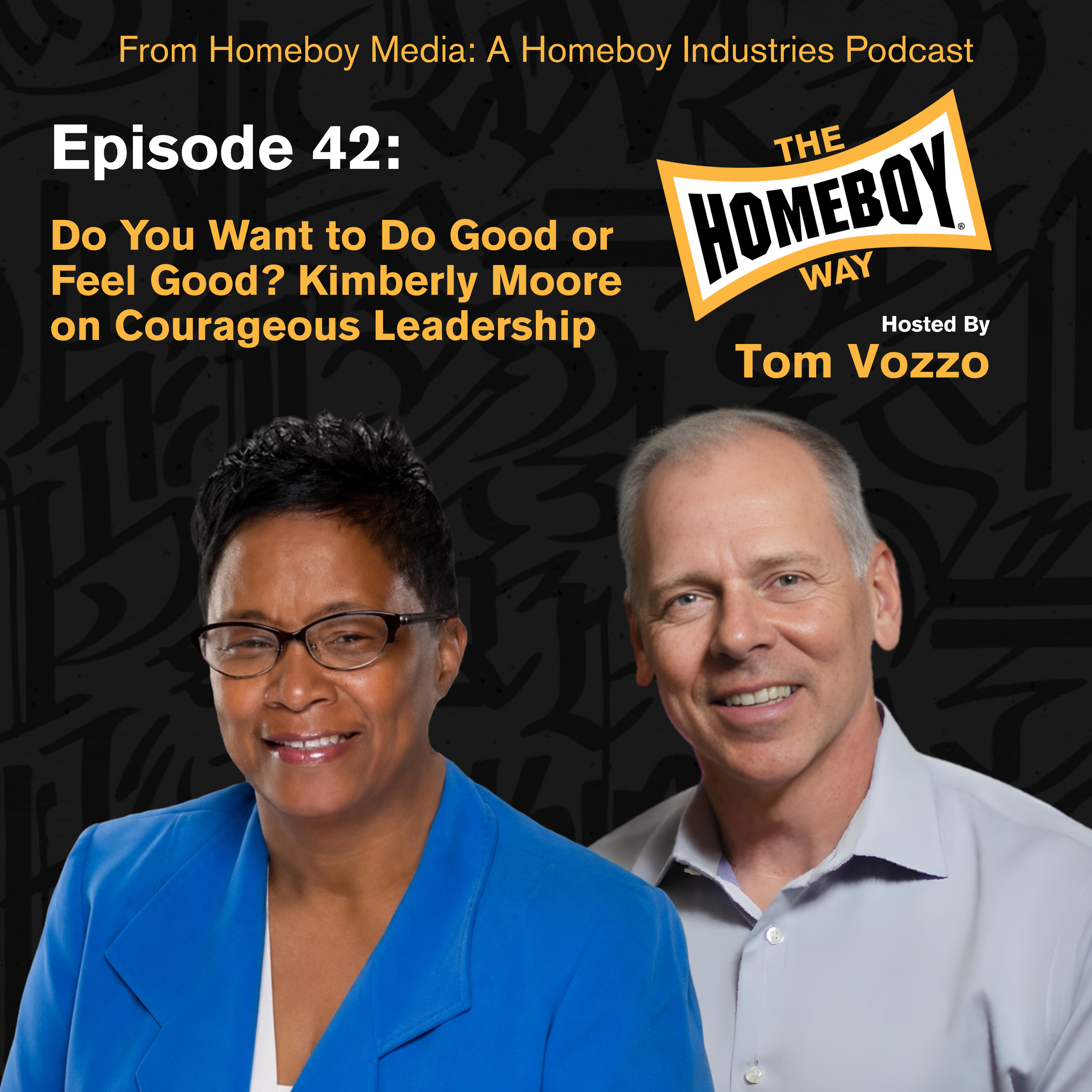
Do You Want to Do Good or Feel Good? Kimberly Moore on Courageous Leadership

Kimberly Moore went from a mattress in a crack house to building a $51 million campus in one of Louisville's most violent neighborhoods. The moment that changed everything came when she watched a six-year-old girl get slapped by her mother for saying she was hungry. Kimberly got up, walked out, and went to treatment. She has been sober since 1998. In this episode, Tom Vozzo sits down with Kimberly Moore to talk about second chances, speaking truth to power, and what it really means to never forget where you came from. Kimberly now works alongside the police who used to lock her up and has the attorney general on speed dial. She challenges donors with a simple question. "Do you want to do good, or do you want to feel good?" When a funder said no, Kimberly did not get angry. She heard "not right now." Two years later, they gave her $50,000. For her 60th birthday, Kimberly brought everyone to the Muhammad Ali Center, the people she got high with and the people who helped her get sober. She will not apologize for her life getting good, and she will not dim her light for anyone still in darkness. Her credentials? "A PhD from the streets." Key Takeaways Look underneath the behavior Behavior often reflects deeper struggles like trauma, family conflict, or unstable housing. Real support begins by addressing the root cause. Delay is not denial Kimberly sees rejection as "not right now." Persistence turned one funding rejection into a future $50,000 grant. Someone took a chance on you, too Because someone believed in her, Kimberly believes others deserve the same opportunity to change. Sobriety doesn't mean leaving people behind Recovery didn't separate Kimberly from her community. She stays connected so others know help is always available. Change happens on its own timeline People change when they're ready. Kimberly's turning point came from within, not from pressure or persuasion. Don't count the addict out Someone believed in Kimberly when she couldn't repay them. That grace shaped her commitment to helping others recover. Withholding a chance wastes potential One mistake shouldn't define a life. Second chances allow people to discover their purpose. A PhD from the streets still counts Kimberly embraces her past and uses it to lead, refusing to apologize for where she came from or where she's going. In This Episode: [00:00] Introduction [00:27] Meet Kimberly Moore [01:27] Kimberly’s work today [02:22] Leaving politics for purpose [03:27] Truth to power on violence [07:26] Finding Homeboy Network [09:05] Building a one-stop campus [11:36] Second chances and self-care [14:44] Getting sober for real [17:35] Why people deserve more chances [18:33] Second chances mindset [19:44] Hard truths with families [22:58] Right time for change [24:52] Not apologizing for growth [26:15] Therapy and boundaries [27:04] Do good or feel good [28:39] Homeboy redefines success [29:57] Owning your story [30:54] Hope and legacy Notable Quotes “I don't operate in fear, and I see so many people in corporate America that operate in fear, and I just don't.” — Kimberly [18:13] “Being brought out of darkness comes with the responsibility to be a light for others.” — Kimberly [00:23:44] Resources and Links Homeboy Industries https://homeboyindustries.org/ https://www.youtube.com/@HomeboyIndustries_LA/videos Donate: https://homeboyindustries.org/donate/donate-online/ Homeboy Media  https://homeboyindustries.org/social-enterprises/homeboy-media/ Thomas Vozzo https://www.linkedin.com/in/thomasvozzo The Homeboy Way: A Radical Approach to Business and Life: https://www.amazon.com/Homeboy-Way-Radical-Approach-Business/dp/082945456X Credits: Hosted by: Tom Vozzo Produced by: Podify, and Alexa Rousso and Melody Carter of Homeboy Media
33 minAbspielen in:

Mi1Jul
The Homeboy Way

The Homeboy WayHost

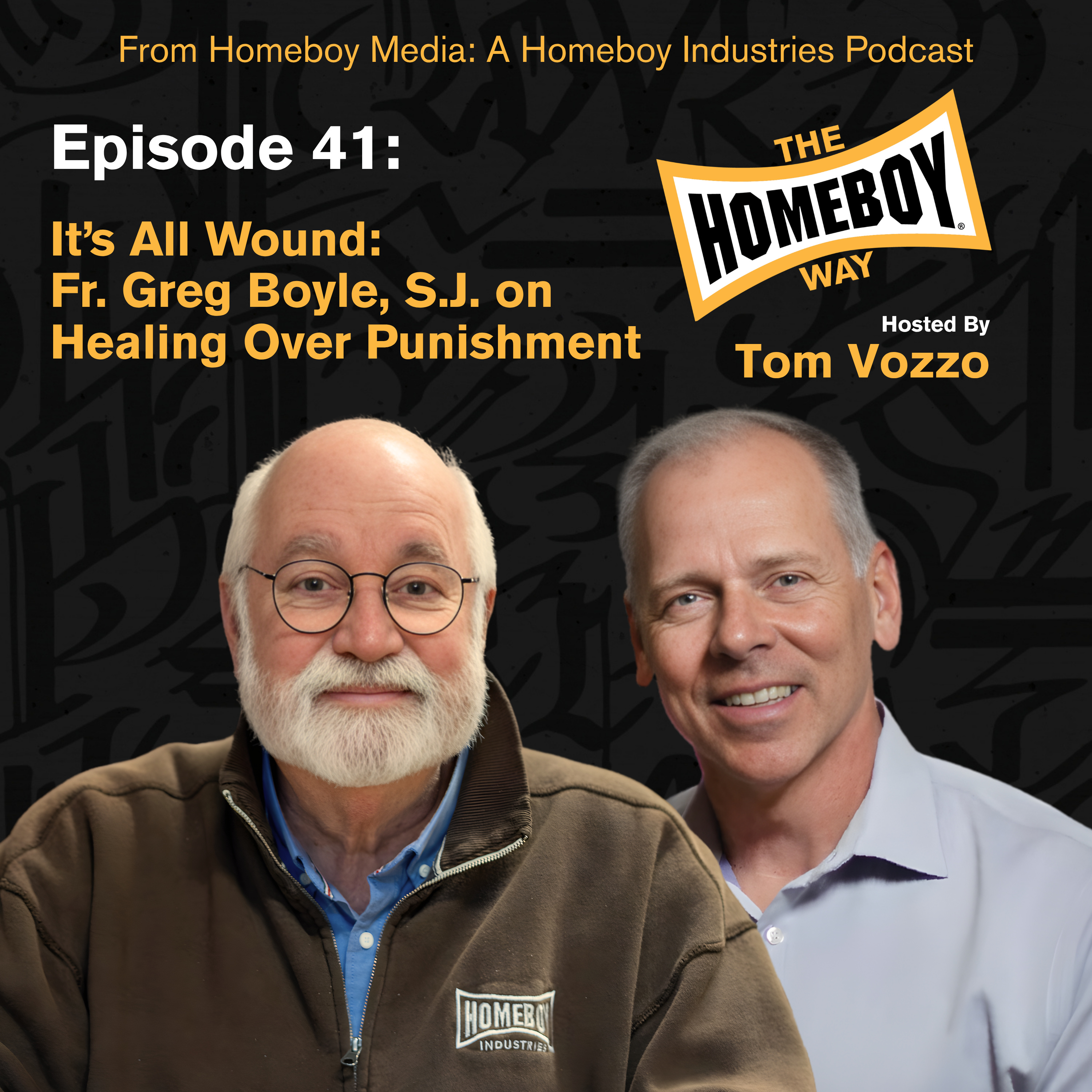
It's All Wound: Fr. Greg Boyle on Healing Over Punishment

When Tom Vozzo stepped down as CEO of Homeboy Industries after thirteen years, he thought he would finally get some peace. What he did not expect was how much he would still need the place and how much it would still need him. In this episode, Tom sits down with founder Fr. Greg Boyle, S.J. to talk about what happens when you stop running an organization but refuse to leave it behind. Fr. Greg admits it was not always easy letting go. But he learned early that Homeboy's magic is not in its policies or programs. It is in the noticing. The text that says "How was your weekend?" The homie who turns around and walks back to greet you because they saw you park. The simple act of paying loving attention. They unpack the question that has guided Fr. Greg for decades. "What do we think we are doing here?" It is a check against conventional wisdom, a reminder that you do not punish wound. You heal it. And they share why no kid ever joins a gang seeking adventure. They are always fleeing something. With board members, with travelers on the road, with homies finding their voice on stage, the answer is always the same. Tell your story. Stay humble. And remember, none of us got here on our own. Key Takeaways Compassion starts with understanding When you understand what someone has survived, it's harder to judge them and easier to walk alongside them. Privilege is often the luck of the draw Fr. Greg reflects on how easily his life could have gone differently. Sometimes geography, circumstance, and opportunity make all the difference. Success should make us humble Tom shares how Homeboy challenged his assumptions about leadership and taught him to listen before offering solutions.  Punishment isn't part of the Homeboy Way Homeboy doesn't focus on consequences for their own sake. The goal is transformation, not punishment.  Name the wound, not the behavior When organizations focus only on behavior, they miss the deeper issue. Healing begins when we understand what's underneath.  It's all wound, all the time The Homeboy philosophy starts with a simple belief: beneath most destructive behavior is pain, trauma, or loss that has never been healed.  In This Episode: [00:00] Introduction [01:05] Fr. Greg's role today [02:06] Letting go of leadership [04:21] How to lead without taking over [06:40] Asking the right questions [08:28] Choosing compassion over punishment [11:56] When gang members were written off [14:14] Why people deserve another chance [16:10] Leadership, boards, and trust [18:15] What privilege really means [21:39] Knowing what you don't know [23:31] Why stories change minds [25:57] Staying connected to the mission [28:17] Why Homeboy doesn't believe in punishment [30:19] The power of being seen [32:55] Taking homies on the road [34:01] Helping people find their voice [37:27] Trust, responsibility, and travel [39:46] Lessons from the road Notable Quotes "No hopeful kid has ever joined a gang. They're always fleeing something." — Greg [00:36:16] "The homies have taught me everything of value. That's not hyperbole. I really believe that." — Greg [00:20:21] "You have to name things correctly, otherwise you're gonna go down a rabbit hole. Homeboy knows that this is all wound. It's all wound all the time." — Greg [00:29:50] "I would never let you go. I understand the benefit and how rich this place is. But you're the boss, and you get to decide whether you stay here or not." — Greg [00:14:37] Resources and Links Homeboy Industries https://homeboyindustries.org/ https://www.youtube.com/@HomeboyIndustries_LA/videos Donate: https://homeboyindustries.org/donate/donate-online/ Homeboy Media  https://homeboyindustries.org/social-enterprises/homeboy-media/ Thomas Vozzo https://www.linkedin.com/in/thomasvozzo The Homeboy Way: A Radical Approach to Business and Life: https://www.amazon.com/Homeboy-Way-Radical-Approach-Business/dp/082945456X Credits: Hosted by: Tom Vozzo Produced by: Podify, and Alexa Rousso and Melody Carter of Homeboy Media
41 minAbspielen in:

Mi17Jun
The Homeboy Way

The Homeboy WayHost

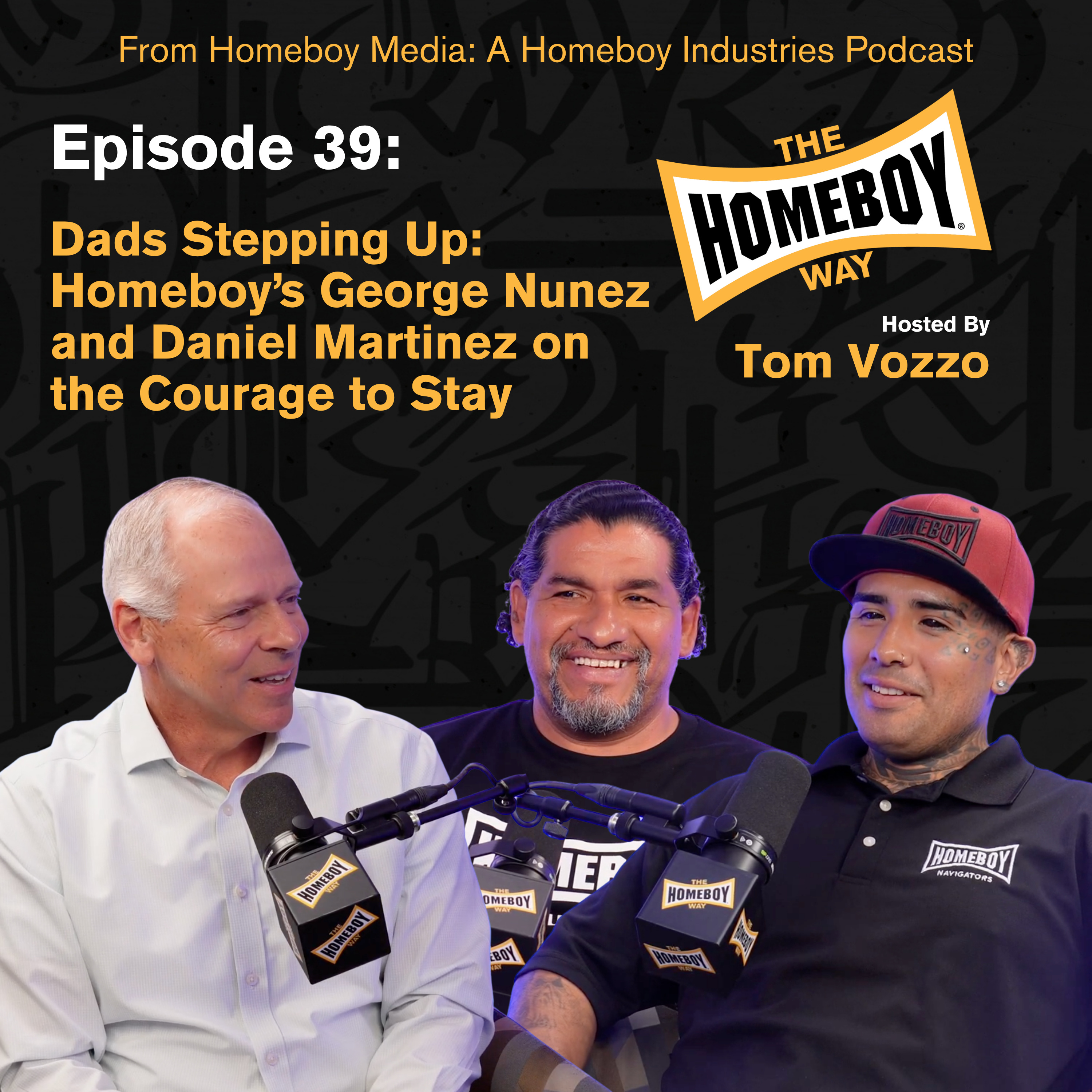
Dads Stepping Up: Homeboy’s George Nunez and Daniel Martinez on the Courage to Stay

George Nunez, Head of Security at Homeboy Industries, spent years in and out of prison. He shut out the world, including his own children, because showing weakness behind bars wasn't an option. Daniel Martinez, a Navigator at Homeboy Industries, asked his parole officer to lock him up again rather than feel like a burden to his brother. Both men walked through Homeboy's doors expecting nothing more than a resume or tattoo removal. What they found instead was a place that wouldn't give up on them and wouldn't let them give up on their kids. In this episode, host Tom Vozzo sits down with George and Daniel to talk about what real fatherhood looks like when you're learning from scratch. They discuss the terror of being vulnerable, the slow work of putting ego aside, and the unexpected mentors, including Father Greg, whom they now call "Dad." Together, they prove that the cycle of abandonment can be broken, one parenting class, one 2:00 a.m. phone call, and one soaked train ride with a baby at a time. Key Takeaways Show up even when you're not ready George doubted himself and didn't want to come to Homeboy, but he chose to show up on Monday. Healing is an inside job George learned in therapy that wanting to change isn't enough,  you have to work on what's inside and let someone help you figure it out. It's not about you anymore George says you save the next person walking through the door, because someone saved you. This lifestyle requires you to care and feel things you never felt before. "You're never in my way" George expected to be scolded by Father Greg, but Greg said, "You start Monday." That one invitation changed everything. Straddling the fence takes time Daniel wanted to be a father, but the lifestyle kept pulling him back. Change didn't happen overnight; it was a battle. Prison taught me to shut the world off George blocked everyone out to survive. Coming home meant learning a new way to be one where you don't have to hide. In This Episode: [00:00] Introduction [00:25] Meet Daniel Martinez and George Nunez [01:05] Daniel finds Homeboy after prison [02:35] Discovering support through classes and community [04:11] Feeling like a burden to family [05:36] George returns to Homeboy in 2013 [08:09] Therapy, trauma, and looking within [10:46] Choosing fatherhood over gang life [11:42] Learning how to be a dad [16:17] The Challenge Program and accountability inside prison [17:44] Trying to be a father while incarcerated [19:05] George explains why he shut the world out [19:59] Learning fatherhood after prison [21:22] Earning back the right to be called Dad [21:55] Parenting classes and communication skills [22:59] Their children begin to see the change [23:58] Father Greg as the father figure they never had [25:42] Learning fatherhood with a new baby [27:02] Mentoring trainees with patience and compassion [28:50] Dreams and hopes for their children [31:54] Why Homeboy feels like family [33:19] Finding joy through fatherhood and healing [36:10] Closing reflections and outro Notable Quotes “I felt the embrace. I felt the love. And I hadn’t even started therapy yet.” — George [00:07:56] “It’s not easy to change. It didn’t take days or months for me. It took years.” — Daniel [00:12:49] “Being a father now is giving my kids what I never got.” — George [00:23:54] Resources and Links Homeboy Industries https://homeboyindustries.org/ https://www.youtube.com/@HomeboyIndustries_LA/videos Donate: https://homeboyindustries.org/donate/donate-online/ Homeboy Media  https://homeboyindustries.org/social-enterprises/homeboy-media/ Thomas Vozzo https://www.linkedin.com/in/thomasvozzo The Homeboy Way: A Radical Approach to Business and Life: https://www.amazon.com/Homeboy-Way-Radical-Approach-Business/dp/082945456X Credits: Hosted by: Tom Vozzo Produced by: Podify, and Alexa Rousso and Melody Carter of Homeboy Media
36 minAbspielen in:

Mi3Jun
The Homeboy Way

The Homeboy WayHost

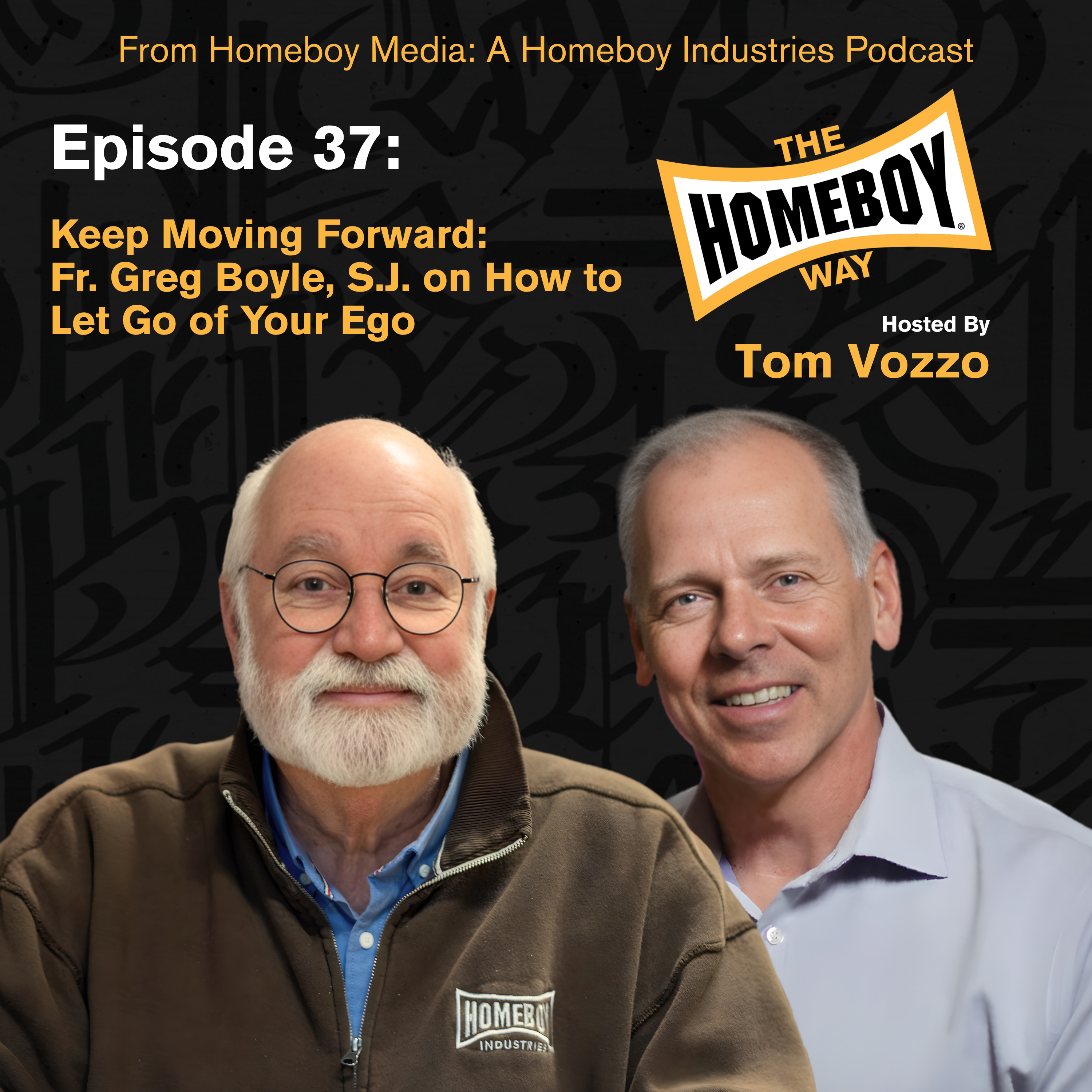
Keep Moving Forward: Fr. Greg Boyle, S.J. on How to Let Go of Your Ego

What does it mean to be loved without needing to earn it? In this episode of The Homeboy Way, host Tom Vozzo sits down with Fr. Greg Boyle, S.J., founder of Homeboy Industries, for a deeply human conversation about love, humility, recognition, trauma healing, and the kind of kinship that changes lives. Fr. Greg reflects on his birthday at Homeboy, the mariachis, the joy of being celebrated, and the lesson that love is not just something people give. It is their joy to give it. From Father Greg Boyle Day in Los Angeles to receiving the Presidential Medal of Freedom, he opens up about how he holds praise lightly, why he resists the language of “success,” and why the work has never been about ego or legacy. Tom and Fr. Greg also explore the heart of the Homeboy Industries model: moving beyond fixing, rescuing, and saving, and toward loving connection. Fr. Greg shares why trauma blocks love, why shame is one of the deepest wounds of poverty, and why walking through the doors of Homeboy requires real courage. This is a conversation about widening the circle, letting go of fear, and discovering the true self in loving. Key Takeaways Love is not begrudging. It is joyful Fr. Greg explains how the birthday celebrations at Homeboy became a living parable for God’s love: not distant, forced, or half-hearted, but full of joy. The goal is not to make a difference. Fr. Greg challenges the usual nonprofit mindset, saying we should not go to the margins to make a difference. We should go so the people there make us different. Trauma blocks loving connection Fr. Greg explains that while loving connection heals trauma, it takes bravery for someone wounded by trauma to take the first step toward that connection. Walking into Homeboy is an act of courage. For someone whose identity is tied to gang life, shame, or survival, entering a place of love is not obvious. It is a leap. Love your neighbor means move forward. Fr. Greg contrasts “fear the world” communities with “love your neighbor” communities. One circles the wagons. The other widens the circle. In This Episode [00:00] Introduction [00:47] Why Fr. Greg’s birthday means so much at Homebo [03:06] “This is not for you. This is for the people. [08:12] Father Greg Boyle Day and the trap of legacy [09:03] Why “making a difference” gets the mission wrong [11:14] The moment Fr. Greg stopped trying to fix everyone [12:21] Why clinging is the source of suffering [14:38] True self in loving vs. false self in succeeding [15:44] Shame, disgrace, trauma, and loving connection [16:42] Why walking into Homeboy takes bravery [18:33] Being seen as a symbol, not a saint [20:16] What the Presidential Medal of Freedom meant to Homeboy [25:42] The deeper meaning of being recognized [29:12] Fear the world or love your neighbor [30:52] The Homeboy vibe outsiders immediately notice [31:37] Moving forward without taking yourself too seriously Notable Quotes “God’s too busy loving you to be disappointed.” — Fr. Greg Boyle [04:04] “Authentic Christian living is about moving forward. You just keep moving forward.” — Fr. Greg Boyle [08:25] “Clinging is the source of all suffering.” — Fr. Greg Boyle [12:26] “Trauma blocks the loving connection… and the loving connection heals the trauma.” — Fr. Greg Boyle [15:53] Resources and Links Homeboy Industries https://homeboyindustries.org/ https://www.youtube.com/@HomeboyIndustries_LA/videos Donate: https://homeboyindustries.org/donate/donate-online/ Homeboy Media  https://homeboyindustries.org/social-enterprises/homeboy-media/ Father Greg Boyle linkedin.com/in/greg-boyle-s-j-05458514 Thomas Vozzo https://www.linkedin.com/in/thomasvozzo The Homeboy Way: A Radical Approach to Business and Life: https://www.amazon.com/Homeboy-Way-Radical-Approach-Business/dp/082945456X Credits: Hosted by: Tom Vozzo Produced by: Podify, and Alexa Rousso and Melody Carter of Homeboy Media Homeboy Media Production Assistant Cohort: Anthony Salazar and Sebastian Guzman
32 minAbspielen in:

Mi20Mai
The Homeboy Way

The Homeboy WayHost

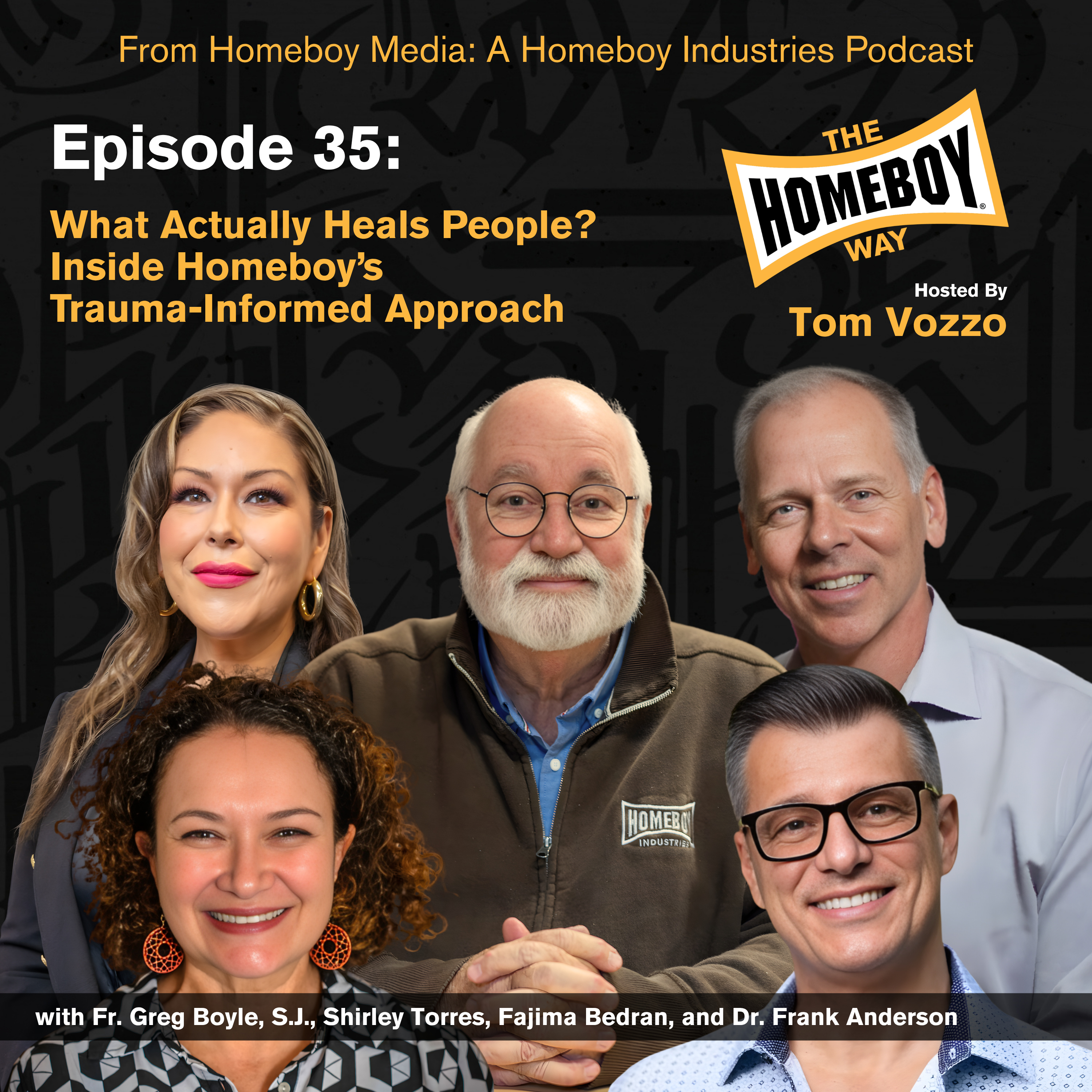
What Actually Heals People? Inside Homeboy’s Trauma-Informed Approach with Fr. Greg Boyle, S.J., Shirley Torres, Fajima Bedran, and Dr. Frank Anderson

What actually helps people heal? Is it therapy? Medication? Community? A conversation? A job? A second chance? In this special episode for Mental Health Awareness Month, host Tom Vozzo steps back from single transformation stories to look at the through line that makes Homeboy Industries actually work: mental health healing in community. Tom sits down with three sets of voices who have built, shaped, and lived Homeboy’s healing model. First, Father Greg Boyle returns to talk about why “listen, listen, love, love” isn’t just poetry but the most sophisticated trauma intervention there is. Then, Dr. Frank Anderson, a Harvard-trained trauma expert and world-renowned psychiatrist, breaks down what trauma actually is (and isn’t), why your symptoms might be protecting you, and the three components of real healing. Finally, Homeboy Industries’ Co-CEO Shirley Torres and longtime Clinical Director Fajima Bedran reveal how joy, dancing, and hot water became essential tools for whole-person healing. This episode teaches us how that transformation becomes possible and why you don’t need a therapy degree to help someone heal. Key Takeaways Healing isn’t formulaic but it is cumulative. Father Greg calls it a “dosing effect” : one person remembers your name, another asks about your baby, a guard greets you. Alone, not therapy. Together, everything changes. Trauma isn’t who you are. It’s what happened to you. Dr. Frank Anderson says drinking, anger or withdrawal aren’t signs you’re broken, they’re adaptations. Healing starts when someone asks, “How is that helping you?” The therapy room is only one part of the container. At Homeboy, healing begins with a tap, an embrace, sitting with tears. What happens outside makes inside possible. Joy and suffering can coexist. Every Friday, Homeboy holds The Body Keeps the Score, stretching, meditation, dancing. Someone who wouldn’t give eye contact a month ago now glows. That’s not a break from work. That is the work. You don’t need to be a therapist to help someone heal. Anyone can sit, listen, offer a dose of love. That’s how a movement works. In This Episode: 00:00 – Introduction 00:29 – Why this episode focuses on mental health healing 02:04 – Father Greg on how healing really happens 03:37 – ACE scores and childhood trauma exposure 05:59 – Why healing is bigger than talk therapy 09:44 – Community healing and the “dosing” effect of love 12:11 – Dr. Frank Anderson joins the conversation 14:56 – Defining trauma and PTSD in simple terms 16:50 – Understanding complex trauma and family dysfunction 21:18 – Seeing people as good instead of broken 22:52 – Looking beneath destructive behavior 24:35 – The three steps required for healing trauma 29:14 – Whole person healing at Homeboy 32:11 – Why healing starts outside the therapy room 41:51 – Staying hopeful while walking with people in pain Notable Quotes "Listen, listen, love, love." — Fr. Greg [07:18] "Trauma blocks love and connection, and love and connection heals trauma." — Dr. Frank Anderson [28:13] "People are not what happened to them, and they are not the worst thing they've ever done." — Shirley Torres  [31:00] "It was the first time I danced sober." — Homeboy trainee, as shared by Fajima Bedran [37:57] Resources and Links Homeboy Industries https://homeboyindustries.org/ https://www.youtube.com/@HomeboyIndustries_LA/videos Donate: https://homeboyindustries.org/donate/donate-online/ Homeboy Media  https://homeboyindustries.org/social-enterprises/homeboy-media/ Fr. Greg Boyle linkedin.com/in/greg-boyle-s-j-05458514 Dr. Frank Anderson https://www.frankandersonmd.com/ Shirley Torres  linkedin.com/in/shirley-torres-1a9516a2 Thomas Vozzo https://www.linkedin.com/in/thomasvozzo The Homeboy Way: A Radical Approach to Business and Life: https://www.amazon.com/Homeboy-Way-Radical-Approach-Business/dp/082945456X Credits: Hosted by: Tom Vozzo Produced by: Podify, and Alexa Rousso and Melody Carter of Homeboy Media
46 minAbspielen in:

Mi6Mai
The Homeboy Way

The Homeboy WayHost

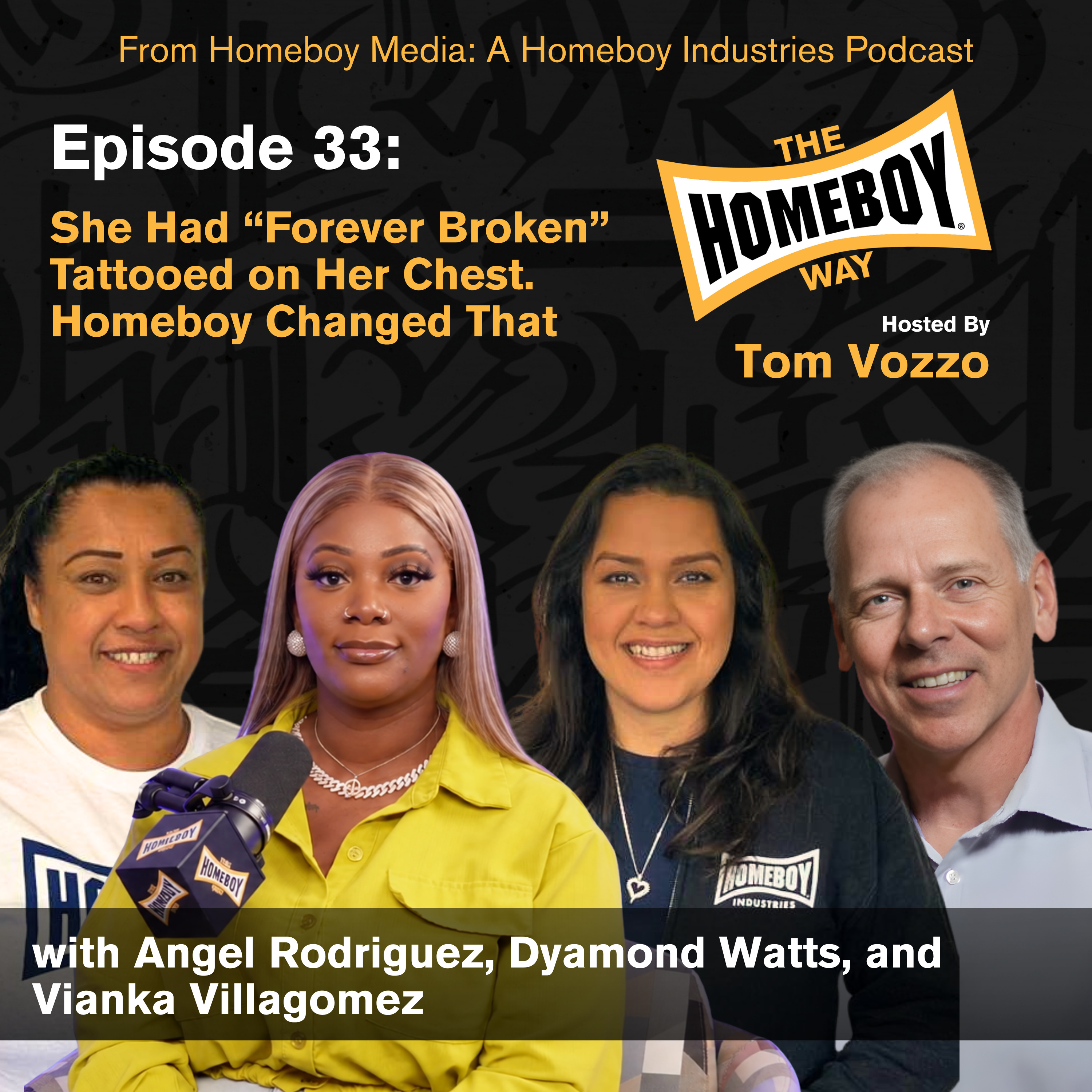
She Had "Forever Broken" Tattooed on Her Chest. Homeboy Changed That with Angel Rodriguez, Dyamond Watts, and Vianka Villagomez

In this episode, Tom Vozzo sits down with three remarkable women who have each walked through Homeboy's doors broken and walked out as leaders. Dyamond is now a brand strategist for the Homeboy Way podcast. Angel is a navigator helping new trainees find their footing. Vianka is an academic program coordinator at Homeboy's adult high school. Together, their stories paint a vivid portrait of what healing looks like when it is real, when it is slow, and when it never really ends. Dyamond came in after escaping an abusive relationship, drawn in by nothing more than the color of her cousin's purple shirt. She did not believe you could be paid to heal. Angel stood in the rain, literally torn between the familiar pain of her past and the unknown promise of Homeboy's open door. She chose the right path. Vianka arrived through Homeboy's anger management program, sent by a case manager she met while incarcerated, stepping through the doors during COVID when the building was nearly empty but the welcome was full. All three carry tattoos and scars and imposter syndrome. All three have sat in the same classes they now help facilitate. All three are raising children who see them showing up every day. And all three have one message for anyone still standing in the rain deciding which way to walk: you are not forever broken. Key Takeaways Healing can be a job. Dyamond couldn't believe it when her cousin said all you have to do is go to classes and they pay you for it. She had to see it to believe it. We don't only hurt ourselves, we hurt the people who love us. Angel learned in incarceration classes that every relapse, every arrest cuts deep into the people who love you, and her son crying for her at night was her turning point.  At Homeboy, the color lines disappear. Coming from the hood where Blacks and Hispanics don't always get along, Dyamond found something different at Homeboy: protection, support, and being seen as a boss. Motherly instinct is a superpower. Vianka feeds off the men's strength, but what connects the women is holding each other through difficult situations because they know what it means to bear kids and show up anyway.  A business card can feel like an Oscar.  Angel handed her mom a card with her name on it, and her mom made the biggest deal out of it. Because seeing your child finally change, that is everything. In This Episode: 00:00 – Introduction 01:20 – Dyamond’s journey to Homeboy 02:45 – Choosing healing over familiar pain 04:20 – Angel’s role as a navigator 06:45 – Angel’s turning point after incarceration 08:49 – Vianka’s path through trauma and healing 15:06 – Lessons for their younger selves 23:09 – Homeboy as a place of sanctuary 24:55 – Being a woman at Homeboy 29:21 – Women who inspire them 40:42 – What gives them hope today 44:14 – The meaning behind the gala moment Notable Quotes " I just couldn't believe that you're paying me to do something that I need to do. It was a win-win." – Dyamond [02:33] "I stood there and it was raining and I was torn because I wanted to go with the comfortable pain that I was used to." – Dyamond [03:32] "Hope has an address. It's 130 West Bruno Street." – Angel [41:30] Resources and Links Homeboy Industries https://homeboyindustries.org/ https://www.youtube.com/@HomeboyIndustries_LA/videos Donate: https://homeboyindustries.org/donate/donate-online/ Homeboy Media  https://homeboyindustries.org/social-enterprises/homeboy-media/ Vianka Villagomez https://www.facebook.com/vianka827/ Dyamond Watts https://www.instagram.com/therealqueenofcompton/ Thomas Vozzo https://www.linkedin.com/in/thomasvozzo The Homeboy Way: A Radical Approach to Business and Life: https://www.amazon.com/Homeboy-Way-Radical-Approach-Business/dp/082945456X Credits: Hosted by: Tom Vozzo Produced by: Podify, and Alexa Rousso and Melody Carter of Homeboy Media
46 minAbspielen in:

Mi29Apr
The Homeboy Way

The Homeboy WayHost

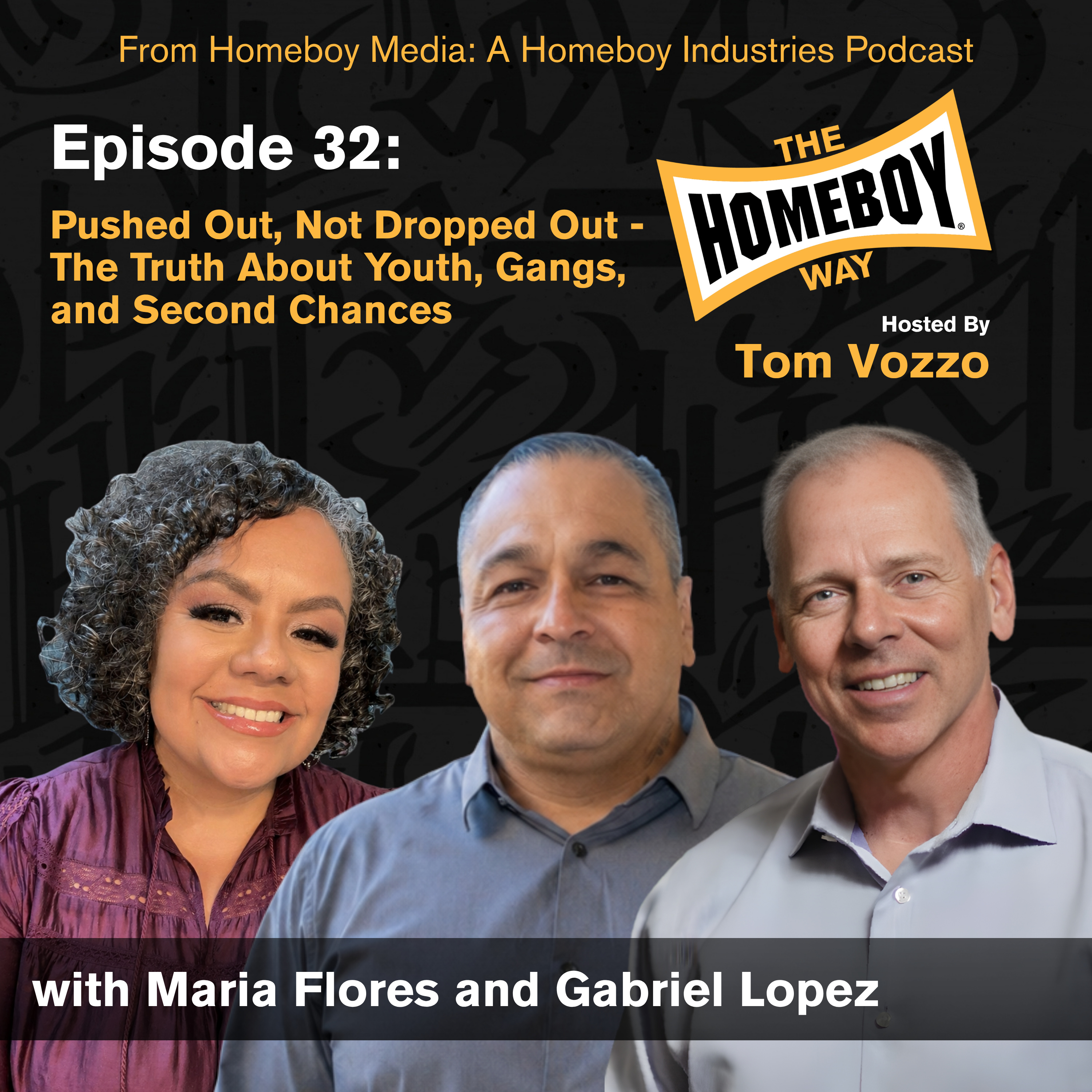
Pushed Out, Not Dropped Out: The Truth About Youth, Gangs, and Second Chances with Maria Flores and Gabriel Lopez

What does it take to reach a kid who’s already been given up on by every system around them? Maria Flores and Gabriel Lopez of Homeboy’s Youth Reentry Center answer simply: show up, stay, and never close the door. In this episode, Tom Vozzo sits down with Maria and Gabriel to explore the reality of working with youth coming out of incarceration and still living in gang violence, generational trauma, and instability. Unlike adults, these young people return to the same environments they came from. Their trauma isn’t something they leave behind, it’s where they live. Gabriel brings lived experience as a former generational gang member who spent years in prison before choosing a different path after his son was born. Maria, with 18 years at Homeboy, has seen entire cycles repeat, including parents she once supported now sending their own children through the program. Together, they describe a model rooted in radical consistency: no youth is ever expelled, no family is abandoned, and no one faces the system alone. From moments of joy like white water rafting trips where a hardened teen smiles for the first time, to a young man who kept returning simply because someone noticed him, this episode shows what happens when kids are treated not as problems to fix, but as people who want to be seen and loved. Key Takeaways Society failed her,  Homeboy showed up A girl out of school for three years wasn’t blamed. Instead, Maria asked how the system failed her. With support, she graduated two years later.  No one gets pushed out here The Youth Reentry Center never expels kids. Instead of punishment, they use reflection and healing circles, offering stability to youth used to rejection.  Education is the turning point Though legally allowed back in school, many youth are pushed out. Homeboy created its own school to ensure they don’t fall through the cracks.  Kids are pushed out not failing alone Behaviors that lead to expulsion in underserved communities are often handled differently elsewhere. The homeboy chooses to open the door instead.  Gang identity is about survival  What looks like defiance is often protection. As Gabriel puts it, beneath it all is a kid who wants to be loved.  Healing the healer matters  Maria calls Homeboy "my medicine." Staying present requires daily practices. Staff wellbeing is essential to sustaining this work.  In This Episode: 00:00 – Introduction 00:30 – Why Homeboy focuses on youth 02:49 – Living in trauma, not beyond it 06:47 – Girls, foster care, and hidden struggles 08:44 – Why no one is ever kicked out 09:30 – The reason Homeboy built a school 10:40 – The “chaser” model and wraparound support 15:27 – Understanding a young man’s mindset 16:30 – Gabriel’s story: joining a gang early 19:02 – What changed the direction of his life 21:12 – Fatherhood and a new sense of purpose 23:26 – Building trust and creating safe spaces 26:42 – Summer programs and moments of joy 28:48 – Lessons in trust and letting go 33:50 – Working with parents and reunification 36:02 – Breaking cycles of conflict and violence 41:26 – Gabriel’s journey as a father Notable Quotes “No one stops to look at what our kids are holding in their heart.” – Gabriel [03:58] “There is no such thing as ‘that’s it, you’re done.” – Maria [09:01] “They’re just little boys that want to be loved, bro.” – Gabriel [16:16] “ There's never a hopeful kid that joins a gang.” – Maria [17:25] Resources and Links Homeboy Industries https://homeboyindustries.org/ https://www.youtube.com/@HomeboyIndustries_LA/videos Donate: https://homeboyindustries.org/donate/donate-online/ Homeboy Media  https://homeboyindustries.org/social-enterprises/homeboy-media/ Thomas Vozzo https://www.linkedin.com/in/thomasvozzo The Homeboy Way: A Radical Approach to Business and Life: https://www.amazon.com/Homeboy-Way-Radical-Approach-Business/dp/082945456X Credits: Hosted by: Tom Vozzo Produced by: Podify, and Alexa Rousso and Melody Carter of Homeboy Media
46 minAbspielen in:

Mi22Apr
The Homeboy Way

The Homeboy WayHost

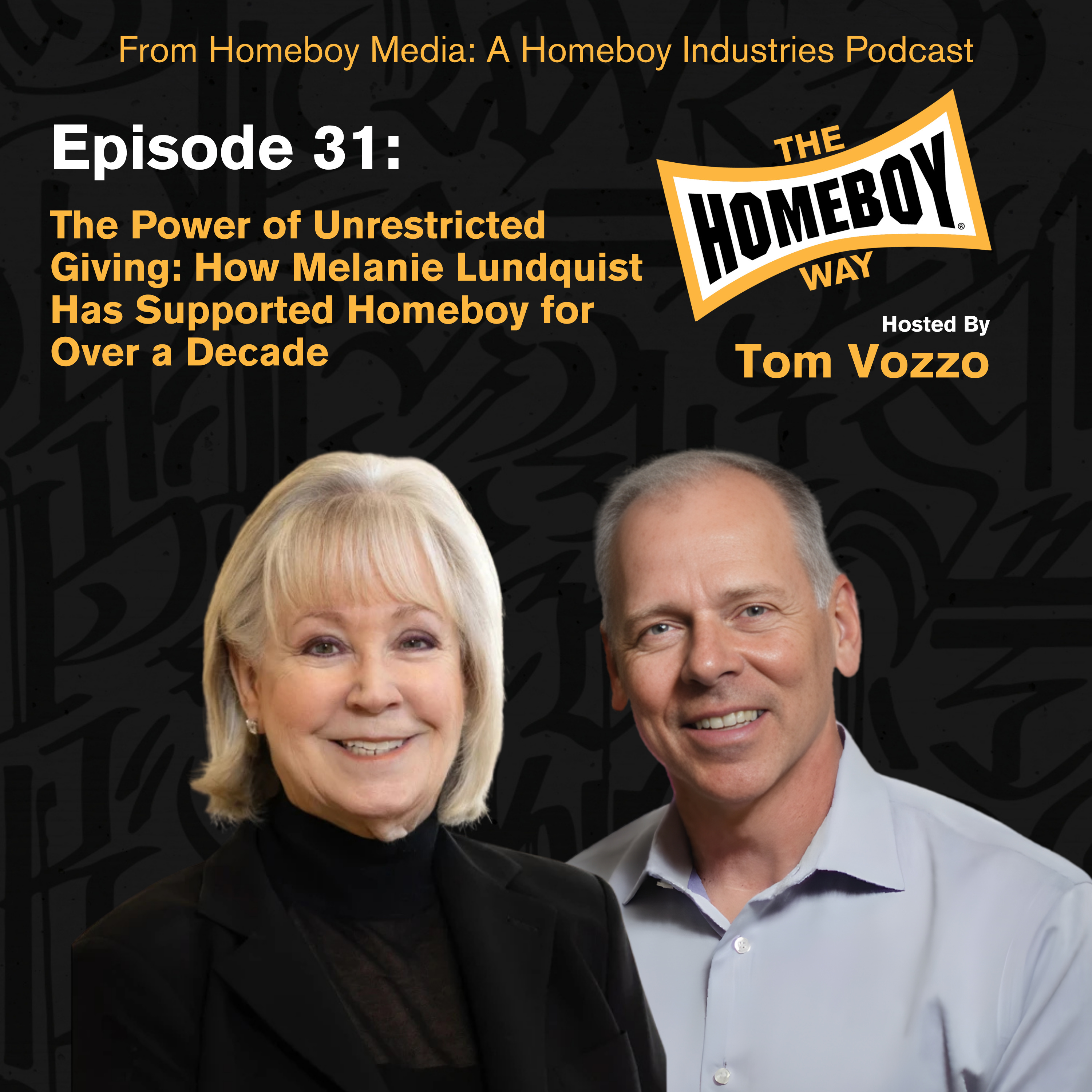
The Power of Unrestricted Giving: How Melanie Lundquist Has Supported Homeboy for Over a Decade

Years ago, Homeboy Industries was experiencing financial hardship. In order to make payroll, Melanie and her husband Richard Lundquist received a call from a Homeboy Board member that resulted in a check with no strings attached. No restrictions. Just trust. In this episode, Tom Vozzo sits down with 2026 Lo Maximo KINSHIP Honoree Melanie Lundquist, longtime Homeboy Industries supporter, to uncover the story behind that trust. Melanie's father was raised in Boyle Heights, and she remains true to her roots, retaining her lifelong love of service to others. Melanie and her husband, Richard are Giving Pledge (https://www.givingpledge.org/) signatories, and for them, impact is not about perfect numbers. It is about walking with the most vulnerable, and investing in replicable models like Homeboy Industries, that create systemic change Key Takeaways Cherishing each other is a shared responsibility. If we had enough cherishing, there would be no need for Homeboy. Melanie subscribes to Warren Buffett's theory: money belongs to society; we're just temporary stewards. Systemic change requires replicable models. We live in a deeply broken system across education, justice, and healthcare. True success is not short term help. It is creating models that can replicate and drive change from the bottom up. Homeboy is a replicable model; dollars invested here reach far beyond LA. Homies belong at the table When people ask if Melanie has had "clients" at her dining room, she corrects them: "They're homies." She's proud to have them there. Your dollars build a model that helps people in Chicago, New York, and beyond. Kindness costs nothing but changes everything Yet we struggle to give it. As a philanthropist, Melanie says, "It's the biggest, most joyful journey of my life. I wouldn't trade it for anything." In This Episode: 00:00 – Introduction 00:41 – Why Melanie became a supporter of Homeboy 05:53 – Why philanthropy gives life meaning 07:50 – Defining impact and systemic change 10:12 – Why donors should engage beyond money 12:10 – Gratitude and the deeper meaning of giving 14:02 – Why she chose to invest in Homeboy 16:20 – Balancing different causes and priorities 19:21 – Five-year forecast: the future of philanthropy 21:00 – Why long-term commitment matters 25:07 – Politics vs. philanthropy 26:45 – Elected officials prioritizing the poor and disenfranchised 27:51 – The freedom and limits of philanthropy 31:47 – Why Homeboy’s model works 34:07 – Can philanthropy save democracy? 37:00 – The power of kindness and empathy 38:03 – The redwood metaphor Notable Quotes “ If we had enough cherishing, there would be no need for Homeboy - Melanie [02:19] “Philanthropy is the rent we pay for the air we breathe.” - Melanie [03:43] “Philanthropy is the meaning of life and what gives our life meaning.” - Melanie [06:00] “What does it cost people to be kind? It costs nothing.” - Melanie [37:00] Resources and Links Homeboy Industries https://homeboyindustries.org/ https://www.youtube.com/@HomeboyIndustries_LA/videos Donate: https://homeboyindustries.org/donate/donate-online/ Homeboy Media  https://homeboyindustries.org/social-enterprises/homeboy-media/ Melanie  Lundquist https://www.givingpledge.org/ Thomas Vozzo https://www.linkedin.com/in/thomasvozzo The Homeboy Way: A Radical Approach to Business and Life: https://www.amazon.com/Homeboy-Way-Radical-Approach-Business/dp/082945456X Credits: Hosted by: Tom Vozzo Produced by: Podify, and Alexa Rousso and Melody Carter of Homeboy Media
40 minAbspielen in:

Mi15Apr
The Homeboy Way

The Homeboy WayHost

From Rehab to Head Barista: Jose Leon’s Homeboy Transformation

In this episode, Tom Vozzo sits down with Jose Leon, head barista at Homegirl Cafe. But Jose almost didn’t stay long enough to make a single cup. The first time Jose walked through the doors of Homeboy Industries, he was already planning his exit. Fresh out of rehab and carrying a charge for “fire,” considered worse than murder on the streets, he assumed a place full of gang members could never be positive. But his roommate, T, had a persistent, vibrant energy that Jose wanted for himself. More than that, he had four daughters. He needed to become someone they could count on. So he stayed. He washed dishes. He unlearned nearly everything. And then he got tricked into becoming a barista. Behind the counter at Homegirl Cafe, Jose discovered that coffee dissolves the barriers between strangers. People walk in with heavy stories, a mother grieving a son, and hand them over with their order. He listens, he serves, and he makes the best latte in Los Angeles. Now the head barista and a quiet leader, Jose still wakes at 3:30 a.m. He still focuses on the next generation, knowing he may never fully heal the wounds of his past. But he shows up differently. And that, he says, changes everything. Key Takeaways If you want something different, you have to do something different. Jose did not suddenly feel ready. He chose differently. He realized that everything he had done before led him to where he was, and if he wanted a different life, he had to take a completely different path. Transformation does not instantly fix relationships Even when someone does the work to heal, grow, and change, family members may still see the old version of them. Rebuilding trust takes time, patience, and consistency. Small, consistent actions can create a sense of purpose. When Jose started in the back of the cafe washing dishes, it wasn't a dead-end job. It was the first time he knew he could do something, finish it, and do it correctly again the next day.  Support can break deeply rooted beliefs Many who come from incarceration or hardship feel like they do not deserve help. Experiencing genuine care through meals, kindness, and community begins to shift that mindset and opens the door to change In This Episode: 00:55 – Jose’s first time at Homeboy 01:28 – The arson charge and coming out of rehab 02:04 – Why Jose was against Homeboy at first 02:45 – What kept him coming back 03:33 – The turning point: “I had to do something different” 05:44 – What Father Greg means to Jose 07:22 – Traveling to Fairbanks, Alaska to speak 08:46 – Unlearning everything 09:20 – Daily practices: waking up at 3:30 a.m. 11:06 – Healing family relationships without expectations 13:33 – Talking to his daughters and focusing on the next generation 14:17 – What Jose tells customers at the coffee counter 15:17 – Daily mindset reminders 17:10 – Part 2: Inside the Homegirl Cafe 17:28 – Starting as a dishwasher in the back 18:35 – Becoming a barista by accident 19:21 – Overcoming insecurity about facial scars 20:38 – Why the coffee counter removes barriers 22:20 – When a mother shared her son’s death 24:06 – Helping people straight out of jail with a free meal Notable Quotes “ If I wanted something different in life, I had to do something different.” — Jose [03:35] “I wanted to be the person my daughters needed me to be” — Jose [02:47] “I had to unlearn everything.” — Jose [09:07] Resources and Links Homeboy Industries https://homeboyindustries.org/ https://www.youtube.com/@HomeboyIndustries_LA/videos Donate: https://homeboyindustries.org/donate/donate-online/ Homeboy Media  https://homeboyindustries.org/social-enterprises/homeboy-media/ Jose Leon linkedin.com/in/jleon77 Thomas Vozzo https://www.linkedin.com/in/thomasvozzo The Homeboy Way: A Radical Approach to Business and Life: https://www.amazon.com/Homeboy-Way-Radical-Approach-Business/dp/082945456X Credits: Hosted by: Tom Vozzo Produced by: Podify, and Alexa Rousso and Melody Carter of Homeboy Media
27 minAbspielen in:

Mi8Apr
The Homeboy Way

The Homeboy WayHost

From Hollywood to the Homeboy Board: Camilla Belle Shares Her Story

A Hollywood actor spent years trying to get through the doors of Homeboy Industries. Not as a client. Not as a case manager. Just as someone who felt drawn to a place she did not fully understand. Camilla Belle had heard Father Greg speak at her church, seen the logo around Los Angeles, and had friends on the inside. But she still needed someone to take her by the hand. In this episode, Tom Vozzo sits down with Camilla to hear the full story, from Mommy & Me classes at Jane Fonda's workout studio to finally getting the tour at Homeboy. She describes her first morning meeting as indescribable: the prayer, the celebrations, the bake sales. That single visit turned into a board seat, a PA training class, and a van ride with a homie who trusted her with his entire life story. Camilla did not come from gangs or prison. She came from Hollywood. And that turned out to be enough. Because at Homeboy, kinship does not require a shared past. Just a willingness to show up, listen, and believe in second chances. Key Takeaways Morning meeting is the heartbeat of Homeboy Camilla describes it as indescribable, a celebration of life, community, and positivity that stays with you. From prayer to bake sales, everyone should experience it. Second chances are irresistible. Camilla was drawn to Homeboy not despite the fear people feel, but because of it. Father Greg's message about giving people another chance spoke to her deeply. You don't need a shared past to belong Many look at Homeboy and think, "I have nothing in common." But inside those doors, there's no judgment. We're all human. Listening is a privilege. During a board activation day, Camilla sat in the front of a van and listened as a homie told her his whole story, incarceration, family, and kids. She felt lucky he trusted her. Homeboy doesn't give anything away. No handouts. You work hard, show up, go through the 18-month program, and dedicate yourself to change. Homeboy gives second, third, and fourth chances as many as it takes. In This Episode: 00:00 – Introduction 00:45 – How Camilla got involved with Homeboy 03:25 – First impressions: the morning meeting 05:25 – Philanthropy and motivation to join Homeboy 07:02 – Finding common ground and human connection 08:41 – Homeboy Media Group and workforce development 09:07 – PA training class experience 11:22 – Navigating the entertainment industry and social media 13:06 – Lessons learned from Father Greg Boyle 14:40 – Applying Homeboy lessons to everyday life 15:26 – Jane Fonda’s influence and activism 17:37 – Encouraging advocacy and activism 19:28 – Building relationships and volunteering 20:17 – Family support and memorable Homeboy stories 22:04 – Hope for the future and second chances 24:00 – The importance of second chances 25:25 – Board member experience 27:39 – Podcast closing Notable Quotes “You walk in here and you say, there's no judgment..” — Camilla [08:08] “If you believe in it, you're going to show up.” — Camilla [15:54] “Get off your phone, talk to people.” — Camilla [17:45] “Slow yourself down and just be available and listen.” — Camilla [21:53] Resources and Links Homeboy Industries https://homeboyindustries.org/ https://www.youtube.com/@HomeboyIndustries_LA/videos Donate: https://homeboyindustries.org/donate/donate-online/ Homeboy Media  https://homeboyindustries.org/social-enterprises/homeboy-media/ Camilla Belle https://www.instagram.com/camillabelle/ Thomas Vozzo https://www.linkedin.com/in/thomasvozzo The Homeboy Way: A Radical Approach to Business and Life: https://www.amazon.com/Homeboy-Way-Radical-Approach-Business/dp/082945456X Credits: Hosted by: Tom Vozzo Produced by: Podify, and Alexa Rousso and Melody Carter of Homeboy Media
28 minAbspielen in:

Mi1Apr
The Homeboy Way

The Homeboy WayHost

Breaking Cycles: A Mother's Fight for Change and a Son's Path to Recovery with Natalie Venegas and Daniel Aguilar

Imagine your children being taken from your home at gunpoint. That searing, shame-filled moment becomes the catalyst. Not for more destruction, but for a journey that leads you from prison yards to the director’s chair, and eventually, to finding freedom in a sun-drenched square in Barcelona. This is Natalie’s story. In this episode of The Homeboy Way, host Tom Vozzo sits down with Natalie Venegas, Director of Case Management at Homeboy Industries, her son Daniel Aguilar, and longtime Homeboy leader Hector Verdugo to explore the long arc of transformation and generational healing. Natalie reflects on her 15-year journey from leaving prison as a four-time felon, carrying the trauma of her children being taken at gunpoint, to rising into senior leadership while pursuing clinical licensure. She shares how addiction, rejection, and survival masks once shaped her life, and how therapy, education, and unconditional love helped her learn how to live, parent, and lead. Daniel offers his perspective on choosing recovery for himself, while Hector reflects on witnessing Natalie’s evolution firsthand. Together, their stories reveal how kinship and consistency reshape not just individual lives, but entire family trajectories. Key Takeaways Healing begins when survival ends Natalie shares how emotional shutdown and stoicism kept her alive but also kept her stuck. Healing began only when she felt safe enough to be vulnerable. Consistency builds trust where words cannot Homeboy’s steady presence taught Natalie how to be consistent for herself, her children, and others, something she never experienced growing up. Unconditional love creates capacity  Being loved without prerequisites allowed Natalie to believe in herself, pursue education, enter therapy, and step into leadership. Healing is generational  Daniel’s recovery is connected to his mother’s healing. Homeboy’s model shows how helping one person reshapes an entire family’s future. You cannot do it alone, and you are not meant to  Walking alongside others through sponsors, staff, and peers makes transformation sustainable and real. In This Episode: 00:00 – Introduction 00:42 – Natalie’s early years and repeated incarceration 02:09 – Being taken from her children at gunpoint 03:59 – Choosing not to numb out in prison 06:28 – A letter from her son that changed everything 08:09 – The Greyhound bus, temptation, and choosing sobriety 10:36 – Entering a program and first encounters with Homeboy 12:18 – “You don’t fit our profile”: misjudgment and persistence 14:58 – Vulnerability breaks through stoicism 17:22 – Learning how to live on the outside 18:36 – Education, therapy, and discovering a calling 21:10 – From survival to service 23:09 – Daniel shares his recovery journey 28:25 – Parenting, boundaries, and letting go 31:26 – How Homeboy changes entire family trajectories 33:01 – Traveling the world as formerly incarcerated leaders 35:26 – Belonging without labels Notable Quotes “I didn’t know how to live out here. I knew how to hustle, but not how to be a mom.” — Natalie Venegas [17:02] “I’m the only one who’s going to fix my life.” — Daniel Aguilar [26:35] “Homeboy loves people, gives people hugs until they learn how to love themselves.” — Natalie [23:01] Resources and Links Homeboy Industries https://homeboyindustries.org/ https://www.youtube.com/@HomeboyIndustries_LA/videos Donate: https://homeboyindustries.org/donate/donate-online/ Homeboy Media  https://homeboyindustries.org/social-enterprises/homeboy-media/ Natalie Venegas https://www.linkedin.com/in/natalie-venegas-1327b0a3/ Hector Verdugo https://www.linkedin.com/in/hector-verdugo-7297a684 Thomas Vozzo https://www.linkedin.com/in/thomasvozzo The Homeboy Way: A Radical Approach to Business and Life: https://www.amazon.com/Homeboy-Way-Radical-Approach-Business/dp/082945456X Credits: Hosted by: Tom Vozzo Produced by: Podify, and Alexa Rousso and Melody Carter of Homeboy Media
38 minAbspielen in:

Mi18Mär
The Homeboy Way

The Homeboy WayHost

Listen, Listen. Love, Love: Fr. Greg Boyle, S.J. on the Heart of Healing

At Homeboy Industries, healing rarely happens through a single method. It unfolds through therapy, community, compassion, and the steady presence of people who care. In this episode, Tom Vozzo sits down with Fr. Greg Boyle, S.J. to explore how healing really happens for people carrying deep trauma. Fr. Greg describes it as the “cumulative dosing effect of cherishing” when someone is consistently seen, known, and valued. Yet that kind of love can feel overwhelming. Some homies even walk away at first because they do not know how to receive it. Fr. Greg reflects on the early days of Homeboy, when therapy carried heavy stigma. Today, the demand is so great that there are waiting lists. He shares stories of people wrestling with addiction, hearing voices, and confronting wounds they once tried to bury. Through decades of experience, Fr. Greg reveals a deeper truth. Healing does not happen only in therapy. It happens in a community where people discover they are no longer alone. Key Takeaways Overwhelm from love is real. Fr. Greg shares about a homie who left Homeboy not because things were bad, but because he “didn’t know how to handle all the love.” For people used to trauma, steady care and belonging can feel unfamiliar or overwhelming, so some leave and return when they are ready. Community dosing surrounds and amplifies therapy. Beyond methods like talk therapy and EMDR, healing also happens through daily relationships. Consistent care from staff, mentors, and volunteers helps build resilience. The three profiles of gang members (and all of us). Fr. Greg breaks down that everyone falls into one of three categories: despair (can't imagine a future), trauma (high ACEs score), or mental illness. Luck and privilege shape our lives more than we admit. Fr. Greg reminds us that success is not only about hard work. Many benefit from unseen advantages, and recognizing this can foster humility and compassion. In This Episode: 00:00 – Introduction  01:00 –  How healing happens 02:28 – Why therapy must be voluntary 03:09 –  The early days and the need for therapy at Homeboy (ACEs) 05:50 – What surrendering to healing looks like 07:44 – When love feels overwhelming 09:14 –  Challenges finding therapists and homies to try therapy 12:29 – The rise of therapy and volunteer clinicians 14:35 – Listening and loving as the foundation of healing 16:05 – Alternative therapies and healing experiences 20:32 – Why there is no “one-size-fits-all” healing 23:37 – Compassion and forgiveness in the healing process 26:38 – What it means to be a “stranger to yourself” 30:43 – Three profiles of gang members 33:44 – Excavating generational wounds in everyday life 36:31 – The role of luck, privilege, and circumstance 38:46 – Reducing stigma around mental health 40:35 – Mental illness and societal misunderstanding 45:39 – Why healing is reliable and ongoing Notable Quotes “I don't think healing is so formulaic. I think if you believe in how the cumulative dosing effect of cherishing is, you can observe it.” — Fr. Greg Boyle, S.J. [01:00] “Listen, listen. Love, love.” — Fr. Greg Boyle, S.J. [14:01] “If you don’t welcome your own wound, you will be tempted to despise the wounded.” — Fr. Greg Boyle, S.J. [28:01] “How do you transform your pain so you no longer transmit it?” — Fr. Greg Boyle, S.J. [31:41] Homeboy Industries https://homeboyindustries.org/ https://www.youtube.com/@HomeboyIndustries_LA/videos Donate: https://homeboyindustries.org/donate/donate-online/ Homeboy Media  https://homeboyindustries.org/social-enterprises/homeboy-media/ Father Greg Boyle linkedin.com/in/greg-boyle-s-j-05458514 Thomas Vozzo https://www.linkedin.com/in/thomasvozzo The Homeboy Way: A Radical Approach to Business and Life: https://www.amazon.com/Homeboy-Way-Radical-Approach-Business/dp/082945456X Credits: Hosted by: Tom Vozzo Produced by: Podify, and Alexa Rousso and Melody Carter of Homeboy Media
47 minAbspielen in:

Mi11Mär
The Homeboy Way

The Homeboy WayHost

Jane Fonda on Why The Homeboy Way Matters Now

Jane Fonda, Oscar-winning actress and lifelong activist, first learned about Homeboy Industries in the 1980s through her then-husband, Tom Hayden. He came home energized by a Jesuit priest who had opened a bakery employing formerly incarcerated gang members. Years later, at a Homeboy gala, she finally heard Father Greg Boyle speak and knew she wanted to be part of something so transformative. In this episode, Tom Vozzo sits down with Jane to reflect on her seven years as a board member and what continues to draw her to a community built on healing and second chances. She shares how walking through Homeboy’s doors feels like “sinking into a warm bath,” and why, at 88, she still finds herself learning from the homegirls she calls “smarter than me in so many ways.” For Jane, leadership begins with humility, and real change starts by listening from the heart. Key Takeaways Jobs are not enough. Healing comes first.  Father Greg realized quickly that employment alone would not create lasting change. Deep trauma, left unaddressed, leads people back into trouble. Homeboy evolved into a healing-centered community where recovery comes before placement. Cherish, don’t judge. To cherish someone is to fully receive them into your heart. Healing begins there. Transformation requires proximity.  It's wonderful when rich people throw money out from their homes up on the hill to people who need it," Jane says. Generosity from a distance is good. But real change happens shoulder to shoulder. Being present, listening, and building relationships transforms everyone involved. Hate the behavior, not the person Bad behavior is often the language of trauma. You can reject harm while still honoring human dignity. We give because we see ourselves.  Homeboy’s mission resonates because we are all broken in some way. Watching others heal reminds us that transformation is possible for us too. Women are the glue.  "In every class, in every rung of society, and in every ethnicity and race in the world, it's women that hold things together. They're the glue for families and for communities." Life with meaning is better.  Jane has lived without meaning and with meaning. "I know that the meaning is a lot better.  In This Episode: 00:00 – Introduction 01:46 – How Jane Fonda first found Father Greg and Homeboy Bakery 03:41 – From the Homeboy Bakery to a healing-centered model 04:40 – "I need whatever that secret sauce is" 06:05 – Kinship and mutuality with people on the margins 08:48 – What Jane learns from homegirls 13:09 – The meaning of cherishing 15:54 – Ignatian spirituality at Homeboy 18:32 – Funding the mission 19:51 – Gangsters, leaders, and the pressure of machismo 21:32 – Homeboy’s culture shift: from toughness to tears 22:09 – Poverty, business hiring, and “show by doing” 23:30 – Jane Fonda’s activist origin story 26:19 – The urgency of activism today 28:19 – What Jane would tell her younger self 30:06 – The Global Homeboy Network Notable Quotes “ Bad behavior, even evil behavior is the language of the traumatized.” — Jane [07:25] " Avoid violence. Violence is our enemy." — Jane [28:04] “ Cherished, to me is even greater than love means I've brought you fully into my full heart in every possible way.” — Jane [13:42] “I've lived without meaning, and I've lived with meaning, and I know that the meaning is a lot better.”— Jane [29:19]  Resources and Links Homeboy Industries https://homeboyindustries.org/ https://www.youtube.com/@HomeboyIndustries_LA/videos Donate: https://homeboyindustries.org/donate/donate-online/ Homeboy Media  https://homeboyindustries.org/social-enterprises/homeboy-media/ Jane Fonda https://www.linkedin.com/in/jane-fonda-2408b4302/ Thomas Vozzo https://www.linkedin.com/in/thomasvozzo The Homeboy Way: A Radical Approach to Business and Life: https://www.amazon.com/Homeboy-Way-Radical-Approach-Business/dp/082945456X Credits: Hosted by: Tom Vozzo Produced by: Podify, and Alexa Rousso and Melody Carter of Homeboy Media
35 minAbspielen in:

Mi4Mär
The Homeboy Way

The Homeboy WayHost

Healing Through Art at the Homeboy Art Academy with Fabian Debora and Barbara Fant

When Tom Vozzo first walked into Homeboy Industries more than 12 years ago, he was skeptical. “Shouldn’t we be doing work here at ‘Industries’?” he wondered, seeing art classes throughout the building. In this episode, Tom sits down with Fabian Debora, Executive Director of the Homeboy Art Academy, and Program Manager Barbara Fant to explore how art reaches wounds words cannot and why creativity is central to Homeboy’s model of healing and belonging. Fabian shares how, as a child hiding from domestic violence, drawing became his refuge, a sanctuary that carried him through addiction, recovery, and ultimately national recognition as a Heritage Fellow with the National Endowment for the Arts. Barbara reflects on losing her mother at fifteen and turning grief into poetry, using verse as both prayer and therapy. Through the Art Academy, rival youth create side by side, guided by Fabian’s Three R’s: Reconnect, Re-identify, and Reimagine. Key Takeaways Art is refuge As a child, Fabian learned art did not just express him, it held him. Hiding under a coffee table from violence, he found safety and hope. That same refuge is what the Art Academy now offers every young person who enters. Mentorship restores what shame steals.  When a teacher destroyed Fabian’s artwork, Father Greg Boyle saw him for who he truly was and gave art back. That moment of being seen and reassured that his gift mattered changed everything. Poetry can be prayer. At 15, without therapy, Barbara turned sermon notes into poems, using them to grieve, pray, and make sense of losing her mother. Healing is intentional. The Art Academy practices a healing-centered approach: circles, reflection, the three R’s, creative exercises aligned with specific aspects of healing, and structured closing reflections. Identity can evolve. The young man known for his face tattoo begins with gang writing and gradually discovers artistry, leadership, and gentleness within himself. In This Episode: 00:00 – Introduction 01:26 – Fabian’s childhood and art as refuge 03:32 – Mentorship and artistic development 05:28 – Barbara’s story: poetry as prayer 11:03 – The Homeboy Art Academy 12:32 – Healing-centered approach and the three R’s 14:25 – Community, safety, and transformation 16:29 – Co-designing the Academy’s modality 18:09 – Stories of transformation: Giselle and Jesus 20:13 – Managing gang dynamics and building kinship 21:55 – Team approach and wraparound services 24:03 – Challenges of the work 27:07 – Resilience and returning youth 28:17 – Fabian’s artistic recognition and advocacy 30:21 – Barbara’s writing and influence of Homeboy 31:52 – Future vision: accredited school of art 32:44 – Graffiti, tagging, and artistic expression Notable Quotes “People really do heal through the arts.” — Tom [01:16] "Art gave me a sense of purpose, existence, and, most importantly, hope." — Fabian [02:08] “ I started writing as just this way of processing, of talking to God and of prayer.” — Barbara [07:14] “The toughest part of the job has been the heartbreak.”— Tom [26:23]  Resources and Links Homeboy Industries https://homeboyindustries.org/ https://www.youtube.com/@HomeboyIndustries_LA/videos Donate: https://homeboyindustries.org/donate/donate-online/ Homeboy Media  https://homeboyindustries.org/social-enterprises/homeboy-media/ Barbara  Fant https://www.linkedin.com/in/barbara-fant-mfa-8114b633/ https://homeboyindustries.org/services/art-academy/ Fabian Debora https://www.linkedin.com/in/fabian-debora-886279a/ https://homeboyindustries.org/services/art-academy/ Thomas Vozzo https://www.linkedin.com/in/thomasvozzo The Homeboy Way: A Radical Approach to Business and Life: https://www.amazon.com/Homeboy-Way-Radical-Approach-Business/dp/082945456X Credits: Hosted by: Tom Vozzo Produced by: Podify, and Alexa Rousso and Melody Carter of Homeboy Media

37 minAbspielen in:

Mi25Feb
The Homeboy Way

The Homeboy WayHost

We All Belong Here: Pete Holmes on Comedy, Wounds, and Cherished Belonging

In this episode, Tom Vozzo sits down with comedian and podcaster Pete Holmes to talk about faith, belonging, and spirituality. Pete shares how discovering Fr. Greg Boyle, S.J. and Homeboy Industries reshaped not just his theology, but the way he walks on stage. Before performing, he often listens to Father Greg to remind himself that “we belong to each other,” shifting comedy from performance to kinship. Pete reflects on coming from the Christian tradition, where being the center of attention can feel almost wicked, like becoming the “special boy.” Comedy, he explains, is not that. He will play the role of the special performer, and the audience plays their role too. But underneath it all, it is just a connection. It is all just sunlight wearing different masks. Reflecting on the story of the prodigal son, Pete explains that you cannot be more of the man’s son in the kingdom and less his son with the pigs. It is about accepting that you are accepted. You are already in. They talk about staying soft when things go wrong, letting anger move through without shame, and resisting the urge to create “the other.” Key Takeaways We are sunlight wearing different masks. Pete looks at the audience and does not see strangers. He sees himself in different forms. Each person carries quiet burdens, love and hurt, generosity and selfishness.  The gospel draws a crowd. Pete observes that Homeboy’s lobby feels like Disneyland or summer camp. That pull, he argues, is the real sign of the sacred. Pain is not a competition. Your shit is your shit. Pete almost minimizes his own story beside another’s trauma, then realizes suffering is not a scoreboard. Healing begins when we stop ranking wounds and start honoring them. Want to know you’re accepted? Start accepting others. You can't be more the man's son when you're in the kingdom and less his son when you're with the pigs. Tom watched Greg Boyle pause with wealthy donors to attend to a homie with a simple question. Acceptance is not a reward. It’s a practice we extend, especially to the least visible. Grace is getting it wrong and being loved anyway. Tom’s tree story captures the ache of good intentions missing the mark. That tender space between intent and impact is where grace lives. Hating the other is hating yourself. When we label anyone disposable, we quietly say the same about ourselves. Loving those cast aside brings the hidden parts of us back to life. In This Episode: 00:00 – Introduction 00:53 – Getting involved with Homeboy 01:22 – Connecting with Fr. Richard Rohr and Fr. Greg Boyle 03:16 – The impact of Homeboy’s teachings 04:45 – Performing with compassion 07:43 – Lessons from Homeboy 16:11 – The power of acceptance and belonging 22:39 – Balancing help and personal boundaries 27:17 – Spiritual teachings and reflections 29:03 – The value of vulnerability 29:55 – A humbling medical experience 30:44 – Embracing brokenness 34:14 – Spirituality in the corporate world 35:05 – Discovering true spirituality 42:05 – The role of psychedelics in spiritual awakening Notable Quotes “Every single one of you has an unseen burden.” — Pete Holmes [05:09] "We're all just sunlight wearing different masks." — Pete Holmes [05:43] “If you want to know you're accepted, start by accepting others.” — Tom [25:11] Resources and Links Homeboy Industries https://homeboyindustries.org/ https://www.youtube.com/@HomeboyIndustries_LA/videos Donate: https://homeboyindustries.org/donate/donate-online/ Homeboy Media  https://homeboyindustries.org/social-enterprises/homeboy-media/ Pete Holmes https://peteholmes.com/ https://www.youtube.com/user/peteholmes Thomas Vozzo https://www.linkedin.com/in/thomasvozzo The Homeboy Way: A Radical Approach to Business and Life: https://www.amazon.com/Homeboy-Way-Radical-Approach-Business/dp/082945456X Credits: Hosted by: Tom Vozzo Produced by: Podify, and Alexa Rousso and Melody Carter of Homeboy Media

59 minAbspielen in: