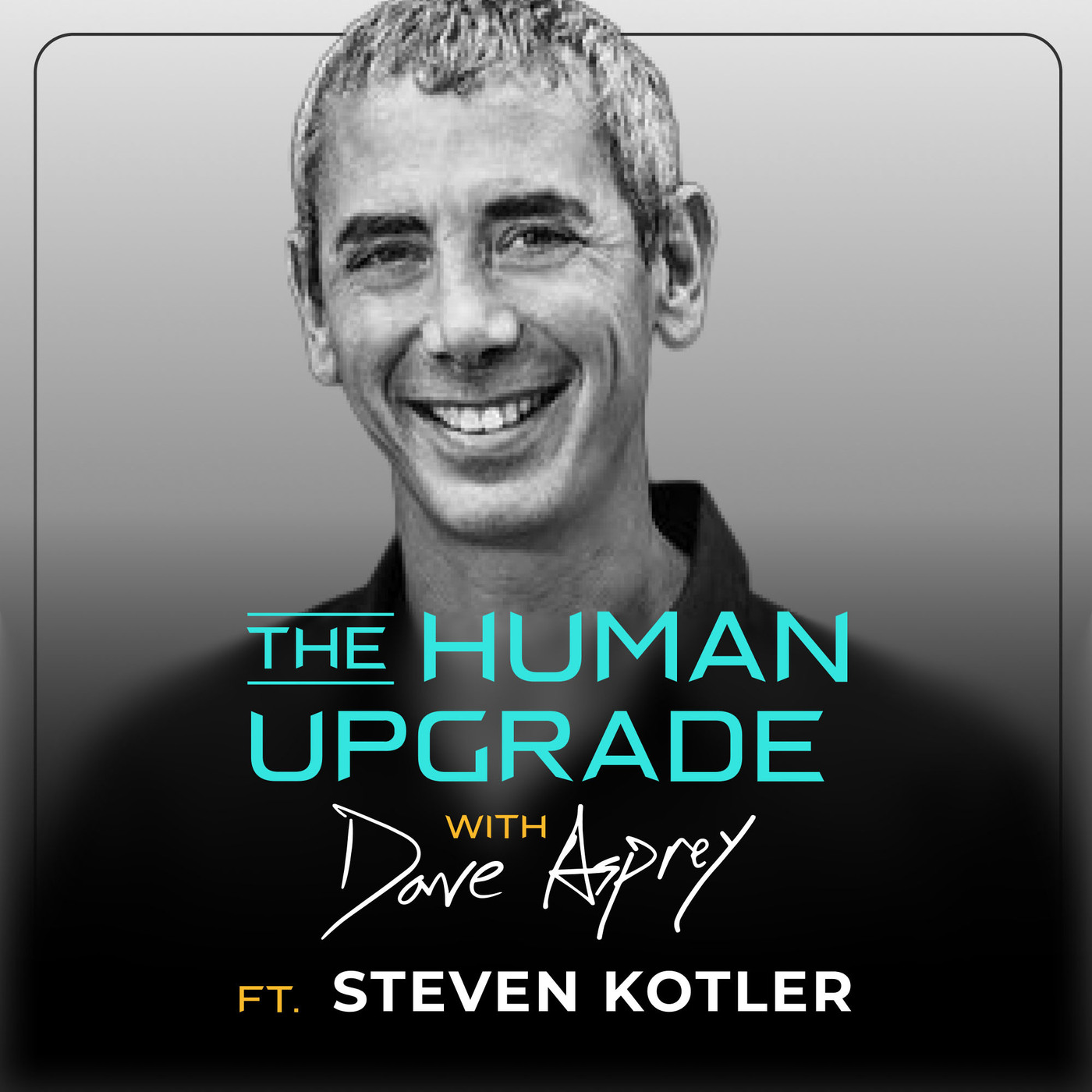
SK
Gerade überall zu Gast: 4 Podcasts in 6 Monaten

Steven Kotler

American author, journalist and entrepreneur

Steven Kotler war in den letzten 12 Monaten in 4 Podcast-Folgen aus 4 verschiedenen Sendungen zu Gast. Zuletzt: The Human Upgrade: Biohacking for Longevity & Performance, 22. Okt. 2026.

Kurzbiografie aus Wikipedia

Zwei Jahre auf Sendung

GastHostErwähnt

Gastauftritte

Do22Okt
The Human Upgrade: Biohacking for Longevity & Performance

The Human Upgrade: Biohacking for Longevity & Performance

How to Trigger Flow States From The 5 Brain Chemicals You Need : 1559

The Neuroscience of Flow, Peak Performance, Psychedelics, Trauma, Intuition & Consciousness with Steven Kotler Host Dave Asprey sits down with Steven Kotler, New York Times bestselling author and leading researcher in the neuroscience of flow, to explore how altered states of consciousness influence peak performance, mental health, creativity, intuition, and our perception of reality. Steven Kotler is a bestselling author of 17 books, including The Art of Impossible and We Are as Gods, and the founder of the Flow Research Collective. For decades, he has studied the neurobiology of peak performance, working with elite athletes, military personnel, and high-performing professionals to understand how people can reliably access flow states. Dave and Steven begin by exploring the neuroscience of flow and why it may be one of the most powerful altered states available without drugs. Steven explains how dopamine, norepinephrine, serotonin, anandamide, and endorphins contribute to the flow experience, why his research suggests caffeine can increase flow susceptibility, and how chasing the neurochemical high of peak performance can become dangerous. They discuss the darker side of flow training, including its potential risks for people prone to mania, the importance of recovery, and why attempting to remain in a flow state indefinitely can undermine performance. Steven shares how his training programs approach sleep, attention, and behavioral changes to help people access flow more consistently. The conversation then moves into psychedelics, ketamine-assisted therapy, and the neuroscience of trauma. Steven introduces emerging research suggesting that unresolved emotional patterns may involve the brain's predictive processing systems. Dave shares a personal experience involving Joe Rogan and how revisiting an early childhood memory changed his emotional response to public criticism. Dave and Steven also explore how the brain constructs reality, including the neuroscience of perception, sensory processing, and the flexible boundary between ourselves and our environment. They discuss how flow alters our sense of self, why the brain predicts what we experience before we consciously perceive it, and how these mechanisms may help explain certain spiritual and out-of-body experiences. Finally, Steven reveals new research investigating the neurological connections between flow, intuition, synchronicity, and purpose. He discusses emerging theories of consciousness, the role of information processing in subjective experience, and how artificial intelligence may change the future of human performance. You'll Learn: How flow states influence dopamine, norepinephrine, serotonin, anandamide, and endorphins, and why Steven's research suggests caffeine may help make the brain more susceptible to flow. Why chasing the neurochemical high of flow can become dangerous, how flow training may affect people prone to mania, and why sleep and recovery are essential for sustained peak performance. How ketamine-assisted therapy may help uncover forgotten emotional experiences and why Steven believes the brain's predictive processing systems play an important role in trauma. How the brain constructs our perception of reality, why sensory information reaches consciousness at different speeds, and what happens to our sense of self during altered states. Why flow may enhance intuition and how emerging neuroscience research is investigating connections between synchronicity, purpose, and the brain's information-processing systems. How Steven is using neuroscience, artificial intelligence, and years of flow training data to develop more accessible methods for improving focus, learning, and performance. Dave Asprey is a four-time New York Times bestselling author, founder of Bulletproof Coffee, and the father of biohacking. With over 1,000 interviews and 1 million monthly listeners, The Human Upgrade brings you the knowledge to take control of your biology, extend your longevity, and optimize every system in your body and mind. Each episode delivers cutting-edge insights in health, performance, neuroscience, supplements, nutrition, biohacking, emotional intelligence, and conscious living. New episodes are released every Tuesday, Thursday, Friday, and Sunday (BONUS). Dave asks the questions no one else will and gives you real tools to become stronger, smarter, and more resilient. Keywords: Steven Kotler, Dave Asprey, flow state, neuroscience of flow, peak performance, Flow Research Collective, dopamine, caffeine and flow, altered states, consciousness, psychedelics, ketamine therapy, trauma, predictive processing, neuroplasticity, intuition, synchronicity, brain science, mental performance, cognitive enhancement, flow triggers, serotonin, anandamide, meditation, human optimization, artificial intelligence, We Are as Gods, The Art of Impossible New episodes are released every Tuesday, Thursday, Friday, and Sunday (BONUS). Dave asks the questions no one else will and gives you real tools to become stronger, smarter, and more resilient. Resources: • Explore Steven Kotler's books, research, and flow training programs at https://www.flowresearchcollective.com/ • Get My 2026 Clean Nicotine Roadmap | Enroll for free at https://daveasprey.com/2026-clean-nicotine-roadmap/ • Dave Asprey's Latest News | Go to https://daveasprey.com/ to join Inside Track today. • Danger Coffee: https://dangercoffee.com/discount/davetube • My Daily Supplements: SuppGrade Labs (15% Off) • Favorite Blue Light Blocking Glasses: TrueDark (15% Off) Thank you to our sponsors! ZenBud | Dave’s Nervous System Biohack. Visit zenbud.health and use code DAVE15 at checkout for a discount. Timeline | Visit timeline.com/dave and get up to 20% off when you subscribe and save OneSkin | For a limited time try the new OS-01 FACE RICH CREAM with 15% off at oneskin.co/DAVE Kenetik | Instead of pushing your system harder, Kenetik feeds your brain the ketones it craves to fuel calm clarity and steady focus. Go to drinkkenetik.com/DAVE and use code DAVE for a discount. Timestamps: 00:00 — Trailer 01:12 — Intro 05:08 — Psychedelics and Peak Performance 11:10 — Trance, Voices, and Shamanism 18:00 — Dangers of Flow Training 24:00 — Ketamine and Innate Intelligence 30:00 — The Prediction Problem 35:25 — Embodied Cognition 46:30 — Consciousness and Synchronicity 50:20 — New Books and Research 53:00 — Flow for the Many See Privacy Policy at https://art19.com/privacy and California Privacy Notice at https://art19.com/privacy#do-not-sell-my-info.

56 min

Di29Sep
The Neuro Experience

The Neuro Experience

Top Flow Researcher: How to Get 5 Days of Work Done in 1 Day | Steven Kotler

Steven Kotler has spent 30 years studying the state that makes people 500% more productive, and he has a problem with the book everyone on your feed is quoting. In this conversation he explains what flow actually is, how to train it, and why "The Body Keeps the Score" got trauma wrong. In this episode, Louisa sits down with the flow researcher and Flow Research Collective founder to go through the neurobiology underneath peak performance. He walks through the six characteristics psychologists use to define flow, the McKinsey study that found top leaders were 500% more productive in it, the DARPA experiment that cut skill acquisition time in half, and the data from 15,000 people who went through his eight-week training: a 73.4% increase in time spent in flow, anxiety down 41%, motivation up 40%. Then he gets practical. Flow follows focus, so he lays out the triggers that drive it: why you should give your hardest task 90 to 110 minutes first thing, why task focus beats ego focus, why darkness amplifies divergent thinking and light amplifies convergent, and why the average leader now has 17 incoming channels instead of three. He explains why the two biggest blockers aren't neurological at all, why there are no "three things you can do Monday morning," and why grit should be the last tool you reach for, not the first. They also get into AI, where Kotler is working on a paper arguing these products need warning stickers. He explains why working with AI produces a fake group flow, complete with the dopamine and the fast feedback loops, but missing the one thing real group flow gives you: someone to error-correct you. Finally, the argument that will annoy your Instagram feed. Kotler's paper with Karl Friston, "The Body Does Not Keep the Score," makes the case that trauma isn't stored in your hips or your jaw. It's a prediction problem, not a storage problem. He explains the research showing roughly 70% of people return to baseline within 18 months, why a victim mindset locks you out of flow entirely, why body-based therapies sometimes work for reasons that have nothing to do with stored trauma, and what he learned about grief from running an animal sanctuary. 🤝 Sponsor The Neuro Experience: https://open.substack.com/pub/neuroathletics/p/sponsor-tne Reduce your risk of Alzheimer's with my science-backed protocol for women 30+: https://go.neuroathletics.com.au/youtube-sales-page Subscribe to The Neuro Experience for evidence-based conversations at the intersection of brain science, longevity, and performance. Chapters: 00:00 Flow, AI, trauma and peak performance 01:03 What flow actually is 05:35 The six characteristics of flow 09:09 How long a flow state can last 11:29 Can you train yourself to enter flow? 15:57 Expertise, learning and pattern recognition 21:22 Why modern life makes flow harder 23:01 The triggers that create flow 26:01 Building a 90-minute focus window 30:07 Batch communication and protect your attention 35:12 Why Kotler dedicated his life to flow 38:46 How AI creates fake group flow 48:04 Sex differences, hormones and flow 53:59 Does the body keep the score? 59:41 Trauma as a prediction problem 1:11:20 Why peak performance has no shortcuts 1:13:20 Flow, grief and creating new memories 1:20:57 Measuring group flow 1:23:43 Does prayer help you enter flow? 1:27:30 First principles for getting into flow Thank you to our sponsors: Nuropod: 5% off https://nuropod.com/neuro Timeline (Mitopure): https://timeline.com/NEURO - Get 20% off when you subscribe and save Solius: https://solius.com - Use code NEURO for 10% off I'm Louisa Nicola — clinical neurophysiologist, Alzheimer's prevention specialist, and founder of Neuro Athletics. My mission is to translate cutting-edge neuroscience into actionable strategies for cognitive longevity, peak performance, and brain disease prevention. If you're committed to optimizing your brain, reducing Alzheimer's risk, and staying mentally sharp for life, you're in the right place. Stay sharp. Stay informed. Join thousands who subscribe to the Neuro Athletics Newsletter → https://bit.ly/3ewI5P0 Instagram: https://www.instagram.com/louisanicola_/ Twitter: https://twitter.com/louisanicola_

1 h 35 min

Di23Jun
Moonshots Podcast: Superstar mindsets and success habits

Moonshots Podcast: Superstar mindsets and success habits

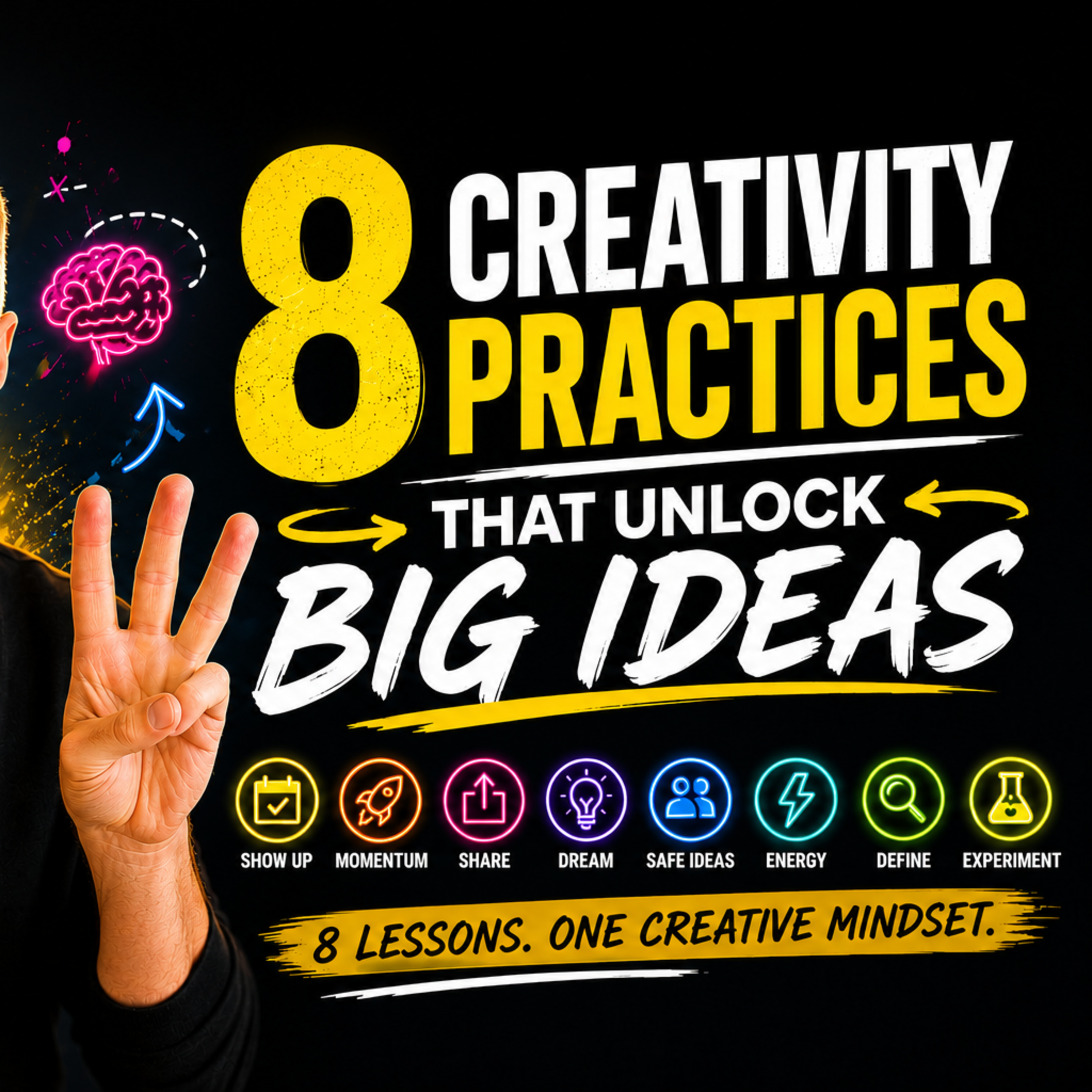
I Studied 100+ Creativity Experts. Here Are the 8 Ideas That Matter.

Over the last eight years of Moonshots, we've explored the work of hundreds of authors, entrepreneurs, scientists, artists, educators, and innovators. We've studied creativity from every angle imaginable. We've looked at the habits of musicians, the methods of filmmakers, the thinking of scientists, the systems of entrepreneurs, and the practices of some of the most creative people who have ever lived.As we prepare to launch a new creativity series on Moonshots, beginning with Steven Kotler's *The Art of the Impossible*, I wanted to pause and reflect on what we've learned so far.What surprised me most wasn't how different these thinkers are. It was how often they arrived at the same conclusions.A legendary music producer, a bestselling novelist, the founder of Pixar, one of history's greatest physicists, an education visionary, and a pair of Stanford design professors all seem to be pointing toward the same set of principles.Creativity is not a gift possessed by a lucky few.It is a practice.It is a way of approaching problems, ideas, opportunities, and life itself.In this episode, I share eight creative practices that have had the biggest impact on my own work as a founder, advisor, podcaster, writer, speaker, software builder, and lifelong learner.The first lesson comes from Rick Rubin and *The Creative Act*. One of the most valuable ideas I've taken from Rick is the importance of showing up early and allowing ideas time to develop. Great work rarely appears on demand. Whenever I'm preparing a keynote, building a product, creating content, or solving a difficult client problem, I start earlier than I need to. I immerse myself in the work and then let it sit. I allow ideas to ferment. Some of my best work has emerged not from pushing harder, but from creating enough space for intuition and imagination to do their job.Elizabeth Gilbert's *Big Magic* offers another powerful reminder. Momentum is more important than perfection. I see perfectionism derail founders every week. They delay launches, delay decisions, delay customer conversations, and delay progress because they want everything to be perfect. The reality is that creative people create. They publish. They ship. They learn. Progress compounds. Perfection delays.Austin Kleon's *Show Your Work* reinforces this principle. Big achievements are usually the result of many small outputs shared consistently over time. Moonshots itself is a perfect example. The show didn't grow because of one viral episode. It grew because Mark and I showed up repeatedly for years. Small contributions, delivered consistently, eventually become meaningful bodies of work.Walt Disney reminds us to dream first and judge later. Too many ideas are destroyed before they have a chance to grow. Whether it's our own self-talk or feedback from others, premature judgement can suffocate creativity. Disney's genius was creating environments where imagination could run free before practicality entered the conversation. Creativity often requires us to suspend disbelief long enough to discover what might be possible.Ed Catmull, in *Creativity, Inc.*, extends this idea even further. He argues that unfinished ideas need safety. Great ideas rarely arrive fully formed. They emerge through discussion, experimentation, and collaboration. Teams that create psychological safety unlock more creativity because people feel comfortable sharing incomplete thoughts. Innovation depends on creating environments where ideas can evolve rather than be evaluated too early.Ken Robinson's work on *The Element* introduces one of my favourite questions. Rather than asking what your passion is, ask yourself what feels good. What activities energise you? What work absorbs your attention?

22 min

Do11Jun
The Next Big Idea

The Next Big Idea

The Case for AI Optimism with Peter Diamandis and Steven Kotler

Nearly half of all Americans believe AI is bad for humanity. Peter Diamandis is not one of them. On his podcast, Moonshots, and in his new book, We Are as Gods, co-written with the inimitable Steven Kotler, he makes the case that artificial intelligence is already ushering in a world of abundance — think radical life extension, 10 billion humanoid robots, and agents that do your job while you're sipping a latte. He knows it may not be all sunshine and hydroponic roses, but he believes our future is incredibly bright. And he's putting his money where his mouth is: XPRIZE, the nonprofit he founded more than 30 years ago to bankroll breakthroughs, just announced it's giving $3.5 million to filmmakers who conjure convincingly optimistic visions of the future. Rufus and Caleb don't have their film treatment ready yet, but they do have plenty of questions for Peter and Steven about flying cars, the future of work, worst-case scenarios, and the new commandments for working with AI. 💬 LINES WE LOVE: “If you’re in ninth grade and you’re using AI to do your homework, that’s just stupid, and you shouldn’t be allowed to do that. But if you’re in ninth grade and you’re using AI to help you build a starship to go to Alpha Centauri, or create a new form of energy, or something that’s way beyond your dreams — and it’s enabling you to up-level your ambition and your abilities — then that’s amazing.” —Peter Diamandis “Human writing is weird, it's surprising, it's idiosyncratic, it has high prediction error. An LLM optimizes towards the mean, towards the average. It standardizes output... [It] may make your writing look a lot cleaner to you, but it's actually hurting communication and it's hurting persuasion. Average gets ignored; remarkable gets remembered.” —Steven Kotler "I'm not worried about artificial intelligence. I'm worried about human stupidity.” —Peter Diamandis 🎬 The Next Big Idea is now on YouTube! You can find our episodes ⁠⁠⁠here⁠⁠⁠. 📱 Follow Rufus on ⁠⁠LinkedIn⁠⁠, subscribe to our ⁠⁠Substack⁠⁠, or send us an email at ⁠podcast@nextbigideaclub.com⁠. 🎁 The best way to support the show is by becoming a Next Big Idea Club member. Learn more at ⁠⁠nextbigideaclub.com⁠⁠, and use code PODCAST for a super secret discount (spoiler: it’s 20% off). 🔗 SPONSORED BY: Fora ➡️ Build and scale your own travel business by becoming a Fora Advisor today at foratravel.com/idea Northwest Registered Agent ➡️ Helping small business owners and entrepreneurs launch and grow businesses for nearly 30 years. Learn more at northwestregisteredagent.com/nbifree Shopify ➡️ Launch your business for just $1/month. Start selling today at shopify.com/nbi

1 h 06 min