Bekomm eine E-Mail, wenn Sebastian in einem Podcast zu Gast istPodAppear prüft neue Folgen, sobald sie erscheinen, und lässt die weg, in denen Sebastian nur erwähnt wird. Bis zu 15 Personen kostenlos, ohne Kreditkarte.Bis zu 15 Personen kostenlos, ohne Kreditkarte.
Sebastian Raschka war in den letzten 12 Monaten in 4 Podcast-Folgen aus 4 verschiedenen Sendungen zu Gast. Zuletzt: KI REVOLUTION - Der Business Podcast von Everlast AI | Künstliche Intelligenz | Zukunft | Automation, 17. Sept. 2026.
Wie funktioniert KI und LLM-Training heute wirklich? KI-Forscher Dr. Sebastian Raschka erklärt in seinem ersten deutschsprachigen Interview mit Leonard Schmedding Pretraining, Post-Training, Computer Use, GPT-6 Astra und die wichtigsten KI-Trends 2027.
KI-Fähigkeiten lernen & Karriere absichern:
https://kilernen.de
KI-News direkt aufs Handy (kostenfrei & anonym):
https://whatsapp.com/channel/0029Vb6jkNVFsn0WTfbbzH2t
KI-Lösungen für Unternehmen implementieren:
https://www.kiberatung.de
Baue deine eigene KI-Agentur auf:
https://aiagentur.de
AI-Automations-Manager Weiterbildung (Warteliste):
https://aiautomationsmanager.de
AI Voice Agents für Unternehmen:
https://www.kiberatung.de/ki-telefonassistent
Alle kostenfreien Ressourcen & Community:
https://www.kiberatung.de/ki-champions
----------------------------------------------
Meine Tool-Empfehlungen
Mein Tool für Transkriptionen:
https://voicely.de
RelationFlow – Rechtssichere KI im Unternehmen & lokale Modelle kostenfrei nutzen:
https://relationflow.io
----------------------------------------------
YouTube Kanäle
Everlast AI:
https://www.youtube.com/@everlastai
Interview Ausschnitte:
https://www.youtube.com/channel/UCMSjKPOf6yQc746Ka1tZwfQ
Leonard Schmedding:
https://www.youtube.com/channel/UCiKCgeGNFCoLF086q-Bl-HA
KI-Bubble:
https://www.youtube.com/@ki-bubble
Everlast Robotics:
https://www.youtube.com/channel/UCrsjdqXseSxCpRgeSbdimTg
Cinetiq:
https://www.youtube.com/channel/UC6Y1kbmjgVozhs41nQ6QT8A
----------------------------------------------
Folge mir hier überall
WhatsApp:
https://whatsapp.com/channel/0029Vb6jkNVFsn0WTfbbzH2t
Spotify:
https://creators.spotify.com/pod/profile/ki-revolution/
Instagram:
https://www.instagram.com/derleomartin
LinkedIn:
https://www.linkedin.com/in/leonard-martin-schmedding-415bba1a4/
X (Twitter):
https://x.com/derleomartin
Substack:
https://everlastai.substack.com/
Karriere:
https://everlastkarriere.de/
----------------------------------------------
00:00:00 Highlights
00:01:31 Sebastian Raschka
00:03:17 Trainingsdaten
00:09:07 Web, Bücher, Paper
00:11:50 Daten aus Coding-Harnesses
00:14:24 Investmentbanker bei OpenAI
00:17:29 Wenn alle Daten offenlägen
00:19:40 Post-Training
00:21:30 Preference Tuning
00:27:17 Reinforcement Learning
00:29:15 Wie wichtig Daten heute sind
00:31:50 Looped Transformer
00:34:03 Wiederholte Blöcke
00:39:25 Neuralese
00:44:02 Marge auf API-Tokens
00:45:12 Abstand zu China
00:48:41 100 Millionen für Deutschland
00:50:20 Open Weights als Basis
00:52:25 Welche Summen nötig wären
00:55:21 Die Blase
00:58:25 Prognosen 2027
01:03:32 Besser als vor zwei Jahren?
01:05:14 Kontextfenster
01:08:22 Die größten Bottlenecks
01:09:48 Continual Learning
01:12:56 Themen für 2028
01:14:50 Computer Use
01:17:44 Voice, Video, Bild
01:21:16 Rat für Einsteiger
01:22:53 Watermarking
#künstlicheintelligenz
1 h 25 minAbspielen in:
Do26Feb
The TWIML AI Podcast (formerly This Week in Machine Learning & Artificial Intelligence)
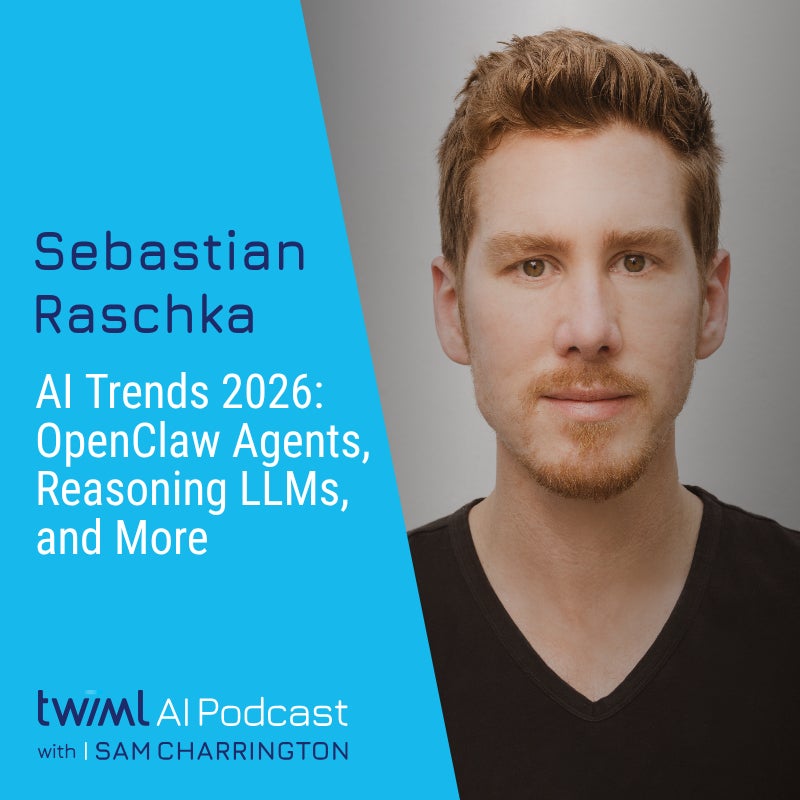
In this episode, Sebastian Raschka, independent LLM researcher and author, joins us to break down how the LLM landscape has changed over the past year and what is likely to matter most in 2026. We discuss the shift from raw model scaling to reasoning-focused post-training, inference-time techniques, and better tool integration. Sebastian explains why methods like self-consistency, self-refinement, and verifiable-reward reinforcement learning have become central to progress in domains like math and coding, and where those approaches still fall short. We also explore agentic workflows in practice, including where multi-agent systems add real value and where reliability constraints still dominate system design. The conversation covers architecture trends such as mixture-of-experts, attention efficiency strategies, and the practical impact of long-context models, alongside persistent challenges like continual learning. We close with Sebastian’s perspective on maintaining strong coding fundamentals in the age of AI assistants and a preview of his new book, Build A Reasoning Model (From Scratch).
The complete show notes for this episode can be found at https://twimlai.com/go/762.
Swyx joined SAIL! Thank you SAIL Media, Prof. Tom Yeh, 8Lee, Hamid Bagheri, c9n, and many others for tuning into SAIL Live #6 with Nathan Lambert and Sebastian Raschka, PhD. Sharing here for the LS paid subscribers. We covered: This is a public episode...
Full show notes and links
52 minAbspielen in:
Do29Jan
The MAD Podcast: How AI Gets Built — with Matt Turck
Sebastian Raschka joins the MAD Podcast for a deep, educational tour of what actually changed in LLMs in 2025 — and what matters heading into 2026.
We start with the big architecture question: are transformers still the winning design, and what should we make of world models, small “recursive” reasoning models and text diffusion approaches? Then we get into the real story of the last 12 months: post-training and reasoning. Sebastian breaks down RLVR (reinforcement learning with verifiable rewards) and GRPO, why they pair so well, what makes them cheaper to scale than classic RLHF, and how they “unlock” reasoning already latent in base models.
We also cover why “benchmaxxing” is warping evaluation, why Sebastian increasingly trusts real usage over benchmark scores, and why inference-time scaling and tool use may be the underappreciated drivers of progress. Finally, we zoom out: where moats live now (hint: private data), why more large companies may train models in-house, and why continual learning is still so hard.
If you want the 2025–2026 LLM landscape explained like a masterclass — this is it.
Sources:
The State Of LLMs 2025: Progress, Problems, and Predictions - https://x.com/rasbt/status/2006015301717028989?s=20
The Big LLM Architecture Comparison - https://magazine.sebastianraschka.com/p/the-big-llm-architecture-comparison
Sebastian Raschka
Website - https://sebastianraschka.com
Blog - https://magazine.sebastianraschka.com
LinkedIn - https://www.linkedin.com/in/sebastianraschka/
X/Twitter - https://x.com/rasbt
FIRSTMARK
Website - https://firstmark.com
X/Twitter - https://twitter.com/FirstMarkCap
Matt Turck (Managing Director)
Blog - https://mattturck.com
LinkedIn - https://www.linkedin.com/in/turck/
X/Twitter - https://twitter.com/mattturck
(00:00) - Intro
(01:05) - Are the days of Transformers numbered?
(14:05) - World models: what they are and why people care
(06:01) - Small “recursive” reasoning models (ARC, iterative refinement)
(09:45) - What is a diffusion model (for text)?
(13:24) - Are we seeing real architecture breakthroughs — or just polishing?
(14:04) - MoE + “efficiency tweaks” that actually move the needle
(17:26) - “Pre-training isn’t dead… it’s just boring”
(18:03) - 2025’s headline shift: RLVR + GRPO (post-training for reasoning)
(20:58) - Why RLHF is expensive (reward model + value model)
(21:43) - Why GRPO makes RLVR cheaper and more scalable
(24:54) - Process Reward Models (PRMs): why grading the steps is hard
(28:20) - Can RLVR expand beyond math & coding?
(30:27) - Why RL feels “finicky” at scale
(32:34) - The practical “tips & tricks” that make GRPO more stable
(35:29) - The meta-lesson of 2025: progress = lots of small improvements
(38:41) - “Benchmaxxing”: why benchmarks are getting less trustworthy
(43:10) - The other big lever: inference-time scaling
(47:36) - Tool use: reducing hallucinations by calling external tools
(49:57) - The “private data edge” + in-house model training
(55:14) - Continual learning: why it’s hard (and why it’s not 2026)
(59:28) - How Sebastian works: reading, coding, learning “from scratch”
(01:04:55) - LLM burnout + how he uses models (without replacing himself)
1 h 08 minAbspielen in:
Warum PodAppear
Folge Menschen, nicht Podcasts.
Du hast Sebastian in einer Sendung gehört. PodAppear findet für dich die nächste, und genauso für alle anderen, die du hören willst.
Eine Meldung, wenn die Person zu Gast istPer E-Mail: sofort oder gebündelt als Tages- oder Wochenübersicht. Dann nur noch auf Play drücken.
Gäste statt bloßer ErwähnungenFolgen, in denen ein Name nur fällt, landen getrennt. Eine Meldung heißt: Die Person ist wirklich in der Sendung.
Alle in einem FeedGründerinnen, Autoren, Sportler, Forscherinnen. Folge allen mit Namen, quer durch jede Sendung, in der sie auftreten.