Bekomm eine E-Mail, wenn Sabine in einem Podcast zu Gast istPodAppear prüft neue Folgen, sobald sie erscheinen, und lässt die weg, in denen Sabine nur erwähnt wird. Bis zu 15 Personen kostenlos, ohne Kreditkarte.Bis zu 15 Personen kostenlos, ohne Kreditkarte.
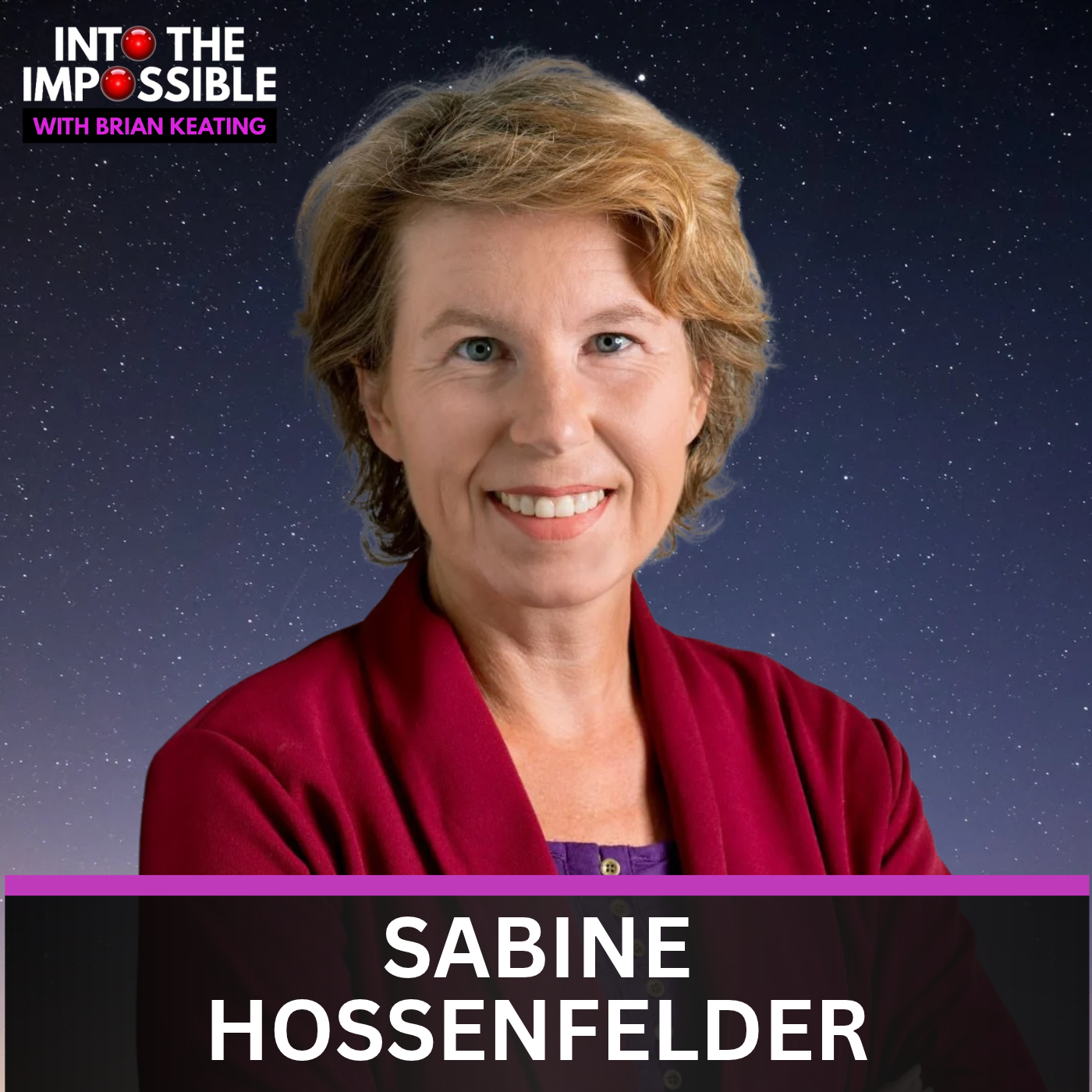
Sabine Hossenfelder war in den letzten 12 Monaten in 4 Podcast-Folgen aus 3 verschiedenen Sendungen zu Gast, am häufigsten bei The Origins Podcast with Lawrence Krauss (2-mal). Zuletzt: Into the Impossible With Brian Keating, 20. Nov. 2026.
A theoretical physicist claims particle physicists have wasted decades searching for dark matter particles with zero evidence. The real path to the next physics breakthrough requires a total pivot that mainstream science is ignoring.
Sabine Hossenfelder is a theoretical physicist and scientific commentator. We cover: why direct detection dark matter experiments may be a waste of time, why current AI large language models fail at generative physics, what happens when quantum computing fails to deliver on commercial hype, and the specific experiment needed to test whether quantum mechanics is truly fundamental.
"I think that's just wrong. We don't have any evidence that dark matter is made of particles."
00:00 "Microtubules is still crap"
00:29 What did the latest dark matter signal actually see?
01:21 Is building bigger colliders a waste of money?
02:20 Do neutrinos prove dark matter is a particle?
04:17 Did Gaia data just disprove dark matter AND Mond?
04:55 Why are influencers being paid to push AI doom?
05:28 The supervolcano risk nobody is talking about
06:03 How access to AI knowledge creates new biological threats
06:43 Why intelligent AI might treat us like pets
07:26 Why large language models are terrible at physics
08:32 Will quantum computing ever pay off its investment?
10:40 The $0 experiment that could fix quantum mechanics
11:38 Roger Penrose’s microtubule theory debunked
12:48 Are UAPs alien probes visiting Earth?
13:58 The hidden problem with how foundational science gets funded
15:42 Did the 2011 dark energy Nobel Prize jump the gun?
16:45 The single biggest mistake in quantum mechanics history
📬 Get the transcript, fascinating bonus content, and my Monday M.A.G.I.C. Message: https://briankeating.com/yt
🌠 Have a .edu email and live in the USA 🇺🇸? You automatically win a meteorite: https://BrianKeating.com/edu
🎯 Support Into the Impossible on Patreon: get my weekly M.A.G.I.C. Message, unfiltered bonus content, and live monthly Office Hours with me: https://www.patreon.com/drbriankeating
⭐ Join this channel for perks, monthly Office Hours, and your name in the Member Roster at the end of every episode: https://www.youtube.com/channel/UCmXH_moPhfkqCk6S3b9RWuw/join
📚 My books:
Losing the Nobel Prize (memoir): http://amzn.to/2sa5UpA
Think Like a Nobel Prize Winner: https://a.co/d/03ezQFu
Focus Like a Nobel Prize Winner: https://a.co/d/hi50U9U
Galileo's Dialogue (first-ever audiobook): https://a.co/d/iZPi9Un
🌐 More:
🏄♂️ Twitter: https://twitter.com/BrianKeating
📚 Substack: https://briankeating.substack.com/ss
✍️ Blog: https://briankeating.com/blog
🎙️ Audio-only: https://briankeating.com/podcast
Learn more about your ad choices. Visit megaphone.fm/adchoices
Hey Everyone, I'm delighted to present our third and final live show from The Mystery of Existence series at the Royal Institution Theatre, London.
People travelled from far and wide to join us, and for our final event we brought together four intellectual heavyweights: Slavoj Žižek, Sabine Hossenfelder, William Lane Craig, and Rowan Williams. In a two vs two debate, they explored the existence of God through science, scepticism, and the resurrection. The full video is now available on the Unbelievable? YouTube channel, so be sure to check it out.
Thank you again for supporting the show. We're incredibly excited to be celebrating our tenth anniversary, and we have an important announcement coming in two weeks' time, so stay tuned. Until then, I hope you enjoy the show!
Links
Watch the debate: Premier Christian Radio, Unbelievable
Happy August! . Heading back to North America as we just concluded our Origin Project Adventure to Cyrpus and Greece, where we felt the heat, and avoided some wildfires while having some amazing positive experiences as well with an amazing group of 26 travelers. Please stay safe and try and stay cool this month.
To help distract you from the heat, I hope you will enjoy this latest conversation about new discoveries in science with Sabine Hossenfelder. As always, we try and deconstruct the facts behind the headlines, and also explore new strange corners of our universe.
This episode begins with some new observations of the Bullet Cluster of galaxies. This cluster contains two galaxies that have collided, and seems to have provided evidence for exotic dark matter that has passed through the collision unscathed. Not so, says a new analysis, which claims evidence for more dark matter in the form of black holes and other less visible normal matter. There are strong reasons to be skeptical however, as both Sabine and I agree.
Speaking of black holes, a new analysis of collisions of black holes at the terrestrial gravitational wave detectors proposes a solution to the mystery of how black holes in a so-called forbidden gap between 10-20 solar masses and more than 50 solar masses have formed. They provide evidence that some of the black holes observed in collisions have been built up from earlier collisions with other black holes. This hierarchical growth could potentially explain how very large black holes in the early universe form, though it is a long way from 50 solar masses to 1 billion solar masses!
Strange goings on at the largest scales of the universe continue to be claimed, as yet another study argues for an unexpected and unexplained cosmic spatial asymmetry. It is hard to reconcile this with the observed uniformity of the universe on the largest scales we can observe via the Cosmic Microwave Background. As a result, it is too early to get excited, even if newspaper reporters love to report on claims that fly in the face of the standard model of cosmology.
The Vera Rubin Space Observatory has started its 10 year project to monitor a huge swath of sky every night looking for things that go bump in the night. On the first night, they found a few hundred thousand possible events. With a 10 year movie of the cosmos who knows what they will discover.
Sabine introduced me to an article about Quantum Batteries. Are they going to be useful, or just another cute example of how quantum mechanics produces strange phenomena? Time will tell.
Finally, I couldn’t resist introducing a story about cockroaches with nervous system implants that allow their motion to be remote controlled by experimenters, with tiny diving suits attached that allow them to breathe underwater for extended periods. It is claimed that they may help in undersea rescue.. Wow! Maybe so… What will they think of next?
Until the next time.. enjoy!
As always, an ad-free video version of this podcast is also available to paid Critical Mass subscribers. Your subscriptions support the non-profit Origins Project Foundation, which produces the podcast. The audio version is available free on the Critical Mass site and on all podcast sites, and the video version will also be available on the Origins Project YouTube.
Get full access to Critical Mass at lawrencekrauss.substack.com/subscribe
New Year’s Eve always comes with that familiar urge to clean the slate, toss out what didn’t hold up, and keep what actually earned its place. That’s basically the spirit of our latest “What’s New in Science” episode with Sabine Hossenfelder.
We began with the season’s favorite shiny object: wormholes. The headlines have been everywhere, but we talked through why most of these stories quietly slide from “a speculative tool in a model” to “a virtual phenomenon that might be useful in calculations.” Traversable wormholes of course still run straight into hard constraints like negative energy and the time machine problem.
From there we moved to something much more grounded: CERN. ATLAS has now observed the Higgs decaying into muon pairs, which is exactly the kind of precise confirmation you want for the Standard Model, and while it is yet another remarkable confirmation of how well the fundamental feature of the Standard Model works, it once again sharpens the contrast with the inexplicable nature of the only feature that doesn’t seem to fit: neutrino masses. And it leaves us hanging about where to look next.
We next spent time on what the future might look like for big particle collider projects and what it says about the field’s priorities, including the signal sent by China’s latest five-year plan, which no longer features a massive circular collider proposal. We touched on a smaller CERN result as well, and used it to reflect on a broader point: some of the most stubborn, interesting physics lives in regimes that are messy rather than glamorous.
Then we took a quick detour into a quantum gravity-adjacent proposal about whether the way we average quantities in general relativity could matter for quantum corrections, and finally landed on a genuinely satisfying closer: OSIRIS-REx’s Bennu samples. Finding ribose alongside other prebiotic building blocks makes it harder to dismiss the idea that the chemistry of life might be widespread, and not a once-only cosmic fluke.
I hope you enjoy the episode, and I hope you’re welcoming the new year surrounded by friends and family. Thank you, as always, for listening and for your continued support.
As always, an ad-free video version of this podcast is also available to paid Critical Mass subscribers. Your subscriptions support the non-profit Origins Project Foundation, which produces the podcast. The audio version is available free on the Critical Mass site and on all podcast sites, and the video version will also be available on the Origins Project YouTube.
Get full access to Critical Mass at lawrencekrauss.substack.com/subscribe
54 minAbspielen in:
Warum PodAppear
Folge Menschen, nicht Podcasts.
Du hast Sabine in einer Sendung gehört. PodAppear findet für dich die nächste, und genauso für alle anderen, die du hören willst.
Eine Meldung, wenn die Person zu Gast istPer E-Mail: sofort oder gebündelt als Tages- oder Wochenübersicht. Dann nur noch auf Play drücken.
Gäste statt bloßer ErwähnungenFolgen, in denen ein Name nur fällt, landen getrennt. Eine Meldung heißt: Die Person ist wirklich in der Sendung.
Alle in einem FeedGründerinnen, Autoren, Sportler, Forscherinnen. Folge allen mit Namen, quer durch jede Sendung, in der sie auftreten.