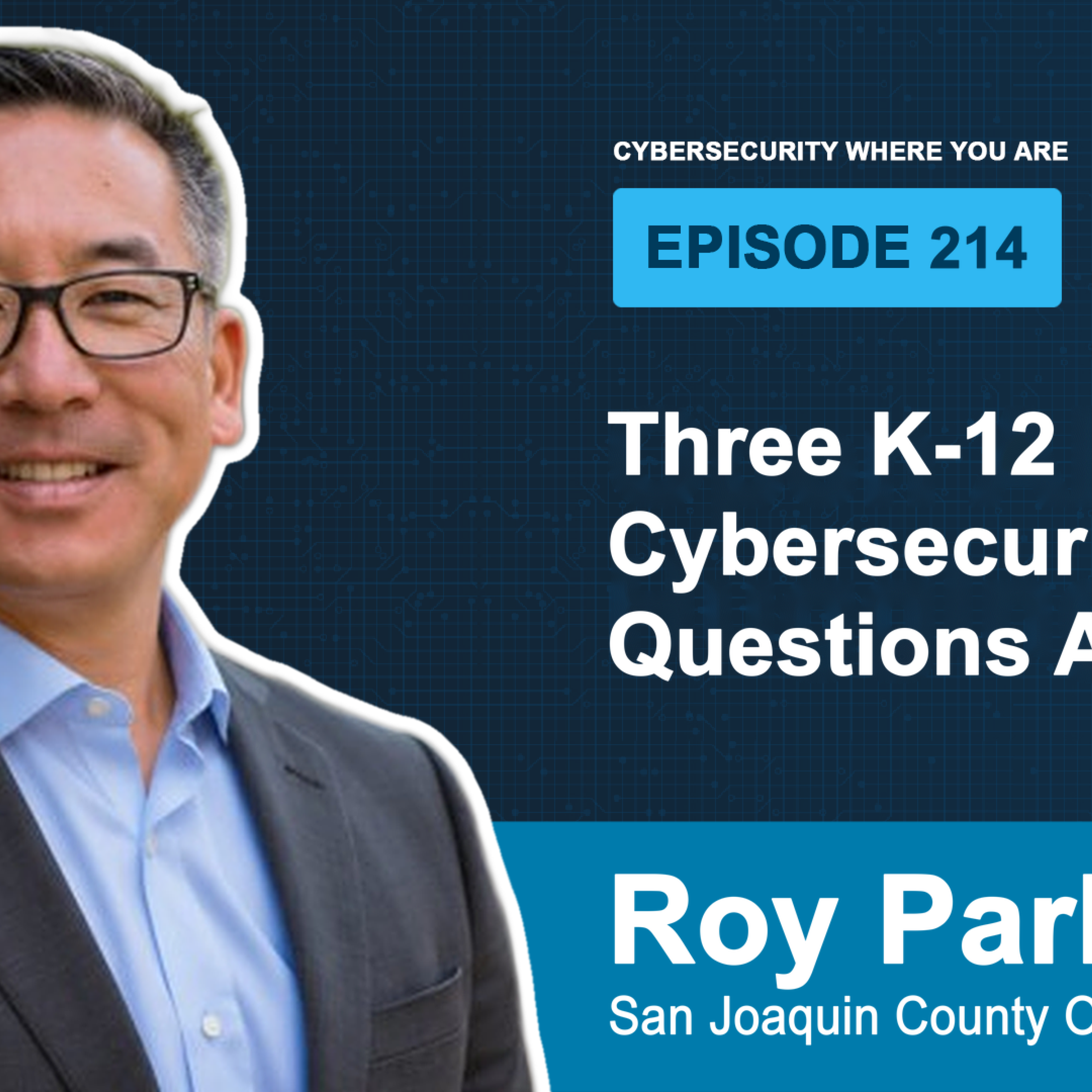
In episode 214 of Cybersecurity Where You Are, Sean Atkinson and Tony Sager speak with Roy Park, Director of Cybersecurity & Digital Privacy for the San Joaquin County Office of Education; and Randy Rose, Vice President of Security Operations & Intelligence at the Center for Internet Security® (CIS®). Together, they answer three unanswered questions from a webinar on The State of K-12 Cybersecurity 2026: how malicious domain blocking data can inform defense, how to plan for a SaaS provider failure, and where to start with identity security.
Here are some highlights from our episode:
01:36. The value of the webinar in helping to communicate report findings to K-12 leadership
02:37. Why K-12 cybersecurity isn't only a technology challenge
04:53. How the impacts of threat activity targeting K-12 organizations go beyond education
07:35. The report's findings: Unsurprising, yet a starting point for learning from other districts
09:35. Report stat: 11% of K-12 school districts lack someone responsible for cybersecurity
11:00. The inability of most of the economy to defend itself on its own
11:27. How CIS focuses on commonalities to bring people together around shared solutions
17:40. Report stat: 3.5B malicious connection attempts blocked across 1,100+ organizations using CIS’s domain-blocking service
21:13. The need for K-12 schools to focus on ransomware defense
21:46. Layered defense as a means of reducing risk
23:30. Incident response plans and strategies around supply chain risk management
24:30. An example of a K-12 school needing to quickly pivot after a vendor closed its doors
25:56. Calendar reminders: A simple habit for driving K-12 cybersecurity improvements
27:54. The shifting shared responsibility model and the need for service diversification
29:08. When rational cybersecurity choices create more risk at a system level
30:58. Supply chain risk management: The need to factor in how everyone can have a bad day
33:46. How a lack of vendor diversification complicates K-12 cybersecurity
35:36. The need for vendors to have the machinery to deal with vulnerabilities and other issues
37:00. If there's one identity and access management recommendation to start with, it's this
38:10. The value of having logging data when investigating a security incident
39:17. A single source of truth and automation: Two tools for securing identities
40:25. Shout-out to all the work Roy is doing in Northern California
41:30. Parting recommendation: Start building relationships in the K-12 cybersecurity space
Resources
Multi-State Information Sharing and Analysis Center® (MS-ISAC®)
Security Operations & Intelligence
Malicious Domain Blocking and Reporting (MDBR)
2026 K-12 Cybersecurity Report: Key Takeaways for School Leaders
CIS, MS-ISAC, and CoSN Report: K-12 Schools Face Growing Cyber Threats Amid Resource Constraints and Rapid AI Adoption
CIS Critical Security Controls®
Policy Templates
Beyond the AI Hype: A Data-Driven Look at What Actually Protects Your Organization
CIS Community Defense Model (CDM) v3.0
Combatting Ransomware
Microsoft restores service to Outlook and Teams after global outage
Cloud Security and the Shared Responsibility Model
Critical Support for Navigating the PowerSchool Breach
CrowdStrike Falcon Outage Exploited for Social Engineering
If you have some feedback or an idea for an upcoming episode of Cybersecurity Where You Are, let us know by emailing podcast@cisecurity.org.