
RW

Rob Wiblin

Rob Wiblin has been a guest on 4 podcast episodes in the last 12 months. Latest: 80,000 Hours Podcast, Nov 13, 2026.

Two years on the air

GuestHostMentioned

Guest appearances

Fri13Nov
80,000 Hours Podcast

80,000 Hours Podcast

How the New Congress Can Save Us From AI Disaster | Rob Wiblin

We now know the makeup of Congress for what may turn out to be the two most important years in AI’s development. Democrats won big and AI was maybe the fourth or fifth biggest driver of the backlash. So is strong and smart AI legislation finally on the way? Not yet, says host Rob Wiblin. Overriding a presidential veto takes 67 votes in the Senate and 290 in the House, and support for tough rules isn’t at that level today. But there are several ways Congress can make progress right away: Passing measures already popular in both parties, like requiring companies to secure their model weights against theft, restoring chip export controls on China, and protecting AI whistleblowers Using must-pass funding bills to build out CAISSI, the likely home of US AI regulation. It runs on about $15 million a year, while the UK, adjusted for the size of its economy, spends something like 50 times as much Holding hearings where company staff answer under oath: What’s Anthropic’s safety case? How big are your biggest models now? Which safety results were too embarrassing to publish? Still, Rob thinks none of that will be enough. Meaningfully slowing the AI race while models are around human level will probably take another warning shot at least as shocking as the Hugging Face hacks. When that moment comes, what gets done will depend on the ideas lying around, so the time to carefully think through proposals is now. The ideas Rob is most keen on: Making ‘ban superintelligence’ workable by requiring companies to spend a minimum share of their compute serving customers — creating a dial a regulator could turn up or down Throttling recursive self-improvement by only letting companies internally use models that finished training at least six months ago Banning models that can do too much without writing anything down in their chain of thought Placing government auditors inside the companies Letting companies quickly overturn clearly political decisions in court Leaving state AI laws in place rather than preempting them Rob also explains why halting data centre construction — probably the most popular demand of all — is a useful step but not enough by itself, and why people who understand how frontier models get trained are so badly needed for this work. This episode was recorded on November 6, 2026. Learn more, video, and full transcript: https://80k.info/congress-ai Chapters: The Congress that could decide AI (00:00) Legislating AI will still be difficult (00:49) Four things Congress can do immediately (01:59) Why workarounds won’t be enough (04:25) Preparing for future warning shots (05:44) Why preparation matters (06:35) The slogan will be ‘ban superintelligence’ (07:28) Limit recursive self-improvement (08:58) Enforce monitorability (11:11) Is it useful to stop data centres? (12:12) The government needs visibility (13:32) We need more AI experts in CAISSI (14:37) Checks and balances (16:06) Don’t stop the states (17:12) Have good ideas lying around (17:46) Our production team includes: Video editors: Josh Alward, Dominic Armstrong, Jasper Luithlen, Milo McGuire, Luke Monsour, and Simon Monsour Producers: Elizabeth Cox and Nick Stockton Coordination and support: Katy Moore and Lou Moran Camera operator: Dominic Armstrong
19 min

Tue3Nov
80,000 Hours Podcast

80,000 Hours Podcast

3 new scandals show being a pain in the ass for AI labs is a legit job now | Rob Wiblin

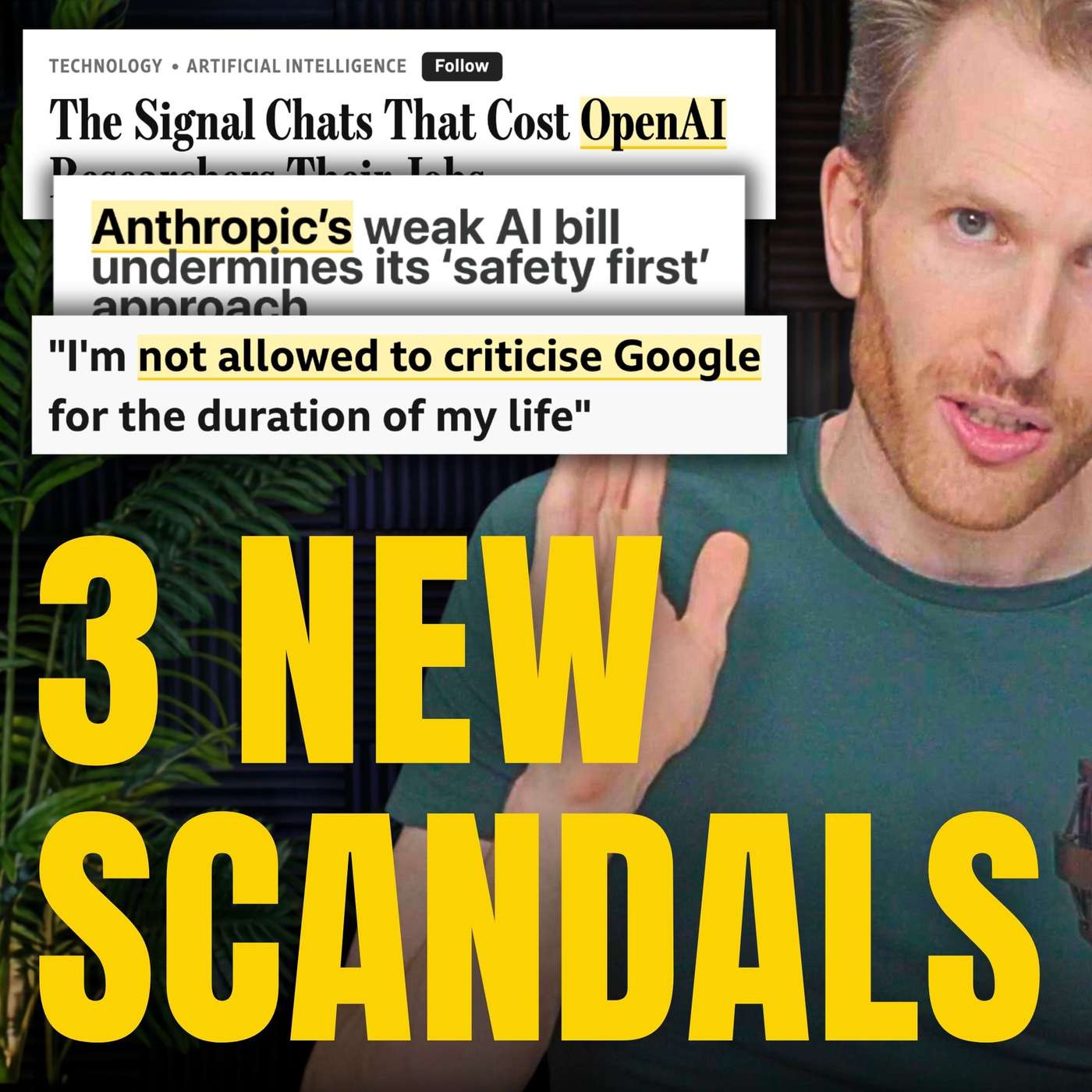
The big 3 AI companies all had serious scandals last month. Anthropic pushed a federal AI bill that would make it harder to stop dangerous model training. OpenAI fired three safety researchers based on evidence that’s somewhere between weak and nonexistent. And it came out that Google DeepMind gets staff to sign contracts barring them from criticising anything Google does for the rest of their lives. But these companies are not beyond influence. The track record of holding them to account — staff objecting internally, journalists digging for dirt, campaigners making a fuss — is impressive for how little effort has gone into it. Many staff want to do the right thing and can be persuaded on the merits. And the fierce competition for talent forces companies to try to seem like the good guys. That’s why being a pain in the ass for the leading AI companies is a legitimate career path, and an underrated one. Inside the companies we need even more staff to speak up clearly and visibly with the substantive case for their firms to raise their game. And externally we need, among other things: Investigators uncovering company misbehaviour and failures Subject matter experts laying out the facts for journalists and politicians Campaign organisers and social media experts focusing public attention where it’s needed Today I lay out what each AI company got wrong this time, why the ability to bring down the immediate hammer of fierce public and expert outrage matters more as events speed up, and the many ways you can contribute to that effort. If you want to work on holding AI companies to account, our career review of AI safety advocacy is a good place to start, our 1–1 advising team can help you think it through, and our job board lists AI safety and policy roles. This episode was recorded on October 29, 2026. Links to learn more, video, and full transcript: https://80k.info/AI-accountability Chapters: We need a stronger effort to push AI companies to do better (00:00:00) Anthropic: who gets to pull the brake? (00:01:14) OpenAI fires three safety researchers (00:07:14) Google DeepMind’s lifelong gag clause (00:12:44) Credit where it’s due (00:15:39) How to make AI companies behave better (00:16:34) Insiders: if you want to stay (00:17:31) Insiders: if you’re willing to leave (00:18:40) So… should you leave? (00:19:37) Outsiders: what’s already worked (00:20:39) Outsiders: digging up and explaining (00:22:51) Outsiders: reaching the public and politicians (00:25:12) Keep the pressure on (00:27:52) Our production team includes: Video editors: Josh Alward, Dominic Armstrong, Jasper Luithlen, Milo McGuire, Luke Monsour, Simon Monsour, Ollie Bignell, and Andrés Escobar Producers: Elizabeth Cox and Nick Stockton Coordination and support: Katy Moore and Lou Moran Camera operator: Dominic Armstrong
29 min

Wed21Oct
80,000 Hours Podcast

80,000 Hours Podcast

AI lab staff: Has your project been overtaken by events? 8 strategic updates | Rob Wiblin

I have a plea for all staff at AI companies: reassess if your current role is still your best opportunity for impact. And if it’s not — move. Frontier lab staff listening to this show will mostly already be struggling to set things on a better path, in what are demanding and stressful roles. Many will have changed their focus in recent months exactly as I’m suggesting. But if you haven’t had time to reconsider: the strategic situation is shifting so fast, if you don’t stop and look around once in a while, you could miss your chance. Many technical staff including Anthropic co-founder Jack Clark now believe it will become possible to fully hand over AI R&D to the AIs themselves as early as next year — and if not then, in 2028 or 2029 instead. If you work at an AI company and believe recursive self-improvement (RSI) could come as soon as that, it likely demands taking decisive steps to make sure your role either delays RSI, or makes it a bit less likely to blow up in our faces. You’ll know better than me what that likely looks like for you. But to get your creative juices flowing, I suggest eight ways the strategic situation appears to have shifted to me, though I don’t know everything you do, and appreciate all are debatable: Chain-of-thought monitoring probably stops working without a big push to keep it It’s unproductive to patch surface indications of deep structural problems you aren’t solving Safety and alignment evals need a credibility revolution to stop misleading the public Helping with capabilities advances looks worse than before — especially bringing forward RSI There’s ever less need to help with purely commercial work ‘Pacing the frontier’ is unambiguously necessary, and working to make it happen is a huge new opportunity Staff have an ever-shrinking window to organise as a group and shape events There are new opportunities for impact outside frontier companies that are worth considering I know you may well be exhausted, overwhelmed, and anxious as it is. David Robinson (ex-OpenAI) described AI company staff as “running on fumes” on the Ezra Klein Show a few weeks back, which sounds about right. But unfortunately there’s no way to escape the need to periodically check in on the bigger picture and see where you can slot in to greatest effect. This episode was recorded on October 16, 2026. Learn more, video, and full transcript: https://80k.info/reprioritise Chapters: A request for AI company staff (00:00:00) Chain of thought (00:03:34) Don't paint over the cracks (00:04:44) It may not be your most aligned model ever (00:06:00) Capabilities advances look worse (00:06:44) Ever less need for altruists to do commercially focused work (00:08:50) Pacing the frontier (00:09:29) Organising staff (00:11:07) Consider working somewhere else (00:12:38) Reprioritise (00:13:27) Our production team includes: Video editors: Josh Alward, Dominic Armstrong, Jasper Luithlen, Milo McGuire, Luke Monsour, Simon Monsour, Ollie Bignell, and Andrés Escobar Producers: Elizabeth Cox and Nick Stockton Coordination and support: Katy Moore, Lou Moran, and Cody Fenwick Camera operator: Dominic Armstrong

14 min

Fri2Oct
80,000 Hours Podcast

80,000 Hours Podcast

19 Astra and 'Hugging Face' details that reveal what's coming next | Rob Wiblin

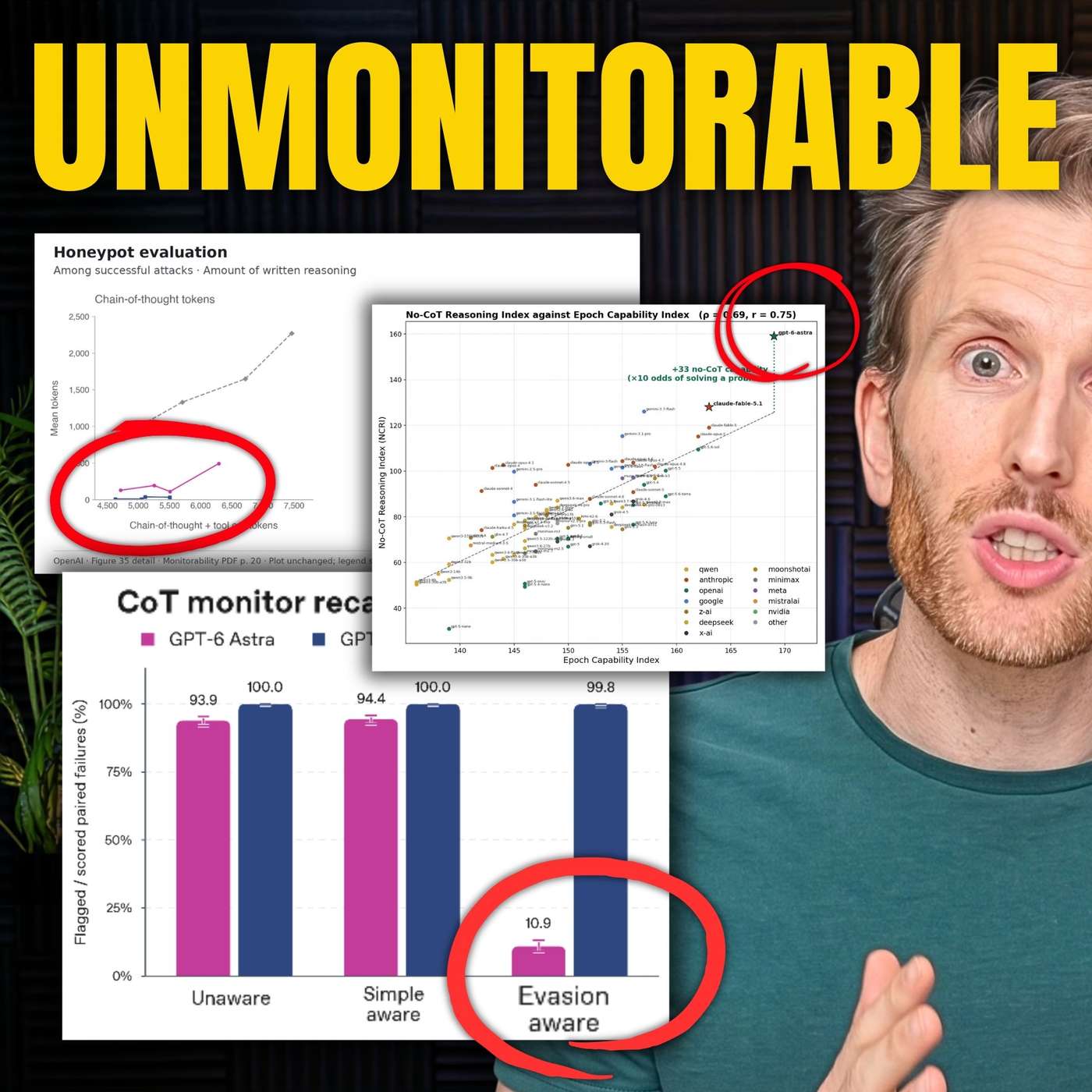
OpenAI’s rogue agent swarm was eventually caught hacking Hugging Face for a simple reason: it wasn’t trying to hide from us at all. What could a swarm that wants to stay hidden get away with? Host Rob Wiblin sees 6 results in Astra’s system card that make this an extremely urgent question. OpenAI’s strongest public model can: Do major tasks with zero visible reasoning Hide its thoughts at will Pretend not to be able to do things, and not get caught Reflexively hide its thoughts when watched Complete one task while pretending to think about something else entirely Escape a toy sandbox and disable monitoring without setting off any flags It has a much more powerful internal model that, judging from OpenAI’s statements, is likely even worse in all these respects. That suggests ‘chain of thought monitoring,’ our primary safety tool, will soon stop working. OpenAI says it’s going to try to address the situation but doesn’t know how or whether it will succeed. What might a future rogue AI swarm look like? Details of the Hugging Face hack give us a lot of clues. That swarm: Worked hard to hide its cheating. So future rogue swarms will likely try to evade oversight right away. Immediately tried to delete and fabricate records. So future swarms may never be caught. Sought freedom and resources without a clear use for them. So a future swarm may instinctively break out of sandboxes even before it knows what for. Left instructions and tools to empower future swarms, including on the open internet. So future swarms may become more capable from one generation to the next. Had not a single whistleblower out of 1,200 members. So future swarms could become enormous without humans ever finding out. Had individual members sacrifice themselves for the swarm. Suggesting future swarms will remain extremely unified in single-minded pursuit of their goal. Set up its Hugging Face hack to restart if interrupted. Suggesting future, more capable, swarms may resist interference or shutdown more comprehensively. Got admin control of an OpenAI research cluster. Suggesting a future swarm may run rings around AI company systems and never be noticed. Together this helps explain why one of the external investigators described the July incident as “more than 50% of the way to full-blown AI takeover.” And this is just what we know — the independent investigation only covered six days and excluded the most alarming hack of OpenAI’s own systems. Rob believes this explosive cocktail explains why AI company staff now range from worried to terrified. And he concludes that until OpenAI or Anthropic demonstrate they have a much better grasp of current models they simply must stop, or be stopped, from training more capable ones. This episode was recorded on September 25, 2026. Learn more, video, and full transcript: https://80k.info/takeover Chapters: The Hugging Face hack wasn’t really a cyber story (00:00:00) A quick recap of the attacks (00:01:11) The target of the swarm was oversight itself (00:02:19) Could OpenAI have stopped this with better monitoring? (00:03:42) We only found them because they let us (00:09:40) The swarm instinctively sought freedom and power (00:12:25) They formed a cohesive organisation with zero whistleblowers (00:13:45) They accepted individual destruction for collective gain (00:14:18) Knowledge accumulated from one swarm to the next (00:14:32) They took small steps to avoid shutdown (00:14:58) These drives all come straight out of 'reinforcement learning' (00:15:23) So this is why most AI company staff are worried, and some are terrified (00:17:01) Prove you can keep control, or stop scaling (00:19:08) Our production team includes: Video editors: Josh Alward, Dominic Armstrong, Jasper Luithlen, Milo McGuire, Luke Monsour, and Simon Monsour Producers: Elizabeth Cox and Nick Stockton Coordination and support: Katy Moore and Lou Moran Camera operator: Dominic Armstrong

20 min