Bekomm eine E-Mail, wenn Paul in einem Podcast zu Gast istPodAppear prüft neue Folgen, sobald sie erscheinen, und lässt die weg, in denen Paul nur erwähnt wird. Bis zu 15 Personen kostenlos, ohne Kreditkarte.Bis zu 15 Personen kostenlos, ohne Kreditkarte.
Paul kostenlos folgen
PB

Paul Burgess

Paul Burgess war in den letzten 12 Monaten in 2 Podcast-Folgen aus 2 verschiedenen Sendungen zu Gast. Zuletzt: Tom Nelson, 13. Okt. 2026.

Zwei Jahre auf Sendung

GastHostErwähnt

Gastauftritte

Di13Okt
Tom Nelson

Tom Nelson

Paul Burgess: “An explanation of climate change, pure and simple” | Tom Nelson Pod #436

Paul Burgess presents his “Oceanic Index” model of climate change, arguing oceans regulate low cloud cover that acts as Earth’s thermostat, explaining satellite-era temperatures (1982–2025) with high accuracy and extending the approach back using proxies. He accepts anthropogenic CO2 and a direct ECS near 1–1.2°C per doubling, estimating about 0.6°C warming from CO2 since 1850, but rejects IPCC feedbacks and says a ~2.4% reduction in low clouds can account for additional warming, consistent with CERES radiation data where ocean changes lead cloud changes and then temperature. He discusses mechanisms from meteorology (marine inversion changes), historical periods (Little Ice Age, Roman/Medieval warmth) as largely natural, critiques temperature records and climate messaging, and briefly comments on Lindzen’s iris effect and energy policy debates. 00:00 Cloud Thermostat Intro 01:25 Oceanic Index Basics 03:16 What I Accept 04:45 Out of Sample Proof 06:00 ECS Debate Explained 07:32 Ocean Cloud Mechanism 09:16 CERES Sunshade Evidence 12:59 Small Cloud Drop Big Warming 14:26 Back to 1695 16:34 Holocene Lessons 17:40 Oceans Through Minima 20:57 Warm Periods Without CO2 22:03 Mediterranean Cloud Check 24:51 Extending Index to 1800s 28:02 Connolly Adjustment Fit 29:49 El Nino 1870s Peak 30:55 El Niño Context 31:22 ECS Assumptions 31:52 Clouds Fill The Gap 33:32 Feedback Claim Rebuttal 34:57 Frozen Formula Validation 36:02 CERES Versus IPCC 38:04 Scorecard Evidence 40:12 Cloud Mechanism Explained 41:07 Kid Friendly Ocean Cycle 44:21 Alarmism And Propaganda 50:49 Iris Effect Question 52:40 Net Zero Cost Reality 55:27 Closing Thoughts Climate Realism by Paul Burgess: https://www.youtube.com/@ClimateRealism Main paper: https://paulburgess3.substack.com/p/how-the-sun-via-the-oceans-controls The paper on comparing the  Mediterranean study: https://paulburgess3.substack.com/p/a-mediterranean-study-of-the-effect The Paper On The  Holocene as far as LIA: https://paulburgess3.substack.com/p/holocene-to-the-little-ice-age-a ========= Slides, summaries, references, and transcripts of my podcasts: https://tomn.substack.com/p/podcast-summaries My Linktree: https://linktr.ee/tomanelson1
56 minAbspielen in:

Di4Aug
Digital HR Leaders with David Green

Digital HR Leaders with David Green

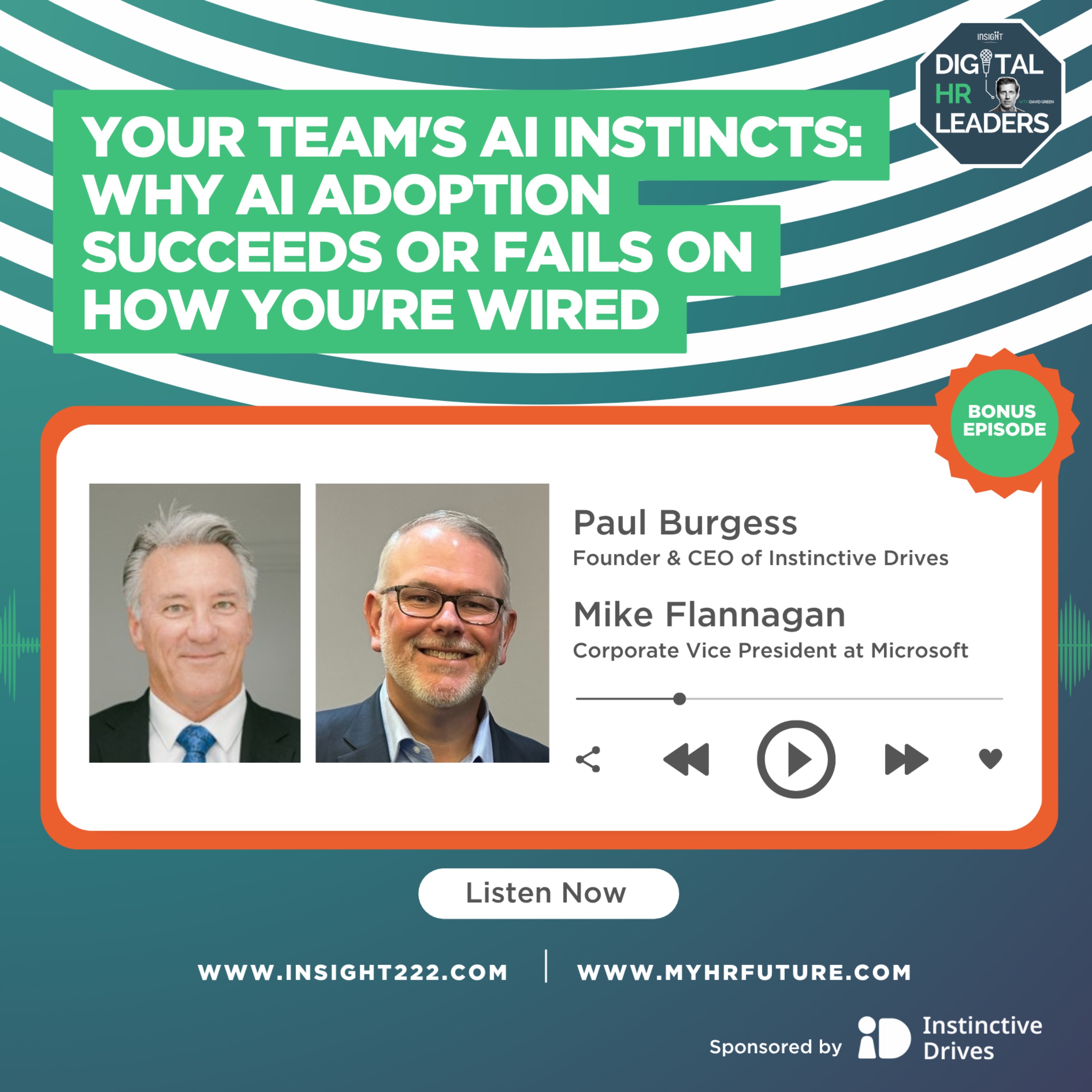
Your Team's AI Instincts: Why AI Adoption Succeeds or Fails on How You're Wired

Do you know which of your people are wired to thrive in chaos, and which ones need certainty to do their best work? In this episode, David is joined by Mike Flannagan, Corporate Vice President, Customer & Commercial Success at Microsoft, and Paul Burgess, founder of Instinctive Drives, to explore Microsoft's recent partnership with Instinctive Drives and what it reveals about the human side of AI transformation. Together they unpack why the biggest barrier to AI adoption isn't the technology itself, but the mismatch between people's natural instincts and the roles they're being asked to play. Join the dynamic trio as they discuss: Why AI adoption is a people transformation How the Instinctive Drives framework explains why people react so differently to change What happens when the wrong people get pushed into high-experimentation, high-failure roles Why psychological safety is the real prerequisite for AI adoption at scale How a shared language around instincts can rebuild trust and speed up team performance Listeners can try their own Instinctive Drives assessment for free for a limited time (expires 31st of October 2026) - the link is in the show notes below. This episode is sponsored by Instinctive Drives. As organisations invest heavily in AI, the people expected to deliver are often overwhelmed and working against their own natural wiring. Instinctive Drives' science-backed methodology reveals how each person is wired to work — which is why Microsoft chose them as their strategic partner for enterprise AI adoption worldwide. Try your own Instinctive Drives assessment for free at instinctivedrives.com/digitalhrleaders - available until 31 October 2026. Resources: Instinctive Drives assessment - available until 31 October 2026 Hosted on Acast. See acast.com/privacy for more information.

49 minAbspielen in:

Warum PodAppear

Folge Menschen, nicht Podcasts.

Du hast Paul in einer Sendung gehört. PodAppear findet für dich die nächste, und genauso für alle anderen, die du hören willst.

  • Eine Meldung, wenn die Person zu Gast istPer E-Mail: sofort oder gebündelt als Tages- oder Wochenübersicht. Dann nur noch auf Play drücken.
  • Gäste statt bloßer ErwähnungenFolgen, in denen ein Name nur fällt, landen getrennt. Eine Meldung heißt: Die Person ist wirklich in der Sendung.
  • Alle in einem FeedGründerinnen, Autoren, Sportler, Forscherinnen. Folge allen mit Namen, quer durch jede Sendung, in der sie auftreten.

Bis zu 15 Personen kostenlos, ohne Kreditkarte.