Bekomm eine E-Mail, wenn Max in einem Podcast zu Gast istPodAppear prüft neue Folgen, sobald sie erscheinen, und lässt die weg, in denen Max nur erwähnt wird. Bis zu 15 Personen kostenlos, ohne Kreditkarte.Bis zu 15 Personen kostenlos, ohne Kreditkarte.
A Boeing 767 lands more than 3,700 feet down a Miami runway and overruns the pavement, killing five people on the ground. A Cirrus SR22 crashes during a second go-around, killing all five aboard. And a Cessna 421 loses both engines after being fueled with Jet A instead of avgas.
In Episode 41 of NTSB News Talk, aviation safety experts Max Trescott and Rob Mark examine the critical decisions behind these accidents and the lessons pilots can take away.
The newly released Miami Boeing 767 preliminary report raises serious questions about tailwinds, unstable approaches, airspeed warnings, and a go-around attempted far too late. A new NTSB final report on a fatal Cirrus SR22 crash at Kill Devil Hills reveals striking flight-data evidence of excessive pitch and an aerodynamic stall.
The hosts also discuss Diamond DA40 crashed in mountainous terrain near Eldorado Springs, Colorado, a deadly Piper JetProp icing encounter over Wisconsin, a Gulfstream air ambulance crash following reported electrical problems, a Beech Bonanza fuel-starvation accident involving a congressman, a fatal nighttime Piper crash, and a midair collision between gliders.
From fuel management and emergency procedures to stall prevention and go-around proficiency, this episode highlights a fundamental truth: even experienced pilots cannot afford to skip the basics.
Episode 40 examines a wide range of recent accidents before focusing on a troubling pattern: pilots flying with impairing OTC medications or drugs in their systems.
Max Trescott and Rob Mark begin with a fatal nighttime crash of C-GPTX, a Cessna 172 in Saskatchewan and the runway overrun of Eclipse 500 N816KD at Auburn, California. They also discuss Beech Travel Air N529RB, which was flown in repeated low-level circles about 100 feet above the Pacific before crashing into the ocean, raising the possibility of an intentional act.
Preliminary reports include Piper Seneca N212ML, lost near the Bahamas in convective weather; C-IFBY, a Para-Ski VX powered parachute carrying three people even though its U.S. operation did not qualify under Part 103; and Lake Amphibian N6185V, which apparently ran out of fuel just miles from Ithaca.
Final reports include a fatal VFR-into-IMC accident involving N9626K, a Piper PA-28 and the crash of Ameriflight Beech C99 N130GP after a partial engine-power loss.
The episode closes with four fatal-accident reports involving the active ingredients in Benadryl and Zyrtec, or cyclobenzaprine, cannabis, or morphine. The takeaway is simple: “over the counter” does not mean “safe to fly,” and pilots need to understand the FAA’s medication waiting-period guidance. Max also explains why medication effects can undermine a pilot’s own self-assessment.
37 minAbspielen in:
Do27Aug
Aviation News Talk – Pilot Stories, Safety Tips & General Aviation NewsHost
Gear-up landings are often dismissed as embarrassing pilot mistakes, but landing gear mishaps are far more common, complicated, and expensive than many pilots realize. In this episode, Max talks with Tom Turner of the American Bonanza Society Air Safety Foundation about why gear-up landings and landing gear collapses continue to happen—and the operating habits and maintenance practices that can prevent them.
Turner says the Beechcraft Bonanza, Baron, Debonair, and Travel Air fleet averages about one reported landing gear mishap every week. Those events represent roughly 40 percent of the mishaps reported to the American Bonanza Society. And because many landing gear events do not meet NTSB reporting thresholds, Turner says contacts in the insurance, aircraft rebuilding, and salvage industries believe the actual number may be two to three times higher.
The problem is not unique to Beechcraft. Turner previously tracked landing gear events across piston retractable-gear aircraft and found comparable or even higher rates in some other types. Landing gear mishaps also have an outsized impact on aircraft insurance because a seemingly survivable gear-up landing can result in propeller damage, an engine teardown, belly damage, and repair costs high enough for an insurer to total the airplane.
Much of the conversation focuses on developing habits that make forgetting the landing gear less likely. Turner teaches the concept "gear down to go down." Rather than beginning the final descent simply by reducing power, landing gear extension becomes the event that initiates the descent from traffic pattern altitude or onto the final portion of an instrument approach.
He also teaches Gear Extension Altitude, or GEA. On a straight-in or other nonstandard arrival, the pilot selects an altitude below which the airplane will not descend until the landing gear has been extended and confirmed.
Max relates two occasions during his flying career when normal landing gear cues broke down. In one, while training in a Diamond DA42, he reached the flare before his instructor revealed that the gear was still up. In another, while flying a Vision Jet instrument approach, the normal glidepath cue used for gear extension never appeared. The airplane's warning system ultimately caught the omission.
That leads to one of Turner's strongest recommendations: regardless of when you normally extend the landing gear, establish a deliberate final gear confirmation on short final, around 400 to 500 feet AGL. If distraction, a changed traffic pattern, a go-around, or some other interruption causes you to miss your normal extension cue, that final check provides one more opportunity to catch the error.
Warning systems alone are not enough. Turner describes pilots who continued toward landing while gear warning horns sounded and bright warning lights flashed. During high workload, pilots may simply stop processing repetitive warnings. In multi-engine training, the problem can become particularly insidious because pilots may listen to a landing gear warning horn throughout a simulated engine-out exercise and effectively tune it out before landing.
Turner recommends using more than cockpit lights to verify the gear. Listen to the gear motor and notice whether it sounds normal. Feel and observe the expected change in drag and pitch. Compare airspeed, power, descent rate, and aircraft performance with what you normally expect. Then verify the cockpit indications. ABS even recommends holding the gear handle until this entire confirmation process is complete.
Go-arounds introduce another human-factors trap. Pilots may vividly remember extending the gear—but the memory may be from the previous trip around the pattern. Turner favors making a go-around resemble a normal takeoff, then using the same normal extension cue on the next approach. Whatever technique a pilot chooses, the key is consistency and making sure the cue will still occur following a go-around.
The discussion then turns to touch-and-go landings, which both Max and Tom strongly discourage in retractable-gear airplanes. A pilot reaching to retract the flaps can inadvertently select the landing gear instead. They similarly recommend not reconfiguring the airplane during the landing roll. Wait until the airplane is clear of the runway and preferably stopped on the taxiway before moving flap or similar controls.
And pilots should not assume squat switches will save them. Turner describes observations showing that systems tied to weight-on-wheels switches may not recognize the airplane as firmly on the ground until surprisingly late in the landing roll—and may switch to flight mode early during takeoff. Bumps and unloading of the landing gear can further reduce their effectiveness.
Gear collapses also have a significant maintenance component. At American Bonanza Society maintenance evaluation events, aircraft are placed on jacks and their landing gear rigging and downlock tensions are carefully inspected. Turner says it is not unusual for roughly two airplanes out of a 24-aircraft event to have gear tensions so far out of tolerance that the owners are advised not to fly until adjustments are made.
ABS considers improper rigging serious enough that it developed a 38-step landing gear inspection checklist to supplement normal Beechcraft inspection procedures.
Finally, Turner discusses what to do when the gear itself malfunctions. If the gear begins to extend and then jams, perhaps popping the motor circuit breaker, repeatedly cycling it may turn a damaged push rod or rod end into a complete failure. Instead, Turner recommends following the airplane's approved manual landing gear extension procedure, which can place less stress on a compromised system and may give the pilot the best chance of getting all the gear down.
The episode highlights the American Bonanza Society's Put Your Gear Down campaign, which makes decades of landing gear operating and maintenance information available to pilots of all retractable-gear airplanes. Its goal is simple: replace the familiar saying that there are "those who have and those who will" have a gear mishap with a third category—pilots who use disciplined operating and maintenance practices to make sure it never happens to them.
If you're getting value from this show, please support the show via PayPal, Venmo, Zelle or Patreon.
Support the Show by buying a Lightspeed ANR Headsets Max has been using only Lightspeed headsets for nearly 25 years! I love their tradeup program that let's you trade in an older Lightspeed headset for a newer model. Start with one of the links below, and Lightspeed will pay a referral fee to support Aviation News Talk. Lightspeed Delta Zulu Headset $1299NEW – Lightspeed Zulu 4 Headset $1099 Lightspeed Zulu 3 Headset $949Lightspeed Sierra Headset $749 My Review on the Lightspeed Delta Zulu
Send us your feedback or comments via email
If you have a question you'd like answered on the show, let listeners hear you ask the question, by recording your listener question using your phone.
News Stories
FAA Flags 3D Printed Cockpit Accessories As Unapproved Parts
Satellite Device Guides Cessna Accident Rescue
FAA's ATC modernization is moving faster
FAA Accepts HIMS Reform Petition For Review
8 killed in plane crash at remote Alaska radar site
Cirrus Burns During Parachute Deployment
Aging GA Fleet Faces Growing Aircraft Parts Challenge
Teton Civil Air Patrol Squadron Deactivated, Cessna 206 Reassigned
EAA Chapter 1240 Funds Stolen
Mentioned on the ShowBuy Max Trescott's G3000 Book Call 800-247-6553 UAV News Talk - Archer Aviation episode NTSB News Talk - episode #37 EAA HeartLand Chapter 1240 Put Your Gear Down Website
Free Index to the first 282 episodes of Aviation New Talk So You Want To Learn to Fly or Buy a Cirrus seminars Online Version of the Seminar Coming Soon – Register for Notification
Check out our recommended ADS-B receivers, and order one for yourself. Yes, we'll make a couple of dollars if you do.
Get the Free Aviation News Talk app for iOS or Android.
Check out Max's Online Courses: G1000 VFR, G1000 IFR, and Flying WAAS & GPS Approaches. Find them all at: https://www.pilotlearning.com/
Social Media Like Aviation News Talk podcast on Facebook Follow Max on Instagram Follow Max on Twitter Listen to all Aviation News Talk podcasts on YouTube or YouTube Premium
"Go Around" song used by permission of Ken Dravis; you can buy his music at kendravis.com If you purchase a product through a link on our site, we may receive compensation.
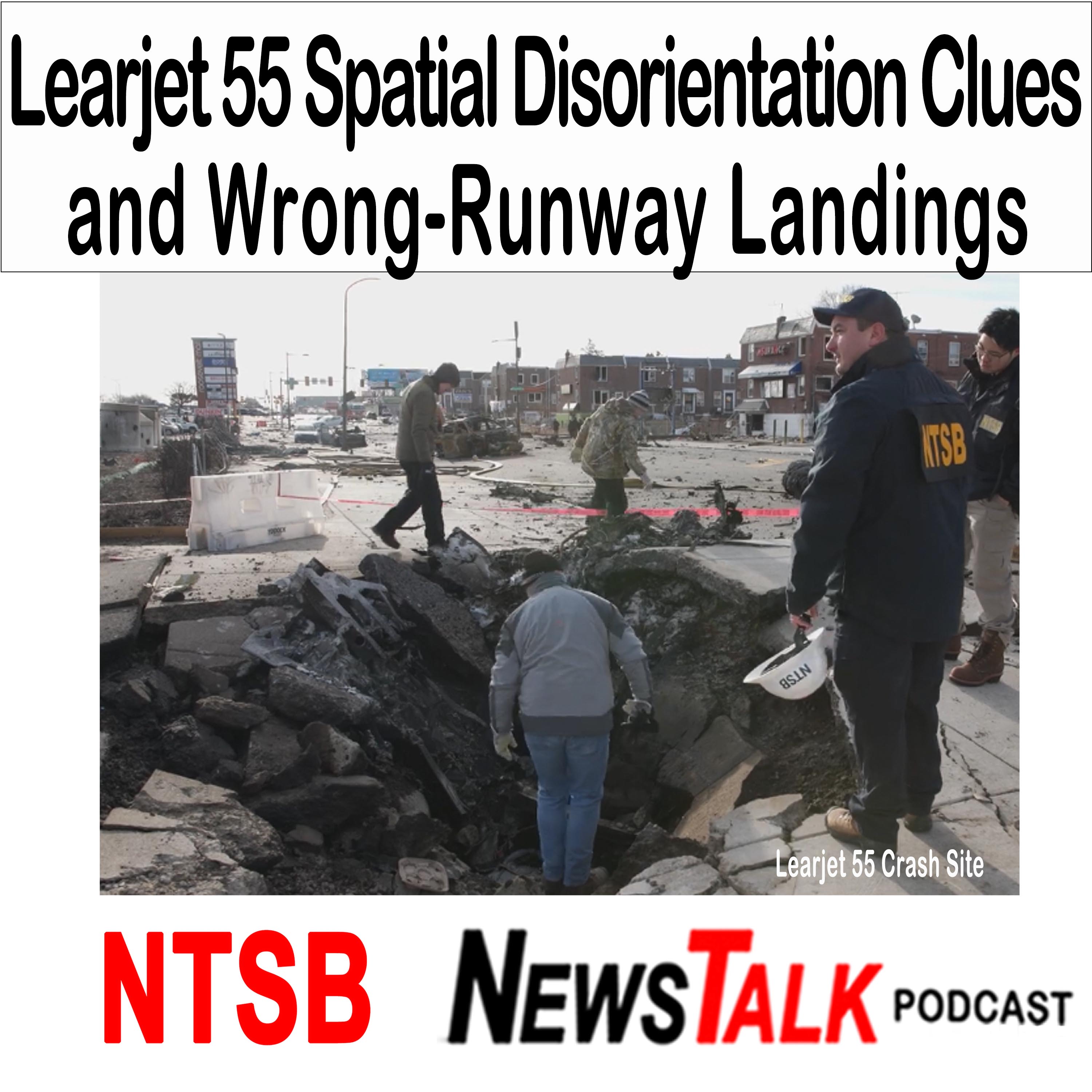
In Episode 37 of NTSB News Talk, Max Trescott and Rob Mark examine new evidence from the fatal Learjet 55 air ambulance crash in Philadelphia and several other accidents with important lessons for pilots.
Brought to you by AVEMCO aircraft insurance.
Support Rob and Max by making a donation at Patreon.com
The Learjet 55 departed Northeast Philadelphia Airport at night into a roughly 400-foot overcast. Newly released NTSB docket material shows the aircraft initially beginning its assigned right turn before slowly rolling left. The exceptionally gradual roll raises the possibility of somatogyral illusion—a form of spatial disorientation in which the inner ear may fail to detect slow rotational movement. Investigators also examined somatogravic illusion, cockpit workload, pitch trim, and the captain’s previous training history. Both engines appeared to be producing takeoff power, making an engine failure less likely.
Max and Rob also discuss two wrong-runway landings near Chicago that illustrate continuation bias and task saturation.
Other accidents include a Cirrus Vision Jet striking a pipe across a closed portion of a runway at Driggs, Idaho; a fatal Cessna 150 collision with a Pennsylvania State Police helicopter; N1850N a Beechcraft Duchess accident during simulated single-engine training; and a photographer fatally struck by the wing of glider N8217W. Also, two wrong-runway landings near Chicago, N772MR (Envoy 3936) and N1128M Learjet 60.
Those final incidents highlight a recurring human-factors problem: once pilots commit mentally to a plan, contradictory evidence can become surprisingly difficult to recognize.
38 minAbspielen in:
Do20Aug
Aviation News Talk – Pilot Stories, Safety Tips & General Aviation NewsHost
In Episode 425 of Aviation News Talk, Max talks with retired Air Force General David Brubaker about STEM Flights, a nonprofit organization that pairs middle- and high-school students with volunteer pilot mentors for free, one-on-one aviation experiences designed to introduce them to careers in aviation, aerospace, engineering, and other STEM fields.
STEM Flights grew out of Brubaker's own experience after retiring from the Air Force in 2005. During his military career, he flew aircraft including the F-4 and F-16 and finished his career with an assignment at the Pentagon. After retiring, he became active in general aviation and began taking young people flying.
But Brubaker didn't simply give them airplane rides. He expected them to participate. They helped with navigation, looked at the instrumentation, worked with the radios, and often took the controls themselves.
Years later, he began hearing back from some of those young people. Several had gone on to study aviation, aerospace, engineering, and other technical subjects. One young woman eventually earned her ratings, joined the West Virginia Air National Guard, and became a C-130 pilot.
Those experiences helped Brubaker recognize that pilots could have an enormous influence on the career choices of young people simply by sharing aviation with them in a meaningful way. His children encouraged him to turn what he was doing informally into a nonprofit, and STEM Flights was launched in 2018.
Today, STEM Flights connects students with volunteer pilot mentors around the country. Students don't simply show up at an airport for a free ride. They apply to the program, receive a recommendation, select a mission based on their interests, and complete homework before being paired with a pilot.
That preparation is part of what makes STEM Flights different. Brubaker describes the program as a more intensive, personal experience than a typical introductory airplane ride. A student is paired one-on-one with a pilot mentor, and the pilot learns about the student's interests before the flight. On the day of the mission, they discuss safety and learning objectives, preflight the airplane, and then head into the air.
Once they reach a safe altitude, the student usually gets the controls. They may learn about navigation, aircraft instrumentation and communications, and Brubaker says he likes to have each student make at least one radio call. But the most powerful moment often comes when the student realizes that he or she is actually flying the airplane.
Brubaker tells the story of one reluctant young man whose mother encouraged him to participate. On the ground, the student appeared completely uninterested, and Brubaker wondered whether the flight would accomplish anything. Then they took off.
Within minutes of taking the controls, the boy came alive. He started participating, asking questions, and enthusiastically flying the airplane. A couple of weeks later, Brubaker received a letter from the boy's mother. She explained that her son had approached life believing it was better not to try than to try and fail. Flying an airplane—something he never imagined he could possibly do—changed his perception of what he might be capable of accomplishing.
That experience illustrates why STEM Flights is about more than simply recruiting future pilots. Students have gone on to pursue aircraft maintenance, avionics, aerospace engineering, military aviation, and other technical fields. Brubaker says dozens have attended universities with aviation or engineering programs, and STEM Flights continues supporting students after their flights through a program called Flight Following.
Flight Following connects participants with information about scholarships, flight schools, grants, Civil Air Patrol, and other organizations and programs that can help them continue toward aviation and STEM careers.
For pilots listening to Aviation News Talk, one of the most important parts of the conversation is how they can participate. STEM Flights calls its volunteers "pilot mentors," and you don't need to be a flight instructor. Brubaker says pilots generally need a private pilot certificate, at least 250 hours of flight time, appropriate medical and aircraft qualifications, and a background check.
You don't necessarily need to own an airplane either. Some pilot mentors rent aircraft or belong to flying clubs, and in some areas STEM Flights has arrangements with local flight schools.
The organization has pilot mentors in 49 states, but matching students with available pilots remains a constant challenge. At the time of the interview, Brubaker said roughly 115 young people were waiting to be paired with pilots.
After a career that included fighter jets, simulated air combat and pulling nine Gs, Brubaker says mentoring young people offers a different kind of satisfaction. Military flying was intensely focused on accomplishing a mission. STEM Flights provides an opportunity to give something back.
And for a general aviation pilot wondering how to help strengthen the future of aviation, the concept is remarkably simple.
Share your airplane.
Share your experience.
Put a young person at the controls.
And you may help launch an aviation career that otherwise never would have begun.
If you're getting value from this show, please support the show via PayPal, Venmo, Zelle or Patreon.
Support the Show by buying a Lightspeed ANR Headsets Max has been using only Lightspeed headsets for nearly 25 years! I love their tradeup program that let's you trade in an older Lightspeed headset for a newer model. Start with one of the links below, and Lightspeed will pay a referral fee to support Aviation News Talk. Lightspeed Delta Zulu Headset $1299NEW – Lightspeed Zulu 4 Headset $1099 Lightspeed Zulu 3 Headset $949Lightspeed Sierra Headset $749 My Review on the Lightspeed Delta Zulu
Send us your feedback or comments via email
If you have a question you'd like answered on the show, let listeners hear you ask the question, by recording your listener question using your phone.
News Stories
Pilots, Flight Attendants Have Greater Risk of Radiation-Related Cancer Death Than Other Professions
Louisiana Blocks ADS-B Landing Fees
FAA Orders Rotax Gearbox Inspections
FAA Invites Comments on Flightdeck Controls Draft AC
Laredo Youth Pilot Program Draws More Than 1,000 Applicants
Pentastar Aviation FBO Introduces Wingwalking Robots
Mentioned on the ShowBuy Max Trescott's G3000 Book Call 800-247-6553 UAV News Talk - Archer Aviation episode NTSB News Talk - episode #36 Go-Arounds Are Awesome website STEM Flights
Free Index to the first 282 episodes of Aviation New Talk So You Want To Learn to Fly or Buy a Cirrus seminars Online Version of the Seminar Coming Soon – Register for Notification
Check out our recommended ADS-B receivers, and order one for yourself. Yes, we'll make a couple of dollars if you do.
Get the Free Aviation News Talk app for iOS or Android.
Check out Max's Online Courses: G1000 VFR, G1000 IFR, and Flying WAAS & GPS Approaches. Find them all at: https://www.pilotlearning.com/
Social Media Like Aviation News Talk podcast on Facebook Follow Max on Instagram Follow Max on Twitter Listen to all Aviation News Talk podcasts on YouTube or YouTube Premium
"Go Around" song used by permission of Ken Dravis; you can buy his music at kendravis.com If you purchase a product through a link on our site, we may receive compensation.
1 h 01 minAbspielen in:
Warum PodAppear
Folge Menschen, nicht Podcasts.
Du hast Max in einer Sendung gehört. PodAppear findet für dich die nächste, und genauso für alle anderen, die du hören willst.
Eine Meldung, wenn die Person zu Gast istPer E-Mail: sofort oder gebündelt als Tages- oder Wochenübersicht. Dann nur noch auf Play drücken.
Gäste statt bloßer ErwähnungenFolgen, in denen ein Name nur fällt, landen getrennt. Eine Meldung heißt: Die Person ist wirklich in der Sendung.
Alle in einem FeedGründerinnen, Autoren, Sportler, Forscherinnen. Folge allen mit Namen, quer durch jede Sendung, in der sie auftreten.
Max talks with Greg Brown about one of the most important—and often underestimated—roles in aviation: the flight instructor. Greg is one of aviation's most respected CFIs, writers, and pilot mentors. A pilot since 1972 and a flight instructor since 1979, he was named the 2000 Industry/FAA National Flight Instructor of the Year, became the first-ever Master Flight Instructor, and was inducted into the Flight Instructor Hall of Fame in 2021. Many pilots know Greg from his aviation books, including The Savvy Flight Instructor, The Turbine Pilot's Flight Manual, Flying Carpet, You Can Fly!, and Job Hunting for Pilots, as well as from his long-running "Flying Carpet" column in AOPA Flight Training magazine and his Cockpit Adventures from the Flying Carpet podcast.
In this episode, Greg and Max focus on practical advice for people who are becoming CFIs, looking for CFI jobs, or trying to build a better flight instruction business. Greg explains that he did not become a flight instructor immediately after earning his private pilot certificate. By the time he earned his CFI, he had already accumulated a great deal of flying experience and had discovered that he loved teaching. He instructed about 800 hours in his first year while still holding another full-time job, and soon discovered that instruction could lead to unexpected aviation opportunities.
One of Greg's key messages is that becoming a CFI should not be viewed as a dead end or merely a required stepping stone to an airline job. He tells the story of teaching an instrument student who owned a scientific instrument company. That student eventually invited Greg to become the company's chief pilot and help select and fly a cabin-class twin. Greg's point is that CFIs meet people, build trust, and create opportunities in ways that are impossible to predict.
Greg also offers detailed advice on how new instructors can get hired. He explains that many applicants simply send resumes and end up in a large pile with everyone else. A smaller number know someone at the flight school. But the strongest applicants are those who have built a personal relationship with the owner, chief instructor, or people already working there. Greg urges aspiring CFIs to visit flight schools, ask for advice, stay in touch, and create a simple system to maintain relationships over time. In a tight CFI job market, he says, networking and reputation can be more important than raw hours.
Max and Greg also discuss different paths into flight instruction, including academies, Part 61 flight schools, flying clubs, universities, and independent instruction. Greg says flying clubs can be a terrific environment because instructors often know their students, have access to aircraft, and may face less bureaucracy. They also discuss the idea of buying an airplane to teach in. While that can work for some instructors, Greg and Max point out the financial and insurance challenges, along with the practical limitation that when a student solos your airplane, you no longer have that airplane available for dual instruction.
A major theme of the episode is that flight instructors must also learn marketing and sales. Greg recommends that CFIs create photo business cards with an airplane or cockpit image, a QR code, and contact information. He says the card does the work of explaining who you are and often starts conversations with people who may be interested in aviation. Greg also recommends having at least a simple web page, so potential students searching online for flight training or a local flight instructor can find you.
Greg also strongly recommends earning a ground instructor certificate. He explains that the advanced ground instructor written test overlaps substantially with the commercial and flight instructor written tests, making it a practical step for many aspiring CFIs. Teaching ground school can help a future instructor get connected with a flight school, develop teaching skill, and attract future flight students. Max adds that teaching ground school before his CFI checkride made it far easier to stand at a board, explain concepts clearly, and teach an examiner during the practical test.
The discussion then turns to how CFIs can earn more and build long-term credibility. Greg compares flight instruction to golf or tennis instruction: the best instructors are not necessarily the cheapest, but the ones who provide the most value. He recommends building references, earning additional instructor ratings, pursuing credentials such as Master Flight Instructor, and developing expertise. Max adds that specialization can move an instructor up the value chain. A CFI might become known for tailwheel training, glass cockpit instruction, instrument training, mountain flying, aircraft ownership, Cirrus training, Mooney training, or another niche.
Greg and Max also explore the deeper human side of flight instruction. Greg tells two stories about challenging students. One student showed poor judgment and returned from a long solo cross-country with nearly empty tanks and a damaged wing after failing to refuel. Another student, a CFI applicant, performed terribly on a checkride because of severe test anxiety, even though he had been well prepared in training. Rather than dismiss him, Greg helped connect him with support. That student eventually became an airline captain. The lesson: some problems reflect character and judgment, while others are barriers a good instructor can help a pilot overcome.
Near the end of the episode, Greg asks listeners to think of the flight instructor who most influenced their lives. Max names his primary instructor, Dick Johnston, and recalls how his advice still echoes decades later. Greg remembers his own primary instructor, Bob Vetter, who let him recover from an inadvertent spin under careful supervision and taught him lessons that shaped his own approach to instruction.
Max closes by describing flight instructing as a sacred responsibility. CFIs are not merely preparing students for checkrides; they are helping pilots build the judgment and habits that may keep them alive for decades. Greg agrees and shares how meaningful it is to hear from former students, now airline captains, who still remember the role he played in their lives. This episode is both a practical guide to CFI jobs and a reminder that flight instructors can profoundly shape the future of the pilots they teach.
If you're getting value from this show, please support the show via PayPal, Venmo, Zelle or Patreon.
Support the Show by buying a Lightspeed ANR Headsets Max has been using only Lightspeed headsets for nearly 25 years! I love their tradeup program that let's you trade in an older Lightspeed headset for a newer model. Start with one of the links below, and Lightspeed will pay a referral fee to support Aviation News Talk. Lightspeed Delta Zulu Headset $1299NEW – Lightspeed Zulu 4 Headset $1099 Lightspeed Zulu 3 Headset $949Lightspeed Sierra Headset $749 My Review on the Lightspeed Delta Zulu
Send us your feedback or comments via email
If you have a question you'd like answered on the show, let listeners hear you ask the question, by recording your listener question using your phone.
News Stories
AOPA Releases Proposed Bylaw Changes
FAA Debuts New mobile tool for IFR Clearances
California Pilots Challenge Use of ADS-B Data for Aircraft Taxes
Departing FAA Leader Says Agency Is Being 'Nudged' to Embrace Risk
FAA Reminds Pilots To Land at the Right Airport
Archer To Acquire Wisk and other Companies From Boeing
First Emergency Medical Response Deployed by eVTOL Aircraft
Farmer Charged With Attempted Murder After Shooting at Crop Duster
Mentioned on the ShowBuy Max Trescott's G3000 Book Call 800-247-6553 UAV News Talk - Archer Aviation episode NTSB News Talk - episode #36 Greg Brown's Website
Free Index to the first 282 episodes of Aviation New Talk So You Want To Learn to Fly or Buy a Cirrus seminars Online Version of the Seminar Coming Soon – Register for Notification
Check out our recommended ADS-B receivers, and order one for yourself. Yes, we'll make a couple of dollars if you do.
Get the Free Aviation News Talk app for iOS or Android.
Check out Max's Online Courses: G1000 VFR, G1000 IFR, and Flying WAAS & GPS Approaches. Find them all at: https://www.pilotlearning.com/
Social Media Like Aviation News Talk podcast on Facebook Follow Max on Instagram Follow Max on Twitter Listen to all Aviation News Talk podcasts on YouTube or YouTube Premium
"Go Around" song used by permission of Ken Dravis; you can buy his music at kendravis.com If you purchase a product through a link on our site, we may receive compensation.
1 h 22 minAbspielen in:
Mo3Aug
Aviation News Talk – Pilot Stories, Safety Tips & General Aviation NewsHost
Max talks with Maya Shpak, CEO of SkyPath, about how pilots can avoid turbulence and find smoother air by combining crowdsourced observations, aircraft data, and machine-learning predictions.
The idea for SkyPath came from an airline captain and check airman who encountered turbulence and realized that the iPad already carried in the cockpit contained accelerometers capable of measuring aircraft movement. Much like a traffic app gathers information from phones on the road, SkyPath could collect ride-quality observations from participating aircraft, send them to the cloud, and return an updated turbulence picture to other pilots. Maya says the system now receives data from about 40,000 users each day.
An iPad observation is only one of five sources used by SkyPath. The system filters accelerometer readings, removes noise, and normalizes each report for aircraft type. That adjustment is important because light turbulence in a large business jet may feel moderate in a smaller general aviation airplane. When two pilots have iPads aboard the same aircraft, SkyPath can compare the two devices and identify a questionable reading.
SkyPath also derives turbulence information from ADS-B vertical-rate data. Many aircraft provide both ADS-B reports and iPad observations, allowing the company to compare the two and refine its conversion algorithm. This expands coverage into areas where no participating iPad-equipped aircraft has recently passed.
The platform also incorporates PIREPs and eddy dissipation rate, or EDR, reports. EDR is an aircraft-independent measure of atmospheric turbulence widely used in commercial aviation. SkyPath can convert its sensor information into EDR-compatible reports while using existing EDR data to supplement its own observations.
The fifth source is SkyPath's predictive model. More than 200 meteorological parameters from NOAA and other government sources are fed into a machine-learning system trained with SkyPath's observational data. This produces estimated ride conditions where direct reports are limited. Maya says this is particularly useful to general aviation pilots flying below normal airline cruise altitudes, although the company generally sees better accuracy above about 5,000 feet.
Pilots can use SkyPath before takeoff or during a flight. They may enter a call sign or flight number, paste a route from another electronic flight bag, or operate without a filed IFR flight plan. In its bearing mode, the app monitors an area approximately 100 miles ahead and 15 degrees to either side of the aircraft's direction of flight. It can run in the background and generate an alert about ten minutes before the airplane reaches significant turbulence.
For larger operators, the same information can also be delivered through SkyPath's own flight-following tools or integrated EFB systems. Pilots can set the alert threshold, place the app in the background, and continue using their primary navigation display. Dispatchers may receive warnings when an aircraft is approaching rough air and then contact the crew through the operator's normal communications system. Maya says SkyPath was not yet integrated with ForeFlight at the time of the interview, although routes can be copied from ForeFlight into the app.
The altitude slider helps pilots compare ride conditions above and below their planned or current altitude. This can support a decision to climb, descend, or choose a different cruising altitude before departure. SkyPath also displays validated smooth-air observations as white hexagons. Knowing where the air is smooth can be more actionable than simply seeing where rough air has been reported.
The display uses familiar aviation colors to represent smooth, light, light-to-moderate, moderate, and occasional severe turbulence. Observed and predicted areas appear differently, allowing pilots to distinguish between actual aircraft encounters and conditions generated by the forecast model. Users can filter the display to emphasize the severity levels most relevant to their aircraft and operation.
Maya says access to better turbulence information can change pilot behavior. One business aviation operator using SkyPath reported nearly a 50 percent reduction in moderate-turbulence encounters. SkyPath also reviewed 180 published turbulence incidents and found that matching information had been available beforehand in 79 percent of them.
The app may also improve communication with passengers. Maya describes pilots showing charter passengers where rough air is expected and when it should end. That visual explanation can help nervous flyers understand why they need to remain seated and keep their seatbelts fastened.
Unexpected turbulence can produce injuries, diversions, medical expenses, airport fees, passenger accommodations, replacement-aircraft costs, and schedule disruptions. Even an unsecured passenger, flight attendant, or hot drink can create a serious event. Better information gives pilots more opportunity to avoid the roughest areas or prepare everyone aboard before reaching them.
Finally, SkyPath allows pilots to submit a digital PIREP from the app directly into the FAA reporting system. Individual pilots can begin with a free trial and choose between subscription levels. Maya explains how SkyPath is designed to supplement the navigation and weather tools pilots already use while providing a more detailed picture of where they may find rough or smooth air.
If you're getting value from this show, please support the show via PayPal, Venmo, Zelle or Patreon.
Support the Show by buying a Lightspeed ANR Headsets Max has been using only Lightspeed headsets for nearly 25 years! I love their tradeup program that let's you trade in an older Lightspeed headset for a newer model. Start with one of the links below, and Lightspeed will pay a referral fee to support Aviation News Talk. Lightspeed Delta Zulu Headset $1299NEW – Lightspeed Zulu 4 Headset $1099 Lightspeed Zulu 3 Headset $949Lightspeed Sierra Headset $749 My Review on the Lightspeed Delta Zulu
Send us your feedback or comments via email
If you have a question you'd like answered on the show, let listeners hear you ask the question, by recording your listener question using your phone.
News Stories
FAA Expands Approval List For Swift Fuels' 100R Unleaded Avgas
FAA Accepts New MOSAIC Light-Sport Standards
ForeFlight's Newest Feature ClearNOTAMs
Industry urges Congress to provide $20 billion for air traffic control upgrades
New Sentry SkyPlay Brings ForeFlight to the Instrument Panel
Redbird Unveils G1000 NXi Emulator, Enhanced Simulator Panel
Lightspeed Headset Customized For Rotax Power
Bad Boy's File: Florida Speeder May Miss His Checkride
Mentioned on the ShowBuy Max Trescott's G3000 Book Call 800-247-6553 SkyPath Turbulence App
Free Index to the first 282 episodes of Aviation New Talk So You Want To Learn to Fly or Buy a Cirrus seminars Online Version of the Seminar Coming Soon – Register for Notification
Check out our recommended ADS-B receivers, and order one for yourself. Yes, we'll make a couple of dollars if you do.
Get the Free Aviation News Talk app for iOS or Android.
Check out Max's Online Courses: G1000 VFR, G1000 IFR, and Flying WAAS & GPS Approaches. Find them all at: https://www.pilotlearning.com/
Social Media Like Aviation News Talk podcast on Facebook Follow Max on Instagram Follow Max on Twitter Listen to all Aviation News Talk podcasts on YouTube or YouTube Premium
"Go Around" song used by permission of Ken Dravis; you can buy his music at kendravis.com If you purchase a product through a link on our site, we may receive compensation.
Max Trescott and Rob Mark review a mysterious Boeing 737 cargo crash, several fuel-related accidents, loss of control, and a dangerous carb-ice misconception. K2 Airways Flight KTA1732, Boeing 737-400F AP-BOI, reported a navigation problem before plunging into the Arabian Sea. The hosts analyze Beechcraft 95-A55 Baron N7501S after an apparent dual-engine failure near Lancaster, South Carolina, following an 18-hour flying day, raising questions about fuel endurance, fatigue, and nighttime hypoxia.
Preliminary reports include Cessna 150L N156KA, where the instructor tried to select a nonexistent right-tank position and investigators found a striking fuel imbalance; Cessna P210N N54CC, which stalled and spun above a 9,550-foot runway; Pacific Aerospace 750XL N221BN, whose engine was producing power before a fatal skydiving crash; and experimental Piper PA-20 N7635K, which struck mountainous terrain while flying toward instrument conditions with a suspended certificate and expired medical.
Final reports cover Cessna 172M N4464R, whose seat slid aft during takeoff, and Cessna 182 N8580T, which lost power on final after the left tank ran dry despite fuel remaining in the right tank. Listener Sam Dawson closes with a warning that no carbureted airplane should be assumed immune from carb ice or what its POH may imply alone.
36 minAbspielen in:
Di26Mai
Aviation News Talk – Pilot Stories, Safety Tips & General Aviation NewsHost
Max talks with Troy Duck and John Von Fange about their dramatic Cirrus SR22T CAPS parachute deployment in N39VF after a power loss near Chanute, Kansas. What began as a routine flight quickly turned into an emergency when they heard a loud banging noise and lost engine power. Faced with a rapidly developing situation, they attempted to divert toward the airport, declared an emergency, and ultimately pulled the CAPS parachute. The event was unique in that they were able to user their Spyderco Manix 2 pocket knives to cut two of the parachute's Kevlar attachment harness lines from within the airplane.
In this episode, Troy and John describe what happened in the cockpit, how they assessed their options, and what led them to activate the Cirrus Airframe Parachute System. They also share what happened after touchdown, when strong winds kept the parachute inflated and dragged the aircraft across the ground, creating a second phase of danger after they were already on the surface.
This conversation offers valuable lessons for Cirrus pilots and all general aviation pilots about emergency decision-making, power-loss scenarios, CAPS readiness, and the importance of acting decisively before options disappear. It's a firsthand survival story with practical training value and a powerful reminder that preparation matters. If you're getting value from this show, please support the show via PayPal, Venmo, Zelle or Patreon.
Support the Show by buying a Lightspeed ANR Headsets Max has been using only Lightspeed headsets for nearly 25 years! I love their tradeup program that let's you trade in an older Lightspeed headset for a newer model. Start with one of the links below, and Lightspeed will pay a referral fee to support Aviation News Talk. Lightspeed Delta Zulu Headset $1299NEW – Lightspeed Zulu 4 Headset $1099 Lightspeed Zulu 3 Headset $949Lightspeed Sierra Headset $749 My Review on the Lightspeed Delta Zulu
Send us your feedback or comments via email
If you have a question you'd like answered on the show, let listeners hear you ask the question, by recording your listener question using your phone.
Mentioned on the ShowBuy Max Trescott's G3000 Book Call 800-247-6553 Spyderco Manix 2 pocket knives
Free Index to the first 282 episodes of Aviation New Talk So You Want To Learn to Fly or Buy a Cirrus seminars Online Version of the Seminar Coming Soon – Register for Notification
Check out our recommended ADS-B receivers, and order one for yourself. Yes, we'll make a couple of dollars if you do.
Get the Free Aviation News Talk app for iOS or Android.
Check out Max's Online Courses: G1000 VFR, G1000 IFR, and Flying WAAS & GPS Approaches. Find them all at: https://www.pilotlearning.com/
Social Media Like Aviation News Talk podcast on Facebook Follow Max on Instagram Follow Max on Twitter Listen to all Aviation News Talk podcasts on YouTube or YouTube Premium
"Go Around" song used by permission of Ken Dravis; you can buy his music at kendravis.com If you purchase a product through a link on our site, we may receive compensation.
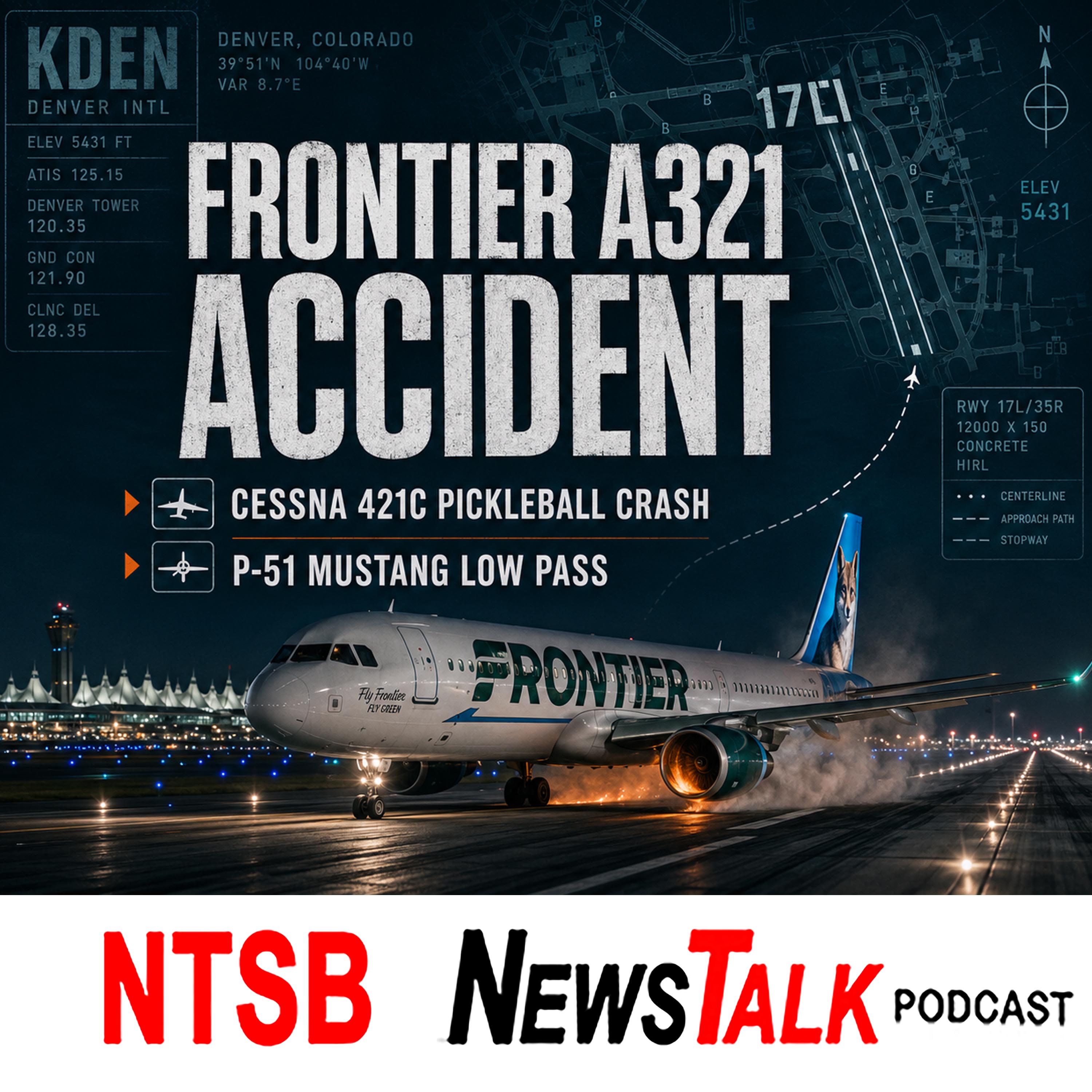
Max Trescott and Rob Mark discuss several recent aviation accidents and new NTSB reports, beginning with a tragic Frontier Airlines A321 accident at Denver International Airport, where a man entered the runway environment and was struck during takeoff. The crew rejected the takeoff at high speed, the right engine caught fire, and multiple passengers reported minor injuries.
Brought to you by AVEMCO aircraft insurance.
Support Rob and Max by making a donation at Patreon.com
The episode then examines the fatal crash of Cessna 421C N291AN near Wimberley, Texas. The aircraft was carrying people reportedly traveling to a pickleball tournament when it crashed at night in IMC with thunderstorms in the area. The pilot reportedly told ATC that the pitot heat had iced up, that the airplane was on backup gauges, and that pitot heat was not working.
Max and Rob also discuss other accidents include Cirrus SR22 N39VF, which deployed CAPS and was later dragged by the parachute across fields, fences, and a highway; Cessna 401B N122AT, which crashed after takeoff before reaching blue line speed; Beech 58 Baron N2063G during an instrument proficiency check; a King Air 300 ditching in the Atlantic; a Quad City Challenger ultralight issue; and Cessna 152 N588BR fuel exhaustion.
30 minAbspielen in:
Di7Apr
Aviation News Talk – Pilot Stories, Safety Tips & General Aviation NewsHost
Max talks with Russell Ladbrook about a chance meeting in New Zealand that turned into one of the most delightful episodes of Aviation News Talk. Max was taking a glowworm cave tour when Russell noticed his Cirrus jacket, struck up a conversation, and soon realized he was talking to the host of a podcast he had followed for years. By the end of the day, the two were sitting down at the Fjordland Aero Club near Manapouri Airport for a conversation about flying in one of the most scenic and demanding parts of the world.
How aero clubs keep flying affordable
Russell explains that aero clubs fill a role in rural New Zealand that would often be handled by a flight school or FBO in the United States. In smaller towns, there may not be enough demand to support a traditional aviation business, so clubs become the way local flying survives. The Fjordland Aero Club has about 85 members, a hangar, and club-owned aircraft, along with privately owned airplanes brought in by members.
What makes the model especially interesting is the economics. Russell says the club rents its aircraft wet for about 150 New Zealand dollars per hour, plus GST, and that includes fuel. The airplanes are microlights rather than larger certified aircraft, which helps reduce costs. Even more striking, much of the labor is donated. Club members help with maintenance, instruction, and field work. Russell himself mows the runway, and the club also earns revenue by mowing airport property and baling hay from the surrounding grass. It's a practical, community-based approach that makes flying accessible in a part of the world where a normal commercial model might fail.
Flying near Milford Sound
The conversation then shifts to the geography of New Zealand's South Island and the challenges of flying there. Russell describes the area around Te Anau and Manapouri as farmland on one side and steep mountains on the other, right on the edge of a huge national park. The terrain is beautiful, but it also makes aviation more demanding. ADS-B coverage can be spotty because mountains block signals, some aircraft operate without transponders, and local knowledge matters enormously. Russell gives an example of a nearby valley where 4,500 feet might provide a smooth ride while 3,500 or 5,500 feet can be rough.
That local knowledge becomes even more important around Milford Sound, where tourism flying is a major part of the aviation scene. Russell says many of the flights into Milford use Cessna Caravans from Queenstown, and that it is not unusual to see dozens of aircraft lined up there. Helicopters are also everywhere, supporting sightseeing and practical work in remote terrain. Russell talks about helicopter flights into the mountains, helicopter barbecues in remote valleys, and the many ways rotary-wing aircraft are woven into daily life in the region.
Weather, waterfalls, and helicopter work
One of the strongest parts of the episode is Russell's description of the weather around Milford Sound. He confirms that many planned flights never happen because low clouds, wind, avalanche danger, and poor visibility can shut things down completely. He describes Milford as one of the wettest places in New Zealand and says it can receive astonishing amounts of rain, with conditions that may be dramatically different only a short distance away on the other side of the mountains. On wet days, entire mountainsides fill with temporary waterfalls, while only a few permanent waterfalls remain visible when the rain stops.
Russell also explains that helicopters in New Zealand do far more than scenic flights. They recover deer, resupply backcountry huts, and haul waste out of remote wilderness areas where it would be impractical to carry supplies in and out by hand. That operational detail gives the episode a more grounded feel. This is not just a postcard version of New Zealand. It's a working aviation environment where flying is both practical and essential.
Glowworm caves and an unexpected connection
The final section of the episode brings the story back to where it started: the glowworm caves. Russell says his first full-time job in the mid-1980s involved both flying Cessna 172s and working as a cave guide, and that decades later he is once again guiding visitors through the same cave system. He explains that glowworms are tiny insects that live in dark, damp spaces and use light to lure prey into sticky threads. The cave tour includes a boat ride, narrow walkways, an underground waterfall, and a final passage through deep darkness where the glowworms shine overhead.
Russell's description of guiding the boat through the cave is especially memorable. He compares it to a kind of cave IFR, navigating in darkness by feel and by markers on chains overhead. It's a funny comparison, but also a revealing one. The whole episode is built on that same blend of aviation mindset, local knowledge, and sense of wonder. Russell also shares his own story of returning to flying after doubting himself for years, and the joy he now gets from taking others aloft, especially children seeing aviation up close for the first time. That gives the episode a strong emotional finish and makes it about more than scenery. It becomes a story about community, confidence, and how aviation creates connections in the most unexpected places.
If you're getting value from this show, please support the show via PayPal, Venmo, Zelle or Patreon.
Support the Show by buying a Lightspeed ANR Headsets Max has been using only Lightspeed headsets for nearly 25 years! I love their tradeup program that let's you trade in an older Lightspeed headset for a newer model. Start with one of the links below, and Lightspeed will pay a referral fee to support Aviation News Talk. Lightspeed Delta Zulu Headset $1299NEW – Lightspeed Zulu 4 Headset $1099 Lightspeed Zulu 3 Headset $949Lightspeed Sierra Headset $749 My Review on the Lightspeed Delta Zulu
Send us your feedback or comments via email
If you have a question you'd like answered on the show, let listeners hear you ask the question, by recording your listener question using your phone.
News Stories
Latest ALERT Bill Allows Portable ADS-B In
Digital Airman Certificate Bill Clears U.S. House
Potential Investors Looking At Sonex
Mayor excludes FAA from hearing on closing Burke Lakefront
Report Calls for Major Flight Training Changes
Michael Graham Named NTSB Vice Chairman
Idaho pilot sentenced to jail time for flying drunk, crashing near Boise airport
Pilot sentenced for fatal 2021 Sevier County helicopter crash
Mentioned on the ShowBuy Max Trescott's G3000 Book Call 800-247-6553 NTSB News Talk #13 - NTSB Member Graham InterviewGarmin Service Alert - Use of Advisory Vertical Guidance (+V)NTSB News Talk #26 - LaGuardia and Losing Friends in Aircraft AccidentsFjordland Aero Club website Fjordland Aero Club Facebook pageWings and Water Fiordlands by Seaplane Over the Top - Helicopter Tours
Free Index to the first 282 episodes of Aviation New Talk
So You Want To Learn to Fly or Buy a Cirrus seminars Online Version of the Seminar Coming Soon – Register for Notification
Check out our recommended ADS-B receivers, and order one for yourself. Yes, we'll make a couple of dollars if you do.
Get the Free Aviation News Talk app for iOS or Android.
Check out Max's Online Courses: G1000 VFR, G1000 IFR, and Flying WAAS & GPS Approaches. Find them all at: https://www.pilotlearning.com/
Social Media Like Aviation News Talk podcast on Facebook Follow Max on Instagram Follow Max on Twitter Listen to all Aviation News Talk podcasts on YouTube or YouTube Premium
"Go Around" song used by permission of Ken Dravis; you can buy his music at kendravis.com If you purchase a product through a link on our site, we may receive compensation.
In episode 25 of NTSB News Talk, Max Trescott and Rob Mark break down seven NTSB reports with a common theme: the accident often starts long before the impact.
Brought to you by AVEMCO aircraft insurance.
Support Rob and Max by making a donation at Patreon.com
They begin with an experimental Carbon Cub (N126C) that appears to have struck power lines during very low flight along the Payette River near Montour, Idaho—another reminder that wires are nearly invisible until they aren’t. Next is a Cessna 310R (N252DL) that descended into terrain on an IFR flight after the pilot stopped responding to ATC, pointing toward possible pilot incapacitation amid icing concerns and other red-flag gaps.
The episode then tackles the Beech 35-C33 Debonair crash (N5891J) near Pulaski, Tennessee, where ADS-B data showed worsening pitch oscillations consistent with an autopilot/trim misunderstanding and pilot-induced oscillations. Two more reports highlight night risk: a Zenith CH 701 (N4209W) lost to spatial disorientation after VFR flight into deteriorating conditions, and a Cozy Mk IV (N656TE) that departed Half Moon Bay into night IMC and went into the ocean.
Finally, they cover a Cirrus SR22 (N253BC) overweight takeoff with distraction from alerts, and a Piper Saratoga (N4187Q) engine power loss at night IFR that left the pilot with few runway options.
36 minAbspielen in:
Mi11Mär
Aviation News Talk – Pilot Stories, Safety Tips & General Aviation NewsHost
Max talks with Mike VanStaagen about the design philosophy behind the Cirrus SR20, SR22, and SF50 Vision Jet, and how Cirrus rethought what pilots and passengers should experience inside an airplane. Mike explains how his architectural mindset helped him bring together competing ideas at Cirrus and turn them into aircraft that felt modern, spacious, intuitive, and comfortable.
They discuss why Cirrus focused so heavily on easier entry and exit, better visibility on the ground and in flight, and a roomier cabin than traditional GA airplanes. Mike describes how ideas borrowed from the auto industry shaped the Cirrus cockpit, from the pilot-centered layout to the center console and cleaner instrument panel design. He also shares the story of how a tiny clay model helped convince Cirrus leadership to move away from a conventional flat panel toward the now-familiar Cirrus interior.
The conversation then turns to the Vision Jet, including the secret garage project where the concept first took shape, why the aircraft ended up with a distinctive V-tail, and how hours spent inside an early mockup led to key design breakthroughs. This is a fascinating look at how thoughtful design changed modern personal aviation.
If you're getting value from this show, please support the show via PayPal, Venmo, Zelle or Patreon.
Support the Show by buying a Lightspeed ANR Headsets Max has been using only Lightspeed headsets for nearly 25 years! I love their tradeup program that let's you trade in an older Lightspeed headset for a newer model. Start with one of the links below, and Lightspeed will pay a referral fee to support Aviation News Talk. Lightspeed Delta Zulu Headset $1299NEW – Lightspeed Zulu 4 Headset $1099 Lightspeed Zulu 3 Headset $949Lightspeed Sierra Headset $749 My Review on the Lightspeed Delta Zulu
Send us your feedback or comments via email
If you have a question you'd like answered on the show, let listeners hear you ask the question, by recording your listener question using your phone.
Mentioned on the ShowBuy Max Trescott's G3000 Book Call 800-247-6553 BeechBash in Kentucky The Flight Academy Adventure Tours +V Advisory glide slopes with less than 250 feet clearance from obstacles
Free Index to the first 282 episodes of Aviation New Talk
So You Want To Learn to Fly or Buy a Cirrus seminars Online Version of the Seminar Coming Soon – Register for Notification
Check out our recommended ADS-B receivers, and order one for yourself. Yes, we'll make a couple of dollars if you do.
Get the Free Aviation News Talk app for iOS or Android.
Check out Max's Online Courses: G1000 VFR, G1000 IFR, and Flying WAAS & GPS Approaches. Find them all at: https://www.pilotlearning.com/
Social Media Like Aviation News Talk podcast on Facebook Follow Max on Instagram Follow Max on Twitter Listen to all Aviation News Talk podcasts on YouTube or YouTube Premium
"Go Around" song used by permission of Ken Dravis; you can buy his music at kendravis.com If you purchase a product through a link on our site, we may receive compensation.
1 h 06 minAbspielen in:
Do5Mär
Aviation News Talk – Pilot Stories, Safety Tips & General Aviation NewsHost
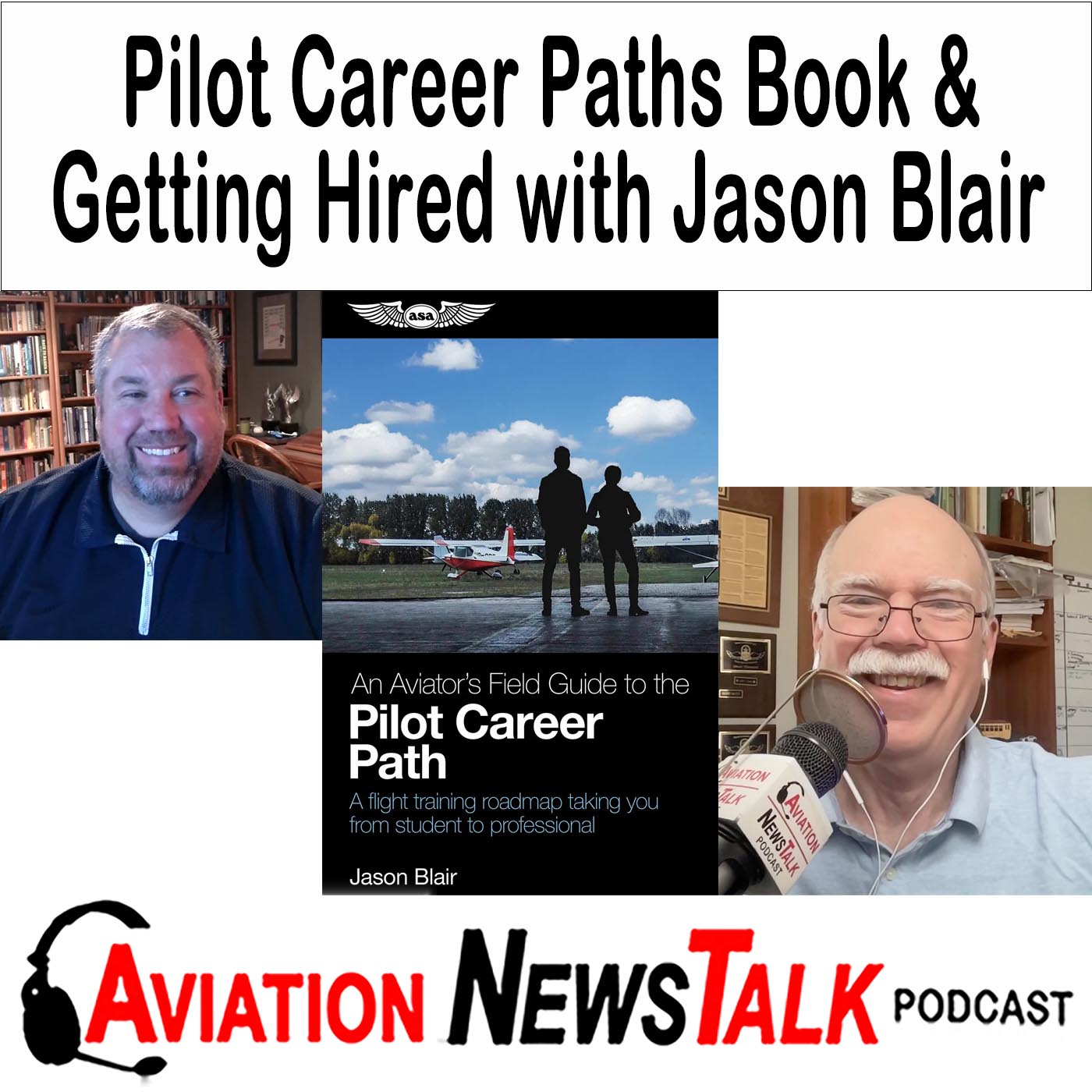
Airline pilot career path roadmap with Jason Blair: Part 61 vs Part 141, R-ATP, and what matters most for getting hired. Max talks with Jason Blair about building an airline pilot career path that gets you to the right seat faster—without expensive detours. If you're comparing Part 61 vs Part 141, wondering whether R-ATP changes your strategy, or trying to figure out what actually helps with getting hired, this episode is a practical roadmap.
Jason explains how to think backwards from your target job (regional, major airline, charter, corporate) and make training decisions that protect your timeline and seniority. They start with the gatekeeper: the FAA medical. Jason shares how to "preflight" potential medical issues, avoid self-inflicted paperwork delays, and choose the right AME strategy.
Then they break down training options: where Part 141 structure can reduce total hours and accelerate progress, and where Part 61 flexibility makes more sense for career changers balancing work and family. Jason also clarifies restricted ATP (R-ATP) pathways and a common mistake that can eliminate eligibility if you do training in the wrong order.
Finally, they cover the hiring reality: why airlines are becoming more selective again, how checkride failures and training history show up, and how to present your story like a professional. They close with the unglamorous stuff that wins careers: clean logbooks, backups, and smart training finances.
If you're getting value from this show, please support the show via PayPal, Venmo, Zelle or Patreon.
Support the Show by buying a Lightspeed ANR Headsets Max has been using only Lightspeed headsets for nearly 25 years! I love their tradeup program that let's you trade in an older Lightspeed headset for a newer model. Start with one of the links below, and Lightspeed will pay a referral fee to support Aviation News Talk. Lightspeed Delta Zulu Headset $1299NEW – Lightspeed Zulu 4 Headset $1099 Lightspeed Zulu 3 Headset $949Lightspeed Sierra Headset $749 My Review on the Lightspeed Delta Zulu
Send us your feedback or comments via email
If you have a question you'd like answered on the show, let listeners hear you ask the question, by recording your listener question using your phone.
Mentioned on the ShowBuy Max Trescott's G3000 Book Call 800-247-6553 Jason Blair's website Jason's Books: An Aviator's Field Guide to the Pilot Career Path Private Pilot Oral Exam Guide Instrument Pilot Oral Exam Guide Commercial Pilot Oral Exam Guide Flight Instructor Oral Exam Guide
Free Index to the first 282 episodes of Aviation New Talk
So You Want To Learn to Fly or Buy a Cirrus seminars Online Version of the Seminar Coming Soon – Register for Notification
Check out our recommended ADS-B receivers, and order one for yourself. Yes, we'll make a couple of dollars if you do.
Get the Free Aviation News Talk app for iOS or Android.
Check out Max's Online Courses: G1000 VFR, G1000 IFR, and Flying WAAS & GPS Approaches. Find them all at: https://www.pilotlearning.com/
Social Media Like Aviation News Talk podcast on Facebook Follow Max on Instagram Follow Max on Twitter Listen to all Aviation News Talk podcasts on YouTube or YouTube Premium
"Go Around" song used by permission of Ken Dravis; you can buy his music at kendravis.com If you purchase a product through a link on our site, we may receive compensation.
58 minAbspielen in:
Fr27Feb
Aviation News Talk – Pilot Stories, Safety Tips & General Aviation NewsHost
Max talks with Josh Harnagel, COO of Redbird Flight, about a practical use-case that matters to almost every instrument pilot: logging IFR instrument currency and staying proficient in an FAA-approved simulator. Josh explains why many pilots buy Redbird's FAA-approved tabletop devices specifically for currency—especially to knock out the holding requirement—and why he likes shooting an approach in the simulator before flying it in the airplane. Max shares why he does the same thing before recurrent training, because simulator reps surface the "gotchas" that can spike workload in real IFR—like autopilot behavior on LNAV+V.
Josh breaks down Redbird's product lineup, clarifies what's FAA approved versus "just a computer," and explains where Basic ATDs and Advanced ATDs fit in training. They also touch on Redbird GIFT (Guided Independent Flight Training), remote instruction possibilities, and why avionics emulation is hard (and expensive) to do with perfect fidelity.
Then the episode pivots to a Redbird factory tour: outbound shipping and crating, assembly workflow, fabrication of honeycomb aluminum shells, wiring harness and switch panel build, PCB soldering and parts inventory, completions/testing, and even the cooling/vent system inside the sim—ending with why engineering and the shop are co-located for faster iteration and better quality.
If you're getting value from this show, please support the show via PayPal, Venmo, Zelle or Patreon.
Support the Show by buying a Lightspeed ANR Headsets Max has been using only Lightspeed headsets for nearly 25 years! I love their tradeup program that let's you trade in an older Lightspeed headset for a newer model. Start with one of the links below, and Lightspeed will pay a referral fee to support Aviation News Talk. Lightspeed Delta Zulu Headset $1299NEW – Lightspeed Zulu 4 Headset $1099 Lightspeed Zulu 3 Headset $949Lightspeed Sierra Headset $749 My Review on the Lightspeed Delta Zulu
Send us your feedback or comments via email
If you have a question you'd like answered on the show, let listeners hear you ask the question, by recording your listener question using your phone.
Mentioned on the ShowBuy Max Trescott's G3000 Book Call 800-247-6553 Video Simulation of Epic E1000 Crash at Steamboat Springs, CO on Patreon Helicopter VR Flight Simulator Training podcast: Loft Dynamics
Free Index to the first 282 episodes of Aviation New Talk
So You Want To Learn to Fly or Buy a Cirrus seminars Online Version of the Seminar Coming Soon – Register for Notification
Check out our recommended ADS-B receivers, and order one for yourself. Yes, we'll make a couple of dollars if you do.
Get the Free Aviation News Talk app for iOS or Android.
Check out Max's Online Courses: G1000 VFR, G1000 IFR, and Flying WAAS & GPS Approaches. Find them all at: https://www.pilotlearning.com/
Social Media Like Aviation News Talk podcast on Facebook Follow Max on Instagram Follow Max on Twitter Listen to all Aviation News Talk podcasts on YouTube or YouTube Premium
"Go Around" song used by permission of Ken Dravis; you can buy his music at kendravis.com If you purchase a product through a link on our site, we may receive compensation.
56 minAbspielen in:
Di10Feb
Aviation News Talk – Pilot Stories, Safety Tips & General Aviation NewsHost
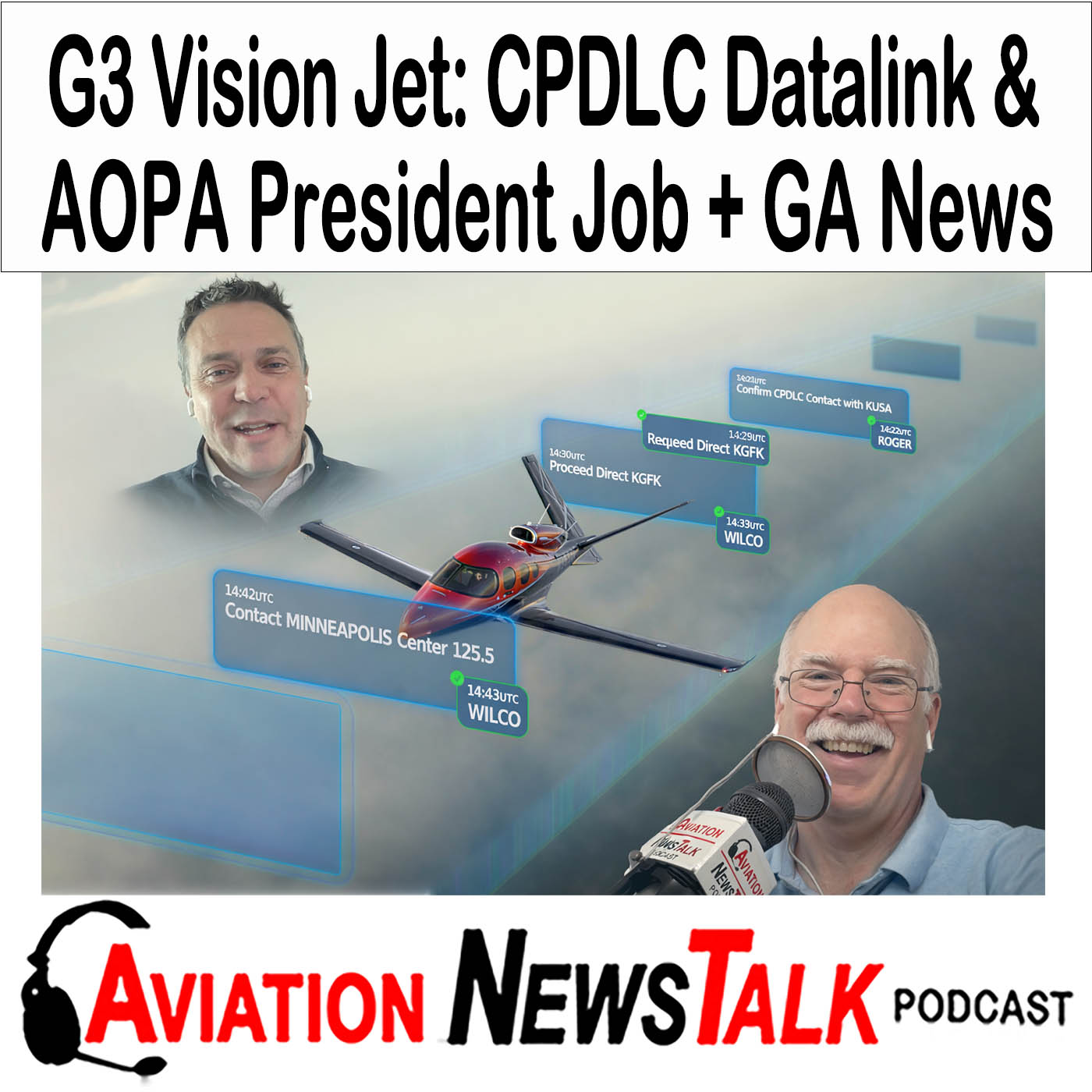
Max talks with Matt Bergwall, Executive Director of the Vision Jet Product Line at Cirrus, about the just-announced Cirrus SF50 G3 Vision Jet—and before that, he offers an unusually personal look at what the AOPA President's job actually requires.
Max opens by explaining that he interviewed for the AOPA President role twice and uses that experience to outline what makes the position difficult and consequential. In his view, the job is not simply "being the public face of GA." It demands relentless travel to connect with members, lawmakers, regulators, and stakeholders—while still maintaining a strong day-to-day presence at headquarters to lead a sizable staff. He also emphasizes the fundraising reality: membership dues matter, but major donors increasingly drive what's possible, especially as traditional advertising revenue has eroded across media. Max argues that regardless of opinions about leadership changes, AOPA's advocacy work and member services—like the hotline—can be meaningful to pilots, and he encourages continued support for the organization. He also describes the way top roles like this are typically filled: boards often rely on executive search firms and closed candidate pipelines rather than a standard "job posting" process.
Then the focus shifts to the Vision Jet. Matt explains the G3 Vision Jet changes through a pilot-centric lens: what's different in capability, how it affects workload, and what it feels like in real use. One headline upgrade is cabin practicality. Cirrus designed the G3 so six adults can fit comfortably, while still maintaining seven seat belts. That might sound like a simple seating tweak, but Matt describes it as a serious engineering effort that required deep iteration with mockups, real-world body sizes, and attention to the small geometry problems that make the third row either tolerable or miserable. The end goal was not only more capacity, but a better experience for passengers in the back—especially when the airplane is used as family transportation rather than a four-person luxury machine.
On the performance side, Matt notes that Cirrus increased the airplane's MMO by 0.01 Mach, which equates to roughly 7 knots of additional true airspeed in certain cruise conditions and can also help during descents and arrivals. He frames the gain as less about bragging rights and more about flow: small speed margins can matter when mixing with faster traffic in busy terminal environments. He also explains the "why" behind the change: rather than a dramatic redesign, the team "sharpened their pencils," did additional flight testing, and validated that the aircraft had enough performance and safety margin to raise the limit. Max asks whether that might also yield a slight range improvement, and Matt says it can—though it's hard to quantify cleanly—while still being a meaningful, felt benefit on colder days when the throttle might otherwise need to pull back.
A major avionics headline is CPDLC / ATC Datalink. Matt describes it as a system long familiar to airlines, increasingly available in U.S. centers and at many larger airports for text-based clearances. The practical advantage is removing the most error-prone part of IFR communication: copying down complex clearances and route changes while juggling frequency congestion. With datalink, pilots can receive clearances as text, review them at their own pace, and—in many cases—push the routing or frequency changes directly into the avionics instead of re-typing and re-verifying everything manually. In flight, the system can reduce "did ATC call me?" uncertainty: messages arrive with a clear alert and are hard to miss. Max and Matt also touch on D-ATIS and planning advantages, including how having information in text can reduce repeated listening and make it easier to configure the airplane early.
They also cover a string of real operational refinements that make the G3 feel more modern day-to-day: improved taxi situational awareness features, taxiway routing guidance, and more capable visual-approach tools that help pilots set up patterns beyond the common "straight-in" workflow. Inside the cabin, Matt describes seat mechanism improvements that make entry and adjustment easier and more intuitive, plus passenger comfort refinements aimed at making the airplane more usable across a wider range of missions.
The result is a G3 that's less about one giant breakthrough and more about a stack of changes that compound: a truer six-adult cabin, modest but useful speed flexibility, and datalink and avionics upgrades that reduce friction during the highest workload moments of an IFR trip. Max closes with the practical ownership layer—what this means for buyers thinking about price and programs—so listeners can translate "new features" into real-world value.
If you're getting value from this show, please support the show via PayPal, Venmo, Zelle or Patreon.
Support the Show by buying a Lightspeed ANR Headsets Max has been using only Lightspeed headsets for nearly 25 years! I love their tradeup program that let's you trade in an older Lightspeed headset for a newer model. Start with one of the links below, and Lightspeed will pay a referral fee to support Aviation News Talk. Lightspeed Delta Zulu Headset $1299NEW – Lightspeed Zulu 4 Headset $1099 Lightspeed Zulu 3 Headset $949Lightspeed Sierra Headset $749 My Review on the Lightspeed Delta Zulu
Send us your feedback or comments via email
If you have a question you'd like answered on the show, let listeners hear you ask the question, by recording your listener question using your phone.
News Stories
AOPA Seeks New President
OIG To Audit Controller Training
FAA Recommends More Spatial Disorientation Training For Pilots
FAA Sets 25-hour Cockpit Voice Recorder Standard for New Aircraft
Texas pilot sentenced for falsifying aircraft maintenance records
Mentioned on the ShowBuy Max Trescott's G3000 Book Call 800-247-6553 Video of the Week:
Free Index to the first 282 episodes of Aviation New Talk
So You Want To Learn to Fly or Buy a Cirrus seminars Online Version of the Seminar Coming Soon – Register for Notification
Check out our recommended ADS-B receivers, and order one for yourself. Yes, we'll make a couple of dollars if you do.
Get the Free Aviation News Talk app for iOS or Android.
Check out Max's Online Courses: G1000 VFR, G1000 IFR, and Flying WAAS & GPS Approaches. Find them all at: https://www.pilotlearning.com/
Social Media Like Aviation News Talk podcast on Facebook Follow Max on Instagram Follow Max on Twitter Listen to all Aviation News Talk podcasts on YouTube or YouTube Premium
"Go Around" song used by permission of Ken Dravis; you can buy his music at kendravis.com If you purchase a product through a link on our site, we may receive compensation.
53 minAbspielen in:
So1Feb
Aviation News Talk – Pilot Stories, Safety Tips & General Aviation NewsHost
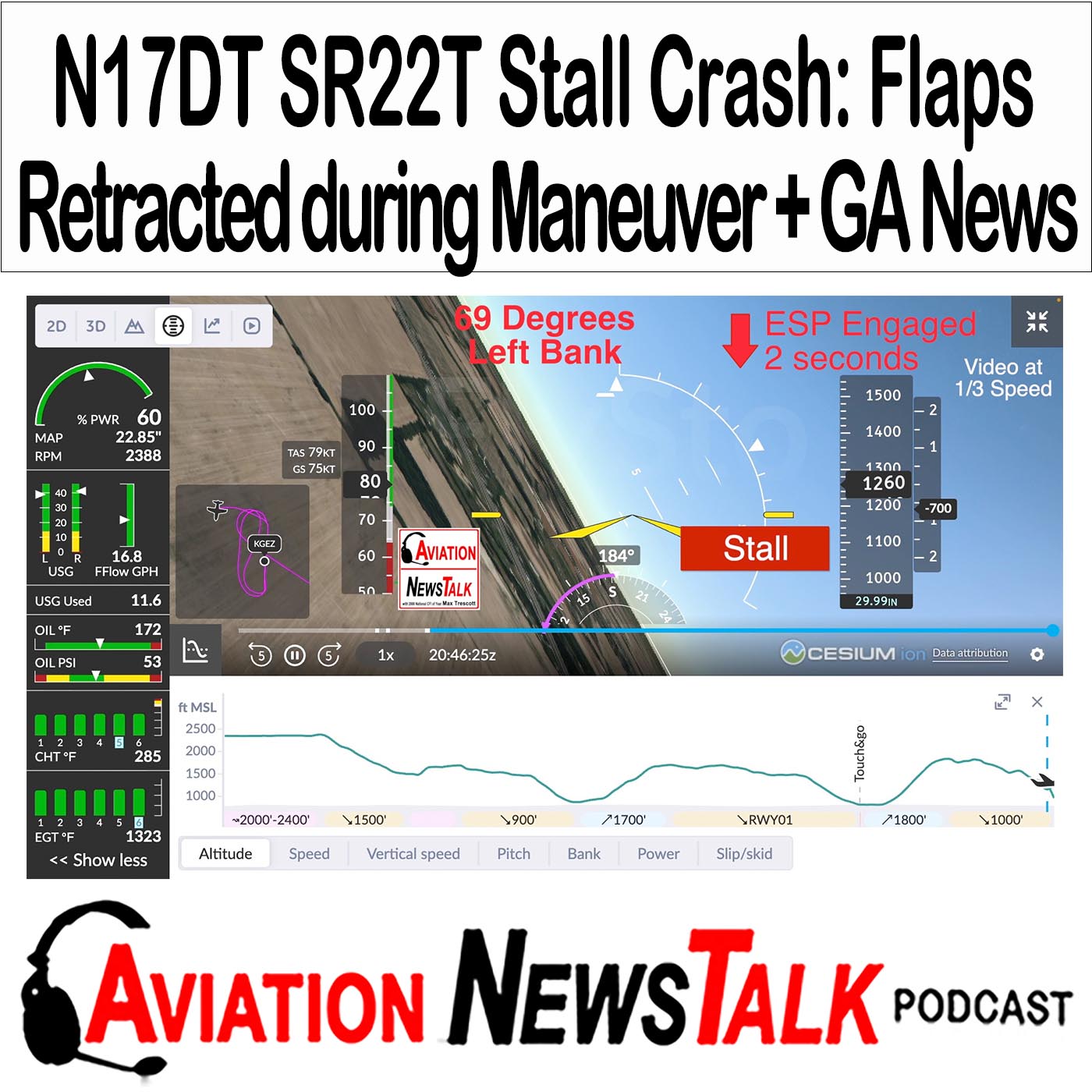
Max talks with Rob Mark about the fatal crash of Cirrus SR22T N17DT near Shelbyville, Indiana, and why this accident is so instructive for any pilot who flies approaches at low altitude with high workload. The NTSB's probable cause centers on inadequate airspeed and an aerodynamic stall, but the real value is in the flight data that shows how the airplane got there: low power held for an extended period, repeated stall warnings, multiple ESP interventions, and flaps that ultimately remained retracted until impact.
This episode matters because it's rare to have this level of detail. The NTSB recovered onboard data that captures dozens of parameters multiple times per second—far more than you usually get from ADS-B alone. Max describes how the NTSB published extensive graphs and also released a spreadsheet of recorded parameters. The spreadsheet didn't include position data, so Max combined it with ADS-B track points and interpolated the missing locations to create a second-by-second reconstruction. The result is a cockpit-style view that shows airspeed, pitch attitude, power, flap position, stall warning activations, and ESP engagement together—so you can see the chain of events, not just the endpoint.
The key factual finding: the engine was operating normally. The "partial engine failure" theories that circulated right after the crash don't hold up against the final report and recorded parameters. Instead, power was pulled back to a very low setting—about 15%, roughly 10–11 inches of manifold pressure—and held there. That's close to a landing-power setting, which means airspeed and energy must be managed carefully to avoid drifting toward stall, especially if configuration changes.
The second key finding is configuration. The flap record shows the flaps briefly at about 50% and then transitioning to 0%. Later, the data shows the flaps again toggling, but ultimately the airplane ends up with flaps retracted and stays that way until the crash. That detail is not cosmetic—stall speed is strongly affected by flap setting. In a low-power approach, retracting flaps increases stall speed and requires a different pitch picture and energy plan. If the airplane is flown as if it has more lift available than it actually does, airspeed can silently bleed away.
As the airplane slowed, the recorded data shows repeated stall warning activations in the final minute, and ESP (Envelope Stability Protection) engaging multiple times. ESP is designed to help discourage pilots from exceeding the envelope by nudging pitch and roll back toward safer values, but it can't create airspeed or altitude. It's a guardrail, not an autopilot that can save a low-altitude slow-speed situation once the margin is gone. In the reconstruction, stall warnings and ESP engagement cluster around the periods when the airplane is slow, pitched up, and operating near the edge of the envelope.
Witness observations align with a low-altitude stall sequence. A driver on a nearby interstate described the airplane as very low, appearing to "hang," then making a sharp turn. The witness observed a wing drop and rapid rocking from one wing vertical to the other before the aircraft disappeared behind trees and a fireball was seen seconds later. The NTSB's recorded data similarly shows the airplane slowing near stall speed followed by a loss of control consistent with a stall at low altitude.
The practical lessons are direct and transferable to any airplane, not just a Cirrus. First, treat any stall warning on approach as a command—not a suggestion. You don't troubleshoot while the airplane is approaching the critical angle of attack. Your first move is to reduce angle of attack (unload) and regain airspeed. Second, make configuration errors harder to commit and easier to catch. Flap position is not a "set it and forget it" item when workload is high. Use callouts, verify indications, and confirm the pitch picture matches the configuration you think you have. Third, recognize that "low-power" plus "slow" plus "turning" is the classic trap. Bank increases stall speed, and when you're low, you don't have the altitude budget to recover from a stall break and wing drop.
Finally, this episode reinforces a mindset: the accident wasn't one bad second; it was a sequence of small choices and small drifts that added up to zero margin. The data shows multiple warning opportunities—stall horn and ESP events—before the final loss of control. The goal for listeners is not to judge the pilots. It's to build habits that make this chain harder to start, easier to detect, and easy to abandon early. When the airplane is telling you it's running out of margin, believe it—then reset the approach while you still have altitude to spare.
If you're getting value from this show, please support the show via PayPal, Venmo, Zelle or Patreon.
Support the Show by buying a Lightspeed ANR Headsets Max has been using only Lightspeed headsets for nearly 25 years! I love their tradeup program that let's you trade in an older Lightspeed headset for a newer model. Start with one of the links below, and Lightspeed will pay a referral fee to support Aviation News Talk. Lightspeed Delta Zulu Headset $1299NEW – Lightspeed Zulu 4 Headset $1099 Lightspeed Zulu 3 Headset $949Lightspeed Sierra Headset $749 My Review on the Lightspeed Delta Zulu
Send us your feedback or comments via email
If you have a question you'd like answered on the show, let listeners hear you ask the question, by recording your listener question using your phone.
News Stories
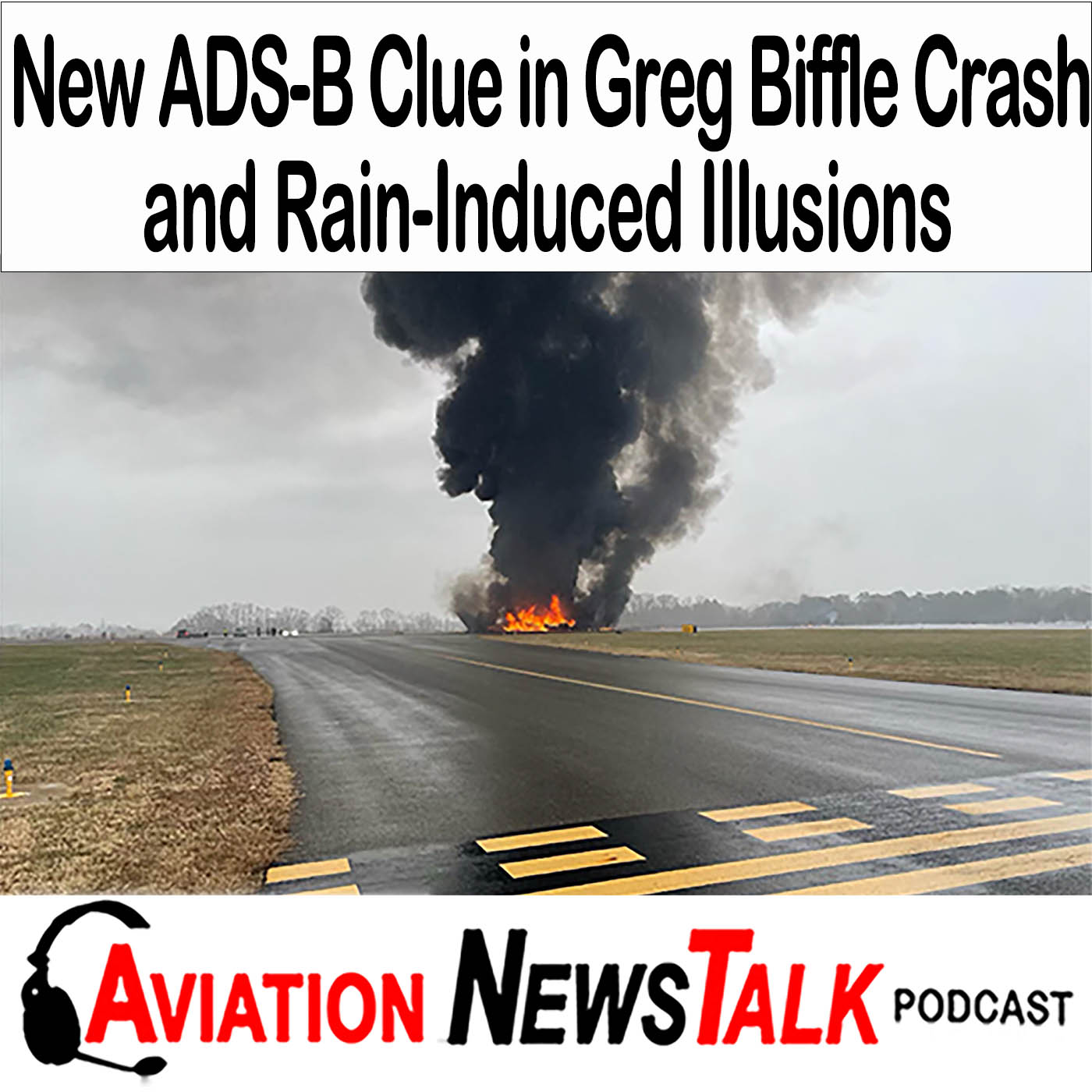
NTSB: Greg Biffle Crash Followed Instrument Failure
Reagan National Midair Collision Probable Cause
AOPA Air Safety Institute suggests icing as factor in Challenger crash
Burbank Airport at risk of a midair collision, according to NTSB
Pomona Man Arrested in Connection with Aircraft Thefts
Mentioned on the ShowBuy Max Trescott's G3000 Book Call 800-247-6553 Video of the Week: Max's FLYING Magazine article: Pattern Problems
Free Index to the first 282 episodes of Aviation New Talk
So You Want To Learn to Fly or Buy a Cirrus seminars Online Version of the Seminar Coming Soon – Register for Notification
Check out our recommended ADS-B receivers, and order one for yourself. Yes, we'll make a couple of dollars if you do.
Get the Free Aviation News Talk app for iOS or Android.
Check out Max's Online Courses: G1000 VFR, G1000 IFR, and Flying WAAS & GPS Approaches. Find them all at: https://www.pilotlearning.com/
Social Media Like Aviation News Talk podcast on Facebook Follow Max on Instagram Follow Max on Twitter Listen to all Aviation News Talk podcasts on YouTube or YouTube Premium
"Go Around" song used by permission of Ken Dravis; you can buy his music at kendravis.com If you purchase a product through a link on our site, we may receive compensation.
1 h 13 minAbspielen in:
Sa24Jan
Aviation News Talk – Pilot Stories, Safety Tips & General Aviation NewsHost
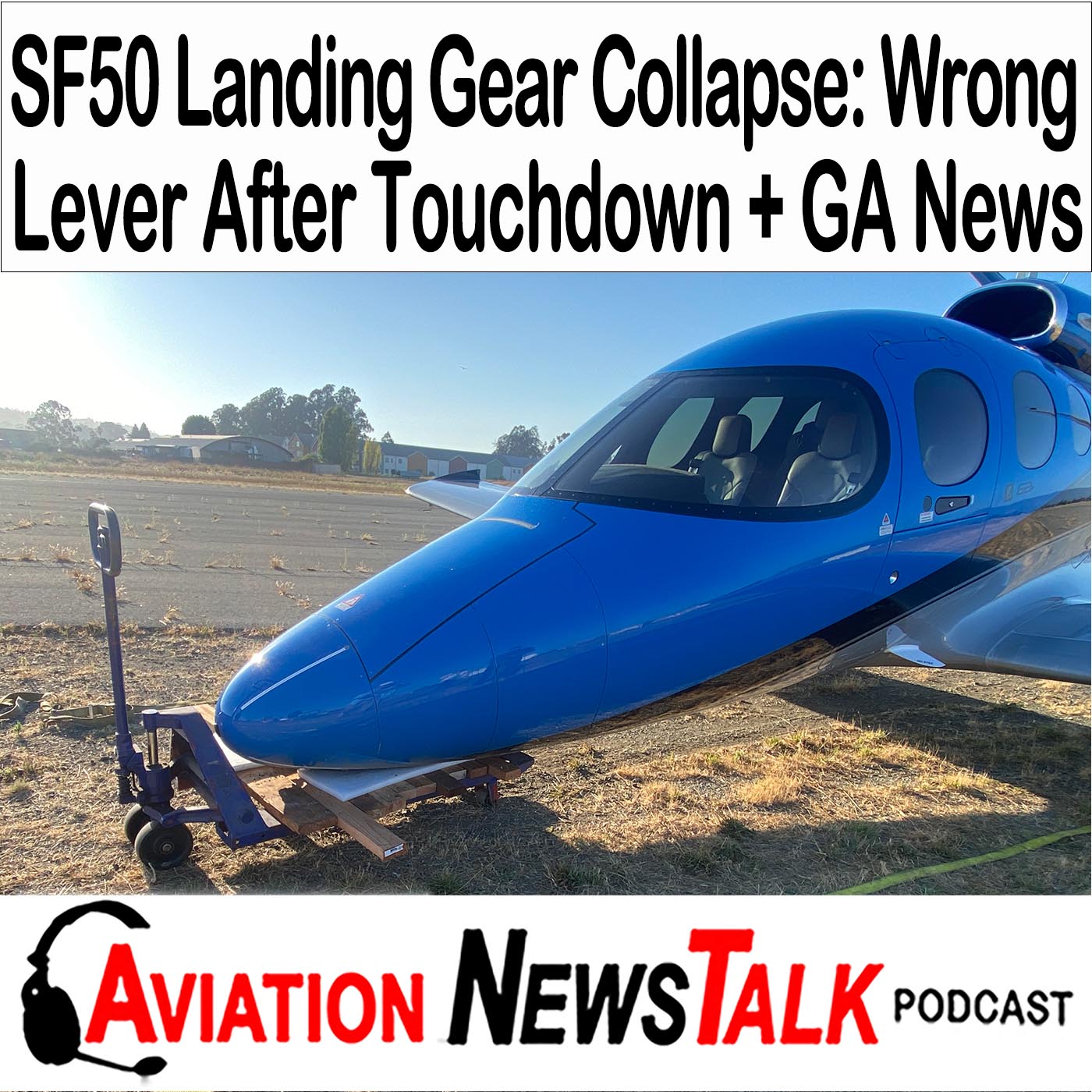
Max talks with Rob Mark about a classic "simple mistake with big consequences" scenario: a pilot who possibly raised the landing gear handle instead of selecting flaps up during the landing roll in a Cirrus Vision Jet. The event looks minor on the surface—no injuries and the airplane stayed on the runway—but it exposes a human-factors trap that can bite any retractable-gear pilot, especially when you're trying to be quick and efficient right after touchdown.
The discussion centers on the NTSB's final report for a Cirrus SF50 Vision Jet that landed at Watsonville Municipal Airport (Watsonville, California) on August 9, 2024. The pilot reported a normal approach and landing. Before touchdown, he had the flaps set to 100% and saw three green landing gear indications. Touchdown itself was uneventful. But during the landing roll—right about when braking began—the nose landing gear collapsed.
Max and Rob walk through what the data showed. On short final, the airplane was properly configured: flaps at 100% and the landing gear down and locked. During rollout, both weight-on-wheels switches were briefly "unloaded," and the landing gear handle was raised and then lowered. That sequence unlocked the nose gear and allowed it to collapse. The main gear also unlocked, but it re-locked before collapsing. The probable cause boiled down to an inadvertent control selection: the pilot likely moved the gear handle instead of selecting the flap switch to 0%.
From there, they unpack why this kind of error is so believable. The flap selector switch sits below the landing gear handle, and many pilots develop a post-touchdown habit of "cleaning up" quickly. Some of that comes from short-field technique: retracting flaps can put more weight on the wheels, increase braking effectiveness, and reduce stopping distance. But the exact moment you're tempted to do it is also the moment you have the least spare attention. You're still fast, directional control still matters, braking is being modulated, and you're managing the transition from flight to rollout. Add fatigue, distraction, or a slightly different cockpit flow than usual, and a wrong-control grab becomes completely plausible.
A big takeaway is that landing isn't over at touchdown. Many pilots subconsciously relax as soon as the mains touch, as if the hard part is done. In reality, the landing roll is when you still have a lot of kinetic energy and limited margin for distraction. Looking down, changing configuration, or reaching for cockpit controls before you're stabilized is how small errors turn into big repair bills. Max and Rob emphasize that "post-landing tasks" are optional until the airplane is clearly under control and slowing.
So what should pilots do differently? Their answer is intentionally boring: slow the flow down. On most runways there is no operational need to rush flap retraction during rollout. Keep your eyes outside, keep the airplane tracking straight, and let speed decay. If you choose to retract flaps on rollout, treat it like a checklist item, not a reflex. Touch the correct control deliberately, verify what you're touching, and use a short verbal callout ("flaps zero") before you move it. Better yet, tie configuration changes to safer triggers—below taxi speed, after exiting the runway, or after stopping and running the after-landing checklist—so you're not doing "extra tasks" while still managing high speed and directional control.
They also discuss building habits that are resistant to error. If your technique is "as soon as I touch down, I do X," you're training your hands to move before your brain has finished verifying the right target. Replace that with a pause that forces confirmation, or a flow that keeps critical controls physically and mentally separated in time. The goal isn't to be fast; it's to be consistent and correct.
If you're getting value from this show, please support the show via PayPal, Venmo, Zelle or Patreon.
Support the Show by buying a Lightspeed ANR Headsets Max has been using only Lightspeed headsets for nearly 25 years! I love their tradeup program that let's you trade in an older Lightspeed headset for a newer model. Start with one of the links below, and Lightspeed will pay a referral fee to support Aviation News Talk. Lightspeed Delta Zulu Headset $1299NEW – Lightspeed Zulu 4 Headset $1099 Lightspeed Zulu 3 Headset $949Lightspeed Sierra Headset $749 My Review on the Lightspeed Delta Zulu
Send us your feedback or comments via email
If you have a question you'd like answered on the show, let listeners hear you ask the question, by recording your listener question using your phone.
News Stories
ForeFlight and Jeppesen announce Layoffs
AOPA asks pilots to contact Congress to Support PAPA
FAA makes permanent restrictions for helicopters near DCA
House passes bill that would block ATC privatization
Report Shows Rise in DPE Supply
Super Bowl LX: What General Aviation Pilots Need to Know
New glider distance record - Instagram video
Stolen Plane Crashes Into Hangar
FBI investigates stolen planes, one found at Auburn airport
Authorities looking for couple in connection with thefts
Pilot in crash near Boise charged with operating under the influence
Mentioned on the ShowBuy Max Trescott's G3000 Book Call 800-247-6553 Video of the Week: Max's video showing ADS-B data for NASCAR driver crash
Free Index to the first 282 episodes of Aviation New Talk
So You Want To Learn to Fly or Buy a Cirrus seminars Online Version of the Seminar Coming Soon – Register for Notification
Check out our recommended ADS-B receivers, and order one for yourself. Yes, we'll make a couple of dollars if you do.
Get the Free Aviation News Talk app for iOS or Android.
Check out Max's Online Courses: G1000 VFR, G1000 IFR, and Flying WAAS & GPS Approaches. Find them all at: https://www.pilotlearning.com/
Social Media Like Aviation News Talk podcast on Facebook Follow Max on Instagram Follow Max on Twitter Listen to all Aviation News Talk podcasts on YouTube or YouTube Premium
"Go Around" song used by permission of Ken Dravis; you can buy his music at kendravis.com If you purchase a product through a link on our site, we may receive compensation.
Max Trescott and Rob Mark connect a string of very different accidents with one shared theme: safety margin usually disappears one “reasonable” choice at a time—until the airplane (or the environment) collects the debt.
They open with a major development: the NTSB’s urgent recommendation to Textron after two fatal post-maintenance stall test flights in Hawker business jets. Max and Rob explain why stall testing in swept-wing jets can be uniquely unforgiving, and why “unacceptable stall characteristics” should make every pilot sit up straight. The takeaway: if a flight requires test-pilot skills, then “maintenance requires it” doesn’t make it safe—it demands the right training, the right crew, and the right conditions.
Max then shares NTSB news: a public board meeting on Tuesday, January 27, 2026 at 9:00 a.m. ET to determine probable cause for the January 29, 2025 midair collision over the Potomac River near Reagan National (PSA CRJ700 and an Army UH-60L Black Hawk). Max and Rob will be watching closely and will share clips in a future episode.
From there they break down recent accidents and reports, including: the Dassault Falcon 50, 9H-DFS, crash near Haymana, Turkey; an MD530F helicopter, N3502P, near Superior, Arizona where a slackline/highline may have been a factor; a TBM 700, N700PT, near Monroe, Wisconsin involving an approach continued below minimums; the Hawker 900XP, N900VA, fatal post-maintenance stall test crash; a Cessna P210, N1400, fuel exhaustion accident in San Diego in IMC with low recent flying; and a Bonanza G36, N360FV, near Tracy, California that illustrates the engine-emergency dilemma: choose the ugly, certain option—or gamble for the “better” airport you might not reach.
53 minAbspielen in:
So11Jan
Aviation News Talk – Pilot Stories, Safety Tips & General Aviation NewsHost
Max talks with Mark Waddell of the Cirrus Owner and Pilots Association (COPA) about how Cirrus pilots can reduce accidents by focusing on the places where the accident chain most often begins: unstable approaches, indecisive go-arounds, and delayed choices during power-loss events. They discuss what pilots are doing in the cockpit that turns routine flights into incidents, and what specific habits and training standards reduce that risk.
Mark explains that 2025 included eight fatal Cirrus accidents and twelve CAPS saves. Mark argues that the big safety wins come from addressing repeatable patterns: how pilots manage energy on final, how quickly they reject a bad approach, and how early they commit to the safest outcome when the engine isn't reliable.
A major theme is decisiveness in abnormal situations, especially anything involving power. Mark walks through how power-loss or engine-roughness events can seduce pilots into flying a normal pattern and hoping things stabilize. That often burns altitude and distance in exchange for false comfort. The operational hazard is simple: the moment a pilot realizes the runway is no longer assured, they're already low, already out of options, and now forced into rushed decisions. Mark emphasizes that when the engine is uncertain, "normal" is the enemy. The airplane doesn't care that the pattern looked tidy; it only cares whether you end up with a survivable outcome.
This ties directly into CAPS decision-making. Mark's message is not "CAPS solves everything," but rather that pilots need an explicit decision framework that prevents them from negotiating with themselves while altitude evaporates. He discusses the idea of a CAPS hard deck—an altitude by which, if a pilot is not certain of a safe landing outcome, they commit to pulling the handle. The point of a hard deck isn't to remove judgment; it's to remove hesitation. If you wait until you're low, you've converted a controlled, survivable deployment into a desperate last-second attempt. In that sense, the hard deck is less about the parachute and more about training the pilot's brain to act early enough for any option to work.
From emergency decisions, the discussion moves to the most universal risk zone: landing and go-around. Mark notes that a large share of reportable events occur during landing or during an attempted go-around. That makes this phase-of-flight a high-leverage target for training, standards, and self-discipline. The trap is that approaches feel "fixable" until they suddenly aren't. Pilots often rationalize small deviations—slightly fast, slightly high, slightly untrimmed—because they believe they can correct it in the last few hundred feet. But each late correction is an energy trade, and those trades frequently end with excessive speed over the threshold, a flat touchdown, a bounce, or a rushed go-around.
They get specific about the "flat landing" pattern. Mark challenges a common cultural habit: equating "smooth" with "good." In many airplanes—and especially in a fast, slick airplane—chasing smoothness can encourage a flatter attitude and higher speed, which increases the chances of touching down on the nose gear or loading it too early. That can lead to nose-gear abuse, shimmy events, prop strikes, and expensive engine tear-downs.
Max reinforces the technique side: trimming matters. If pilots are muscling the airplane through configuration changes and final approach, they're behind the airplane before the flare even begins. A well-trimmed airplane is easier to slow, easier to pitch correctly, and easier to land in the right attitude without forcing it onto the runway.
Go-arounds get treated as a primary skill, not a backup plan. Mark describes why late go-arounds are especially dangerous: if a pilot waits until a bounce or a deep, unstable touchdown attempt, the airplane is close to the ground, slow, and in a configuration that can punish abrupt changes. The go-around itself is not complicated, but it requires coordinated execution: power comes in, right rudder counters yaw, pitch is managed to prevent an excessive nose-up attitude, and configuration changes are timed rather than rushed. A common failure mode is trying to do everything at once—adding power, retracting flaps too aggressively, and pitching up—creating a stall-prone situation at the worst possible altitude.
Mark's guidance pushes pilots toward objective gates: if the approach isn't stable by a defined point, you go around—period. The pilots who get into trouble tend to have elastic standards. They keep moving the goalposts because they want the landing to work. Mark argues that consistency is the cure: standardized stabilized-approach criteria, practiced go-arounds that feel routine, and an acceptance that a go-around is not a failure, it's good judgment.
They also address proficiency and recency, emphasizing that safe performance is less about total hours and more about how frequently a pilot is flying and practicing the right skills. Mark points out that annual hours correlate strongly with landing outcomes; low annual utilization can create a false sense of competence because the pilot has experience, but not recent repetition. The solution isn't heroic flying—it's structured practice: recurring instruction, intentional go-around reps, and consistent standards that prevent "drift" back into sloppy technique.
To make those standards stick, Mark advocates data-driven debriefing. Instead of relying on subjective feel—"that was fine"—pilots can use post-flight tools, such as FlySto and ForeFlight's Cloud Ahoy, to evaluate approach stability, speed control, glidepath consistency, and touchdown energy. The goal isn't chasing a score; it's finding patterns that predict future mistakes. If your data repeatedly shows fast thresholds, unstable vertical paths, or late corrections, you now have something specific to train. Mark's point is blunt: most pilots don't need more aviation wisdom; they need feedback that's objective enough to change behavior.
The episode's bottom line is that Cirrus safety is not about secret techniques. It's about earlier decisions, tighter standards, and repeated practice in the phases of flight where accidents are born. Nail stabilized approaches, normalize early go-arounds, commit sooner in power-loss scenarios, and use honest debriefing to identify risk trends before they turn into an NTSB report.
If you're getting value from this show, please support the show via PayPal, Venmo, Zelle or Patreon.
Support the Show by buying a Lightspeed ANR Headsets Max has been using only Lightspeed headsets for nearly 25 years! I love their tradeup program that let's you trade in an older Lightspeed headset for a newer model. Start with one of the links below, and Lightspeed will pay a referral fee to support Aviation News Talk. Lightspeed Delta Zulu Headset $1199 HOLIDAY SPECIALNEW – Lightspeed Zulu 4 Headset $1099 Lightspeed Zulu 3 Headset $849 HOLIDAY SPECIALLightspeed Sierra Headset $749 My Review on the Lightspeed Delta Zulu
Send us your feedback or comments via email
If you have a question you'd like answered on the show, let listeners hear you ask the question, by recording your listener question using your phone.
Mentioned on the ShowCirrus Owner Pilots Association (COPA) COPA YouTube Channel Video: Garmin Green Donut Explained Buy Max Trescott's G3000 Book Call 800-247-6553 a Aviation News Talk Network podcasts NTSB News Talk podcast UAV News Talk podcast Rotary Wing Show podcast Free Index to the first 282 episodes of Aviation New Talk
So You Want To Learn to Fly or Buy a Cirrus seminars Online Version of the Seminar Coming Soon – Register for Notification
Check out our recommended ADS-B receivers, and order one for yourself. Yes, we'll make a couple of dollars if you do.
Get the Free Aviation News Talk app for iOS or Android.
Check out Max's Online Courses: G1000 VFR, G1000 IFR, and Flying WAAS & GPS Approaches. Find them all at: https://www.pilotlearning.com/
Social Media Like Aviation News Talk podcast on Facebook Follow Max on Instagram Follow Max on Twitter Listen to all Aviation News Talk podcasts on YouTube or YouTube Premium
"Go Around" song used by permission of Ken Dravis; you can buy his music at kendravis.com If you purchase a product through a link on our site, we may receive compensation.
1 h 10 minAbspielen in:
Di30Dez 25
Aviation News Talk – Pilot Stories, Safety Tips & General Aviation NewsHost
Max talks with host Scott Hamilton of WBT, Charlotte's News Talk radio, about the Statesville, North Carolina Citation 550 crash that killed NASCAR driver Greg Biffle and six others, then expands the conversation with a fresh technical finding and a practical training takeaway for pilots. While preparing for the short radio interview, Max revisited the ADS-B track and noticed something he hadn't seen anyone else write about: the altitude anomaly isn't merely a "jump," it's an impossible spike.
The key number is stark. The ADS-B data shows a reported climb of 1,374 feet in 1.64 seconds, which implies a climb rate of almost 50,000 feet per minute—a rate that doesn't make sense for a Citation.
Max's point is that this isn't a real aircraft maneuver; it's a data or sensor-path artifact. What makes it more compelling is what happens immediately beforehand: for 34 seconds, there were 14 ADS-B transmissions in a row with the exact same reported altitude.
That kind of perfectly flat series is abnormal even if an aircraft is "steady," because pressure altitude reporting typically wiggles at least a little from sample to sample.
Max lays out a simple, pilot-intuitive interpretation: the aircraft was likely climbing normally, but the altitude value feeding ADS-B froze for about 34 seconds and then unfroze, "catching up" in one big correction.
If you treat that 1,374-foot change as occurring across the 34-second freeze rather than across 1.64 seconds, you get a climb rate around 2,200 fpm—entirely plausible for a departing Citation.
About 20 seconds after the correction, the aircraft turned back toward the airport.
Max also notes there is audio where a pilot announces on CTAF they are returning because they were "having issues," and he believes those "issues" were likely altimeter/altitude-related rather than a direct cause of the crash.
From there, he turns the discussion into something useful for any pilot: how altitude gets measured, encoded, and transmitted—and what kinds of failures can create misleading outputs. In the Citation 550, there are multiple static ports feeding pilot-side and copilot-side instruments, plus potentially additional static sources feeding backups.
Depending on the configuration, ADS-B altitude can be sourced through a blind encoder tied to the static system, an air data computer, or an encoding ("coding") altimeter common in older round-gauge aircraft.
The operational point: pilots might see one thing on their instruments while the transmitted pressure altitude shows something else—or the opposite—depending on where the fault lives.
Max then shifts to the accident sequence on return. Regardless of what prompted the turnback, he argues the crash itself likely occurred on short final for a different reason: visual illusions in rain and degraded visibility.
The aircraft struck the approach lighting system short of the runway threshold, which is exactly the kind of outcome that can happen when pilots subtly, unknowingly fly a shallow or low path while "going visual."
He emphasizes that we don't yet know the cause with certainty, but absent evidence of an engine failure on short final, illusions are a credible explanatory bucket—and one pilots can learn from immediately.
The primary illusion he highlights is water refraction. Rain on the windshield can make the horizon appear lower than it is, which creates the sensation of being higher than you really are—leading to an unconscious nose-down correction and a lower-than-intended glidepath.
He also cites guidance that rain, mist, and limited slant visibility reduce and distort visual cues during the instrument-to-visual transition, exactly when pilots are most vulnerable to subtle errors.
These effects are also documented in Flight Safety Foundation's ALAR "Visual Illusions" briefing note, which specifically calls out rain-on-windshield refraction and the way rain can change the apparent intensity/brilliance of approach lighting.
Max closes with a concrete "do this next time" list. First, if you accept a visual in marginal conditions, load the ILS and use it to back up the visual—it would have shown a low path before contact with approach lights.
Second, he discusses a tech-forward defense: using Garmin visual approaches (the NTSB recovered a Garmin GTN 750 from the wreckage) and tools like Pathways in synthetic vision to help maintain a stable vertical picture.
But he adds a blunt warning that pilots routinely get wrong: Garmin visual approaches do not guarantee terrain clearance, and in hilly terrain or limited visibility they can route you into terrain unless you've validated them in good conditions.
The takeaway is simple: when your eyes can lie, disciplined cross-checking—and knowing the limitations of your tools—is what keeps you off the lights and on a safe path to the runway.
If you're getting value from this show, please support the show via PayPal, Venmo, Zelle or Patreon.
Support the Show by buying a Lightspeed ANR Headsets Max has been using only Lightspeed headsets for nearly 25 years! I love their tradeup program that let's you trade in an older Lightspeed headset for a newer model. Start with one of the links below, and Lightspeed will pay a referral fee to support Aviation News Talk. Lightspeed Delta Zulu Headset $1199 HOLIDAY SPECIALNEW – Lightspeed Zulu 4 Headset $1099 Lightspeed Zulu 3 Headset $849 HOLIDAY SPECIALLightspeed Sierra Headset $749 My Review on the Lightspeed Delta Zulu
Send us your feedback or comments via email
If you have a question you'd like answered on the show, let listeners hear you ask the question, by recording your listener question using your phone.
Mentioned on the ShowFlight Safety Visual Illusions Briefing Note 5.3 Buy Max Trescott's G3000 Book Call 800-247-6553 Aviation News Talk Network podcasts NTSB News Talk podcast UAV News Talk podcast Rotary Wing Show podcast Free Index to the first 282 episodes of Aviation New Talk
So You Want To Learn to Fly or Buy a Cirrus seminars Online Version of the Seminar Coming Soon – Register for Notification
Check out our recommended ADS-B receivers, and order one for yourself. Yes, we'll make a couple of dollars if you do.
41 minAbspielen in:
Fr12Dez 25
Aviation News Talk – Pilot Stories, Safety Tips & General Aviation NewsHost
Max talks with John Fiscus, co-founder of The Flight Academy, and Director of Operations Jordan Ming to break down how one of the country's most respected Cirrus-focused training organizations was created, expanded, and refined over more than two decades. Whether you're an instructor considering the entrepreneurial leap, a pilot curious about how flight training businesses operate, or someone fascinated by the evolution of modern GA training, this conversation delivers clear, practical insights rooted in real experience.
John opens with the origin story behind The Flight Academy—one shaped unexpectedly by the aftermath of 9/11. Before starting the company, John was an instructor and corporate pilot for Cirrus Aircraft, preparing for an airline career. When airline hiring collapsed overnight, he and colleague Luke realized they could not compete with furloughed, highly experienced pilots suddenly entering the market. But they also saw a growing demand: Cirrus owners nationwide needed instructors who truly understood their aircraft. Many local CFIs didn't yet have the expertise or avionics familiarity that early-generation Cirrus owners required. That gap created an opportunity.
Instead of opening a traditional flight school with airplanes and an office, John and Luke launched The Flight Academy in 2002 with a completely different model. They owned no airplanes, no local training fleet, and no physical facility. Instead, they traveled around the country teaching owners in their own Cirrus aircraft. This approach dramatically reduced overhead while giving customers access to specialized training. What seemed unconventional at the time turned out to be the ideal way to enter the market, and demand steadily grew.
As the business matured, the founders recognized the need for a home base and added a small office at Boeing Field. Eventually, they purchased their first aircraft—not a leaseback, but a nearly new Cirrus that offered strong depreciation benefits and made financial sense for the business. Today the school operates 13 aircraft across two locations—Seattle and the Portland area—supported by eight to ten instructors, depending on season and demand. About 70–80% of all hours flown at The Flight Academy are dual instruction, a reflection of their focus on high-quality training rather than simple aircraft rental volume.
Jordan explains that this training-centric model shapes everything about how the business operates. The Flight Academy books training in full-day or half-day blocks, giving instructors and clients the freedom to adapt to weather, focus on deep learning, and avoid the churn of hourly scheduling. Their instructors also spend significant time traveling to clients, giving them a unique range of experience compared to CFIs who fly the same local routes every day. Many instructors make multiple coast-to-coast flights before reaching the airlines, which sets them apart in both skill and confidence.
Beyond daily training, the school has diversified its business through multiple complementary revenue streams. John describes their history of Atlantic ferry flights, delivering both new and pre-owned Cirrus aircraft to Europe. He also recounts the dramatic ferry incident—captured on video—in which a malfunctioning transfer tank forced a ferry pilot to deploy the Cirrus parachute into the Pacific. That experience eventually led the team to discontinue Pacific ferrying, though they continue to complete many Atlantic deliveries.
Another major offering is their Vision Jet program, which includes discovery flights, pre-type-rating preparation, and training support. Luke also works with Arista to support the Vision Jet pre-owned market, creating a powerful ecosystem that blends aircraft sales, owner transitions, and specialized instruction. Jordan emphasizes that this interlocking structure allows the team to provide a seamless experience for owners, from first flight through long-term advanced training.
Perhaps the most distinctive part of The Flight Academy's identity is their adventure trips—all-inclusive guided flying experiences to destinations such as Alaska, Morocco, the Caribbean, Europe, and New England during fall foliage season. These trips sell out consistently and create long-lasting friendships among participating owners. Jordan notes that many pilots appreciate having experts plan the hotels, customs logistics, activities, and daily flight legs—allowing them to simply enjoy the journey and the aircraft.
When it comes to hiring CFIs, John is clear: "We don't hire pilots. We hire teachers." A strong instructor mindset matters more than flight time or ratings. He looks for individuals who demonstrate genuine interest in the business, a thoughtful approach to training, and the professionalism needed to work with sophisticated clients. He also shares hard-earned lessons about policies, cancellations, contracts, and pricing—key areas where many new flight school owners struggle.
The episode closes with candid advice for CFIs considering launching their own school. Jordan stresses the importance of accepting that owners will fly less and manage more, while John encourages thoughtful planning and learning from others who have successfully done it. Their message is hopeful but realistic: starting a flight school is absolutely possible if you approach it with a solid plan, a clear mission, and a commitment to delivering exceptional training.
If you're getting value from this show, please support the show via PayPal, Venmo, Zelle or Patreon.
Support the Show by buying a Lightspeed ANR Headsets Max has been using only Lightspeed headsets for nearly 25 years! I love their tradeup program that let's you trade in an older Lightspeed headset for a newer model. Start with one of the links below, and Lightspeed will pay a referral fee to support Aviation News Talk. Lightspeed Delta Zulu Headset $1199 HOLIDAY SPECIALNEW – Lightspeed Zulu 4 Headset $1099 Lightspeed Zulu 3 Headset $849 HOLIDAY SPECIALLightspeed Sierra Headset $749 My Review on the Lightspeed Delta Zulu
Send us your feedback or comments via email
If you have a question you'd like answered on the show, let listeners hear you ask the question, by recording your listener question using your phone.
Mentioned on the ShowBuy Max Trescott's G3000 Book Call 800-247-6553 The Flight Academy flight school Cirrus SR22 Parachute Pull near Hawaii Check out our recommended ADS-B receivers, and order one for yourself. Yes, we'll make a couple of dollars if you do.
So You Want To Learn to Fly or Buy a Cirrus seminars Online Version of the Seminar Coming Soon – Register for Notification
Check out Max's Online Courses: G1000 VFR, G1000 IFR, and Flying WAAS & GPS Approaches. Find them all at: https://www.pilotlearning.com/
Social Media Like Aviation News Talk podcast on Facebook Follow Max on Instagram Follow Max on Twitter Listen to all Aviation News Talk podcasts on YouTube or YouTube Premium
"Go Around" song used by permission of Ken Dravis; you can buy his music at kendravis.com If you purchase a product through a link on our site, we may receive compensation.