Bekomm eine E-Mail, wenn Marisa in einem Podcast zu Gast istPodAppear prüft neue Folgen, sobald sie erscheinen, und lässt die weg, in denen Marisa nur erwähnt wird. Bis zu 15 Personen kostenlos, ohne Kreditkarte.Bis zu 15 Personen kostenlos, ohne Kreditkarte.
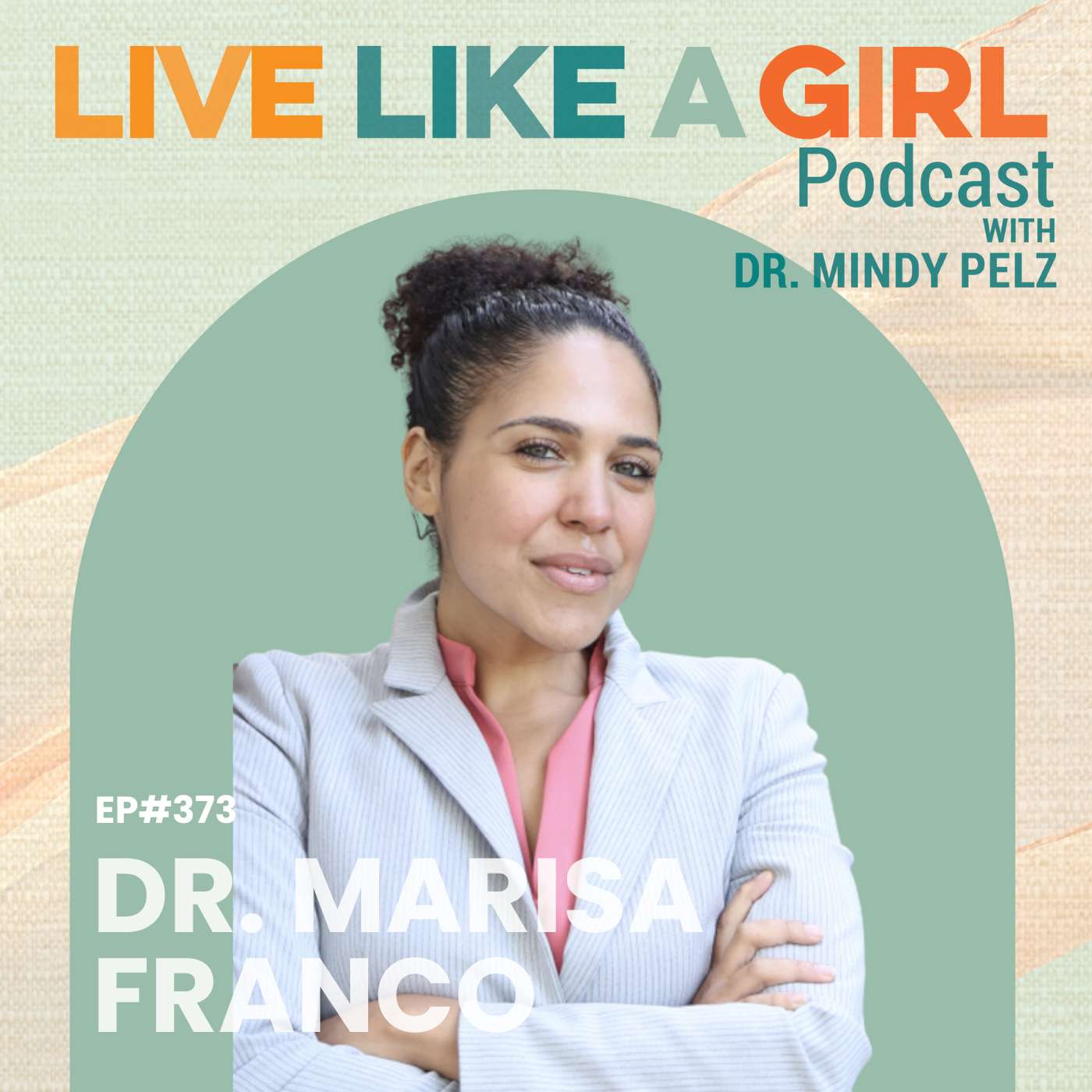
Marisa Franco war in den letzten 12 Monaten in 5 Podcast-Folgen aus 5 verschiedenen Sendungen zu Gast. Zuletzt: Live Like a Girl with Dr. Mindy Pelz, 28. Sept. 2026.
So many women believe they’ll finally feel better about themselves when they lose the weight, change their body, or reach the goal. But changing the outside doesn’t always change how we feel on the inside.
Psychologist and author Dr. Marisa G. Franco joins me to explore where our sense of self-worth actually comes from and how old experiences can continue shaping the way we see ourselves years later.
We talk about body image as we age, menopause, insecurity, nervous system patterns, reparenting, vulnerability, and why learning to acknowledge the parts of ourselves we’d rather push away may be an important part of building genuine self-worth.
In this episode:
Self-worth vs. confidence
Body image and menopause
How old memories shape the way we see ourselves
Why insecurity can feel protective
Reparenting and Internal Family Systems
Interrupting negative thought spirals
Vulnerability and deeper relationships
Learning to value who you are now
_
RESOURCES MENTIONED
FREE Nervous System Questionnaire
NEW! Book Worth
Best Selling Book Platonic
_
MORE ON MARISA FRANCO
Instagram: @drmarisagfranco
Substack Newsletter: Attached by Dr. Marisa Franco
LinkedIn: Dr. Marisa G Franco
Website: https://drmarisagfranco.com/
NEW! Book Worth
Best Selling Book Platonic
For more resources related to today’s episode, visit the podcast episode page: drmindypelz.com/ep373
Connect with Dr. Mindy:
Join Reset Academy
Watch the episodes on YouTube
Follow Dr. Mindy on Instagram
Subscribe to Dr. Mindy’s newsletter
Disclaimer: This podcast is intended for educational and informational purposes only and is not a substitute for professional medical advice. Always consult a qualified healthcare professional before making changes to your diet, fasting routine, or lifestyle.
Psychologist and NY Times bestselling author Dr. Marisa Franco joins host Richard Taite to unpack the difference between self-worth and self-esteem — and why the people who need love the most are often the ones who reject it.Dr. Franco, a University of Maryland professor and author of Worth and Platonic, explains why confidence isn't the fix for low self-esteem, how childhood memories shape adult relationships, why trauma can live in the body, and a practical exercise anyone can use to start building genuine self-worth today.Topics covered: self-worth vs. self-esteem, secure attachment, childhood memory and trauma, somatic healing, honesty vs. confidence, and the surprising research on friendship and connection.Learn more about Dr. Marisa Franco at drmarisagfranco.com. Her new book, Worth: The New Science of Self-Esteem and Secure Attachment, is available now.New episodes of We're Out of Time every Tuesday. Follow and leave a review — it helps others find the show.
#751: The belief that’s quietly sabotaging your progress might not even be true. Free worksheet to question it: https://affordanything.com/turn-it-around
Two people can grow up with the exact same test scores — and as adults, one of them ends up earning double the other. Psychologist Marisa Franco says the deciding factor isn't intelligence, and it isn't luck. It's whether you actually believe good things are allowed to happen to you.
Dr. Marisa Franco is a psychologist and professor at the University of Maryland, and the New York Times bestselling author of Platonic. She's back to talk about her new book, Worth: The New Science of Self-Esteem and Secure Attachment.
In this episode, we discuss:
How self-worth — not intelligence or family income — predicts how much you'll earn as an adult
Why some people quietly sabotage their own portfolio right before they hit financial independence
The difference between "good" and "bad" high self-esteem, and why one of them wrecks relationships
Why getting more love or praise than you expect can make you pull away instead of lean in
How to actually process a hard emotion instead of shoving it down
Why hitting a big financial goal can leave you feeling strangely empty once you get there
How to rebuild your sense of self after losing an identity you were attached to
Whether you've ever undermined your own progress right before a finish line, or wondered why reaching a goal didn't feel the way you thought it would, this episode gives you a framework for understanding — and changing — that pattern.
⏱️ TIMESTAMPS
Note: Timestamps may vary slightly depending on dynamic ad placements.
(02:05) The two very different types of high self-esteem
(04:36) Self-esteem vs. self-worth: the real difference
(05:37) Why self-worth predicts income more than SAT scores
(12:21) Sabotaging your own portfolio right before you hit FI
(14:15) The self-fulfilling prophecy behind financial fear
(23:36) Why too much love can make you pull away
(25:05) How low self-worth blocks promotions and job offers
(36:13) The memory trick that can change your brain
(46:19) Why self-worth matters most in a bad market
(1:06:10) Does self-worth actually drive your net worth?
🔗 RESOURCES MENTIONED
👉 Worth: The New Science of Self-Esteem and Secure Attachment: https://drmarisagfranco.com/worth-the-book/
👉 Marisa's website (speaking, articles, more): https://drmarisagfranco.com
👉 Marisa on Instagram (for signed copies via Lost City Books): https://www.instagram.com/drmarisagfranco/
Learn more about your ad choices. Visit podcastchoices.com/adchoices
See Privacy Policy at https://art19.com/privacy and California Privacy Notice at https://art19.com/privacy#do-not-sell-my-info.
Who are you when your role at work changes? Psychologist and author Marisa Franco, PhD rejoins us to discuss her new book Worth: The New Science of Self-Esteem and Attachment. We explore self-worth, identity, relationships, and the challenge of becoming someone new. She explains why our sense of worth often becomes attached to achievement and professional identity, and why major transitions such as retirement can shake that foundation. Marisa Franco offers a different approach: develop a sense of worth that isn’t dependent on remaining who you’ve always been.
________________________
Bio
An enlightening psychologist, New York Times bestselling author, and TED speaker, Dr. Marisa G. Franco is known for digesting and communicating science in ways that resonate deeply enough with people to change their lives.
Dr. Franco works as a professor at The University of Maryland and authored the New York Times bestseller Platonic: How The Science of Attachment Can Help You Make – and Keep – Friends and her new book Worth: The New Science of Self-Esteem and Attachment. She writes about relationships for Psychology Today and has been a featured connection expert for major publications like The New York Times, The Telegraph, and Vice.
Dr. Franco speaks on how to build relationships with yourself and others at corporations, government agencies, non-profits, and universities across the country, including Harper Collins Publishers, Cisco, American Association for the Advancement of Science, and The Department of State.
_________________________
For More on Marisa G. Franco, PhD
Worth: The New Science of Self-Esteem and Attachment
Website
Her first visit with us on her book Platonic about making friends as an adult
___________________________
Open to another take on worth?
(Highly recommend)
Taylor Mali – What Teachers Make (3 minute video)
___________________________
Other Retirement Podcast Conversations You’ll Love
Self-Compassion – Dr. Kristin Neff
Shift – Ethan Kross
___________________________
Wise Quotes
On Contingent Worth
“We’re very much taught to have a contingent sense of self-worth: I am worthy if… I’m worthy if I have this job. I’m worthy if I’m in this relationship. I’m worthy if I have this financial stability perhaps. And so that contingent self-worth means that when we don’t have those things, we no longer feel worthy. What I am proposing is a non-contingent sense of self-worth—a sense of self-worth that is there no matter who you are, no matter what happens to you.”
On Identity & Reinvention
“What I counterintuitively suggest is to allow yourself to not know yourself. You can allow your sense of self to be fluid in each moment, and you don’t have to be who you’ve always been, but you can still have high regard for yourself. Whoever I am in each moment is okay.”
On Possibility Within Loss
“If you were to see this loss as an offering in some way, what would make this an offering? Is this giving you more time to spend with your friends? Is it taking you out of a workplace that maybe wasn’t working for you? Is it allowing you more time to engage in an interest or passion that you’ve always wanted to engage in?”
_______________________
About The Retirement Wisdom Podcast
There are many podcasts on retirement, often hosted by financial advisors with their own financial motives, that cover the money side of the street. This podcast is different. You’ll get smarter about the investment decisions you’ll make about the most important asset you’ll have in retirement: your time.
About Retirement Wisdom
I help people who are retiring, but aren’t quite done yet, discover what’s next and build their custom version of their next life. A meaningful retirement doesn’t just happen by accident.
Schedule a call today to discuss how the Designing Your Life process created by Bill Burnett & Dave Evans can help you make your life in retirement a great one — on your own terms.
About Your Podcast Host
Joe Casey is an executive coach who helps people design their next life after their primary career and create their version of The Multipurpose Retirement.™ He created his own next chapter after a 26-year career at Merrill Lynch, where he was Senior Vice President and Head of HR for Global Markets & Investment Banking.
Joe has earned Master’s degrees from the University of Southern California in Gerontology (at age 60), the University of Pennsylvania, and Middlesex University (UK), a BA in Psychology from the University of Massachusetts at Amherst, and his coaching certification from Columbia University.
In addition to his work with clients, Joe hosts The Retirement Wisdom Podcast, ranked in the top 1% globally in popularity by Listen Notes, with over 2 million downloads. Business Insider recognized Joe as one of 23 innovative coaches who are making a difference. He’s the author of Win the Retirement Game: How to Outsmart the 9 Forces Trying to Steal Your Joy.
_________________________
The views and opinions expressed by guests on The Retirement Wisdom Podcast are those of the guests and do not necessarily reflect the policy or position of the host or Retirement Wisdom, LLC. The Retirement Wisdom Podcast covers the non-financial aspects of retirement. From time to time we may invite guests who discuss other aspects of retirement planning, solely for educational purposes. Listeners are advised to consult qualified financial and/or medical professionals on those matters.
Dr. Marisa Franco is back, and this time she's turning her attention from friendship to something underneath it: self-worth. Her new book, Worth: The New Science of Self-Esteem and Secure Attachment, starts with a confession. While her relationship was falling apart, she was performing security, saying all the right things, staying calm, doing everything the books tell you to do, while quietly abandoning what she actually felt. She and Dr. Joy talk through why that kind of self-abandonment is so familiar to Black women in particular, and what it costs us.
The conversation moves through what Dr. Franco calls the difference between the good twin and the bad twin of high self-esteem, both of whom say they feel good about themselves, but only one of whom can sit with a hard feeling instead of pushing it away. She explains why insecurity isn't a flaw so much as a coping strategy our brains developed to protect us from repeat harm, and introduces memory reconsolidation, the idea that revisiting an old memory with care can actually change its emotional charge and help you feel safer moving forward.
They also dig into stigma, identity stretching, and what happens when we spend our lives chronically evaluating ourselves against an ideal we didn't choose. Dr. Franco talks about raising kids with real self-worth instead of just confidence, why chasing achievement often keeps us from feeling anything at all, and what it means to aim for secure-ish instead of secure.
Resources & Announcements
Want to reflect on this conversation in community? Join us inside our Patreon community where we’re unpacking this episode together.
You can now catch episodes of the Therapy for Black Girls podcast on YouTube. Be sure to subscribe to get new episodes every week.
Did you know you can leave us a voice note with your questions for the podcast? If you have a question you'd like some feedback on, topics you'd like to hear covered, or want to suggest movies or books for us to review, drop us a message at memo.fm/therapyforblackgirls and let us know what’s on your mind. We just might share it on the podcast.
Grab your copy of Sisterhood Heals.
Where to Find Our Guest
Grab your copy of Worth
Instagram: @drmarisagfranco
Website: drmarisagfranco.com
Newsletter: Attached (on Substack)
Stay Connected
Is there a topic you'd like covered on the podcast? Submit it at therapyforblackgirls.com/mailbox.
If you're looking for a therapist in your area, check out the directory at https://www.therapyforblackgirls.com/directory.
Grab your copy of our guided affirmation and other TBG Merch at therapyforblackgirls.com/shop.
The hashtag for the podcast is #TBGinSession.
Make sure to follow us on social media:
Instagram: @therapyforblackgirls
Facebook: @therapyforblackgirls
Our Production Team
Executive Producers: Dennison Bradford & Gabrielle Collins
Director of Podcast & Digital Content: Ellice Ellis
Producer: Ndeye Thioubou
Production Assistant: Bria Mosley
See omnystudio.com/listener for privacy information.
51 minAbspielen in:
Warum PodAppear
Folge Menschen, nicht Podcasts.
Du hast Marisa in einer Sendung gehört. PodAppear findet für dich die nächste, und genauso für alle anderen, die du hören willst.
Eine Meldung, wenn die Person zu Gast istPer E-Mail: sofort oder gebündelt als Tages- oder Wochenübersicht. Dann nur noch auf Play drücken.
Gäste statt bloßer ErwähnungenFolgen, in denen ein Name nur fällt, landen getrennt. Eine Meldung heißt: Die Person ist wirklich in der Sendung.
Alle in einem FeedGründerinnen, Autoren, Sportler, Forscherinnen. Folge allen mit Namen, quer durch jede Sendung, in der sie auftreten.