Joshua and T.K. speak with Luke Burgis about the identities hidden in our desires, the psychological problem with keeping things "just in case," why sentimental items can be so emotionally heavy, and much more.
Discussed in this episode:
How has being a father made Luke better? (1:58)
Do the lightest objects carry the most weight? (3:51)
How much of what we keep is tied to who we believe we are—or who we might need to be again someday? (6:03)
Listener Tip: When we let go of something deeply sentimental, what are we actually letting go of? (30:51)
Listen to the full Maximal episode on Patreon: patreon.com/theminimalists
Detailed show notes: minimalists.com/podcast
#743: Everyone talks about a loneliness epidemic — but Luke Burgis argues the opposite problem is just as real: we now have so much easy, frictionless community that we never have to develop a solid sense of who we actually are.
Luke Burgis is a professor of business at The Catholic University of America and the founder of the Cluny Institute, and the bestselling author of Wanting: The Power of Mimetic Desire in Everyday Life. He returns to the show to talk about his new book, The One and the Ninety-Nine.
In this episode, we discuss:
Why having too much easy community can be just as damaging as having none at all
How to tell whether your beliefs are actually yours — or something you inherited without ever examining it
Why cutting people off has quietly become the default response to conflict
How to stop shrinking yourself just to keep other people comfortable
The zero-tolerance rule Luke enforces at his own company to kill passive-aggressiveness before it starts
How Luke actually decides who to trust, hire, and build relationships with
What an existential crisis at 29 — and five humbling years training for the priesthood — taught a successful entrepreneur about identity
This episode is for anyone who feels the pull between fitting in and standing out — in your family, your workplace, or your online life. Luke offers a way to build an identity solid enough to hold up under pressure, without giving up on real community.
⏱️ TIMESTAMPS
Note: Timestamps may vary slightly depending on dynamic ad placements.
(7:42) Two competing drives wired into every human being
(10:11) Why group pressure breaks some people and not others
(17:39) Why cutting people off replaced working through conflict
(19:39) The real number of close friends you actually need
(26:51) Where your beliefs actually came from
(32:00) You're not responsible for how someone else feels
(36:09) The zero-tolerance workplace rule against passive-aggressiveness
(41:22) How to actually tell who you can trust
(53:33) The existential crisis that sent an entrepreneur toward the seminary
(55:39) The humbling lesson hidden in a vending machine
🔗 RESOURCES MENTIONED
👉 This free 10-day workbook helps you trace your money habits back to whether they're actually yours — starting with your own money mindset — https://affordanything.com/fiire
👉 Luke's website (books, newsletter, and more) — https://lukeburgis.com
👉 Luke's new book, The One and the Ninety-Nine: Forging Identity in the Age of Social Contagion — https://www.amazon.com/One-Ninety-Nine-Forging-Identity-Contagion/dp/1250373034
👉 Paul Graham's essay "Cities and Ambition," on how the place you live shapes what you want — https://paulgraham.com/cities.html
Learn more about your ad choices. Visit podcastchoices.com/adchoices
See Privacy Policy at https://art19.com/privacy and California Privacy Notice at https://art19.com/privacy#do-not-sell-my-info.
We all want two things that can seem at odds with each other: to be our own person and to belong. We want to stand apart from the crowd, but we also want to be connected to it. When that balance gets out of whack, we either lose ourselves in tribalism or drift into isolation.
My guest today says many of the problems in modern life stem from our inability to hold these two impulses in tension. His name is Luke Burgis, and he’s the author of The One and the 99: Forging Identity in the Age of Social Contagion. Today on the show, Luke explains how becoming a true individual can give you the strength to be a part of a community. We discuss the difference between a solid self and a pseudo self — and what role families and rites of passage can play in moving us toward one or the other — why modern politics feels like a dysfunctional family, the dangers of performative religion, and much more.
Resources Related to the PodcastLuke’s previous appearances on the AoM podcast:
Episode #714: Why Do We Want What We Want?
Episode #910: Thick Desires, Political Atheism, and Living an Anti-Mimetic Life
The True Believer by Eric Hoffer
Education of a Wandering Man by Louis L’Amour
AoM Podcast #1,025: The Life and Legacy of Louis L’Amour
AoM article with L’Amour’s weekly to-do lists
AoM article and podcast about C.S. Lewis’ The Abolition of Man and the idea of objective value
The Courage to Be by Paul Tillich
The Quest for Community by Robert Nisbet
AoM Podcast #847: Overdoing Democracy
AoM Podcast #1,010: How to Resist Group Anxiety and Become a Differentiated Self
AoM Article: Becoming a Well-Differentiated Leader
Dying Breed article: A New Kind of Monasticism — The Power of Community to Shape the Soul
The Rule of St. Benedict
Connect With Luke Burgis
Luke’s website
Take your personal data back with Incogni! Use code MANLINESS at the link below and get 60% off an annual plan: https://incogni.com/MANLINESS
Timestamps
0:00 Introduction
0:54 Guest Intro: Luke Burgis & The One and the 99
4:48 The Parable of the Lost Sheep & the Book's Framework
10:17 Defining the Self (vs. Identity & Soul)
14:37 The Pseudo Self Explained
19:40 How to Develop a Solid Self
25:35 Louis L'Amour & Education for a Solid Self
28:18 Curiositas vs. Studiositas (Ordered vs. Disordered Knowledge)
44:30 Tribalism, Politics, & the Pseudo Self
45:08 How Undifferentiation Fuels Political Dysfunction
51:13 Religion, Performative Piety & the Digital World
54:15 What Monasteries Teach Us About Community & Solid Selves
See Privacy Policy at https://art19.com/privacy and California Privacy Notice at https://art19.com/privacy#do-not-sell-my-info.
While the podcast team is taking a Radical Sabbatical, Kim is interviewing authors of the books that have had a big impact on her in the past two years.
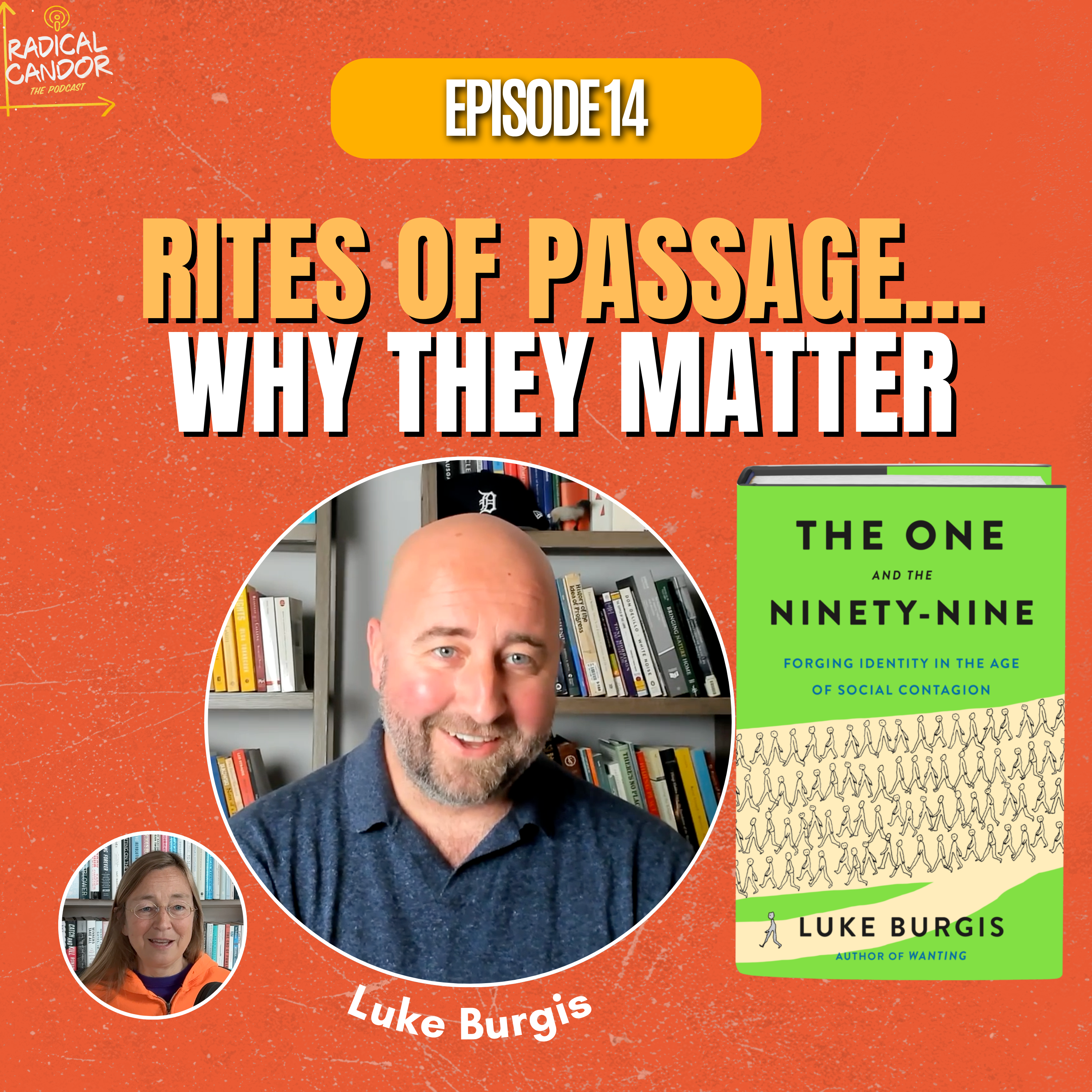
In this episode, she’s speaking with Luke Burgis about his new book, The One and the Ninety-Nine, Forging Identity in the Age of Social Contagion. Through stories ranging from the parable of the lost sheep to August Landmesser, the only person in a huge crowd to refuse to salute to Hitler, Luke describes the missing skill that makes real community possible: learning how to remain oneself while staying connected to others. He offers practical, tactical advice for how to recognize false belonging, escape coercive dynamics, and pass through the rites of passage that produce people with integrity and courage. This is a book that will help you figure out what YOU want, so that you can go get it rather than being distracted by what others want.
Guest Background: Luke Burgis is the director of The Cluny Institute and a professor at The Catholic University of America, where he studies the invisible forces that shape human behavior. He is the author of Wanting: The Power of Mimetic Desire in Everyday Life. He lives in Washington, D.C., and Michigan with his wife, Claire, and their children.
CHAPTERS
(00:00) Introduction to the Radical Sabbatical and Luke Burgis' Book
(02:09) The Meaning Behind 'The One and the 99'
(03:24) Exploring the Parable of the Lost Sheep
(06:05) August Landmesser: Standing Alone Against the Crowd
(10:48) Family Dynamics and the Solid Self
(17:55) Education and the Self: Navigating Expectations
(22:37) The Role of Technology in Education
(29:13) The Loss of Subtle Cues in Communication
(31:37) The Evolution of Education and Rites of Passage
(35:18) The Importance of Ownership in Learning
(37:45) Mimetic Desire and Its Impact on Choices
(40:44) Understanding Political Mimesis
(46:20) The Tension of Relationships and Community
(51:36) Finding Meaning in Tension and Discomfort
Connect with the Radical Candor team:
Website
LinkedIn
YouTube
Learn more about your ad choices. Visit megaphone.fm/adchoices