JM
Doing the rounds: 3 shows in 6 months

John Martinis

John Martinis has been a guest on 3 podcast episodes across 3 shows in the last 12 months. Latest: Global Roaming with Geraldine Doogue and Hamish Macdonald, Nov 26, 2026.

Two years on the air

GuestHostMentioned

Guest appearances

Thu26Nov
Global Roaming with Geraldine Doogue and Hamish Macdonald

Global Roaming with Geraldine Doogue and Hamish MacdonaldNew today

Move over AI, quantum computing is about to change the world

Artificial intelligence may dominate today's technology headlines, but some of the world's leading scientists believe an even bigger revolution could still be ahead. Hamish Macdonald speaks with Professor John Martinis, Nobel Prize-winning physicist and one of the pioneers of quantum computing, about a technology that promises to tackle problems beyond the reach of today's most powerful computers. From accelerating and drug development to completely up-ending cybersecurity, quantum computing could reshape industries that underpin modern life. But first, it requires understanding a very strange reality: a world where particles can behave like waves, where quantum bits can be both 0 and 1 at the same time, and where the laws of physics seem to operate by entirely different rules. The conversation also explores the growing competition between the United States and China, the relationship between quantum computing and AI, and whether concepts like multiple universes belong in science, science fiction, or both. How close are we to the quantum age, and what could it mean for the future? Guest: Professor John Martinis, 2025 Nobel Physics Prize laureate Get in touch: We'd love to hear from you! Email us at global.roaming@abc.net.au

29 min

Tue22Sep
632nm

632nm

Building Quantum Computers at Semiconductor Scale | John Martinis on Qolab + Superconducting Qubits

What does it actually take to build a quantum computer that can scale to millions of qubits? Learn more about Qolab here: https://qolab.ai/ In this episode, we speak with John Martinis, recipient of the 2025 Nobel Prize in Physics. Martinis is a pioneer in superconducting quantum computing and led the team of engineers at Google Quantum AI during the development of their Sycamore chip, which was the first to demonstrate “Quantum Supremacy,” the outperformance of a quantum computer compared to a classical supercomputer. John is now the co-founder of Qolab, a company developing new approaches to building scalable superconducting quantum circuits. Martinis discusses why scaling quantum computers is fundamentally an engineering and manufacturing problem, and why the next generation of quantum hardware may require rethinking how the chips themselves are designed and fabricated. We explore the challenges of building superconducting qubits, from fabrication and packaging to control electronics, wiring, power dissipation, and the subtle imperfections that can determine whether a quantum chip works at all. Martinis explains why adding more qubits is not simply a matter of making existing systems larger. At the scale of hundreds of thousands or millions of qubits, every component has to work together, and improvements in one part of the system can create new problems somewhere else. Martinis describes the philosophy behind Qolab and its effort to develop a fundamentally different architecture for scalable quantum computing. Rather than simply pushing existing approaches forward, Qolab is trying to remake the individual elements of the system and integrate them in new ways. We discuss wafer-scale fabrication, the challenges of connecting and controlling large numbers of superconducting qubits, and why the manufacturing techniques used to build modern semiconductor chips could be important for the future of quantum computing. We also discuss the practical engineering lessons Martinis learned while developing superconducting quantum processors, including the difficulty of getting an entire system to work reliably. He recounts the development of the hardware behind Google's early quantum computing efforts, the unexpected failure caused by a circuit board rather than the qubit chip itself, and the many subtle fabrication and engineering issues that can become increasingly important as quantum systems grow larger. Finally, Martinis explains why he sees quantum computing as a system engineering problem involving dozens of interconnected constraints. From the physics of superconducting qubits to semiconductor fabrication, cryogenic electronics, packaging, and control, building a useful quantum computer requires solving many problems simultaneously. The goal is not simply to build a better qubit, but to develop an architecture that can ultimately support quantum computers at truly large scale. Follow us for more technical interviews with the world’s greatest scientists: Twitter: https://x.com/632nmPodcast Instagram: https://www.instagram.com/632nmpodcast?utm_source=ig_web_button_share_sheet&igsh=ZDNlZDc0MzIxNw== LinkedIn: https://www.linkedin.com/company/632nm/about/ Substack: https://632nmpodcast.substack.com/ Follow our hosts! Mikhail Shalaginov: https://www.linkedin.com/in/mikhail-shalaginov/ Michael Dubrovsky: https://www.linkedin.com/in/michael-dubrovsky/ Xinghui Yin: https://www.linkedin.com/in/xinghui-yin/ Subscribe: Apple Podcasts: https://podcasts.apple.com/us/podcast/632nm/id1751170269 Spotify: https://open.spotify.com/show/4aVH9vT5qp5UUUvQ6Uf6OR Website: https://www.632nm.com Timestamps: 00:00 - Intro 01:06 - Secrecy of Fabrication 03:24 - 2 Qubit Gate with Transmons 05:18 - New Knowledge of Superconducting Quantum Computers 08:53 - What are Transmons? 35:56 - Lessons from Failure 38:05 - The Role of Theory in Martinis’ Work 44:51 - Two Level States 48:15 - Engineering Tricks in Superconducting Quantum Computers 53:32 - Metrics for Quantum Success 1:00:11 - Scaling Quantum Computers 1:08:08 - Identifying Sources of Error 1:16:15 - Quantum Supremacy Experiment 1:25:45 - What If Quantum Mechanics Failed? 1:33:10 - Is Quantum Supremacy Holding Up? 1:34:42 - Lift-off Fabrication for Superconducting Quantum Computers 1:41:59 - Quantum Flexibility vs Foundries 1:43:40 - Connecting Distant Qubits 1:47:41 - Codesign for Fault-Tolerance 1:49:16 - Martinis’ Nobel Prize 2:01:55 - Advice for Young Scientists #quantumcomputing #quantumphysics #superconductor #nobelprize #fabrication

2 h 05 min

Tue11Aug
Into the Impossible With Brian Keating

Into the Impossible With Brian Keating

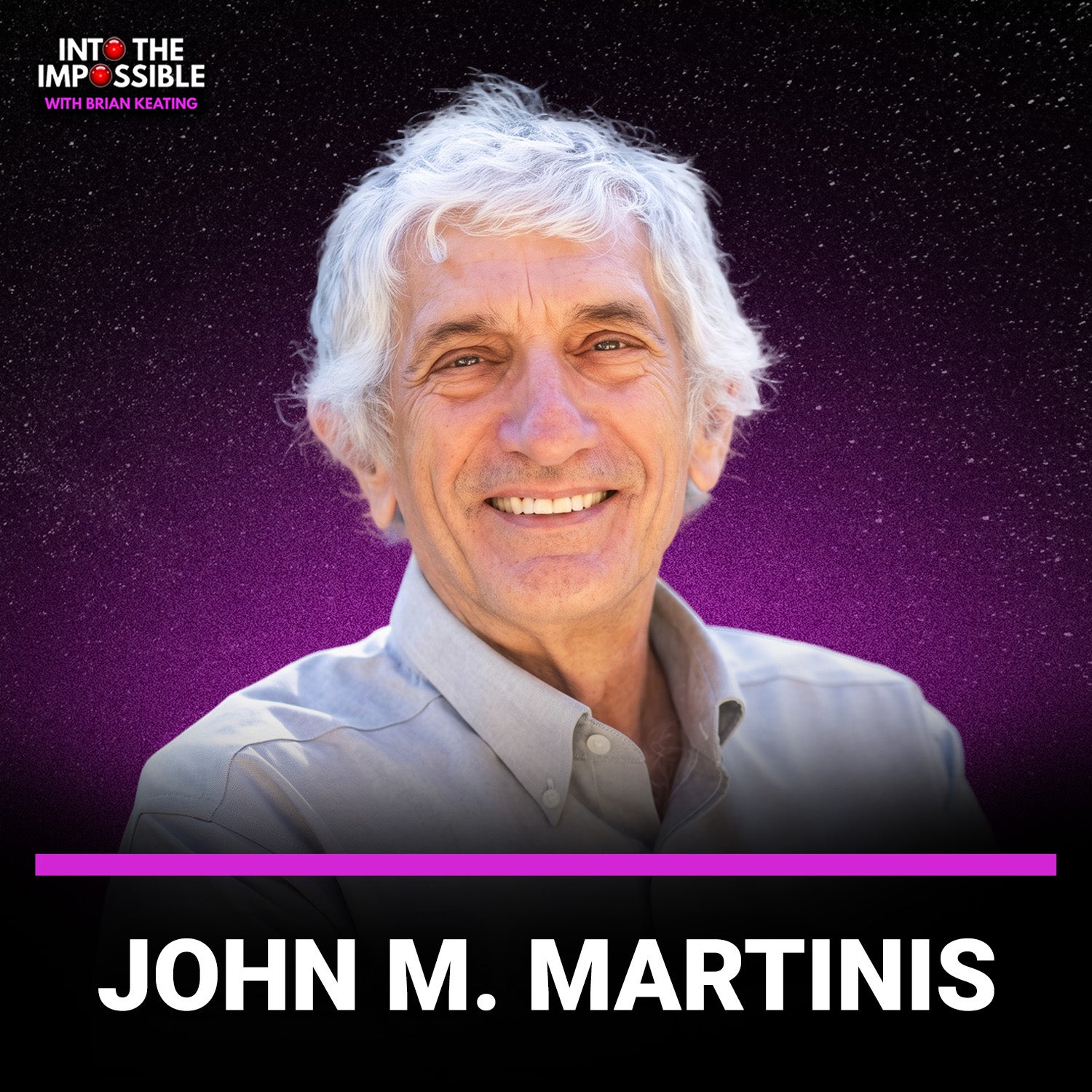
John Martinis: The Nobel Physicist Behind Macroscopic Quantum Tunneling - #566

John Martinis won the 2025 Nobel Prize in Physics for proving macroscopic quantum tunneling is real. Less than a year later he’s telling why he left Google’s quantum computing team to start over. Subscribe if you want the physics and the politics of building the impossible. Martinis is the co-founder of Colab and one of the physicists who proved ordinary quantum rules apply to macroscopic systems. He built his career on the same Josephson-junction hardware his Nobel is built on, then led Google’s superconducting-qubit effort, the same team behind Google’s 2019 quantum supremacy claim, before an internal reorg pushed him out. We go into Anthony Leggett’s challenge to Schrödinger’s cat, what decoherence in quantum mechanics really means, and whether quantum computing is the first technology ever born from pure theory rather than experiment. We also cover the internal Google reorg that pushed Martinis out and what he learned about building something new inside a large institution. Whether quantum mechanics applies to the macroscopic world and what it took to prove it Why Martinis thinks quantum computing may be the first technology born from pure theory, not experiment What negative authority means and why it matters for anyone building something new inside a large institution Whether the US can win the quantum computing race against China How Martinis thinks about quantum mechanics interpretations after spending a career inside the math “Always be on the lookout for the impossible, right?” John Martinis CHAPTERS 00:00 The Nobel call that almost wasn't 01:01 How his wife found out before he did 03:32 Anthony Leggett's challenge to Schrödinger's cat 05:53 Why a Josephson junction, not a quantum dot or trapped ion 07:45 Quantized oscillations: the “smoking gun” and Balmer's ghost 08:18 Measuring the system: the resonance experiment 11:21 Systematic effects: what separates a good scientist from a lucky one 13:42 The Ed Ohm story: the man who found the CMB and doubted it 15:01 Wigner's “unreasonably effective” math and the weirdest thing about QM 16:54 The transistor myth: chewing gum, coat hangers, and germanium 17:34 Microwave engineering meets quantum mechanics 19:26 Decoherence: the friction you can't live without 24:06 The heretical claim: does theory ever precede technology? 28:22 The “paper qubit” problem 29:34 What quantum computers are actually good for 32:27 Should quantum computing be regulated like AI? 33:35 US vs. China: the quantum computing race 35:44 Collapse, Copenhagen, or many worlds? Martinis's answer 37:43 Leaving Google: “essentially demoted” 40:48 Why Colab exists and what “negative authority” means 42:50 The real bottleneck: funding, not physics 43:31 Final advice: always be on the lookout for the impossible Qolab: https://qolab.ai/ Get the transcript, fascinating bonus content, and my Monday M.A.G.I.C. Message: https://briankeating.com/yt Have a .edu email and live in the USA? You automatically win a meteorite: https://BrianKeating.com/edu Subscribe: https://www.youtube.com/DrBrianKeating?sub_confirmation=1 Support Into the Impossible on Patreon, get my weekly M.A.G.I.C. Message, unfiltered bonus content, and live monthly Office Hours with me: https://www.patreon.com/drbriankeating Join this channel for perks, monthly Office Hours, and your name in the Member Roster at the end of every episode: https://www.youtube.com/channel/UCmXH_moPhfkqCk6S3b9RWuw/join My books: Losing the Nobel Prize (memoir): http://amzn.to/2sa5UpA Think Like a Nobel Prize Winner: https://a.co/d/03ezQFu Focus Like a Nobel Prize Winner: https://a.co/d/hi50U9U Galileo's Dialogue (first-ever audiobook): https://a.co/d/iZPi9Un Twitter/X: https://x.com/BrianKeating Substack: https://briankeating.substack.com Blog: https://briankeating.com/blog Audio-only: https://briankeating.com/podcast Landing page: https://awake-mill-k25t.here.now #intotheimpossible #briankeating #JohnMartinis #NobelPrize #quantumcomputing #physics #podcast Learn more about your ad choices. Visit megaphone.fm/adchoices

49 min