Sat21Nov

A Charlie Rose Global Conversation
Jensen Huang in 2009: The Charlie Rose Interview Before AI Changed the World
NVIDIA, graphics processing technology, and the future of computing.

Taiwanese-American business executive (born 1963)
Jensen Huang has been a guest on 19 podcast episodes across 15 shows in the last 12 months, most often on How I Built This with Guy Raz (3 times). Latest: A Charlie Rose Global Conversation, Nov 21, 2026.
Bio from WikipediaPhoto: Anderseidesvik, CC BY-SA 4.0, via Wikimedia Commons
A Charlie Rose Global Conversation
NVIDIA, graphics processing technology, and the future of computing.

How I Built This with Guy Raz
Given recent news about Jensen Huang, we're revisiting this unusually personal conversation with the Nvidia co-founder and former CEO. Recorded in April 2026, before the revelations that led to his resignation, the interview offers a fuller picture of Jensen: his family, the sacrifices he made during 33 years leading the company, his demanding leadership style, and his views on the U.S., Taiwan, and AI. Nvidia is one of the most valuable companies in human history. Its chips run the AI systems transforming everything from entertainment to warfare. But for years, Jensen struggled to convince others of his vision. He spent nearly a decade pouring billions of dollars into a technology called CUDA, long before AI made it profitable. Jensen also shares how Nvidia came within 30 days of going out of business, what it took to lead the company through decades of uncertainty, and why, despite its phenomenal success, he's not sure he'd choose to do it all again. Watch this Episode on YouTube: Jensen Huang: The Man Behind NVIDIA (April 2026) What You’ll Learn: Why Jensen doesn't like talking about himself What he missed out on while building Nvidia Why past failures still haunt him How a desperate trip to Japan helped save Nvidia How AI researchers discovered the power of Nvidia's gaming chips Why Jensen believes fears about AI and job loss are overblown Production Credits How I Built This is produced by Podcast Pointman and part of the Vox Media Podcast Network. Follow How I Built This: YouTube → @HowIBuiltThis Instagram → @howibuiltthis X → @HowIBuiltThis Facebook → How I Built This Follow Guy Raz: Instagram → @guy.raz X → @guyraz Substack → guyraz.substack.com Website → guyraz.com Learn more about your ad choices. Visit podcastchoices.com/adchoices

KI Espresso
Wie viel Strom braucht KI, was bedeutet sie für Arbeitsplätze und wer kontrolliert ihre Entscheidungen? Elon Musk, Jensen Huang und Tom Brown diskutieren diese Fragen beim America.gov-Launch am 29. September 2026 in Washington, D.C. Gavin Baker moderiert das Gespräch. Wir veröffentlichen die deutsche Fassung, weil die Runde technische Fragen mit ihren Folgen im Alltag verbindet: vom Bau von Rechenzentren über KI-Agenten bis zu gemeinsamen Prüfverfahren. Die Aussagen und Prognosen geben die Sicht der Teilnehmer wieder. Diese Podcastfassung enthält ein neues deutsches Vorwort von KI Espresso und anschließend die gesamte rund 27-minütige Panelaufzeichnung von Right Side Broadcasting Network (RSBN). Sie umfasst nicht die gesamte Veranstaltung. Übersetzung und deutsche Bearbeitung: KI Espresso. Die deutsche Übersetzung wird mit synthetischen Stimmen gesprochen. Es handelt sich nicht um die Originalstimmen der Teilnehmer. An einer nicht eindeutig verständlichen Stelle bleibt der englische Originalton erhalten. Originalaufnahme und Quelle: Right Side Broadcasting Network (RSBN) Upload der Originalaufnahme: 29. September 2026 https://www.youtube.com/watch?v=388P7IFSpwE Themen: Energie und Infrastruktur für KI; Rechenzentren und Arbeitsplätze; Sicherheit von KI-Agenten; Starship und Rechenleistung im All; Tom Brown über Opus 5.5; KI im Alltag; Werte und Urteilsvermögen; gemeinsame Kontrolle und Prüfverfahren. Kapitel: 00:00 Einleitung von KI Espresso 01:05 Begrüßung 01:57 Energie und Infrastruktur für KI 09:03 Rechenzentren und Arbeitsplätze 13:33 Sicherheit von KI-Agenten 17:20 Starship und Rechenleistung im All 19:15 Tom Brown über Opus 5.5 20:49 KI im Alltag 23:45 Werte und Urteilsvermögen von KI 25:42 Gemeinsame Kontrolle und Prüfverfahren

Squawk on the Street
Carl Quintanilla, David Faber and Michael Santoli delved into AI trade weakness, including why Meta and Tesla shares fell despite both companies posting Q3 beats. The anchors reacted to what Meta CEO Mark Zuckerberg and Tesla CEO Elon Musk said on their respective earnings calls. On a rough day for the chip sector, CNBC's Arjun Kharpal interviewed Nvidia CEO Jensen Huang at the company's GTC conference in Berlin. Also in focus: Meta's new class of stock to fund AI spending; Buzz surrounding a potential SpaceX-Tesla merger; IBM earnings reaction; The "Tide" is high for P&G; Lockheed Martin rallies; Airline earnings impacted by fuel costs; Oil prices surge on Middle East tensions; Barclays and the job cuts parade; Carriers cut the price of Apple's foldable iPhone Duo ahead of its Friday in-store debut. Squawk on the Street Disclaimer Hosted by Simplecast, an AdsWizz company. See pcm.adswizz.com for information about our collection and use of personal data for advertising.

BG2Pod with Brad Gerstner and Bill Gurley
Can AI revenues justify the spending? Jensen Huang breaks down the biggest bottlenecks heading into 2027, the path to the singularity, open vs. closed models, and why he’s 99.99% optimistic about the decade ahead. Jensen joins Brad Gerstner and Clark Tang for their third BG2 conversation, recorded days after the Xi State Dinner, the White House Accord on superintelligence, and his receipt of the National Medal of Science. They explore why building technology responsibly also means moving fast, how power constraints could shape AI’s next phase, and whether SpaceX could help put data centers in orbit. Jensen also explains why NVIDIA sees demand extending far beyond just two AI labs. Produced by STMNT Studios Music by Yung Spielberg www.bg2pod.com Follow: Brad Gerstner https://x.com/altcap Clark Tang https://x.com/_clarktang NVIDIA https://x.com/nvidia BG2 Pod https://x.com/BG2Pod The statements made and information presented in this podcast reflect each speaker's personal opinions and do not necessarily reflect the view of any other person or entity, including Altimeter Capital Management, LP ("Altimeter"). The information provided is believed to be from reliable sources, but no liability is accepted for any inaccuracies. This podcast is for informational purposes only, and statements should not be construed as providing investment advice or making an investment recommendation. Past performance does not guarantee future performance. Certain of Altimeter's funds have invested in the referenced portfolio companies, which may incentivize executives of such companies to provide favorable reviews of Altimeter. Altimeter and its respective clients trade in public securities and have made and/or may make investments in or investment decisions relating to the companies referenced in the podcast. Altimeter and its respective clients reserve the right to make investment decisions or engage in trading activity that would be (or could be construed as) consistent and/or inconsistent with the views expressed herein.

A Bit Personal with Jodi Shelton
In a conversation three decades in the making, host Jodi Shelton sits down with Jensen Huang, the visionary co-founder and CEO of NVIDIA.Jodi and Jensen’s professional journey began over 30 years ago, long before GPUs powered the global AI revolution. This deep-rooted history allows for a side of Jensen rarely seen by the public. We travel back to the early days of NVIDIA. To the risks, the near-failures, and the relentless grit, all before looking ahead. From the origins of accelerated computing to the future of generative AI, this is a masterclass in vision from the man who saw the future before it arrived. This is a public episode. If you would like to discuss this with other subscribers or get access to bonus episodes, visit www.abitpersonalpod.com
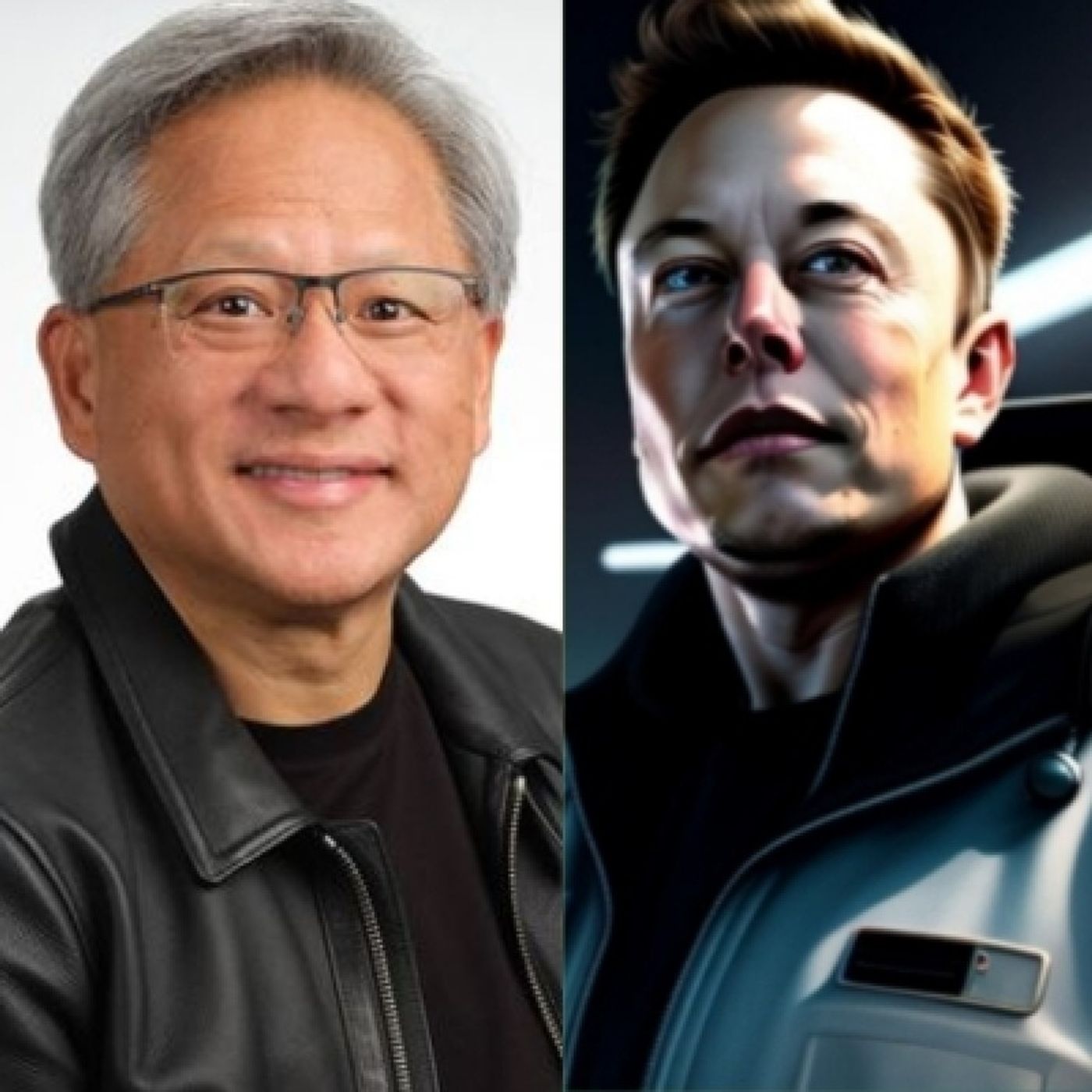
Elon Musk Thinking
Latest: Elon Musk, Jensen Huang, Tom Brown Discuss the AI Revolution!!! #ElonMusk #JensenHuang #TomBrown Source: https://youtu.be/388P7IFSpwE?s... Elon Musk is the CEO of the company X, Tesla, Neuralink, SpaceX and the Boring Company. Follow me on X https://x.com/Astronautman627?... Become a supporter of this podcast: https://www.spreaker.com/podcast/elon-musk-thinking--5839286/support.

Squawk Pod
In an extended interview, Nvidia CEO Jensen Huang explains the company’s newest AI safety software–part of an effort to create a modern web browser for AI. Huang makes the case to innovate and understand technology before attempting to regulate it. Then, former Disney CEO Bob Chapek unveils his memoir, “Inside the Castle Walls: My Thirty Years at the Happiest Place on Earth.” Chapek recounts his long career at Disney and his tumultuous two and a half years as CEO, before being replaced by the very leader he succeeded: Bob Iger. Chapek reflects on the dramatic and disappointing end to his tenure. Plus, Bill Gates has issued another warning on AI. Jensen Huang - 09:32 Bob Chapek - 38:36 In this episode: Jensen Huang, @JensenHuang Becky Quick, @BeckyQuick Andrew Ross Sorkin, @andrewrsorkin Cameron Costa, @CameronCostaNY Hosted by Simplecast, an AdsWizz company. See pcm.adswizz.com for information about our collection and use of personal data for advertising.

Anderson Cooper 360
This evening the White House denied two CNN reporters and MS NOW journalists from covering Chinese leader Xi Jinping’s arrival back at the White House for a state dinner. President Xi is being honored by President Trump and many of the nation's financial and technology giants, including NVIDIA CEO Jensen Huang whose chips are the de facto linchpin of AI around the world. Anderson sat down with Huang to discuss his thoughts on AI regulation. Learn more about your ad choices. Visit podcastchoices.com/adchoices

All-In with Chamath, Jason, Sacks & Friedberg
(0:00) Jensen Huang joins The Besties! (1:39) Thoughts on Dario's blog, Frontier Labs calling to slow down AI, and Doomer psychology (9:58) Sensible AI regulation and RSI (16:05) Hugging Face acquisition, future of Open Source, and the race with China (22:58) President Trump calls in live to discuss the Doomer Hoax (31:29) The AI boom and Nvidia's capital allocation strategy (40:21) Nvidia's Open Source model ambitions, thoughts on Elon's Terafab Thanks to our partners for making this possible! IREN is a vertically integrated AI Cloud platform, delivering data centers, compute and software for AI training and inference. https://iren.com/ Oracle connects the data, applications, and infrastructure that turn AI into business outcomes—with the flexibility, choice, and control to optimize as AI evolves. http://oracle.com/ai EY helps tech innovators scale from startup to exit to megacap. You build the future. We'll handle the rest. http://www.ey.com Meta believes the future is for everyone. We're focused on giving every person the tools to reach their full potential and making sure the benefits of technology are distributed to all. http://www.meta.com Keel Infrastructure owns the power, land, and connectivity that HPC and AI run on - backed by secured energy assets and established grid interconnections across North America. https://keelinfra.com/ Airwallex - Agentic Global Business Accounts. Open local accounts in 70+ countries to accept payments, earn yield, pay globally, and manage spend. http://airwallex.com PayPal has been revolutionizing commerce globally for more than 25 years. Creating innovative experiences that make moving money, selling, and shopping simple, personalized, and secure, PayPal empowers consumers and businesses in approximately 200 markets to join and thrive in the global economy. For more information, visit https://www.paypal.com Google for Startups connects founders with the right people, products, and best practices to help startups build faster and go further. https://startup.google.com/ Explore ideas, industries, and technologies worth understanding with Chamath every week on Learn with Me: https://research.socialcapital.com/allin Follow Jensen: https://x.com/JensenHuang Follow the besties: https://x.com/chamath https://x.com/Jason https://x.com/DavidSacks https://x.com/friedberg Follow on X: https://x.com/theallinpod Follow on Instagram: https://www.instagram.com/theallinpod Follow on TikTok: https://www.tiktok.com/@allin Follow on LinkedIn: https://www.linkedin.com/company/allinpod Intro Music Credit: https://rb.gy/tppkzl https://x.com/yung_spielburg Intro Video Credit: https://x.com/TheZachEffect
Squawk Pod
Nvidia has officially agreed to buy open-source artificial intelligence platform Hugging Face for $12.9 billion, as the chipmaker and world’s most valuable company moves into a future beyond hardware. The CEOs of both companies, Nvidia’s Jensen Huang and Hugging Face’s Clement Delangue, join exclusively to discuss the terms of the courtship and the deal – and the future of artificial intelligence’s open source commitment. Plus, the NBA suspends Clippers’ owner Steve Ballmer for violating terms of the league’s salary cap in signing Kawhi Leonard. And, New York City schools ban AI from elementary school classrooms Jensen Huang and Clement Delangue - 13:32 In this episode: Jensen Huang, @JensenHuang Clement Delangue, @ClementDelangue Becky Quick, @BeckyQuick Andrew Ross Sorkin, @andrewrsorkin Katie Kramer, @Kramer_Katie Hosted by Simplecast, an AdsWizz company. See pcm.adswizz.com for information about our collection and use of personal data for advertising.

Bloomberg Tech
Nvidia is investing $3.5 billion in MediaTek, deepening collaboration with the Taiwanese chipmaker at a time when it’s working to persuade more companies to build chips that plug into its dominant data center ecosystem. Nvidia CEO Jensen Huang and MediaTek CEO Rick Tsai join Bloomberg Tech's Ed Ludlow to discuss the deal. See omnystudio.com/listener for privacy information.

Y Combinator Startup Podcast
NVIDIA started with the wrong technology, learned the right one from three textbooks bought at Fry’s, and went on to invent most of the major breakthroughs in modern computing.At Startup School 2026 at Chase Center, Garry Tan sits down with Founder and CEO Jensen Huang to talk about confronting reality, learning your way into new domains, and why resilience — getting through one day at a time — matters more than anything else.

How I Built This with Guy Raz
NVIDIA is one of the most valuable companies in human history. Its chips run the AI systems transforming everything from entertainment to warfare. But for years, almost nobody believed in co-founder Jensen Huang’s vision. Jensen spent nearly a decade pouring billions into a technology called CUDA, long before AI made it profitable. In this deeply personal conversation, Jensen tells Guy why NVIDIA’s very first chip was a catastrophic failure … and how at one point, the company was 30 days away from going out of business. Jensen also explains why he thinks fears about AI are overblown, and why he believes the next generation will have more opportunity — not less — because of AI. What You’ll Learn: Why NVIDIA nearly collapsed before becoming an AI giant How researchers sparked the AI boom using NVIDIA gaming chips How to lead through uncertainty when a huge bet hasn’t yet paid off How Jensen approaches hard decisions like an engineer We’re “doing ourselves a disservice” by being afraid: Jensen on AI and job loss How Jensen defends his demanding management style Why past failures still haunt him Key Moments From the Interview: 00:05:26 — Jensen Huang’s childhood at an unusual Kentucky boarding school 00:12:25 — Why Jensen left a stable career to help start NVIDIA 00:14:49 — NVIDIA’s first failure: the NV1 disaster 00:17:26 — The desperate trip to Japan that gave the company a lifeline 00:20:46 — “The only idea we had” for prototyping: the emulator Hail Mary 00:26:13 — The book that shaped Jensen’s thinking about innovation 00:30:24 — Why NVIDIA kept investing in CUDA while Wall Street lost faith 00:36:58 — The moment AI researchers discovered the power of NVIDIA’s chips 00:47:07 — Jensen on fear of job loss from AI, and why America risks falling behind 00:55:46 — Knowing what he knows now, would he do it again? Yes — and no This episode was researched and produced by Alex Cheng with music by Ramtin Arablouei. It was edited by Neva Grant. Our engineers were Patrick Murray and Robert Rodriguez. Follow How I Built This: Instagram → @howibuiltthis X → @HowIBuiltThis Facebook → How I Built This Follow Guy Raz: Instagram → @guy.raz Youtube → guy_raz X → @guyraz Substack → guyraz.substack.com Website → guyraz.com Learn more about your ad choices. Visit podcastchoices.com/adchoices

Dwarkesh Podcast
I asked Jensen about TPU competition, Nvidia’s lock on the ever more bottlenecked supply chain needed to make advanced chips, whether we should be selling AI chips to China, why Nvidia doesn’t just become a hyperscaler, how it makes its investments, and much more. Enjoy! Watch on YouTube; read the transcript. Sponsors * Crusoe’s cloud runs on state-of-the-art Blackwell GPUs, with Vera Rubin deployment scheduled for later this year. But hardware is only part of the story—for inference, Crusoe’s MemoryAlloy tech implements a cluster-wide KV cache, delivering up to 10x faster TTFT and 5x better throughput than vLLM. Learn more at crusoe.ai/dwarkesh * Cursor helped me build an AI co-researcher over the course of a weekend. Now I have an AI agent that I can collaborate with in Google Docs via inline comment threads! And while other agentic coding tools feel like a total black-box, Cursor let me stay on top of the full implementation. You can try my co-researcher out at github.com/dwarkeshsp/ai_coworker, or get started on your own Cursor project today at cursor.com/dwarkesh * Jane Street spent ~20,000 GPU hours training backdoors into 3 different language models, then challenged my audience to find the triggers. They received some clever solutions—like comparing the base and fine-tuned versions and extrapolating any differences to reveal the hidden backdoor—but no one was able to solve all 3. So if open problems like this excite you, Jane Street is hiring. Learn more at janestreet.com/dwarkesh Timestamps (00:00:00) – Is Nvidia’s biggest moat its grip on scarce supply chains? (00:16:25) – Will TPUs break Nvidia’s hold on AI compute? (00:41:06) – Why doesn’t Nvidia become a hyperscaler? (00:57:36) – Should we be selling AI chips to China? (01:35:06) – Why doesn’t Nvidia make multiple different chip architectures? This is a public episode. If you would like to discuss this with other subscribers or get access to bonus episodes, visit www.dwarkesh.com

Lex Fridman Podcast
Jensen Huang is the co-founder and CEO of NVIDIA, the world’s most valuable company and the engine powering the AI computing revolution. Thank you for listening ❤ Check out our sponsors: https://lexfridman.com/sponsors/ep494-sc See below for timestamps, transcript, and to give feedback, submit questions, contact Lex, etc. Transcript: https://lexfridman.com/jensen-huang-transcript CONTACT LEX: Feedback – give feedback to Lex: https://lexfridman.com/survey AMA – submit questions, videos or call-in: https://lexfridman.com/ama Hiring – join our team: https://lexfridman.com/hiring Other – other ways to get in touch: https://lexfridman.com/contact EPISODE LINKS: NVIDIA: https://nvidia.com NVIDIA on X: https://x.com/nvidia NVIDIA AI on X: https://x.com/NVIDIAAI NVIDIA on YouTube: https://youtube.com/@nvidia NVIDIA on Instagram: https://www.instagram.com/nvidia/ NVIDIA on LinkedIn: https://www.linkedin.com/company/nvidia/ NVIDIA on Facebook: https://www.facebook.com/NVIDIA/ NVIDIA on GitHub: https://github.com/NVIDIA Nemotron: https://developer.nvidia.com/nemotron SPONSORS: To support this podcast, check out our sponsors & get discounts: Perplexity: AI-powered answer engine. Go to https://perplexity.ai/ Shopify: Sell stuff online. Go to https://shopify.com/lex LMNT: Zero-sugar electrolyte drink mix. Go to https://drinkLMNT.com/lex Fin: AI agent for customer service. Go to https://fin.ai/lex Quo: Phone system (calls, texts, contacts) for businesses. Go to https://quo.com/lex OUTLINE: (00:00) – Introduction (00:26) – Sponsors, Comments, and Reflections (06:34) – Extreme co-design and rack-scale engineering (09:20) – How Jensen runs NVIDIA (28:41) – AI scaling laws (43:41) – Biggest blockers to AI scaling laws (45:25) – Supply chain (47:20) – Memory (53:25) – Power (58:45) – Elon and Colossus (1:02:13) – Jensen’s approach to engineering and leadership (1:07:38) – China (1:15:51) – TSMC and Taiwan (1:21:06) – NVIDIA’s moat (1:26:43) – AI data centers in space (1:30:31) – Will NVIDIA be worth $10 trillion? (1:40:40) – Leadership under pressure (1:54:26) – Video games (2:01:18) – AGI timeline (2:03:31) – Future of programming (2:17:02) – Consciousness (2:23:23) – Mortality PODCAST LINKS: – Podcast Website: https://lexfridman.com/podcast – Apple Podcasts: https://apple.co/2lwqZIr – Spotify: https://open.spotify.com/episode/0BGcaYvcDPkvBzFmkRI5uY – RSS: https://lexfridman.com/feed/podcast/ – Podcast Playlist: https://www.youtube.com/playlist?list=PLrAXtmErZgOdP_8GztsuKi9nrraNbKKp4 – Clips Channel: https://www.youtube.com/lexclips

All-In with Chamath, Jason, Sacks & Friedberg
(0:00) Jensen Huang joins the show! (0:26) Acquiring Groq and the inference explosion (8:53) Decision making at the world's most valuable company (10:47) Physical AI's $50T market, OpenClaw's future, the new operating system for modern AI computing (16:38) AI's PR crisis, refuting doomer narratives, Anthropic's comms mistakes (20:48) Revenue capacity, token allocation for employees, Karpathy's autoresearch, agentic future (30:50) Open source, global diffusion, Iran/Taiwan supply chain impact (39:45) Self-driving platform, facing competition from active customers, responding to growth slowdown predictions (47:32) Datacenters in space, AI healthcare, Robotics (56:10) OpenAI/Anthropic revenue potential, how to build an AI moat (59:04) Advice to young people on excelling in the AI era Follow the besties: https://x.com/chamath https://x.com/Jason https://x.com/DavidSacks https://x.com/friedberg Follow on X: https://x.com/theallinpod Follow on Instagram: https://www.instagram.com/theallinpod Follow on TikTok: https://www.tiktok.com/@theallinpod Follow on LinkedIn: https://www.linkedin.com/company/allinpod Intro Music Credit: https://rb.gy/tppkzl https://x.com/yung_spielburg Intro Video Credit: https://x.com/TheZachEffect

The Joe Rogan Experience
Jensen Huang is the founder, president, and CEO of NVIDIA, the company whose 1999 invention of the GPU helped transform gaming, computer graphics, and accelerated computing. Under his leadership, NVIDIA has grown into a full-stack computing infrastructure company reshaping AI and data-center technology across industries.www.nvidia.com www.youtube.com/nvidia Perplexity: Download the app or ask Perplexity anything at https://pplx.ai/rogan. Visible. Live in the know. Join today at https://www.visible.com Don’t miss out on all the action - Download the DraftKings app today! Sign-up at https://dkng.co/rogan or with my promo code ROGAN GAMBLING PROBLEM? CALL 1-800-GAMBLER, (800) 327-5050 or visit gamblinghelplinema.org (MA). Call 877-8-HOPENY/text HOPENY (467369) (NY). Please Gamble Responsibly. 888-789-7777/visit ccpg.org (CT), or visit www.mdgamblinghelp.org (MD). 21+ and present in most states. (18+ DC/KY/NH/WY). Void in ONT/OR/NH. Eligibility restrictions apply. On behalf of Boot Hill Casino & Resort (KS). Pass-thru of per wager tax may apply in IL. 1 per new customer. Must register new account to receive reward Token. Must select Token BEFORE placing min. $5 bet to receive $200 in Bonus Bets if your bet wins. Min. -500 odds req. Token and Bonus Bets are single-use and non-withdrawable. Token expires 1/11/26. Bonus Bets expire in 7 days (168 hours). Stake removed from payout. Terms: sportsbook.draftkings.com/promos. Ends 1/4/26 at 11:59 PM ET. Sponsored by DK. Learn more about your ad choices. Visit podcastchoices.com/adchoices