Bekomm eine E-Mail, wenn Iroro in einem Podcast zu Gast istPodAppear prüft neue Folgen, sobald sie erscheinen, und lässt die weg, in denen Iroro nur erwähnt wird. Bis zu 15 Personen kostenlos, ohne Kreditkarte.Bis zu 15 Personen kostenlos, ohne Kreditkarte.
Iroro kostenlos folgen
IT

Iroro Tanshi

Nigerian ecologist and conservationist

Iroro Tanshi war in den letzten 12 Monaten in 3 Podcast-Folgen aus 3 verschiedenen Sendungen zu Gast. Zuletzt: The Great Simplification with Nate Hagens, 4. Nov. 2026.

Kurzbiografie aus Wikipedia

Zwei Jahre auf Sendung

GastHostErwähnt

Gastauftritte

Mi4Nov
The Great Simplification with Nate Hagens

The Great Simplification with Nate Hagens

Saving Bats to Save Ourselves: How to Stop the Tragedy of the Commons with Iroro Tanshi

(Conversation recorded on September 24th, 2026) One in five mammal species on Earth is a bat, yet they remain some of the most overlooked and misunderstood creatures in conservation. Bats pollinate crops, control pests, and spread seeds over large areas. But as climate change pushes temperatures and rainfall to new extremes, many forests are increasingly at risk of catching fire, threatening both the wildlife and communities that depend on them. What happens when the land-management knowledge communities have relied on for generations no longer matches reality, and how can species like bats become the catalysts to realign them? In this episode, Nate is joined by Nigerian bat biologist Iroro Tanshi to explore how the rediscovery of a bat species unseen in Nigeria for 45 years – and a wildfire that destroyed half its habitat just days later – launched a community-led fire prevention program. Iroro explains how listening to farmers, who no longer knew when it was safe to burn their fields, led to a simple fire danger warning system that local leaders then backed with their own bylaws, directly addressing tragedy-of-the-commons dynamics. She also shares what it's like to navigate conversations about climate and biodiversity with rural Nigerian communities, and how her team is now scaling their fire management solution across the tropics. What can a tragedy of the commons in rural Nigeria teach us about collective action everywhere? Why might the people experiencing the worst impacts of climate change also be the ones best equipped to lead the response? And in a world drifting toward extremes, what are the fundamental human practices we'll need to relearn in order to adapt to a future that will look very different from the past? About Iroro Tanshi: Iroro Tanshi is a Nigerian ecologist and conservationist whose work focuses on field biology, biodiversity research, and community-led conservation. She earned a PhD in biology from Texas Tech University, where she also received the Horn Distinguished Professors Graduate Research Award for her work in African biodiversity conservation and community engagement. Tanshi's work in Nigeria led to the 2016 rediscovery of the critically endangered short-tailed roundleaf bat – a species that had not been recorded there for roughly four decades. She helped to spark the "Zero Wildfire Campaign" with local communities in order to end harmful land burning practices that contributed to the decline of key bat populations. In the process she co-founded the Small Mammal Conservation Organization (SMACON), whose work in the Southern Nigeria region continues to conserve both individual species, and the forests and social systems on which biodiversity depends. Tanshi's research and conservation career has earned international recognition – this includes the Future for Nature Award in 2020, the Whitley Award in 2021, the Pritzker Emerging Environmental Genius Award in 2023, the 2026 Goldman Environmental Prize, and being recognized as a National Geographic explorer. Much of her recent work has focused on Afi Mountain Wildlife Sanctuary and other remaining primary forests in southeastern Nigeria, where biodiversity conservation is inseparable from the realities of farming, fire, livelihoods, governance, and local decision-making. Tanshi continues to put into action a social-ecological approach to conservation that treats local communities as collaborators, not obstacles. She prioritizes building trust, aligning incentives, developing local expertise, and making conservation durable through local agency. Thumbnail image credits: Etinosa Yvonne Show Notes and More Watch this video episode on YouTube Want to learn the broad overview of The Great Simplification in 30 minutes? Watch our Animated Movie. --- Support The Institute for the Study of Energy and Our Future Join our Substack newsletter Join our Hylo channel and connect with other listeners

55 minAbspielen in:

Fr22Mai
Climate One

Climate One

Fighting Fire with Fiery Passion: 2026 Goldman Prize Winners

The Goldman Environmental Prize is known as the Nobel for grassroots environmental champions, for good reason. Award-winners are earth defenders, often bucking entrenched systems and powerful interests in order to protect and restore the natural environments we all depend on. This week we feature conversations with two of the 2026 Goldman Prize winners:  Iroro Tanshi, a tropical conservationist and bat ecologist who rediscovered a species that hadn't been seen in half a century. When climate-amplified wildfire threatened to destroy her new find, she built a community movement to virtually eliminate the wildfire risk.  Sarah Finch, a tireless environmental advocate who spent years in English courts using planning law as a defense against the fossil fuel industry. She won a major UK Supreme Court ruling, a ruling that is already constraining oil, gas, and coal development across the country.   What can we learn about passion, persistence, and collaboration from these two advocates? Guests:  Iroro Tanshi, Tropical Conservationist Sarah Finch, Environmental Campaigner For show notes, related links, and episode transcript, visit https://climateone.org/podcasts Highlights: 00:00 Intro 03:01 Iroro Tanshi on Warri, Nigeria and the oil industry 05:37 Iroro Tanshi on becoming interested in bats and the forest 09:24 Iroro Tanshi on finding a bat species once thought extinct 14:03 Iroro Tanshi on when a wildfire tore through the research site 19:20 Iroro Tanshi on the wildfire risks of forests in equatorial Africa  20:50 Iroro Tanshi on working with the community to address the wildfires 23:01 Iroro Tanshi how to scale what she’s learned world-wide  24:40 Iroro Tanshi on what bats can teach people about being human 27:17 Sarah Finch on realizing the far reaching implication of her work 30:49 Sarah Finch on why the legal argument finally worked  34:42 Sarah Finch on getting the confidence to go after big oil  44:43 Sarah Finch on how a group of people can make a real difference  ********** Support Climate One by going ad-free! By subscribing to Climate One on Patreon, you’ll receive exclusive access to all future episodes free of ads, opportunities to connect with fellow Climate One listeners, and access to the Climate One Discord. Sign up today at patreon.com/ClimateOne.  Ad sales by Multitude. Contact them for ad inquiries at multitude.productions/ads Learn more about your ad choices. Visit megaphone.fm/adchoices

54 minAbspielen in:

Do30Apr
Climate Curious

Climate Curious

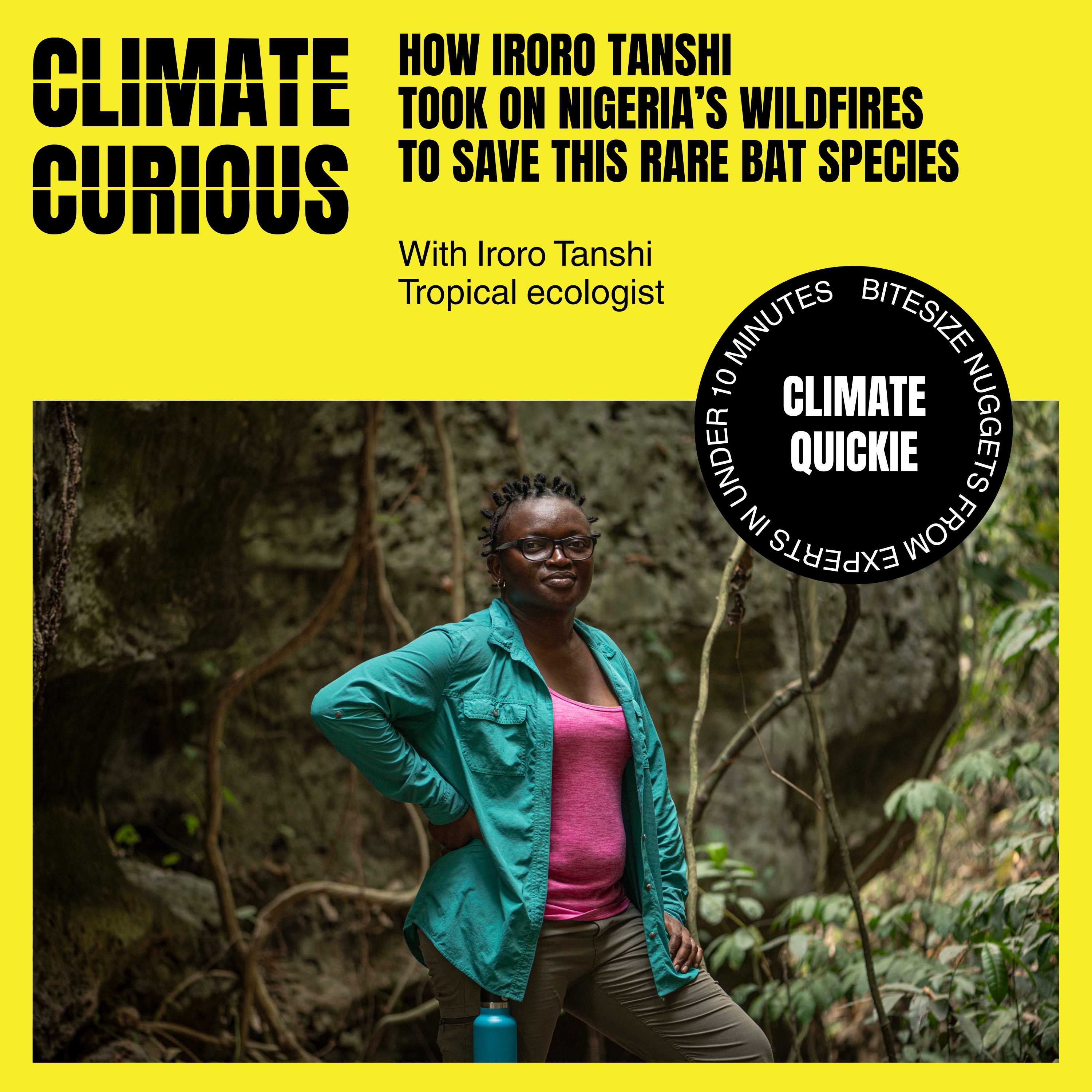
How Iroro Tanshi took on Nigeria’s wildfires to save this rare bat species

In Nigeria’s Afi Mountain Wildlife Sanctuary, a rare short-tailed roundleaf bat whose global population is less than 1500, is trying to survive – and their biggest threat is wildfire. Nigerian tropical ecologist, conservationist and 2026 Goldman Environmental Prize for Africa winner Iroro Tanshi joins Climate Curious to share how farmers are transforming into frontline fire brigades, what community-led climate resilience looks like on the ground in Nigeria, and how she got passionate about bats in the first place! The result? A new model for protecting both nature and livelihoods. Check out Iroro’s work: https://www.goldmanprize.org/recipient/iroro-tanshi/ Support Iroro’s team at the Small Mammal Conservation Organization: https://www.smacon-africa.org/ Check out the 2026 Goldman Environmental Prize Winners: https://www.goldmanprize.org/current-winners/ Hosted on Acast. See acast.com/privacy for more information.

16 minAbspielen in:

Warum PodAppear

Folge Menschen, nicht Podcasts.

Du hast Iroro in einer Sendung gehört. PodAppear findet für dich die nächste, und genauso für alle anderen, die du hören willst.

  • Eine Meldung, wenn die Person zu Gast istPer E-Mail: sofort oder gebündelt als Tages- oder Wochenübersicht. Dann nur noch auf Play drücken.
  • Gäste statt bloßer ErwähnungenFolgen, in denen ein Name nur fällt, landen getrennt. Eine Meldung heißt: Die Person ist wirklich in der Sendung.
  • Alle in einem FeedGründerinnen, Autoren, Sportler, Forscherinnen. Folge allen mit Namen, quer durch jede Sendung, in der sie auftreten.

Bis zu 15 Personen kostenlos, ohne Kreditkarte.